In A Vase on Monday – Barometer Says Summer is Here

00100lportrait_00100_burst20190623101455942_cover.jpg

My father always kept a barometer on the wall in my family’s kitchen. Looking back, I am not sure he ever read it. I am sure I don’t know how to read one, or, for that matter what it means exactly.
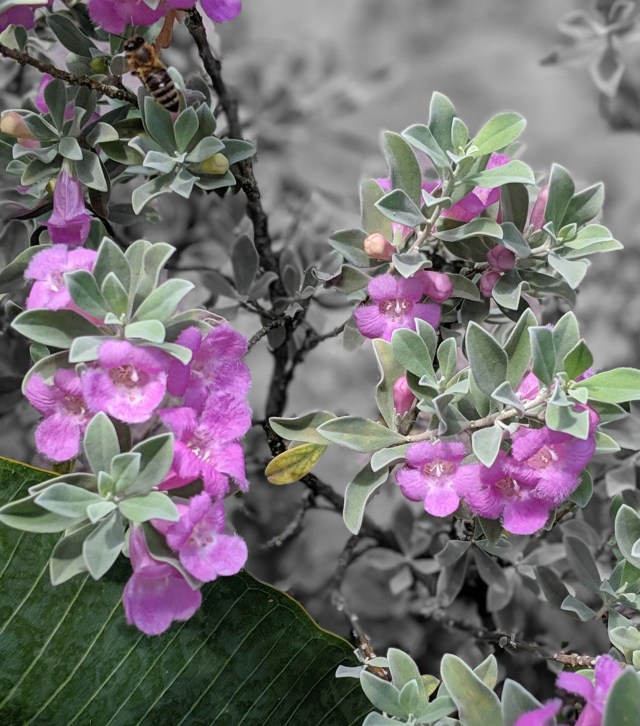
The barometer in this vase is a plant. The small purple flowers with grey foliage come from the Barometer Bush. I know this plant as Texas Sage (Leucophyllum frutescens). I wanted to add some color to an area where my greyhounds hang out and did some research to be sure it wasn’t toxic to dogs (one of them will eat nearly anything).
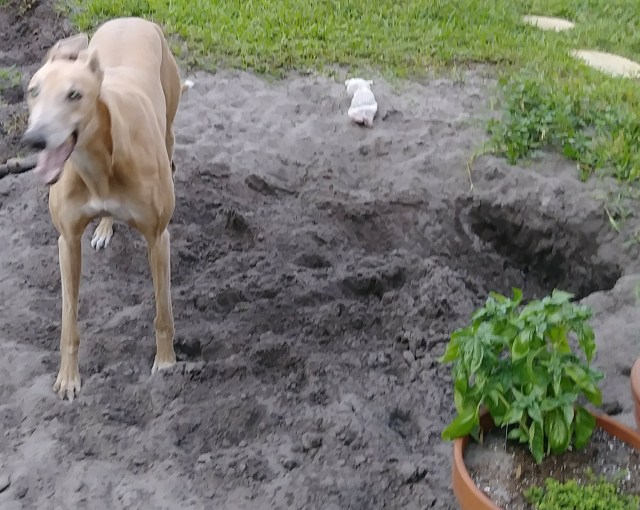
Happily, they are non-toxic and I learned they are native to Texas, super drought tolerant and called Barometer Bush because they are well known to flower before a storm. This one did not live up to its name as it is flowering a few days after receiving a downpour of 2 inches of rain. And they bloom in winter in their native habit. Go figure. Here they are, growing in unamended sugar sand; the dogs run by them daily, pile sand on them and dig them up. It is safe to say this is a tough plant.

00100lPORTRAIT_00100_BURST20190623142416588_COVER_2

As for the rest of the flowers, the Summer Solstice has brought nearly daily thundershowers so all the native wildflowers are lush with foliage and flowers. The Tropical Red Salvia has the seeds stripped off of every seedhead, the seeds must be really good right now. And the birds must be happy.

00100lPORTRAIT_00100_BURST20190623101525354_COVER

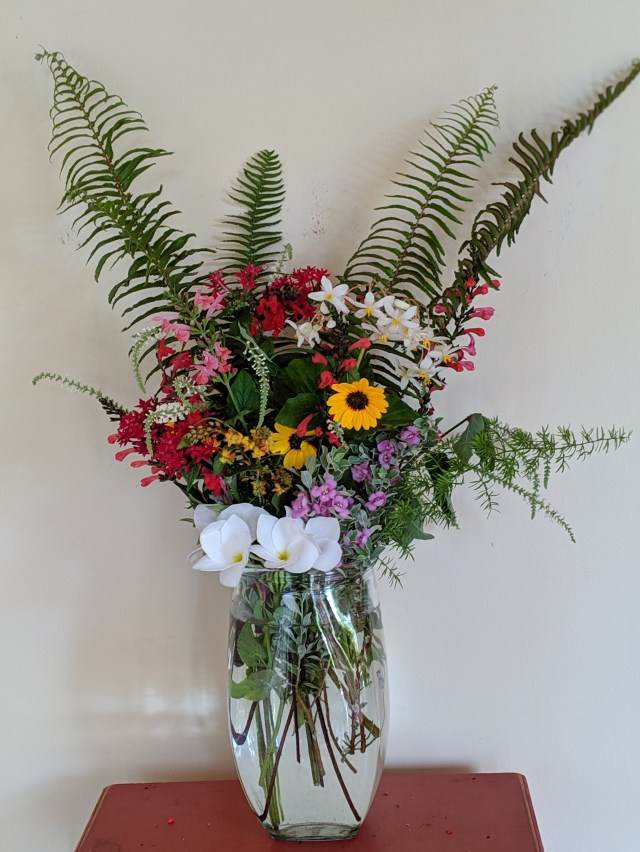
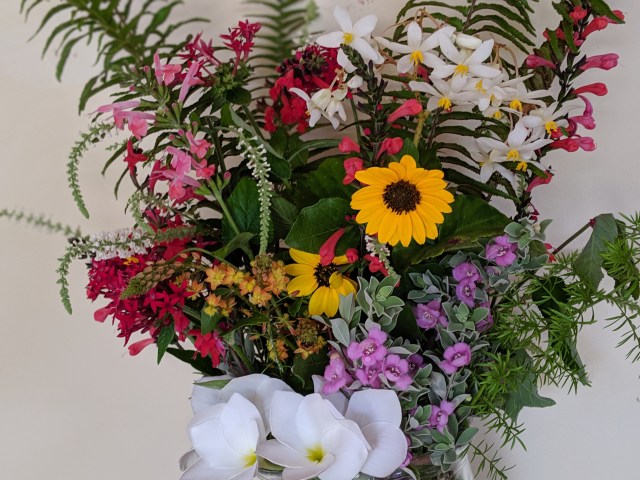
The red and peach spikes are Tropical Red Salvia (Salvia coccinea), the white spikes are Sweet Almond (Aloysia virgata), red clusters are Heirloom Pentas (Penta lanceolata), white flowers at the top are Sweet Begonia (Begonia odorata), white flowers at bottom are Bridal Bouquet Frangipani (Plumeria pudica), yellow flowers are Beach Sunflowers (Helianthus debilis), the ferns are Boston in back and Asparagus on the side. Both volunteers in the garden.

I am enjoying the scents of Frangipani and Sweet Almond from the vase. The glass vase was found on the side of the road while walking the dogs.  The Greyhounds are still digging up the Barometer Bush – maybe they are wondering when it will rain.

20190426_192810-1-1 (1)


In A Vase on Monday – Rainbows

00100lPORTRAIT_00100_BURST20190616133732061_COVER

June is Gay Pride month in the US.  A friend who owns a local business is flying a Rainbow flag in support of Gay Pride and tolerance. She is experiencing push back from employees and customers. Meanwhile, nearby flags supporting our current President have been burned.

She said,  “We need more flowers”.

This made me wonder if I could find all the colors of the Rainbow in my garden. I found all the colors, easily and in the rain. Champagne flutes were used to celebrate what tolerance we have and the blue bottle represents sadness for many who don’t.

00100lportrait_00100_burst20190616132139400_cover-e1560709271471.jpg

The Violet vase is Purple Queen (Setcresea “Purple Queen”), the Indigo vase is Blue Porterweed (Stachytarpeta jamaicensis), the Blue vase is Plumbago (Plumbago auriculata).

00100lPORTRAIT_00100_BURST20190616132121134_COVER

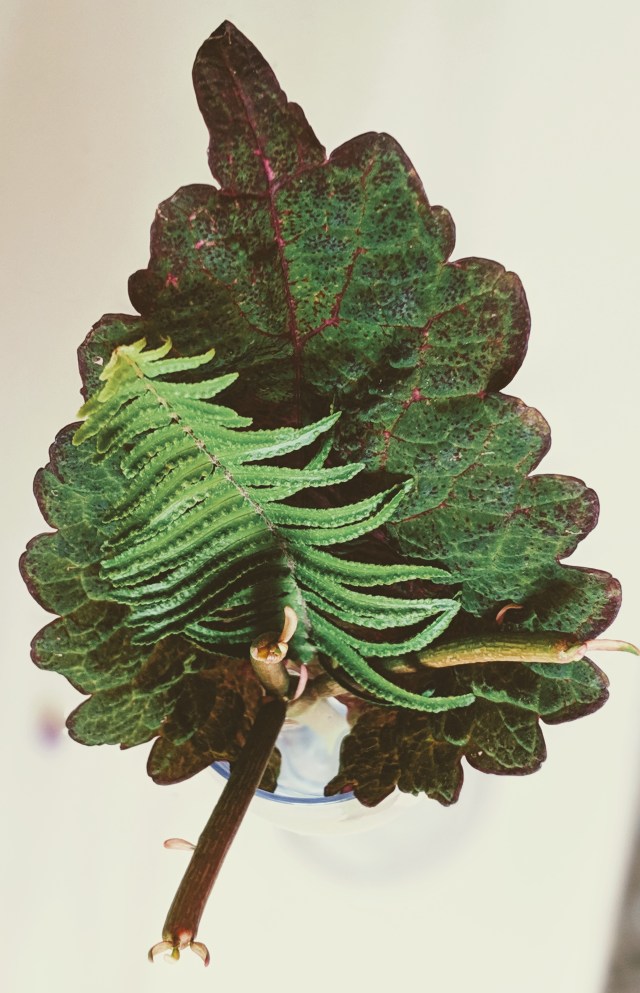
The myriad shades of green never fail to amaze me. The Green vase has (I think) a leaf from ‘Solar Sunrise’ Coleus (grown in shade), Boston Fern (Nephrolepis exaltata), and Pencil Cactus (Euphorbia tirucalli “Firesticks”).

00100lPORTRAIT_00100_BURST20190616132046518_COVER

The Yellow vase is Black Eyed Susan (Rudbeckia hirta), the Orange vase is Mexican Honeysuckle (Justicia spicigera), and the Red vase is The President Hibiscus (Hibiscus rosa-sinensis).

While putting the vases together, I was looking at all the flowers. So different, yet so alike.

Lesson learned.

In A Vase on Monday – Rabbit Food

00100lportrait_00100_burst20190602093912970_cover

Early on Sunday morning I grabbed my shears and went into the garden to collect materials for my vase. My intention, to gather some Black Eyed Susans and other wildflowers for a casual vase.

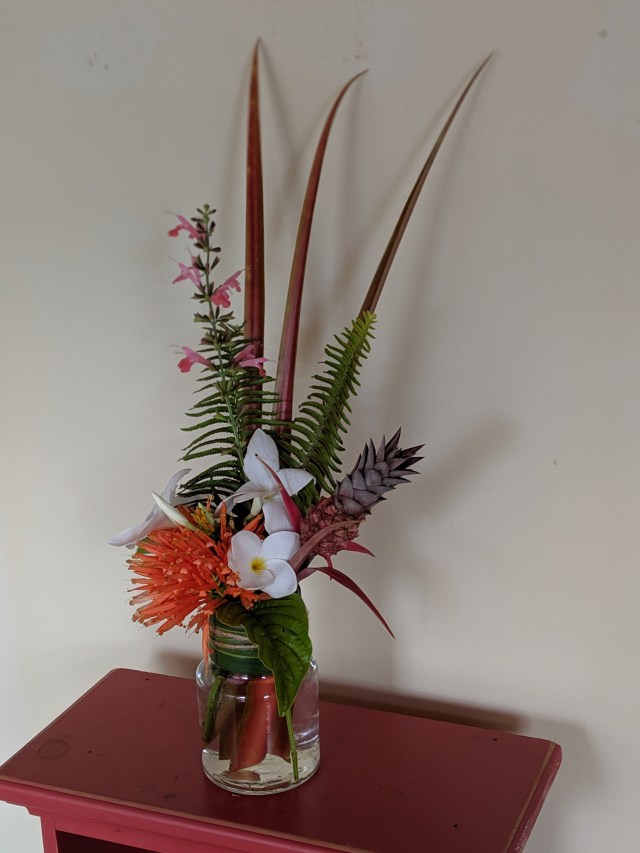
After I closed the gate, keeping my greyhounds in their space – I spied the fattest rabbit I have ever seen lurking near my miniature pineapple plants. The tiny pineapple approaching its juicy peak.. I changed my mind and decided a slightly more tropical vase might be more appropriate. The lovely pineapple was quickly freed from its sharp crown.

00100lportrait_00100_burst20190602094114051_cover

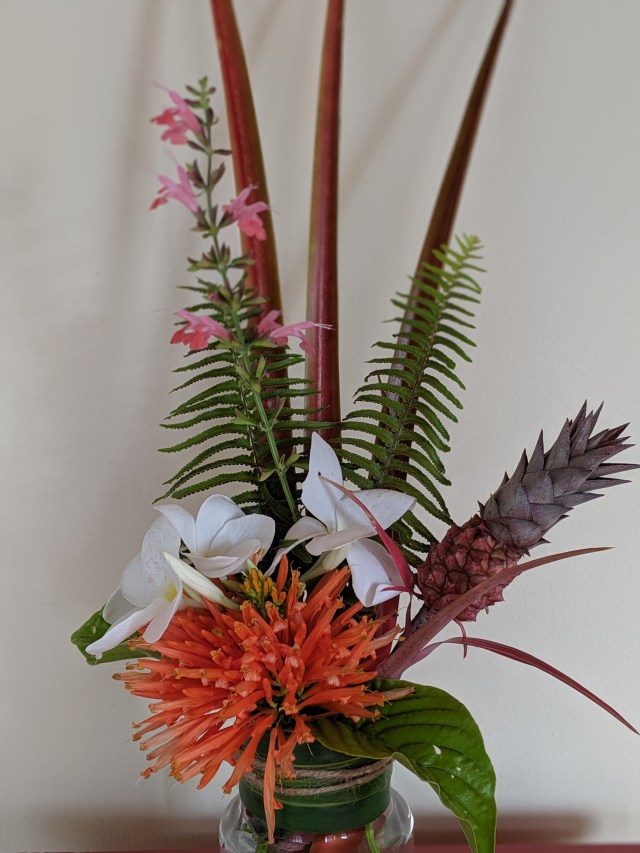
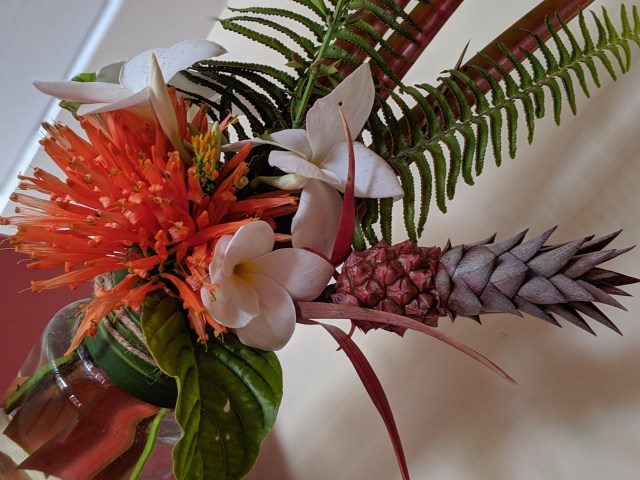
My wildflower theme completely blown by the plus size Rabbit, I searched for more tropical plants. I added some foliage from the miniature pineapple plant, a few sprigs of Boston Fern (Nephrolepis exaltata); the orange flower is Mexican Honeysuckle (Justicia spicigera); the peach flower – the wildflower in the vase, a Tropical Red Salvia (Salvia coccinea); the white flowers are from Bridal Bouquet Frangipani (Plumeria pudica) for a light tropical fragrance. A Pandanus leaf is tied around the vase.

00100lPORTRAIT_00100_BURST20190602094804635_COVER

I am glad I beat the rabbit to the pineapple.

Happy Monday.

In a Vase on Monday – Gifts from Gallardia

00100lportrait_00100_burst20190526103459642_cover

I started a native pollinator garden last year to encourage butterflies. Planting host plants and nectar plants, concentrating on native annuals that will reseed themselves. Theory is native flowers attract native insects- the benefits to me; I won’t have to replant all the time and I hopefully end up with a meadowy mixed wildflower garden. And lots of butterflies. Thus far, the plants are sticking with their own kind and making big drifts, not mixing as of yet.

I recently decided to run my garden specifications through the Native Plant Society “let us choose your plant” web page. Thinking I might get some suggestions to add some other plants to the garden. Ironically, it said no wildflowers will grow in your garden. I guess I should let the butterflies and flowers know about this?

00000img_00000_burst20190526103434963_cover

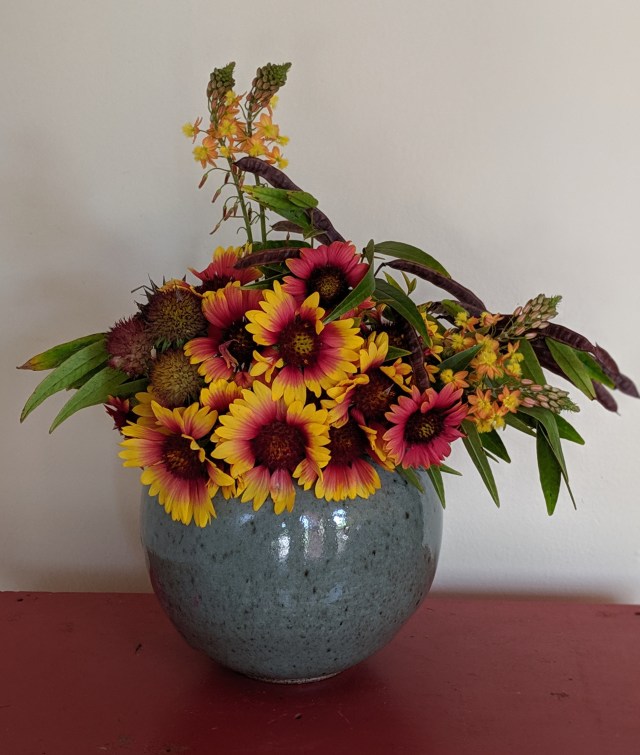
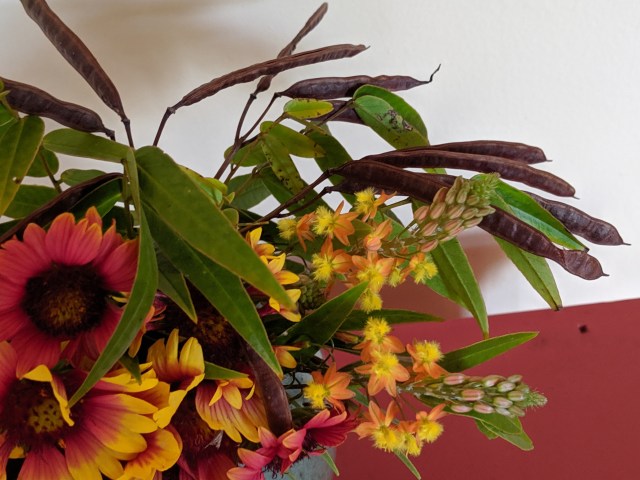
Here is a close up. The vase is someone’s cast off from pottery class I bought at GoodWill (charity shop) for $2, I have really enjoyed their work and use this vase frequently. The red and yellow Gallardia (Gallardia pulchella – Florida native) is going gangbusters in my gardens, cross pollinating and making new colors. The yellow and orange spikes are from Bulbine (not sure which one), the Bulbine has been flowering for a couple of months and doesn’t seem to be slowing down. This is a new favorite. The foliage and brown pods are from the native Senna (Senna ligustrina) – I planted this to attract Sulphur Butterflies and they appeared soon after it was planted in the garden.

Here’s my new Gallardia color, pink! I am still chasing the Sulphur Butterflies around for a photo-op.

img_20190526_102602.jpg

In A Vase on Monday – Summer G’s


20190505_095948-1


Summer began on Thursday here, complete with thunderstorms and wet blanket of humidity slapping me in the face when traveling from air conditioned space to the great, sweaty outdoors. Summer flowers are a consolation for the weather.

20190505_100057-1

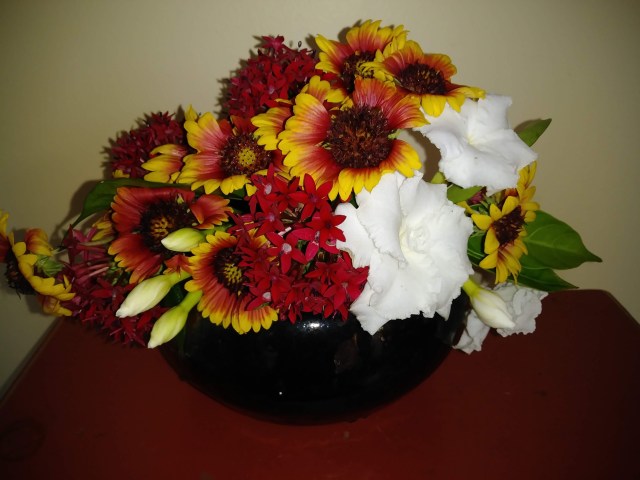
The G’s are Gardenias and Gallardias, the Tropical Gardenias are stalwarts in my garden. They thrive under dreadful conditions and supply flowers off and on all summer long. The plant is probably ten feet tall and I struggle to reach the flowers, having jettisoned more than one across the vegetable garden by letting go of a long branch too quickly. Oddly enough, the buds last a really long time in the vase, but the flowers don’t. I love the graceful lines of the buds, when hanging over (and around) the side of a contrasting vase, the summer garden is looking fine indoors.

20190505_100119


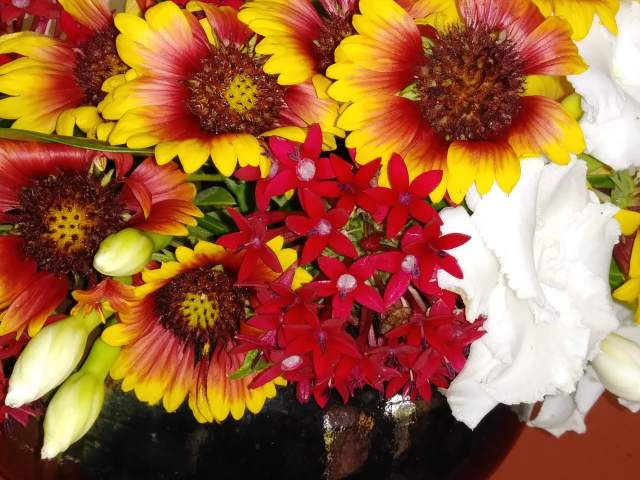
The first G is Florida (or Tropical) Gardenias (Tabernaemontana divaricata), semi deciduous, in my experience and not particularly hardy to frost. The other G is Gallardia (Gallardia pulchella), a native wildflower I have been trying to establish in the Pollinator Garden. The third plant in the vase is a Penta lanceolata, a plant known to serve as a nectar plant for butterflies. I have noticed the butterflies sipping on the flowers, hoping for offspring.

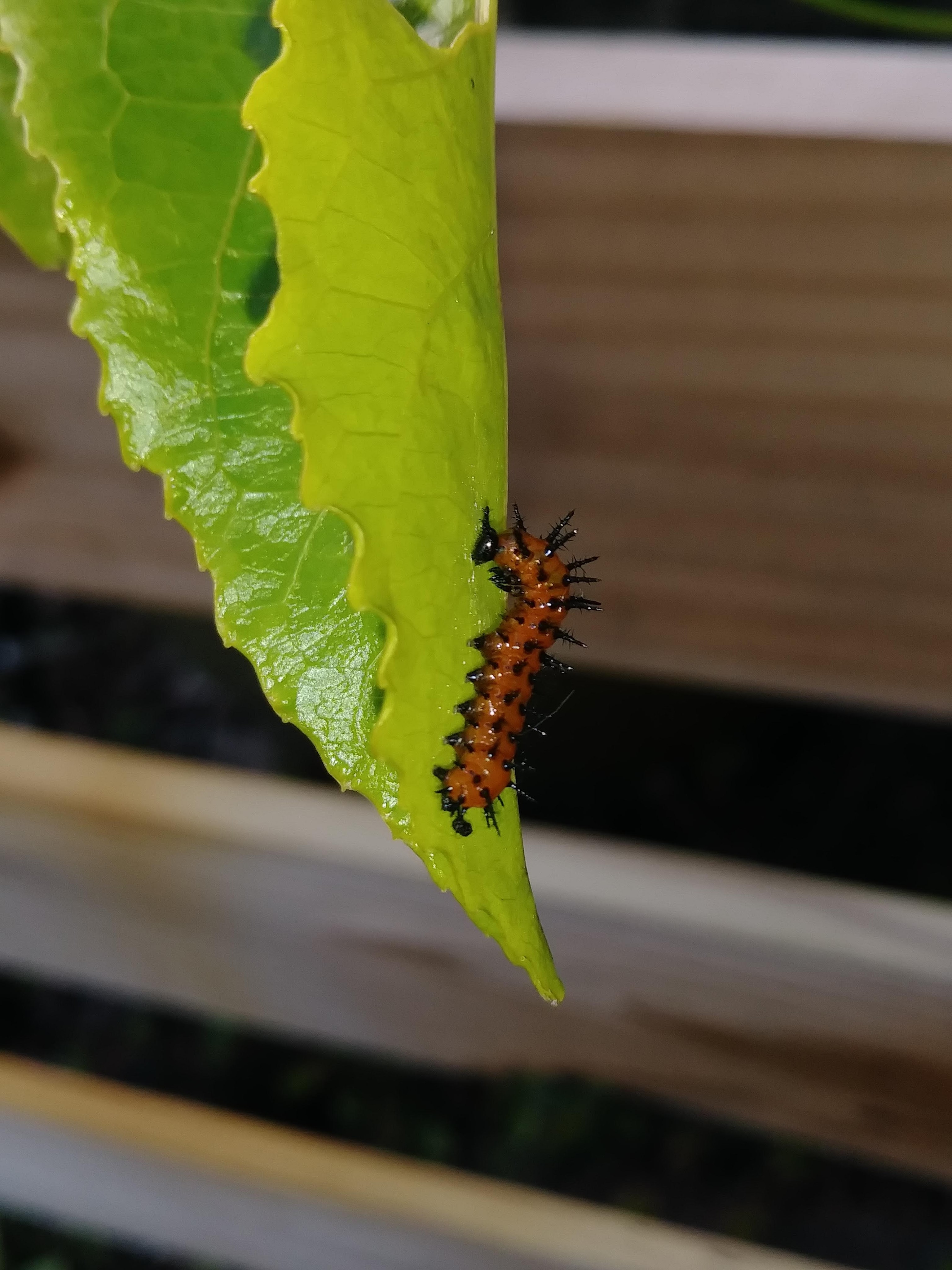
Speaking of pollinators, they are back for summer – these are caterpillars of Gulf fritillary butterflies chowing down on my ‘Lady Margaret’ Passionflower vine. Lady Margaret has been perverse in her unwillingness to flower in my garden, so I don’t mind if the Gulf fritallaries eat her up.

20190502_085055-1

Here are the Gulf Frittilaries from last year. I hope to get better pictures this year,


In a Vase on Monday – Flowers by Karma


20190428_113252-1

Last week I made the bold statement “there is not very much pink in my garden”. As always, karma reigns supreme and two of my favorite plants are in this vase (also supplied by karma). Both are, well, pink.

Strangely enough, last week one of my favorite vases, a simple glass cylinder cracked. Nothing happened to it, the vase just cracked up and down about a third of the height of the vase. It occurred to me I would really like a slightly larger glass vase with a more interesting shape.

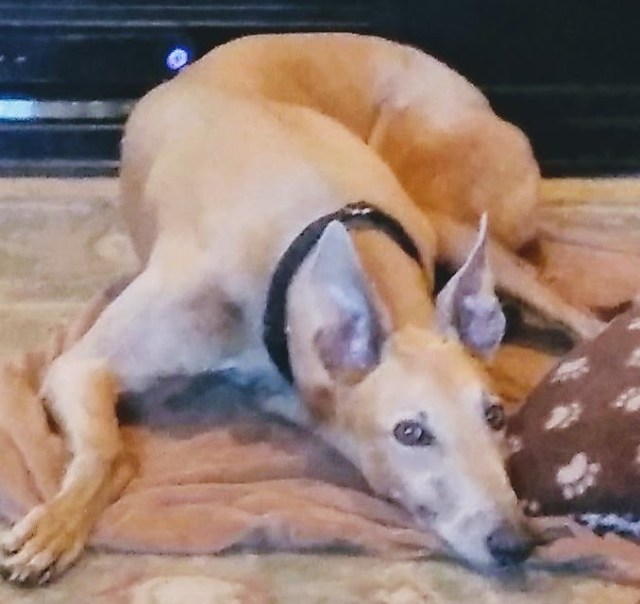
The following morning I was walking my greyhounds and spied this vase, left at the curb as trash. It was promptly removed, by me. The greyhounds did not care. They prefer hanging with a soft blankie or two.

img_20180317_1443482

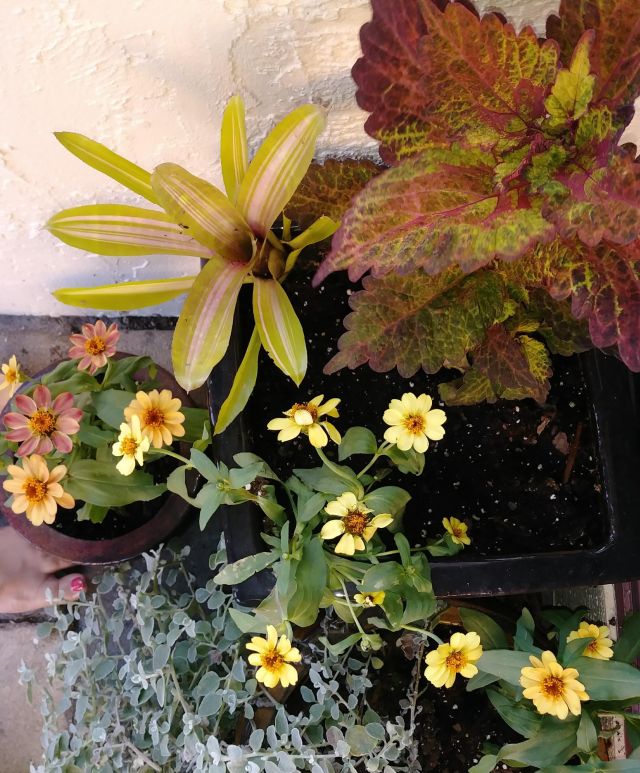
Later in the week, I renovated my front porch containers for summer (the new colors are shades of peach, apricot and burgundy with a touch of gray and chartreuse) I am hopeful the new variety of Zinnia will survive the onslaught of heat and humidity.

20190428_165607-1

During the course of my renovation I removed a long serving ‘Alabama Sunset’ Coleus, it had developed a nearly half inch stem and I knew its days were numbered, so I took some cuttings and put them in the vase to root. The pink vase was inevitable.

20190428_113321

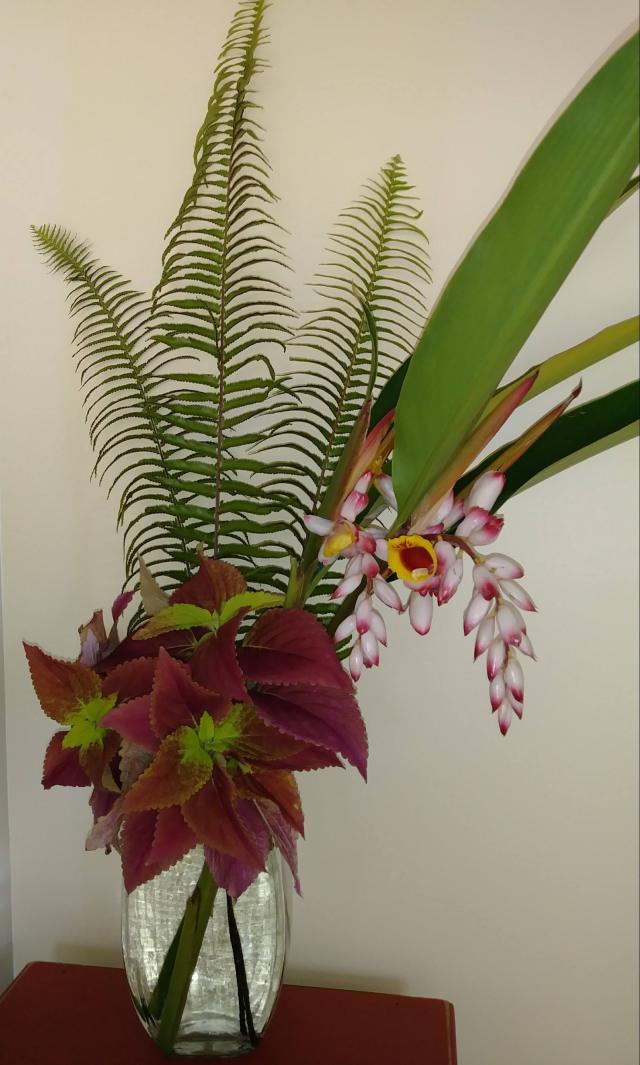
Here is a close up, the ‘Alabama Sunset’ Coleus is at the base of the arrangement. The flowers are Shell Ginger (Alpinia zerumbet), a favorite tropical and the gingery fragrance adds to its appeal. The background greenery is Boston Fern (Nephrolepis exaltata) a native and vase favorite slowly invading my driveway landscape.

Wishing good karma for all this week. And I hope everyone is in the pink.

In a Vase on Monday -Festivitea

20190421_104709-1

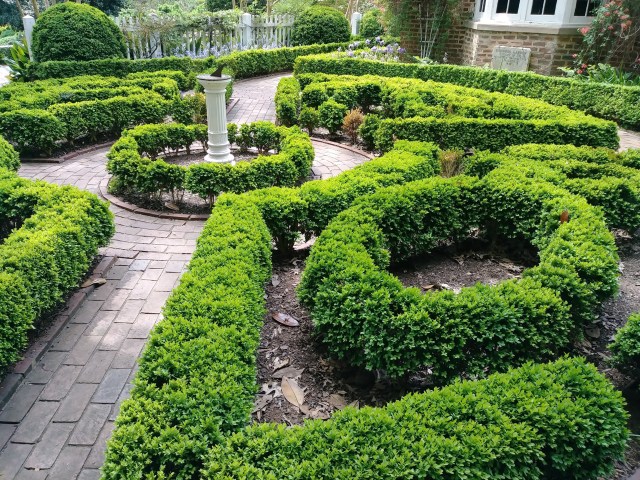
I was absent from IAVOM last week as I was attending some festivities out of town. I went to a reunion of my college Landscape Architecture class at the University of Georgia in Athens, Georgia. April in North Georgia is lovely and we had a luncheon in the courtyard of the Founder’s Memorial Garden on campus. Here is the fruit parterre garden, the shapes formed by the boxwood are lemon, lime, strawberry and cherry; if memory serves – and sometimes memory refuses. This garden is part of the curriculum to learn how to draw Landscape Plans, I can only wonder how many times it has been drawn.

20190413_132255

The luncheon in the courtyard:20190413_122432

The house, originally built in 1857 has served many purposes; most recently the headquarters of the Garden Club of Georgia. The garden commemorates the Founders of the Garden Club movement, established in Athens in 1891 and was opened in 1939 by the first dean of the Landscape Architecture school, Hubert B. Owens. More About the Garden

Back to my Festiv-i-tea vase.

20190421_104424-1

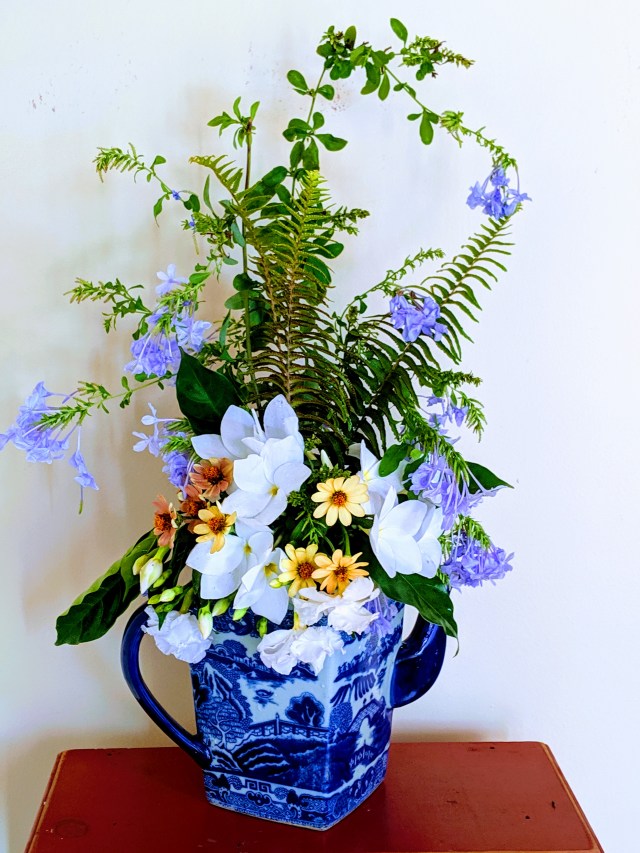
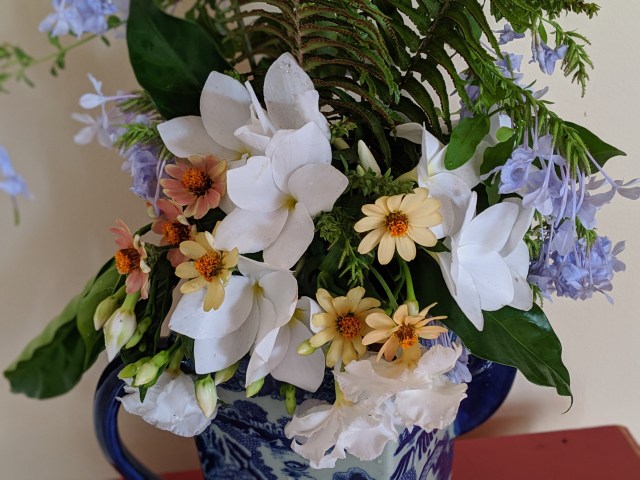
The vase is a teapot of English Blue Willow, one of my all time favorites. For whatever reason, there are a lot of hot colors flowering right now. Soft spring colors are not really a thing in South Florida, in my garden anyway. Living in a deep peach painted house discourages the use of pinks and lavendars.

20190421_104449

The teapot is stuffed full of flowers. The big orange flower is Mexican Bush Honeysuckle (Justicia spicigera), I have been enjoying pruning this one back to size for vases. Nearby are white Petunias of mystical origin; white daisies are the invasive native Bidens alba; the small sunflowers are another native, Beach Sunflowers (Helianthus debilis); red star shaped flowers are Petunia exserta; a few Parrotflowers in the front (Heliconia psittacorum; grey foliage is from Helichyseum petiolaris, Licorice Plant and there is some Tropical Red Salvia (Salvia coccinea) in the back that is not in this picture.

Hope everyone had lovely Easter festivities!

Happy Monday.

In A Vase on Monday – Uber Tropical

20190408_0939472

Frequently I receive comments about my vases being tropical or exotic. Much of this plant material is commonplace in Florida. The above vase, however, seems Uber Tropical to me.

20190408_093854-1-1

Here is a closer view. The arrangement is a stem of Shell Ginger (Alpinia zerumbet); a sprig of Sweet Almond Bush (Aloysia virgata) and a potential replacement for the umbrella in tropical drinks, a Miniature Pineapple. The Pineapple is a cutting from a friend and I have no idea what botanical name goes with it. I cut it because the varmints in my garden usually eat them at about this size. They are not edible, extremely fibrous I am told, but may be juiced.

Here is the pineapple in the garden:

20190314_142939-1

I am happy I beat the varmints to my little pineapple. They are currently eating the new shoots on all the Bromeliads.

Happy Monday!

In A Vase on Monday- Spa Day


20190331_110422From time to time I make an arrangement that generates comments like ‘it belongs in the lobby of a spa’. I think there is a relaxation vibe from some of the more tropical plants in my garden. I have been gardening madly to get my pollinator/fruit garden finished before the rainy season starts, so I could use a Spa Day myself.

20190331_110405

Here is a close up, there is a lot of foliage in this vase. The flowers are; in red, Guzmania Bromeliad, in white, Lotus Leaf Begonia (Begonia nelumbifolia) – a recent addition to the garden, this Begonia gets 5 feet tall and wide. It has just started to flower and is really shooting up in size. The burgundy and green leaves are from Neoregelia Bromeliads, I am not quite sure of the variety. The thinner leaves are from a Varigated Minature Pineapple (currently bearing tiny pink pineapples). Bigger leaf behind is from the Ornamental Banana (Musa ensente). Ferns are from my driveway edge volunteer Boston Ferns (Nephrolepsis exaltata) and the volunteer Asparagus Fern. Vase is wrapped with a Pandanus leaf.20190331_124536-1

Here is my volunteer Boston Fern garden, I have a crushed shell driveway, the shells are held in place by wood timbers and there is an inches wide space between the driveway and my neighbor’s fence where the ferns thrive. I have really enjoyed this gift.

20190324_160127-1

Happy Monday.

In a Vase on Monday – Exserta Experiment

20190324_102853

This is an In A Vase on Monday story. Every Monday morning, Cathy from ramblinginthegarden.wordpress.com invites us to share a vase of flowers from our gardens. The meme is called In A Vase on Monday and gardeners from around the world share flowers from their gardens. I have learned so much from fellow ‘vasers’ and the contents of this vase bear witness to my affinity for IAVOM.

Sometime last summer, Chloris from thebloominggarden.wordpress.com shared photos of the Petunia exserta she had grown in her garden.  I had never seen or heard of this plant and looked it up. To my surprise, this Petunia was rare, from Brazil and grew in cracks on the sides of sandstone towers and is pollinated by Hummingbirds. Sounds perfect for my incredibly well drained sugar sand garden with a bonus of attracting Hummingbirds. I live on the east coast of Florida, where Hummers are not as prolific (I see 3 or 4 a year) I bought a packet of seed (oddly from the US Pacific Northwest)

Not being native to South Florida and really more a plant buyer than propagator, I decided to plant seeds the first of September for winter flowers. They promptly sprouted and were planted in the ground, in pots and gifted to my neighbor to see what happened. They flowered a bit all winter, but as soon as the temperature hit 80 – off they went. I needed to cut them back and they landed in my vase this Monday. Clearly, something has been pollinating them, although I have not seen a Hummer nearby. Here is a close up of the vase, a candle holder from Pier One.20190324_102907_Burst01

The Petunia exserta, the red star shaped flowers, the grey plants are Dusty Miller (Jacobaea maritima), viny grey plants are Helichryseum petiolaris; red spikes are Tropical Red Salvia (Salvia coccinea); foliage Boston Fern (Neophrolepis extalta) and a Red Banana Leaf (Musa ensente).

Here is the Petunia exserta in my garden, placed next to a rock to make it feel at home.

20190324_160150-1