In a Vase on Monday – Palmy Weather

img_20200426_104120

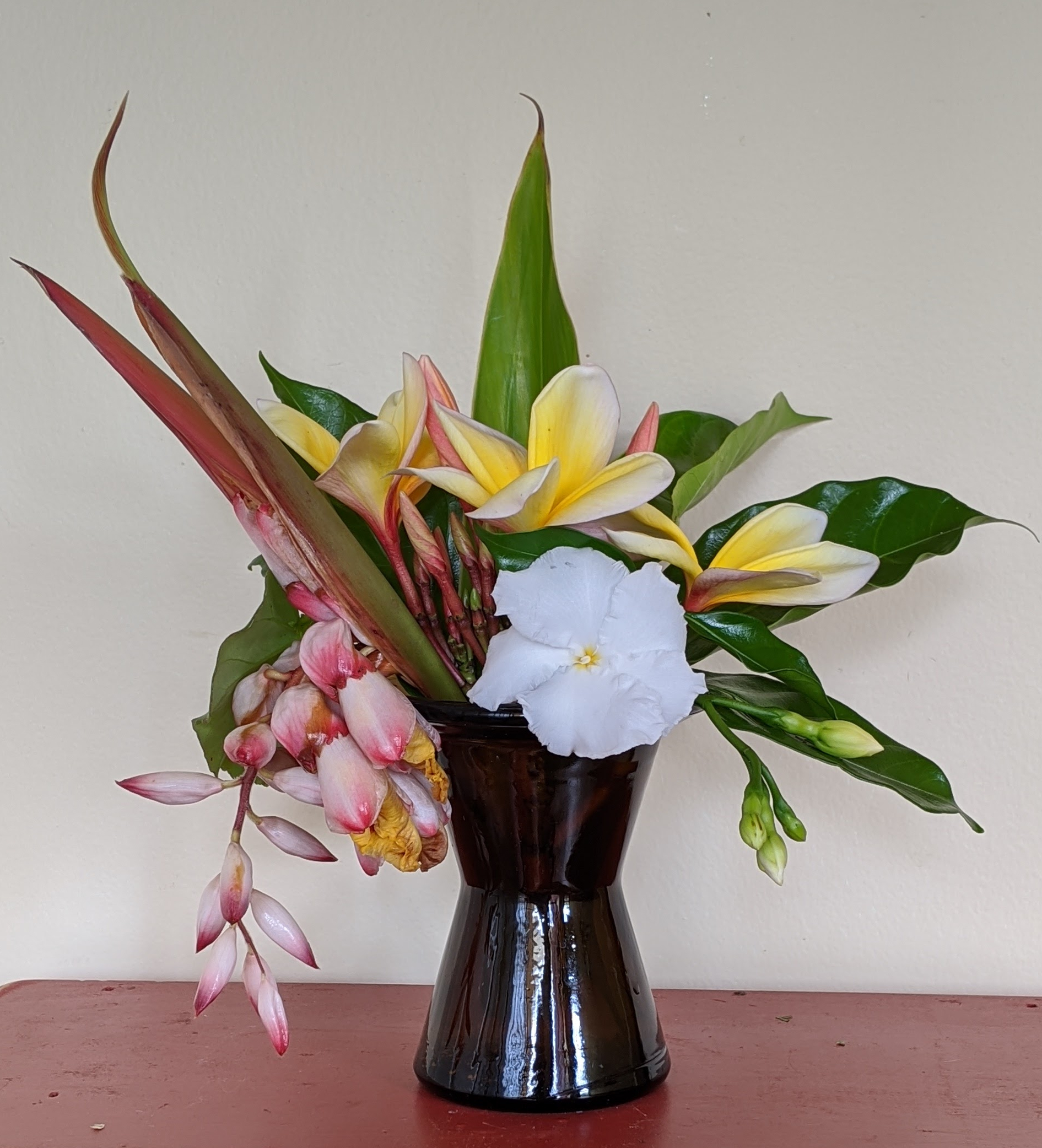
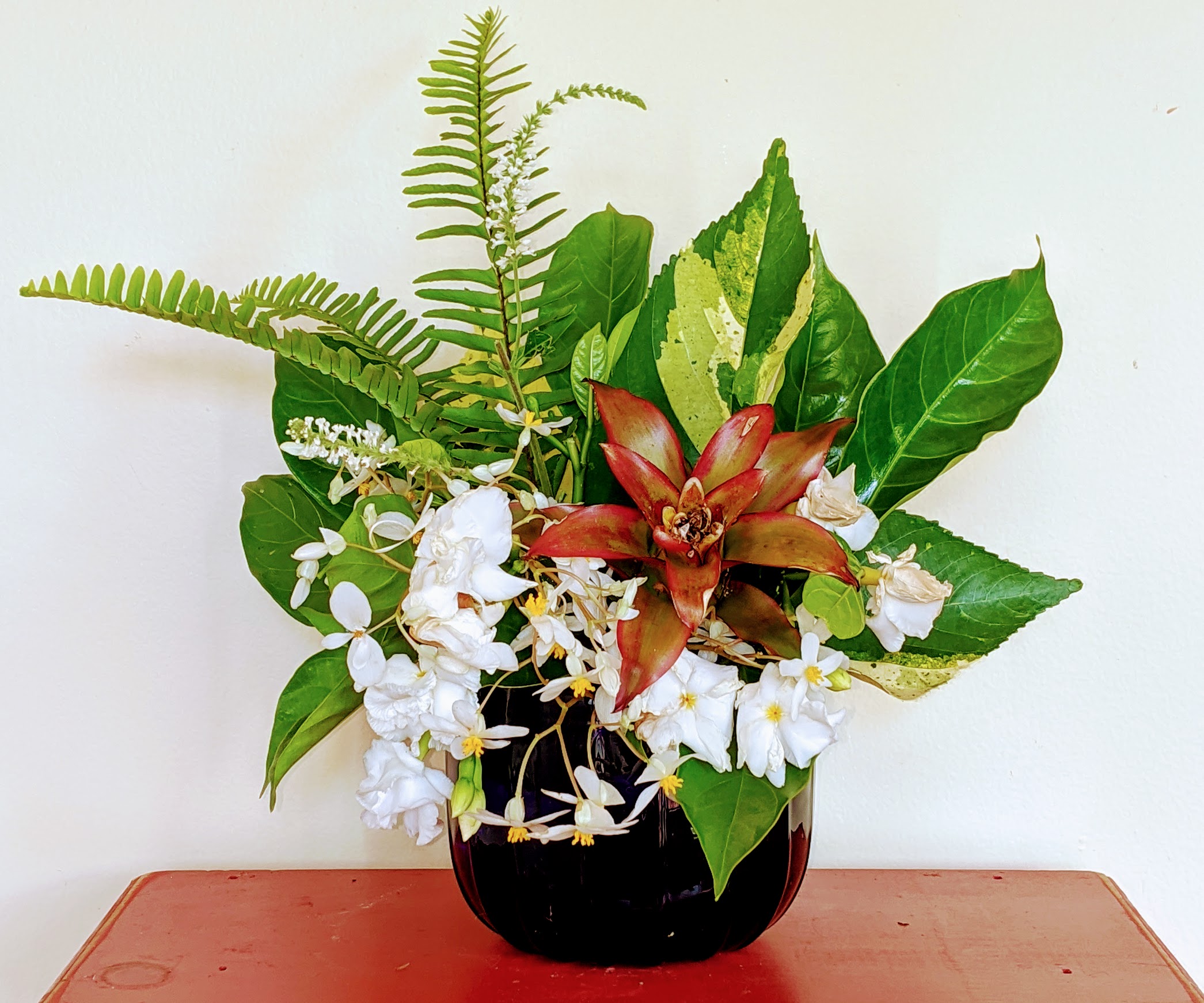
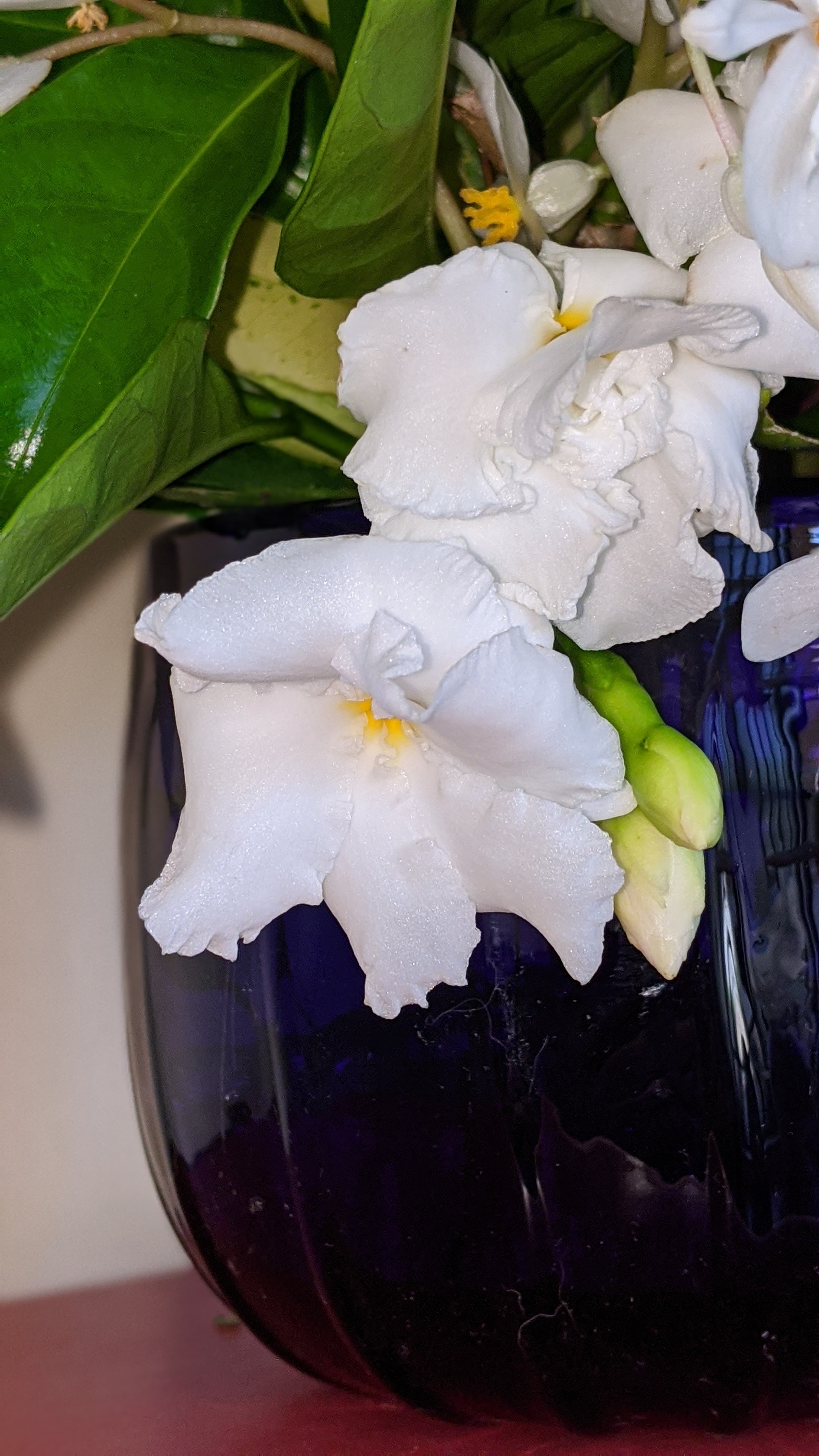
We have been having Palmy weather. Rain off and on and accompanying humidity have inspired the Adonidia Palm in my garden to flower.  I have been eyeing the flower to cut for a vase. It’s the white stemmed flower in the middle.

A palm flower is a bit of a process and interesting to watch. A bud shoots up from the base of fronds, and the flower slowly unfurls. Below is a bud and a flower. The green part is the sheath at the base of the frond. The sheath above was shed, and the buds revealed; the buds later move horizontally and flower. The palm flowers eventually form berries that look very similar to the flower and fall off. This takes until late fall; most people trim the flowers off.

img_20200328_094513

I have been watching other types of palms flowering as I walk my dogs in the morning. It is like a trip through the Cretaceous period, cycads and ferns included, no dinosaurs as of yet.

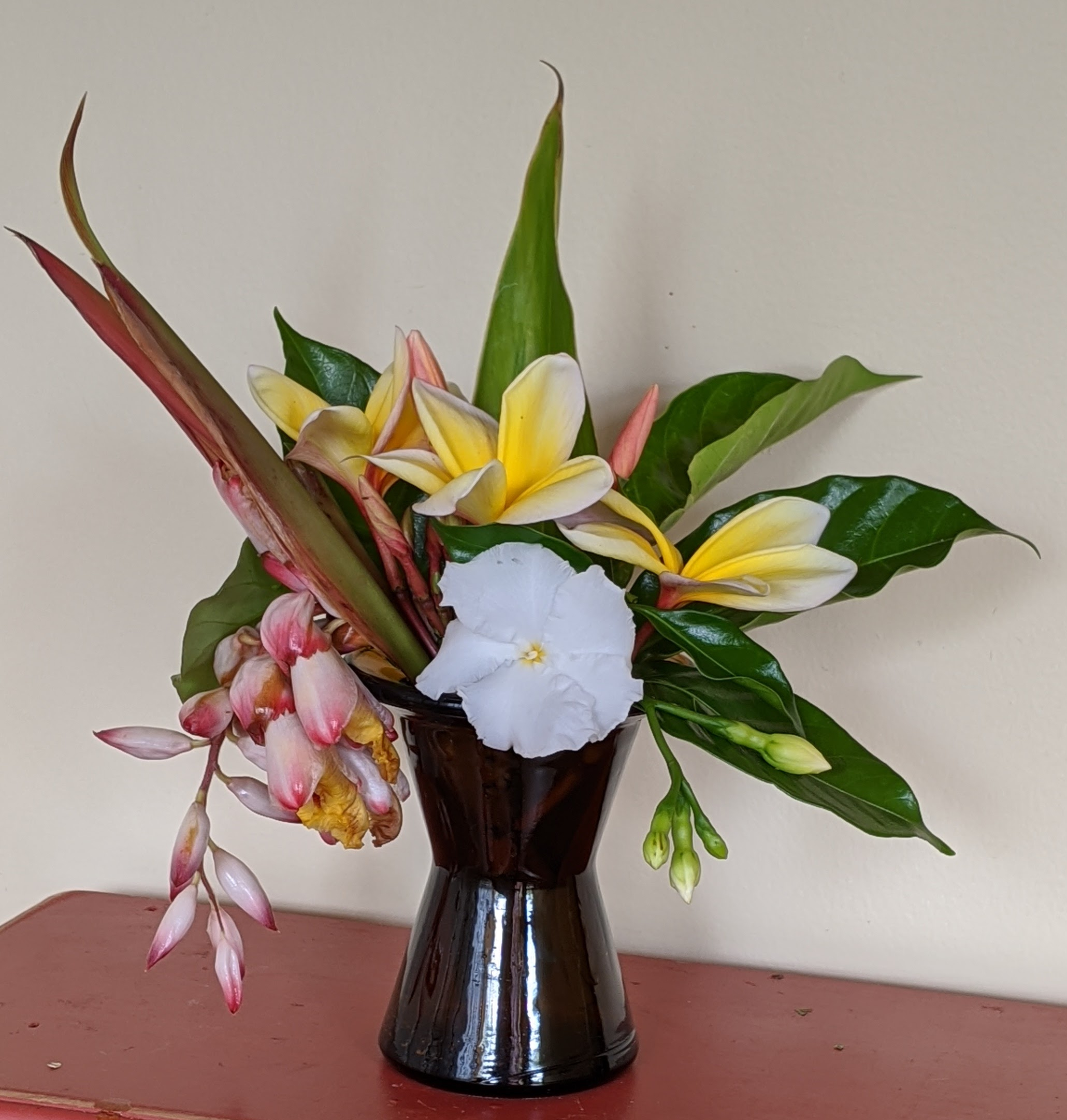
Another view of the vase:

img_20200426_103716

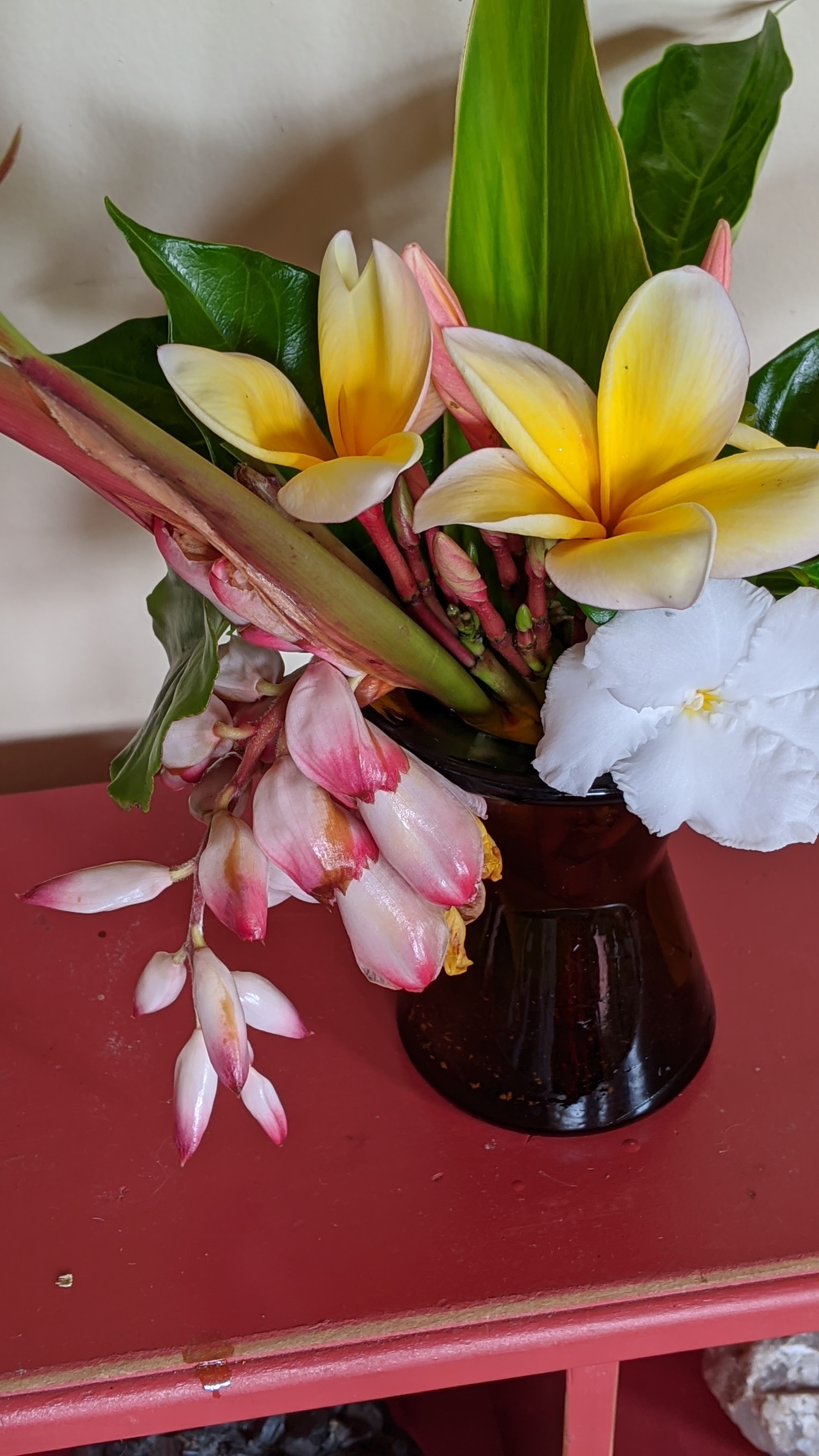
And  a closer view:

img_20200426_103649

The glass container is a heavy, old florist vase I found by the side of the road. Orange and chartruese fruit is from Surinam Cherries, sometimes called Pitanga (Eugenia uniflora), My neighbor, a local, explained I should soak them in water to get the worms out before eating. I declined, though I did try them once, the flavor is a bit reminiscent of turpentine. Another fruit left for the birds, though a friend makes jam from them and says it is good. Red flowers are from the native Firebush, Hamelia patens.

I hope everyone is coping with the solitude and enjoying time in the garden. I seem to be moving a lot of plants around with the rain. And planning more gardens…

Thanks to Cathy, hostess of this garden meme, for carrying on with our Monday fun. See more vases at her blog, http://www.ramblinginthegarden.wordpress.com

In a Vase on Monday – Pastels

img_20200412_105406

It is Easter Sunday and I find myself making liquid hand soap after giving myself a haircut. Strange days, indeed. My haircut seemingly turned out better than the hand soap. Oddly, there is none in stores. Hand soap, or haircuts for that matter.

I decided pastels were necessary for Easter and cut flowers accordingly. The Bromeliad in the middle is from a couple of weeks ago and has faded to pale yellow. The glass pitcher is a wedding gift – possibly its second use after nearly thirty years. My 27th wedding anniversary is Friday and I can say with confidence we are not going out for dinner. The  good news is I found a rack of lamb online and my husband makes a great Mustard Crusted Rack of Lamb!!

It is interesting to take the temperature (not literally)  of gardeners. There is a lethargy encompassing us all, I think. I wonder if it is intentional – in the cosmic sense. Having  spent many decades picking up the pieces after land development – is Mother Nature saying Pause and Reflect? I am feeling that and would  love to know what the rest of  the  world it thinking.

A close up:

img_20200412_105213

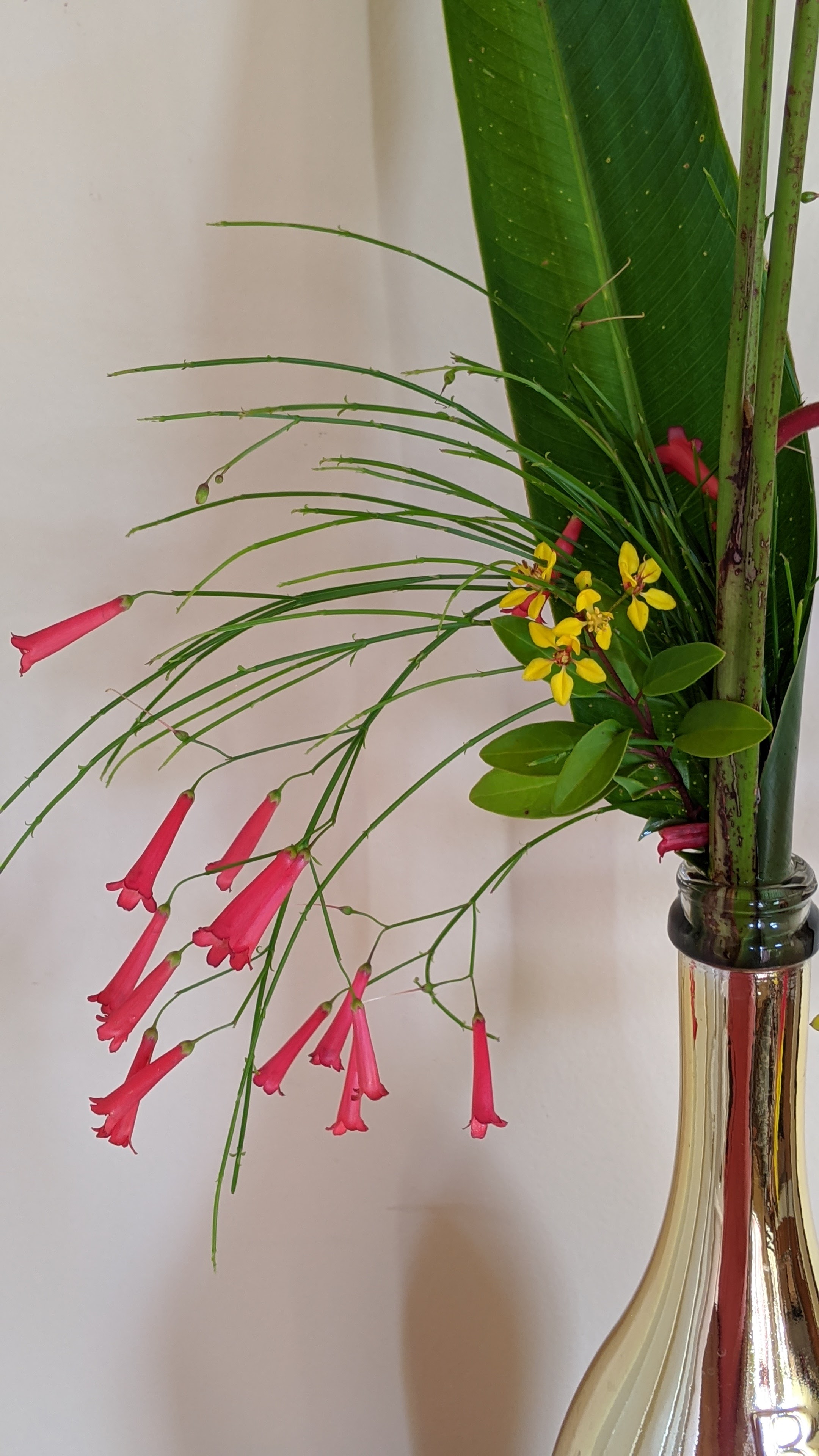
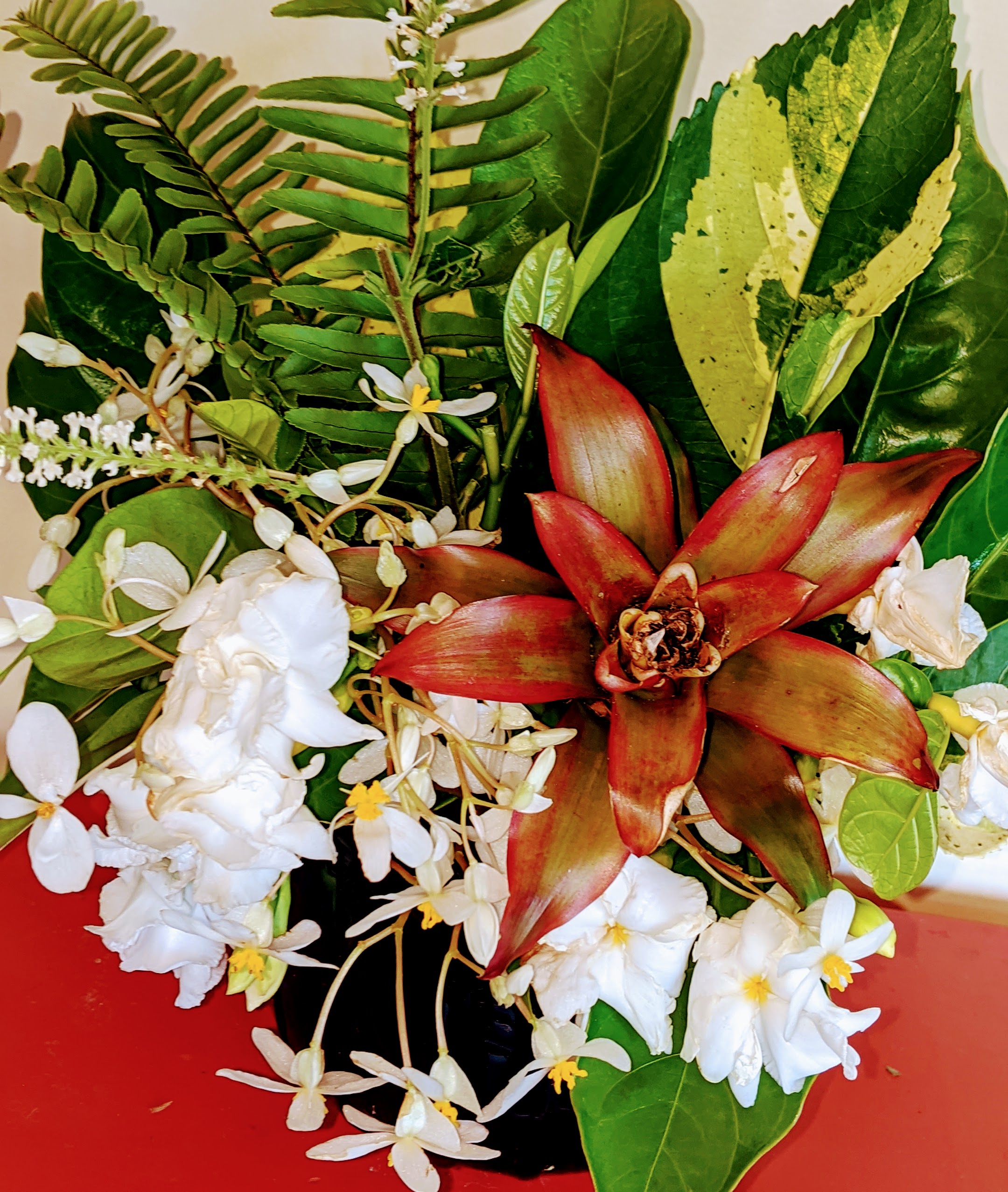
Shell Ginger (Zerumbet  alpinia) appears in pink. The aging Bromeliad is  Little Harv Aechmea. The chartreuse and white flowers are from Lotusleaf Begonia  (Begonia nelumbifolia). Foliage – the  ferns, Asian Sword Ferns, yard trash; varigated leaves  ‘Java White’ Copperleaf (Acalphya wilkesiana “Java White”) the other green foliage is from Firecracker  Plant (Russelia spp.) no firecrackers  yet.

Spend some time in the sunshine, it will lift your spirits.

To see more vases visit Cathy at http://www.ramblinginthegarden.wordpress.com

In a Vase on Monday – More Love

img_20200209_144047

It’s Valentine’s week so…another red vase for the month of love. I  am realizing another oddity of tropical gardening. It is February and I have several types of red foliage to choose from for this vase. Croton foliage is in the vase, but I have several red Bromeliads and Copperleaf foliage as well. Color rules the tropics.

There is also fruit in this vase, it is winter and the fruit has been forming since fall. Which is kind of normal? Or should I say typical? Here is a close up:

img_20200209_144118

The red vase is a thrift store find. The red flowers are from Tropical Red Salvia (Salvia coccinea); red foliage is from Mammey Croton (Codieum variegatum); chartreuse winged fruit is from Sweet Begonia (Begonia odorata ‘Alba’)  and the berries are from Firebush (Hamelia patens)

I have been collecting ingredients for a different Valentine’s treat, a tradition in our house.

20190214_183314

The recipe is called ‘A Very Good Chocolate Cake’ by Edna Lewis, my favorite Southern cookbook author. I have tweaked it a bit over the years, but usually make for my husband’s birthday and  Valentine’s Day. Suffice it to say I will get my cholesterol  bloodwork done before February 14th!

Happy Valentine’s Week!

For more vases on Monday – follow link to Cathy’s blog VASES

In a Vase on Monday – February Love

img_20200202_153009

This vase marks the first for February, the month of love. I challenged myself to create a  shades of red vase in honor of February.

The combination of plant material is unusual, to say the least, ordinarily (not sure why) I don’t like to combine tropical plants with non tropicals, but this is meant to be love struck pinks.

The construction of the vase is a bit unusual as well, the red container is from Christmas, too lightweight for the thick stemmed Shell Ginger. To conquer this issue, I placed a glass pickle jar inside the red container – it was too tall and I covered the jar with Bromeliad foliage. Here is a closer view:

00100lrportrait_00100_burst20200202152805395_cover

The  pink and white flowers are Shell Ginger (Alpinia zerumbet); these are just about to burst into full bloom, really buds. The center plant is a Zinnia of unknown heritage that looks a lot more pink in the garden. The beige and pink flowers are Texas Vintage Rose Mix Celosia grown from seed supplied by Floret. The green tracery in the background is the flower of Dracaena reflexa. The foliage around the base is from a Blushing Bromeliad (Neoregelia carolinae).

Another close up:

00000img_00000_burst20200202153105068_cover

Happy Month of  Love!

For more Vases on Monday filled with flowers from all over the world follow this link to Cathy’s blog In A Vase on Monday

In a Vase on Monday – Bromeliad Cachepot

img_20200126_113117

I decided to do something different this week. This is a pot of Bromeliad cuttings from my garden. The cuttings are in a 1 gallon nursery container double potted inside the cachepot. These Bromeliads are so bulletproof they are planted in old dried out potting soil and sand, a very well drained mix that will serve them well for months to come.

img_20200126_111010

Here is one of the cuttings, a Super Fireball Neoreglia, wonderful groundcover and hard to kill. One of my favorites. It grows almost on a runner (actually a stolon), the mother plant (on the left) dies and generally makes two or three pups like this one. The mother plant is cut off and  thrown away, I always feel bad about this. The roots are left intact and placed inside the nursery container.

Super Fireball Neoregelia in the garden, cold weather makes the red and peach coloration come out, these are closer to green in summer.

20190119_114327-1

Another  view:

img_20200126_113315

The cachepot is Portmerion, bought years ago on an antiqueing mission with my mother. The pot is a favorite of mine, but I rarely have houseplants as I have a strong tendency to kill them. The Bromeliads should last for months and root into the pot.

From above:

img_20200126_113423

These are all Neoregelia Bromeliads, grown primarily for foliage. The flowers are not very exciting. I know two of the four varieties – there are 3500 types of Bromeliads and I lost track of some or never knew the name ( i.e. bought at a garage sale for 5 bucks) The bigger chartruese plant with the red center (the center turns red with cooler weather) is a Blushing Bromeliad (Neoregelia carolinae). The Burgundy with green center and no spots is Super Fireball, the spotted ones I have not a clue the species. The grey plant in the foreground is a succulent – a Graptosedum of some kind that a friend gave to me, they enjoy the same soil conditions and I have a few in containers with Bromeliads on the porches at my house. Spanish moss is used for fill in the edges (and hide the black plastic nursery pot) is also a Bromeliad (Tillandsia usneoides)

Happy Gardening!

For more vases from around the world, visit Cathy at http://www.ramblinginthegarden.wordpress.com.

In a Vase on Monday – Holiday Bus Again

img_20191215_111104

Here’s my favorite holiday tin again. Several years ago a client of my husband brought this from the UK, filled with Scottish Biscuits (shortbread cookies in US speak). The cookies were divine (and didn’t last very long). I am a lover of tins and used it IAVOM twice before during the holidays. This year it is crammed full of red, green and white flowers and foliage, having some perspective on my garden and many others through blogging I realized how downright odd it is to have red and green foliage to cut for Christmas decorations. And I haven’t  done the wreath yet.

A closer view:

img_20191215_111125

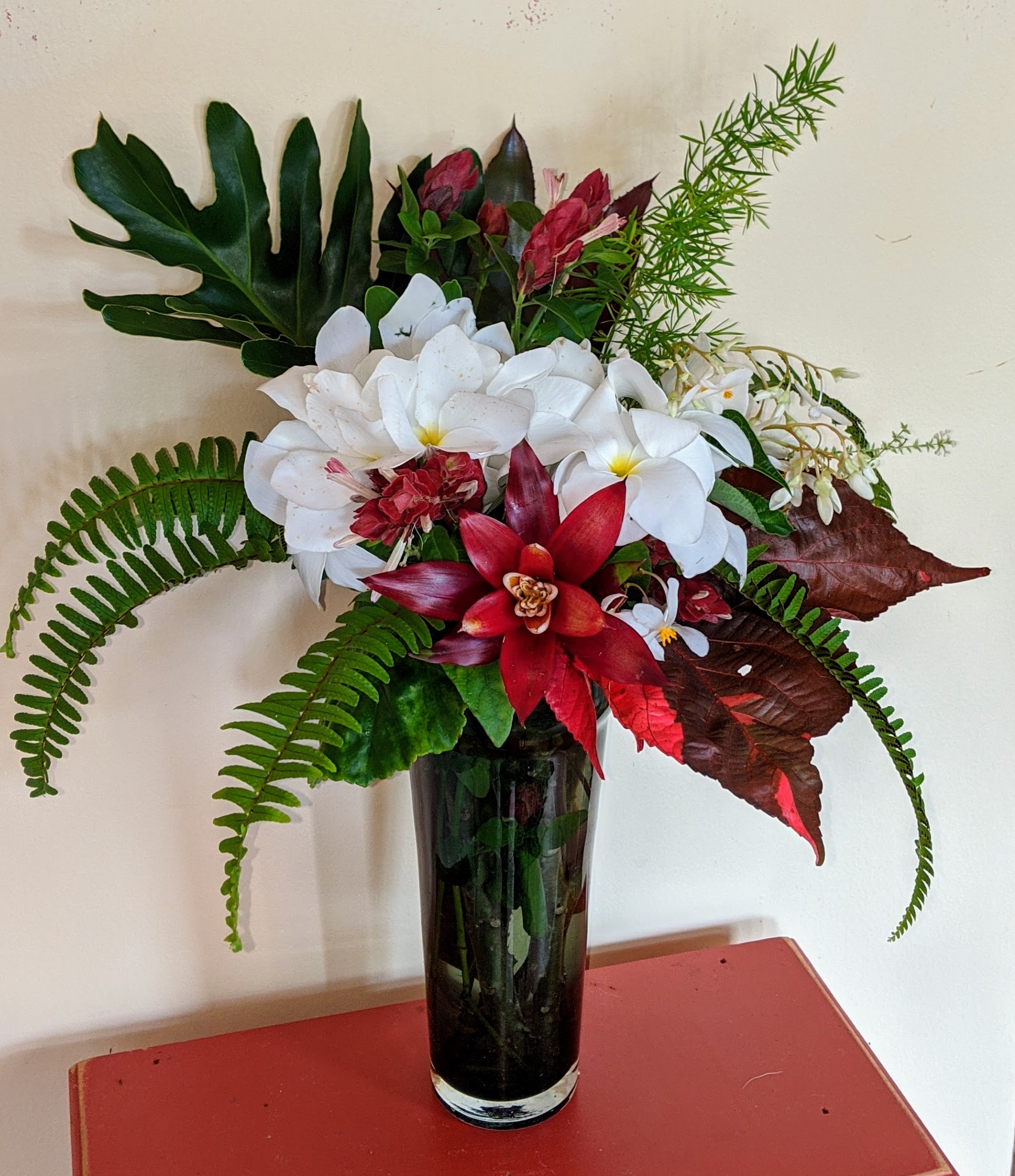
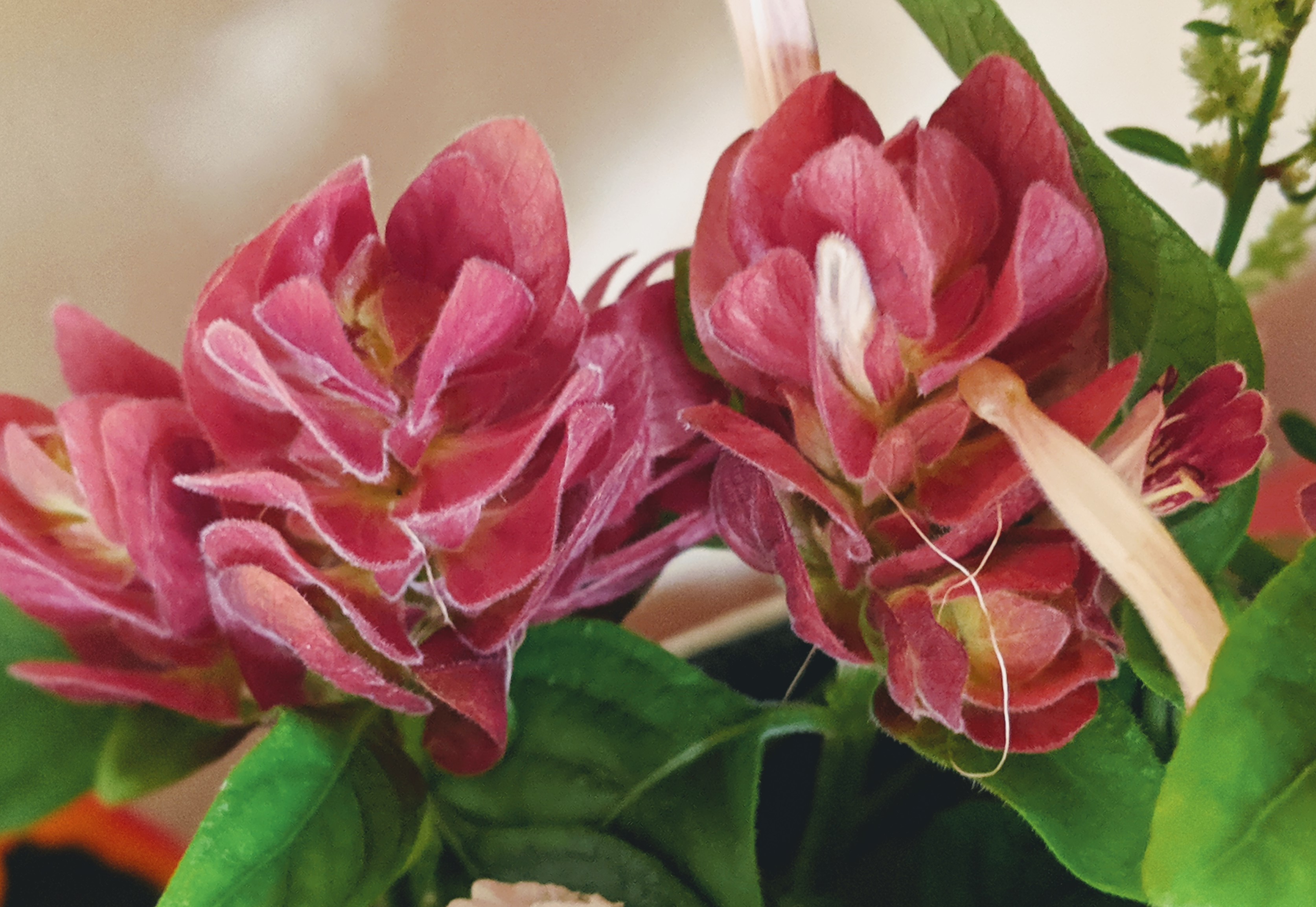
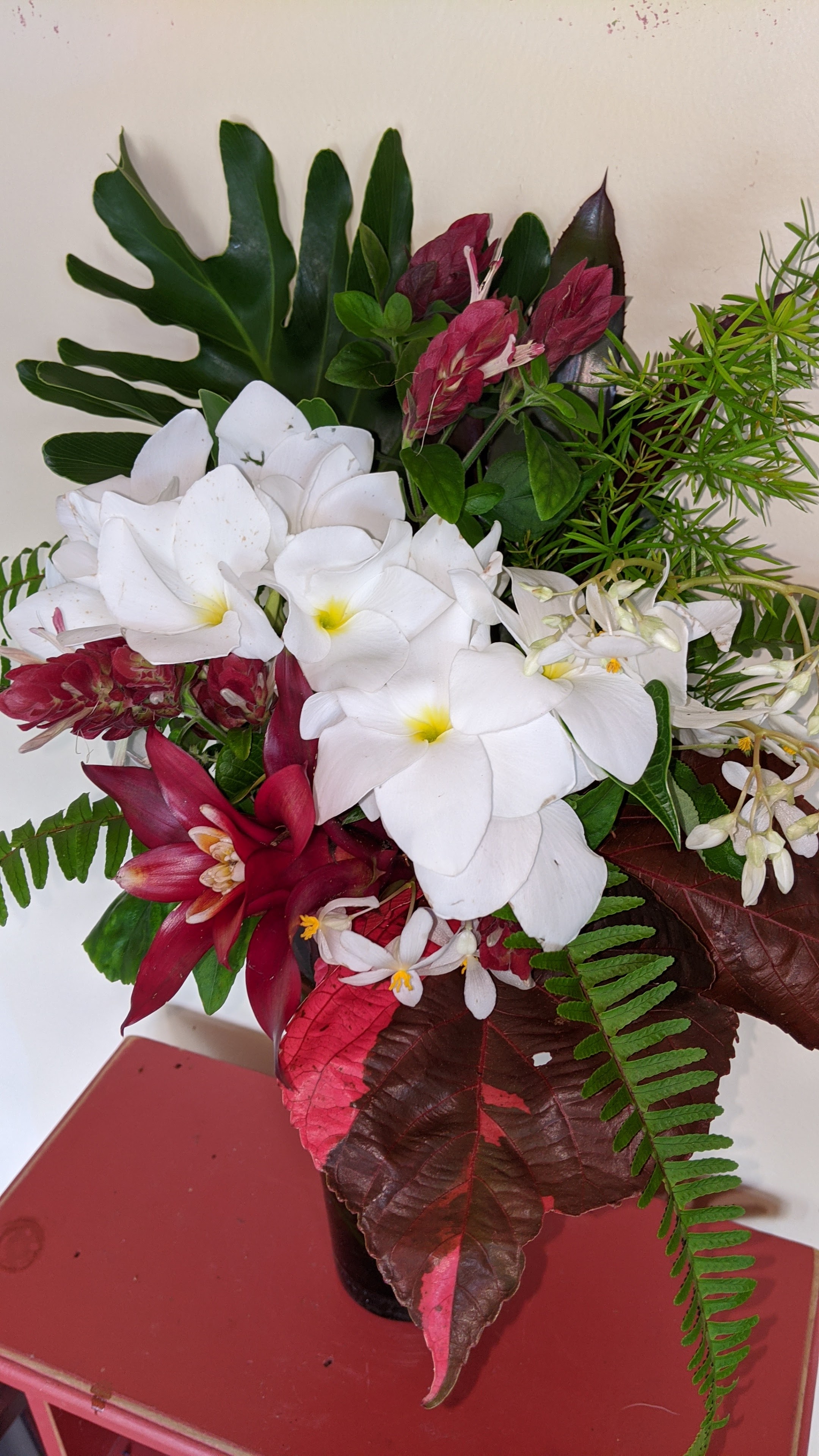
The big white flowers are Bridal Bouquet Frangipani (Plumeria pudica), smaller white flowers and bigger foliage is from Sweet Begonia (Begonia odorata); white and red spikes are from Tropical Red Salvia (Salvia coccinea); the red spikes on the sides are Pineapple Sage (Salvia elegans), red berries are from Brazilian Pepper (Schinus terebenthifolia) – a dreadful weed.

Below is a better image of the red and green foliage – at the right end a Martin Bromeliad (Neoregelia Martin) leaf, the middle has foliage from Mammey Croton (Codieum varigata ‘Mammey’)

00000img_00000_burst20191215111656967_cover

Here is the tin from 2016:20161211_102634-1

And  the original tin/ vase from 2015.

20151220_160007-1

Hmm,  which is your favorite.? 2016 has one of my favorite plants, the Parrotflower (Heliconia psittacorum)  – I like the Flapjack Kalanchoes in 2015 (grey foliage). I may combine all the plants next year into a 2020 mash up.

For more vases on Monday, visit our hostess, Cathy at http://www.ramblinginthegarden.wordpress.com

Happy Holidays!

In a Vase on Monday – Christmas Palm Forest


IMG_20191208_115516It’s an oddly dreary day in South Florida, making it feel more like the holidays to me. I decided to do a mini forest basket for this second week of Advent. The forest idea sprang to mind when I saw the Christmas Palm seedhead from last week lost all its berries and looked like a  birch tree in winter. I usually call these Adonidia Palm, this is one of  those  plants with several common names. The common name can be Christmas Palm or Manila Palm, and my neighbors call them Triple Palms as many have three trunks. The botanical name is Veitchii merrilli. Below is a Christmas Palm with red fruit.

CAM00183


IMG_20191208_115516 (1)

The arrangement has the white stalk from the Christmas Palm seedhead. Red flowers are from Heirloom Pentas (Penta lanceolata); red berries are from the evil Brazilian Pepper  (Schinus terebinthifolia) – the Peppers are invasive in South Florida to the point it is illegal to plant them. I have gotten rid of mountains of  these things, but there are always a few lurking and using them in flower arrangements saves Florida a few in the woods. The ferns are: Boston Fern (Nephrolepis exaltata) in the back and Asparagus Fern around the edges. Both are volunteers in the garden. A closer view:

IMG_20191208_114858

The  basket is a thrift store find and the gold cat is in honor of Mr. Bob, our resident Bobcat.

Feeling a bit more Christmassy this week. Maybe a tree and wreath on the front door next week.

For vases from around the world, follow this link to http://www.ramblinginthegarden.wordpress.com.

Happy Gardening.

In a Vase on Monday – Happy Anniversary

IMG_20191110_104203

In a Vase on Monday is celebrating its sixth anniversary this Monday. Cathy, of Rambling in the Garden blog, created and hosts this meme weekly and challenged us to create a miniature vase (6″x6″) in honor of the anniversary. This  ‘vase’ is just under that and I added a crystal for Cathy as I know she likes crystals.

I decided to use shells and a tiny glass pot as my containers and then determined that they wouldn’t hold water. An additional challenge, waterless vase. The shells are a Tortoiseshell Cowrie in the glass pot and a Lightning Whelk. These shells are common to the east coast of Florida and were found on this beach near the Fort Pierce Inlet about 20 miles north of my house.

20180915_071829

The  Lightning Whelk holds one of our native Bromeliads (Tillandsia utriculata). These are commonly known as Air Plants and it is actually illegal to collect them in Florida.  Most are grown in South America and shipped to Florida, this one came up on its own in a nearby Oak and I moved it to a booted Sabal Palm.

The brown pods are from a Senna ligustrina, another native I planted as a larval host for  Sulphur Butterflies.

00000IMG_00000_BURST20191110104721702_COVER

Here are the Tillandsias in the booted Sabal Palm,  I am planning to add Burgundy Bromeliads and some Cattleya Orchids to the Palm. The boots are the bases of old fronds, many palms are cleaned up with a chain saw for a smooth trunk.

IMG_20191110_115052

The  Tortoiseshell Cowrie holds the dried stems of a seedhead from an Adonidia Palm (Veitchii merrilli). The stems are white until the berries ripen and then turn brown. The white stems are from a younger seedhead.

00100lrPORTRAIT_00100_BURST20191110104730390_COVER

A heartfelt thank you to Cathy for hosting IAVOM, it is an addictive pleasure to share a weekly vase with gardeners from all over the world – and to see theirs! To see more miniature sixth-anniversary celebrations follow this link More Vases.

Happy Anniversary and Happy Gardening!

In a Vase on Monday – Nearly Perfect

IMG_20191027_114051

Today was nearly a perfect fall Sunday in South Florida. Clear blue skies, a light breeze, the native flowers blooming luxuriantly in my pollinator garden buzzing with green bees and butterflies. Unfortunately, it was 88 degrees Fahrenheit/31 Celsius. Too hot to hang around outside very long. Summer can last seemingly forever here. Endless Summer is not just a Beach Boys song. Though the vegetables and what the rest of the Northern Hemisphere considers summer flowers are thriving in the heat. I am hoping for bouquets of Zinnias and baskets of radishes, herbs, and tomatoes later in the season.

A closer view of my native flowers:

IMG_20191027_114112

I love the striking green stems with blue flowers, these are a native (according to some, the native plants’ people get tiresome to me), I think they are Stachytarpheta jamaicensis- Blue Porterweed, maybe the latin means they are native to Jamaica, I don’t know. These flowers are well behaved in my garden and flower nearly year-round. Orange and red daisy-like flowers are Gallardia (Gallardia pulchella) these change with the pollinators and reseed producing different flowers, fun to watch – last year I had some pinks. The pink flowers are Tropical Red Salvia (Salvia coccinea) in a lighter shade; purply pink grasses are Muhly Grass (Muhlebergia capillaris), my favorite Florida grass. Greenish white spikes are from Juba Bush (Iresine diffusa) Ferns are Boston Ferns (Nephrolepis exaltata). The bowl vase is a handmade thrift store find I love.

In my garden, we are hoping for cooler weather and the fruit already out to ripen. Papayas and Passionfruit:

00100lportrait_00100_burst20191025102227646_cover-100000img_00000_burst20191027152424374_cover

I hope to catch a Passionflower soon! Happy Monday and Happy Gardening. For more vases, follow this link More vases. Cathy hosts the vase extravaganza every Monday.

In a Vase on Monday – The Shrimp Boat

00100lportrait_00100_burst20191013105119458_cover

This vase is my grandmother’s gravy boat – it exhibits a bit of family history, my father broke it (probably in the 1930s) and was made to fix it. He glued it back together, I wasn’t sure it would hold water but it does! The patina on this old piece of Blue Willow is extreme. The inside repair is visibly cracked, the spout is deeply chipped and the glue has turned brown – I don’t use it for gravy but keep it on a shelf to enjoy the history.

00100lportrait_00100_burst20191013163634634_cover

The shrimp? It’s the Red Shrimp Plant in the vase. The Red Shrimp Plant is one of the more indestructible plants in my garden. It grows in sugar sand, no fertilizer and if you forget to water it that’s not a problem. Flowering off and on year-round and it has an interesting flower. The plant is kind of gangly, but its benefits far outweigh the ganglies. Does it look like shrimp? Not to me.

A closer look at the rest of the arrangement:

00100lportrait_00100_burst20191013105139355_cover

The red flowers on the left side are from the Coral Plant (Jatropha multifida) – a novelty plant by some accounts though it does look like coral. Red Shrimp Plant (Justicia brandegeana) lounging around the end with white Florida Gardenia (Tabernaemontana diviricata); yellow daisies are Beach Sunflowers (Helianthus debilis), off white spikes at the end are Juba Bush (Iresine diffusa)

I have a feeling my grandmother would think this was a pretty weird thing to do with her broken gravy boat. But, you never know!!

Happy Gardening and Happy Monday. To see more vases follow the link to Rambling in The Garden MOREVASES