The official time for the Fall Equinox is 1:19 PM today. I am waiting for the axial shift to cool our temperatures. I can already tell the sun is lower in the sky and the shadows on the north side of our house are deepening. The sun angles in South Florida are so different from winter to summer it still throws me off. On a due north exposure, the garden goes from full sun in summer to full shade in winter. Selecting plants is a conundrum. I have gone to pots in these areas.
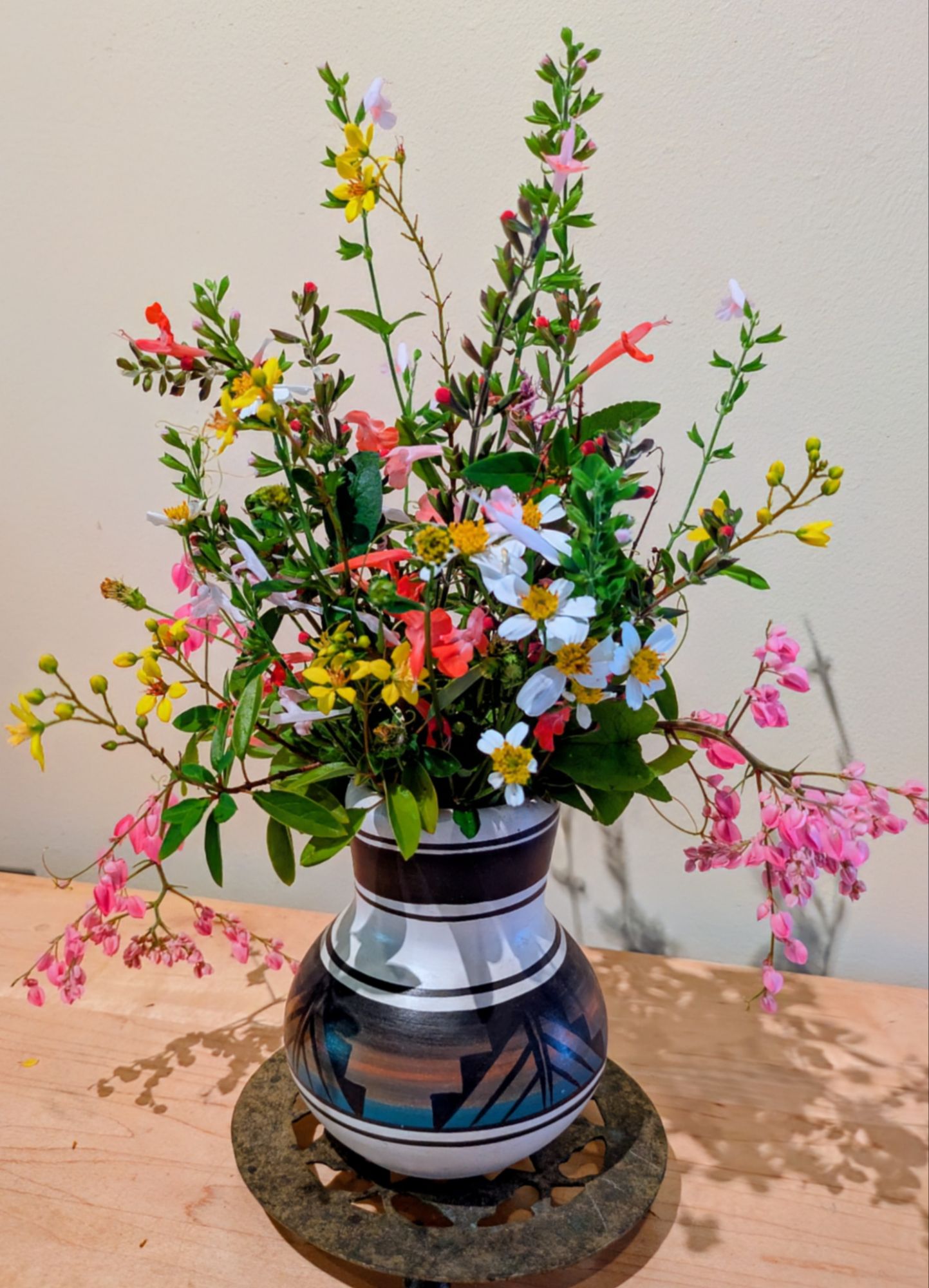
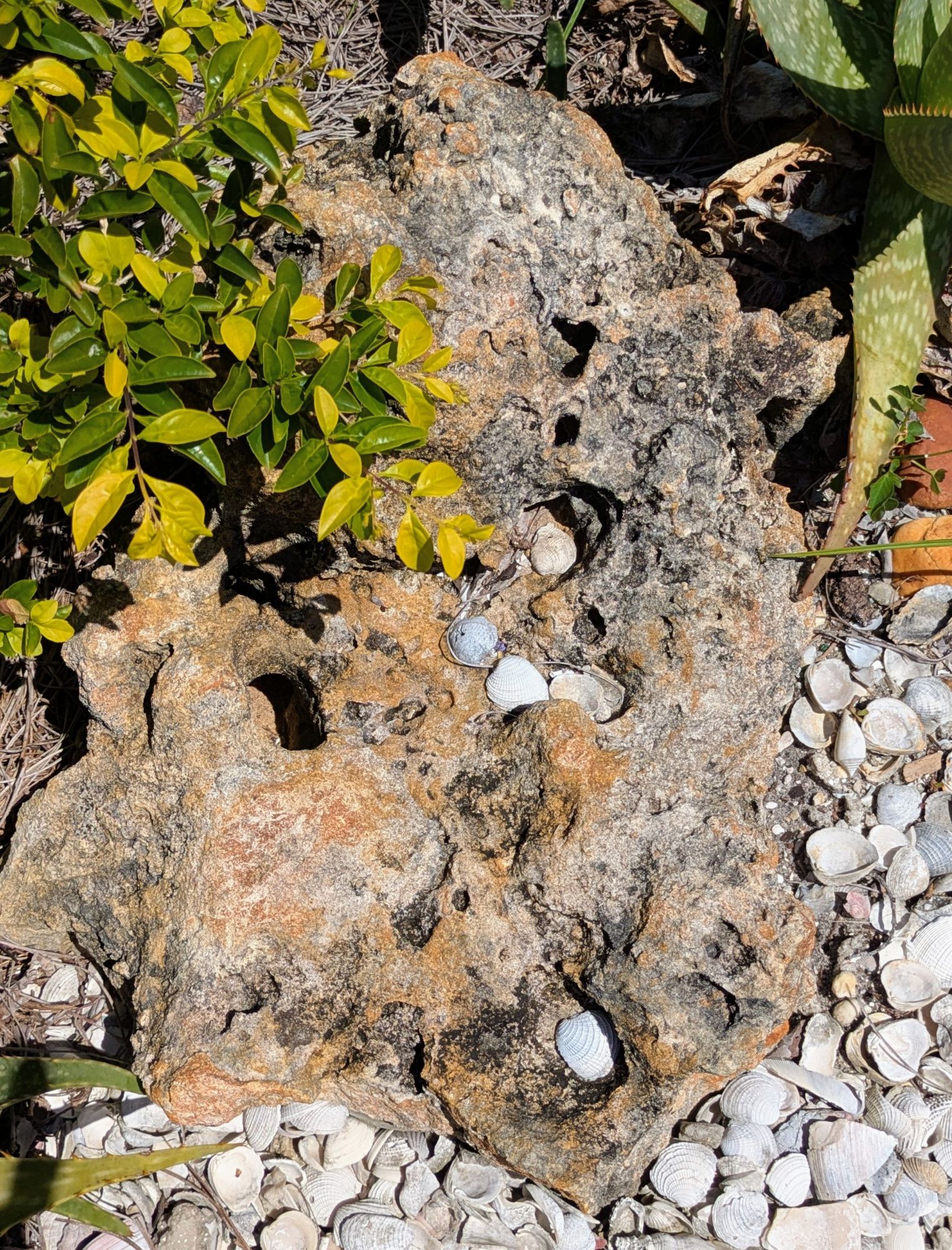
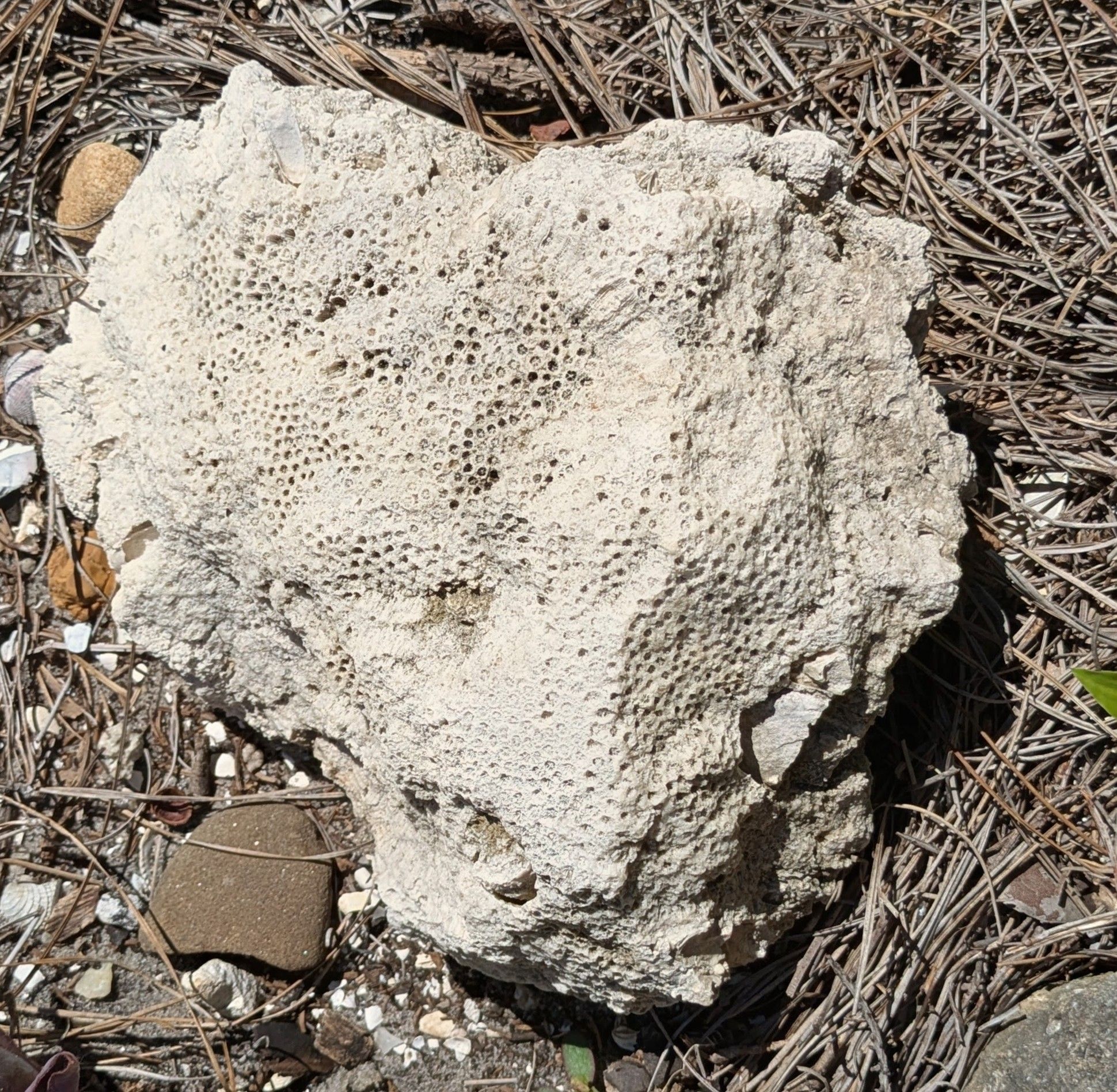
The garden is celebrating the equinox with coral flowers sprinkled through the beds. I also have coral rocks used as accents as I like local stone incorporated into gardens. Coral rocks are limestone boulders with deposits of shells and other sea life visible on the surface.
The flowers:
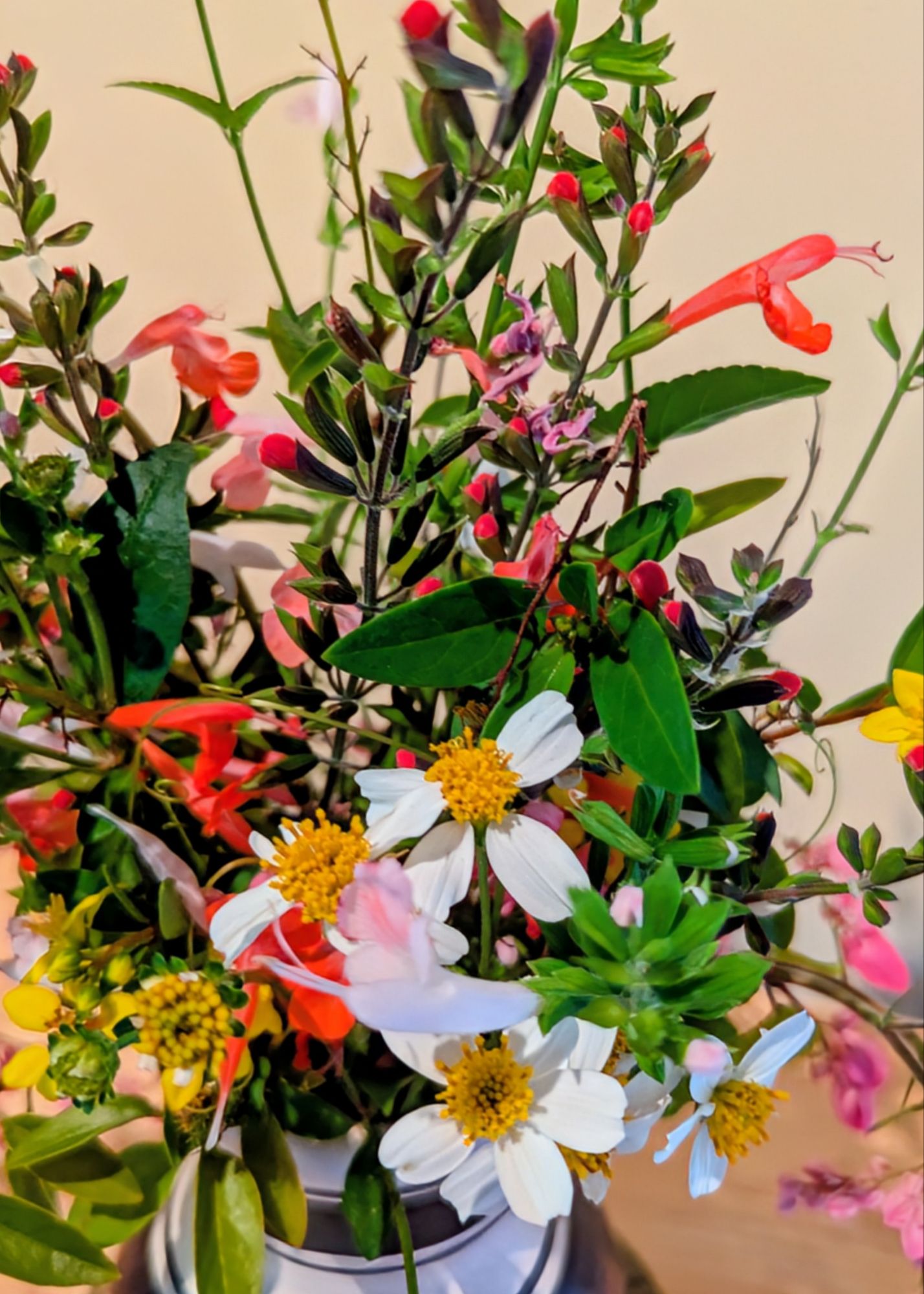
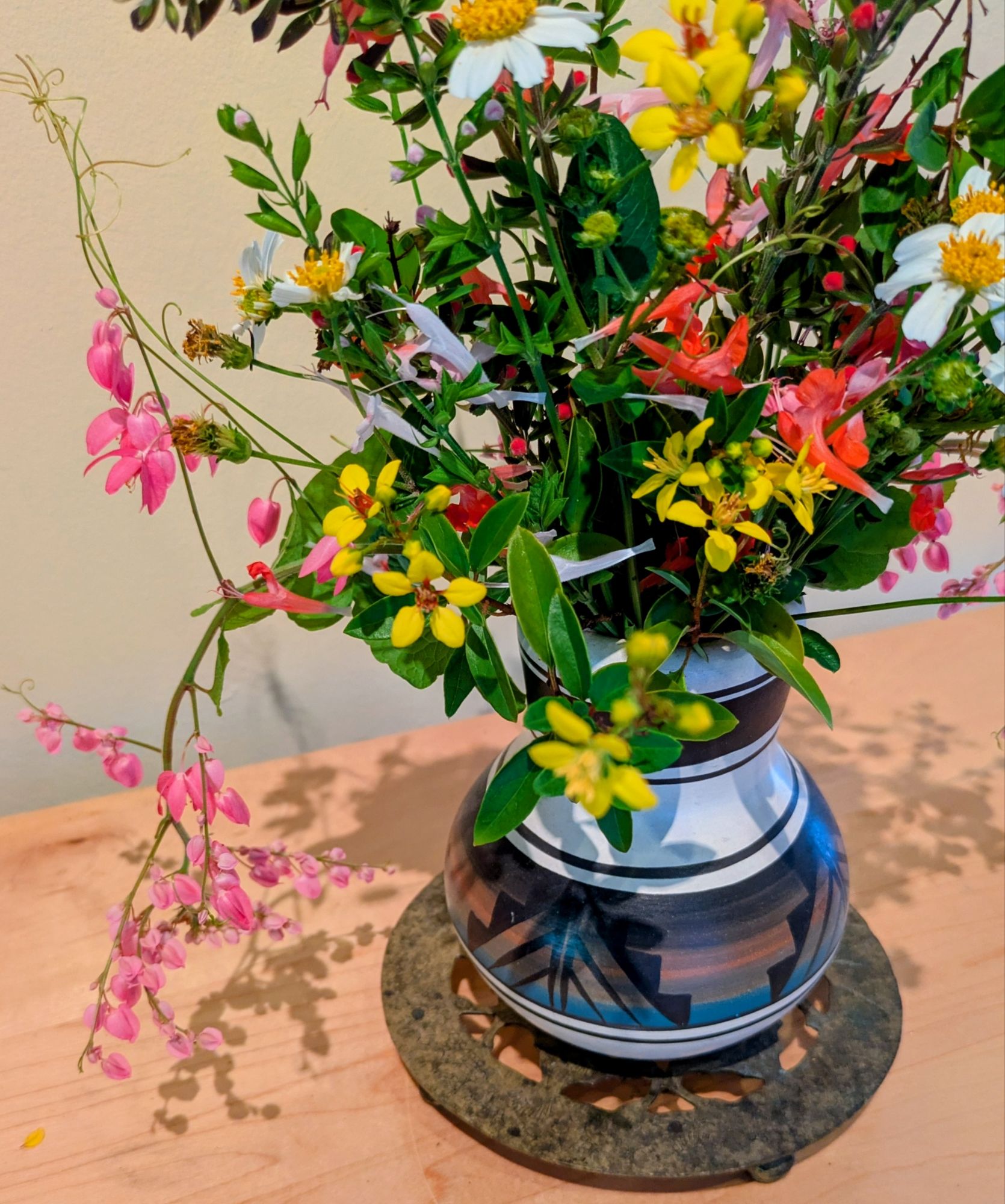
Tropical Red Salvia (Salvia coccinea) is showing up in shades of Coral this week. White daisies are Bidens alba.
Yellow flowers are Thyrallis (Galpinia glauca). The inspiration plant, hanging over the side, is Coral Vine (Antigogon leptopus). The vase was made by the Ute people in the Southwestern US.
And here are the rocks.
I enjoy my rock collection in the garden. I have some heirloom rocks from my Father the Geologist and other interesting stones rocking the garden with the coral.
Follow this link to visit Cathy’s blog RamblingintheGarden to see what she and other gardeners are rocking in their vases.
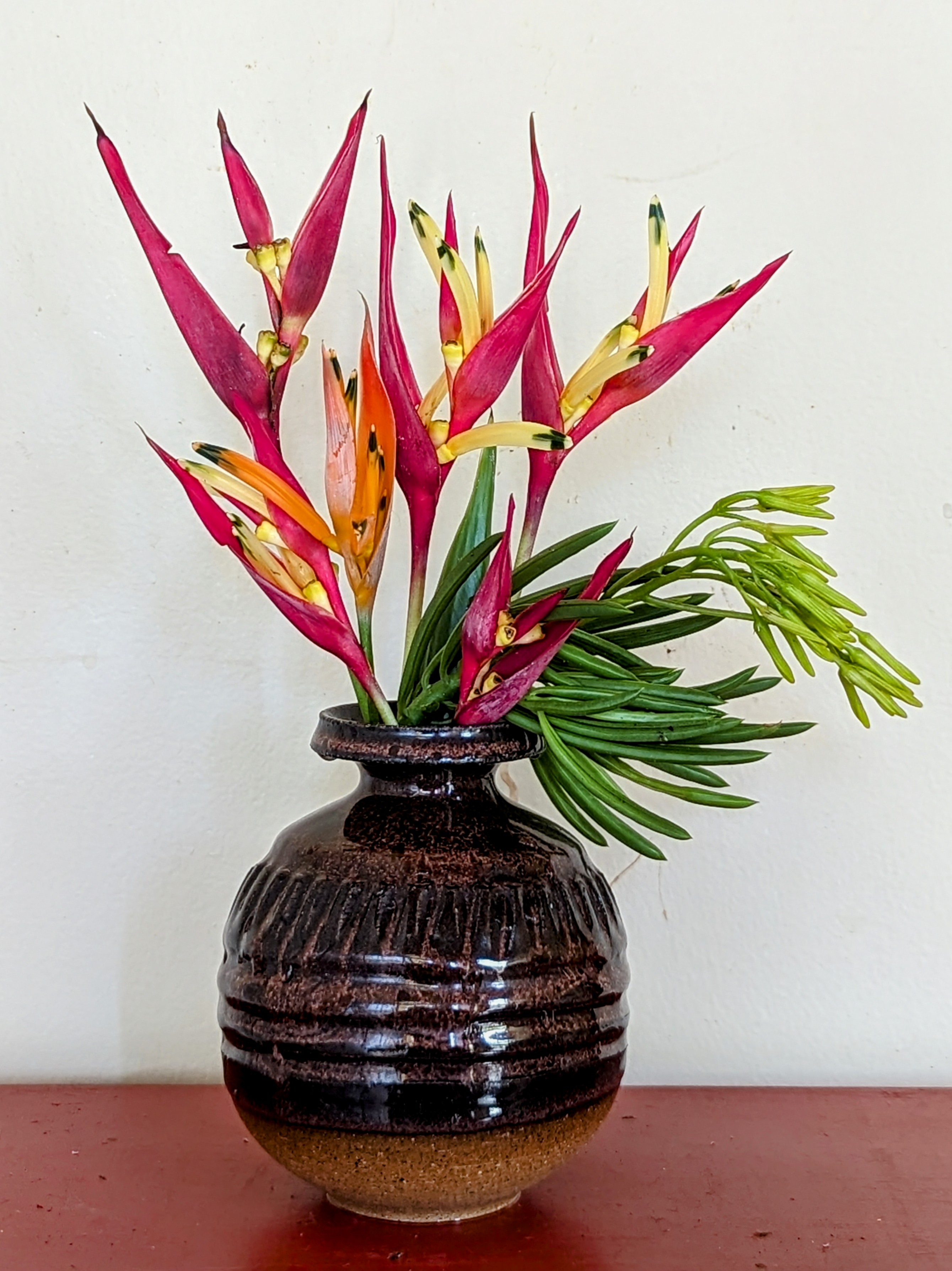
Looking to add some tropical vibe to your garden? Look no further than one of my favorite tropical plants, Heliconias. Heliconias come in many different varieties, two of the most common and easiest types to grow in South Florida’s Zone 10 are Parrot flowers and Lobster claw Heliconias.
Meet the Lobster claw Heliconia (Heliconia rostrata). Featuring large, shiny banana-like foliage and thick stems that support large hanging bracts of red and yellow flowers it is difficult to picture a more tropical plant. They originated in rainforests of South and Central America as understory plants. It is written that the flowers evolved to this shape to attract tropical hummingbirds to pollinate them. In my garden, the hummingbirds aren’t around at the same time as the flowers, so I am guessing this is a phenomena that happens much further south.
While some Lobster claw Heliconia can grow to 15 feet tall, these are usually more tropical types in an actual rainforest. The plants grown in Zone 10 are usually smaller and can be damaged with an extraordinarily cold snap.
Lobsterclaw Heliconia are easily grown in a partial shade setting with ample moisture. They like rich, well drained soil and benefit from compost in the planting hole and mulch. I grow them in my garden on the north side of the house under the edge of the roof. They are very happy and provide cut flowers in the summer.
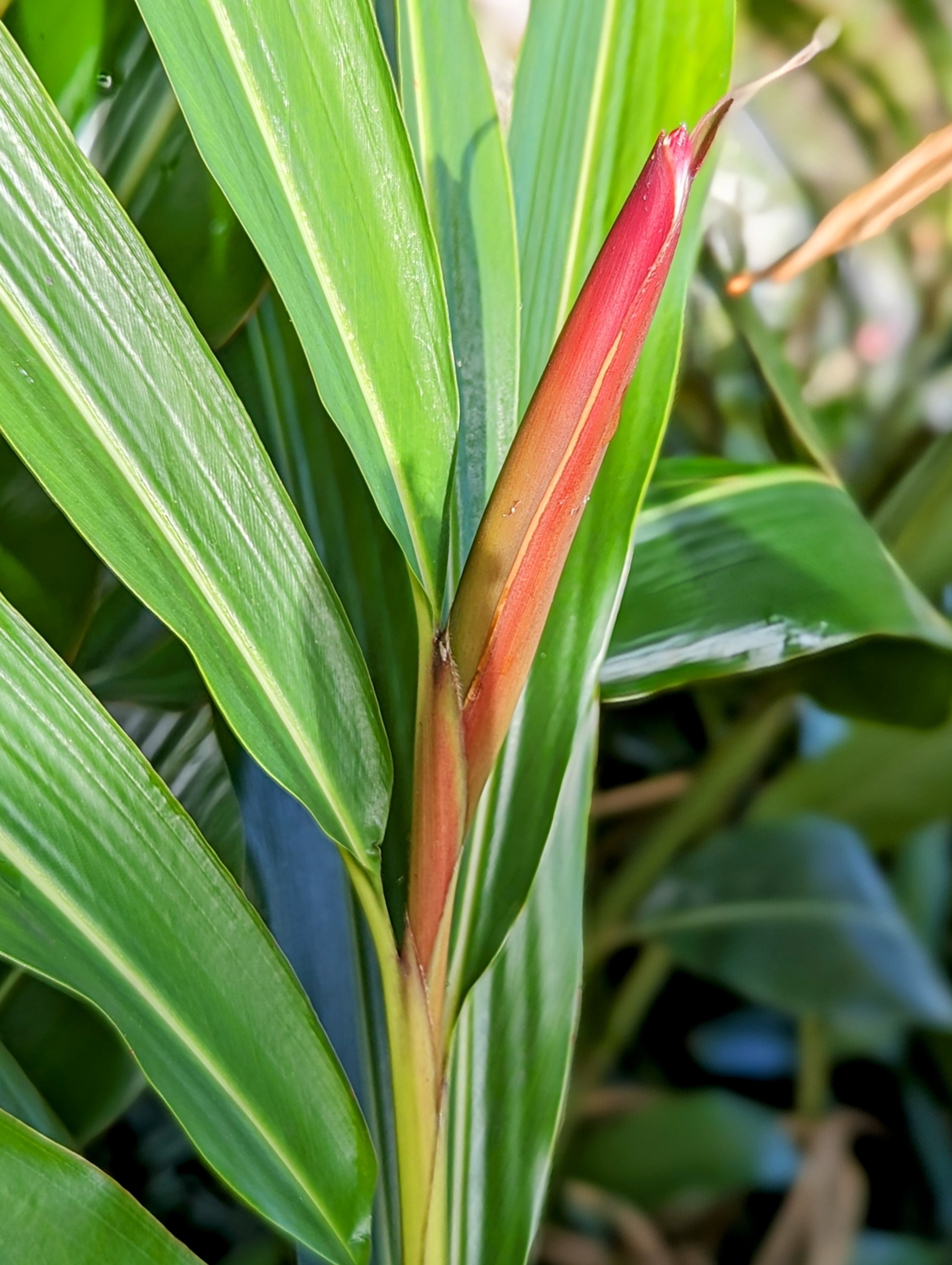
This is a smaller Lobsterclaw Heliconia in my garden. I enjoy cutting these for smaller vases.
Here is a parrot for the garden. Heliconia psittacorum AKA the Parrot flower. I would characterize this as a tropical flowering perennial. They are leafy, grow about two feet tall, enjoy a moist, part shade environment and can spread like mad if happy. I have had these produce flowers almost every month of the year. I believe they slow down with extremes in weather (drought, heat, cold). Below is the “Lady Di” Parrot flower.
This is another long lasting cut flower. I have a few in a vase by my front door.
My Saturday morning garden stroll revealed that spring comes early in South Florida. The scents and sights are promising tropical fruits and flowers later this year. To participate in the blog phenomena Six on Saturday and tour gardens around the world, visit Jim’s blog and follow the links in the comments.
A new arrival in the mail greeted me yesterday – a nice rooted cutting of ‘Gardenmeister’ Fuchsia. This will have to be a sort of a reverse house plant. Outside in winter and indoors for summer. Summer heat and humidity will kill this outside. Should be an interesting experiment.
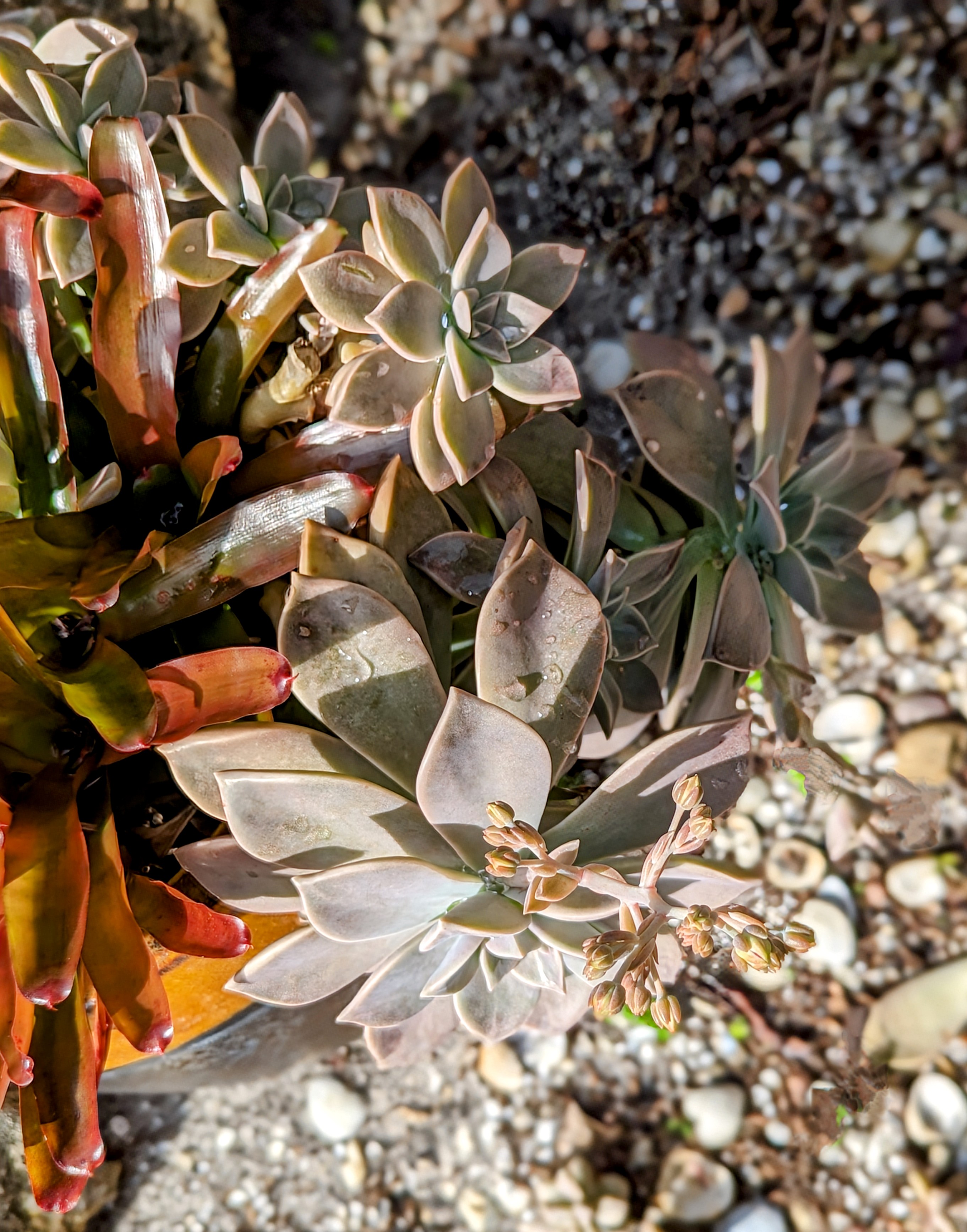
Buds on the Graptosedum.
Buds on the Shell Ginger (Alpinia zerumbet). I am hoping for flowers next week. This is the only ginger I have any luck with. It is over five feet tall.
The back garden smells wonderful. The scent is from the Rangpur lime tree flowering more prolifically than it ever has.
Thai dessert mangos (Nam Doc Mai) setting lots of fruit.
That’s all from South Florida. I hope everyone is seeing signs of spring.
I did not post last week as, for the first time in my blogging history, it was too cold to go outside. Most of Florida experienced the coldest Christmas in 30 years. On the Treasure Coast we had temperatures in the mid 30s (close to 0 C) with a cold north wind coming off the Atlantic. Ordinarily our average low is 40 F (4.4 C).
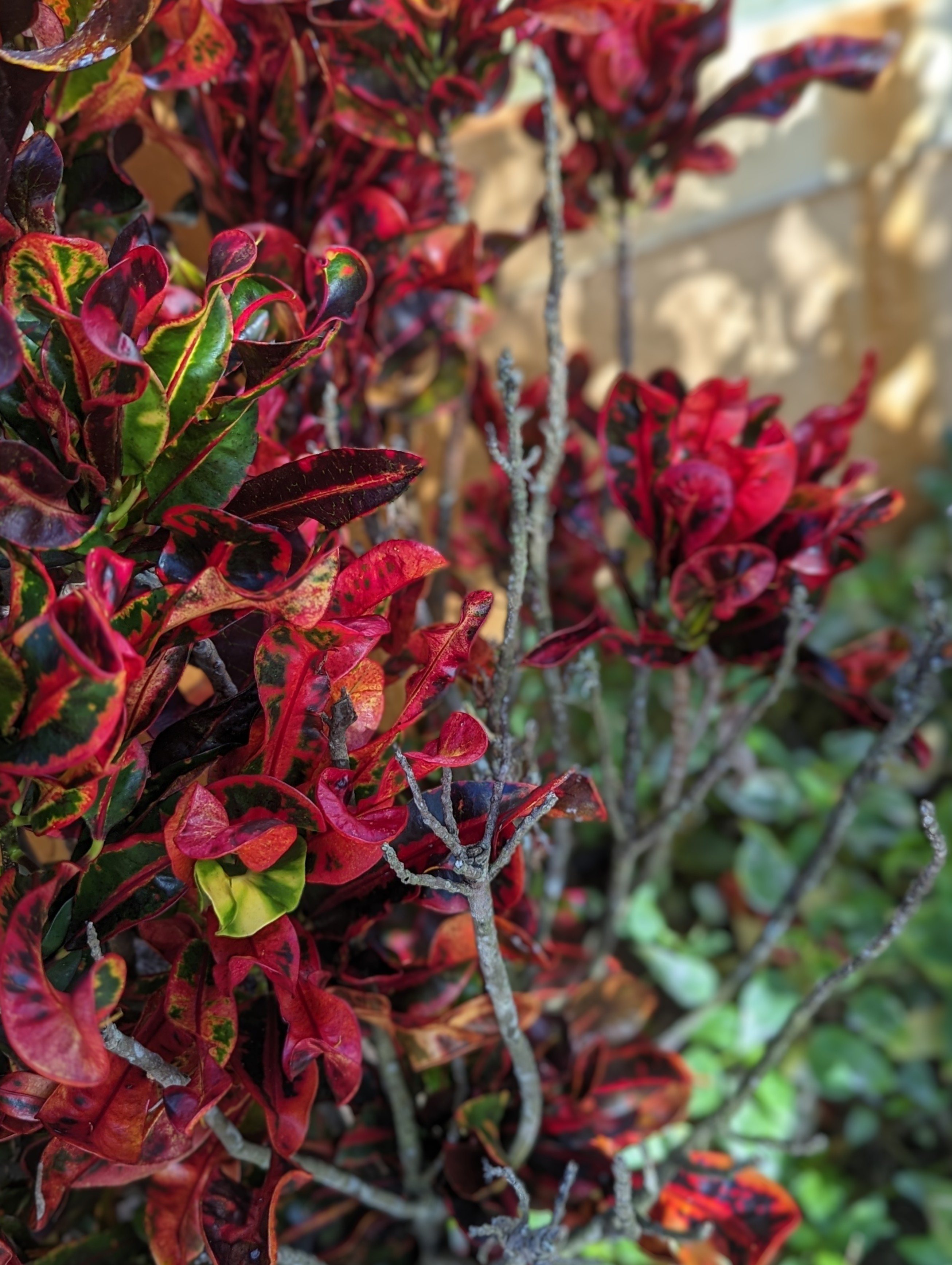
Above is a Mammey Croton, these are notoriously cold sensitive and true to form, it is dropping leaves. Advice on this is to leave it alone and they will grow back with warmer weather. It had not occurred to me to cover it. The orchids I thought about covering, but didn’t are fine as is another Croton. This one may get a bit more wind.
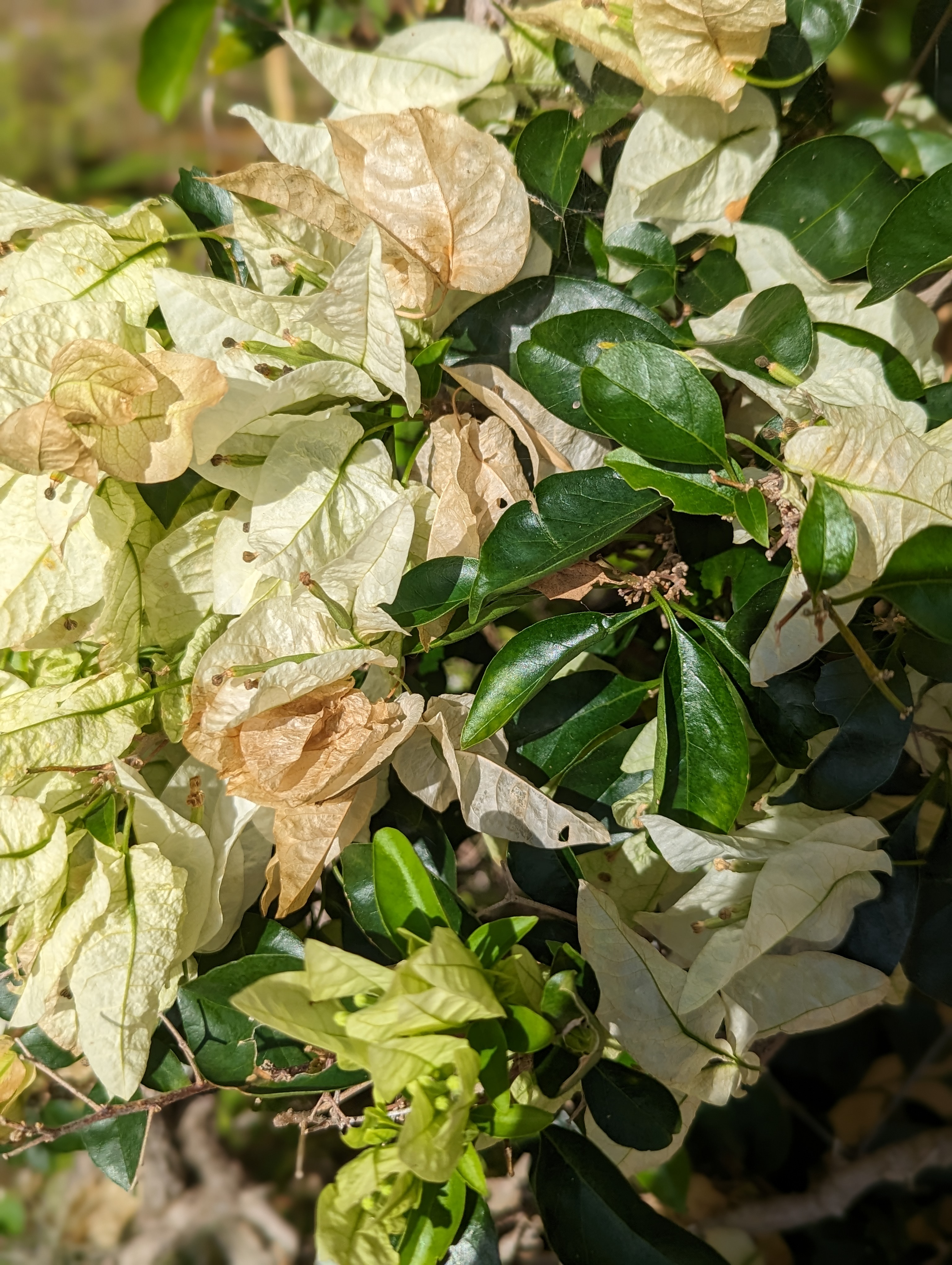
Below is Miss Alice Bougainvillea, burned by the cold, and currently ‘snowing’ white bracts. This is already coming back nicely.
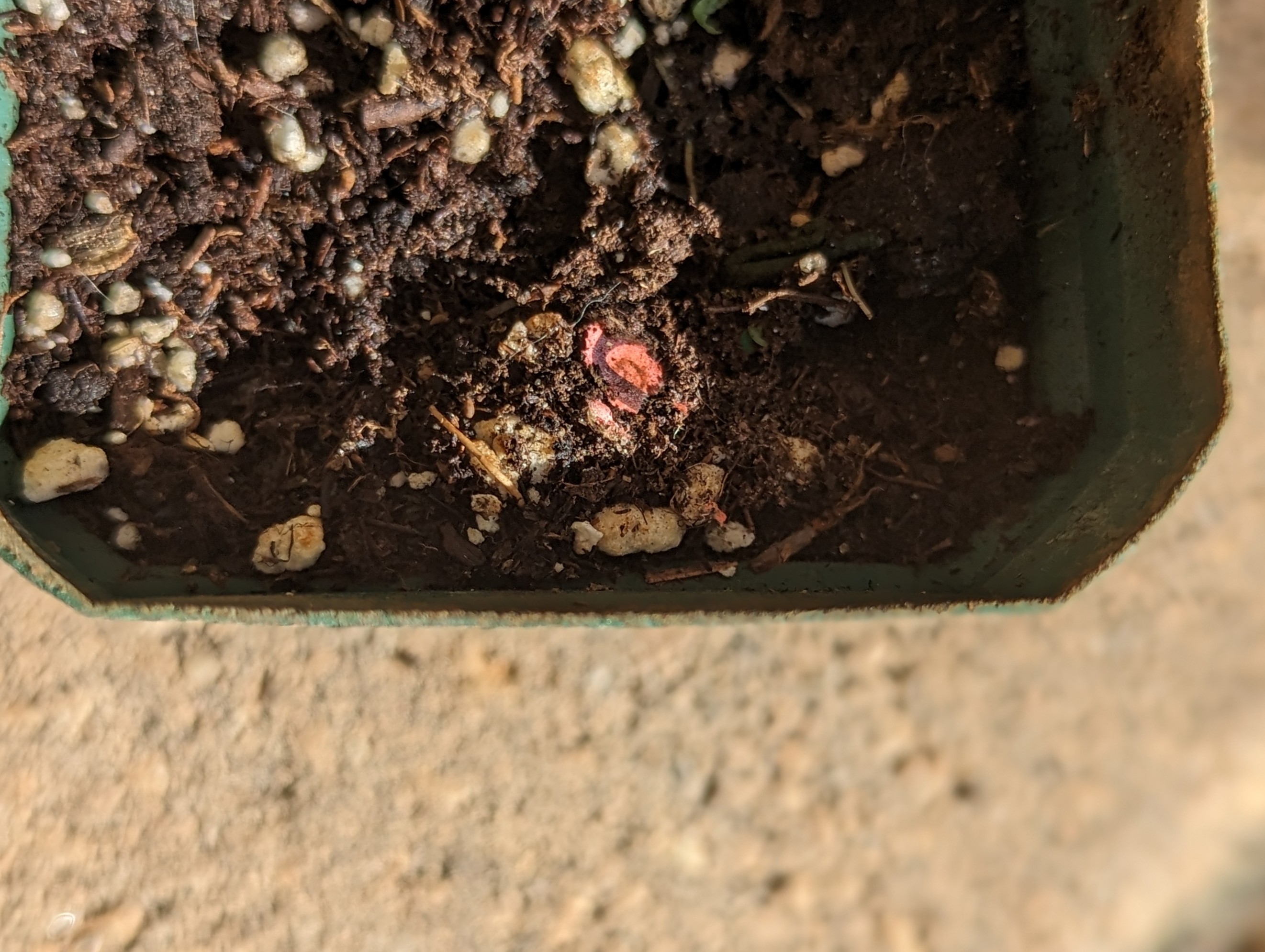
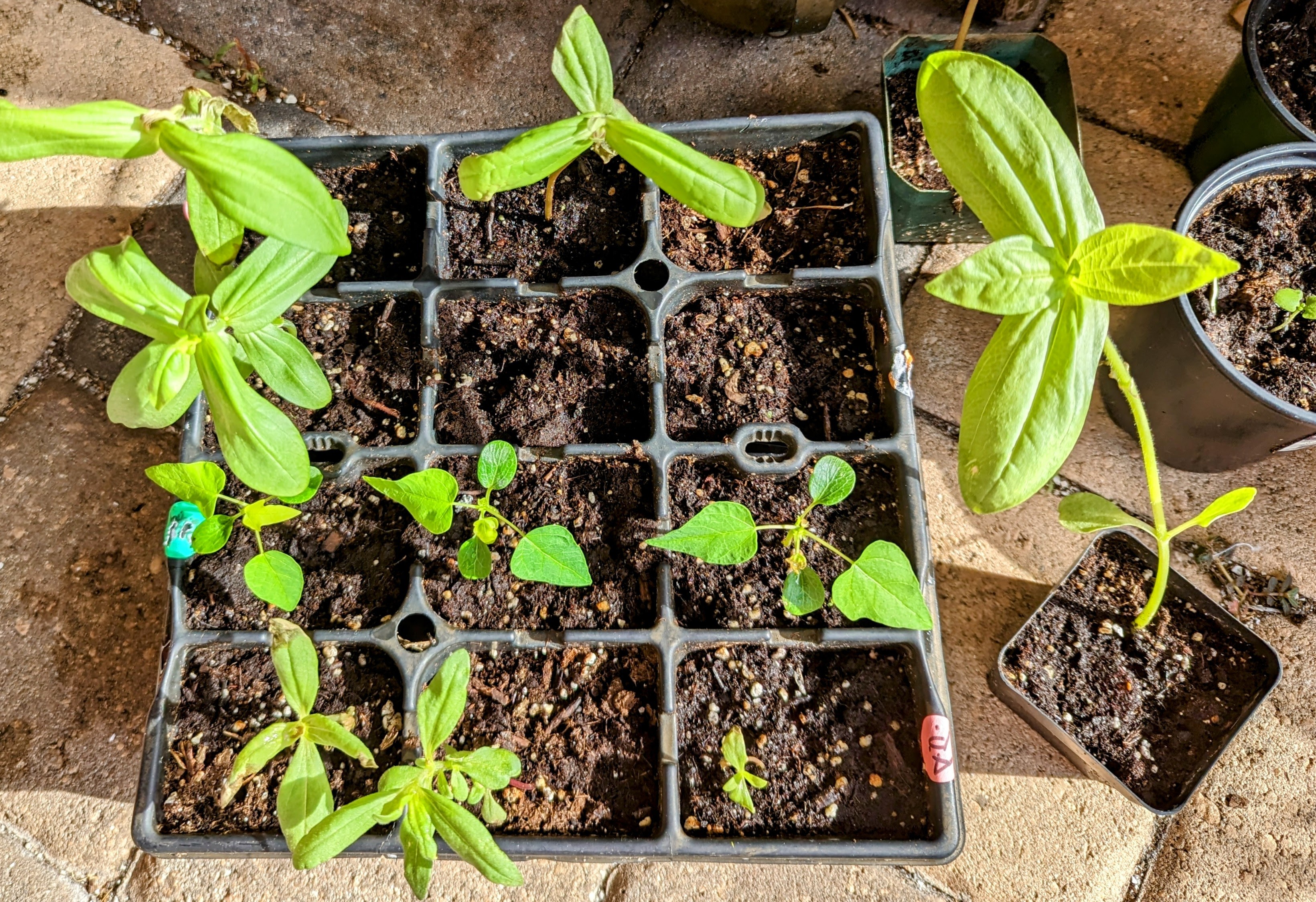
I am fortunate to have gotten off to a late start on planting seeds. Earlier in December, I planted tomatoes, peppers, basil, sunflowers, papayas, Chinese forget me nots and a few types of zinnias. The plants were just getting big enough to pot up when the cold hit. They spent a few days in the bathtub of our guest bathroom. I was surprised to see some cold damage on the zinnia seedlings and grew some pink slime mold on the surface of the potting mix. This pink stuff had me scratching my head for a bit, did I lose a Pepto Bismol tablet somehow? An internet search revealed the pink slime mold, I have only seen the dog vomit version of this in shades of yellow.
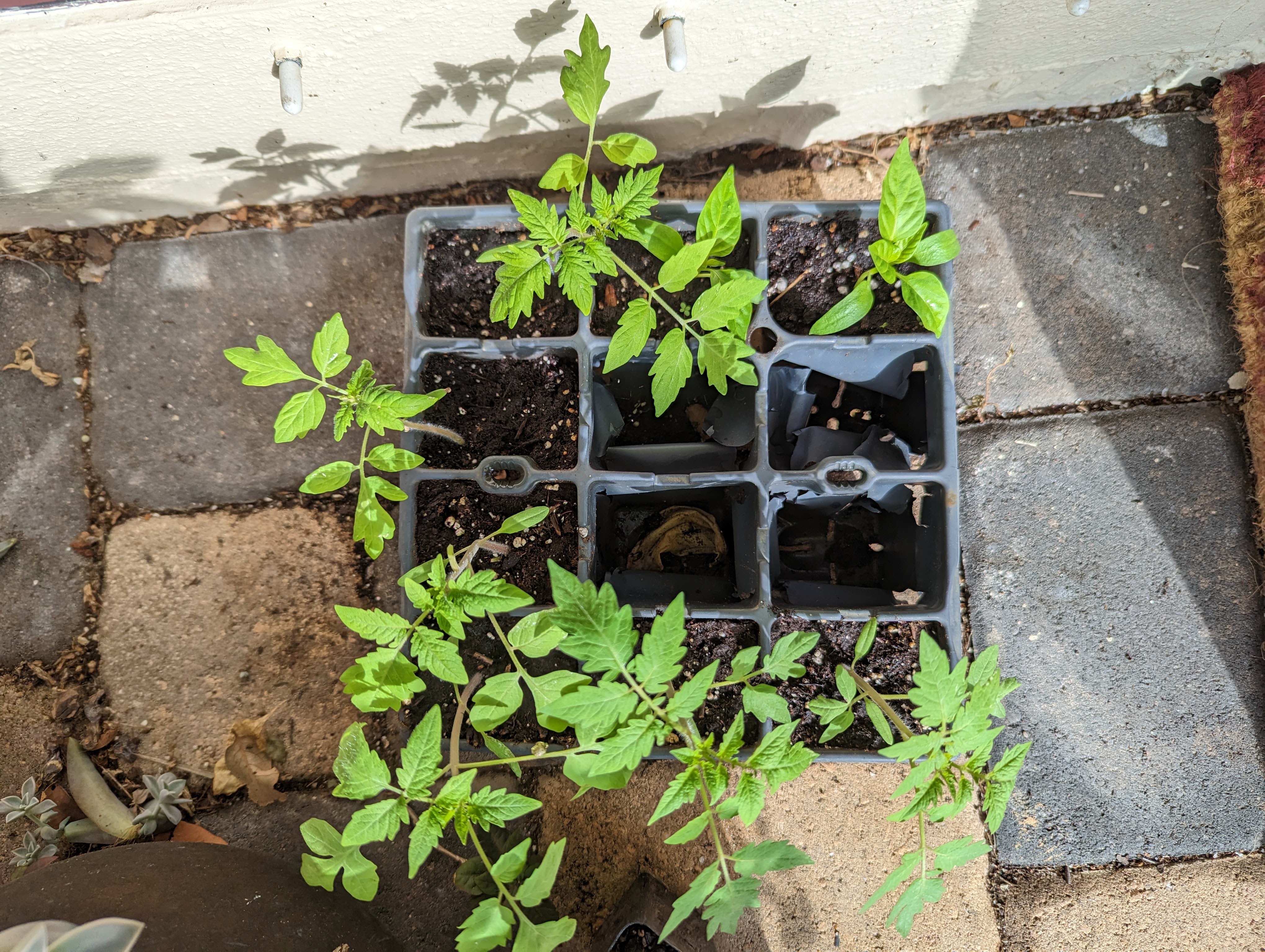
The seedlings. I have Lost Marbles, Black Cherry and Sweet 100 tomatoes and two red bell pepper plants. I gave up on big tomatoes a few years ago and usually have bumper crops of cherry tomatoes. Lost Marbles is a good name for this past year! I am letting these recover a bit before potting them up, hoping for Valentine’s tomatoes.
More seedlings. The zinnias seem to be recovering, though I lost several. I think a cast iron bathtub on the north wall might be colder that I thought it would be. The three seedlings in the second row are papayas grown from two Mexican Papayas we ate this fall. (I have been making Papaya Coconut cupcakes). It takes about a year to get fruit from a seedling if you get a hermaphrodite plant (with self pollinating flowers) Time will tell on these papaya seedlings; they can be male, female or hermaphrodite.
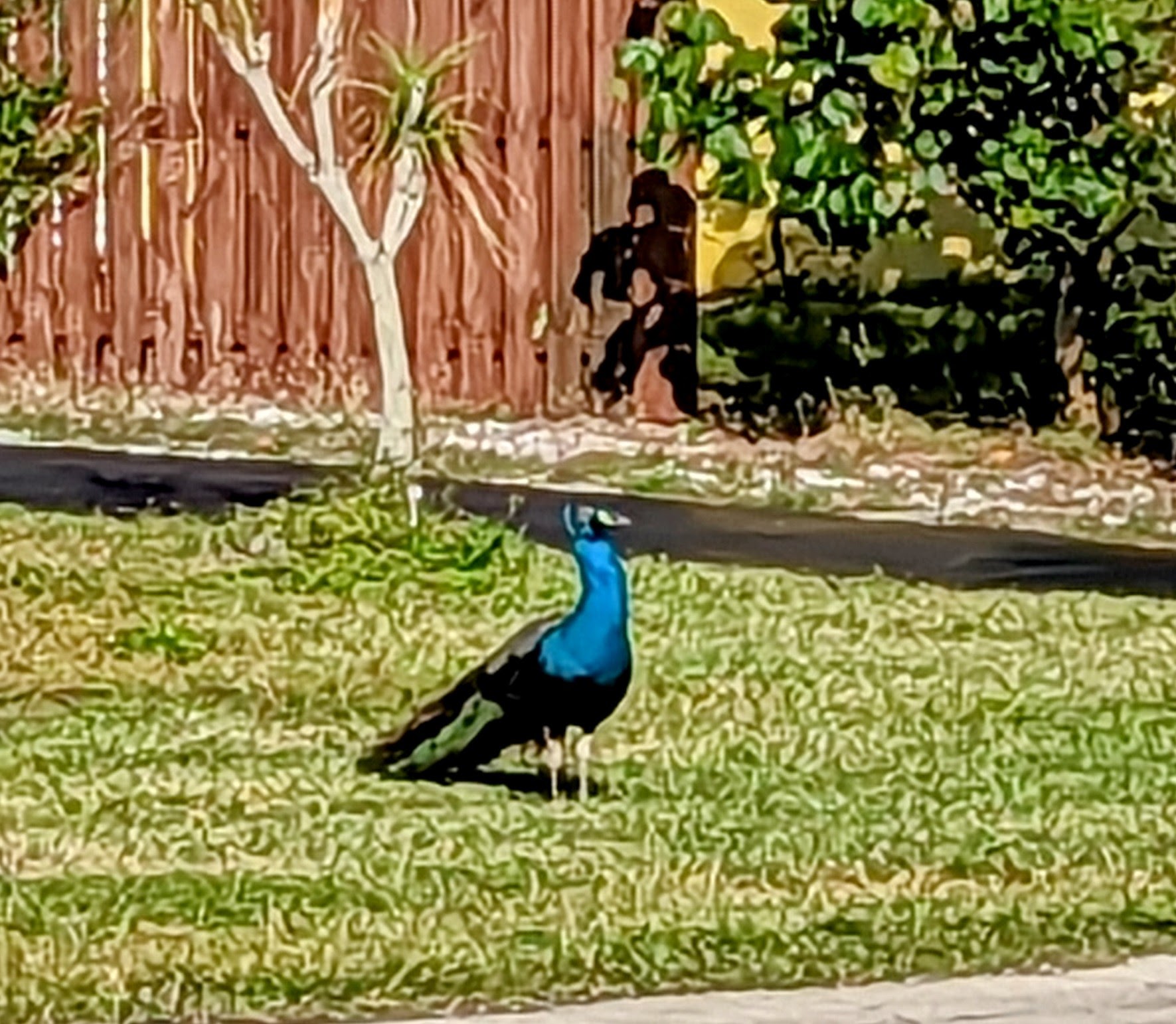
An unusual sight, but not around here. I took my dog to the vet (a neighbor’s Rottweiler bit her! she is doing well). Near the vet’s office is the former estate of Frances Langford, a movie star from fifty years ago. She kept a flock of peacocks and their descendants are still around today. There were about twenty of them, hens and peacocks. Not a great picture, but I always enjoy seeing them. Fiona the greyhound was puzzled.
That is my six from warmer South Florida. It is 84 F (28 C) today and I am grateful for the warmth. To see more posts, visit our host, Jim at gardenruminations.co.uk
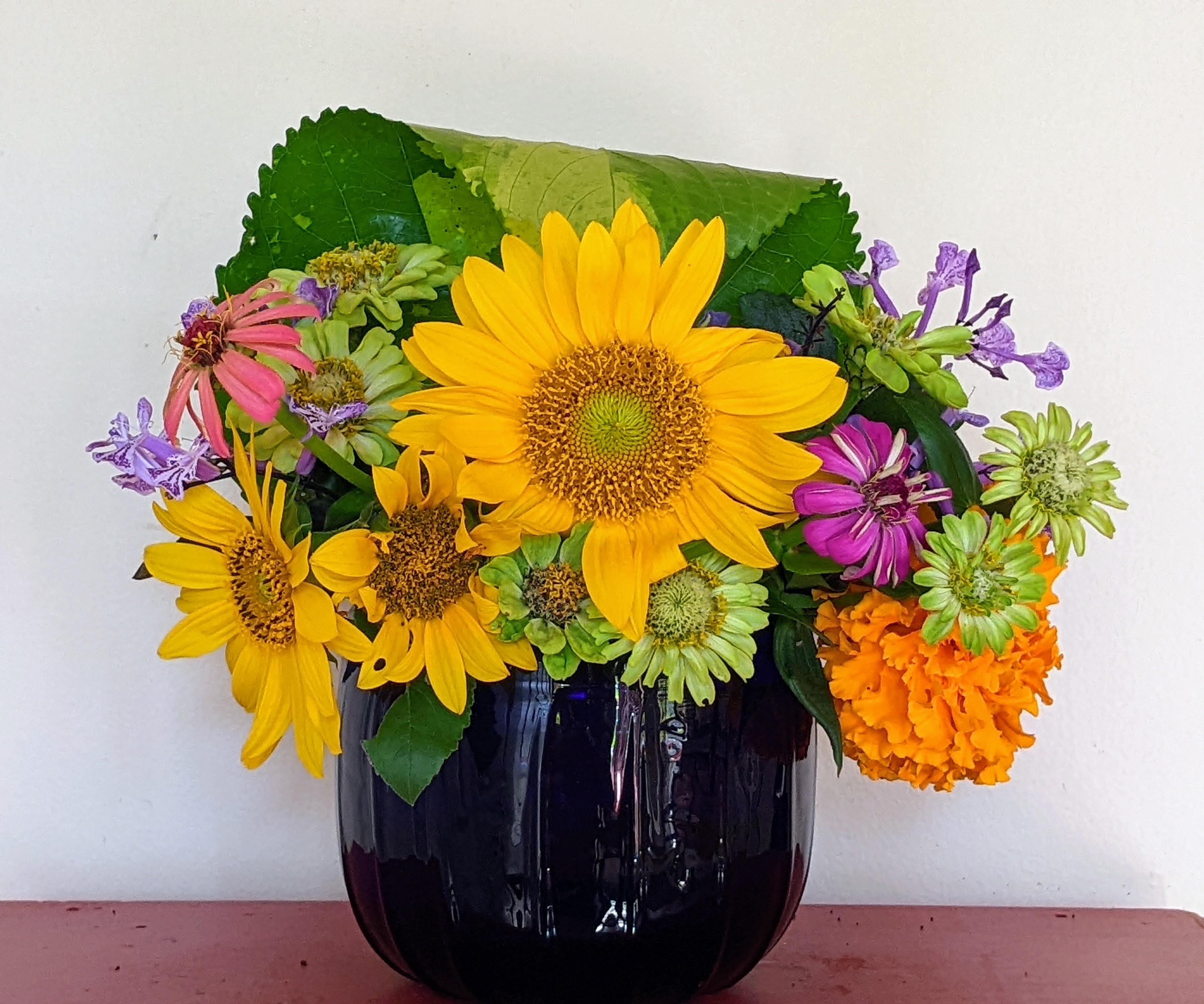
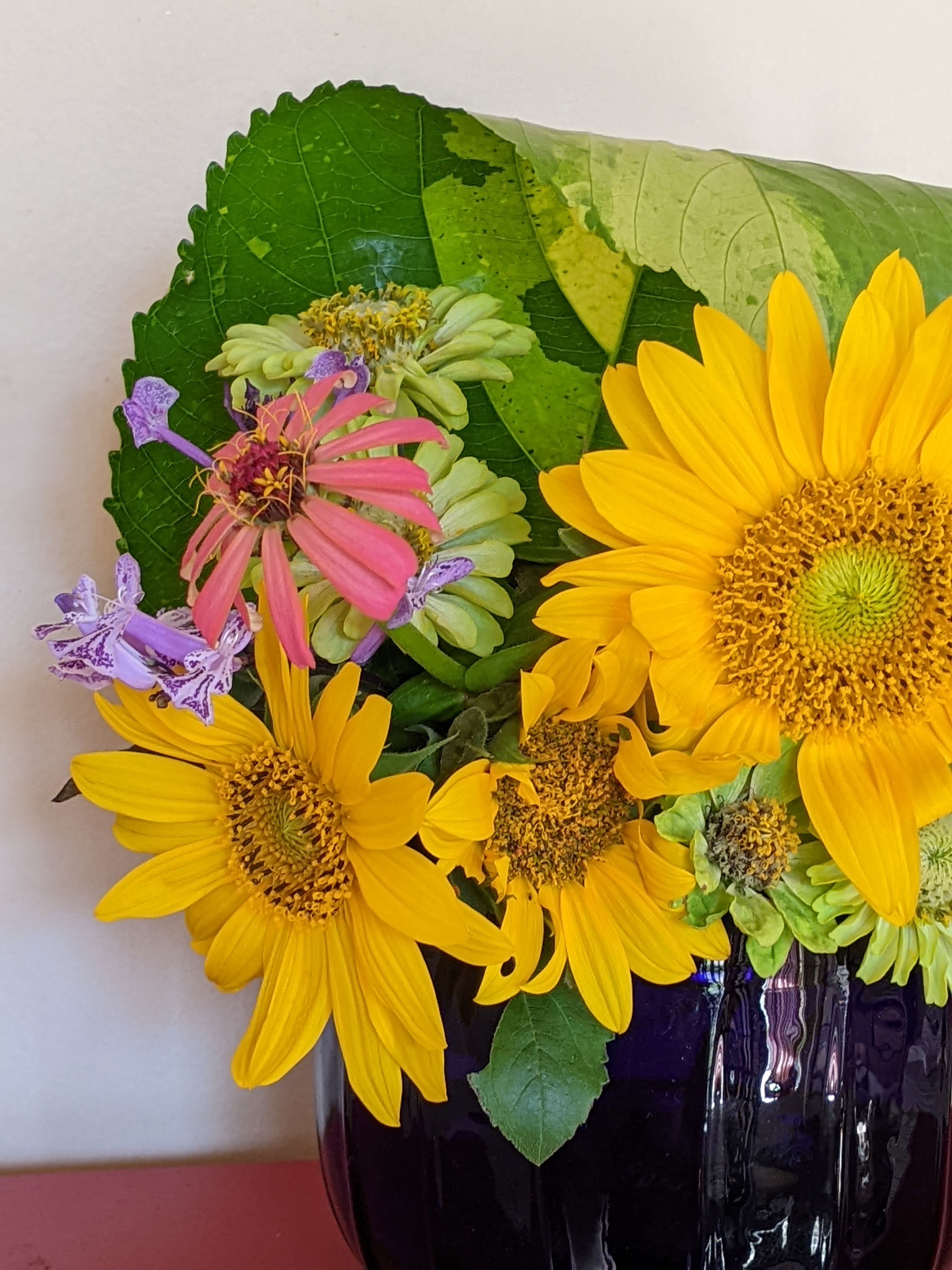
The Winter Solstice passed last week, days are slowly getting longer and more sunshine is on the way. I thought I should share some Florida sunshine with a brightly colored mix from my garden. I have noticed the wildflowers in my garden germinate late in the year – which should have given me a clue years ago about when to grow cut flowers. I am guilty of reading and following directions on seed packages….again. South Florida reigns peculiar over American horticulture.
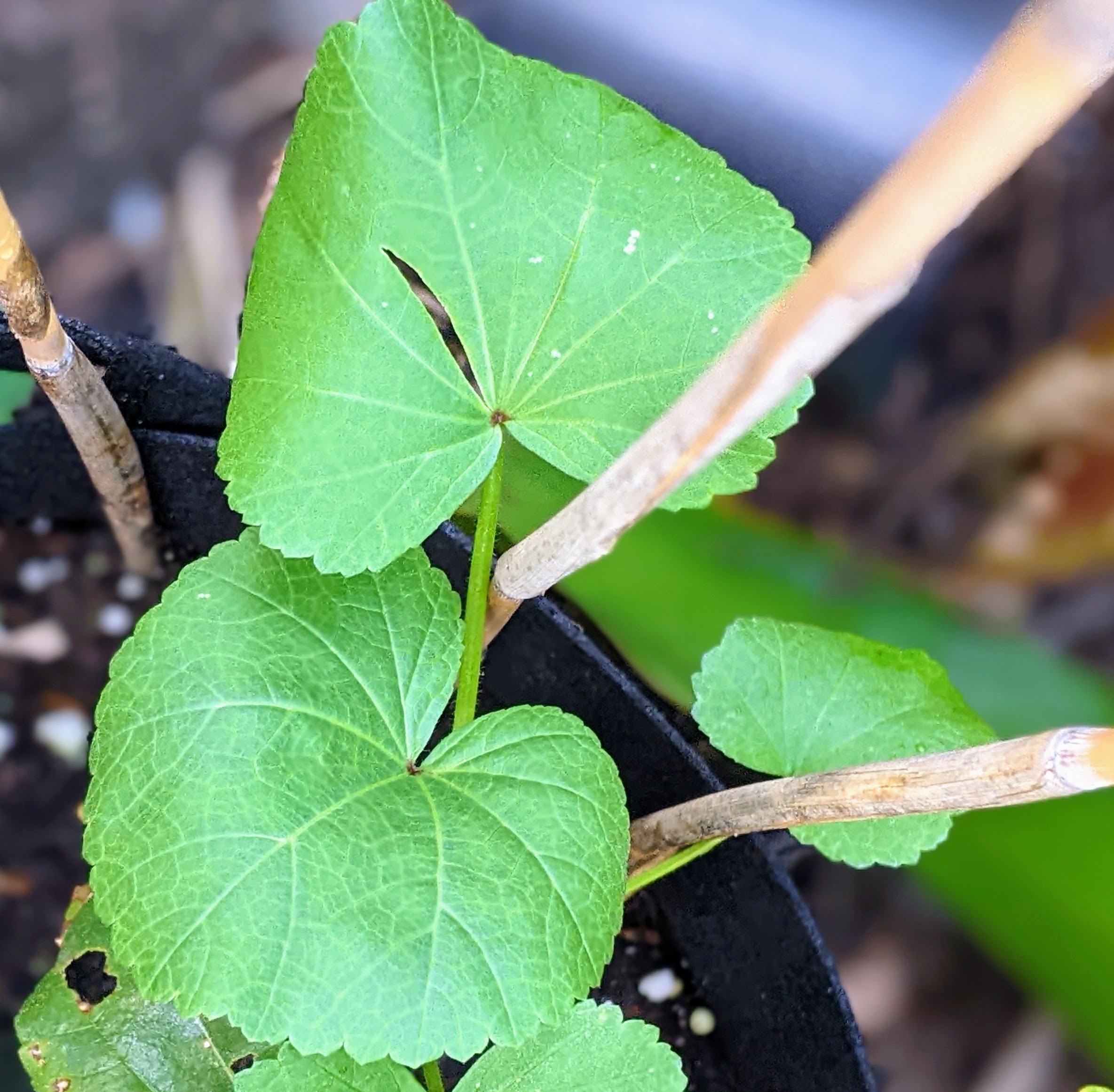
It is difficult to find a sunnier group of flowers. All were grown from seed started in September (some named and some in a cutting garden mix) and currently flourishing (with the exception of Nigella, not sure about that) in containers. I am wondering how long the Zinnias will last. Here is a photo of a seedling from the cutting mix I cannot identify.
Any thoughts? It is not a Hollyhock. That was not included in the mix.
Some closer views:
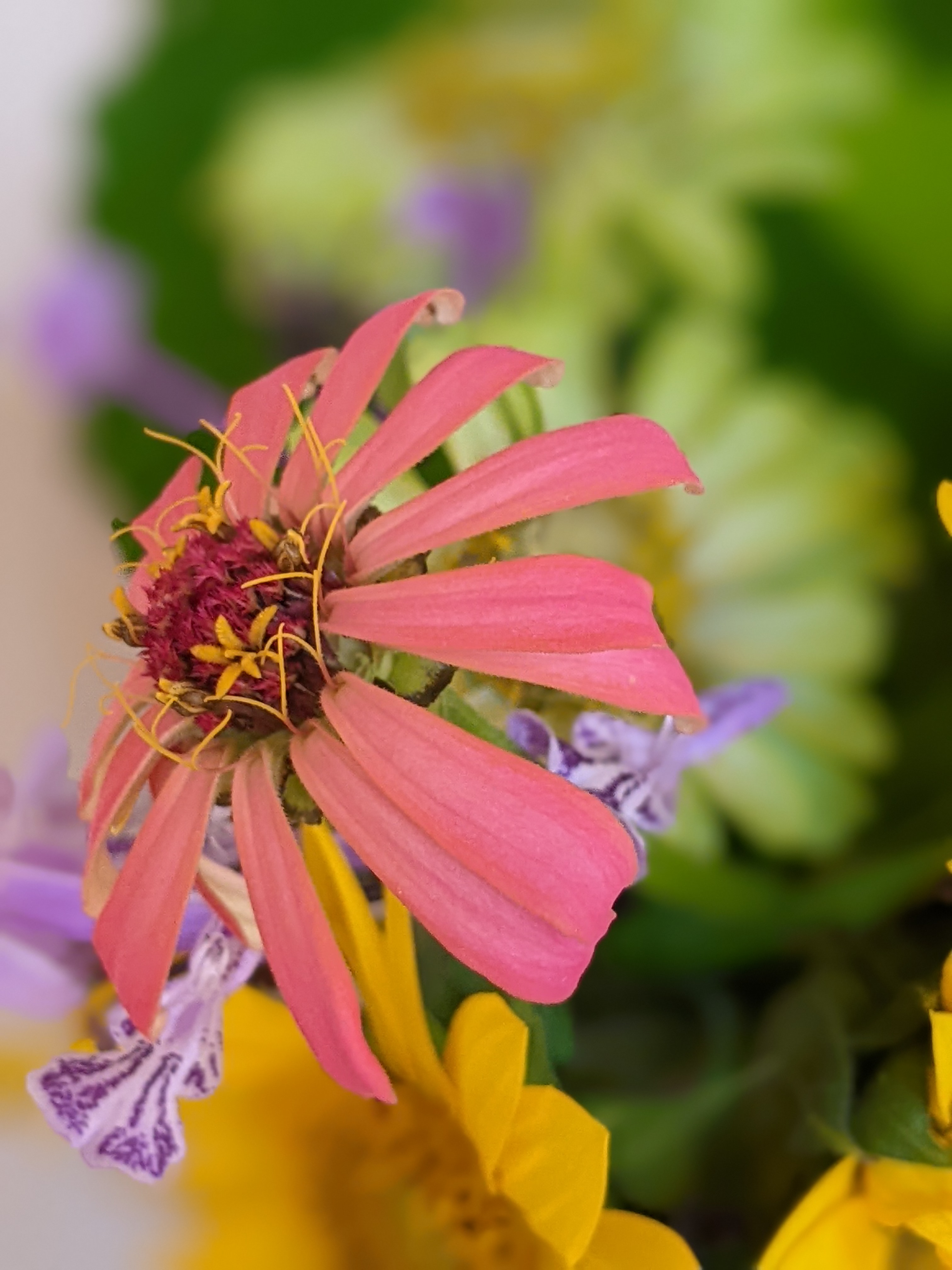
Yellow Sunflowers are ‘Dwarf Sunspot’. Green Zinnias are ‘Green Envy’; purple tubes are from Mona Lavendar Plectranthus. Pink Zinnia is from an Etsy purchase ‘Cactus Mix’. Here is a close up of the Zinnia, I love the stamens (I think?)
The other side:
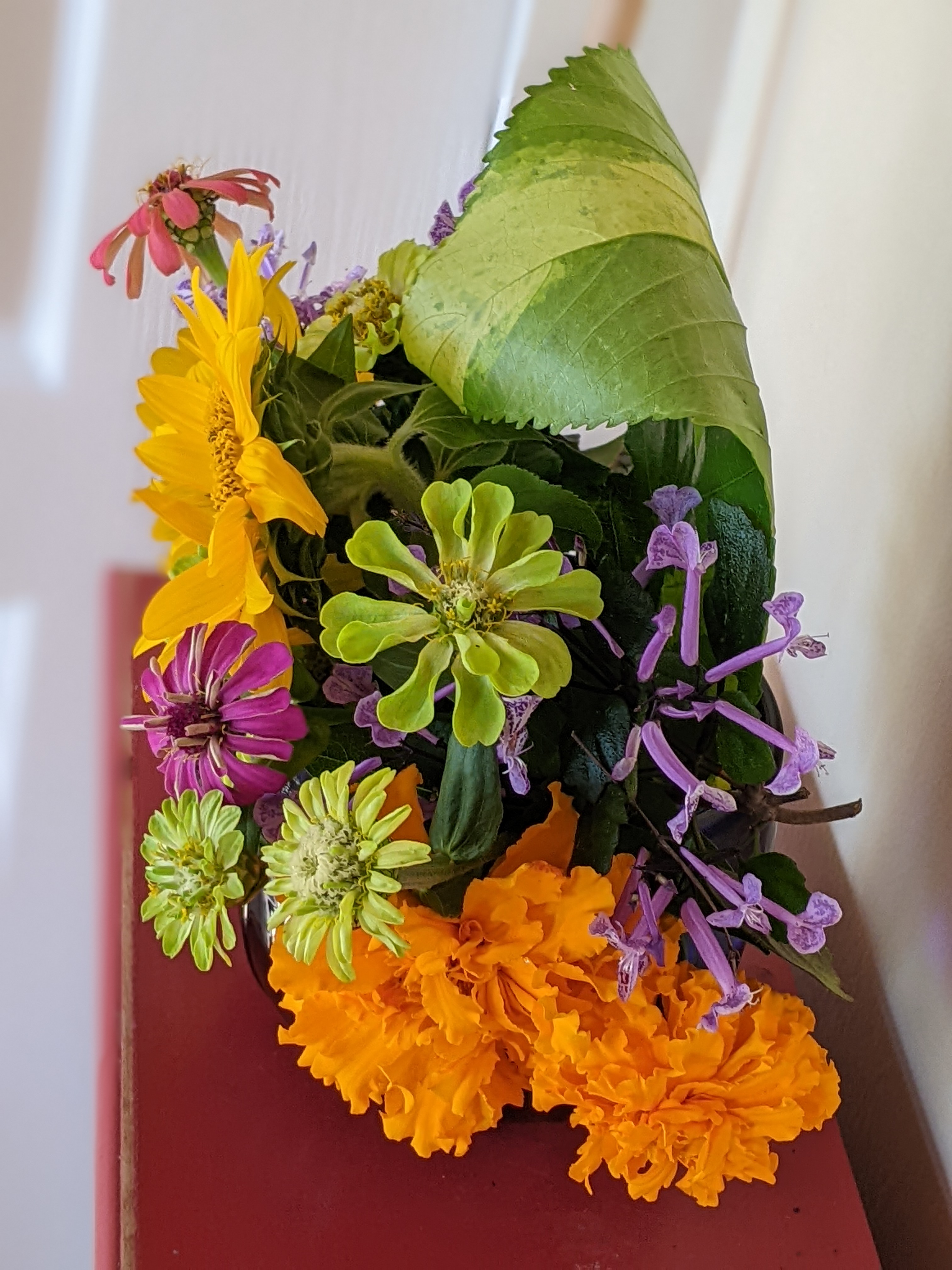
Pink Zinnia and the very different green one are from the ‘Cactus Mix’. The African Marigolds are from the cutting seed mix with the mystery seedling. The big leaf forming the wave hugging the flowers is a big ‘Java White’ Copperleaf (Acalphya wilkesiana). The leaf is 6 inches long and across. It rolled over naturally.
Summer began on Thursday here, complete with thunderstorms and wet blanket of humidity slapping me in the face when traveling from air conditioned space to the great, sweaty outdoors. Summer flowers are a consolation for the weather.
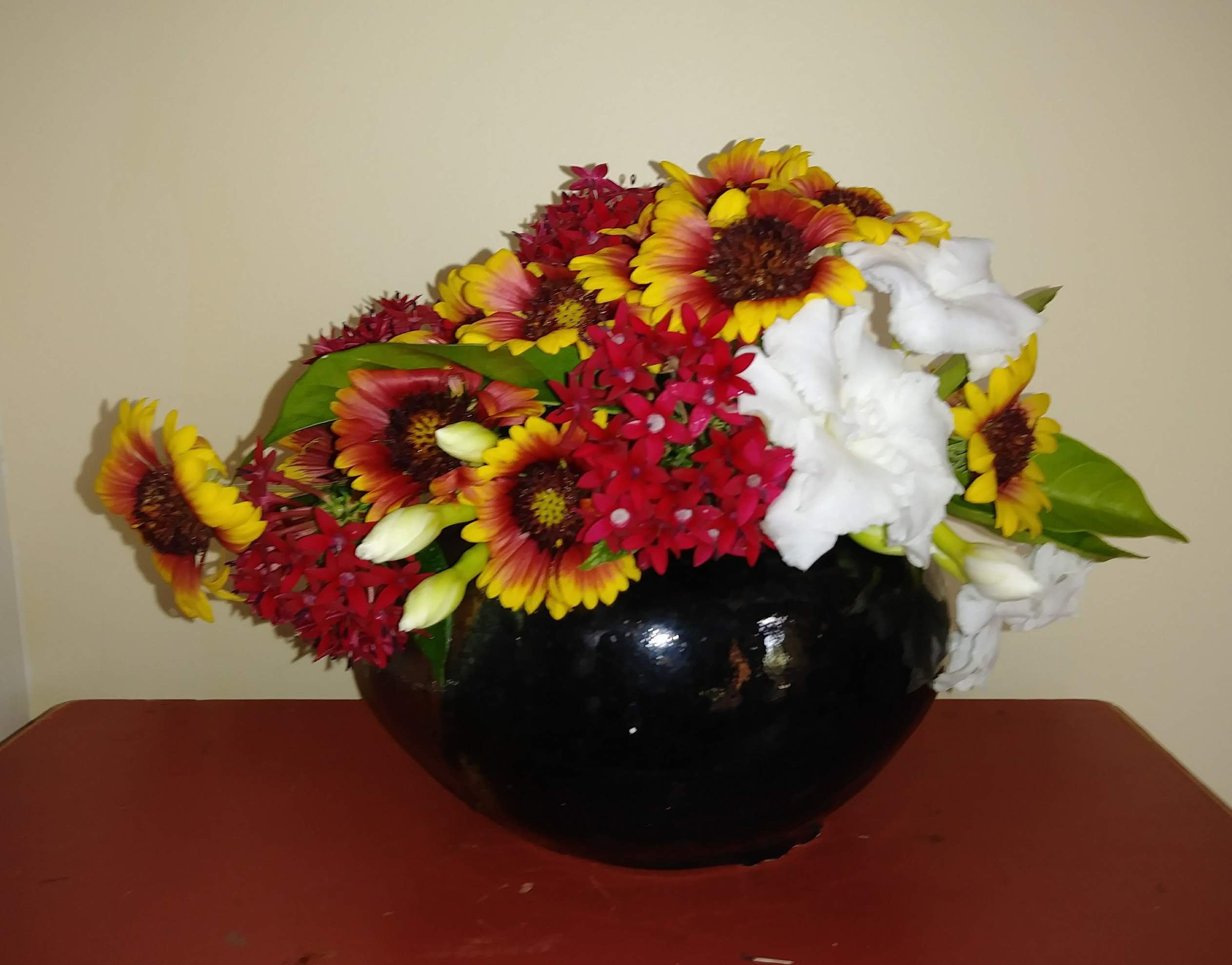
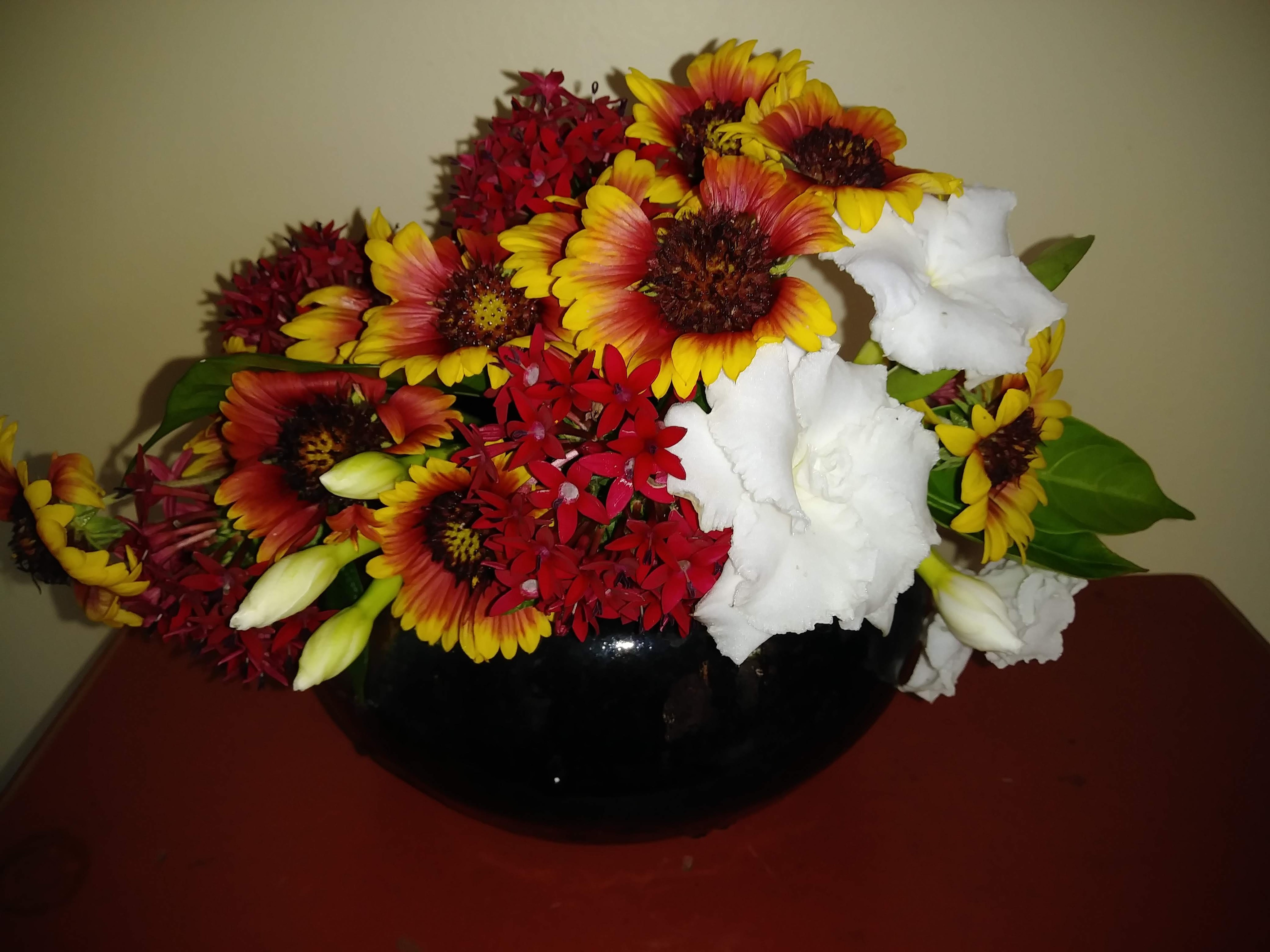
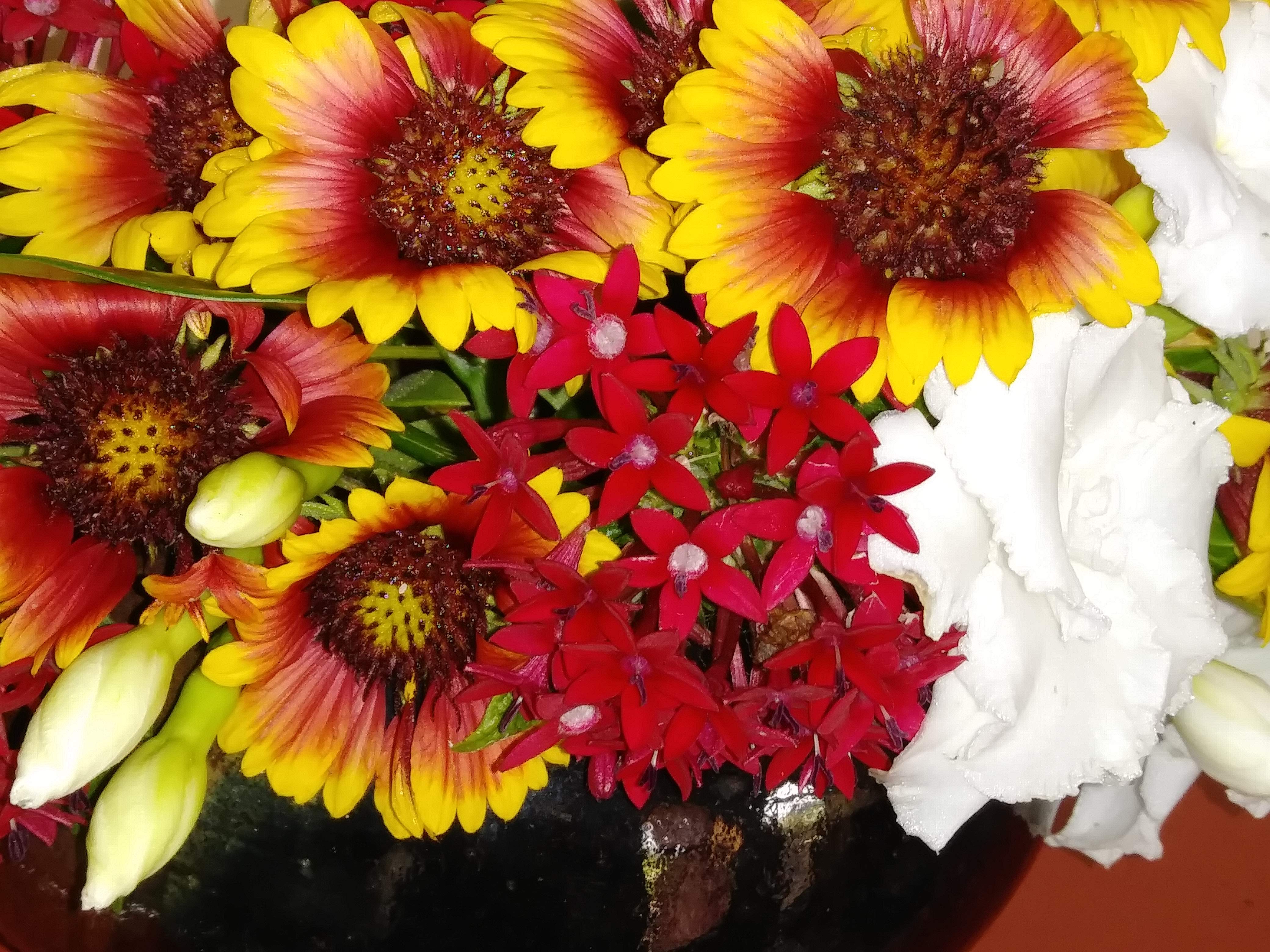
The G’s are Gardenias and Gallardias, the Tropical Gardenias are stalwarts in my garden. They thrive under dreadful conditions and supply flowers off and on all summer long. The plant is probably ten feet tall and I struggle to reach the flowers, having jettisoned more than one across the vegetable garden by letting go of a long branch too quickly. Oddly enough, the buds last a really long time in the vase, but the flowers don’t. I love the graceful lines of the buds, when hanging over (and around) the side of a contrasting vase, the summer garden is looking fine indoors.
The first G is Florida (or Tropical) Gardenias (Tabernaemontana divaricata), semi deciduous, in my experience and not particularly hardy to frost. The other G is Gallardia (Gallardia pulchella), a native wildflower I have been trying to establish in the Pollinator Garden. The third plant in the vase is a Penta lanceolata, a plant known to serve as a nectar plant for butterflies. I have noticed the butterflies sipping on the flowers, hoping for offspring.
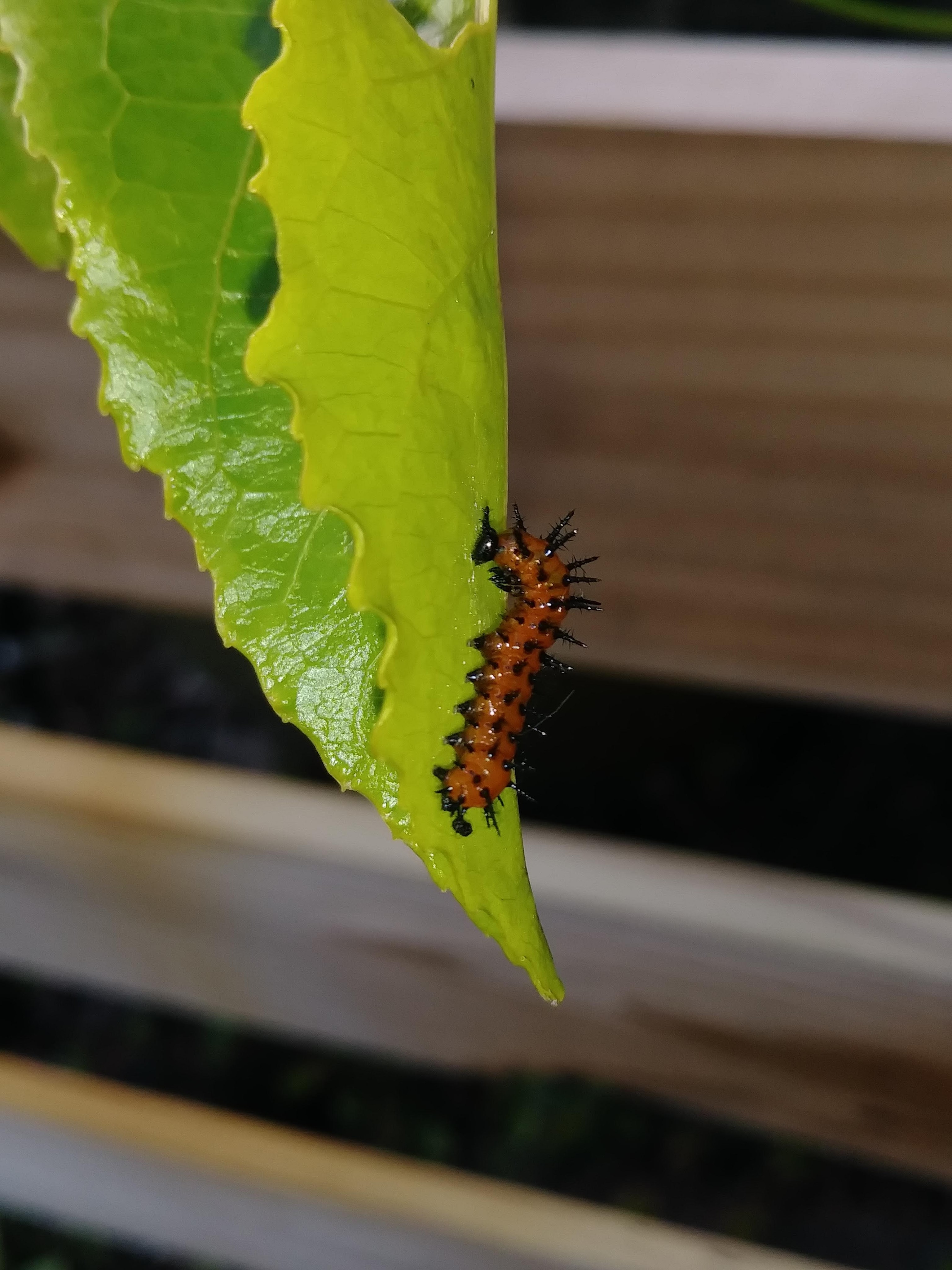
Speaking of pollinators, they are back for summer – these are caterpillars of Gulf fritillary butterflies chowing down on my ‘Lady Margaret’ Passionflower vine. Lady Margaret has been perverse in her unwillingness to flower in my garden, so I don’t mind if the Gulf fritallaries eat her up.
Here are the Gulf Frittilaries from last year. I hope to get better pictures this year,
I could be the Mulchmeister, given the love/ hate relationship with mulch that I have nurtured for years. I love the appearance mulch gives the garden – a soothing blanket of hopefully brownish material, tucking all the plants in for good growth, saving water and helping keep weeds at bay.
Unfortunately, I hate to mulch. Below is the usual result of me buying 5 bags of bark mulch. After 3, I can’t deal with schlepping the bags around anymore and it stays in the garden so long the plastic bags are rendered rust colored from the iron in the well water. And the weeds! Arggh. Florida Jurassic weeds. Oddly, the bark is still fresh as a daisy inside the bag – making me wonder what is on the stuff and in the vegetables I grow?
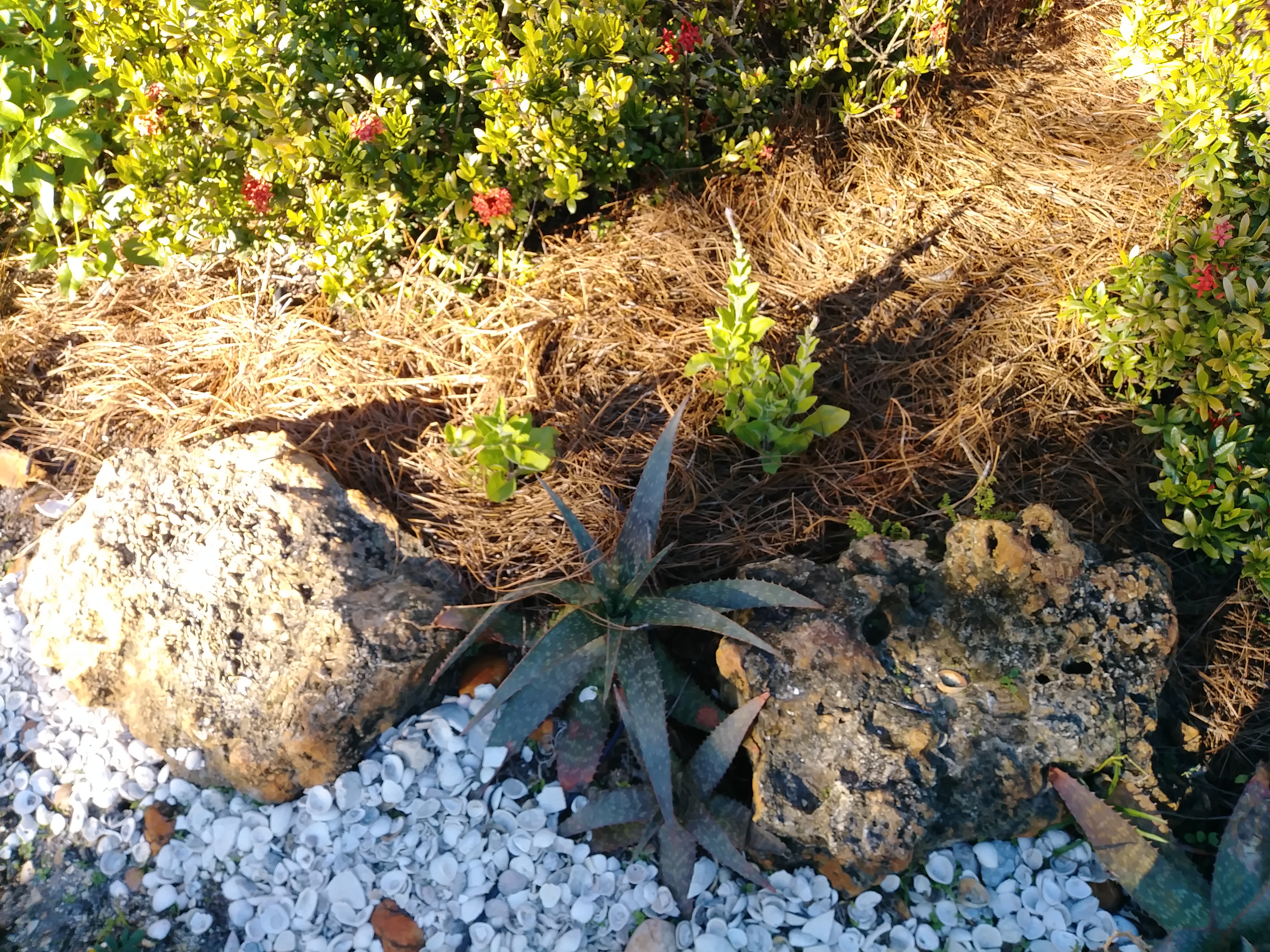
I am learning to love again with an old friend, pinestraw. Some call it pine needles, naturally shed by Pine trees! A good thing and more sustainable than chopping down and chopping up trees to use for mulch. It occurred to me to seek out pinestraw as I was working on a project in Atlanta, using pinestraw as mulch. For some reason, pinestraw is very uncommon in South Florida-even though it is harvested in North Florida.
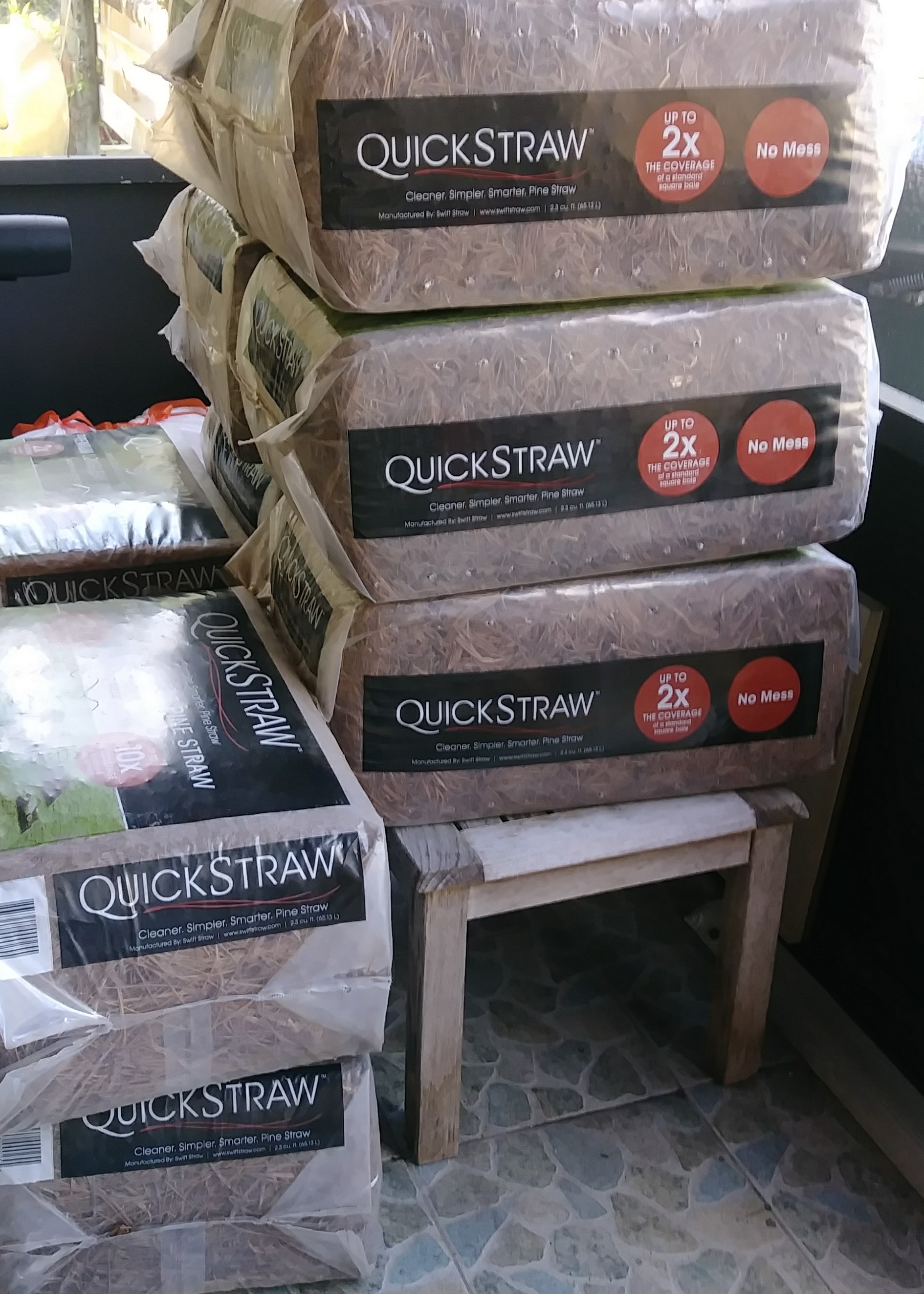
I began the search and after a bit of asking around was gifted with 10 bags of QuickStraw, just in time for Christmas. Compressed and bagged for storage, I can move these around easily and am not ending up covered in mulch.
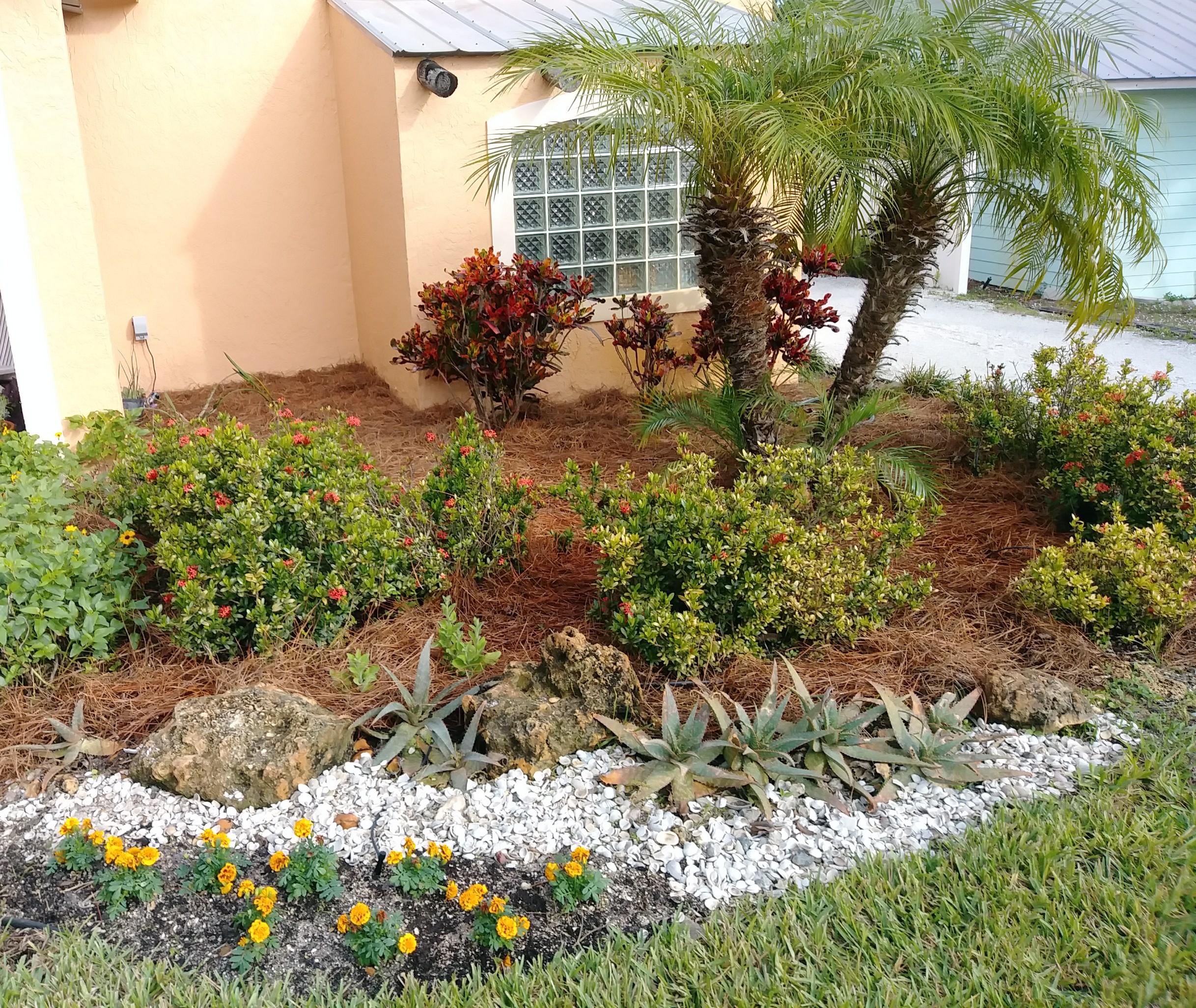
I scraped the Jurassic weeds off, put down some brown woven (the key to long lasting fabric) weed control fabric and mulched with the QuickStraw.
Ahhh, cozy plants, just waiting for everything to grow together.
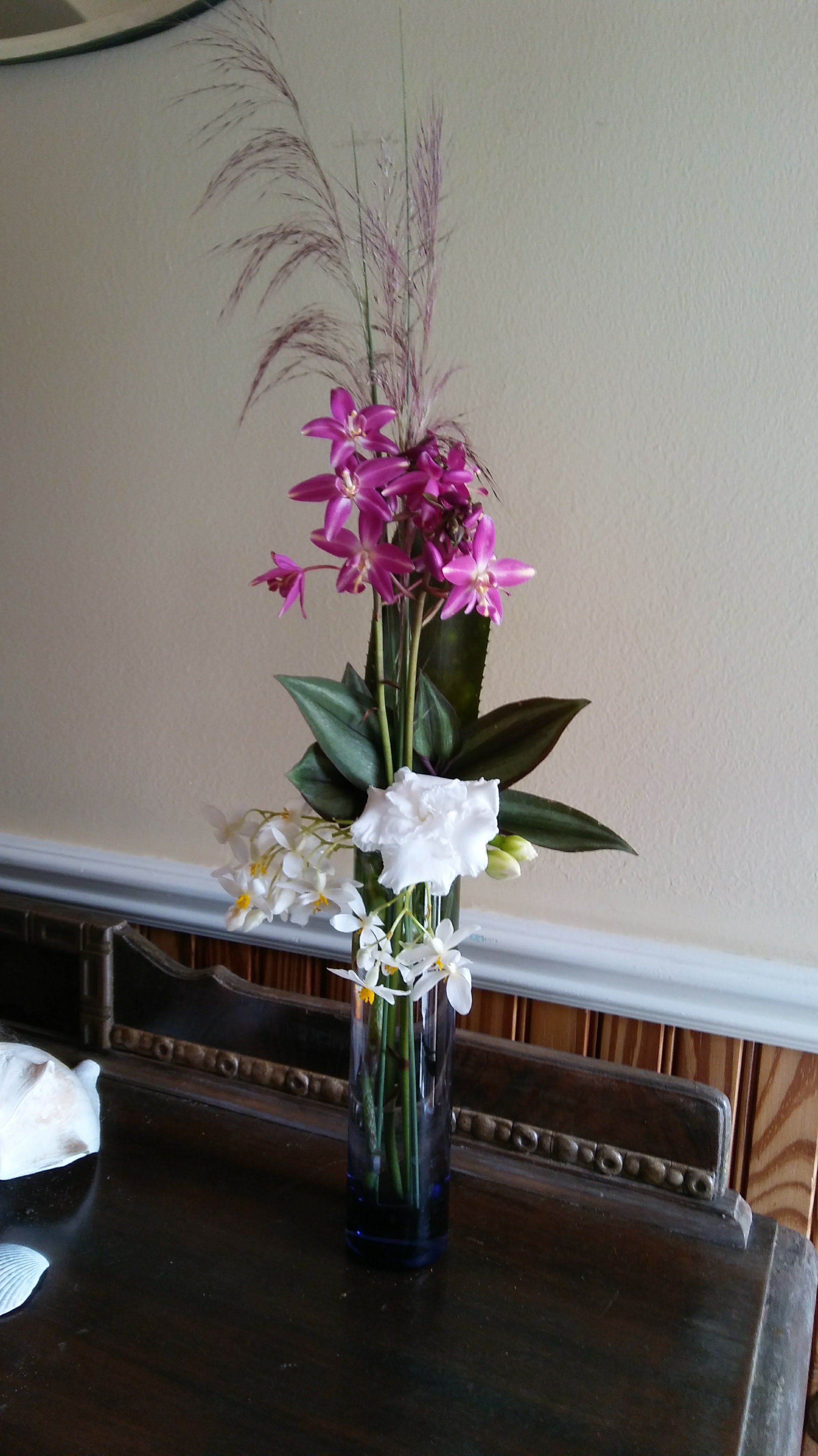
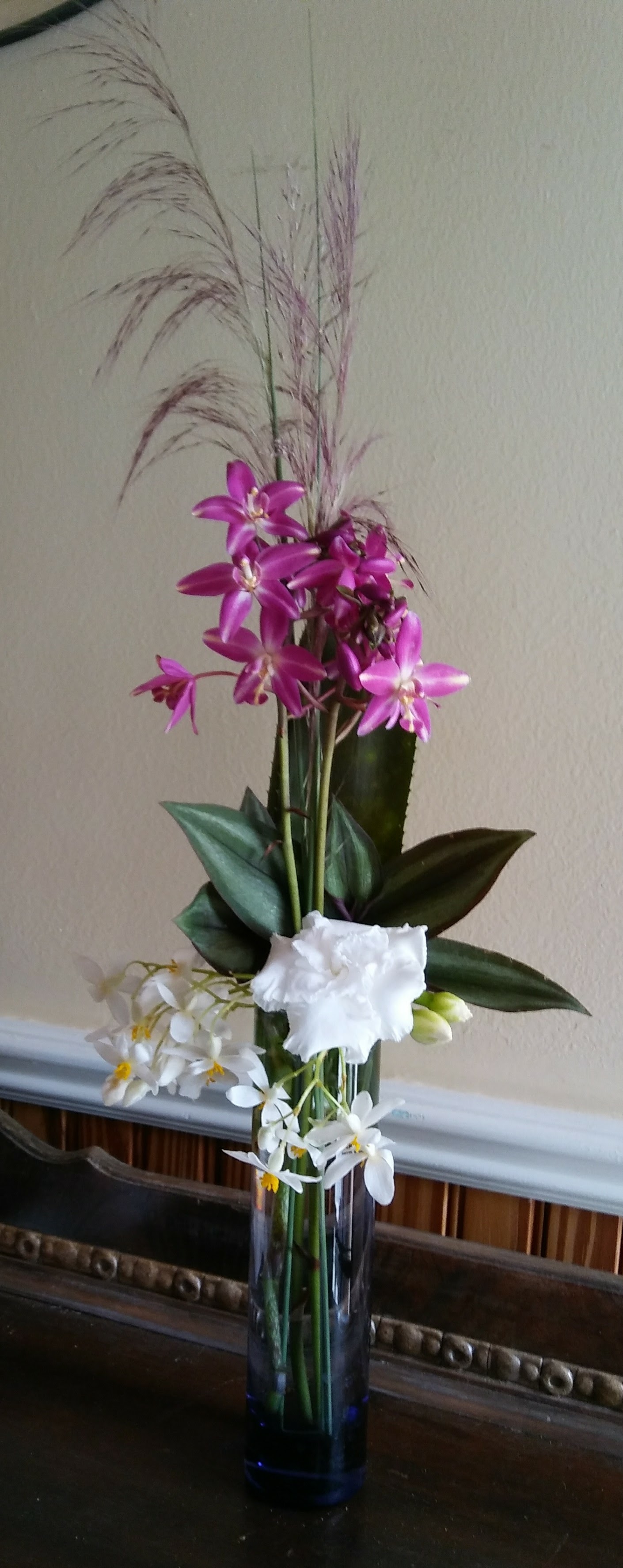
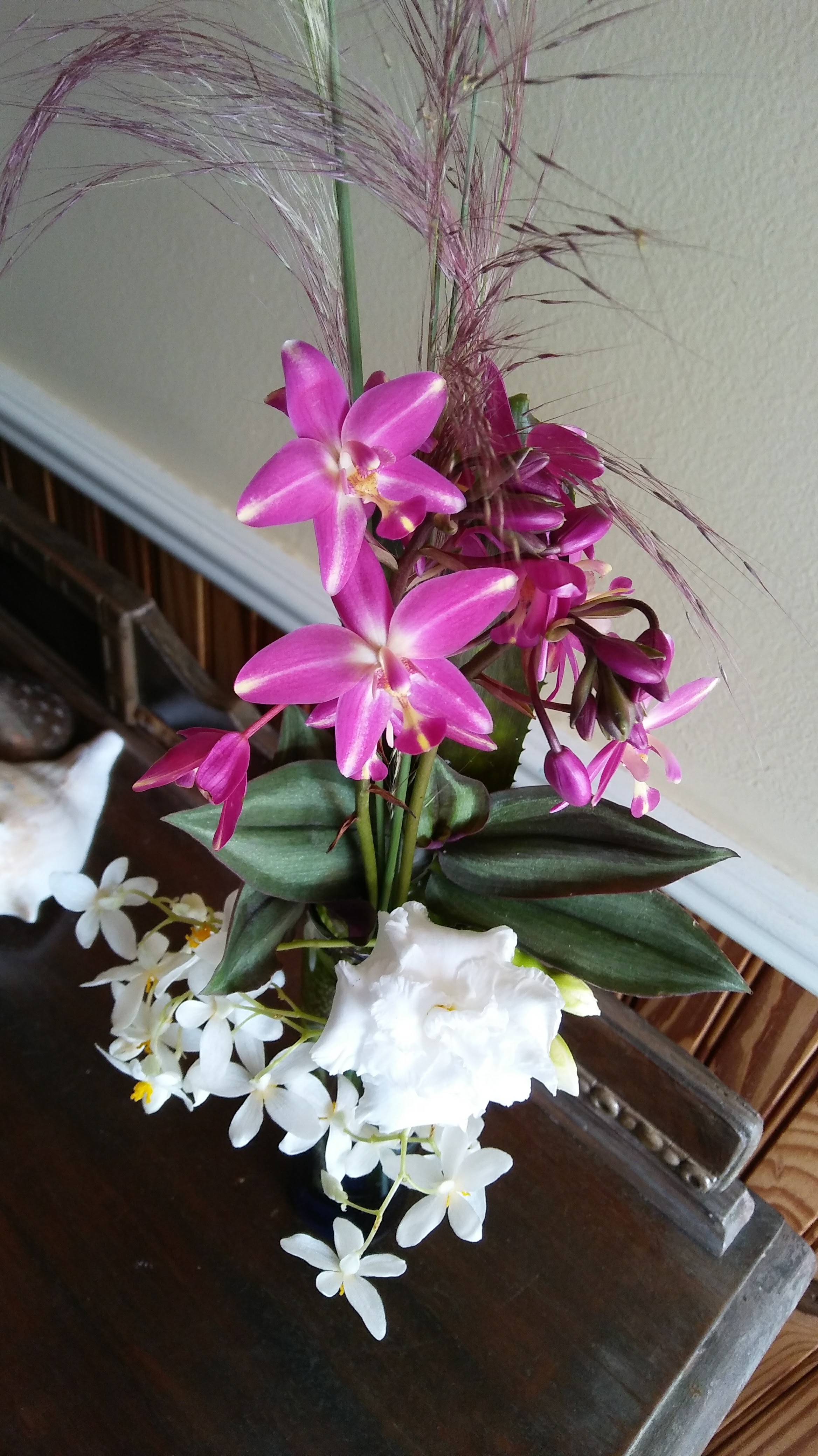
Maximum minimalism seems a contradiction in terms. I was planning to call this Deconstructed Corsage, due to the Gardenia and Orchids. Shortly before I started writing the post, my husband came in and said ‘minimalism’. I countered ‘”it can’t be, too many different things in the vase”. Upon further reflection, there is something minimal about this arrangement, despite the use of six different plants. I think it is the long lines of the vase and Muhly Grass blending all the elements making it appear to be one plant. One spectacularly unusual plant.
Fall has been slow to arrive here, there are some 50 degree low temperatures forecast this week. The temperature this afternoon was less than Autumnal, 86 degrees (feels like 95), 97% humidity. I will believe Fall is here when I see or feel it! The flowers on the Muhly Grass are a better indicator of the season than the weather.
Plants in the arrangement from the top, Muhly Grass (Muhlbergia capillaris), ‘Cabernet’ Spathoglottis Orchids, ‘Hallelujah’ Bromeliad foliage behind the orchid, striped purple leaves are from Transcandentia zebrina, white flowers are Tropical Gardenia (Tabernaemontana divericata) and Sweet Begonias (Begonia odorata). The vase is a thrift shop find.
I am not quick about getting the Christmas decorations up. Anyone who knows me is aware I detest fake, silk or faux plants. So, the wreath on my front door is always real and never hangs around very long. South Florida is not kind to cut foliage hanging outdoors in the sun. This particular wreath is hanging in sling with a bottle of water holding Saw Palmetto, dried Bromeliad flowers, Brazilian Pepperberries, Frazier Fir and a dried miniature Pineapple.
I try to remember to buy a Christmas tree on Monday as fresh trees are delivered on Monday and the least amount of time spent broiling in the sun on an asphalt parking lot the better. This year it slipped my mind and I managed to wait until the Monday before Christmas. Oops, no fresh trees and what was left over was well, less than optimum. I sorted through the Frazier Firs marveling that the needles were still bending and not brown at all. Then decided to see if anything else appealed to me to use as a tree. Podocarpus and Palms are just too far afield to use as a Christmas tree.
Back I went to the Frazier Firs, finding one in reasonably good shape and looking a bit forlorn I was checking for a price tag. Not one to be found. I went inside and asked the cashier who replied ‘they’re free, we are trying to get rid of them’
Minutes later I was dragging the tree through the parking lot and a lady stopped to help me. I told her about it and she was off to the Christmas tree tent. Hopefully all the trees found homes.
This year Christmas Eve and the first day of Hanukkah fall on December 24, the media have christened the date Chrismukkah, which I suppose sounds better than Hanukmas.
In honor of the season and Chrismukkah, I have done two arrangements, one in Christmas colors, red and green and another in traditional Hanukkah colors, blue, white and silver. Being perpetually and cursedly curious, I wondered about the origin of the color schemes.
According to Cambridge University the Christmas color scheme could go back to the Celts who used a red and green tree to mark boundaries. Here is the link, Who color coded Christmas. More research tells me the Hanukkah colors are based on the Israeli flag, why blue.
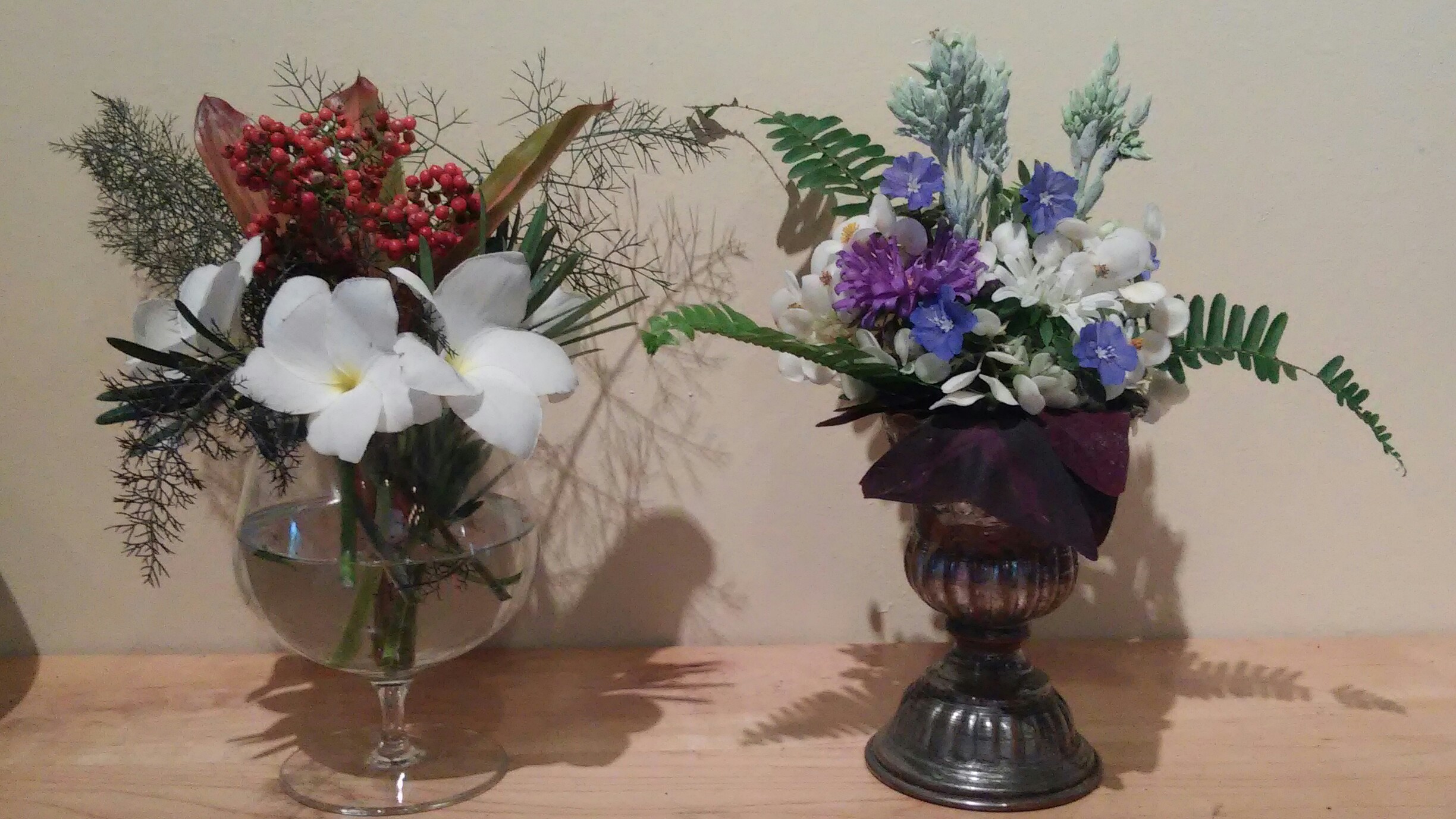
Now that we know the origins of the colors, here is the Hanukkah arrangement. The silver goblet is an heirloom from my mother’s collection and the flowers are in blue and white – Pom-Pom Asters (inspired by Cathy, our hostess) I started some seed in September and now have blue, white and perhaps pink Pom-Pom Asters, who knew they would grow in Florida in the winter.? The Asters are thriving, but alas, so far my other IOVOM flowers, the Cactus Zinnias are a disappointment. Another inspiration, White Italian Sunflowers are going, but they are showing signs of mildew, time will tell. The other blue members of this arrangement are Evolvulous, Blue Daze the annual peeking out here and there. The White Begonias are Sweet Begonias, a perennial here, the silver flowers are from Flapjack Kalanchoes. Deep plum foliage along the edges is from Purple Oxalis, from my neighbor. I think this plant may be the common thread between all of us. Asian Sword Ferns provide a bit of green.
Here is the Christmas arrangement, the original thought that it looked sort of non tropical. Then, the white Bridal Veil Plumeria is a bit difficult to explain. The dark green Yew is Japanese Yew, Podocarpus macrophyllus. Unabashedly tropical as are the red berries of the Brazilian Pepper, outlawed years ago as invasive, but determined to stay around, it is sold as Pink Peppercorn the world over and I have not eaten one of the berries near my house, but many birds have – and on the Brazilian Peppers go, The red striped foliage is from Martin Bromeliads and the ferny foliage is Copper Fennel. I think I have cut more of this than we have eaten, though it is tasty. The vase is an old Brandy snifter from my husbands ‘flaming things in a glass phase’. Go figure. Drinking flaming liquids is not my area of interest.










 I could be the Mulchmeister, given the love/ hate relationship with mulch that I have nurtured for years. I love the appearance mulch gives the garden – a soothing blanket of hopefully brownish material, tucking all the plants in for good growth, saving water and helping keep weeds at bay.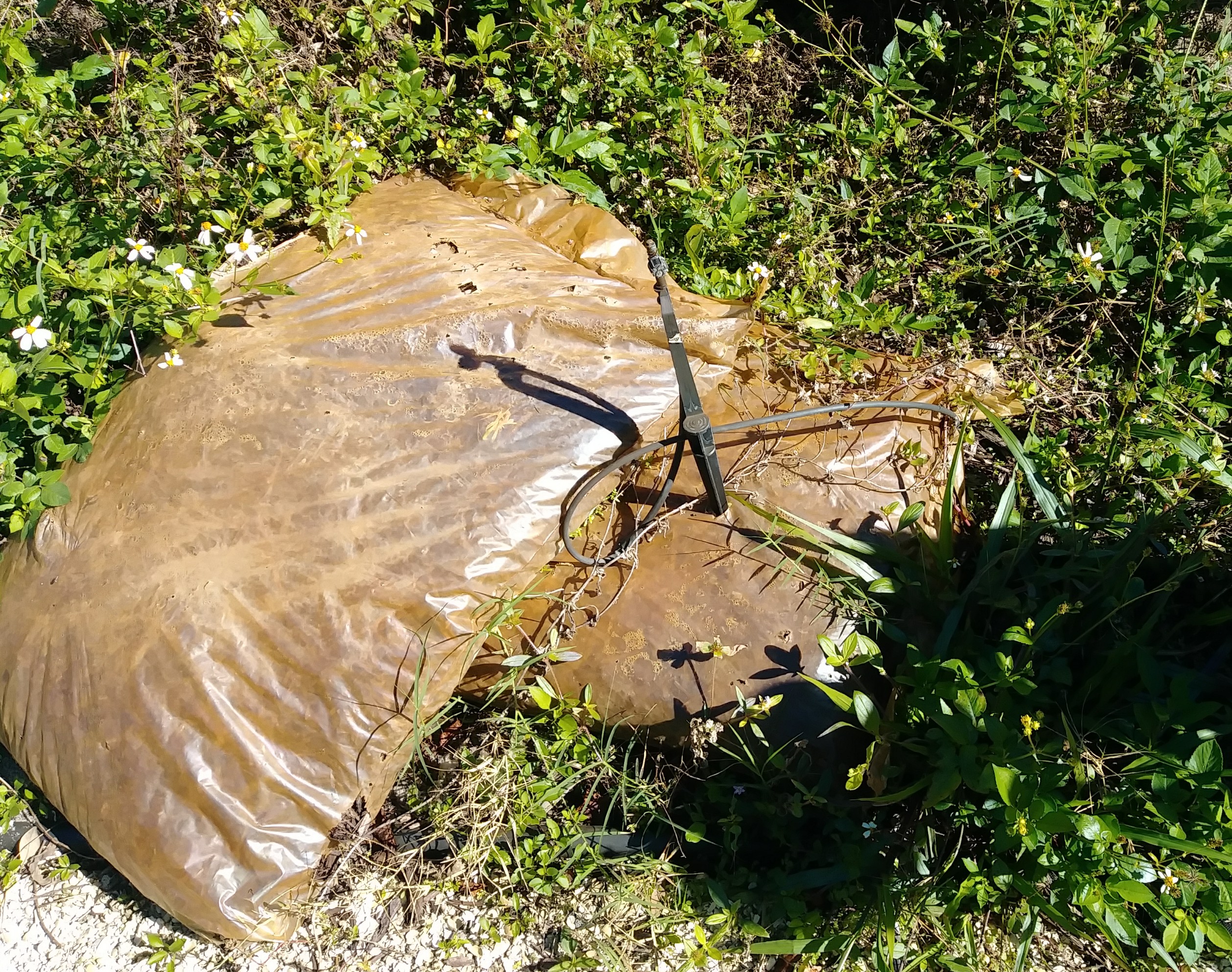





 The Shrub Queen