In a Vase on Monday – House Arrest

img_20200322_133419

I am feeling like I am under house arrest. This week I have been to the grocery store twice and to the vet for a rabies shot – the dog got the rabies shot. I might need one later. The garden has been my solace. I spent today finishing my pollinator and fruit border. My neighbor brought some Roselle plants (edible Hibiscus) and I replanted the Dragonfruit and am working on training it to the fence. As these things go, I discovered some terrifying large ants in the bark mulch followed by the realization I have to add irrigation if I want to actually eat a Roselle. I was cutting the Bidens (white daisies) off – they reseed to the point of never wanting to see another one of those damned things; then realized I should make a vase with them. Viola!

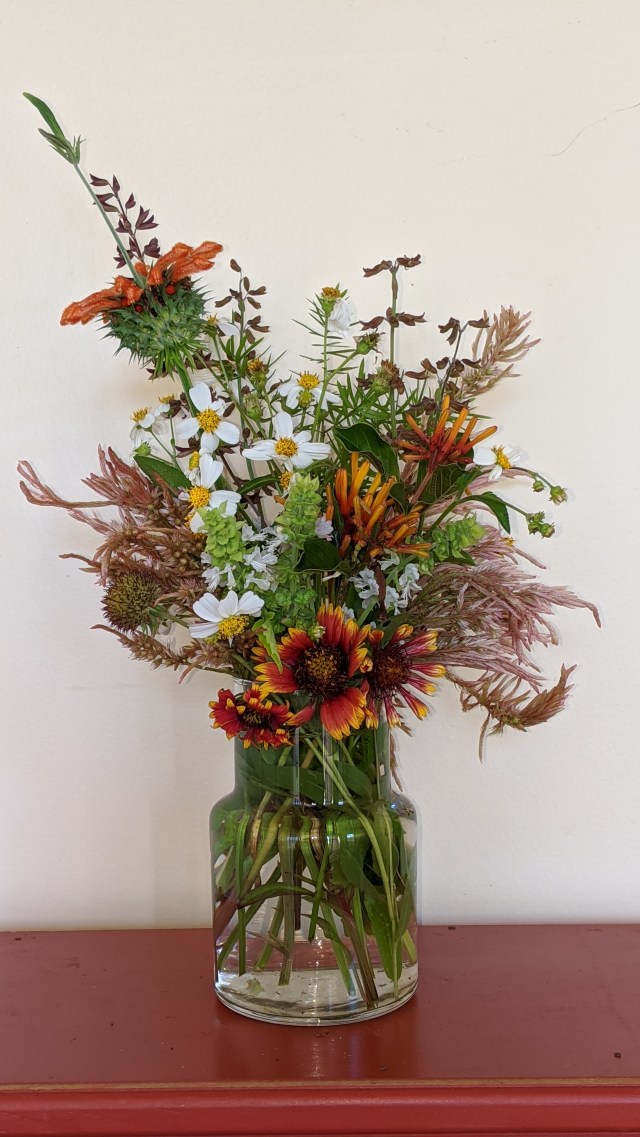
This vase looks a bit like Fall to me and in a way it is. The Basil, Gallardia, Celosia, Leonitis and Bidens are all producing seeds ahead of the rainy and hot weather. Here is a closer view:

img_20200322_133409

The bigger orange flower is Leonitis nepetifolia. Next year I will grow more of these – I have enjoyed them in the garden this year. The white daisies are the dreaded Bidens alba, a native wildflower and great for bees and butterflies. The pink flowers are Texas Vintage Rose Celosia; chartruese seedheads are Genovese Basil; red and yellow daisies and the round seedhead are from our native Gallardia (Gallardia pulchella); tubular orange flowers are Firebush (Hamelia patens). There is a bit of Asparagus Fern in the back and some Salvia coccinea seedheads.

I wish everyone a safe and pleasant respite in their gardens. Even the beaches are closed in Florida. A friend said this gets more surreal every day. I think she is right.

In a Vase on Monday – Charmin Genie

img_20200315_112223

I was, well, shocked to read about the worldwide run on toilet paper or rolls as it is called in the UK..thinking it was an American anomaly. Sunday morning found me searching for the forgotten roll in the guest bath to use as a vase. These are strange times.

My wish is for humanity to shut things down for a bit aand put this viral genie back in the bottle, hence the little purple bottle and the fan of the white stuff cramming the COVID back in. I think all the prescribed measures are working and we soon shall be confident in our stocks of toilet paper/rolls.

img_20200315_112721

View from above. The red glass magic carpet is a Christmas gift from a college friend not serving its real purpose, which is a receptacle for Foccacia, freshly ground Black Pepper and Olive Oil.

img_20200315_112453

The flowers were selected to go with the bottle and the red glass tray. To my knowledge, they are not medicinal. The pink star shaped flowers in front are Heirloom Pentas  (Penta lanceolata); white daisies are Spanish Needles  (Bidens alba) – a native  that is a weed if you ask me, no one does.There is some peachy Tropical Red Salvia (Salvia  coccinea); two colors of Texas Vintage Mix Celosia; the bigger pink fuzzy things are Dwarf Chenille Plant (Acalpyha pendula). There is a bit of Asparagus Fern in the background and a Dwarf Pineapple cutting.img_20200315_112457

The genie’s bottle has a few stems of Tassel Flower in them. They are similar to the Dandelion, imported and producing a flower that can be blown on for wishes. I usually pick these as I don’t wish for any more, but they are cute.

Happy Monday and stay safe in your garden. Continue reading

In a Vase on Monday – Vibrant Colors

img_20200308_145629

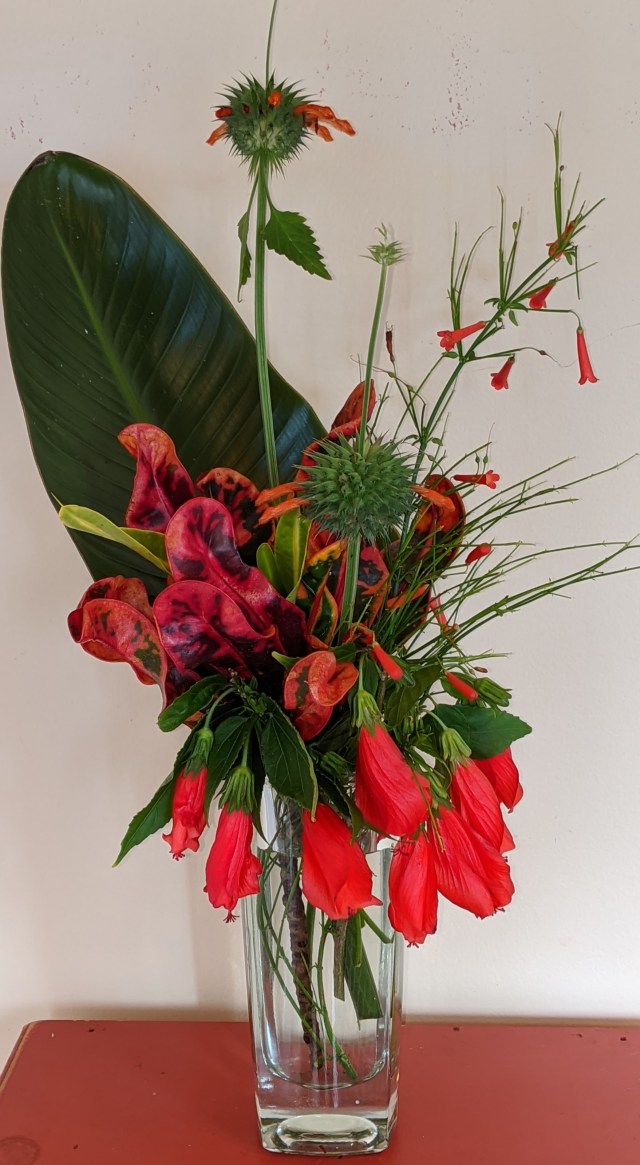
The flowers I started the arrangement with seemed especially vivid today. Maybe it’s the overcast skies or the first flowers of the season make them feel more vibrant; but the Nodding Hibiscus (at the bottom of the arrangement) looks really red (to me). I added the big green leaf (White Bird of Paradise) to calm things down; then realized it was getting a little Christmasssy – that is probably not a word.

Back to the garden, I love a little grey-green in anything and spotted spiky seedheads forming on the Leonitis. Cut the biggest ones and they are sharp like a pinecone. Red, green, yellow and black varigated foliage should be celebrated, so I added a cutting of Mammey Croton and for more red, a sprig of Firecracker Plant. Four plants produce a lot of punch in one little crystal vase.

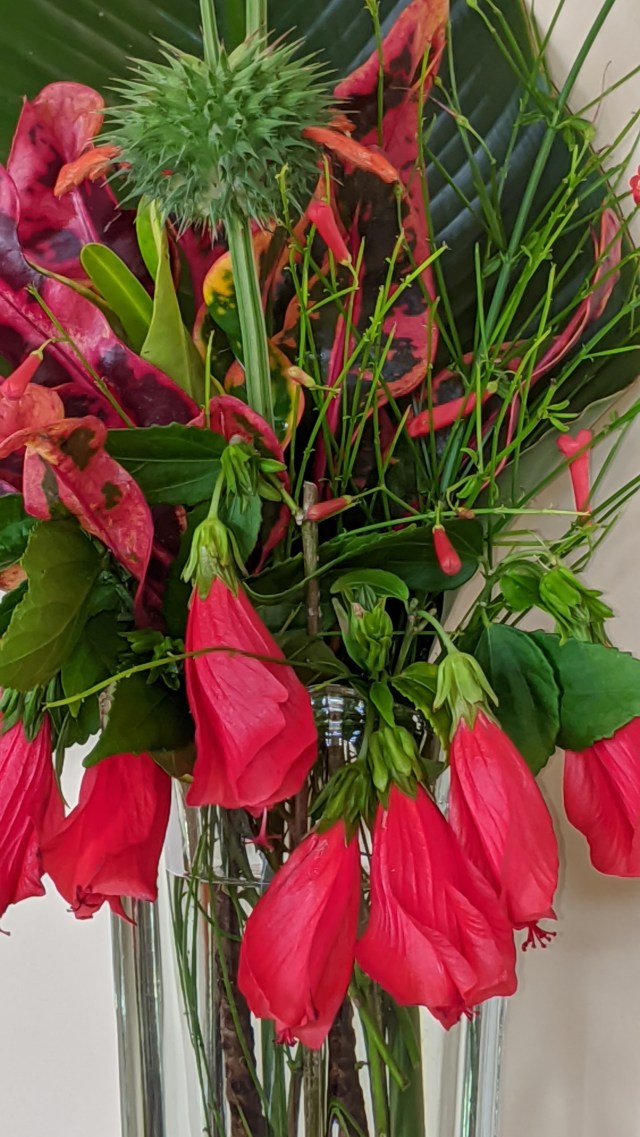
Closer views: My oldest  brother, who passed on several years ago, gave me the heavy crystal vase for Christmas. I have enjoyed it and think of him with each use.

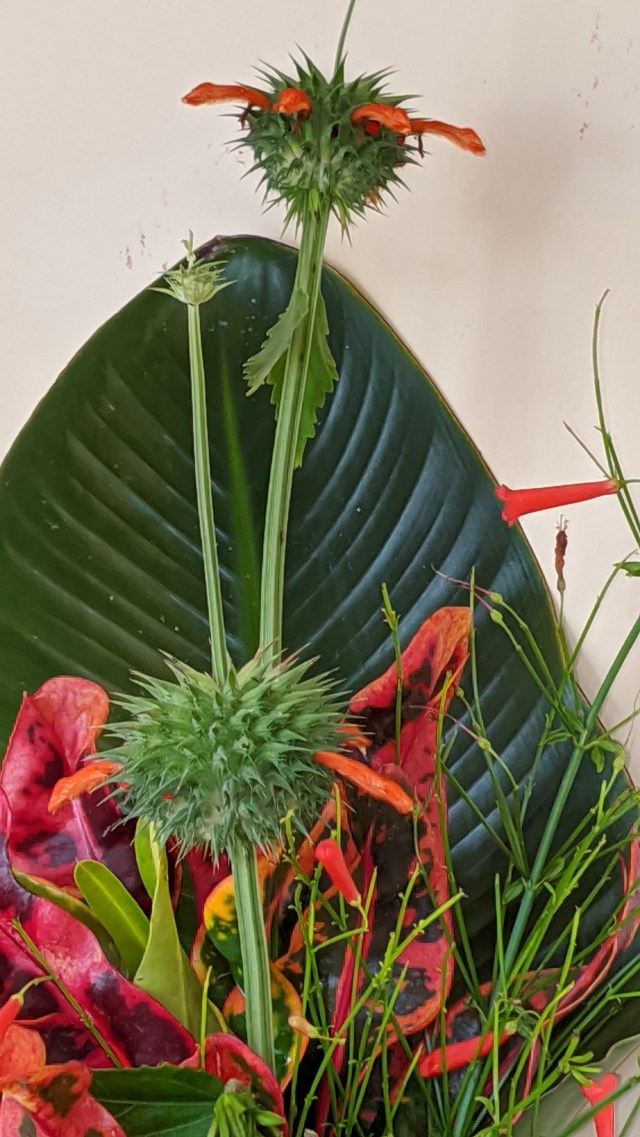
The spikey ball is the going to seed flower of the annual Leonitis (Leonitis nepetifolia). I am a bit confused about this plant. There is another one, considered perennial in Florida called Leonitis leonurus. One or the other or perhaps both seem to be smoked by people in Africa for fun. Something called Dagga. I am not smoking it, like Bill Clinton, I was not meant to inhale. (American joke, sorry – Bill swore he never inhaled Marijuana, despite admitting to smoking it)

The multicolored foliage is from Mammey Croton (Codiaeum varigateum ‘Mammey); fine textured grassy foliage with red bell shaped flowers is Firecracker Plant (Russelia equisetiformus); red flowers are Nodding Hibiscus (Malvaviscus penduliflorus) and the  big green leaf – White Bird of Paradise (Strelitzia nicolai).

img_20200308_145508


img_20200308_145447

Greens, reds, golds and textures in a vase on Monday. To see more vases visit Cathy at  MORE VASES

Happy Gardening.

In a Vase on Monday – March Madness

img_20200301_114301

First of all, this has nothing to do with American college basketball. March Madness is a college basketball tournament, I  would rather read about invasive weeds than watch basketball. College football is a different story. That I will watch.

South Florida seemingly lacks seasons. Spring is subtle, but here. Almost everything takes a few months off, not growing. Just resting for the inevitable plunge into March Madness. The Oak trees, grasses and obscure weeds no one ever heard of are flowering and the pollen is dreadful – the native butterflies and insects are enjoying all of  this and literally making hay while the sun is shining. I am seeing butterflies and insects I have  never seen  before. My bush and pole bean leaves have been folded by butterflies to create chrysalis and while I still have beans, the butterflies emerging are just starting to  amaze me.

img_20200206_133605 This is a Longtail Skipper larvae from a couple of weeks ago, I saw the first butterfly today (it got away from me). I will  post a picture another day if I catch one.

Back to the vase. The actual vase is a old florist vase from the 80s I found by the side of the road. It holds up some heavy cut flowers. Heavy is what I have.

img_20200301_114126

The pink flowers are Shell Ginger (Alpinia zerumbet). They flower off and on year round; not reliably but at some point there they are. And  too pretty to ignore, like some teenage  girls from high school. The ferns are my old stand by, Boston Fern (Nephrolepis exaltata) and the white flowers, Dracaena reflexa. Yes, it grows in my garden and the flowers  have a wonderful scent. Close ups of the flowers:

Happy Spring!!

For more vases follow the link and visit our hostess, Cathy at MORE VASES

In a Vase on Monday – Jurassic Parts

img_20200223_123111

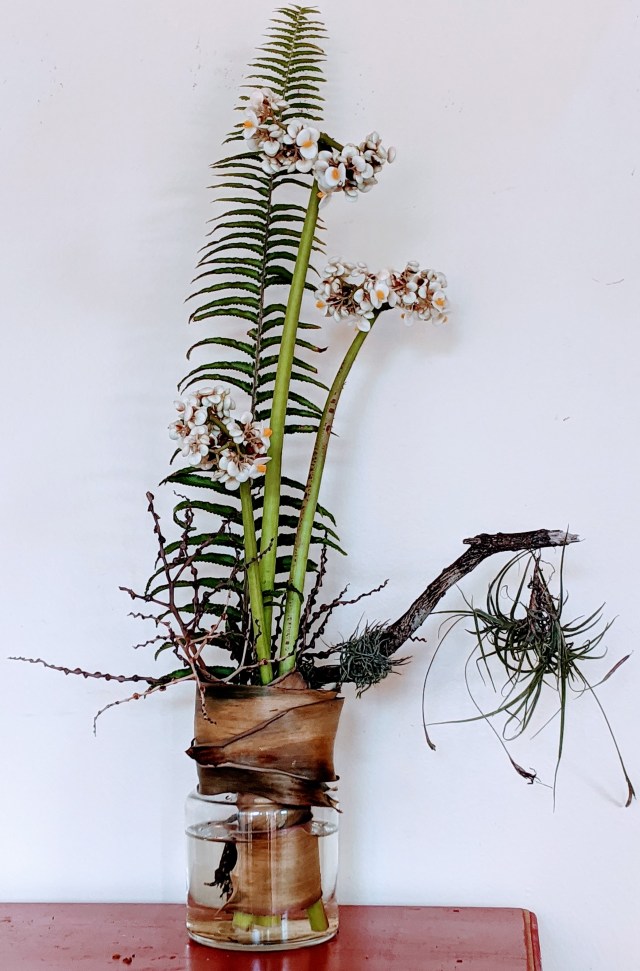
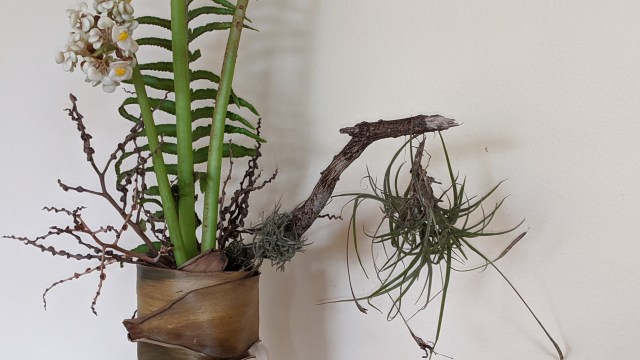
While perusing my garden for vase materials this morning I was seeing a lot of the same old thing and decided I needed to do something different. I wanted to use the dried Bromeliad leaves one more time and the Tillandsia covered branch seemed to go with the idea. The result seems a bit prehistoric to me and in some ways it is containing ferns, palms and bromeliads, all monocots and found in fossils. Here is a closer view:

00000img_00000_burst20200223123209631_cover

The dried brown stems are from the seedhead of an Adonidia Palm (Adonidia merrillii); the white flowers are from Lotusleaf Begonia (Begonia nelumbifolia); fern is a Boston Fern (Nephrolepis exaltata); the dried Bromeliad (Aechmea blanchitiana) leaves wrapped around the vase and holding the Begonia stems together were originally on my Christmas wreath, reused a couple of weeks ago  to wrap a whole vase and this is the final appearance. The hanging Bromeliad and branch were found while walking my dogs a couple of weeks ago, these are Tillandsia recurvata, Ball Moss.

The vase is a pasta container I use as a vase since the top was lost some years ago. My husband refers to the gardeners inevitable stockpile of unplanted pots of plants as my ‘Spare Parts’. I am rarely without spare parts, currently holding at six ‘Java White’ Copperleaf.

If only I had a tiny dinosaur to go with this one.

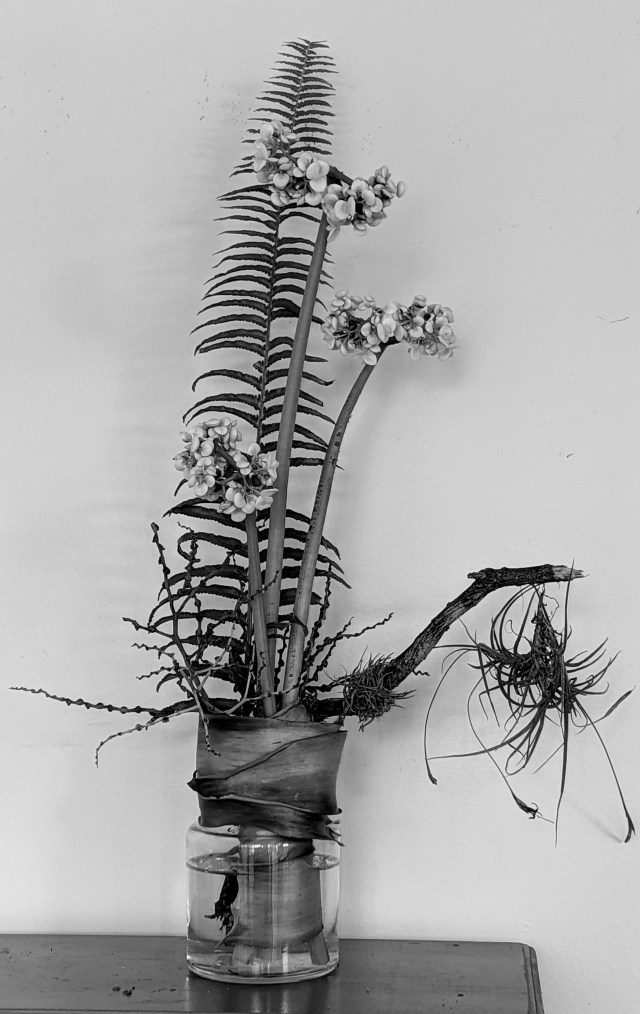
Here it is in black and white, maybe even a bit more Jurassic.

img_20200223_122904

For more vases from around the world follow this link to Cathy’s blog MORE VASES


In a Vase on Monday – Winter Cheer

img_20200216_112153

Our air conditioner has been running today, this always seems odd to me given the month is February. This explains why I have Summer flowers to provide Winter cheer. It’s warm in South Florida!

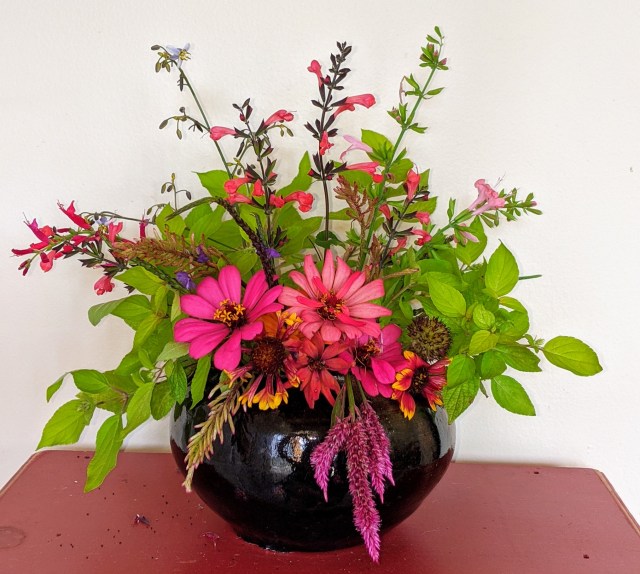
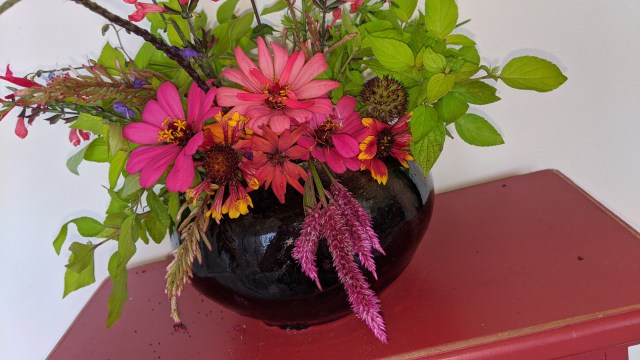
Despite the black vase, the colors of the flowers are so bright and happy and the foliage is Pineapple Sage – It’s like a bowl of summer radiating an herbal fruity scent of the tropics in my foyer. During the completion of the arrangement I had to relocate two whitish green garden spiders  (with the long front legs) outside and suffer a proper foliage selection dither (chartreuse or deep green?) Pineapple Sage won based on color and scent.  I was cheered by this vase once I finished it.

img_20200216_112346

The vase is a thrift store find I have enjoyed tremendously, I hope whoever made it feels the happiness it generates for me. I placed a glass flower frog inside the vase to support my Zinnias; they are oddly short stemmed (day length not long enough?) A majority of the flowers were grown from seed by me. This is a first for me as I usually buy plants and not seeds. The seeds were a bit of work – the results have been fun to witness.

img_20200216_112201

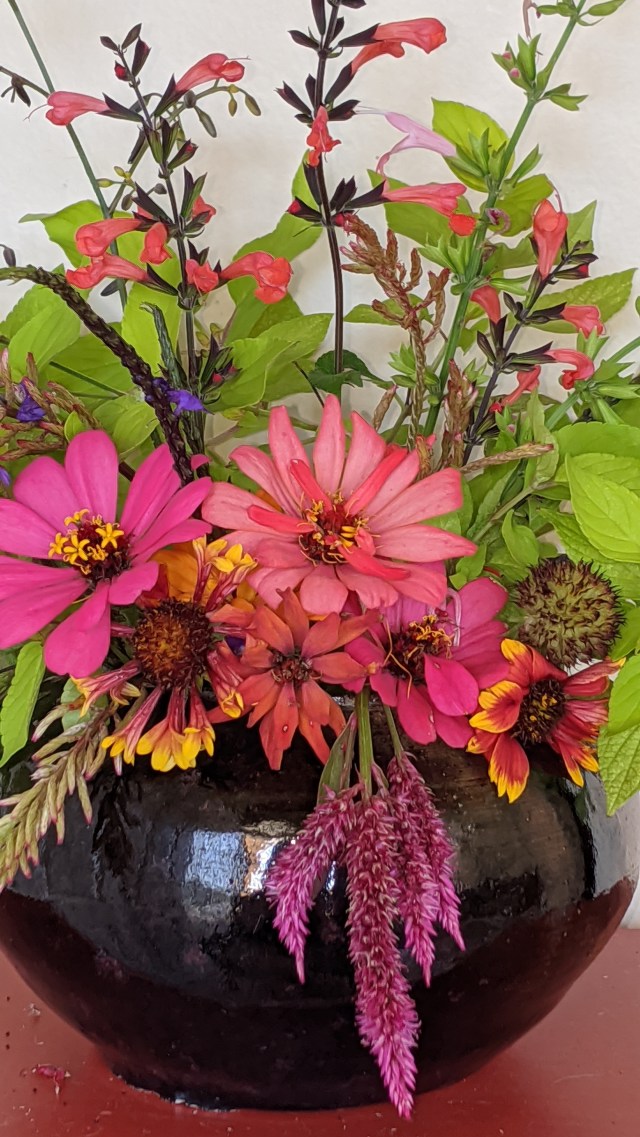
There are two colors from the Texas Vintage Rose Celosia mix hanging over the edge, the  jury is still out on this series of seed. The plants are just not that attractive, and in my heart, I think Celosia is weird. Trying to keep an open mind as is does thrive in my sugar sand. So far, anyway, I will be interested to see what summer brings.

The Zinnias are a mystery – I  planted several kinds of seeds and these don’t really look like any of the pictures on the seed packets. Yellow and red Gallardia (Gallardia pulchella) and a seedhead are stalwarts in my garden and provide nectar  for many butterflies – the Tropical Red Salvia  (Salvia coccinea) in the background (in peachy mode) does as well. The thick stems with blue flowers are Blue Porterweed (Stachytarpheta jamaicaensis) another amazing nectar plant for butterflies. The backdrop of fragrant chartreuse foliage is from Pineapple Sage (Salvia elegans) there is a red Pineapple Sage flower in there as well.

I have been having trouble commenting on blogspot blogs  – if anyone knows how to fix this please let me know! Thanks.

Happy Gardening!

In a Vase on Monday – More Love

img_20200209_144047

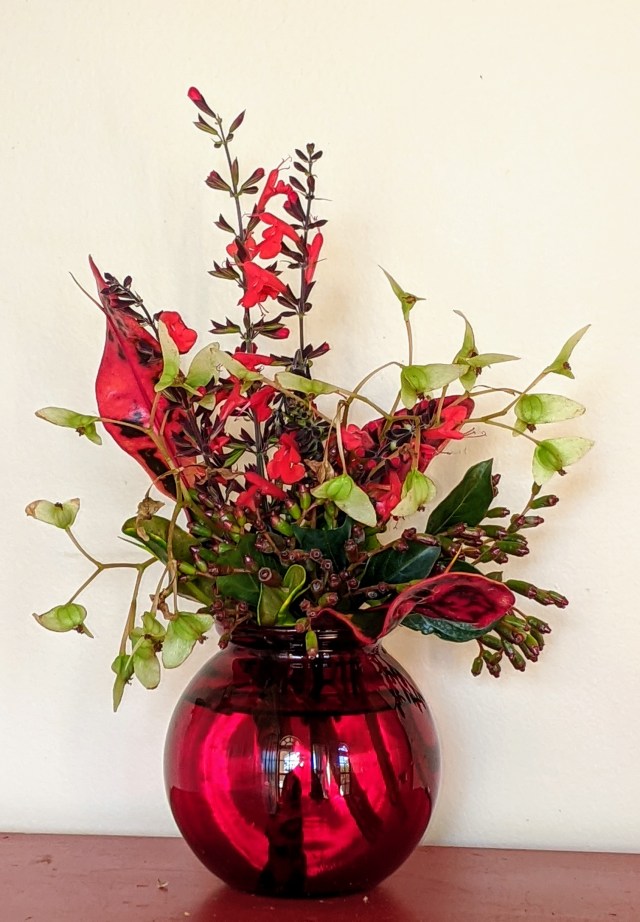
It’s Valentine’s week so…another red vase for the month of love. I  am realizing another oddity of tropical gardening. It is February and I have several types of red foliage to choose from for this vase. Croton foliage is in the vase, but I have several red Bromeliads and Copperleaf foliage as well. Color rules the tropics.

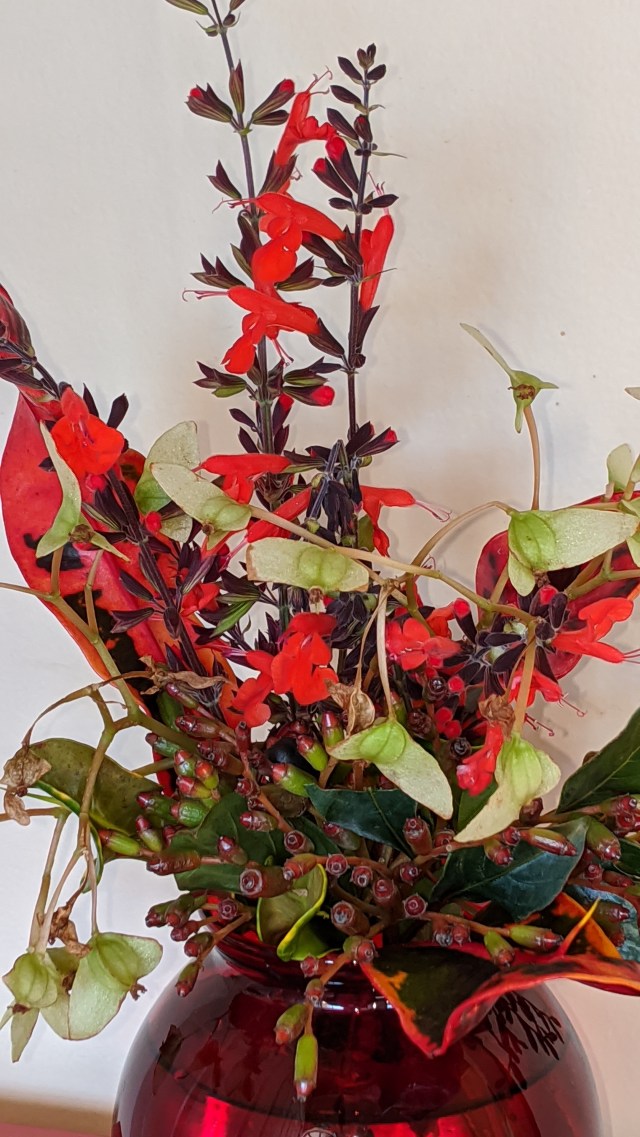
There is also fruit in this vase, it is winter and the fruit has been forming since fall. Which is kind of normal? Or should I say typical? Here is a close up:

img_20200209_144118

The red vase is a thrift store find. The red flowers are from Tropical Red Salvia (Salvia coccinea); red foliage is from Mammey Croton (Codieum variegatum); chartreuse winged fruit is from Sweet Begonia (Begonia odorata ‘Alba’)  and the berries are from Firebush (Hamelia patens)

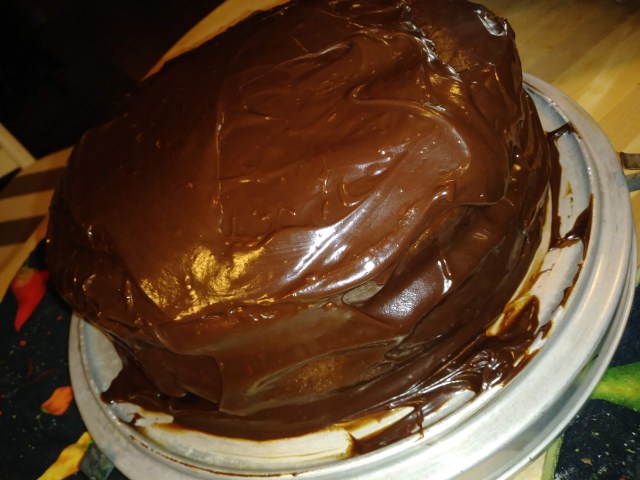
I have been collecting ingredients for a different Valentine’s treat, a tradition in our house.

20190214_183314

The recipe is called ‘A Very Good Chocolate Cake’ by Edna Lewis, my favorite Southern cookbook author. I have tweaked it a bit over the years, but usually make for my husband’s birthday and  Valentine’s Day. Suffice it to say I will get my cholesterol  bloodwork done before February 14th!

Happy Valentine’s Week!

For more vases on Monday – follow link to Cathy’s blog VASES

In a Vase on Monday – February Love

img_20200202_153009

This vase marks the first for February, the month of love. I challenged myself to create a  shades of red vase in honor of February.

The combination of plant material is unusual, to say the least, ordinarily (not sure why) I don’t like to combine tropical plants with non tropicals, but this is meant to be love struck pinks.

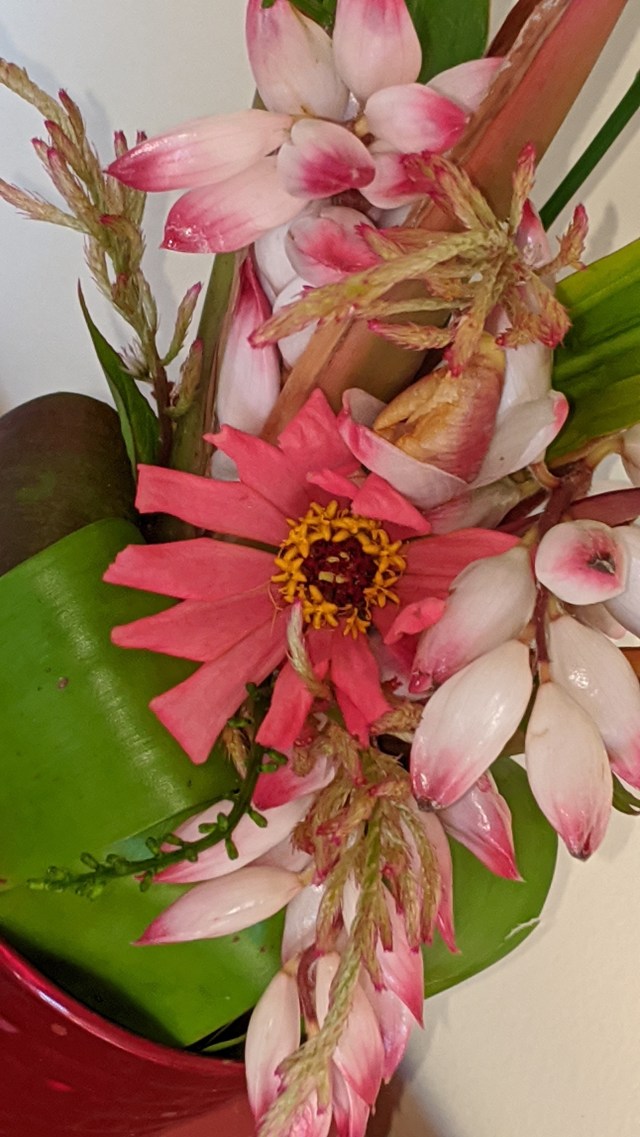
The construction of the vase is a bit unusual as well, the red container is from Christmas, too lightweight for the thick stemmed Shell Ginger. To conquer this issue, I placed a glass pickle jar inside the red container – it was too tall and I covered the jar with Bromeliad foliage. Here is a closer view:

00100lrportrait_00100_burst20200202152805395_cover

The  pink and white flowers are Shell Ginger (Alpinia zerumbet); these are just about to burst into full bloom, really buds. The center plant is a Zinnia of unknown heritage that looks a lot more pink in the garden. The beige and pink flowers are Texas Vintage Rose Mix Celosia grown from seed supplied by Floret. The green tracery in the background is the flower of Dracaena reflexa. The foliage around the base is from a Blushing Bromeliad (Neoregelia carolinae).

Another close up:

00000img_00000_burst20200202153105068_cover

Happy Month of  Love!

For more Vases on Monday filled with flowers from all over the world follow this link to Cathy’s blog In A Vase on Monday

In a Vase on Monday – Bromeliad Cachepot

img_20200126_113117

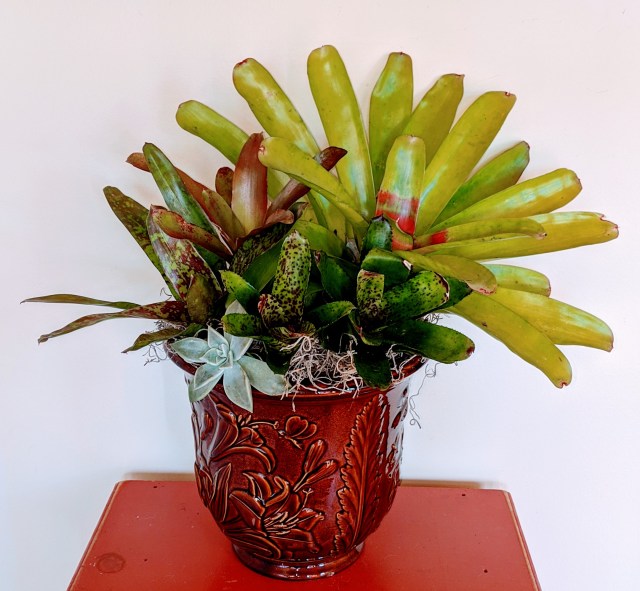
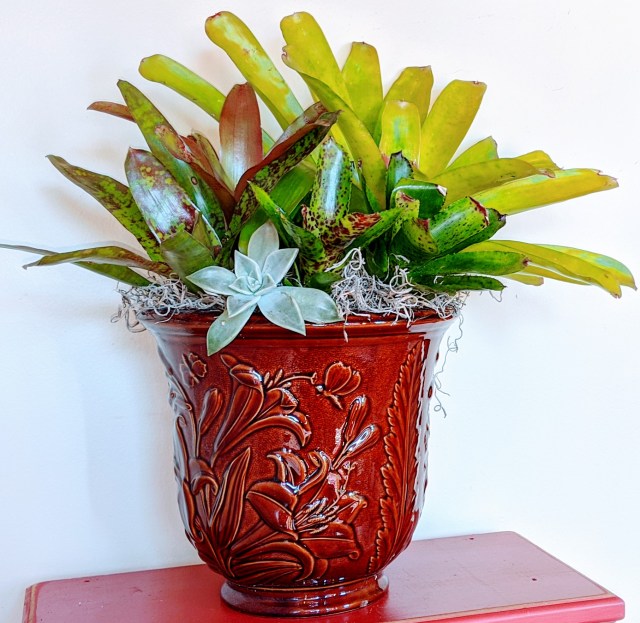
I decided to do something different this week. This is a pot of Bromeliad cuttings from my garden. The cuttings are in a 1 gallon nursery container double potted inside the cachepot. These Bromeliads are so bulletproof they are planted in old dried out potting soil and sand, a very well drained mix that will serve them well for months to come.

img_20200126_111010

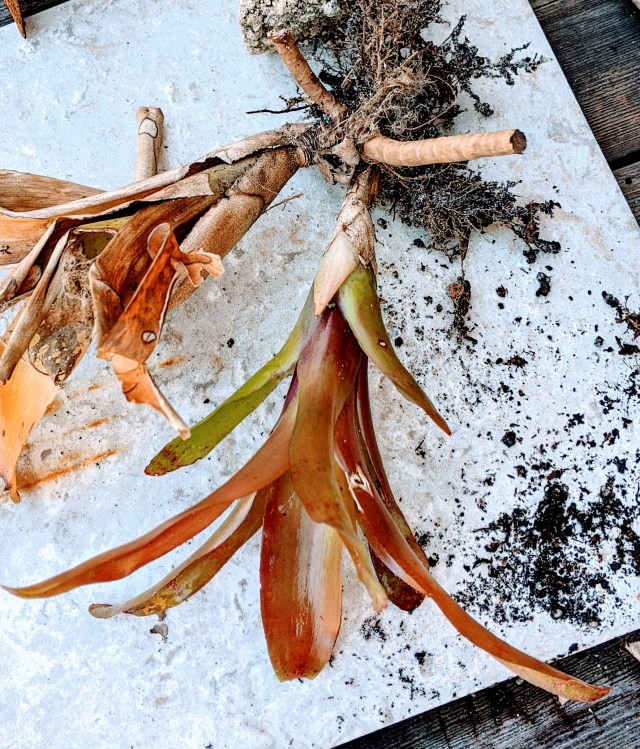
Here is one of the cuttings, a Super Fireball Neoreglia, wonderful groundcover and hard to kill. One of my favorites. It grows almost on a runner (actually a stolon), the mother plant (on the left) dies and generally makes two or three pups like this one. The mother plant is cut off and  thrown away, I always feel bad about this. The roots are left intact and placed inside the nursery container.

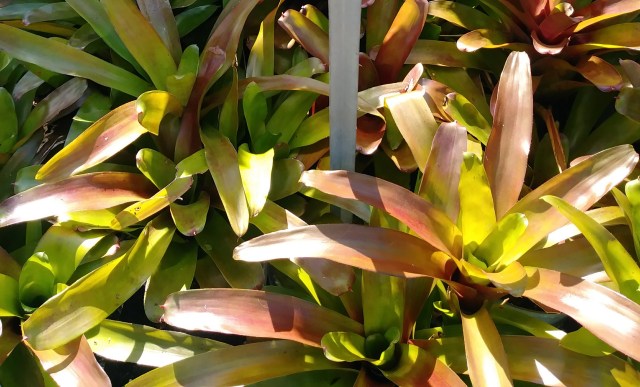
Super Fireball Neoregelia in the garden, cold weather makes the red and peach coloration come out, these are closer to green in summer.

20190119_114327-1

Another  view:

img_20200126_113315

The cachepot is Portmerion, bought years ago on an antiqueing mission with my mother. The pot is a favorite of mine, but I rarely have houseplants as I have a strong tendency to kill them. The Bromeliads should last for months and root into the pot.

From above:

img_20200126_113423

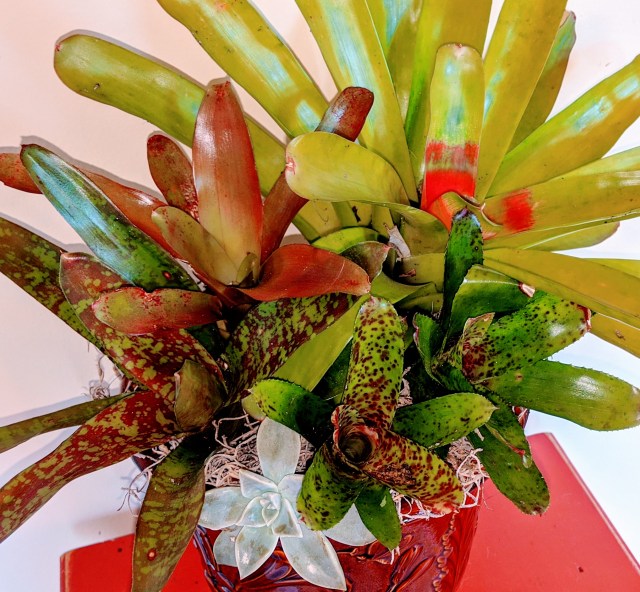
These are all Neoregelia Bromeliads, grown primarily for foliage. The flowers are not very exciting. I know two of the four varieties – there are 3500 types of Bromeliads and I lost track of some or never knew the name ( i.e. bought at a garage sale for 5 bucks) The bigger chartruese plant with the red center (the center turns red with cooler weather) is a Blushing Bromeliad (Neoregelia carolinae). The Burgundy with green center and no spots is Super Fireball, the spotted ones I have not a clue the species. The grey plant in the foreground is a succulent – a Graptosedum of some kind that a friend gave to me, they enjoy the same soil conditions and I have a few in containers with Bromeliads on the porches at my house. Spanish moss is used for fill in the edges (and hide the black plastic nursery pot) is also a Bromeliad (Tillandsia usneoides)

Happy Gardening!

For more vases from around the world, visit Cathy at http://www.ramblinginthegarden.wordpress.com.

In a Vase on Monday – Holiday Upcycle

img_20200119_134719

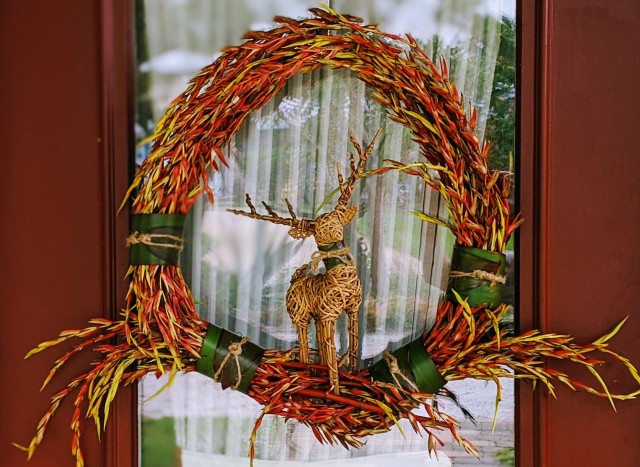
The  upcycle is the vase itself. Made from dried remnants of my front door Christmas wreath.  Here is the wreath in its previous life. The green bands are Blanchetiana Bromeliad foliage wrapped around the wreath and tied with jute. When I took this down the flowers had dried to brown and the bands were curly and retained their color. I saved them because I thought they might make an interesting addition to a vase. Instead, I covered a plastic water bottle with the curled leaves and made a vase.

00100lrportrait_00100_burst20191220124823831_cover

The flowers are a bright mix designed to counter any winter blues. Low temperatures in the 40s (F) are forecast this week, appalling weather to anyone Floridized (living in Florida for over 5 years, blood completely thins out). We might have to wear long pants and  (gasp)  turn on the heat. A closer view of  the vase:

00000img_00000_burst20200119133925401_cover

Another view of  the flowers:

00000img_00000_burst20200119134942300_cover

The yellow daisies are Beach Sunflowers (Helianthus debilis), a year round bloomer. The red and yellow daisies are Gallardia (Gallardia pulchella), another year round bloomer. Both are native and absurdly easy to grow. The pink flower is an unknown Zinnia. Deep pink and chartreuse spikes are Texas Vintage Rose Mix Celosia from Floret, I may really like these. I think they need cutting back, so here they are. Peachy and red spikes are from Tropical Red Salvia (Salvia coccinea). The more beige spikes are Juba Bush (Iresine diffusa) and funky stems with a bit of blue are Blue Porterweed (Stachytarpeta jamaicaensis), white daisies are another native Spanish Needles (Bidens alba).

I am really enjoying my winter garden this year and just planted another round of vegetable seeds. Hoping for more Zinnias and Celosia before the heat sets in.

Happy Gardening and thanks to Cathy at https://ramblinginthegarden.wordpress.com/ for hosting. For more vases, visit Cathy’s blog.