In A Vase on Monday. Frogs and Hallelujah

20161127_125913-1

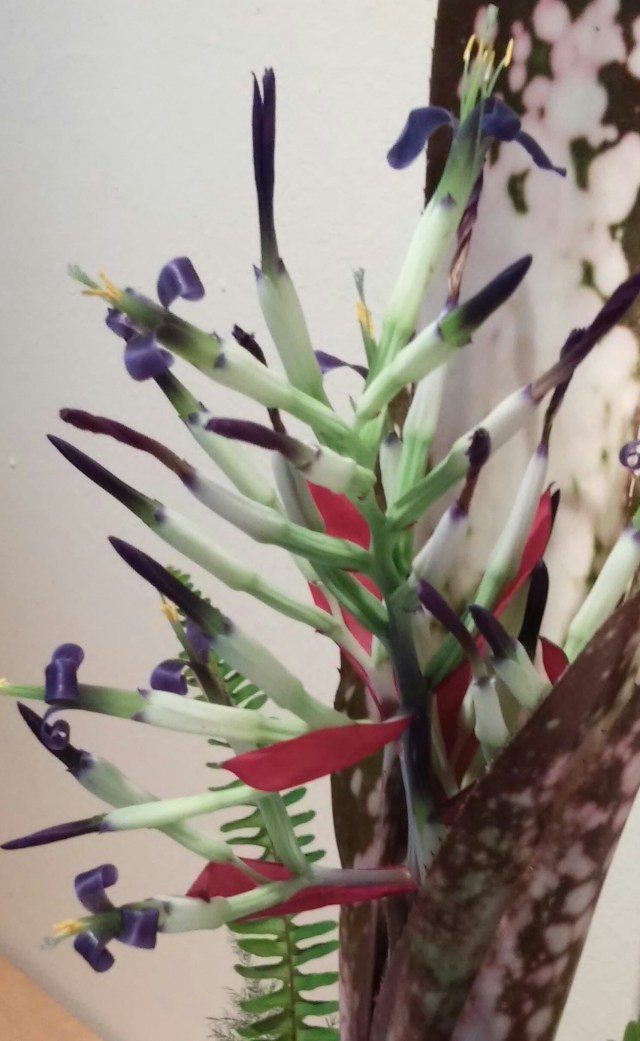
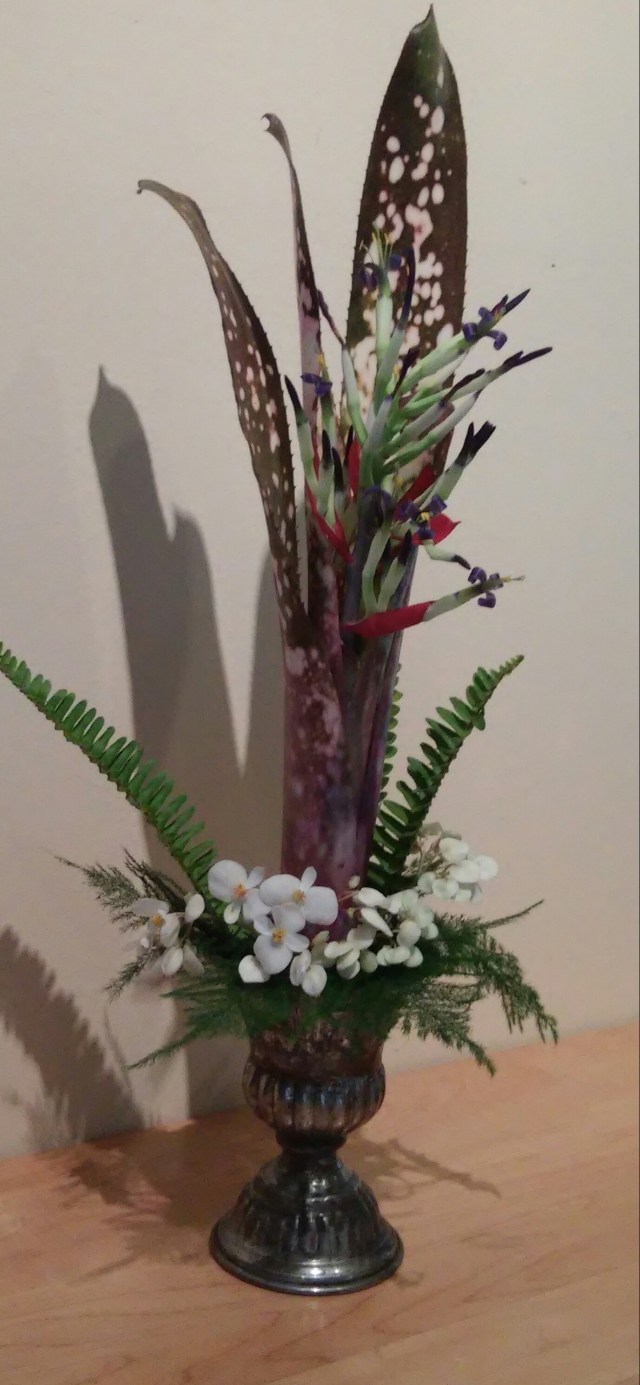
I know, your reaction was probably the same as mine. “Good Lord, what is that?”  Purple and white spotted foliage with a red, white and blue flower – who on earth could have dreamed that up?  As it turns out a guy named Don Beadle did, a famous breeder of bromeliads he created this one – the Hallelujah Billbergia. Here is a closer view of the flower:

20161127_130302-1

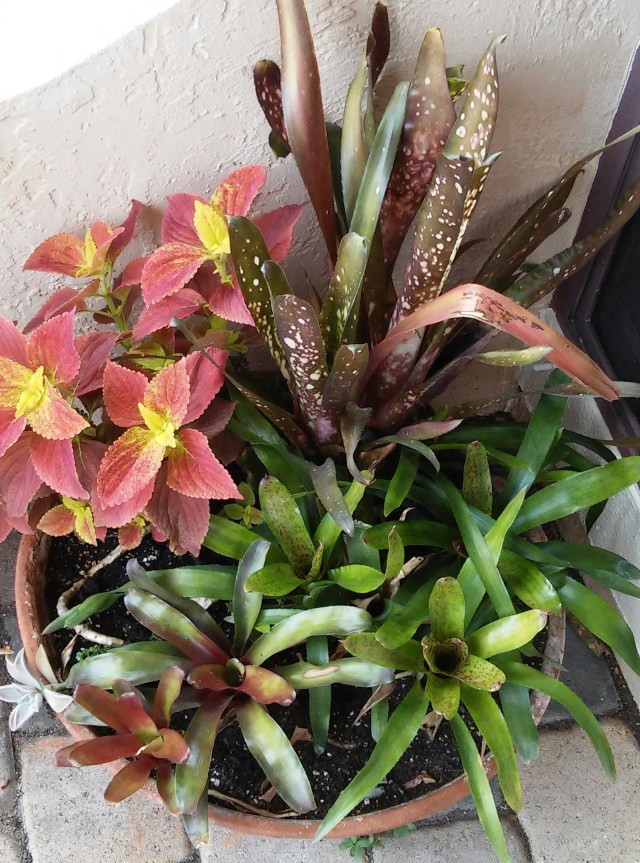
I bought the Billbergia a couple of years ago at a gardening show in Vero Beach, Florida. It was selected to add a tall purple accent in a terracotta wok container of bromeliads I was putting together for my front porch. I did not realize it would flower at all.

20161127_130420-1

I walked out on my porch a couple of mornings ago and thought someone had stuck something in the back of the wok planter. Upon closer inspection, I realized it was a flower, a very funky flower. So I gave it a couple of days to see what it would do and decided to cut it for my Monday vase.

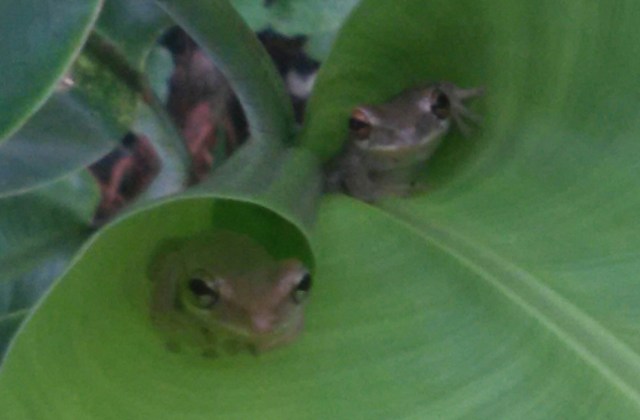
I cut it, brought it into the house and had this feeling something was looking at me. I looked down into the foliage and there was a tiny frog in the foliage surrounding the flower. The frog needed to go back outside, I took the whole thing back onto the front porch and the frog happily jumped over the wall and joined a friend in the Heliconias.

20160926_171831-3

Now there were two frogs looking at me. Hopefully, they are having some grand frog fun eating bugs in the garden. Bad bugs only, of course.

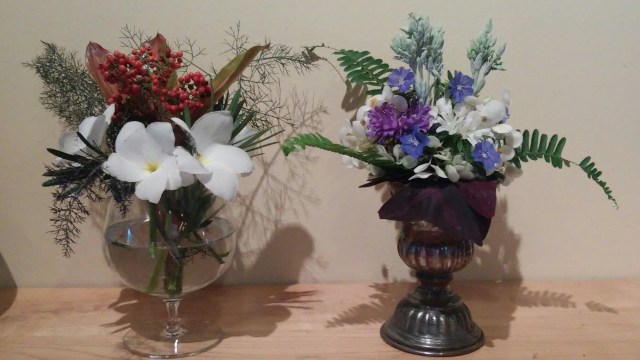
The vase in an old silver-plated something my mother bought in (her words) the junk store. I love the patina and I think it was a goblet, but at my house, it has only been used as a vase. Given the brilliant coloration of the centerpiece Hallelujah Billbergia Bromeliad adding a little green and white seemed the best option. Asian Sword Ferns and Asparagus Ferns are the greens and the white flowers at the base are Sweet Begonias (Begonia odorata “Alba”)

Hallelujah!

In A Vase on Monday – A Cross Cultural Experience

20161113_151451

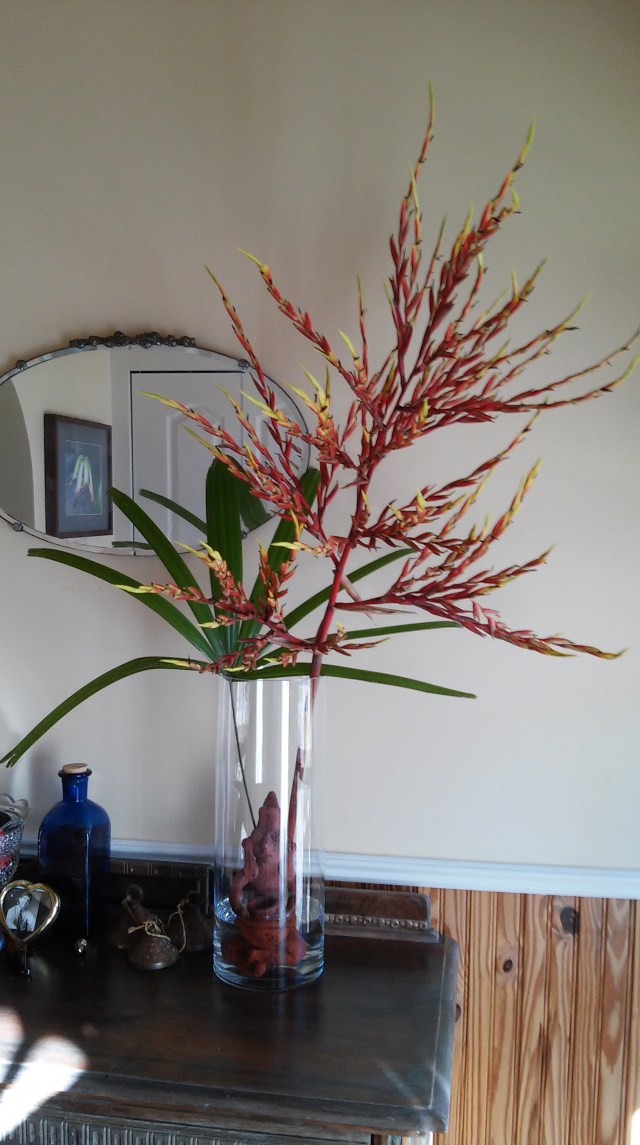
This is truly a cross cultural experience. The plants, while grown in South Florida, hail from both sides of our planet, Southeast Asia and Brazil. The terracotta man in the vase is an incense burner from Pier One that belonged to my brother in the late 1970’s. I am not sure exactly where he came from but the concept was Pre Columbian. I think.

20161113_121000

The red and yellow swirling crab claws are the flower of a Blanchetiana Bromeliad, a native of the eastern side of Brazil. The plant itself is about four feet tall by six feet wide. It has been flowering for about six weeks, of course the flower is on the side I can’t really see unless I am turning the compost heap. So, I decided to cut it and enjoy it in the house as long as it lasted.

20161113_121049

These Bromeliads are relatively common in South Florida and I nearly wrecked my car the first time I saw one. Talk about wild and crazy plants, the foliage can be orange, red, green or yellow and it is big. Even though I had experience with Bromeliads I didn’t realize how big they grew. Another houseplant myth busted by Tropic Florida.

The foliage is a frond of a Lady Palm (Rhaphis excelsa). This palm is native to the Rainforest in Southeast Asia, an understory plant that enjoys shade and water. Relatively hardy, it will grown north to Orlando, and is a favorite of mine for interior use as a potted plant. I bought one a couple of years ago and it sat in the pot a little too long, so it is a bit lopsided and has finally recovered its healthy deep green color and need a little trim.

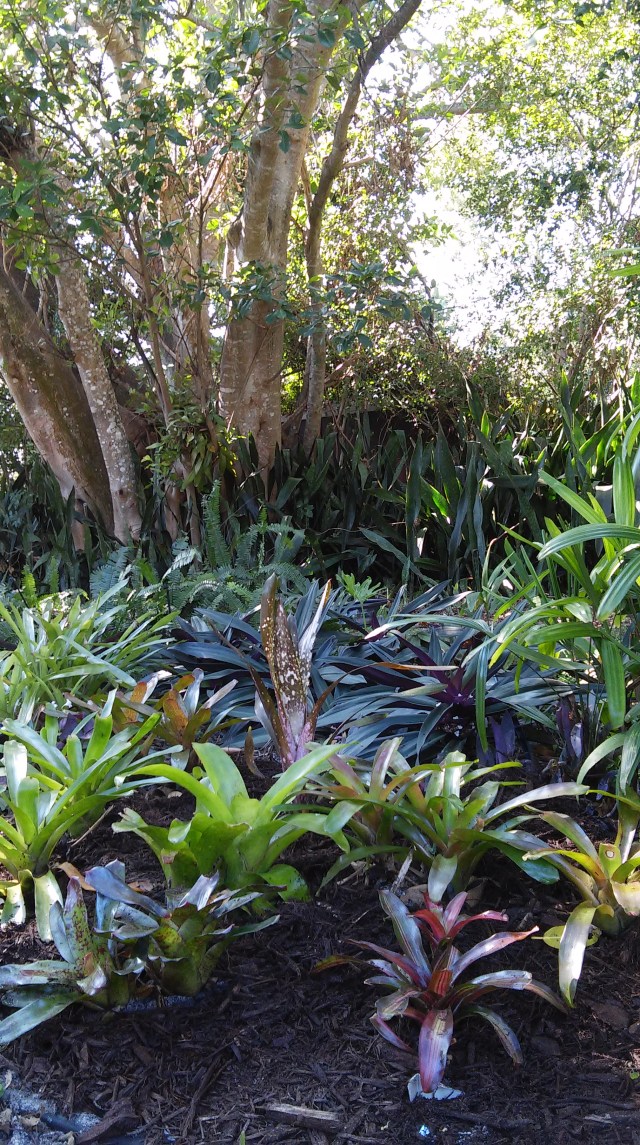
Here is a shot of my Rainforest Garden, where the Lady Palm lives.

20161113_111728

In a Vase on Monday – Spiked Tropical Punch

20160814_100608-1

I finally have some spikes blooming in my garden. Showy panicles or racemes in the classic style are few and far between in Tropic Florida. I love Butterfly Bush and Oakleaf Hydrangeas and all sorts of plants with those flower types, even Lysimachia. None will grow this far south. I found some Tropical Red or Blood Sage (Salvia coccinea) plants, native to coastal sandy soils in the Southeastern US, bought some thinking it should be perfect for my garden.

As these things go sometimes, this widely advertised Tropical Red Salvia is supposed to love dry sandy soils and be drought tolerant. Mine was not feeling that way at all and insisted on water and the addition of some organic matter in the soil before flowering at all. It rained a couple of inches in the past week or so and they shot up these nearly fluorescent red spikes. Yay. Here are the plants:

20160814_134124-1

Native people of the Florida peninsula used this Sage medicinally for all sorts of ailments, the more widely known herb Sage is Salvia officinalis. A tea made from this plant was the cure for anything from menopause to infections. Given the wide range of its curative powers I am not too sure if would help with what ails me so, I am sticking to our modern pain relievers at this time as I don’t really like the taste of culinary Sage.

Other members of this arrangement are in white, Bridal Bouquet Frangipani (Plumeria pudica), Parrot Flower (Psittacorum) in red and yellow, Beach Sunflowers (Helianthus debilis) in yellow, the burgundy foliage is from “Hallelujah” Bromeliad and a Split Leaf Philodendron (Philodendron selloum) Leaf.

Yes, the Split Leaf Philodendron grows in my Rainforest Garden. With many other house plants without spikey panicles.

In A Vase on Monday- Less Tropical

20160731_113517-1

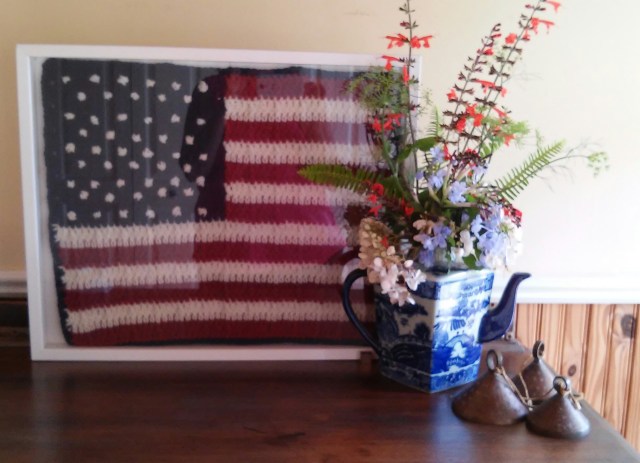
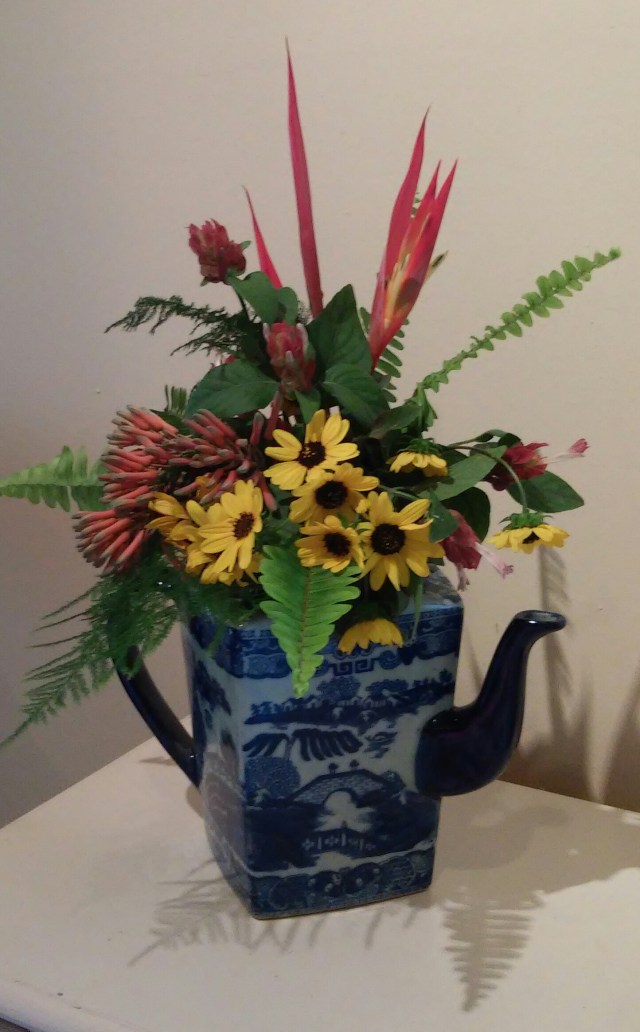
This week I decided to try a less tropical approach to my vase, using our Native Beach Sunflowers (Helianthus debilis) as the basis for a non tropical look. I thought Blue Willow china would be a not so tropical container for my vase. I have a collection of Blue Willow started by my grandmother a hundred years ago I have been adding to for years. So, I started with the Blue Willow bowl my father referred to as the ‘Creamed Onion Bowl’ a low covered casserole. That didn’t really work out the flowers were too tall or maybe the scale of flowers to bowl was just off. Then, everything got moved into this well used English teapot I bought years ago, one of my favorite pieces. I have never made tea in it, but somebody else did, many times, the interior is stained dark from use. I like antiques with a little patina.

To the Sunflowers I added Soap Aloe (Aloe saponaria) flowers in orange, Red Shrimp Plant (Justicia brandegeana), and some Parrot Flower  (Heliconia psittacorum) buds for height, Asparagus Ferns and Asian Sword Ferns for green texture.

20160731_112512

After all of this it occurred to me none of these plants would even grow at Disney World in Orlando, Florida! However, it can be proposed they could be grown as annuals. In containers.

Mission completed.

I renovated my big Frangipani vase from last week and the Bromeliads from two weeks ago are still looking good. I think the buds on the Frangipani will open. Here they are again:

20160731_113847-1

Unabashedly tropical.

In A Vase on Monday – Prunings

20160724_105040-1

My Bridal Bouquet Frangipani was getting too tall, so I planned an arrangement around the prunings. This variety of Frangipani is columnar and tends to break apart in thunderstorms, if anyone else is familiar with the dreadful Bradford Pear (I hope that tree never made it out of the US) the branching structure of this Frangipani is similar and breaks in the same way. The problem with the branching structure of both these trees is that the branches are held at such a steep angle to the trunk the weight of the foliage breaks the branches and sometimes the trunk splits.

The good news is the Frangipani usually doesn’t get more than ten feet tall and rapidly repairs itself if branches break off. This arrangement is four or five feet tall, so there is plenty of shrub left and it looks reasonably good. Better than broken in two anyway.

The red accents in the arrangement are just for fun. No pruning was needed, it just happened. The tall red element is a Raggedy Ann Copperleaf (Acalypha “Raggedy Ann”) A somewhat unfortunate pruning story. This plant is the closest thing to a Japanese Maple that will grow in Tropic Florida. Japanese Maples are one thing I pine for in my garden- so I bought this thinking I could prune it into a tree form ‘Japanese Maple’. Reality is this plant has none of the graceful habit of a Japanese Maple and is totally upright and frankly kind of scraggly looking, especially after tree forming by someone trying to make a Japanese Maple.

The big red foliage leaves are from Blanchetiana Bromeliads, I love these plants for their coarse highly colored foliage and crazy flowers. It took me a couple of years to figure out how to cut the leaves off – kitchen scissors, go figure.

Here is a close up of the flowers in my arrangement:

20160724_105220

In A Vase on Monday-Bromeliads Singing the Blues

20160717_104815-1

Here’s the collection of blues. The violin bottle belonged to my grandmother, she always kept unusual bottles on her windowsills, some filled with colored water. The footed glass was found in my in-laws house whilst cleaning it out to sell it. For some reason they collected one glass each time they went to an Arts Festival, so there was an odd collection of ones, many of them pottery wine glasses. The corked bottle holds dried rose petals I collected from bouquets my husband brought home.

20160717_100806-1

I started with this one, my husband came in and said, ‘It looks like the violin is playing music’ – maybe the blues! The flower in this bottle is from a Miniata Bromeliad (Aechmea miniata) These are very easy to grow and bloom regularly in July. A simple Heliconia leaf has been added to the bottle. Here are the Miniatas in the garden.

20160710_101839

The footed vase has a sprig of Frangipani and a few clippings of our native Firebush (Hamelia patens var patens)

20160717_105006

Here is what has me singing the Bromeliad Blues. I bought this grey foliaged Bromeliad this spring at a Master Gardeners plant sale. No one knew what it was, but I liked the shape and foliage (the leaves have a deep pink tip) and it was $6, so I bought it. Check out this flower, I think this is a Bilbergia ‘Soundwaves’, but I am not sure!

Pineapples and their Cousins


A common element in South Florida gardens is the pineapple patch. Almost everybody has one, from a northern perspective, it seems kind of weird. Grow your own pineapples? Why not? Even one of our neighbors, his yard could be described as nouveau retch, is seen regularly hand watering his pineapples.

20160422_135000-1

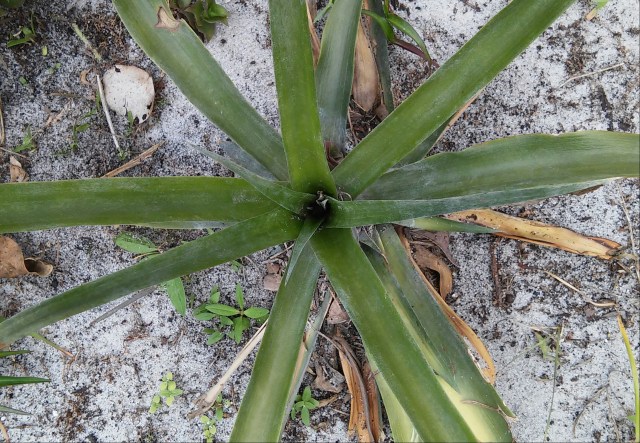
Pineapples are in fact a Bromeliad, which are currently my favorite tropical perennial. Among the many Bromeliads I have planted that are purely ornamental I am afraid I have fallen prey to the trend and now have a pineapple patch between my citrus trees. I eat pineapple just about year round and the tops kept rooting in the compost heap. Unfortunately, the above is my patch, not too pretty.

Pineapples have an interesting history. Originally from the area where modern day Brazil is located, they moved via canoes paddled by traveling natives north to the Caribbean Islands where sea captains picked up on them and carried them home. One early accounting of the discovery of pineapple recounts a meal served by the Caribe tribe where a plate of pineapple rested next to a cauldron of boiling cannibalized humans. I think I would have asked for the fruit plate.

A status symbol on the dining tables of colonial America, pineapples were often rented for centerpieces and then sold after a few uses for eating. Thus the pineapple as a symbol of lush hospitality was born. The prevalence of pineapples as a decorative element may be explained by its being cheaper to carve decorative pineapples into bed posts or garden ornaments instead of renting them by the hour.

The Treasure Coast of Florida, the area I currently call home was once home to a large pineapple plantation. In 1895, Jensen Beach, Florida was named the Pineapple Capital of the World, shipping a million boxes of pineapples a year during the summer season. Later that year a devastating freeze decimated the crop, followed by a few tragic fires and fungal diseases that finished off the pineapple industry by 1920. Agricultural pursuits were redirected towards citrus. Wild Pineapple plants can still be seen on Hutchinson Island and are attributed to the original owner of the plantation, John Jensen.

Like many other popular plants, pineapples have also been bred for Ornamental use. Here are two prettier pineapple plants.


In A Vase on Monday – Frangipani and Fennel Failure


20160515_113820-1

The promise of the eventuality of summer is evidenced by the Frangipani starting to flower in South Florida. The Frangipani in this vase is Bridal Bouquet, a columnar, semi evergreen variety I have come to love in my garden. It is not as fragrant as other Frangipani but the evergreen foliage and form of the plant make up for any shortcomings in fragrance. I have been waiting to see what color the larger Frangipani in my garden are and blast it they are white as well. So, I am in the market for some more colorful friends for the white flowers.

20160515_113615

The failure in this vase is the Fennel, the chartreuse starbursts looking like Dill or Queen Annes Lace. I have been trying to grow culinary Fennel for years from seed. It gets about half the size of a grocery store Fennel and then bolts. I think the climate here is just wrong for Fennel, but have enjoyed eating the foliage and using it in flower arrangements.20160515_135536

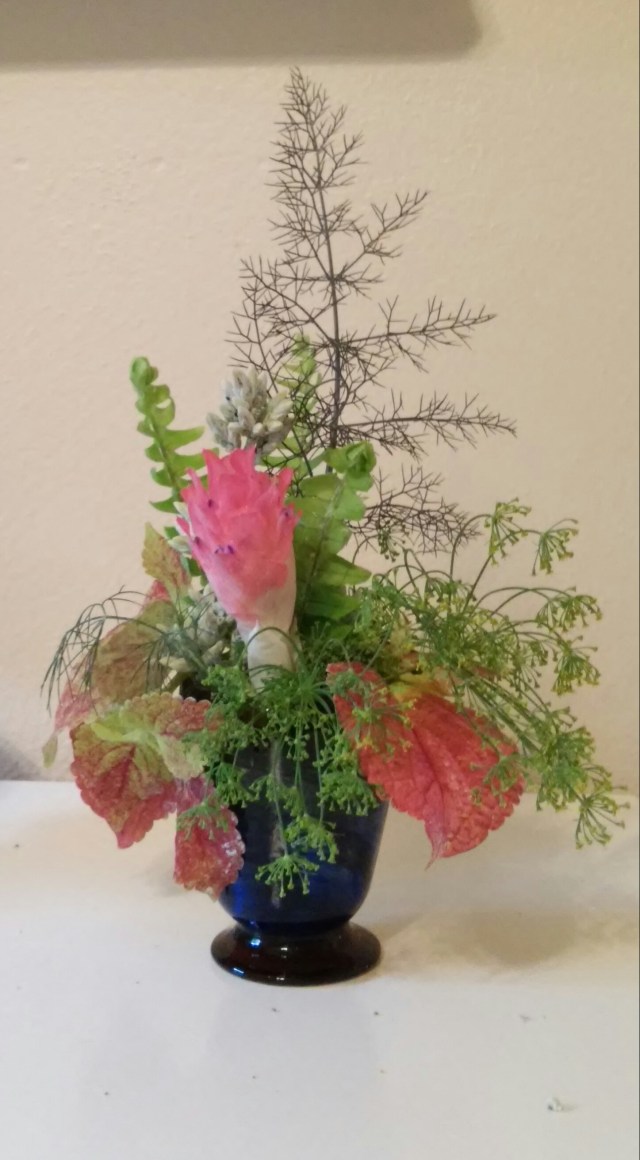
The Burgundy foliage is from my latest Bromeliad bargain. Not a clue what it is. Bargain Bromeliad $5, named specimen, $40. I can live without knowing the name and to me, part of the fun of gardening is seeing what happens next. The other foliage is my everpresent Boston Fern or more likely its evil lookalike tuberous Asian Ferns.

Here is the Bromeliad, burgundy with chartreuse spots, a perfect foil for the yellow green Fennel flowers. If anybody knows its name, please let me know.

20160420_111958

The smoke grey glass vase was from a bargain store near my house bought years ago when I was overrun by a beautiful but much too enthusiastic Red Alstroemeria. The red and gold flecked flowers looked wonderful in the vase, I had a smoke grey glass vase full of Alstroemeria all summer for years.

In A Vase on Monday-Tropical Posy

20160424_171333-1

I am beginning to think I should call these posts “In a Repurposed Object on Monday”. This particular arrangement evolved as I was meandering in my garden with clippers and scissors. I was hoping for some tropical Gardenias but they are still tormenting me with only buds, no blooms.

I was enduring my usual design lecture from myself, must cut 5 flowers followed by foliages (colored)- 3 each,  with contrasting green elements 1 each (coarse and fine textured) As I gathered my elements I realized it was a tropical posy! Relying on my new posy identification skills, a nosegay was formed that was too small to be considered a bouquet. Delightful. If I ever (unlikely) marry again, I wouldn’t mind carrying this. However, a white dress would be out of the question.

The elements of my repurposed object include, the gold glass vase, which I used for a while to hold olive oil by the stove (it has a cork). I determined it would be just as easy to keep the olive oil in the cabinet in the bottle it came in and not worry about how to clean the gold bottle. Reading too many Home and Garden magazines causes these sorts of dilemmas.

The red flowers are Heliconia psittacorum, a prolific flowering perennial, the two colored foliages, in red spots are Piecrust Croton and Ornamental Pineapple in grey green. The green foliage is a Split Leaf Philodendron and Asparagus Fern. I will admit to buying the Split Leaf Philodendron (Philodendron selloum) but that Asparagus Fern just sort of pops up sometimes and I cut it for arrangements.

20160420_111314

In case you were wondering about the Ornamental Pineapple, here it is. The foliage is red and green striped and the pineapples are tiny and inedible, but very pretty. This one was gifted to me by a new gardening friend. Not a clue about the botanical name.

Gardening in the Rain

20160415_163135-1

One day this week I was waiting for the rain to start so I could go work in the garden. I stopped to think – this seems really stupid, do other gardeners do this? And then went out into a gentle rain to move some Beach Sunflower around. It has been so dry lately the sandy soil has tightened its grip on roots to the point it is difficult to pry things out of the ground. Soil is an overstatement in my garden – I should face the facts, it is Sugar Sand, white, infertile and oddly capable of growing many things. I pried some intractable Johnsonsgrass out (and threw it away) then went looking for more beautiful things.

Here is what I found:

20160415_104634

This is a Bromeliad, Billbergia pyramidalis, I think, bought as a cutting in February. I was told it would grow up the trunk of a tree. As a planted it, I was scoffing. Well, whoever told me that was absolutely correct – it is growing up the tree and much to my surprise, flowering at the same time.

This made my time in the rain worthwhile and hopefully the skies will open again soon.