In A Vase on Monday – Floridian Fall

20170827_103206

It’s another stormy Sunday in South Florida. Hurricane Harvey hit the Gulf Coast of Texas on Friday and is still pummeling the Greater Houston area. Our blog friend, the Automatic Gardner, is there.  According to her latest post, so far, so good. Best wishes and luck to her.

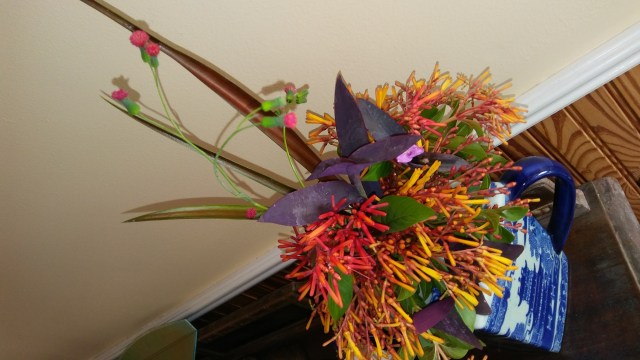
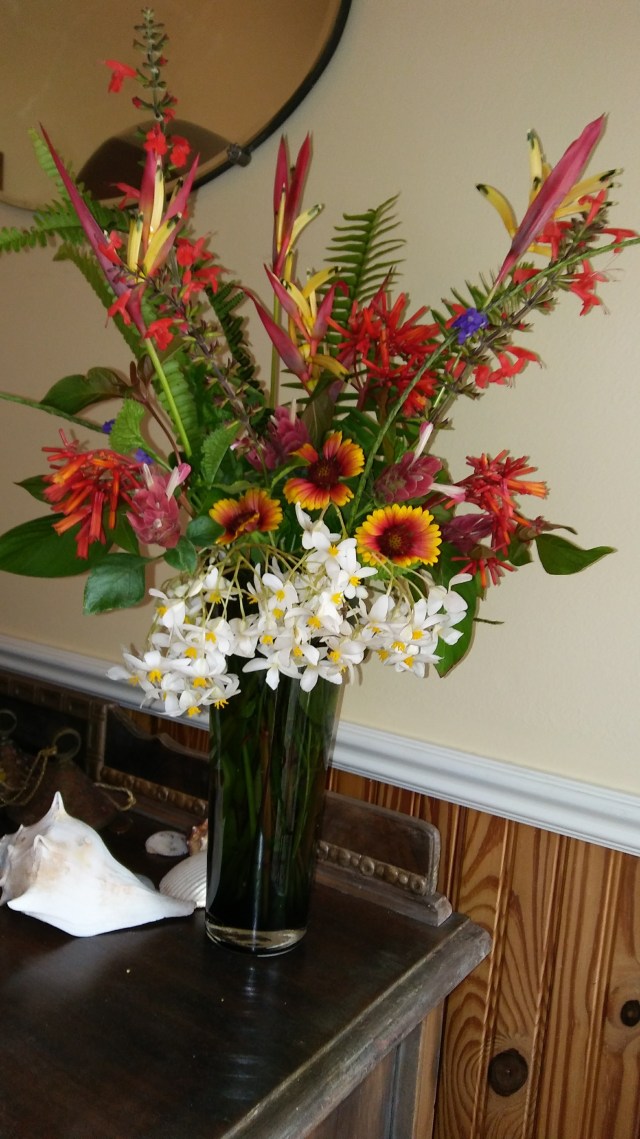
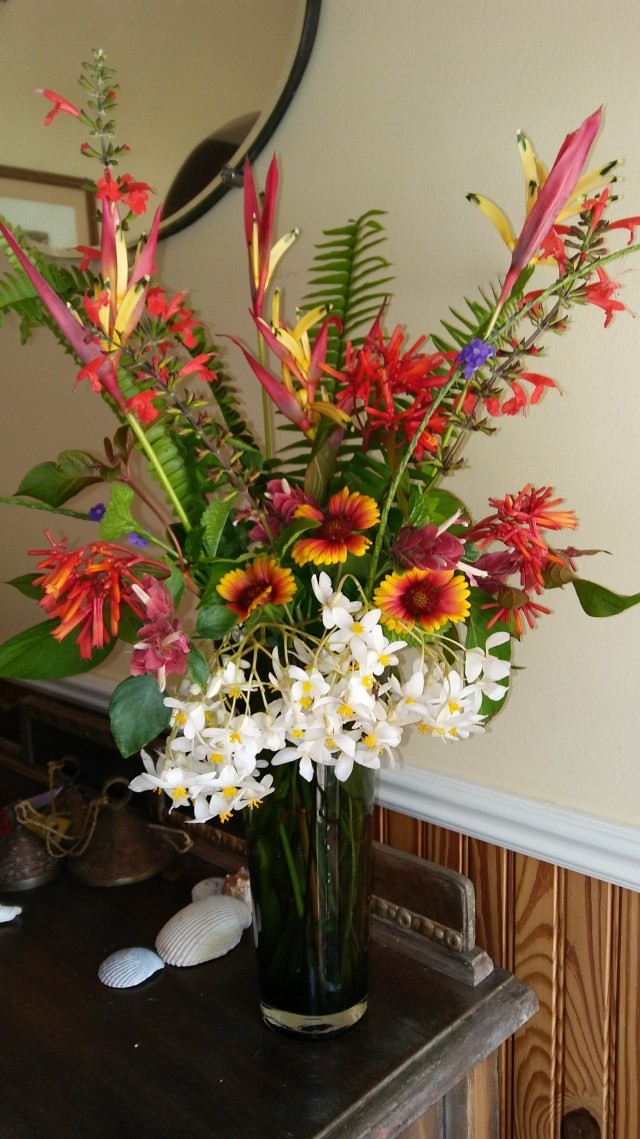
The Atlantic Hurricane Season is in full swing, peaking on September 10. So far, our area has avoided any truly stormy weather. The flowers in my vase today are all native to the area and at their best during the height of Hurricane season.

20170827_103233

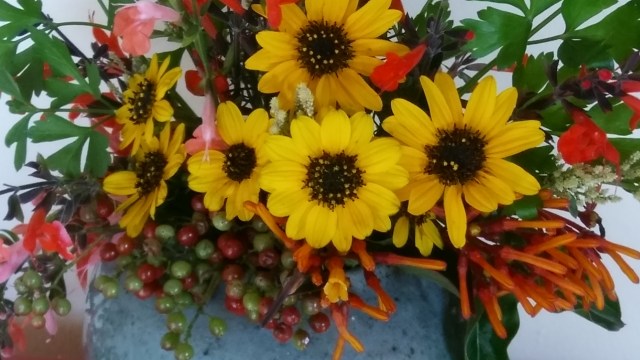
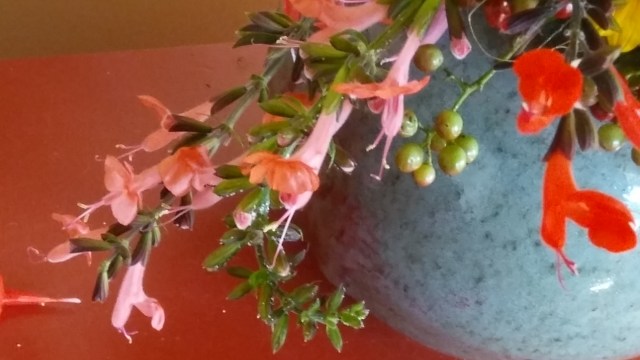
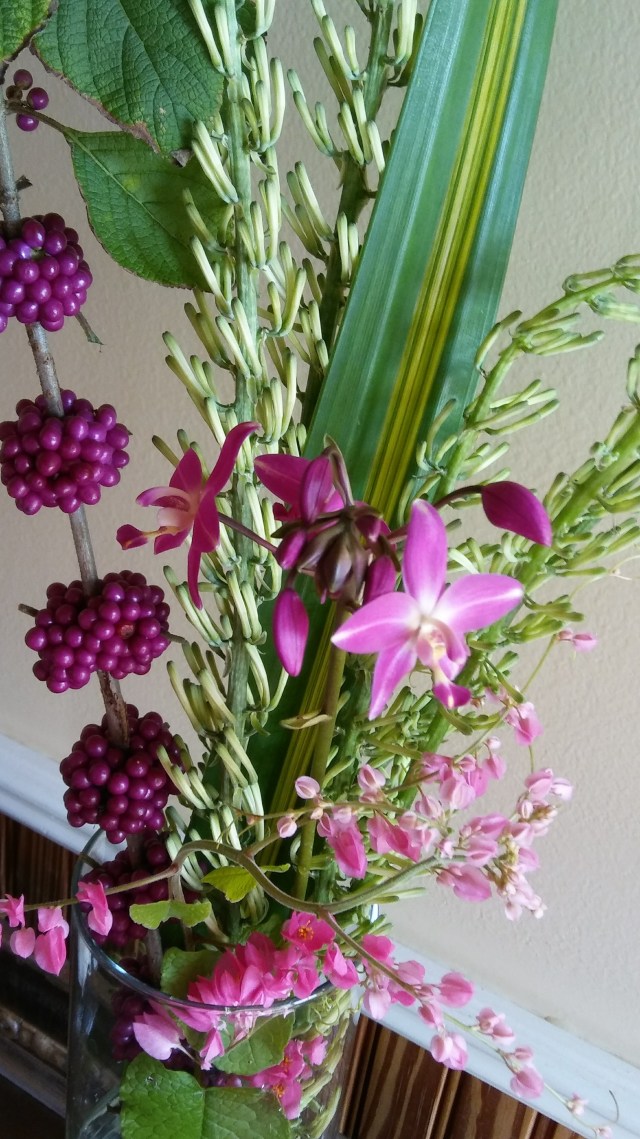
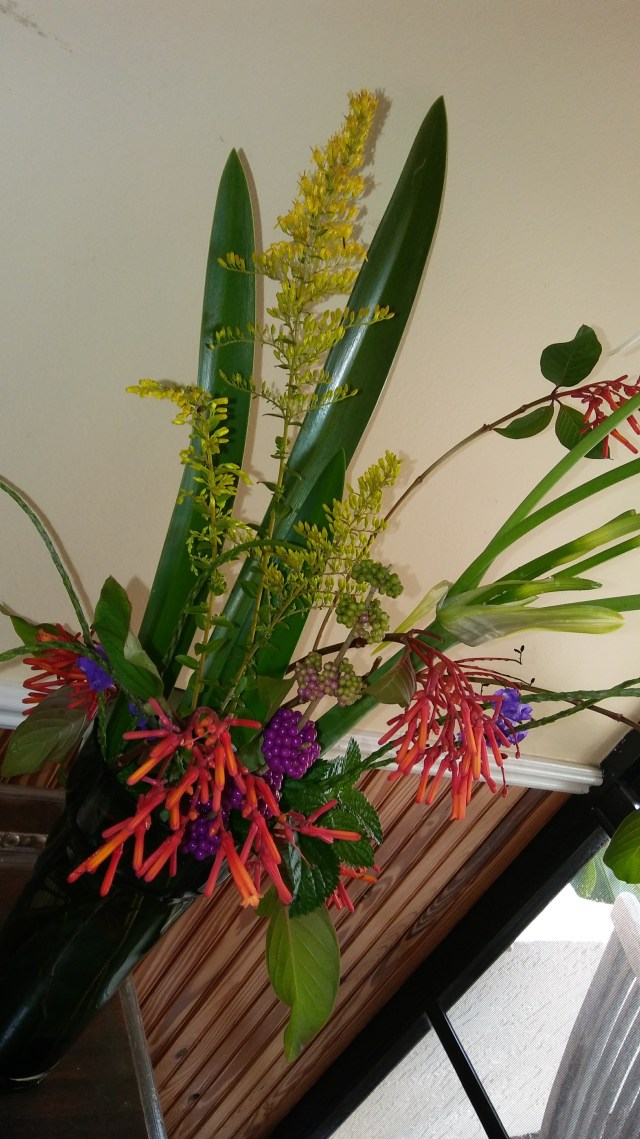
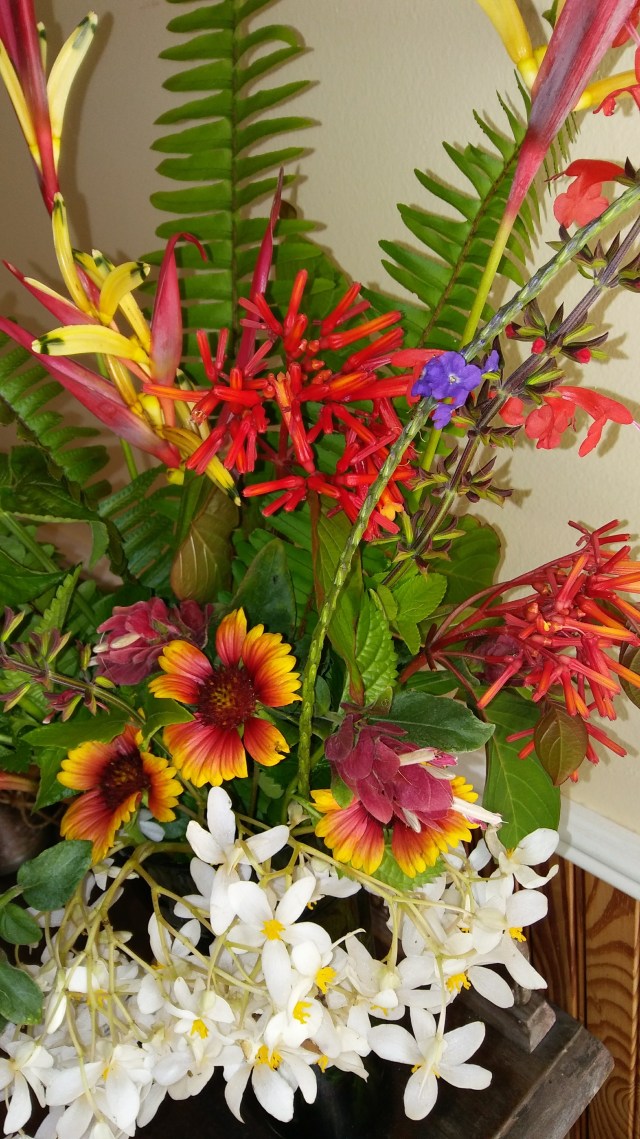
All of the materials in this vase just appeared in my garden with the exception of one. Beautyberry . The purple berries come from the Beautyberry (Calliocarpa americana) I bought a few of these shrubs from a local nursery going out of business. The rest of the flowers just came up and me being me, I left these unknown plants to see what interest they brought to the garden. The orange tubular flowers are Firebush (Hamelia patens var patens), the yellow flowers are Chapman’s Goldenrod (Solidago odora), the blue flowers are Porterweed (still not sure exactly which one).

20170827_103240

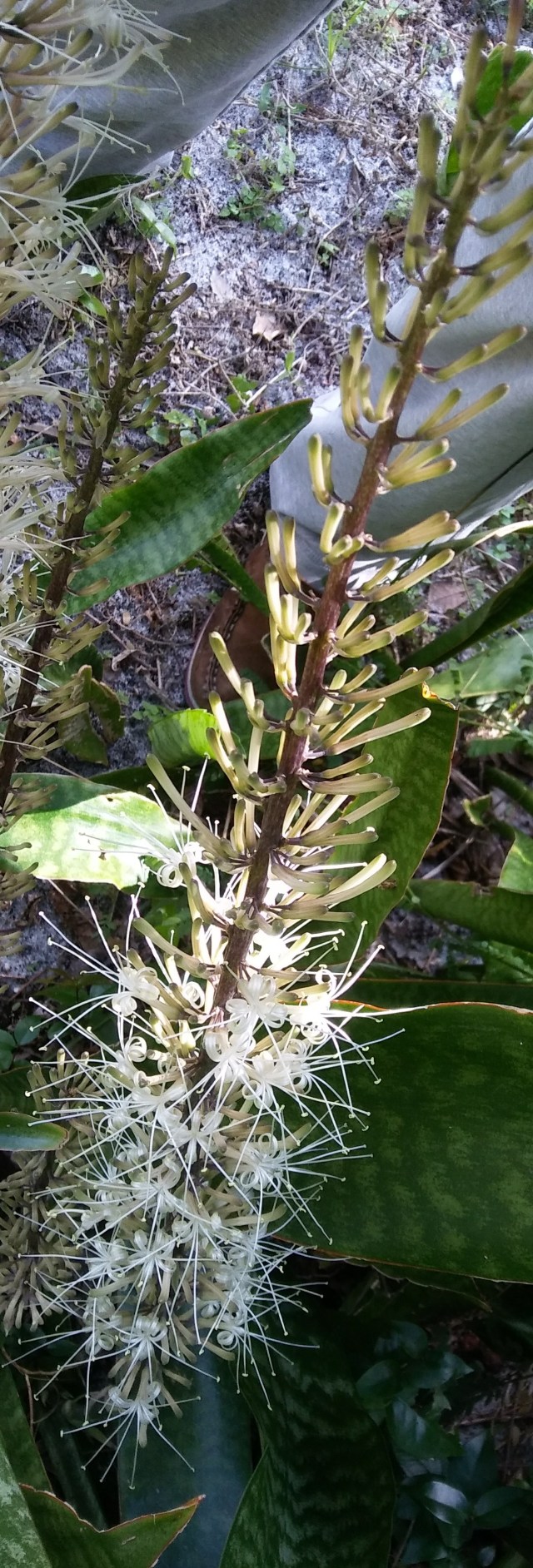
The white flowers and foliage in back of the arrangement are from our native Hymenocallis latifolia (or a friend) These are sometimes called Alligator Lilies and have a lovely scent at night. I found a huge clump of these in the front garden years ago, mistook them for Amaryllis, divided them and have an enormous border of Alligator Lilies in my back garden. Soon to be spectacular, October last year we had Hurricane Matthew here and then the Alligator Lilies flowered. I was surprised, humbled and happy I had divided all of them.

I think of the components of this arrangement as a gift from Mother Nature to remind us of the good things she provides.

Hurricane season notwithstanding.

Happy Gardening.

In A Vase on Monday -Summer Bouquet

20170604_090041

I was missing last week due to attending a family wedding in Atlanta. As unusual as it seems, I found no vases along the way, although late spring was in full swing and all the gardens and especially the wedding arrangements were glorious. And pure white.

20170604_102511

I arrived home to find Memorial Day truly marking the onset of summer. As if on cue,  precipitation started and the weeds burst forth with a joyous and bountiful overtaking of the garden. I am still feeling surly about this and have bought a vast quantity of landscape fabric and cardboard to choke them out. Fifty square feet at a time. Fingers crossed for a victorious outcome. I have, thus far, never defeated the weeds in summer.

I was pleased to see my native plants and the tropicals flowering prodigiously with the onset of wet weather. For whatever deeply buried design reason I am shy about combining these plants – this week I have thrown caution to the wind and come up with the madly mixed Summer Bouquet.

20170604_102612

An old friend of mine, from design school and embarrassed to be ‘a posy poker’ (in reality a very talented designer of floral arrangements and gardens) would have called this a plop arrangement.

Go into the garden, cut whatever strikes your fancy to a similar length and plop into a vase. Simple. My plop this week is in a smoky grey glass vase from the discount store. The members of the cast include in white, Sweet Begonias (Begonia odorata), the daisy shapes are Gallardias (Gallardia pulchella), native to Florida; deeper red and white flowers are Red Shrimp Plants (Justicia brandegeana), The orange trumpets are from my native Firebush (Hamelia patens var patens), red and yellow flowers are tropical Parrotflowers (Heliconia psittacorum); the blue flowers are Porterweed, another native. In green, Asian Sword Ferns, true native plant enthusiasts think this fern is evil. The good side reappears with the red spikes from the native Tropical Red Salvia (Salvia coccinea)

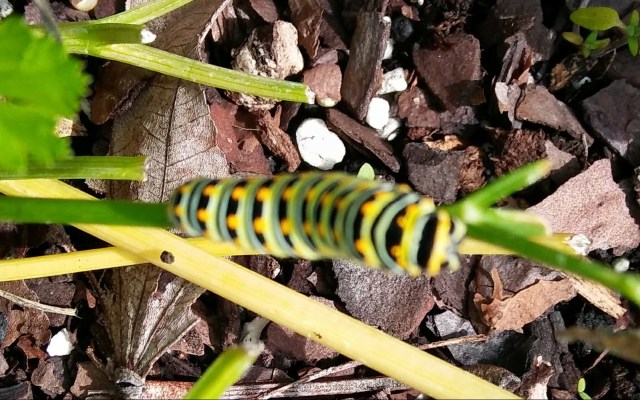
I may eventually recover from my mixing natives with tropicals neurosis as I kind of like this plop. Here is my latest unusual creature discovery. It is a Black Swallowtail Butterfly caterpillar eating the end of my Parsley. I hope to see the Butterfly.

20170604_102656-1

In A Vase on Monday – It’s A Dilly

20170225_163423

It’s a Dilly, is that an American phrase? As far as I know, Dilly translates into it’s remarkable, notable or wonderful. Sources on the Internet say this is Canadian or American slang. Vasers will tell.

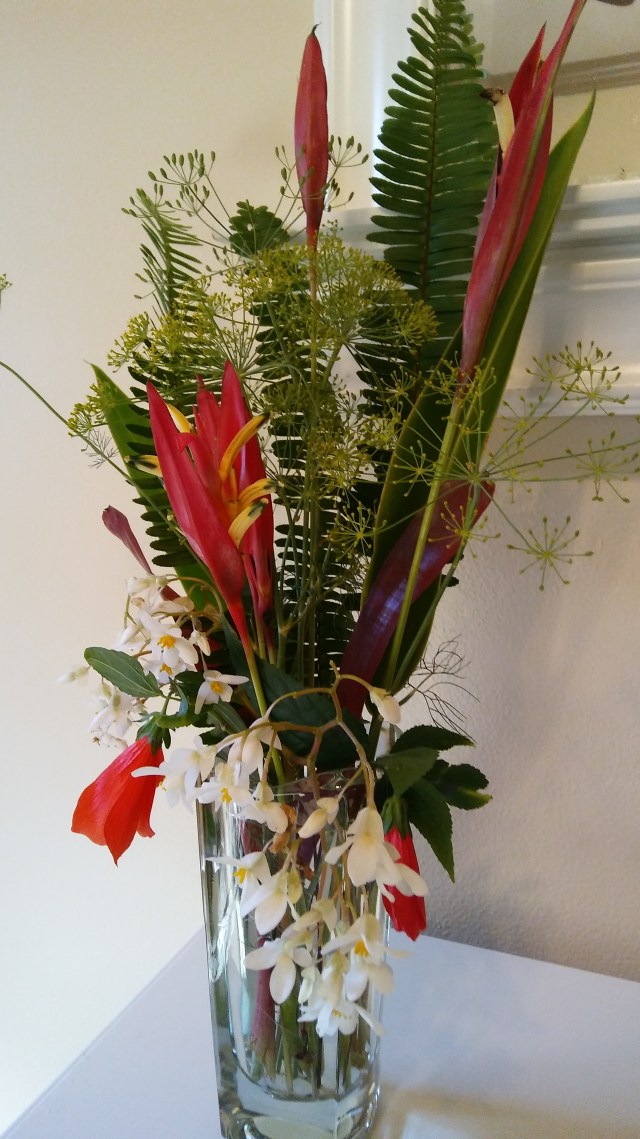
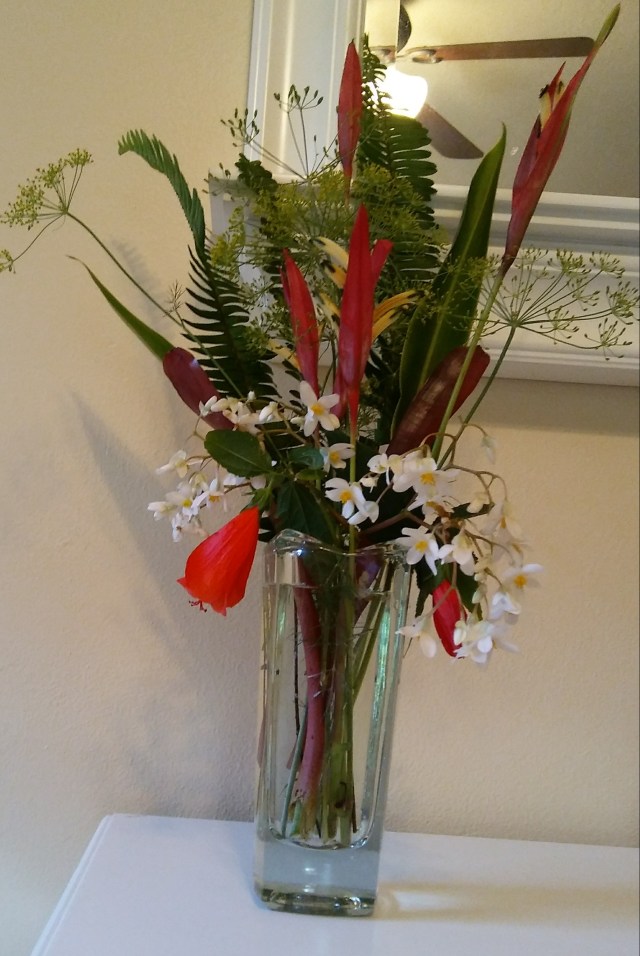
This vase is all about my herbs, I am mourning the impending passing of my Dill plant (this plant has been wonderful) this week. I love fresh Dill with salads, fish, tomato cucumber salad and on and on It has been flowering for at least a month, I keep cutting the flowers hoping for more foliage to eat – alas to no avail. So, I decided to cut most of the flowers for a vase. Some wasps seem to like the flowers as well – I left those guys alone. I hope the wasps inspire more edible Dill.

The Heliconias (Heliconia psittacorus) nearby suffered from something so I cut back and fertilized them a week or two ago. The plants are responding nicely and their flowers have joined the Dill. Sweet Begonias (Begonia odorata “Alba”) in white are flowering again and joined the dirge as well as an unnamed Bromeliad with nice red foliage and some big Ferns that popped up in the garden, again no idea what the ferns are. The red flowers are the native Turk’s Cap Hibiscus (Hibiscus malvaviscus pendiflorus)that rewards me with flowers with the least bit of attention. I watered them!

The vase is a gift from my dearly departed older brother. Always a bittersweet reminder of that makes me miss him. Though I am certain he would be happy I am using the vase and thinking of him.

Here is a close up:

20170225_163213-1

It’s a Dilly!

20170225_163154-1

In A Vase on Monday – Get Your Ducks in a Row

20170205_130619-1

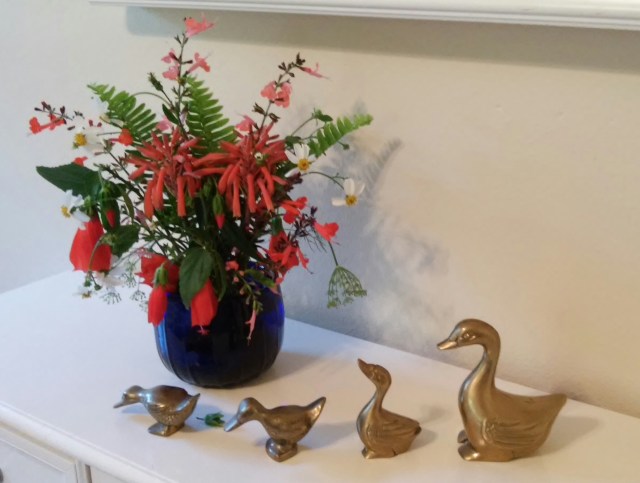
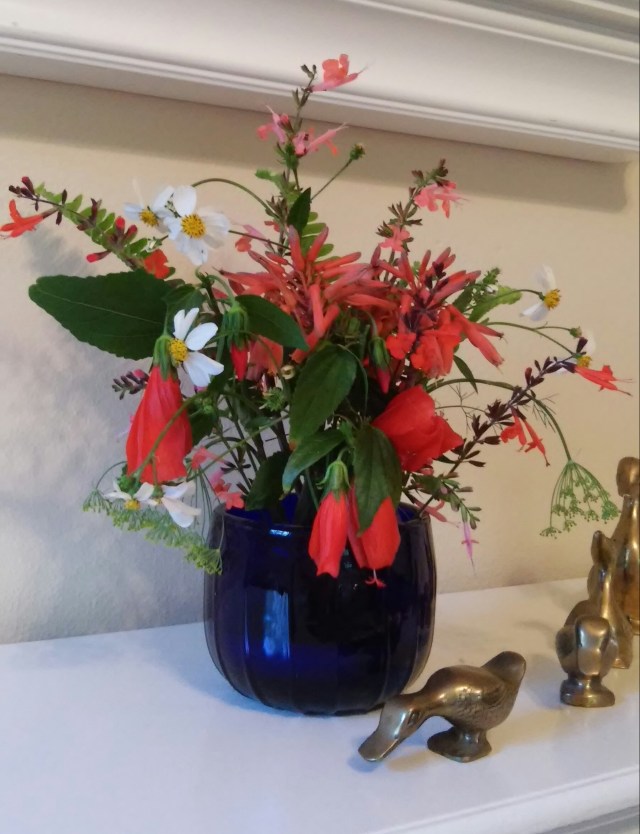
Growing up, my parents constantly told me to get my ducks in a row. This means figuring out what or how you are going to do something before you start. This relates to the flower arrangement as I started out with a beautiful pottery bowl, a wedding gift, placed a flower frog in the bottom and started placing flowers in the holder – only to figure out the base of the bowl was nowhere close to flat, causing the flowers to tip over and then realizing the pendulous flowers were hidden by the edges of the bowl. The blue glass container is Plan B. The ducks were a gift from my father many years ago to remind me.

20170205_130036-1 For this week’s arrangement I was planning Dwarf Jamaican Heliconias and waiting for them to start flowering, Valentine’s Day is usually their prime and they are sticking to their schedule. Maybe next week. More ducks for me to line up. Plan B again.
The Soap Aloe (Aloe saponaria) sent up a stalk earlier this week and it was in full flower so that is the center of the arrangement. The pendulous red flowers are Turk’s Cap Hibiscus (Malvaviscus pendiflorus), a native shrub that appears unbidden in the garden. The white flowers are another native, actually a nuisance, I thought these were Coreopsis run amok, then found out they are actually a wildflower called Indian Needles (Bidens pilosa) considered a medicinal plant and prolific producers of sharp, thin seeds. I am not sure if the seeds were used as needles, but they are sharp enough. Tropical Red Salvia (Salvia coccinea) in red and coral, another native, is thriving so I just keep cutting them. Last but not least, a little foliage accent from Asian Sword Fern and Culinary Dill Flowers.

Interestingly, almost all these plants are medicinal – if I needed shampoo (Soap Aloe) or a cure for hernia pain and upset stomach (Turk’s Cap, Indian Needles, Tropical Red Salvia and Dill) i would have really had my ducks in a row this week.

In A Vase on Monday – Make America Garden Again

20170122_141205-1

All political commentary aside, watching events unfold this weekend sparked a patriotic arrangement for this Monday. The primary colors in the arrangement are Red, white and blue for the United States of America. Hopefully we will put aside our animosity and pick up our tools and get out in the garden again. I do think a new era of activism and civic participation has been unleashed and was amazed to see the rest of the world joining in.

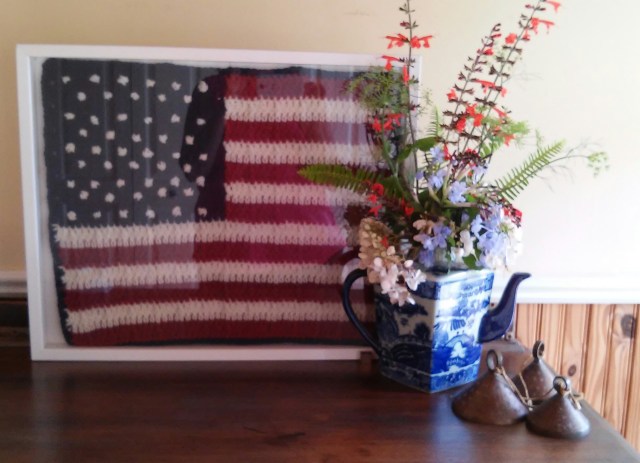
The props with this arrangement are a flag crocheted by my mother in law (we just realized Joan has been gone almost 15 years) as a Fourth of July gift some years ago. After she retired, she sat in her Living Room and crocheted- we had a crocheted something for every occasion and then some.  At some point I reached crochet overload and was relieved to find that volunteer organizations (Women’s shelters, especially) often like these handmade items and have been happy to pass them along. The bells (Let Freedom Ring, anyone?) were collected by my father when he was in the US Army stationed in India during World War II.

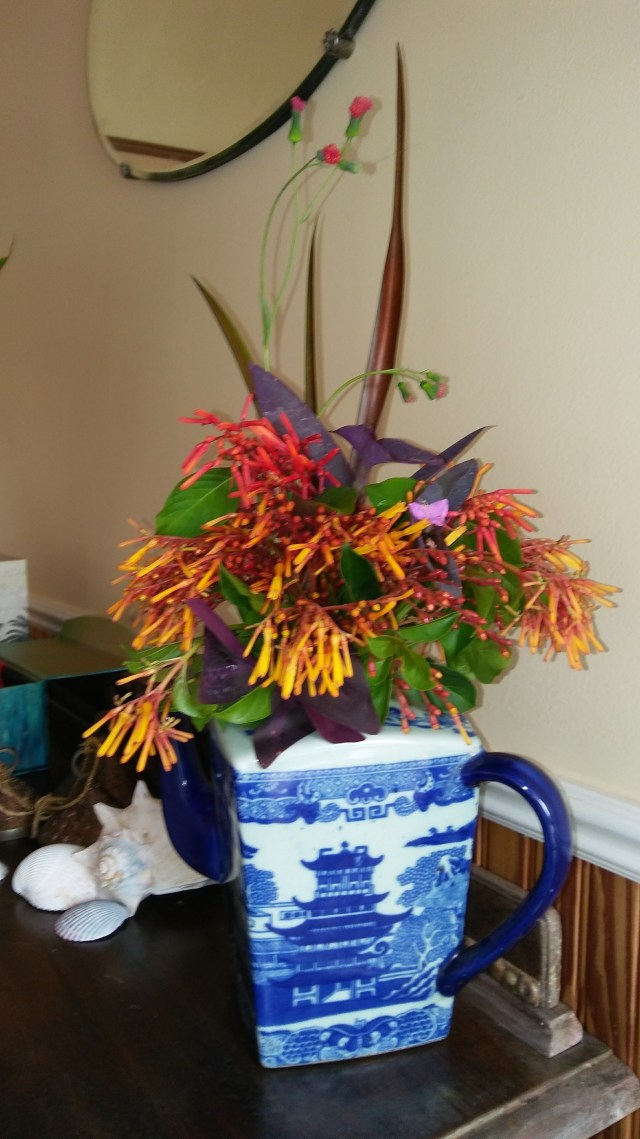
The vase is English, a teapot in my favorite Blue Willow pattern acquired while junk shopping with my mother about 20 years ago. I was thrilled to find a new piece at the thrift shop this week, I inherited some from my grandmother and have been collecting it for about 30 years.

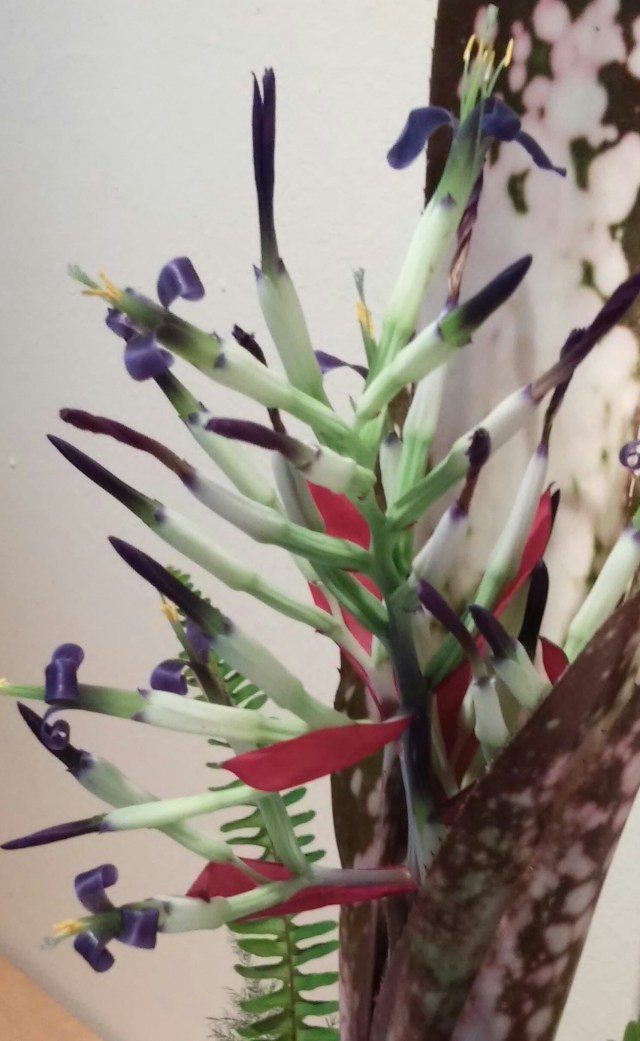
The flowers are in red, Tropical Red Salvia (Salvia coccinea), in blue, Tropical Plumbago (Plumbago auriculata), in white, Sweet Begonias (Begonia odorata ‘Alba’) in the center, difficult to see is a Hallelujah Billbergia Bromeliad. There are a few sprigs of Dill flowers from the herb garden and some Asian Sword Ferns for foliage. Here is a close up of the Bromeliad flower:

20161127_130302-1

Hallelujah Billbergia Bromeliad seems pretty patriotic! Getting back out in the garden to find Hallelujah sporting red, white and blue started the vase idea.

In A Vase on Monday- A Trio of Heirlooms with Comments from the Cats.

20170115_103523-1

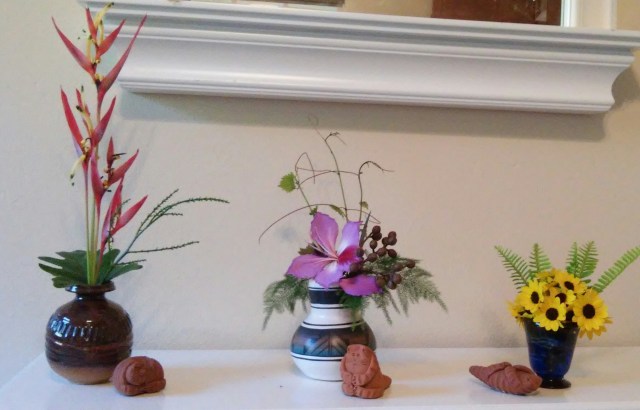
This week I decided to use my heirloom vase collection and limit myself to one type of flower per vase using different foliage types to accent the flowers. The terracotta cats are also heirlooms, inherited from my mother and they are offering comments on the arrangements. The cats are contented by the brown vase, interested in the blue vase and napping by the vase on the right.

20170115_102603-1

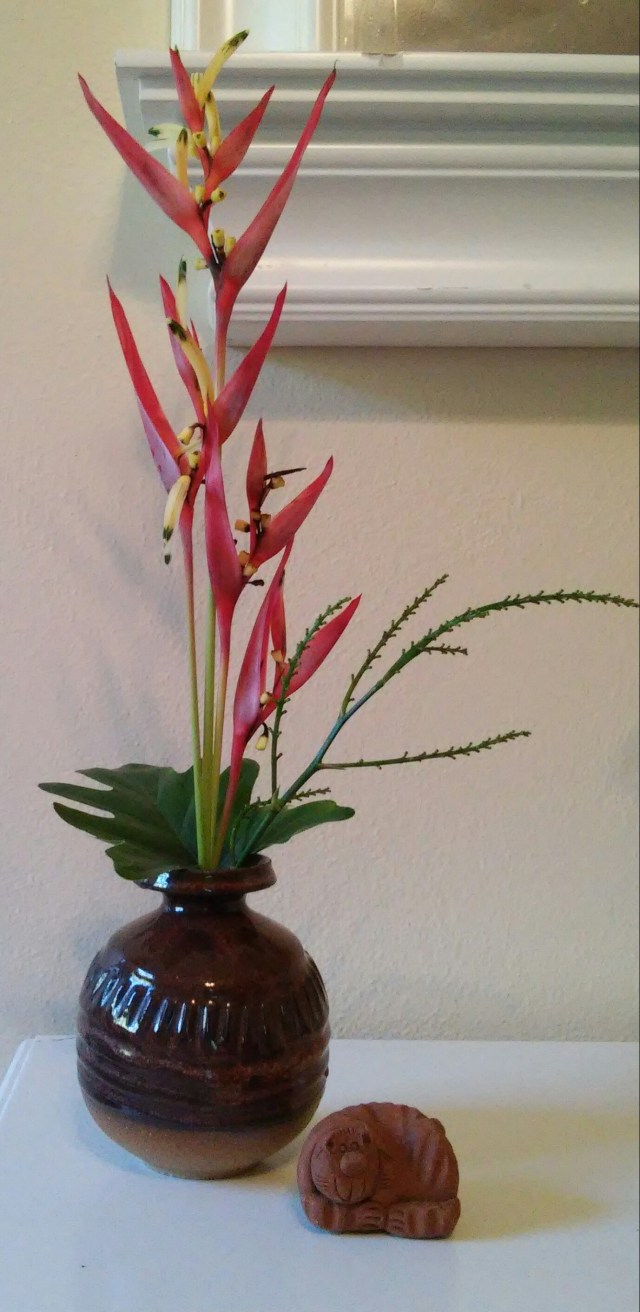
This vase was acquired by my mother on a trip through the Western United States shortly after my parents retired. The origin of the contented cat I am not so sure about. The plants in the vase are: in red, Parrotflowers (Heliconia psittacorum), the bigger leaf is from a Split Leaf Philodendron (Philodendron selloum), the green stem is a budding flower stalk from a Draceana reflexa, some people call these Pleomele. The actual Draceana flowers are an odd brown stringy affair that I was very disappointed in the last year.

20170115_103356

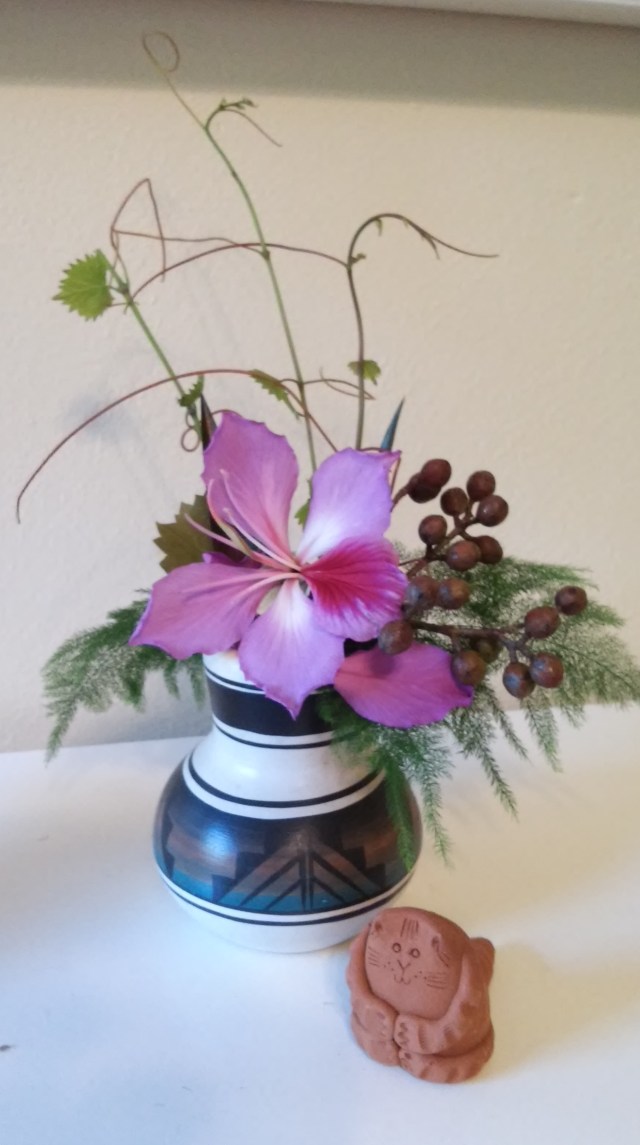
This is another vase collected by my mother on her Western adventure. Made by the Ute Indian tribe, it remains a favorite of mine. I think the cat is excited by all the foliage in this one. The purple flowers are from a Hong Kong Orchid (Bauhinia purpurea) tree, the fine textured fern is the Asparagus Fern, viny elements are Muscadine Grape (Vitis rotundafolia) shoots, a few sprigs of Miniature Varigated Pineapple foliage, and the berries of Gumbo Limbo (Bursea simarouba)

20170115_102652-1

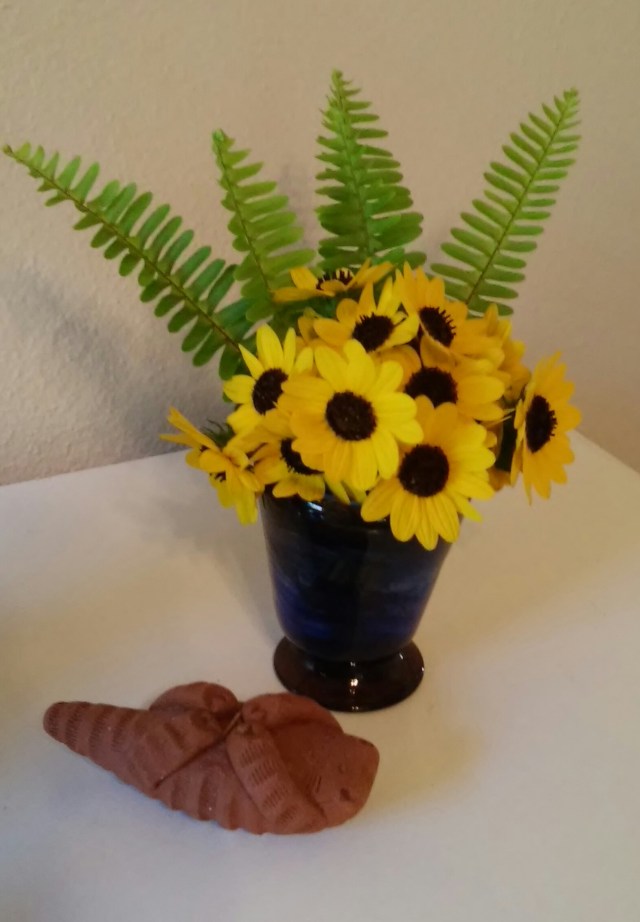
The vase is a blown glass footed object collected by my in laws at their various arts and crafts show outings. It reminds me of them and I use it for small arrangements. The cat is snoozing here as he is worn out from remembering the botanical names in the previous vase. This is simply a bunch of Beach Sunflowers (Helianthus debilis) backed by Asian Sword Fern.

I also inherited my mother’s cat, she is now old enough to drive.

CAM00186

In A Vase on Monday-Chrismukkah

20161218_103508-1

This year Christmas Eve and the first day of Hanukkah fall on December 24, the media have christened the date Chrismukkah, which I suppose sounds better than Hanukmas.

In honor of the season and Chrismukkah, I have done two arrangements, one in Christmas colors, red and green and another in traditional Hanukkah colors, blue, white and silver. Being perpetually and cursedly curious, I wondered about the origin of the color schemes.

According to Cambridge University the Christmas color scheme could go back to the Celts who used a red and green tree to mark boundaries. Here is the link, Who color coded Christmas. More research tells me the Hanukkah colors are based on the Israeli flag, why blue.

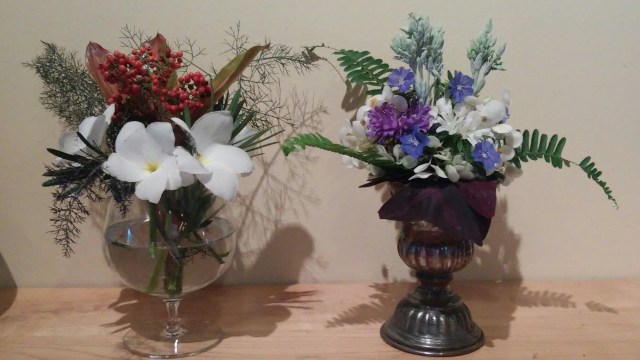
Now that we know the origins of the colors, here is the Hanukkah arrangement. The silver goblet is an heirloom from my mother’s collection and the flowers are in blue and white – Pom-Pom Asters (inspired by Cathy, our hostess) I started some seed in September and now have blue, white and perhaps pink Pom-Pom Asters, who knew they would grow in Florida in the winter.? The Asters are thriving, but alas, so far my other IOVOM flowers, the Cactus Zinnias are a disappointment. Another inspiration, White Italian Sunflowers are going, but they are showing signs of mildew, time will tell. The other blue members of this arrangement are Evolvulous, Blue Daze the annual peeking out here and there. The White Begonias are Sweet Begonias, a perennial here, the silver flowers are from Flapjack Kalanchoes. Deep plum foliage along the edges is from Purple Oxalis, from my neighbor. I think this plant may be the common thread between all of us. Asian Sword Ferns provide a bit of green.


Here is the Christmas arrangement, the original thought that it looked sort of non tropical. Then, the white Bridal Veil Plumeria is a bit difficult to explain. The dark green Yew is Japanese Yew, Podocarpus macrophyllus. Unabashedly tropical as are the red berries of the Brazilian Pepper, outlawed years ago as invasive, but determined to stay around, it is sold as Pink Peppercorn the world over and I have not eaten one of the berries near my house, but many birds have – and on the Brazilian Peppers go, The red striped foliage is from Martin Bromeliads and the ferny foliage is Copper Fennel. I think I have cut more of this than we have eaten, though it is tasty. The vase is an old Brandy snifter from my husbands ‘flaming things in a glass phase’. Go figure. Drinking flaming liquids is not my area of interest.

So, there we go. Happy Holidays to all.

In A Vase on Monday. Thrift Store Finds

20161120_150944-1

Another one of those things I never knew about living in South Florida-the thrift store shopping is excellent. I suppose many estates are settled here and the population is somewhat transient as people buy and sell vacation condos don’t use them very much and then don’t want to move the furniture. A result of all this makes for some unusual and great thrift store finds. Especially if you are in the market for pseudo tropical furniture.

I was actually looking for a table lamp when I happened upon these pottery vases. I love things that are handmade and these are a bit thick and obviously hand thrown for the fun or love or it. I bought them immediately, I spent eight dollars. Well worth it. I also found a table lamp.

While winter is approaching, actual winter in South Florida is more like a really long spring. Freezes are rare and this is gardening season. Vegetable and annual seeds are started in late summer for planting now.

One of my new vases has my first ever Cactus Zinnias, started from seed in September, these do not look nearly as good as the ones I saw in other vases this summer, I am hoping they get bigger. Also new to the garden is the Copper Fennel, which I bought by accident thinking it was Dill for my herb pots. The Tropical Red Salvia (Salvia coccinea) and Bridal Bouquet Frangipani (Plumeria pudica) are old standbys.

Between the Zinnias, Salvias, Fennel and Frangipani the fragrance of this vase is a bit weird. Kind of medicinal.


20161120_110856-1.jpg

My other new vase has a more tropical feeling, I decided to try to avoid ferns for foliage today just for a change. This vase has Parrot Flower ( Heliconia psittacorum) and the foliage and flowers of Sweet Begonia (Begonia odorata ‘Alba’)

20161120_150844-1


In A Vase on Monday – A Cross Cultural Experience

20161113_151451

This is truly a cross cultural experience. The plants, while grown in South Florida, hail from both sides of our planet, Southeast Asia and Brazil. The terracotta man in the vase is an incense burner from Pier One that belonged to my brother in the late 1970’s. I am not sure exactly where he came from but the concept was Pre Columbian. I think.

20161113_121000

The red and yellow swirling crab claws are the flower of a Blanchetiana Bromeliad, a native of the eastern side of Brazil. The plant itself is about four feet tall by six feet wide. It has been flowering for about six weeks, of course the flower is on the side I can’t really see unless I am turning the compost heap. So, I decided to cut it and enjoy it in the house as long as it lasted.

20161113_121049

These Bromeliads are relatively common in South Florida and I nearly wrecked my car the first time I saw one. Talk about wild and crazy plants, the foliage can be orange, red, green or yellow and it is big. Even though I had experience with Bromeliads I didn’t realize how big they grew. Another houseplant myth busted by Tropic Florida.

The foliage is a frond of a Lady Palm (Rhaphis excelsa). This palm is native to the Rainforest in Southeast Asia, an understory plant that enjoys shade and water. Relatively hardy, it will grown north to Orlando, and is a favorite of mine for interior use as a potted plant. I bought one a couple of years ago and it sat in the pot a little too long, so it is a bit lopsided and has finally recovered its healthy deep green color and need a little trim.

Here is a shot of my Rainforest Garden, where the Lady Palm lives.

20161113_111728

In A Vase on Monday-The Pumpkin Chronicles

20161030_125437-1

In a Vegetable on Monday, Part Two. My gourd collection from last week was looking pretty good so I decided to add to the arrangement with an heirloom pumpkin for Halloween. Today is Halloween in the US, traditionally the time to carve a pumpkin into a Jack O Lantern then go door to door seeking chocolate (or that is how I think of it).20161028_185146

This is a Jarrahdale Pumpkin, totally non traditional and it hails from Australia. My father was an enormous fan of pumpkin carving so in his honor, I carve a pumpkin every Halloween. I decided to research this one a bit to see if it was edible – it is, and reportedly has sweet, melon like flesh perfect for pies. My husband is regionally famous for his pumpkin pies – so I read on to find that I should roast the pumpkin for 20-30 minutes if I wanted to save the flesh and then scoop out the flesh and continue with my ‘decorative use’.

Upon the completion of the short roasting time, the shell had changed color a bit and the flesh was slightly softer, but not cooked, so I chiseled it out with a serrate knife, being careful to use my not so nice knife in case it snapped. The pumpkin looked a bit like a crocodile so I carved a mean face into it. The flowers may offset the meaness.

20161030_120142-1

Not so sure about the flesh, I just collected it and put in back in the oven to roast and set about arranging the flowers.

20161030_125613

Starting in the front, the yellow flowers are Beach Sunflowers (Helianthus debilis) the coral star shaped flowers are Dwarf Red Ixora, with a bit of Asian Sword Fern. The red and green leafless stems are from a Firesticks Pencil Cactus (Euphorbia tirucalli), red and yellow flowers are Parrot Flower (Heliconia psittacorum), red bell shaped flowers are from Firecracker Plant (Russelia), the grey foliage is from Flapjack Kalanchoes and a leaf from Split Leaf Philodendron (Philodendron selloum) completes the arrangement. The flowers are in a glass I put into the pumpkin, there is also a tealight candle in there, but I have mixed feelings about lighting it.

About this time, I took the pumpkin out of the oven, let it cool, had a taste and discovered it it really good and does taste of sweet melon – unfortunately, after all that I ended up with 1/2 cup of pumpkin puree. Pumpkin bread, anyone?

20151030_200543-1

Here is a much more traditional Jack O Lantern from years past, Happy Halloween!