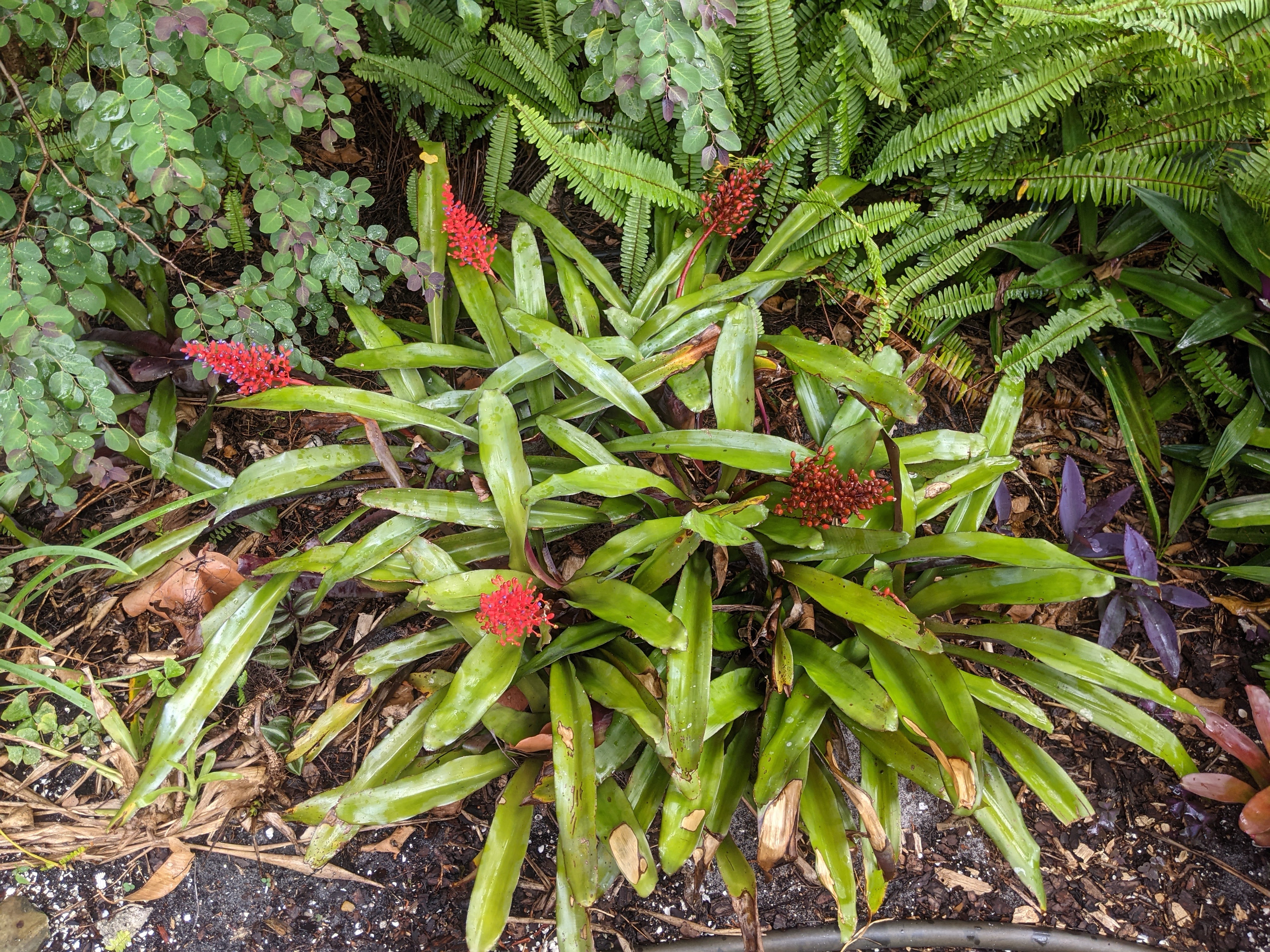
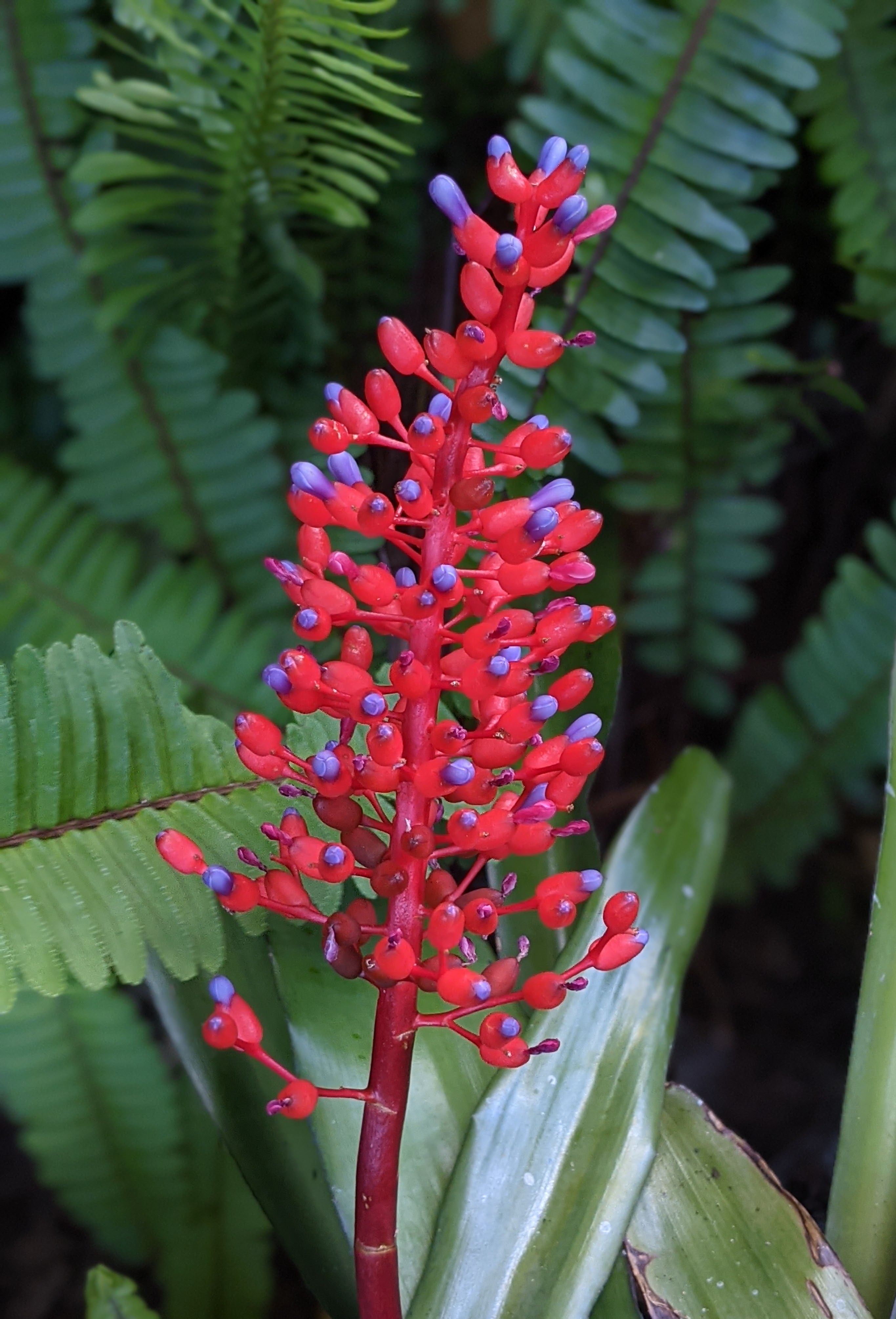
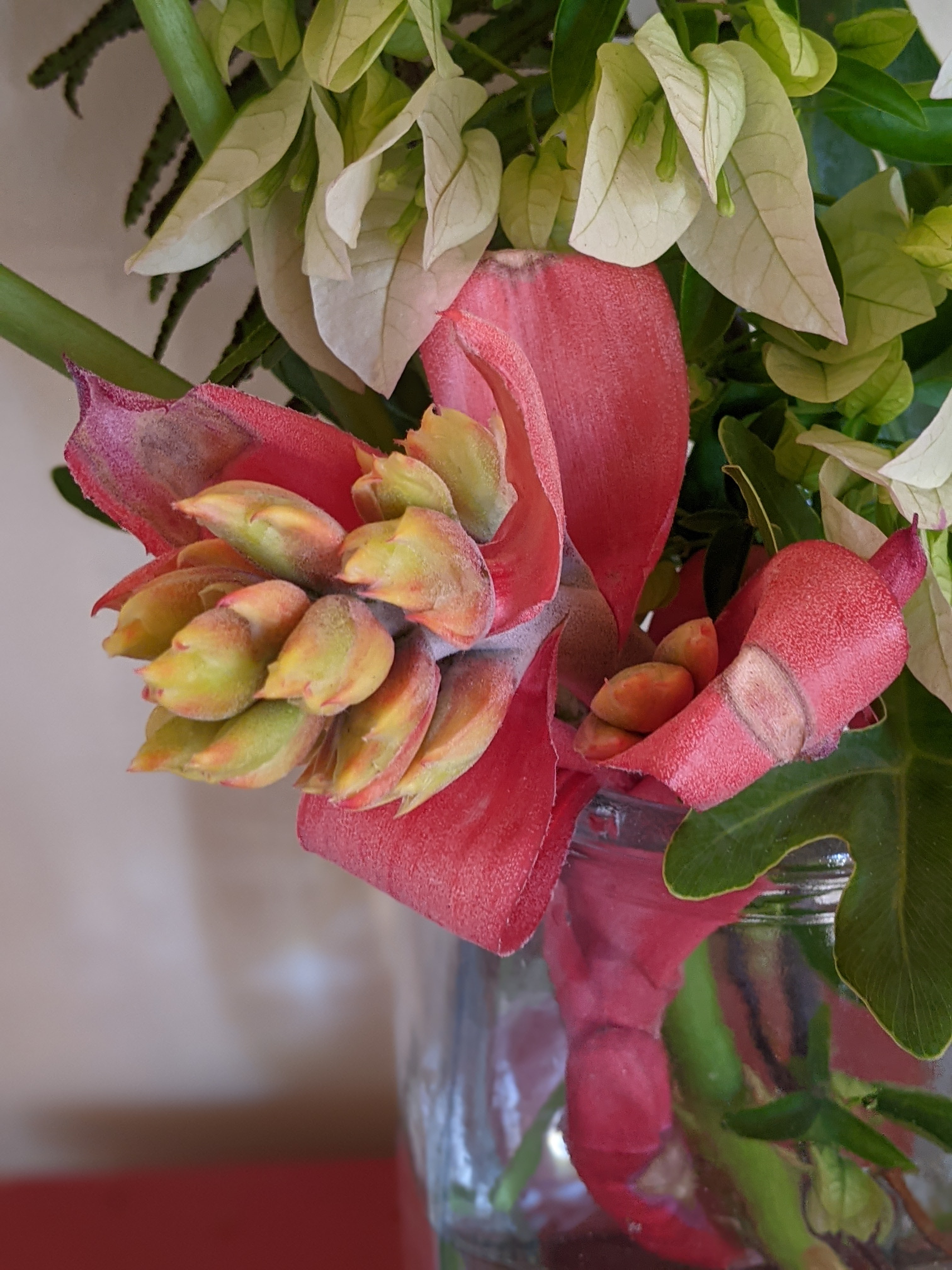
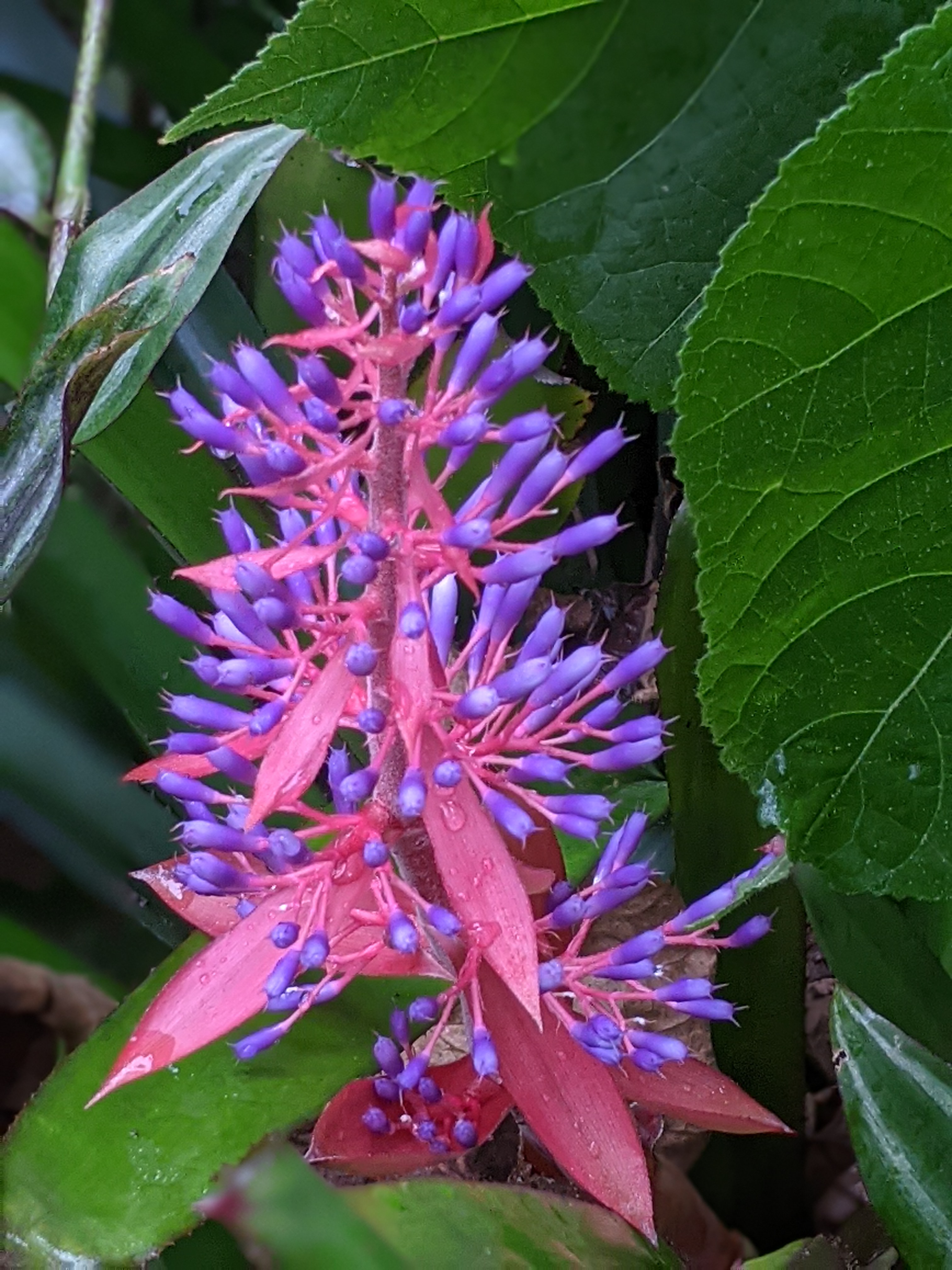
Joining Cathy at http://www.wordsandherbs.wordpress.com for Day Four of AWIF. Follow the link to see more floral loveliness. I am featuring more Bromeliad madness from my garden. Above is Aechmea miniata, a favorite of mine as it is a reliable summer bloomer and really funky. A closer view:
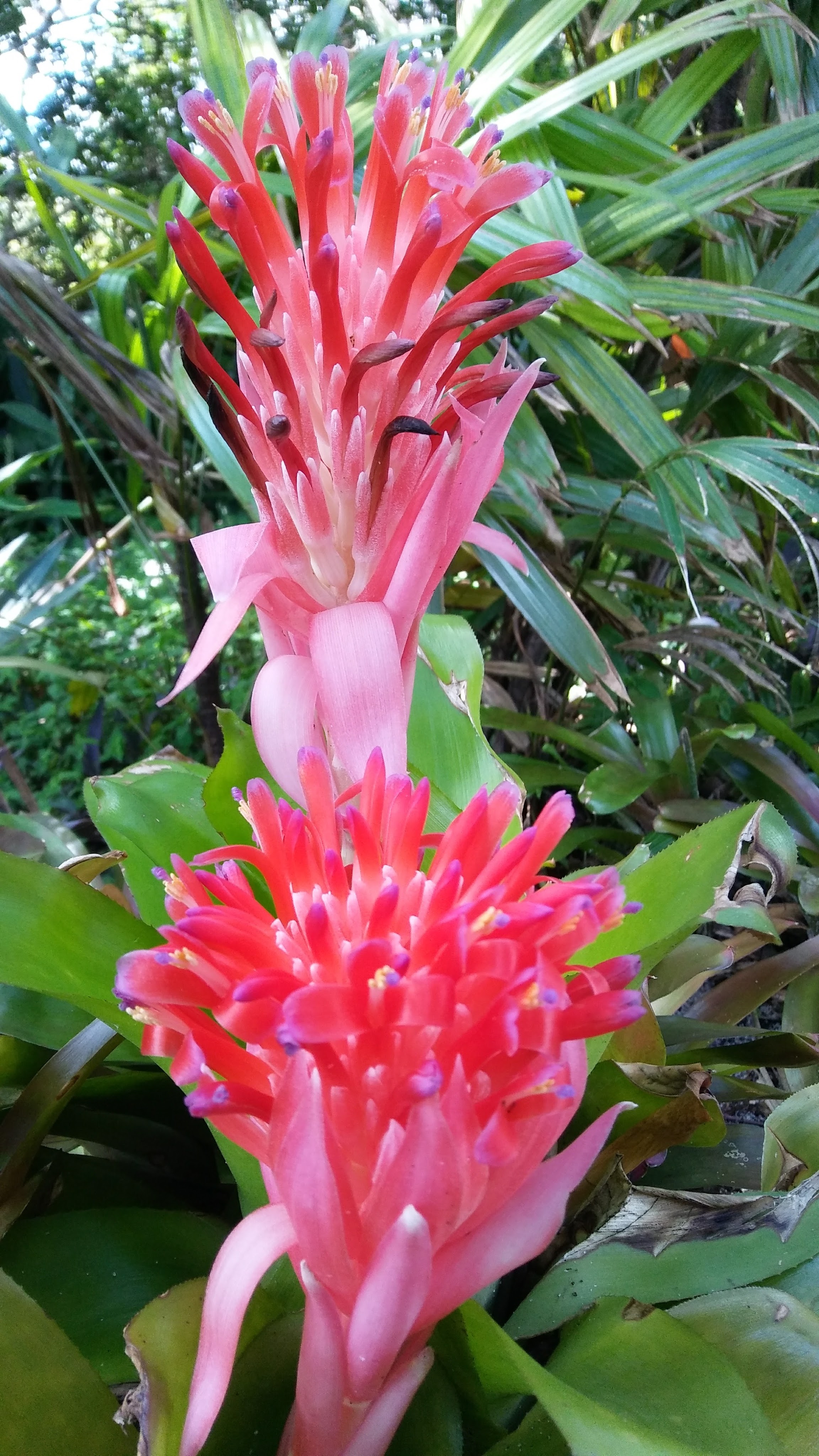
Another summer favorite the Torch or Hurricane Bromeliad, it flowers at the peak of hurricane season and looks like a torch.
I am joining Cathy at Words and Herbs for the second edition of AWIF, posting photos of floral abundance. Today, Bromeliad madness from my garden to spread some tropical warmth.
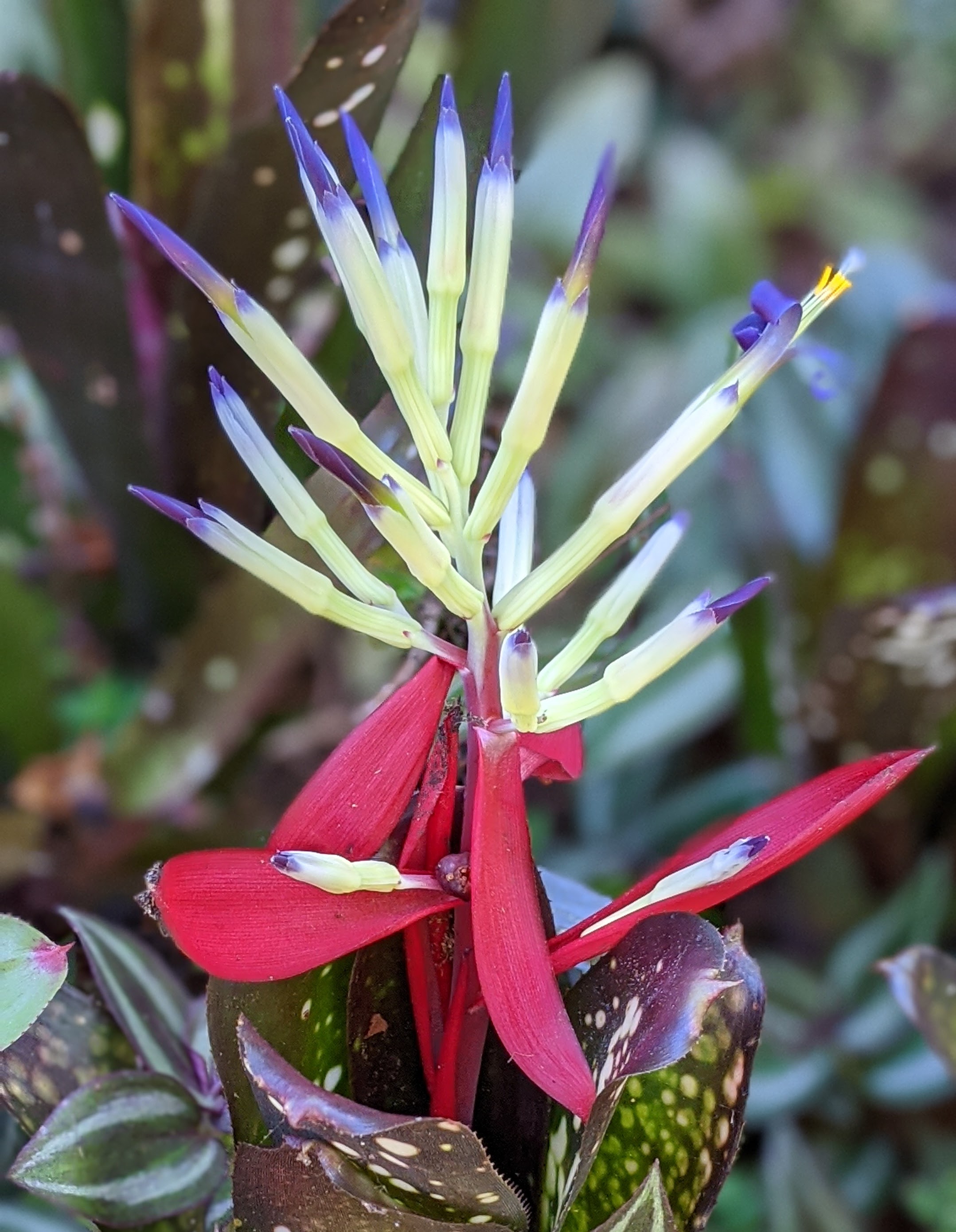
This is a Hallelujah Billbergia Bromeliad, perhaps the maddest of them all. Purple, green and white spotted foliage with red, white and blue flowers.
Another Billbergia of unknown name with a much calmer flower.
Little Harv Aechmea, a close up.
Little Harv in the garden. Little Harv is not so little and is another armored Brom. He was moved away from the walkway as I kept getting stabbed in the calf.
Last, but not least, one of my favorites, with six foot tall flowers, no less. – Aechmea blanchetiana.
I have been inivted to share flowers from my garden daily for a week by Cathy at Words and Herbs on WordPress. The idea is to brighten winter days and add some color to our cyberworld. Follow this link to see more flowers from around the world. https://wp.me/p1RJ1n-5Ya
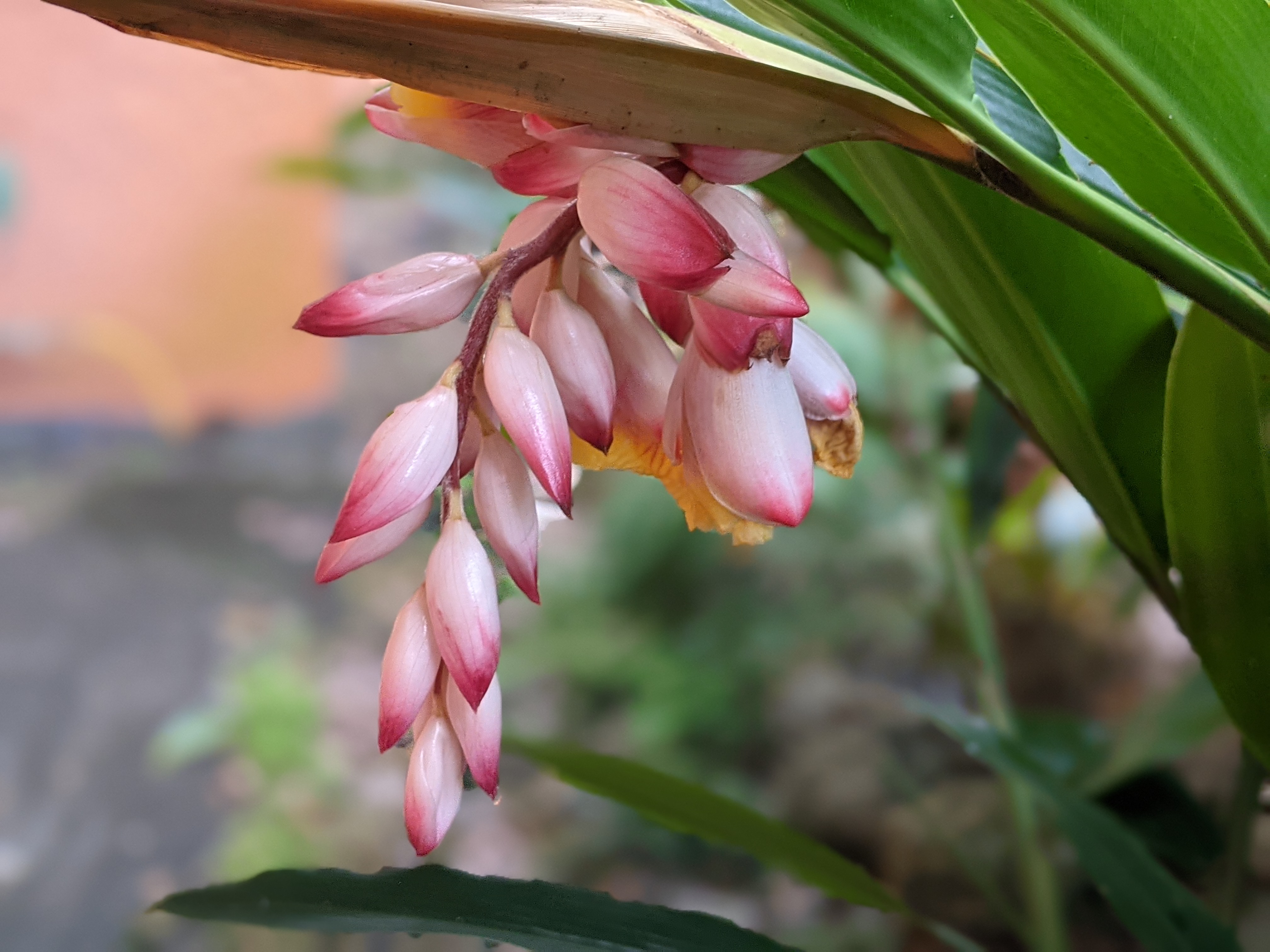
I have chosen winter tropicals from my South Florida garden for today. Above is Shell Ginger (Alpinia zerumbet) a favorite of mine that can flower three times a year if in the mood.
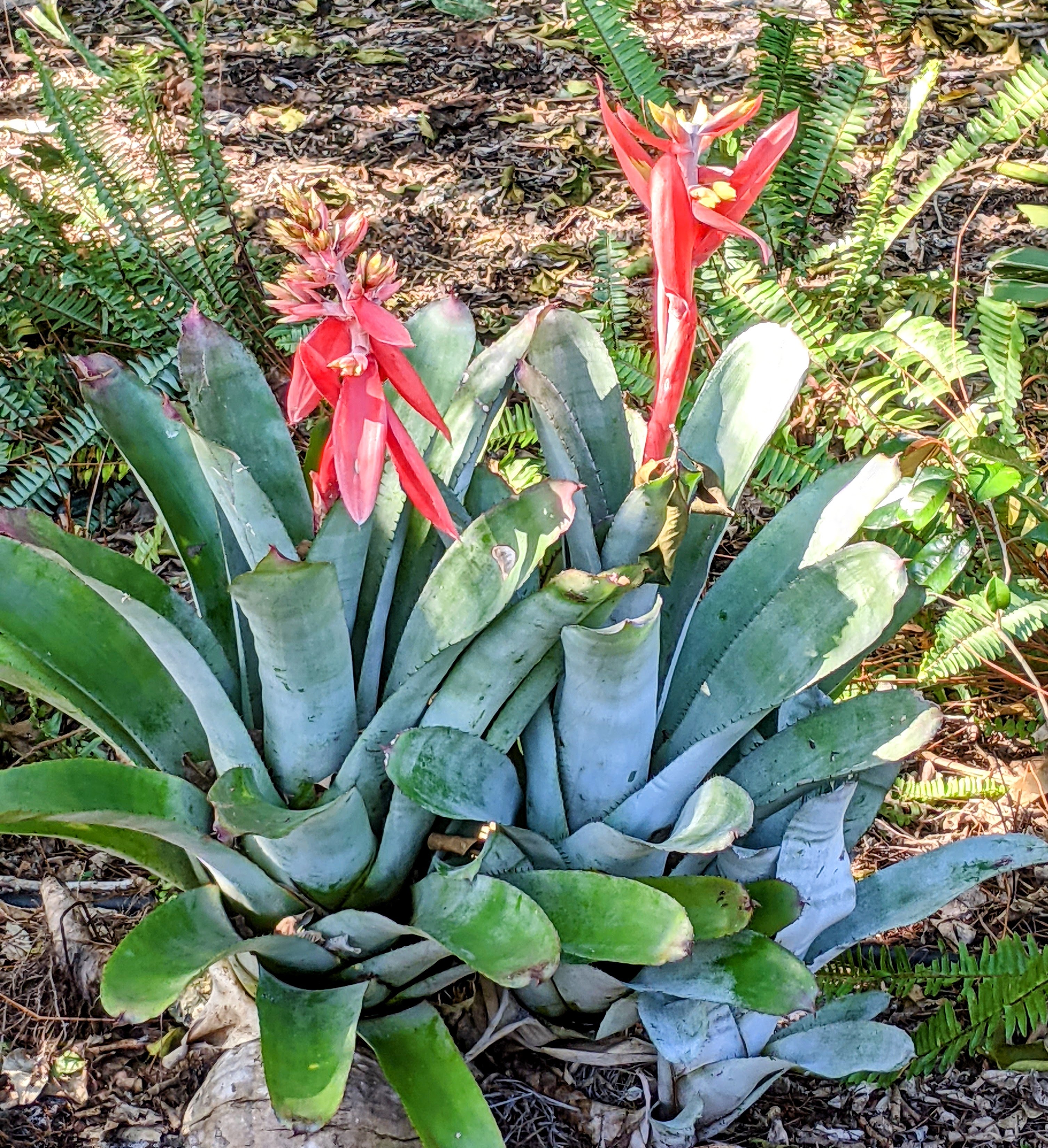
This is a winter flowering Bromeliad, Quesnelia testudo. I think of these as tulips for the tropical garden. They flower in February and March and are reliable for returning and increasing in mass over time. The downside? One very sharp thorn on the end of every leaf.
Thanks to Cathy for hosting. Happy Gardening or flower watching this week.
I am so pleased to have finally successfully grown Cactus Zinnias. Ta da!
My first several attempts resulted in oddly dwarf flowers that were never more than a single flower. These are doubles and the plants are very healthy with big, deep green leaves. This fall, I decided to plant cutting flowers in grow bags to see if it worked better than my futile efforts to amend the existing sugar sand in my garden. After installing bags and bags of compost, worm castings, mulch and irrigation – I still ended up with puny flowers. Here are the happy Zinnias in their bag:
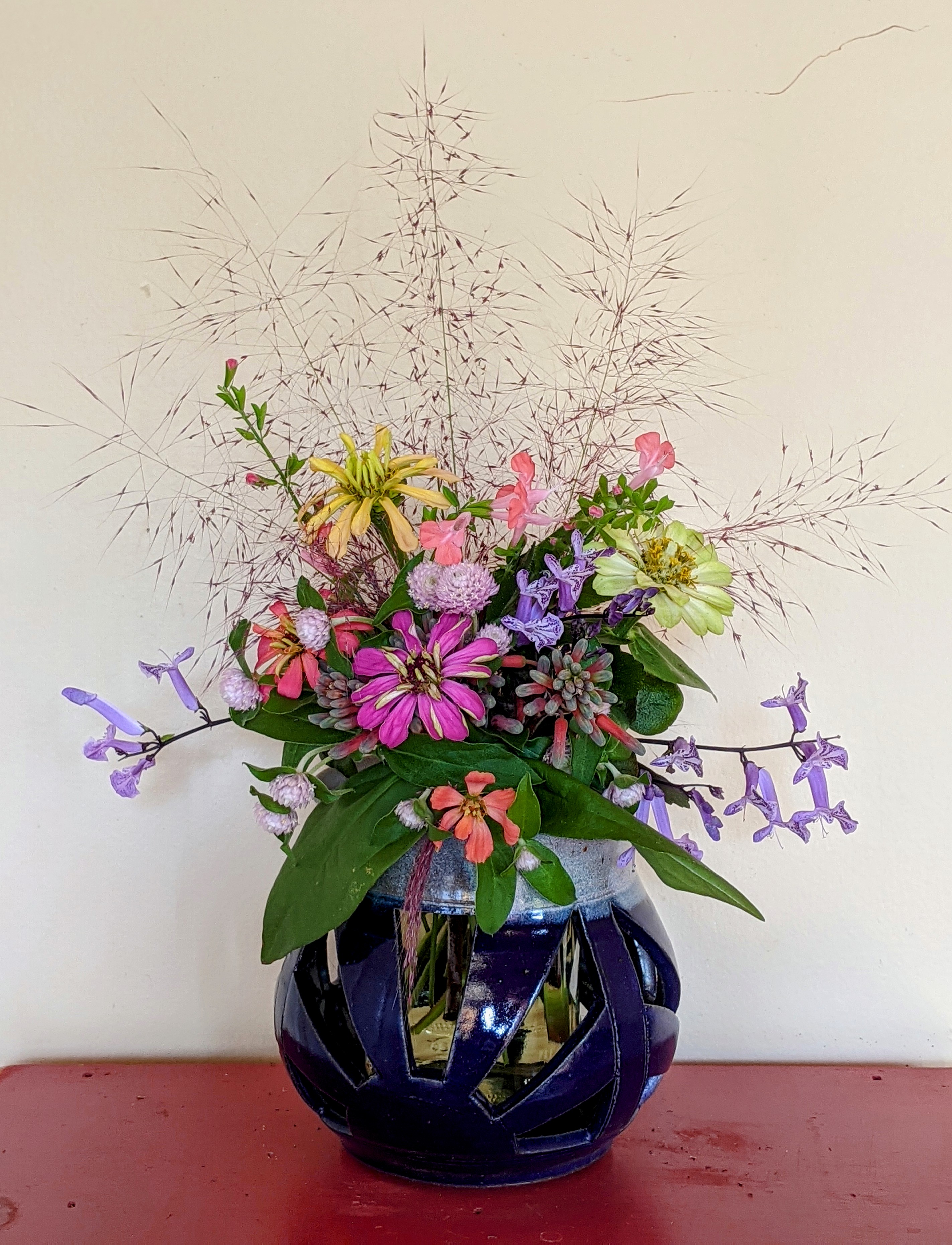
The arrangement is a mixed bag of fall and winter flowers in my garden. Multi colored is probably the best way to describe it. The vase is a pottery candleholder my parents used in summer to hold citronella candles while they sat on their brick patio and drank untold gallons of dreadful Carlo Rossi Chablis. I put a pickle jar inside to hold water and flowers. The vase holds fond memories for me.
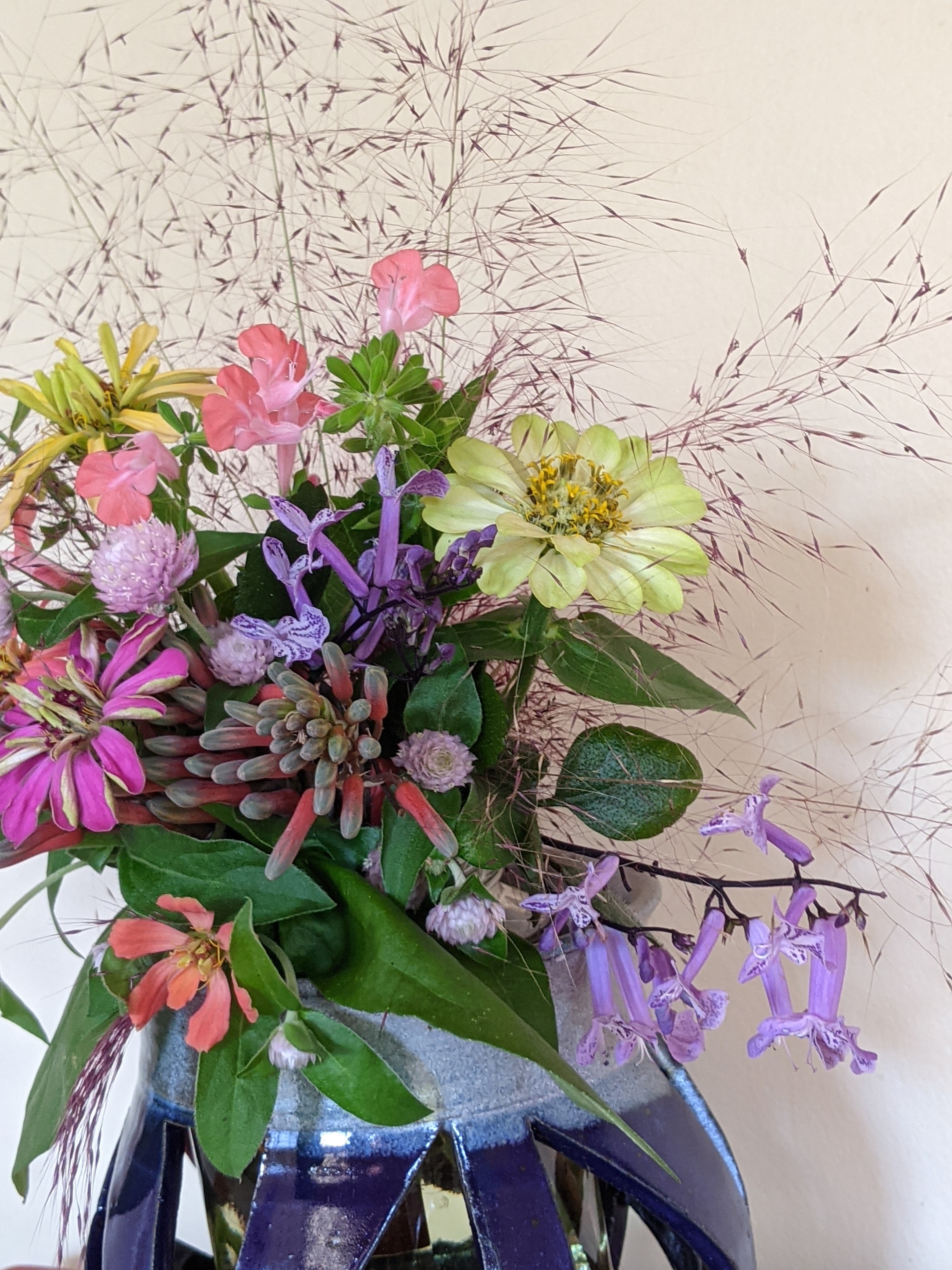
A closer view:
The green Zinnia is Green Envy, these are new to me and my garden. I have planted them with Mystic Spires Blue Salvia and am planning to add chartreuse Sedum below. Green tipped salmon flowers are Soap Aloe (Aloe saponaria); purple spikes are “Mona Lavendar” Plectranthus; salmon spikes are Tropical Red Salvia (Salvia coccinea); pale pink clovers are Globe Amaranth.
The other side:
The Cactus Zinnias are in yellow, pink, purple and salmon. Misty pink flowers are from Muhly Grass (Muhlbergia capillaris).
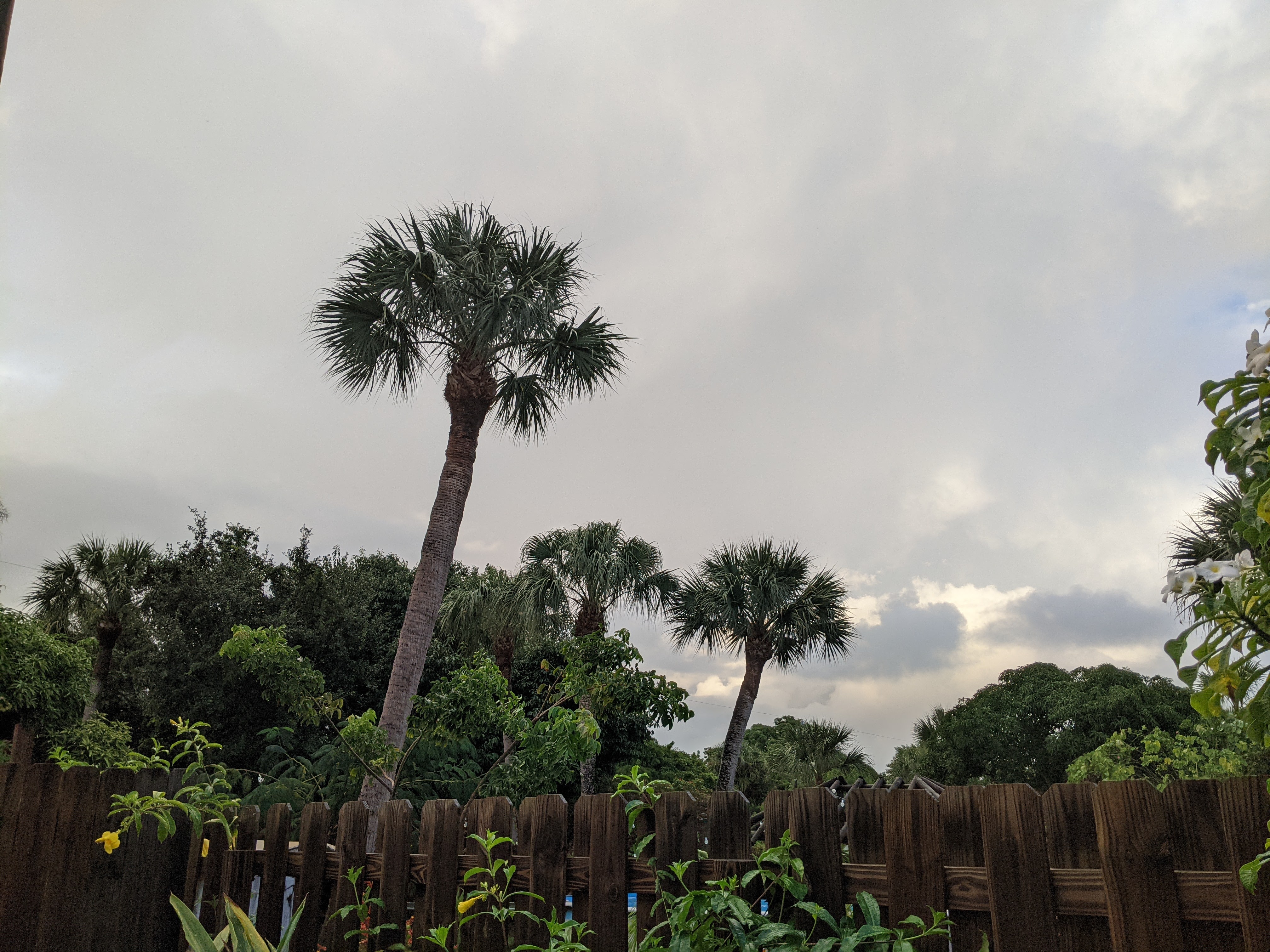
Gloomy is not usually a term I associate with the “dry season” in South Florida. It has been raining and overcast since the middle of last week. We Floridians are addicted to sunshine. The garden is clearly enjoying the rain and hopefully the good plants will absorb more than the weeds. Though I can see the cool season weeds germinating wantonly as I dodge the raindrops walking my greyhounds.
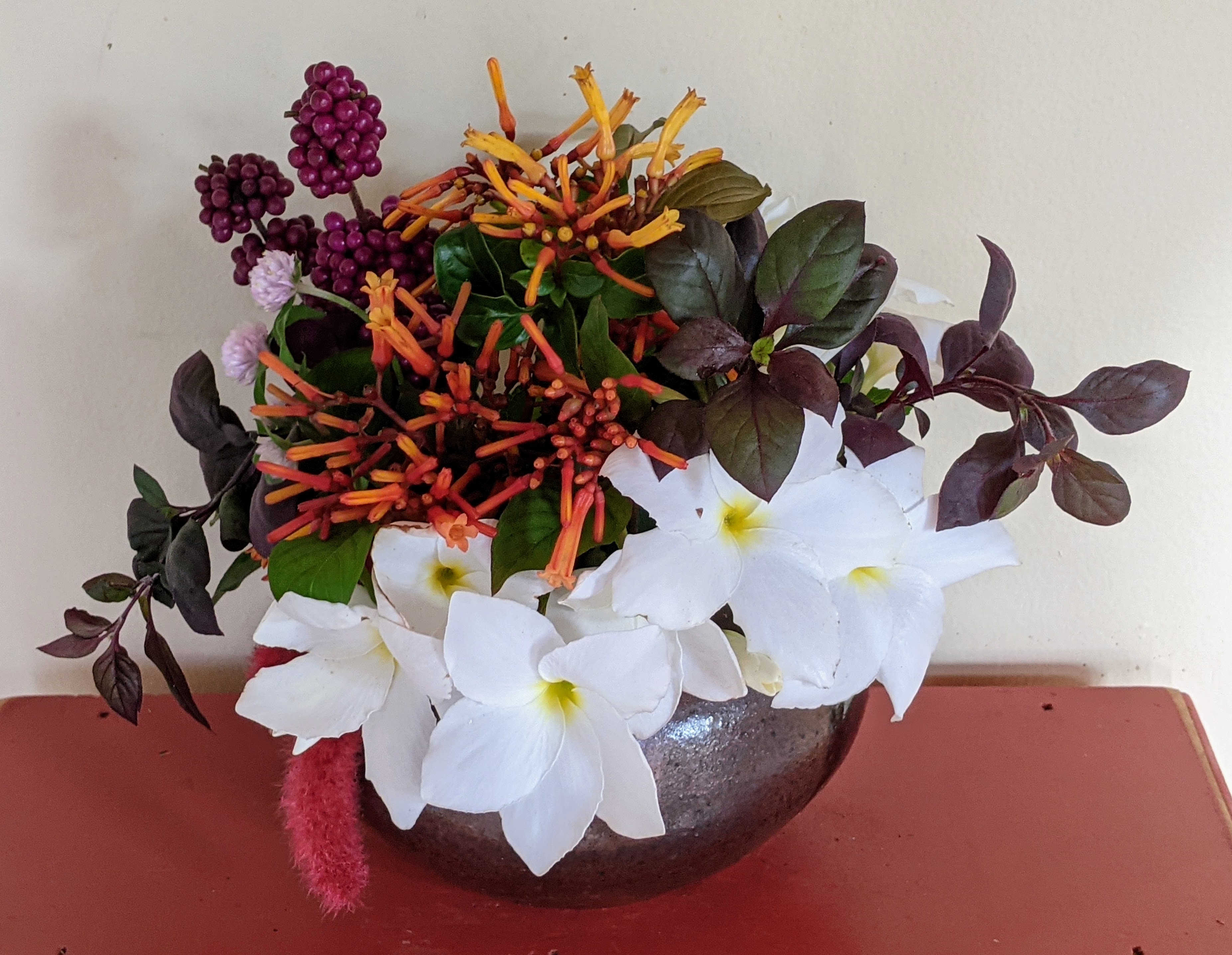
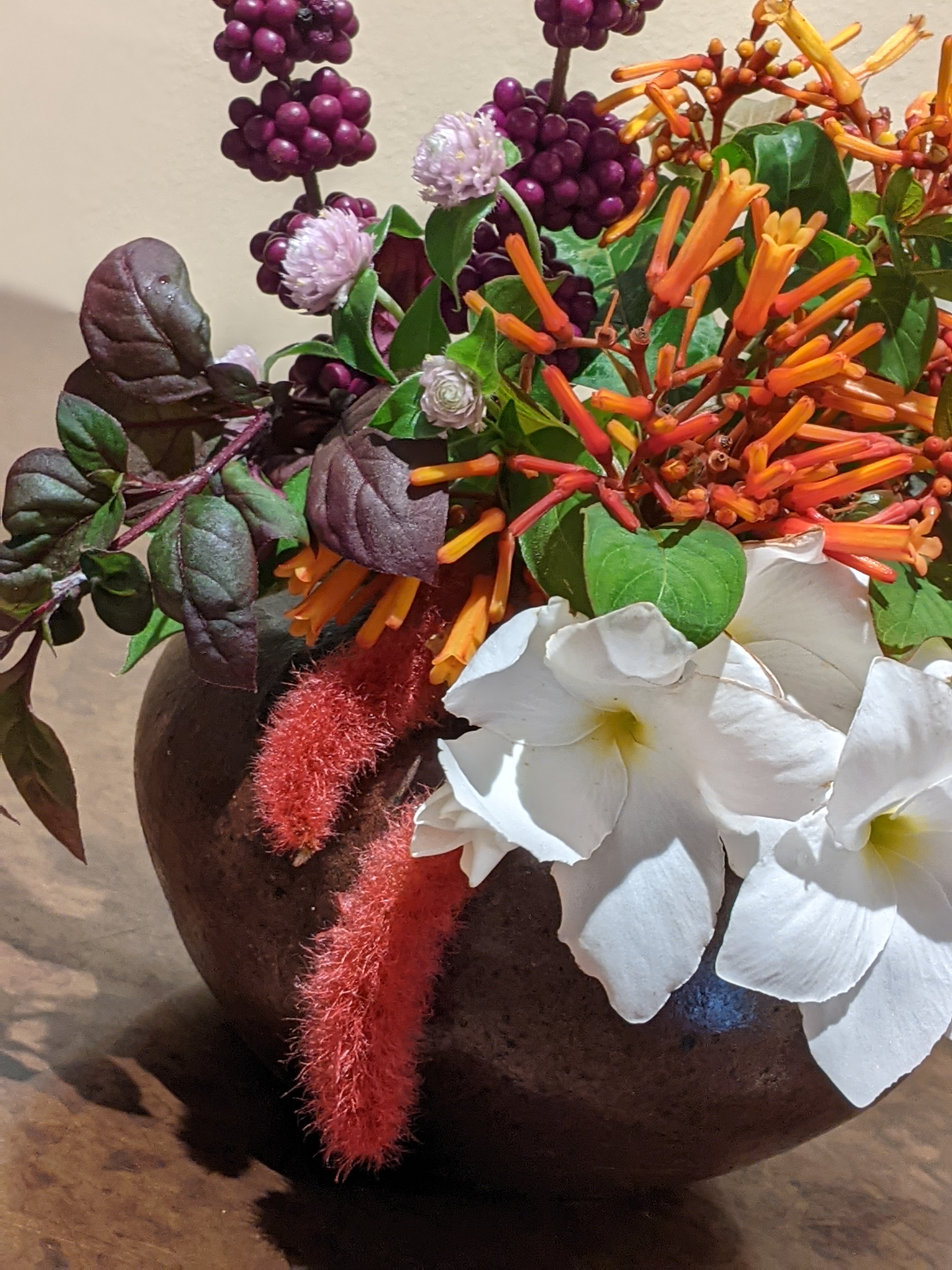
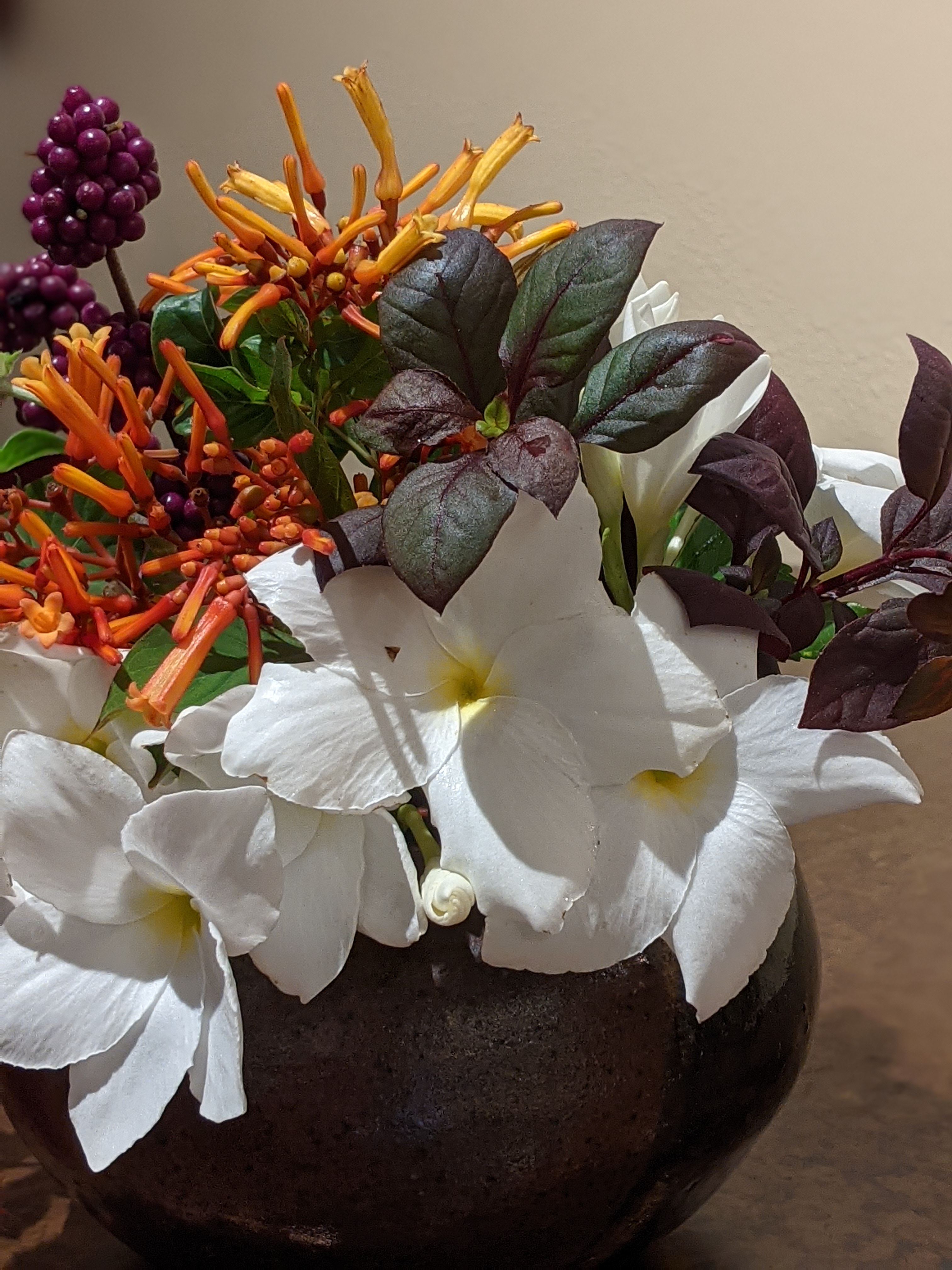
Our moods, needing improvement with some floral friends made me search high and low from the safety of my covered porches to spy some colorful and hopefully a little bit tropical flowers to grace my vase this Monday. All of the components of this vase were cut within a mad dash from our doors.
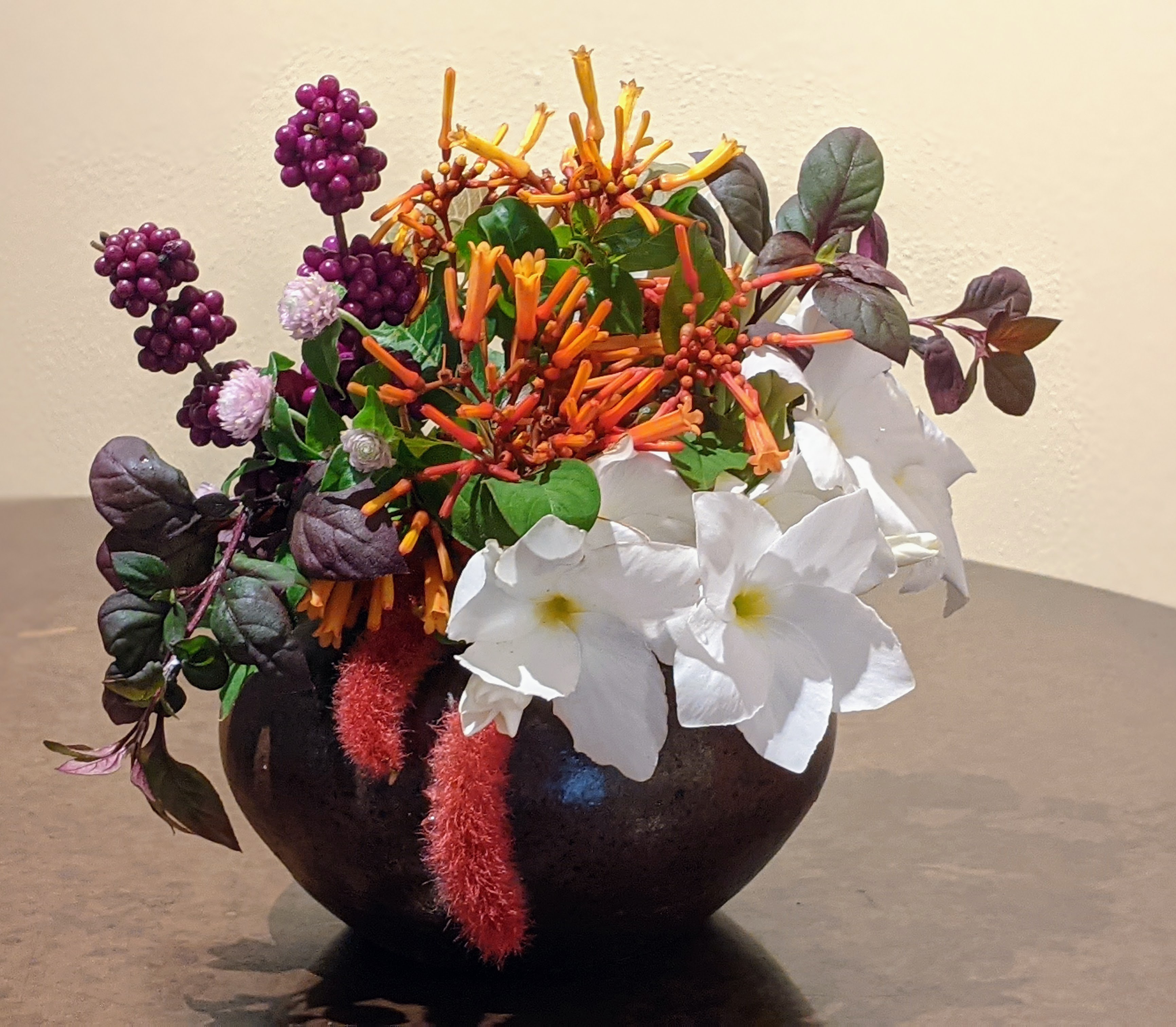
Another view:
Some closer views:
Purple berries are Beautyberry (Calliocarpa americana) – planted by the porch to deter mosquitoes. I think it works. Though I have no comparison. Pink cloverish flowers, some free Globe Amaranth I grew from seed I got from Etsy. Fun, but, yeah looks like clover and is a wimpy color. Not a big fan of pale pink. Darker pink wooly worms, Dwarf Chenille Plant (Acalphya pendula), just tropical fun and a great cut flower. Orange flowers, Firebush (Hamelia patens) grows near front and back doors and a perennial (ha) favorite.
White flowers are from Bridal Bouquet Frangipani (Plumeria pudica). These are slowing down though some consider them evergreen, I do not. Enjoying the slightly fragrant flowers til the bitter end (winter 2022?). Purple foliage is Alternanthera “not sure which one”
The weather seems to be clearing and I hope to be back in the garden soon.
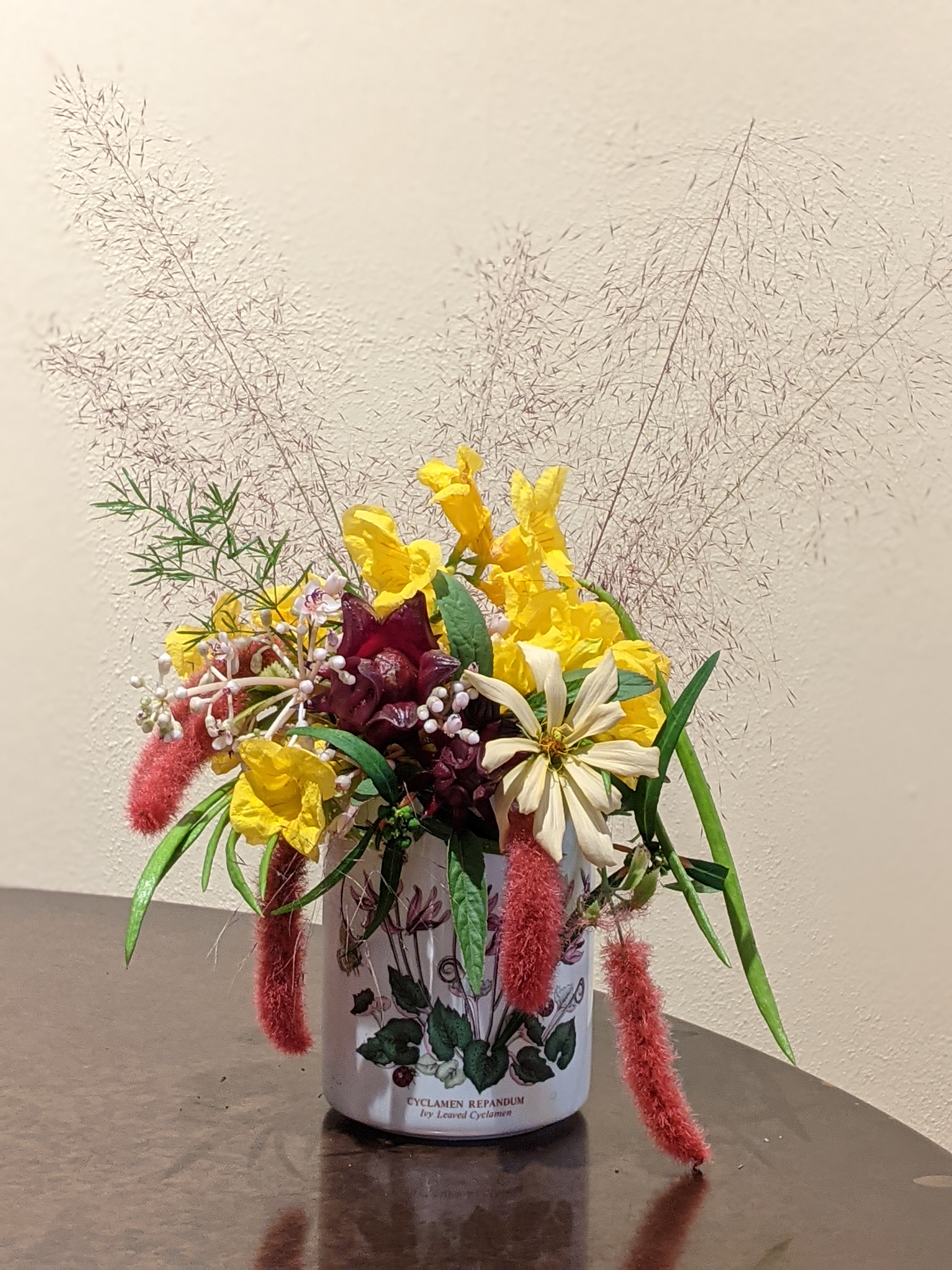
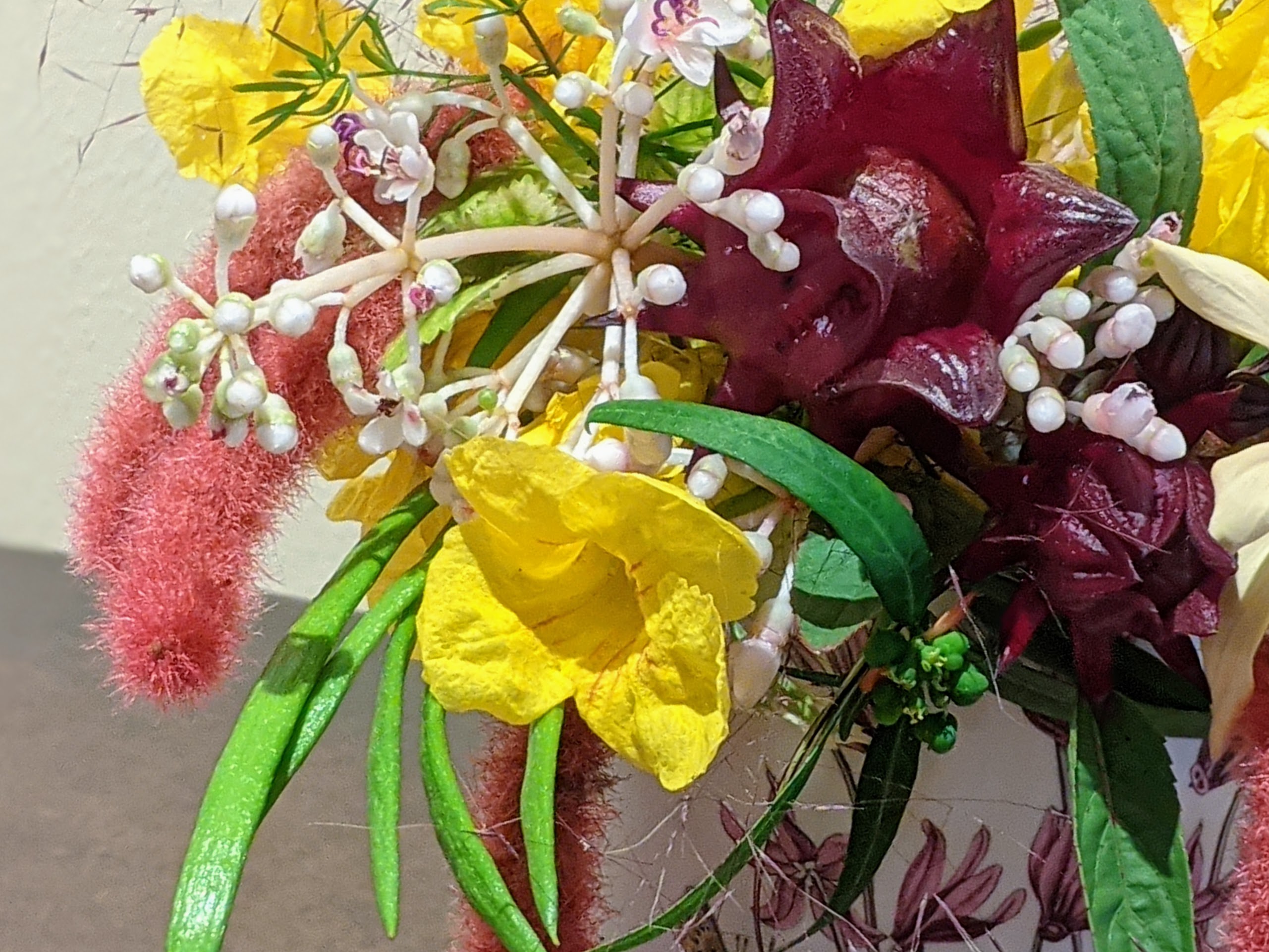
I truly enjoy the wild things (they make my heart sing) I grow in my South Florida garden and have filled, well, not a vase – but a Portmerion canister with fall wild things. Maybe I should call them weird things, though there is not a song for that!
A closer view:
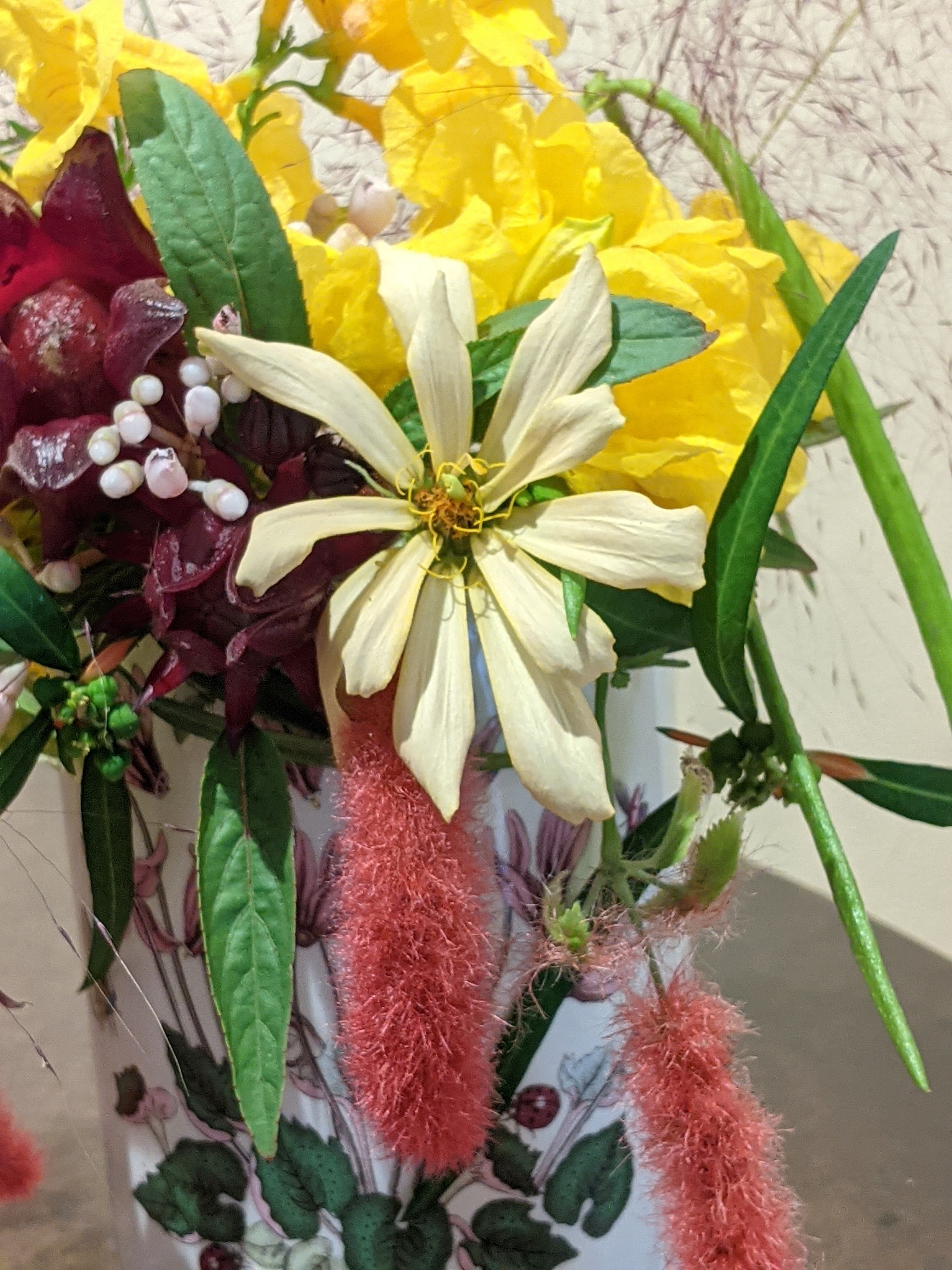
The pink fuzzzies (hubs refers to them as wooly worms) are from Dwarf Chenille Plant (Acalypha pendula); pale pink chandeliers are from the Chandelier Plant (Medinillia cummingii); burgundy edible flowers are Roselles (Hibiscus sabdariffa); yellow flowers and green beans are Esperanza (Tecoma stans). There is a bit of Asparagus Fern in there for green texture.
Ivory Zinnia is my first flower from Cactus Zinnia seeds I started in September. I have Green Envy Zinnias (started at the same time) budding and am hoping I have figured out when to plant Zinnias here. I noted some mature Zinnias around when I planted seed so it may be a two Zinnia season here?? Fluffy pink grass in the background is Muhly Grass (Muhlbergia capillaris)
My vase from last week (Palm berries, etc.) is holding up nicely. The bits and bobs have settled a bit and are drying in place, colors are deepening. This may end up being a dried holiday arrangement with the addition of some sparklies, time will tell.
Last Monday, a challenge was issued to celebrate the eighth anniversary of In a Vase on Monday. Cathy, founder and host of IAVOM, threw down the gauntlet. The challenge, for this week – create a vase without using fresh flowers.
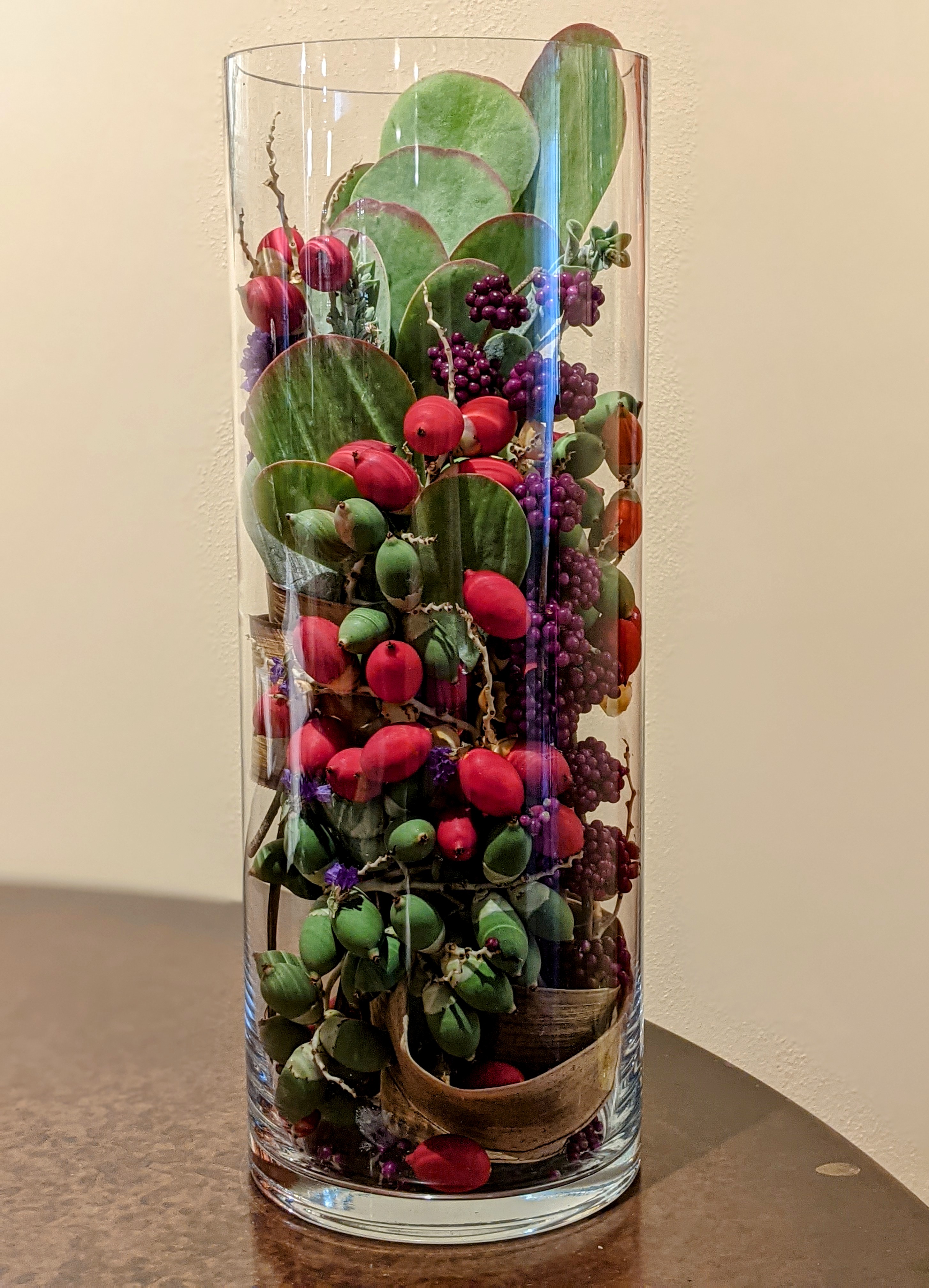
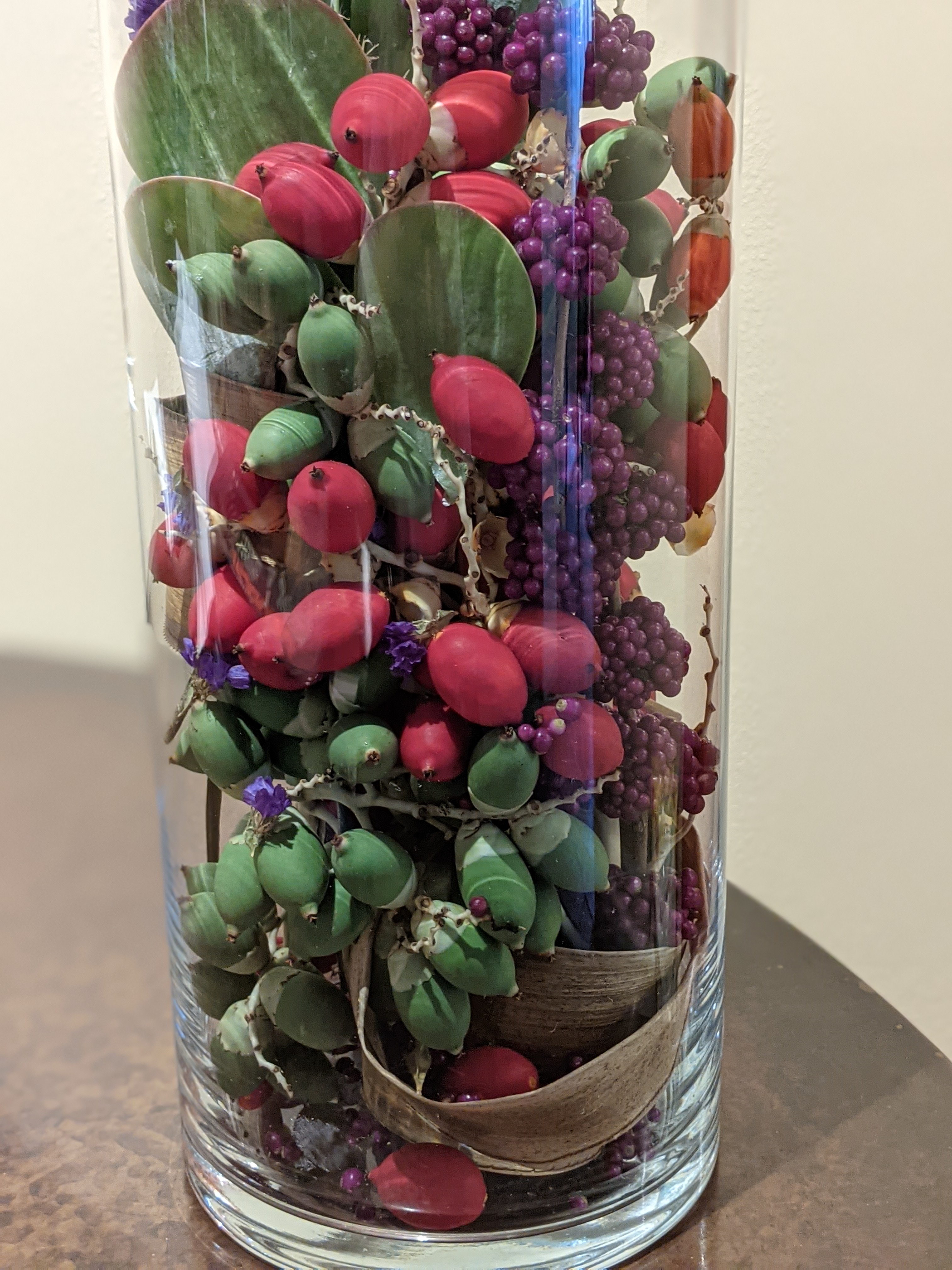
May I present a completely inedible (to most people) berry parfait from my garden. I should invite eight birds, squirrels or lizards for a feast. The lizards are big in South Florida. People can eat these berries, most would chose not too. Tasty they are not.
The parfait is tall – 16 inches (40 cm). Our former house in Atlanta had a two story space in the living room. I kept huge vases in that room and have two tall vases I still enjoy from time to time. This is my first garden fruit parfait.
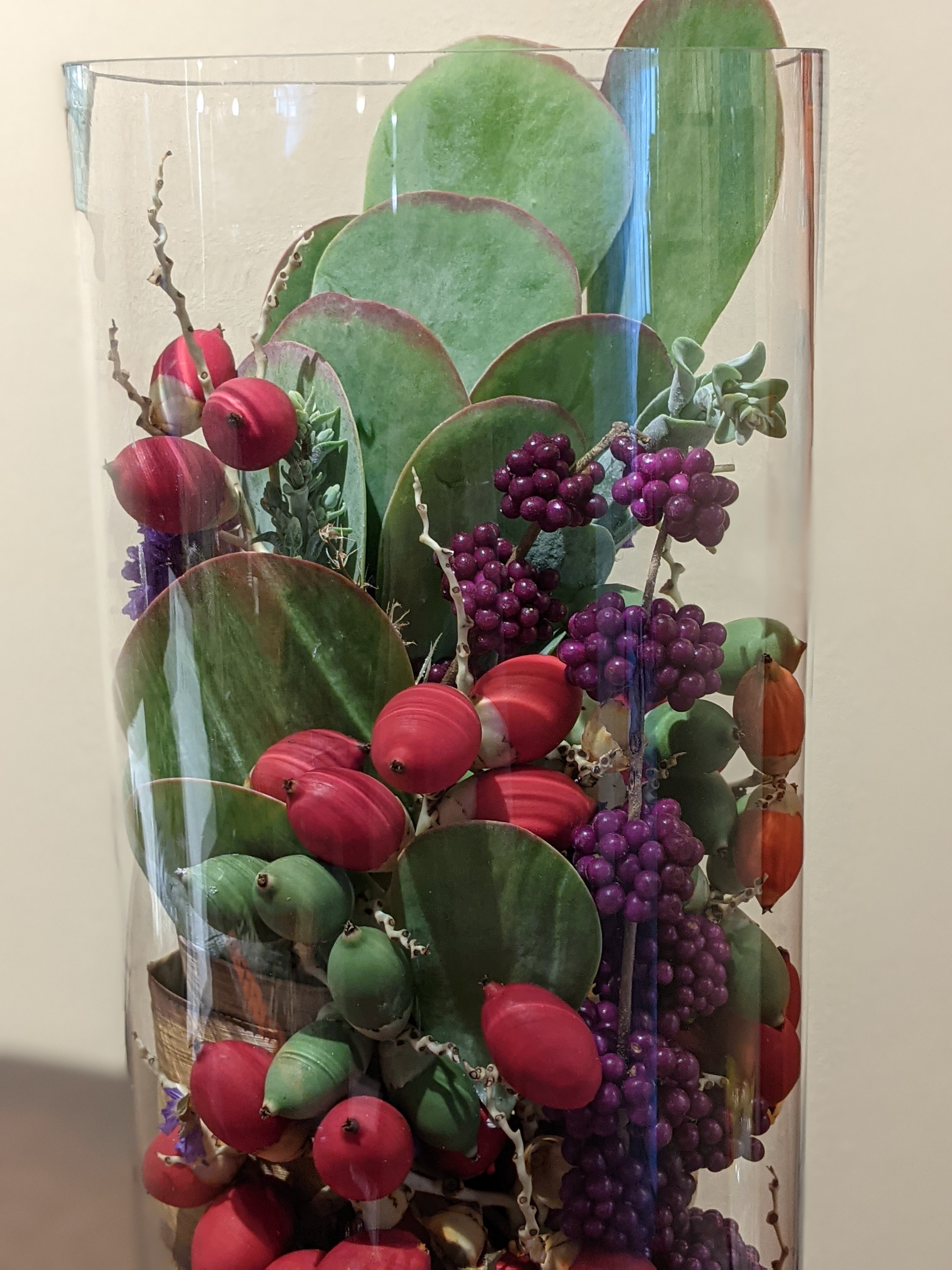
Closer views:
The top of the vase. The grey paddles are Flapjack Kalanchoe (Kalanchoe thyrsiflora) flowers. I have had Flapjacks around for so many years I am not sure of their origin. They grow in containers around my garden. I move them around – so easy to grow here. Green and red berries are from the Adonidia or Christmas Palm (Adonidia veitchii); another favorite of mine. This palm was grown from seed by a friend from Landscape Architecture school, Eddie, he gave me a palm seedling in 2013. The seedling is now 14 feet tall.
Purple berries are from Beautyberry (Calliocarpa americana). I bought the shrubs from a native plants nursery going out of business sale several years ago. The amount of fruit borne in the summer and fall continues to amaze me.
Dried foliage from past vases, Blanchetiana Bromeliads used to wrap jars, has been utilized in its curly state to hold stems in place as I was stacking the fruit and foliage. A few bits of Statice dried from flowers sent by a friend are visible in purple.
November is usually a glorious weather month in South Florida. The past few days have been cold and rainy, which is odd. Temperatures have been in the 60s (F)/15(C). We are cold, my greyhounds are covered in a film of sand and so are the floors. The dogs have enjoyed racing in the cool weather. The garden soaked up the rain and provided some bounty for the gardener.
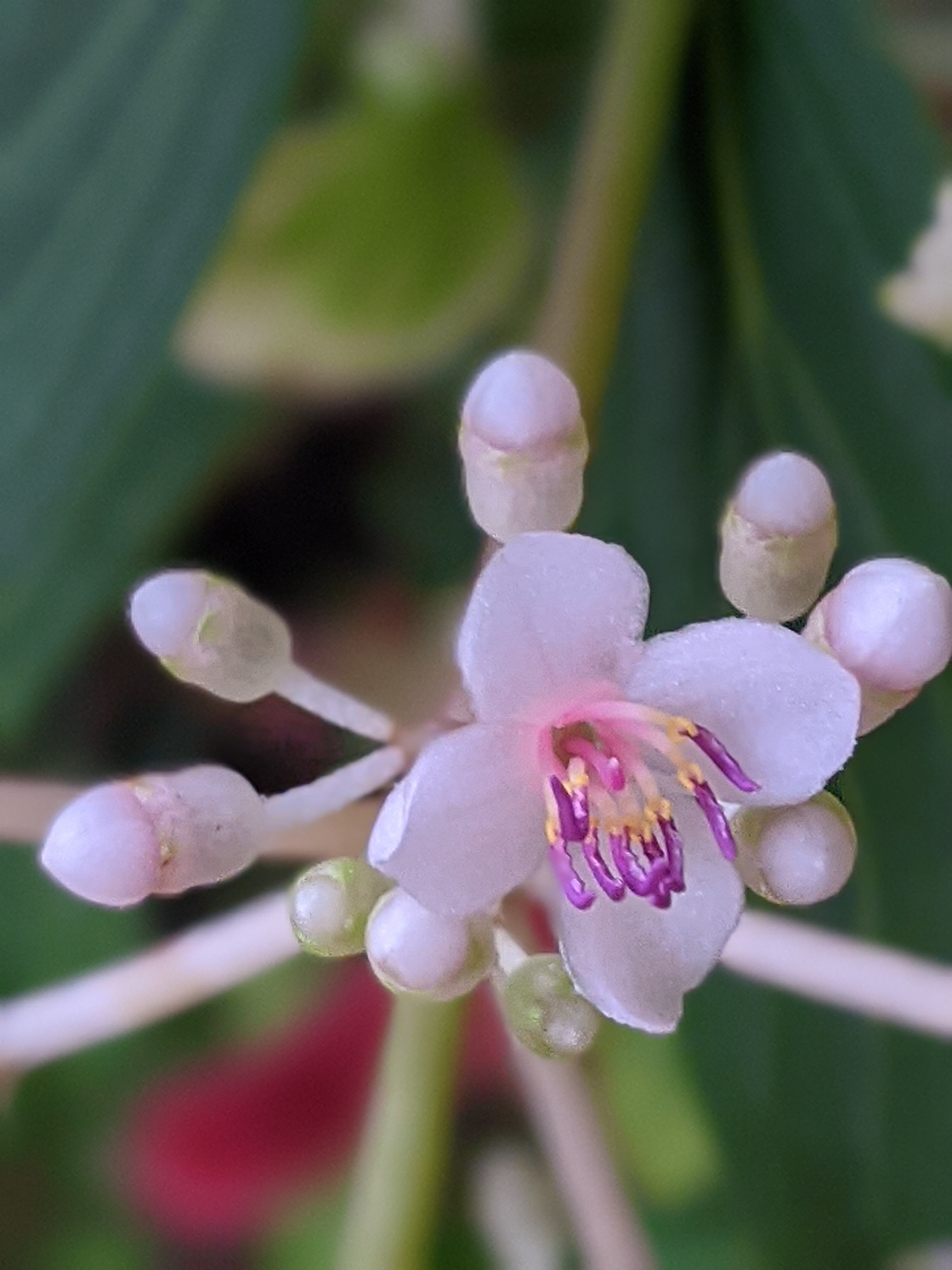
New to the garden this year and the first time I have seen the flower – Medinilla cummingii. Chandelier tree is its common name and a very apt description of the plant. It has numerous buds and I am waiting for the full flowering. Should be spectacular. These are similar to orchids, ocurring naturally growing in trees somewhere in the South Pacific. It must be a fabulous forest. This one is shares a pot with Dwarf Chenille Plant on my front porch.
A closer view of the flower.
I started seeds earlier this year (September) and have my first bud on the Cactus Zinnias.
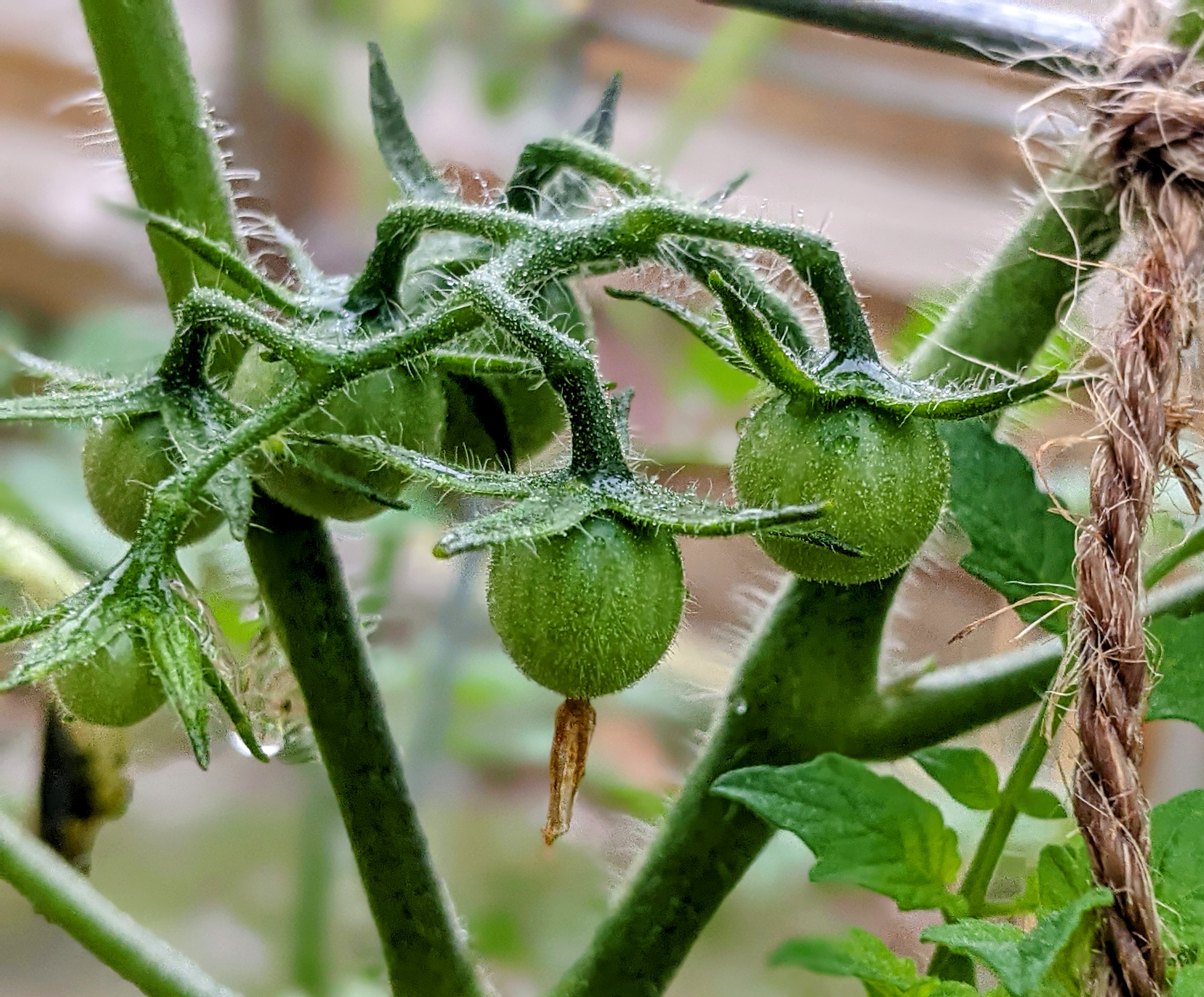
Tomato seeds were started at the same time in early September. I planted Yellow Pear and Sweet 100 cherry tomatoes, these look like neither, but I hope to eat some next week.
I espaliered the red flowering Nodding Hibiscus shrub to my neighbor’s fence – very pleased with how it is turning out.
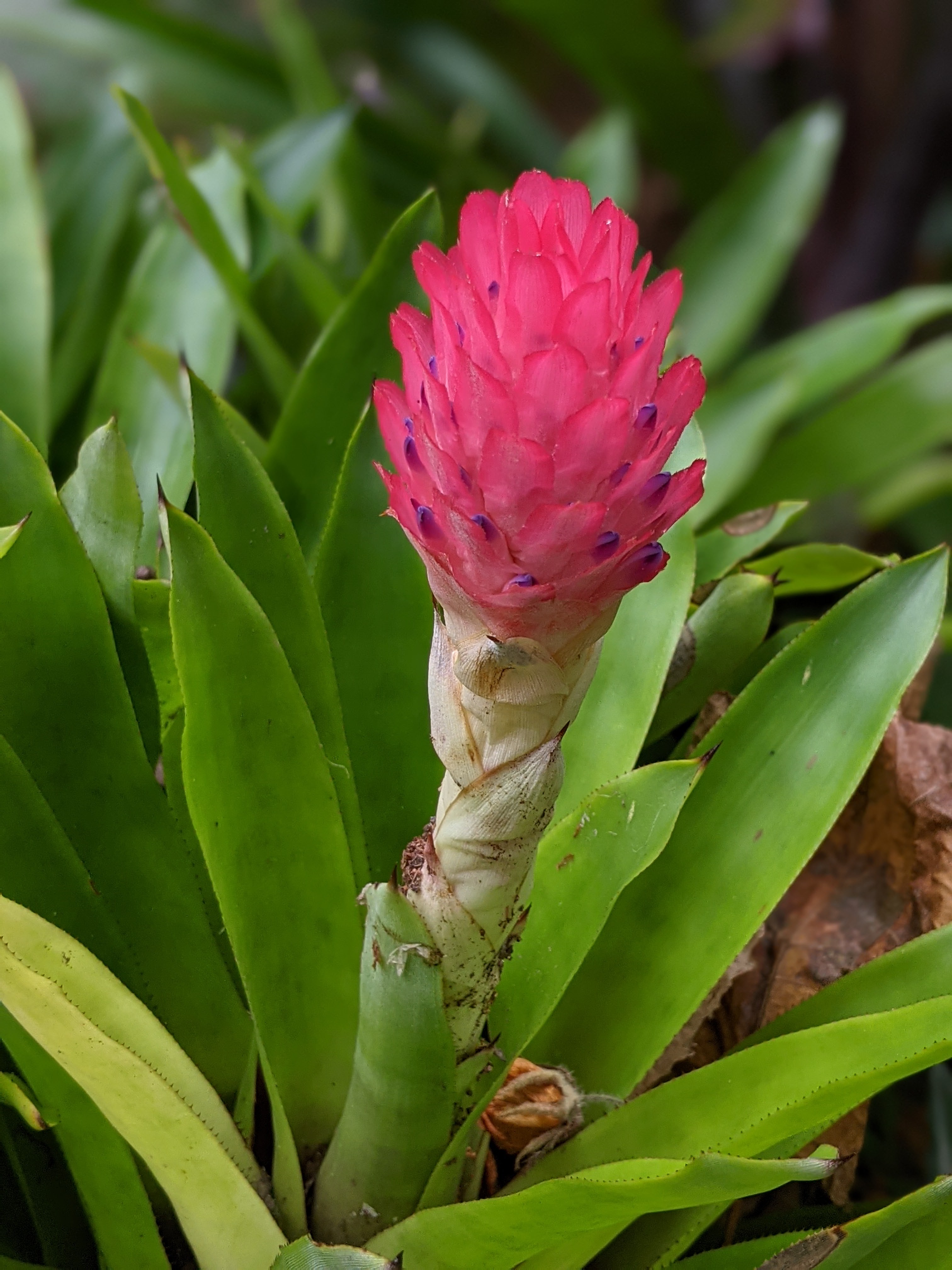
A favorite winter flower – Portea ‘Candy’ Bromeliad. These flowers last a long time and then produce an interesting seedhead. Such mad cool flowers.
My garden is enjoying the weather cool down and making flowers and fruit for fall. I have begun harvesting the Roselles (Hibicus sabdariffa) and here is the first batch:
I pluck these by hand as the green seeds start to appear in the middle of the flower. Rinse them throughly and remove the calyces.
These are the remnants of the flower. The calyces have been removed. I had to look up calyx, in botany speak it is the whole of the sepals that surround the bud of the flower. Calyces is plural of calyx. If the green seeds are allowed to ripen they turn brown and may be ground for a coffee substitute.
Calyx harvested by pulling sepals off or cutting whole. Jam makers like the use the whole ones for aesthetics. I think. I am freezing these bit by bit and looking for recipes.
Fruits of the Christmas Palm (Adonidia veitchii). These are reportedly edible but unpalatable. I leave them for the wildlife. Most people cut them off, though I like to use them for arrangements and enjoy the color.
Tomatoes started from seed in September are setting fruit. I planted Yellow Pear and Sweet 100 Cherry Tomatoes, not sure which one this is, but am looking forward to eating it.
One of my favorite butterfly nectar plants, the Firebush (Hamelia patens) flowers and produces fruit in the fall. More food for wildlife (and maybe thought, while contemplating the butterflies.)
While searching for seasonality in my garden on Sunday, I came up with several autumnal examples. It brought to mind my mother’s favorite fall annual planting schemes. She called them ‘tapestry colors’ usually done with pansies and kales in shades of purple, gold and pink. “Antique Shades” was the favored color mix of pansies.
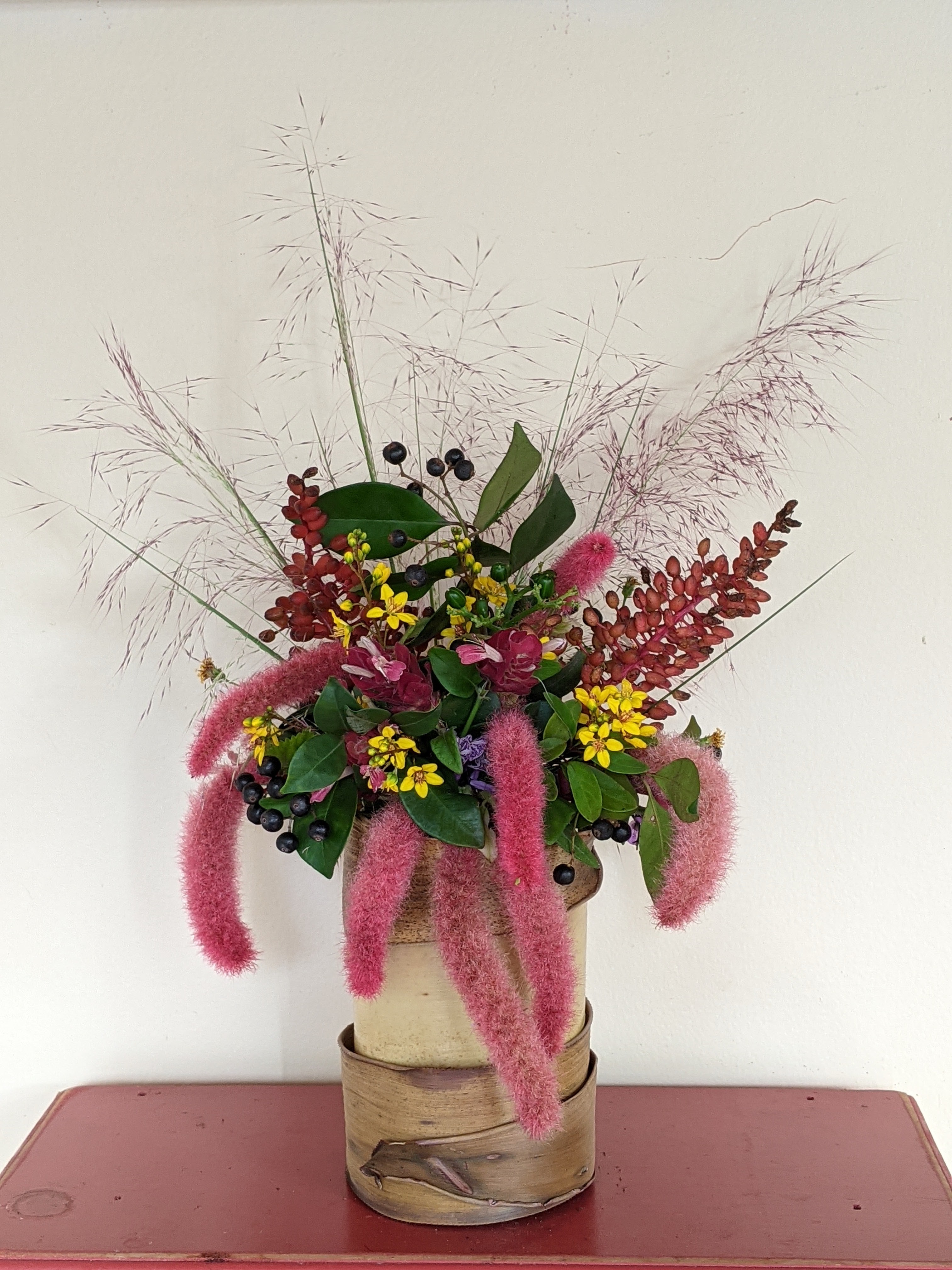
Serving as a vase this Monday is a Bromeliad leaf wrapped pickle jar from a couple of weeks ago that was left to dry and repurposed for a different look. This looks a bit like wood to me.
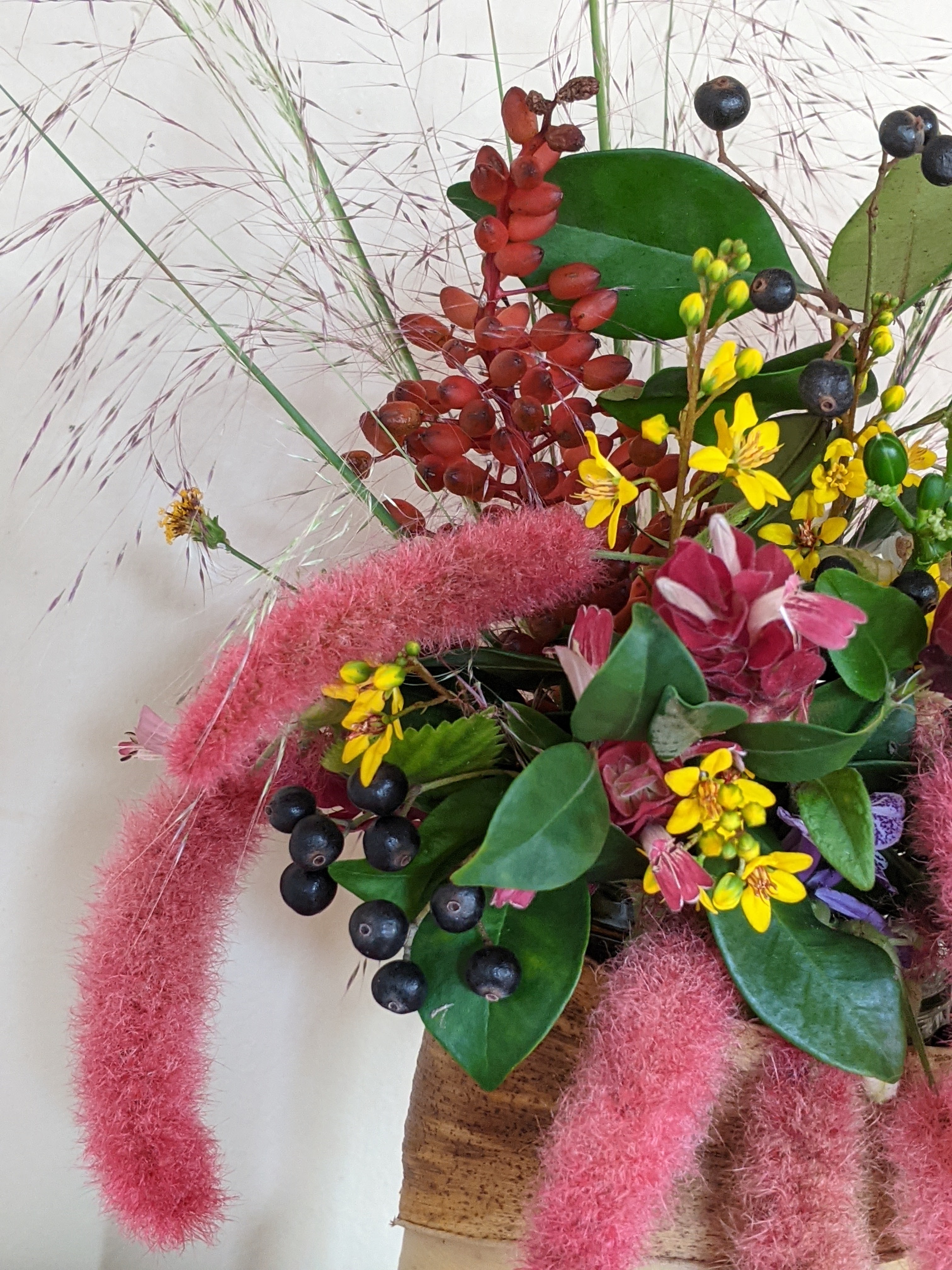
Closer views:
Floaty seed heads of Muhly Grass (Muhlbergia capillaris) provide background and are a true indicator of fall in South Florida. The deep purple berries are from Spicewood (Calyptranthes pallens), a native shrub I am not impressed with thus far. Reportedly has a wonderful spicy scent – I haven’t caught a whiff of this yet and it was a real pain to get established, growing to maybe 3 feet in seven years. I won’t ask it to leave the garden, but wouldn’t buy another. Salmon panicles in the back are dried Miniata Bromeliad flowers (Aechmea miniata) these are bright red and cobalt blue when fresh. Yellow flowers are from Thyrallis (Galphimia glauca) I use this as a shrub in my butterfly garden. Pink fuzzies are from Dwarf Chenille Plant (Acalphya pendula), I have this spilling out of a container – though it can be used as a groundcover here.
Red and white flowers are from Red Shrimp Plant (Justicia brandegeana). Tiny bits of purple peeking out are Mona Lavendar Plectranthus. The green berries are from a Tree Spinach (Cnidoscolus aconitifolius). A few Bidens alba are lurking in the mass of flowers – I may have gotten carried away with the Chenille Plant, so fuzzy and fun to arrange.
Happy Monday and Happy Gardening to all. Thanks to Cathy at http://www.ramblinginthegarden.wordpress.com for hosting this Monday outpouring of floral bliss. Follow the link to see more vases.



















 The Shrub Queen