Once again, I am joining the SOS crowd posting six interesting things from my garden. This Saturday, just past the Solstice and with the first hurricane forming in the Atlantic I am saluting my favorite Summer combos.
Mystic Spires Salvia and Dwarf Red Ixora, I love the contrast of colors. This bed also has white Pentas, yellow Callibrachoa, Blue Daze and chartruese Duranta.
Soap Aloe is flowering nearby.
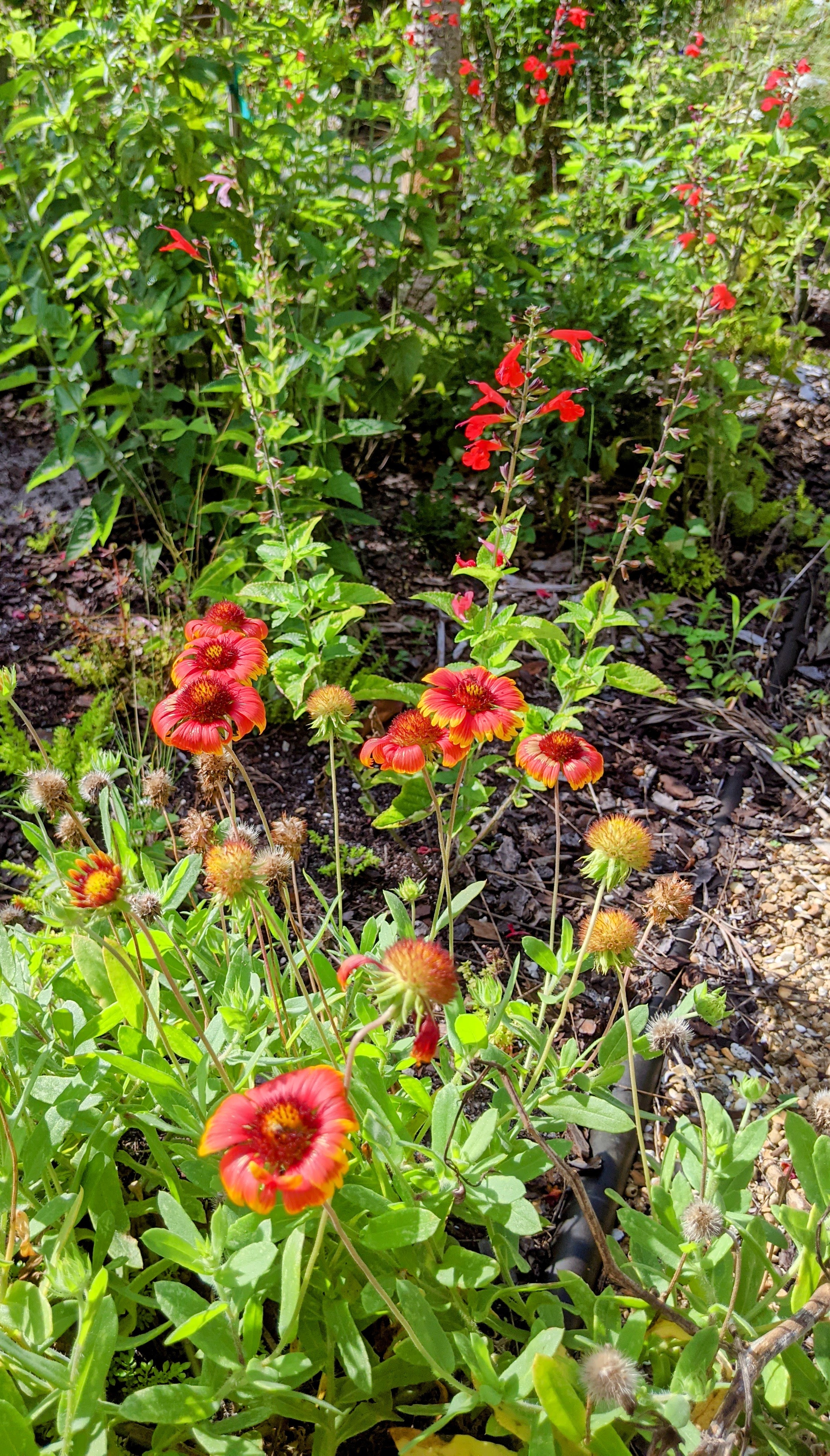
In the butterfly garden, Gallardia and Tropical Red Salvia are flowering.
White Heirloom Pentas and Tropical Red Salvia in the butterfly garden.
In the rainforest garden, shades of red, burgundy and green shimmer in sunny spots.
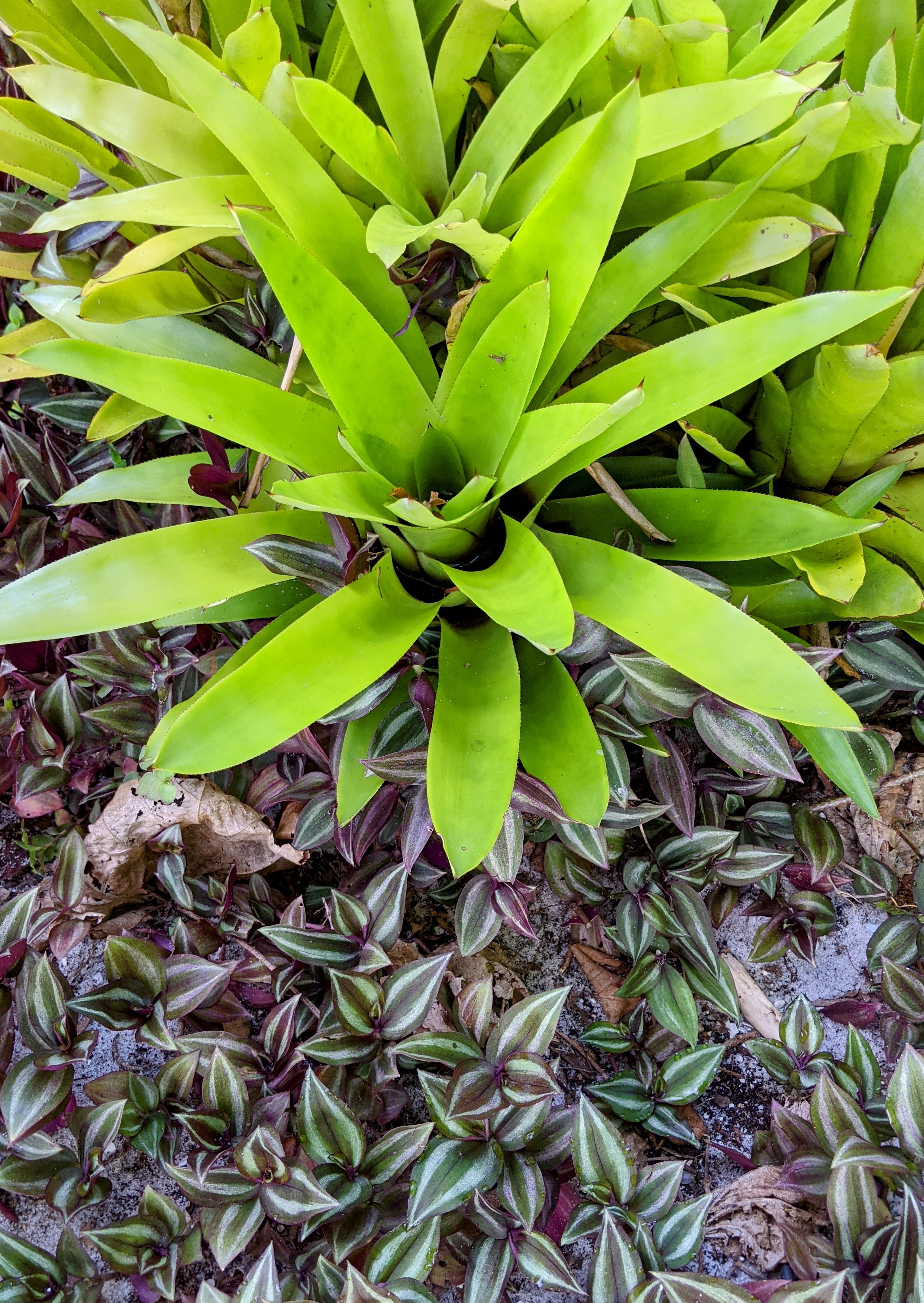
Foliage contrasts in the rainforest garden, chartruese Quesnelia Bromeliad and Zebrina Wandering Jew groundcover, still pretty without flowers. The Quesnelias have pink flowers in winter.
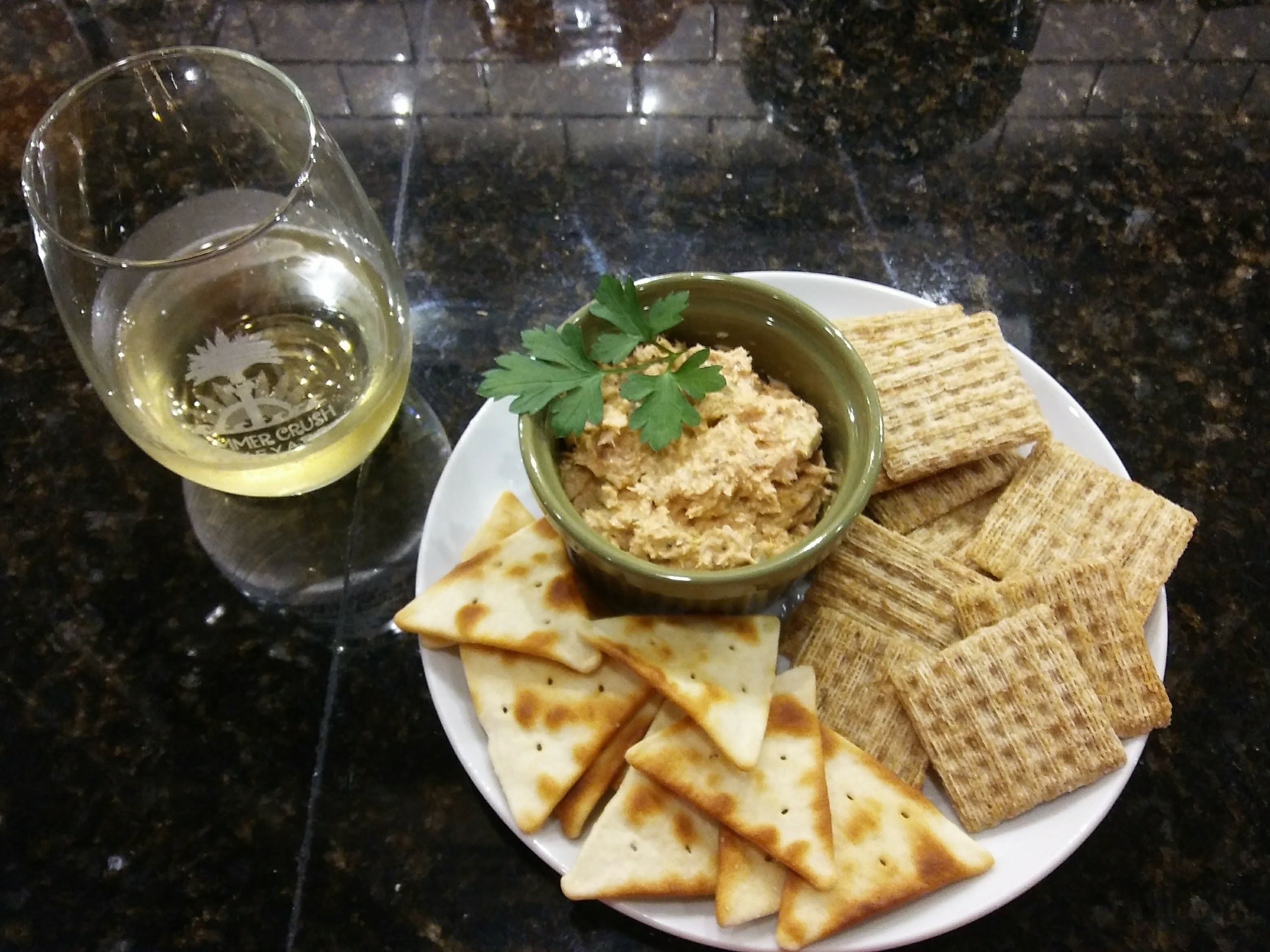
Last, but not least, my favorite snack. Smoked Fish Dip – I am in the midst of making a batch as I blog..wine and fish dip later.
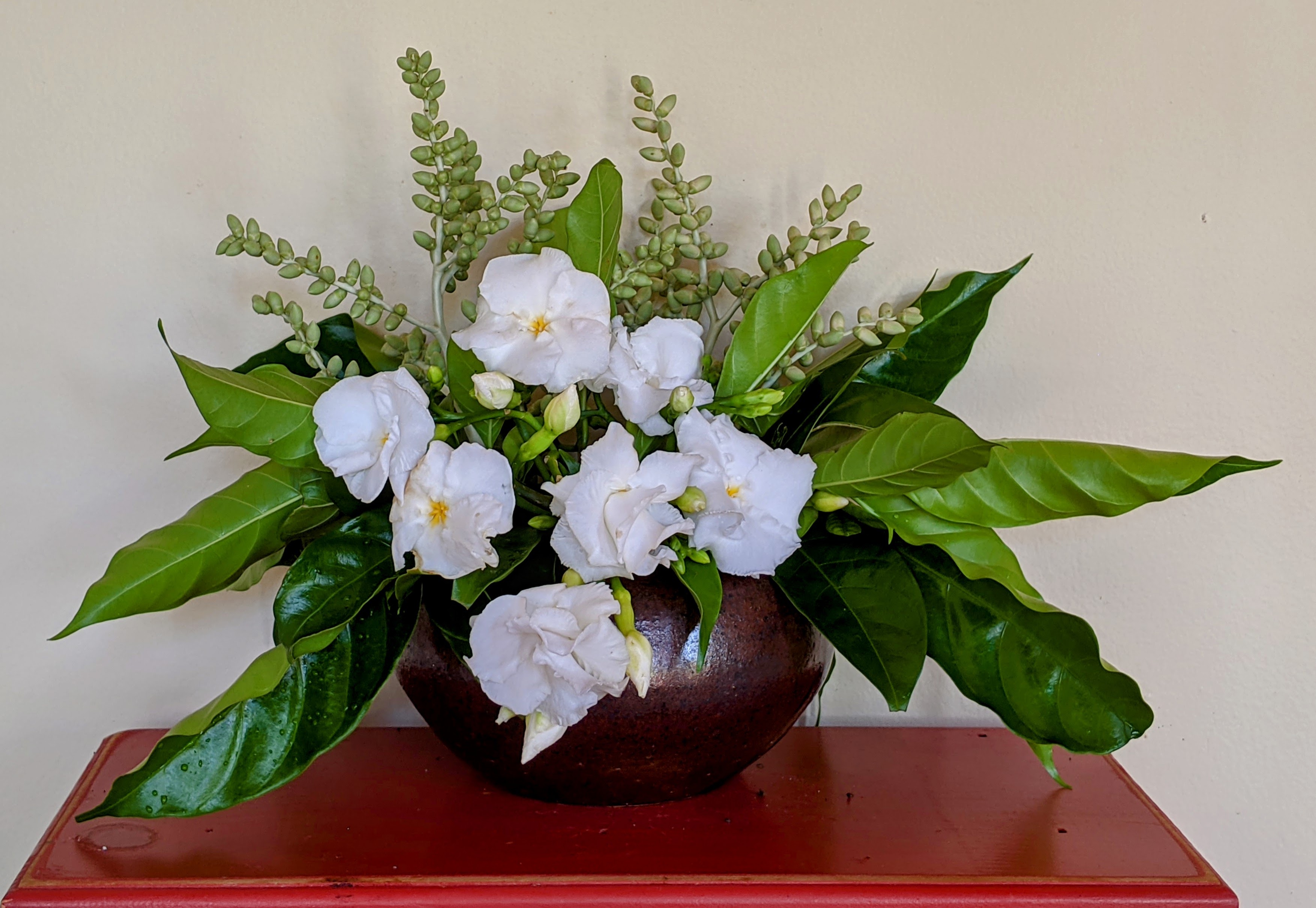
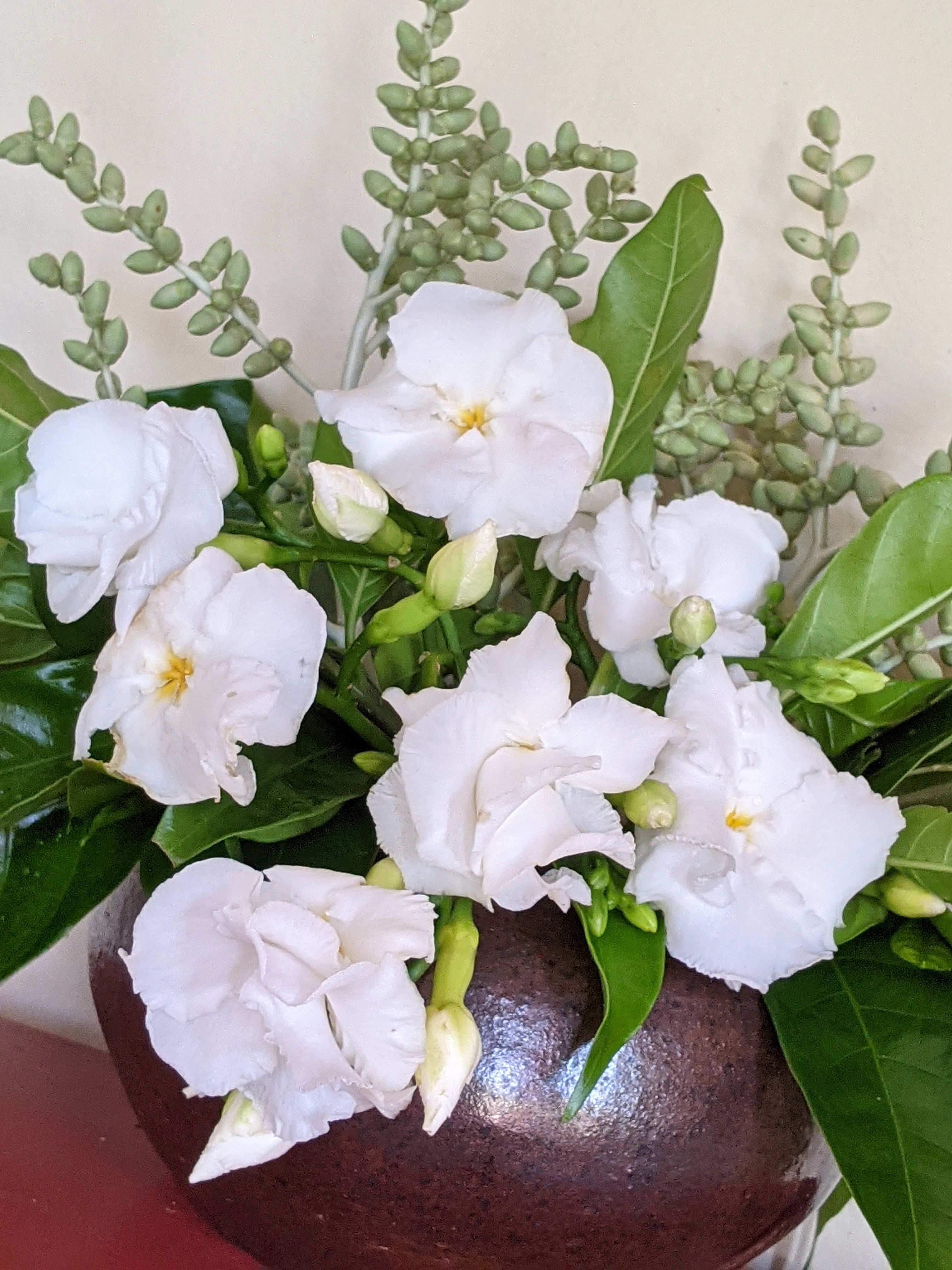
The past few nights the fragrance from my Tropical Gardenias tickled my senses and compelled me to focus on the flowers in this week’s vase. Then I looked them up and found online sources calling them a Crepe Jasmine tree? Most locals call them Tropical or Florida Gardenias. Botanically they are Tabernaemontana divaricata, belonging to the same family as the more common Gardenia jasminoides but much more tropical, growing in the warmest areas of South Florida. They are bigger than common Gardenias, with oversized, glossy foliage and easily reach heights of ten feet. Additionally, nearly bug free and don’t need any coddling. I found mine buried under some overgrown shrubbery in the back yard and cut it free. It is probably 12 feet tall. A little effort is expended to reach and cut the flowers.
A closer view:
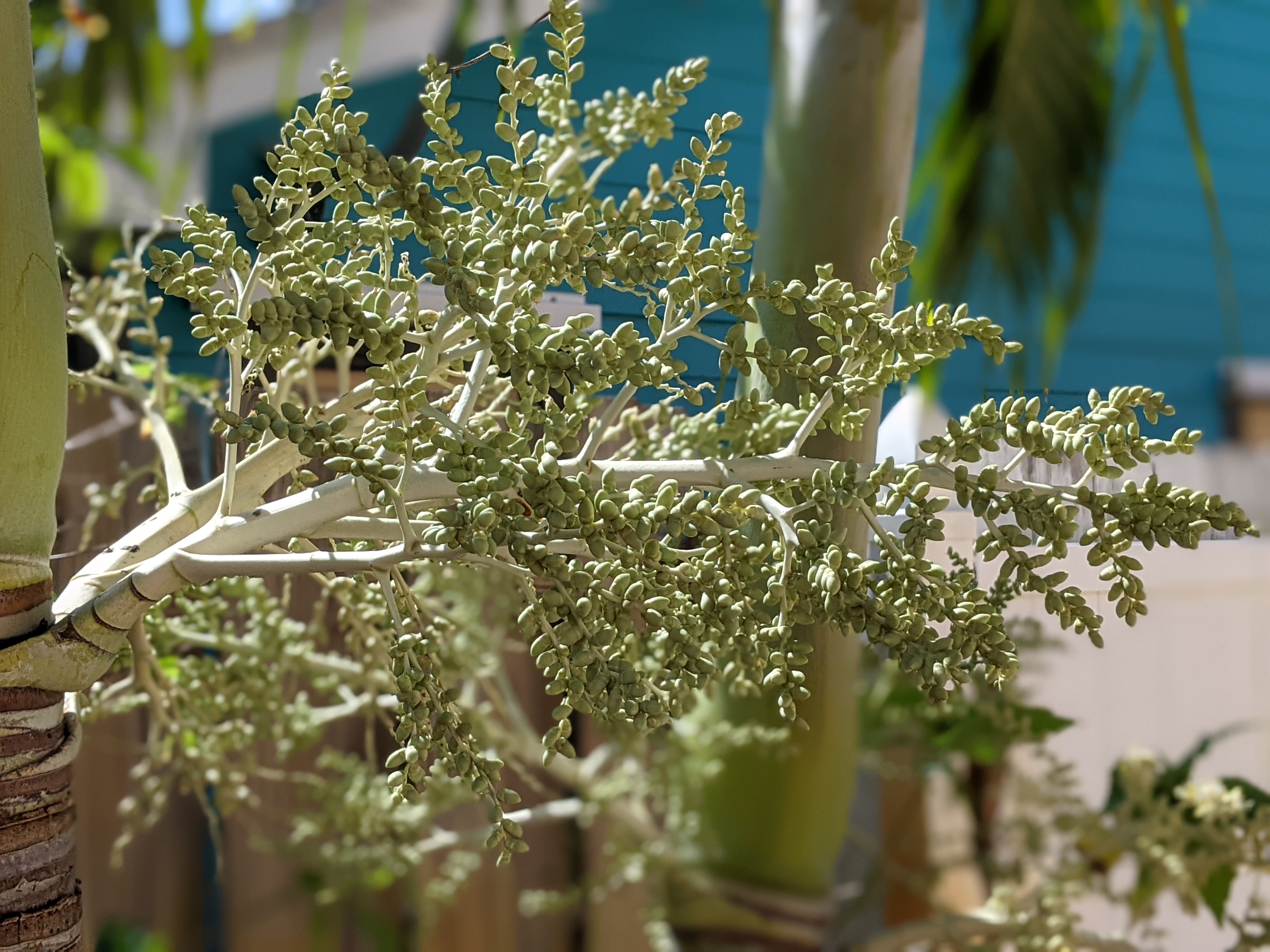
The cut flowers were arranged with most of their foliage intact. I pruned a bit of the foliage to emphasize the flowers and then added some cuttings of flowers from my Adonidia Palm (Veitchia merrilli) The vase, a thrift store find, is my favorite squatty vase.
I adore the flowers on palm trees, having never seen any before moving to Florida. They seem like an architectural element.
The palm flower.
Thank you to Cathy at http://www.ramblinginthegarden.wordpress.com for hosting this weekly gardening meme. I enjoy seeing vases of flowers from gardeners all over the world. Follow the link to see more vases.
The song “Ain’t No Cure for the Summertime Blues” entered my consciousness (my guess) in the late 1970s. The number of artists who recorded this song surprised me. I listened to several versions, sometimes being a country music fan, maybe Alan Jackson’s version is playing in my mind. Nope..then I listened to Eddie Cochran.The song’s author and realized his original version is the one that sticks in my mind. Sadly, I find Eddie Cochran was killed in a taxicab accident at the age of 21.
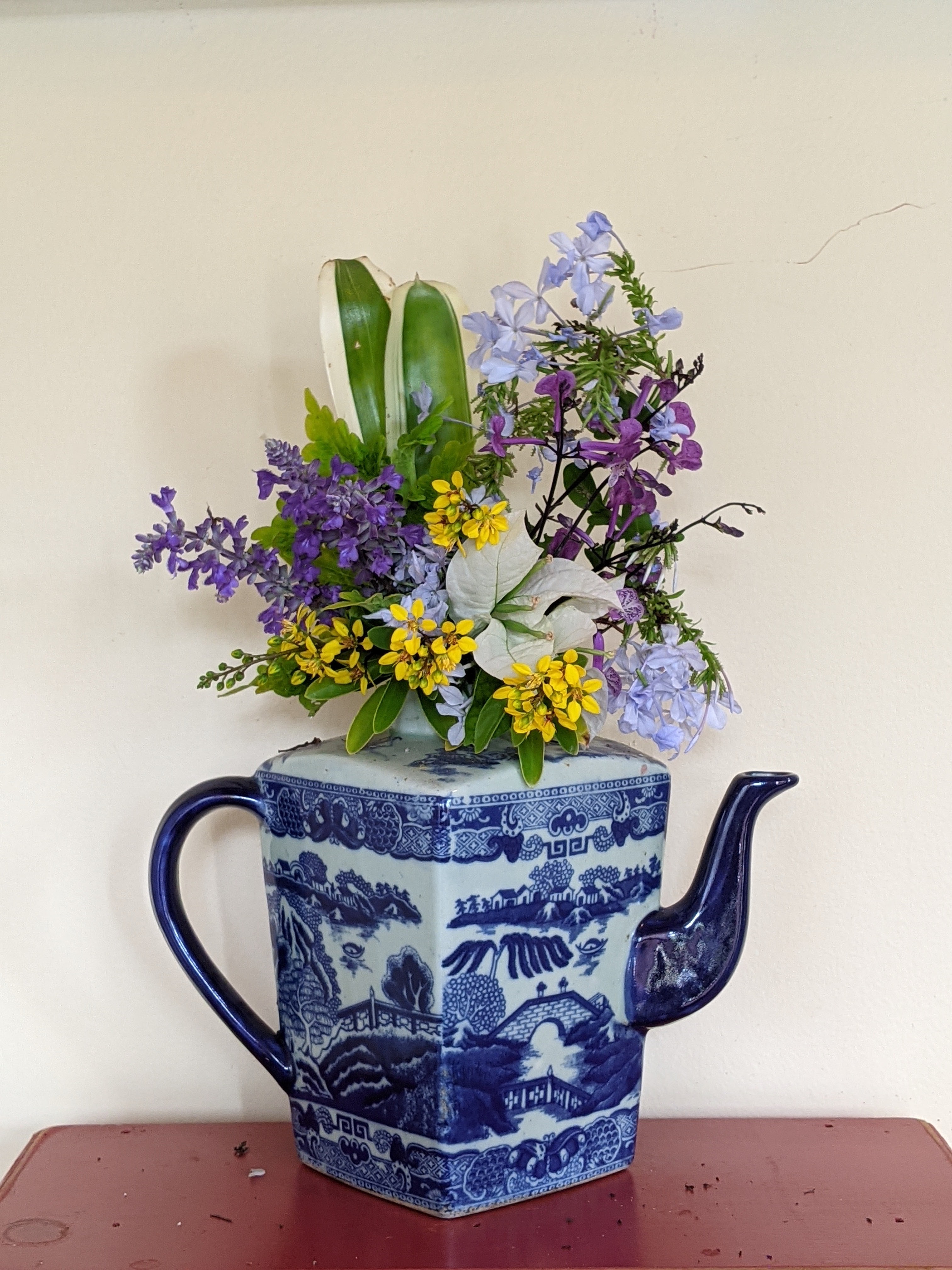
Oh, back to gardening and my vase. This vase is composed of blues and cured me, for a short period of time, of the Summertime Blues. In South Florida, Summertime Gardening Blues can include heat, humidity, bugs, fungus, being horribly sweaty and having hot flashes in the garden, running out of cold water and or, Gatorade, Oh, I forgot weeds! ACK. The vase must be blue and lovely. Here it is.
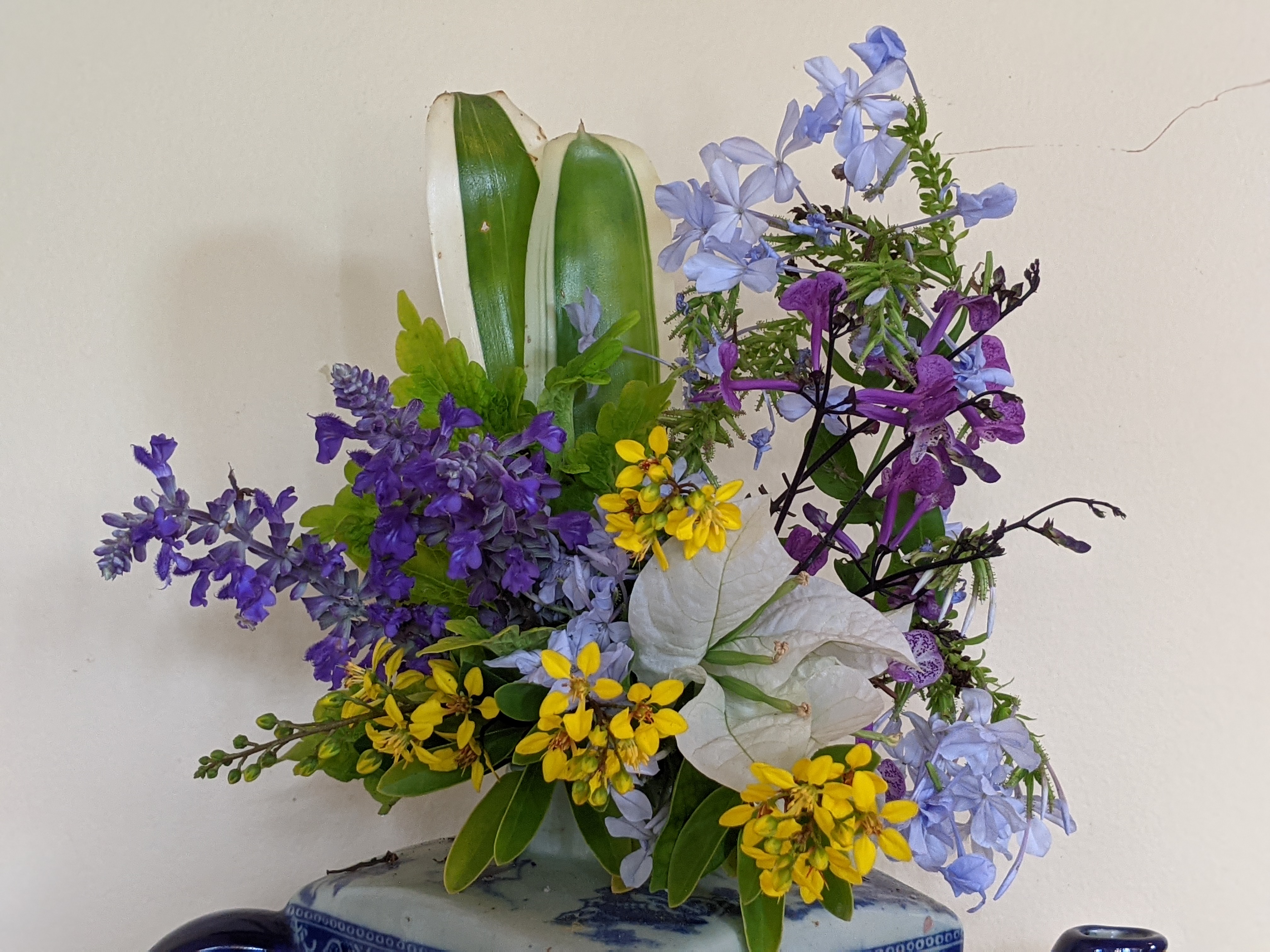
My cure for the Summertime Blues. First, an antique Blue Willow teapot from the UK as a vase. The blue flowers are; in powder blue (what is that powder, anyway?) Blue Plumbago (Plumbago auriculata) a stalwart shrub in my garden. In deeper blue on the left side, Mystic Blue Salvia, wrenched back from near death by my (shocking) overwatering. The purple flowers on the right are my new summer favorite, Mona Lavendar Plectranthus. White flowers are Miss Alice Bougainvillea and the yellow flowers are from Galphinia glauca, Thyrallis. There is a bit of chartreuse Coleus foliage behind the blue salvia and some varigated Bromeliad foliage in the back of the teapot.
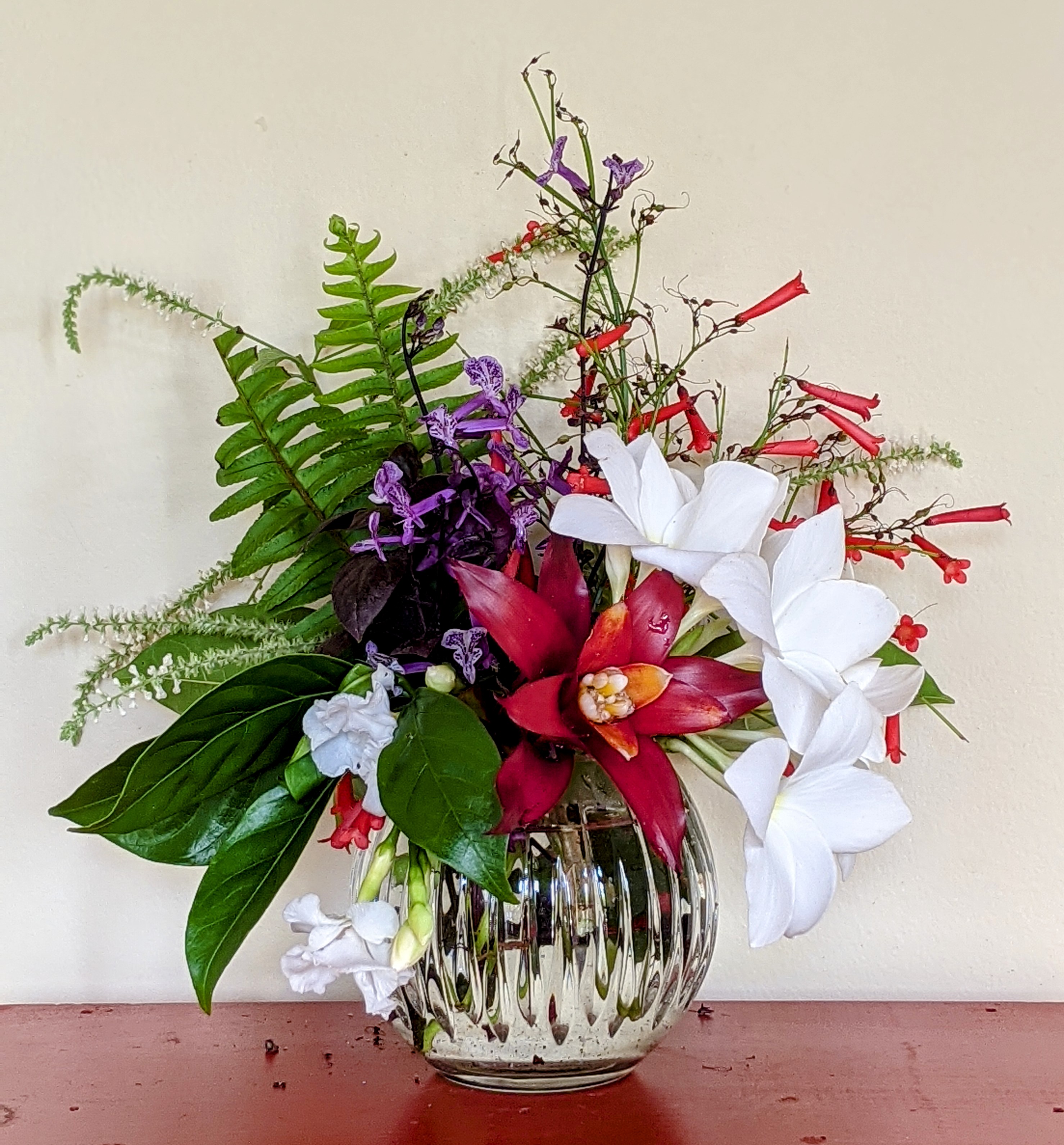
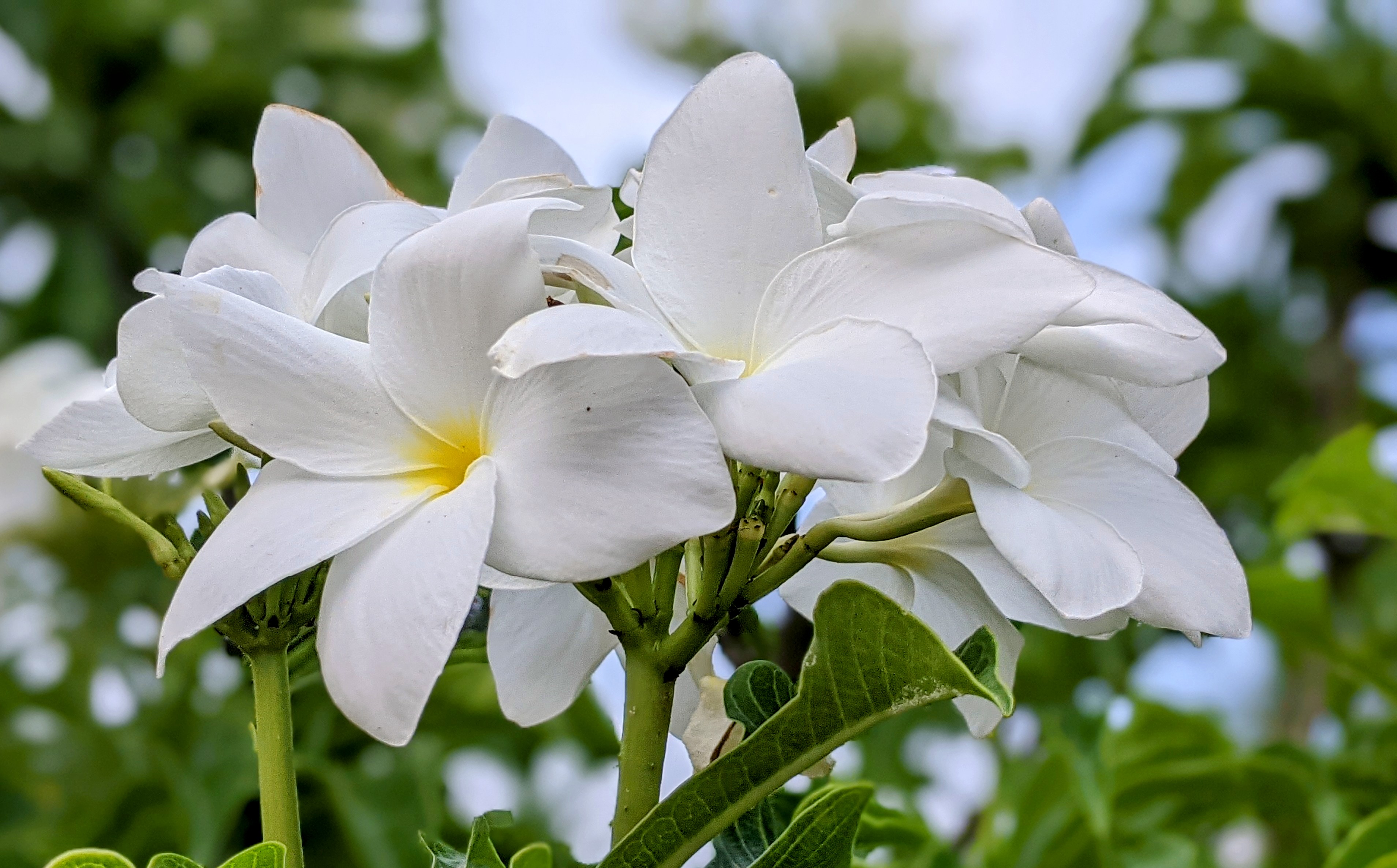
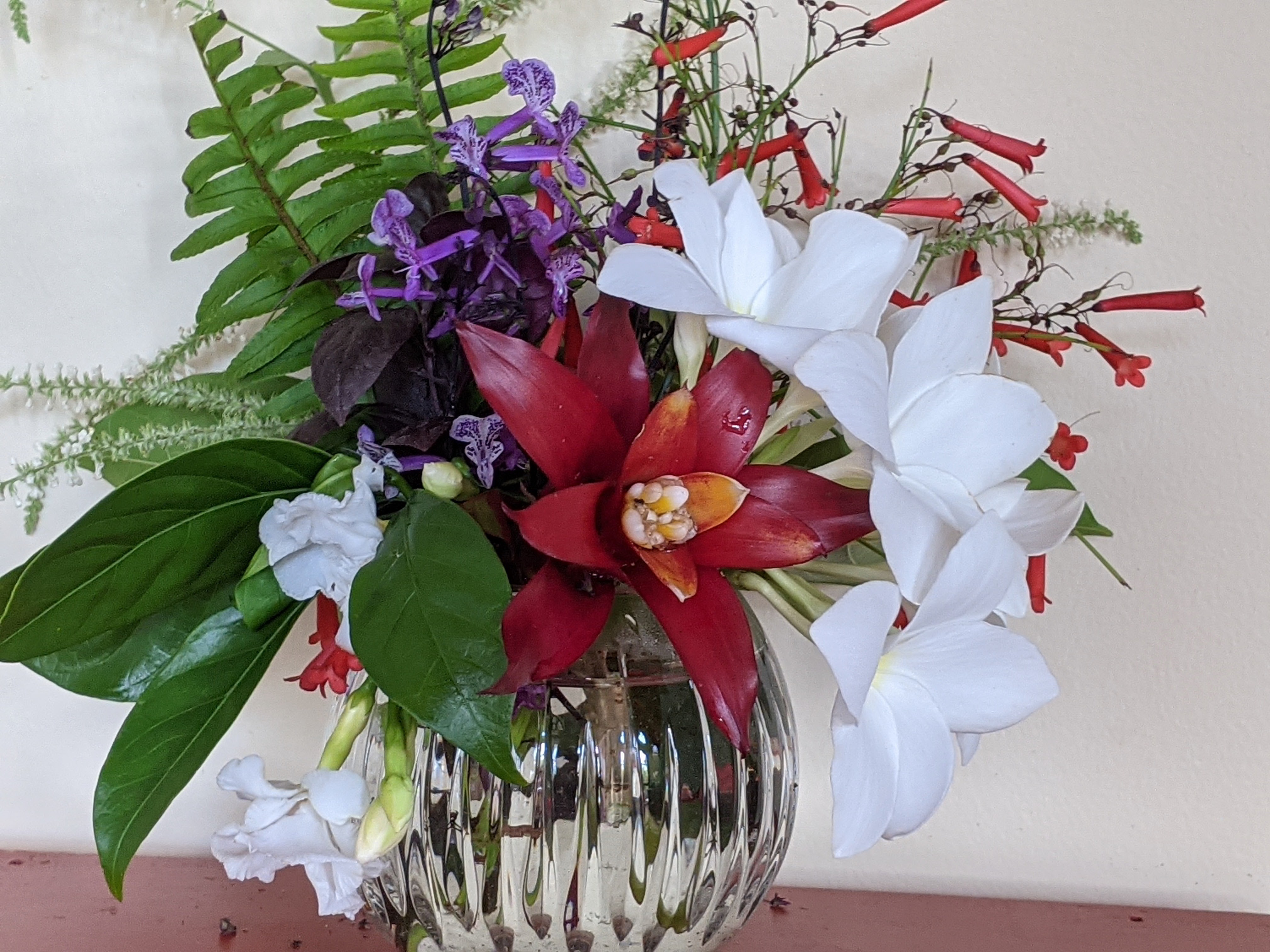
It’s not white hot in South Florida. Yet. The fragrant white flowers are in bloom and some soothing fragrance for the house seems necessary (read, for me!). I decided to add some hot colors for spice and put them in a crystal rose bowl from my mother. I am not sure it has ever held roses during my tenure, certainly not while in South Florida. Roses can be grown here, but it is a lot of trouble and I would rather have the tropical flowers. Honestly, I would never do the amount of tending roses would need here. Here is an easier and much more forgiving fragrant flower, the Bridal Bouquet Frangipani. Shove a few cuttings in the ground and they reward you with six foot semi evergreen foliage and fragrant flowers for months.
Bridal Bouquet Frangipani is a favorite of mine, and oh, so easy to grow. It joins some other fragrant friends in my vase this Monday.
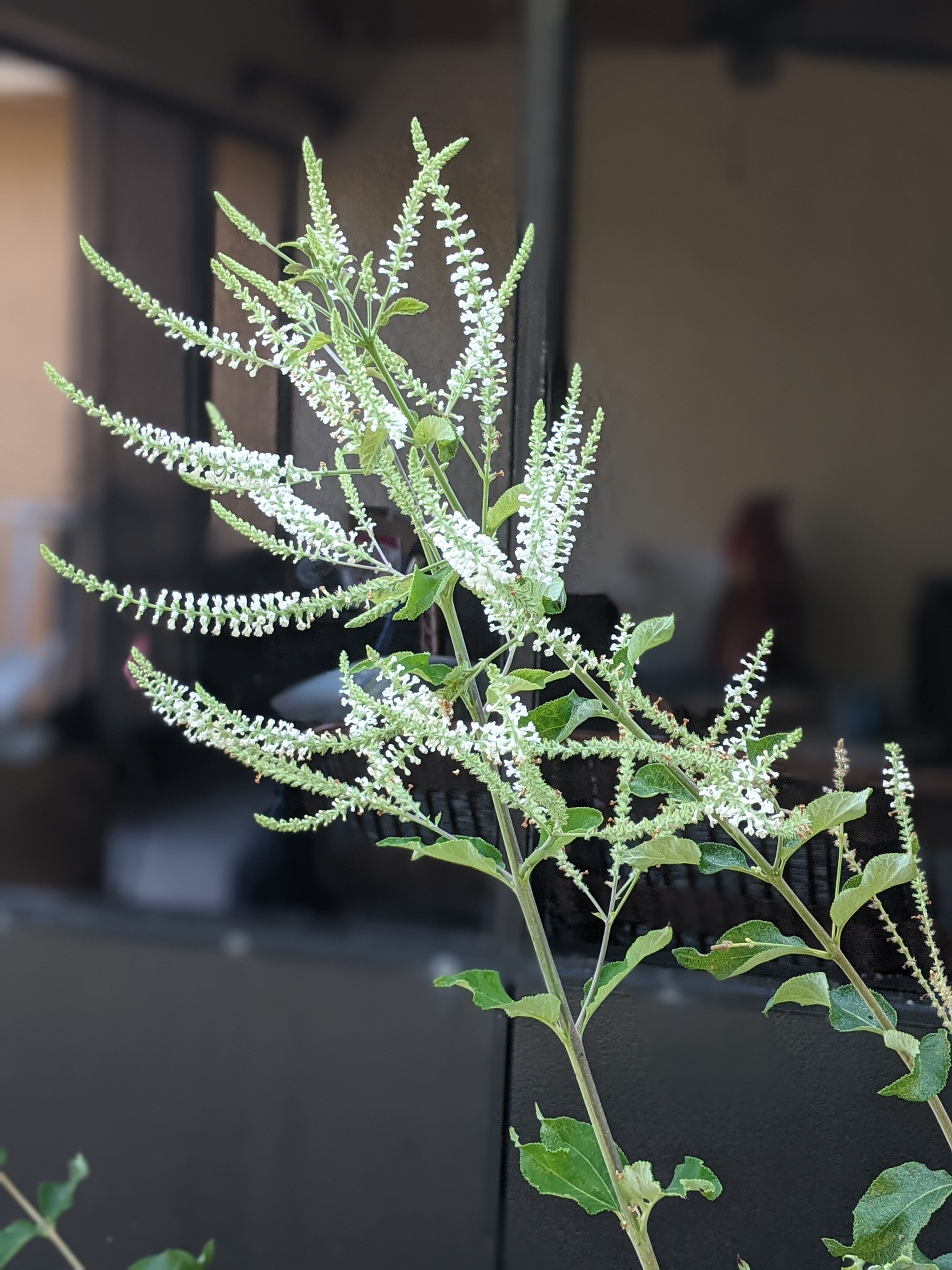
The Bridal Bouquet Frangipani (Plumeria pudica) is on the right side. The fragrant friends, in white, are Tropical Gardenias (Tabernaemontana diviricata) hanging over the side and Sweet Almond Bush (Aloysia virgata) spikes in the background. The hot colors, in red, front and center, the Red Guzmania Bromeliad; the red bells are Russelia equisetiformis, sometimes called the Firecracker Plant. Purple flowers are from Mona Lavender Plectranthus, and the purple foliage is Little Ruby Alternanthera. The ferns, much as I enjoy them in vases are the weed, Asian Sword Fern.
I find something of interest every week in my garden and share it with others gardeners via Six on Saturday. To see more interesting items from other gardens, visit Jon at http://www.thepropagatorblog.wordpress.com.
Above is a Gopher Tortoise, ambling down my shell driveway. These tortoises are endemic to Florida, large – this one is probably 18 inches long and long lived, 50 to 60 years. They are known for making gigantic burrows and sharing them with all sorts of other animals, rattlesnakes included. I am not sure where this one lives. They are not known to travel very far from home and shouldn’t be moved unless necessary. He turned and went back up my driveway and continued down the street.
This morning I noticed the scents of summer are coming on. Several of my neighbors have large Arabian Jasmine shrubs and they are at their sweetest in the moonlight and early in the morning. I don’t have one, don’t need one! In my garden the Tropical Gardenia (Tabernaemontana diviricata) – above and Sweet Almond Bush (Aloysia virgata) – below are flowering and there are buds on the Moonvine.
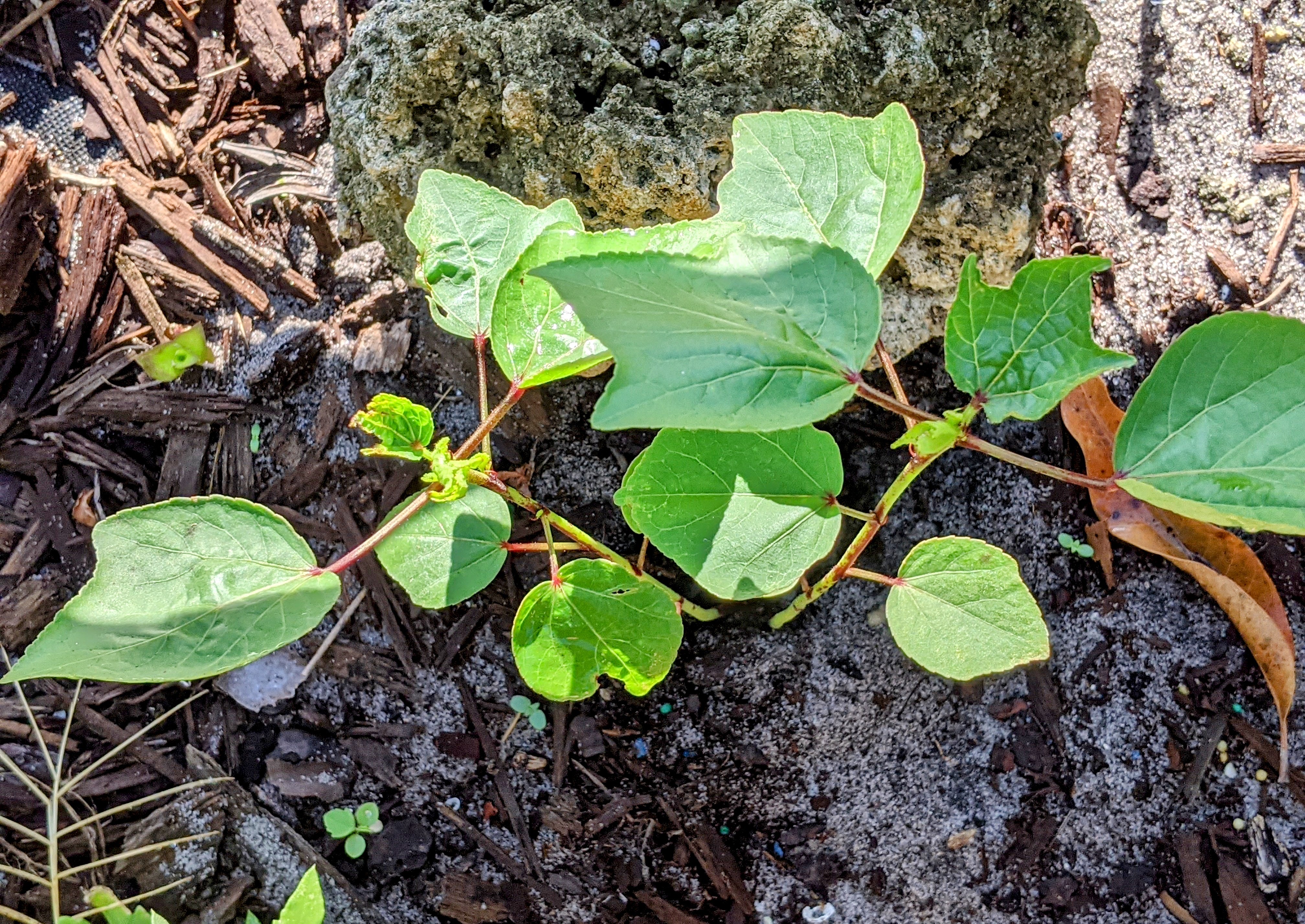
I planted my summer veg – edible Hibiscus. These are called Roselles (Hibiscus sabdariffa). The leaves and flowers are edible. These grow to about four feet and the flowers are harvested in the fall. The calyx of the flower is harvested and used to make tea, jam and jelly – tastes a bit like cranberries. Young leaves may be used in salad similar to Arugula.
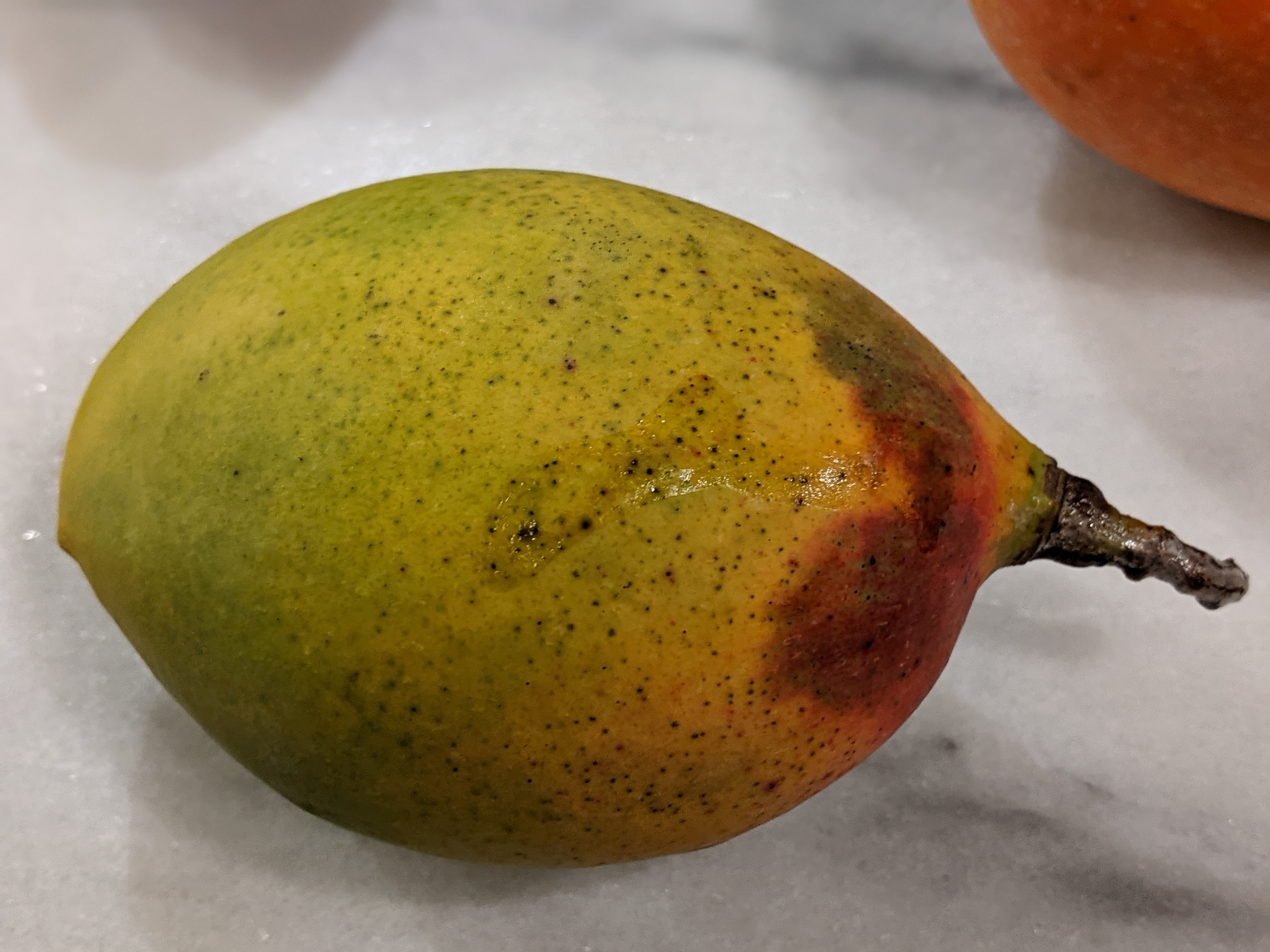
I have harvested and eaten my first Glenn Mango. These are good, low in fiber and have a coconut mango flavor.
This is a Pickering Mango. It is still ripening on the counter. I had these last year and they are yummy.
While collecting flowers for my vase on Sunday, a thought passed through my mind. This is like a jar of summer from my garden. Most of these plants flower all summer and are hot colors. I added the cut flowers to an old pasta container – viola, jarred summer.
Summer can be a bit jarring to those not used to the tropical heat South Florida produces. I have heard it described as a hot, wet blanket that surrounds and then stuns you on the way out of the airport. This is accurate.
I am from the Deep South and thought I knew hot weather. South Florida is a different kind of hot. The first time my husband and I came down (inadvertently) it was the peak of hurricane season and the heat. All I could think was that my hair is hot. Blessed with thick hair, it is still hot – though, I am ready for it and fortunately; it is lighter in color – grey!
In this climate, lighter is better. I started life as a brunette; the grey is cooler, my real color now, though the flower is fake. I learned from this it is difficult to take a picture of your own hair. An old friend from college (a guy) and I have been sending hair pics back and forth. His is longer…
I digress, here is a closer view of the vase:
I love all the high colors, especially in the harsh light of summer in South Florida. Pink just doesn’t stand up to the tropical rays. The yellow daisies at the base are Beach Sunflowers (Helianthus debilis); yellow spikes are Thyrallis (Galphimia glauca) a new and long lasting favorite cut flower. Purple flowers are another new favorite, Mona Lavender Plectranthus, though I question the wisdom of whoever named this plant. Beautiful foliage and flowers and thriving in icky heat – I think it needs a more attractive name. Orange tube flowers are from Firebush (Hamelia patens); lighter orange and sage green flowers are from Soap Aloe (Aloe saponaria). Red spike flowers are Tropical Red Salvia (Salvia coccinea). Blurry white spikes in back are Sweet Almond (Aloysia virgata) for fragrance. A few sprigs of varigated foliage (Dianella spp) set off the flowers.
I am rejoining the Six on Saturday crowd this week after tending my husband last week. He is on the mend and I am happy to be back in the garden. I planted a few new things and found some summer flowers in the garden. Above is a Thyrallis (Galphimia glauca). These have been in the garden for two years. They are advertised to flower year round, not quite so far – though they make long lasting cut flowers.
A new plant in the garden – a Joy Perfume tree (Magnolia champaca). This is a tropical Magnolia, the flowers are used to make Joy perfume. I love the almost polka dotted foliage. I added a Ylang Ylang tree this winter (Chanel No. 5 is made from this tree’s flowers). I hope they are far enough apart. I have a Tropical Lavendar on the other side of the garden. I have a feeling there is enough scent in the garden. Both trees have a reputation for strongly scented flowers. Time will tell.
Another interesting tropical, Chandelier Plant (Medinilla cumingii). A friend shared a rooted cutting with me this spring, it is taking off in a container on my front porch. Similar to orchids, a tropical rainforest plant that lives in trees. This one should have flowers like pink grapes this summer. I am excited to see the flowers. The usual Medinilla I see around here is M. magnifica.
Petunia exserta, grown from seed by my neighbor, are in full flower on the front porch. My porch is a bit overrun with plants right now. I have found it is the best place to grow things from seeds and cuttings.
The first Passionfruit of the year. These have to stay on the vine to ripen – the gardener has to keep a close eye on these to beat the varmints to the fruit.
The last tomatoes of the season. I have had so many good tomatoes this year I decided it was worth the trouble to do it again – but only in containers. The plants in the ground did not do well even with irrigation..
I am certain gardening is a lifelong passion for me. Undoubtedly passed on from my Mother, who referred to this passion as ‘getting the farmer gene’ – her father was a peach farmer in South Georgia. The vases were put together on Mother’s Day, so she has been on my mind – gone for 12 years later this month.
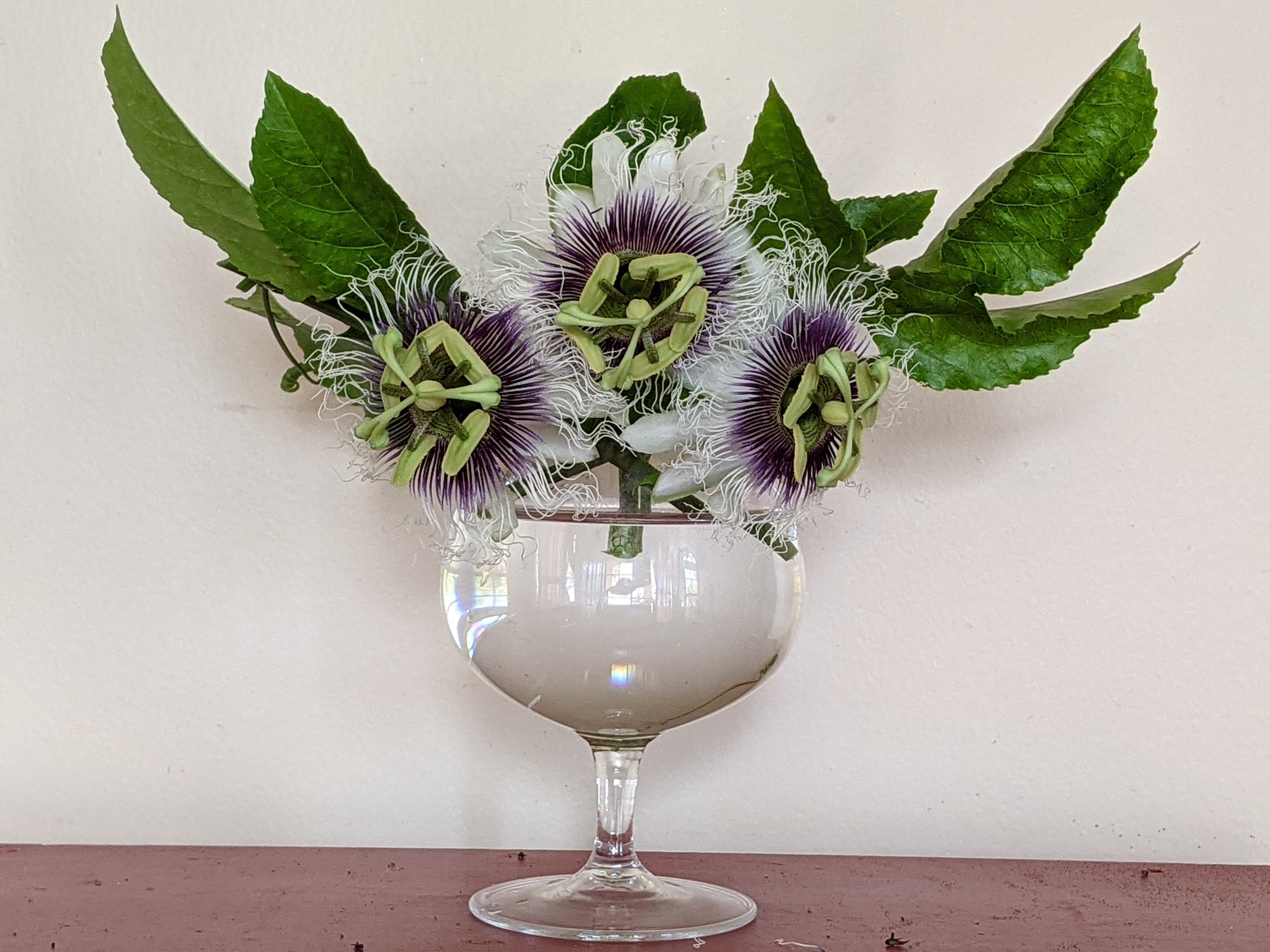
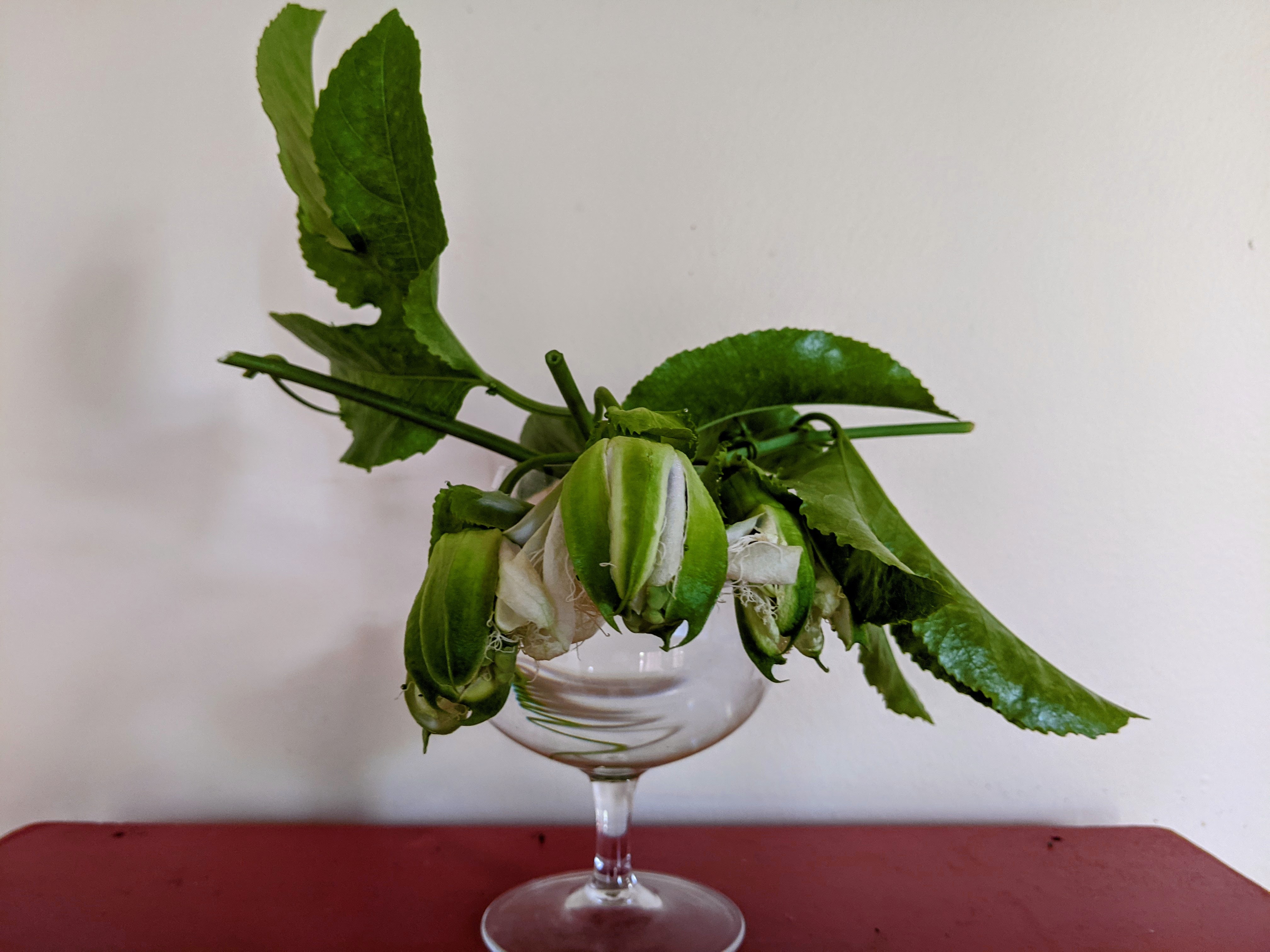
I have always been fascinated by Passionflowers, a graphic design by Mother Nature. A few years ago, I bought one online as a host plant for several butterflies native to South Florida. Despite its reputation as a weed, I had a difficult time establishing the vine in my sand. Two years later, I was disappointed when it flowered, instead of a red passionflower, it was white. Later in the year the fruit produced indicated it was a Purple Possum Passionflower. Passionfruit may be an acquired taste and I think the name is appropriate as most of the fruit was eaten by varmints of some sort. I suspect Raccoons, not Possums.
Since I rarely get any fruit, I cut a few flowers for a vase. These are in a tiny brandy snifter my husband tells me is used to flame brandy…I am well past drinking anything flaming, and the flowers seemed to be fading, so I decided to make another vase with a bit more variety.
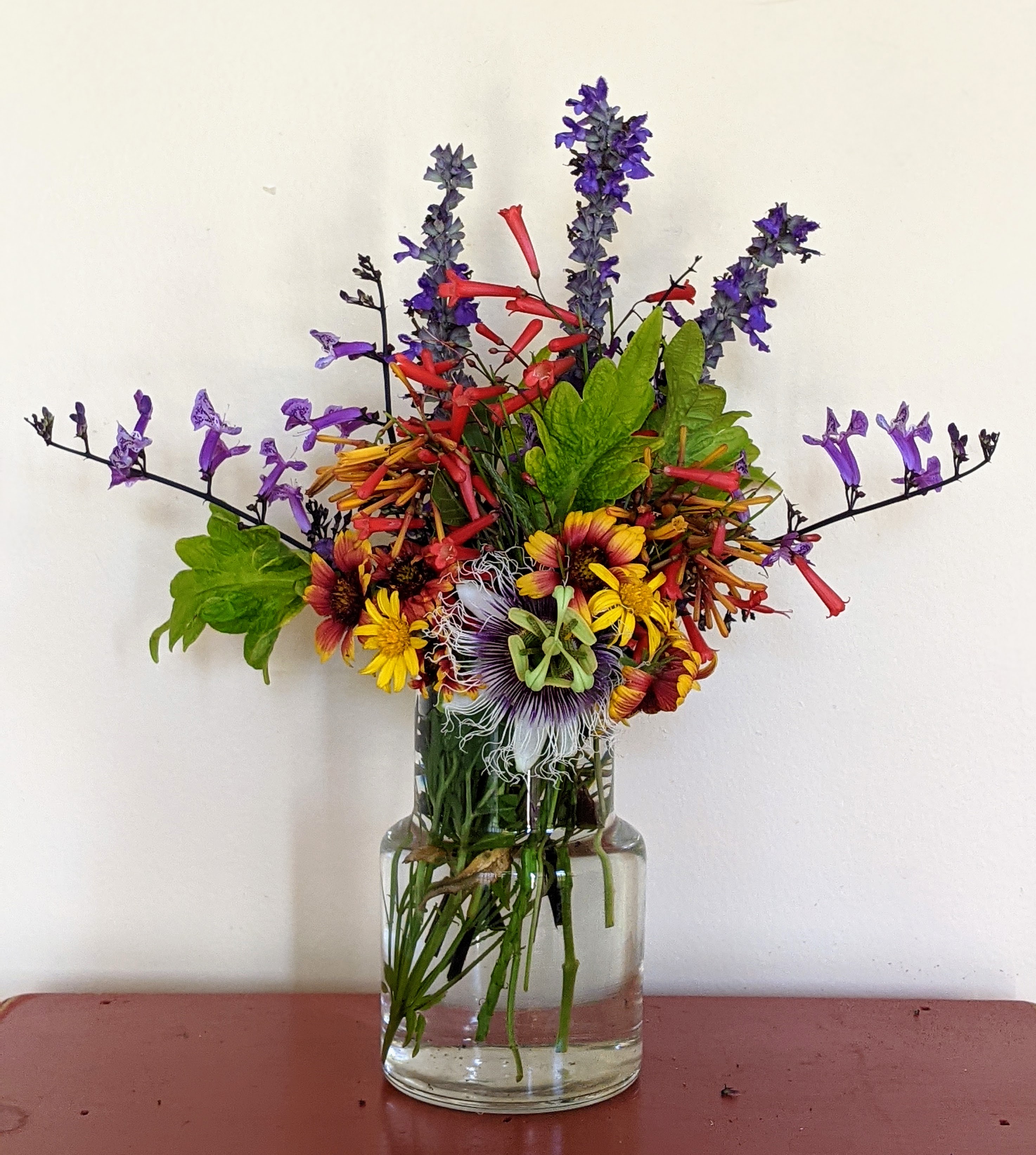
Vase two, more colors and another Passionflower. I enjoy all the high colors produced in my garden. The yellow daisies are a recent addition to the butterfly garden; African Bush Daisies (Gamolepis chrysanthemoides) reportedly drought tolerant when established, and a butterfly attractant. I am not noticing either so far, but it is early and has been very dry. The mixed color daisies are Gallardias (Gallardia pulchella) – these have been considered native for years, but whatever genius decides these things declared them not so recently, though it is a rare, tolerant plant that thrives in my yucky sand and should be celebrated. I fear that will make them less popular. The red flowers are Russelia equisetifolium, Firecracker Plant. The orange flowers are from the Firebush (Hamelia patens). The blue flowers around the edges are Mona Lavendar Plectranthus, that turns out to be a long lasting cut flower. The blue flowers in the middle are Mystic Spires Salvia, which I am enjoying in my garden. Chartreuse foliage is from a mysterious Coleus that is thriving in several containers.
When the sun went down the Passionflowers followed suit, short-lived but worth the trouble.
This Monday my vase may require an explanation. One of our truly great Supreme Court Justices was Ruth Bader Ginsburg, a champion of women’s rights in the United States. She passed on last September serving as a Supreme Court Justice since 1993. She was well known for wearing a lace collar around her neck over black robes and somehow became known as ‘Notorious RBG’ after a prominent rap artist called Notorious B.I.G., evidentially due to her scathing dissenting opinions as a Justice.
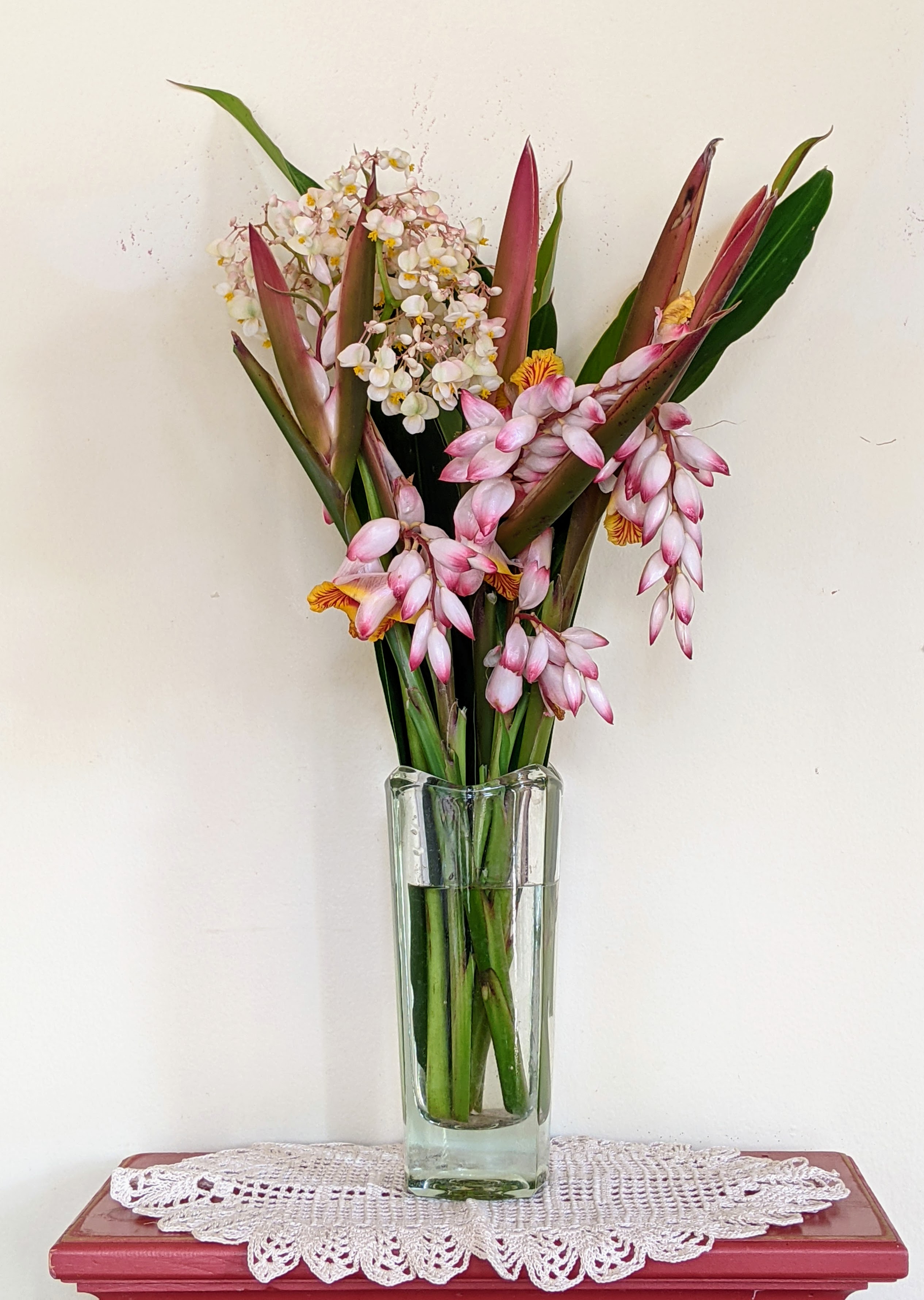
The RBG in my vase this Monday is a Real Big Ginger and the crochet doily was done by another notorious woman, my mother-in-law – Joan Ethel Davis. She passed on in 2002, her initials are crocheted into this doily and I am certain she was a huge fan of the real RBG.
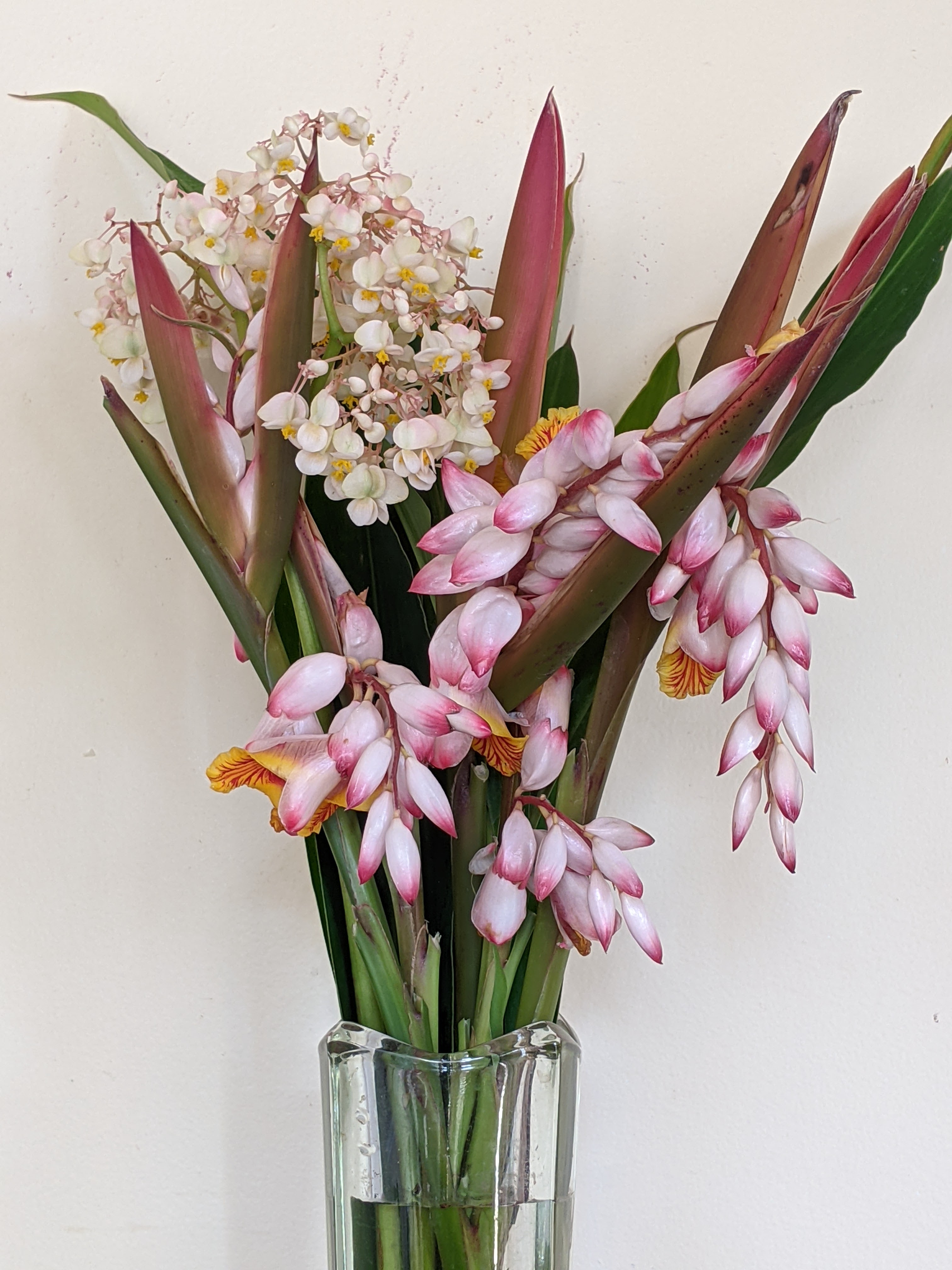
A closer view of the vase. The Real Big Ginger is Shell Ginger (Alpinia zerumbet) in pink and white. It is notorious in my garden as I did not realize quite how huge it would get. Four feet tall and maybe eight feet wide, it has overrun a few milder plants in my landscape and was asked to leave the tropical garden. The off white and slightly pink Begonia is from the Lotusleaf Begonia (Begonia nelumbifolia). Most of the arranging of these flowers involved deciding what to cut off – I trimmed most of the leaves from the Shell Ginger and slipped the Begonia in as a afterthought.
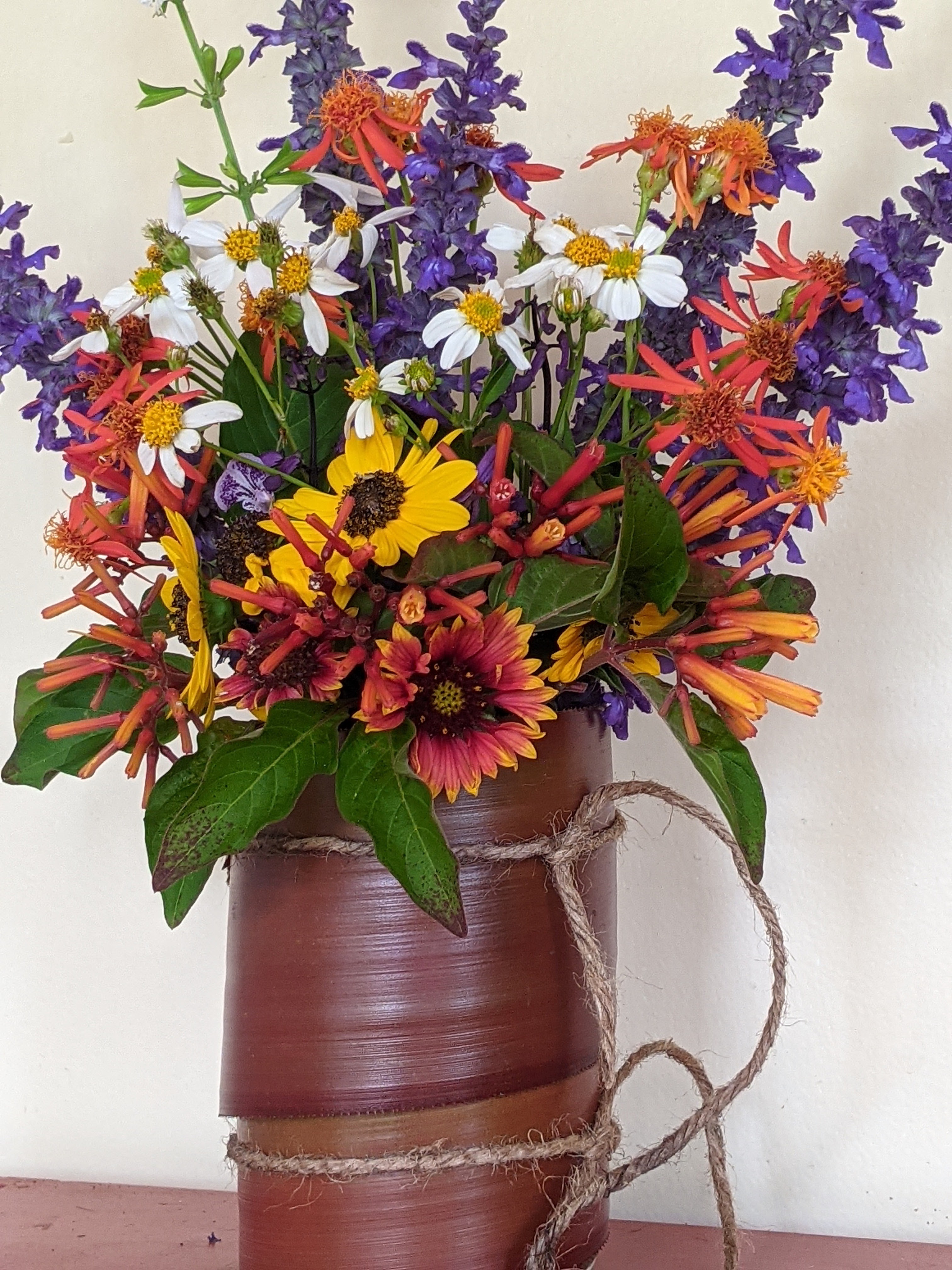
I thought “in a pickle” was American slang. The Dutch started it using “in de pekel zitten” to describe an uncomfortable situation, this translates to “sit in the pickle brine” Seems that would be a stinging experience. Easter Sunday morning found me in the garden thinking “there are no flowers to cut for a Monday vase” – I thought I was in a pickle..Not so much, this rarely proves true, though sometimes I have to look harder to come up with an arrangement. Oddly, there was an abandoned pickle jar in the garden near my Raspberry Blanchetiana Bromeliads. Being “in a pickle” passed through my mind until inspiration hit via the pickle jar. There are also some salsa jars out there I need to get rid of…
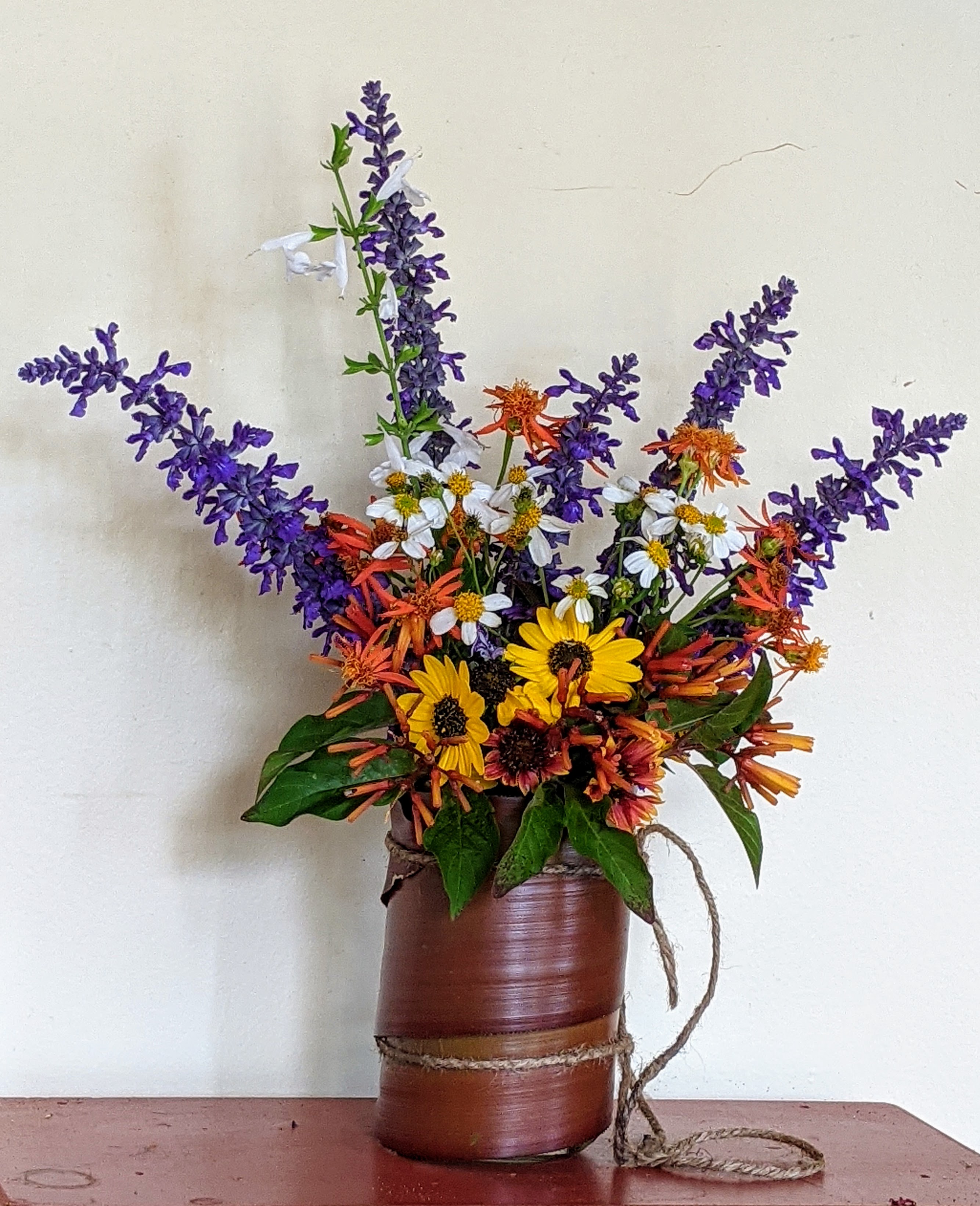
The pickle jar is wrapped with a leaf and tied with jute twine. I left the twine trailing given the casual feel of, well, a covered pickle jar. A closer view of the flowers.
The leaf wrapping the jar is from a Raspberry Blanchetiana Bromeliad. This is a mahogany and greenish red leaf plant with large (4 feet long) red and yellow flowers. The flowers start in November and are looking ragged now. They are as tall as I am when I cut them back to the ground.There are orange and lemon Blanchetiana with the appropriately colored foliage to go with the flowers. I have used the other colors to wrap vases.
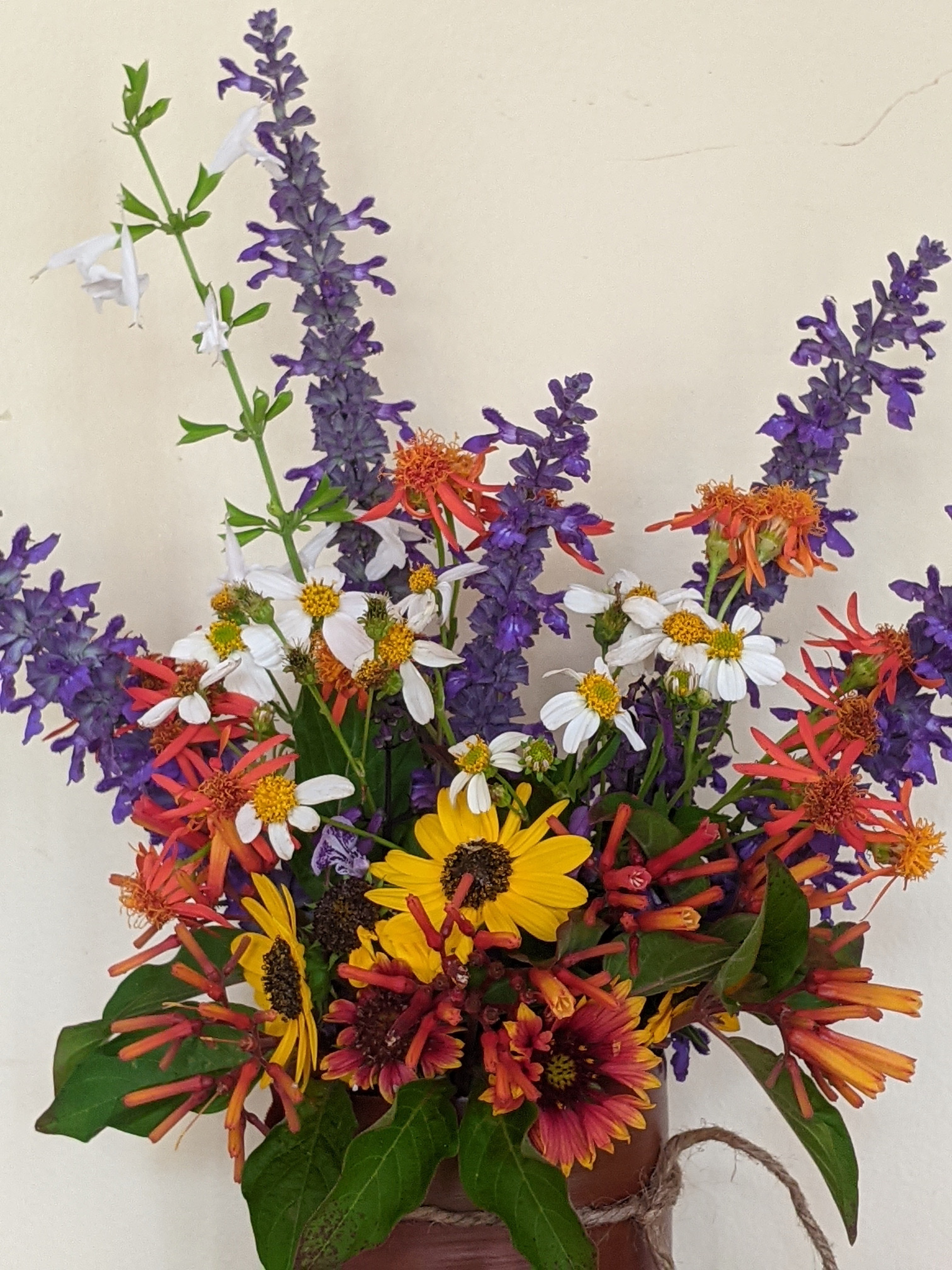
The flowers:
In blue, Mystic Spires Salvia; I am enjoying these so much I am hoping they last the summer. The white daisies are Spanish Needles, an annoying native, botanical name, Bidens alba. Orange daisies are from Mexican Flame Vine (Pseudogynoxys chenpodoides); orange tubular flowers from the native Firebush (Hamelia patens var patens); Yellow daisies are Beach Sunflower (Helianthus debilis) and a white Tropical Red Salvia (Salvia coccinea) is in the back. Two red and yellow native Gallardia round out the front of my pickle jar.
I am glad I did not find myself in the Dutch version of the pickle this Monday.