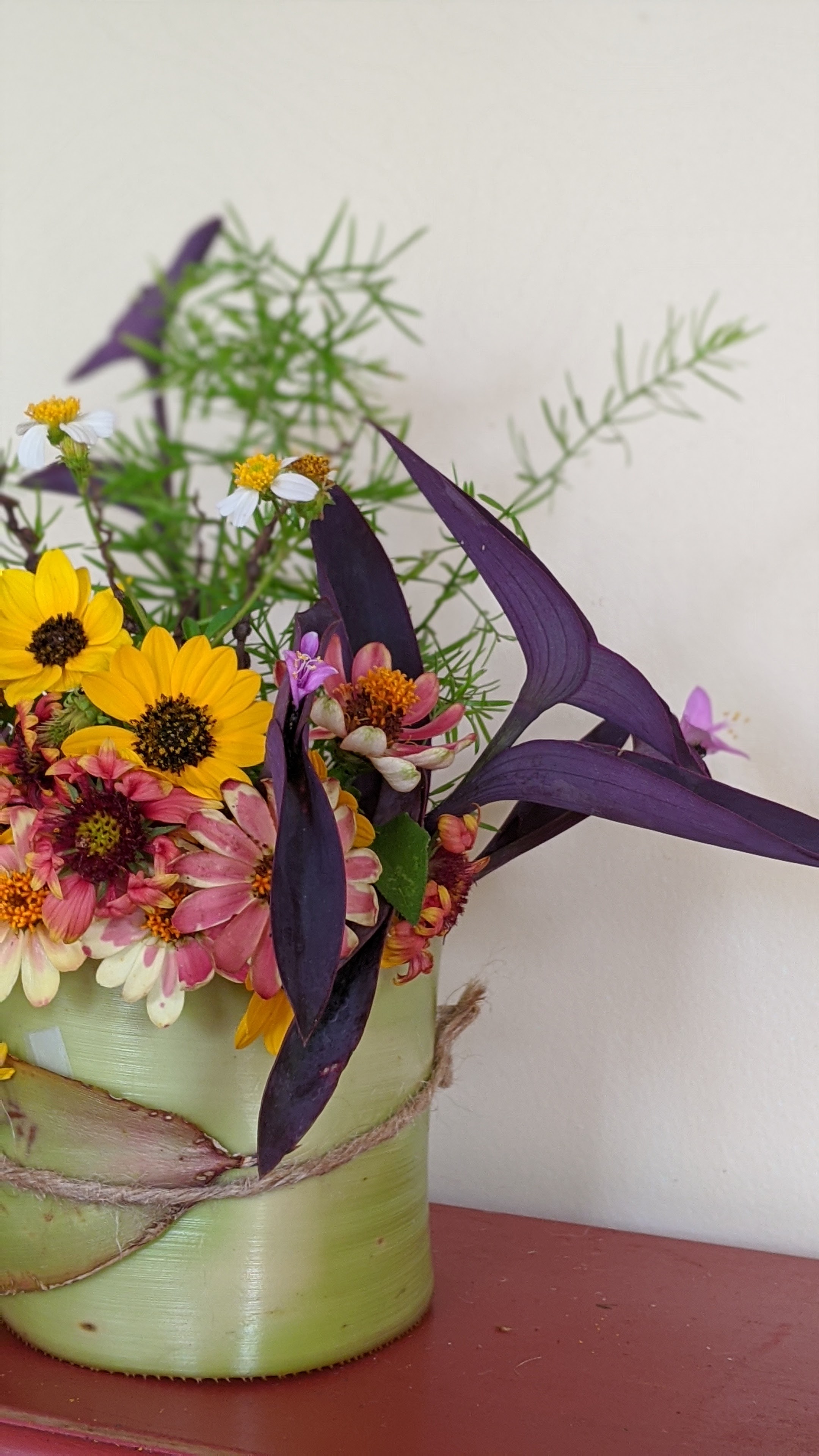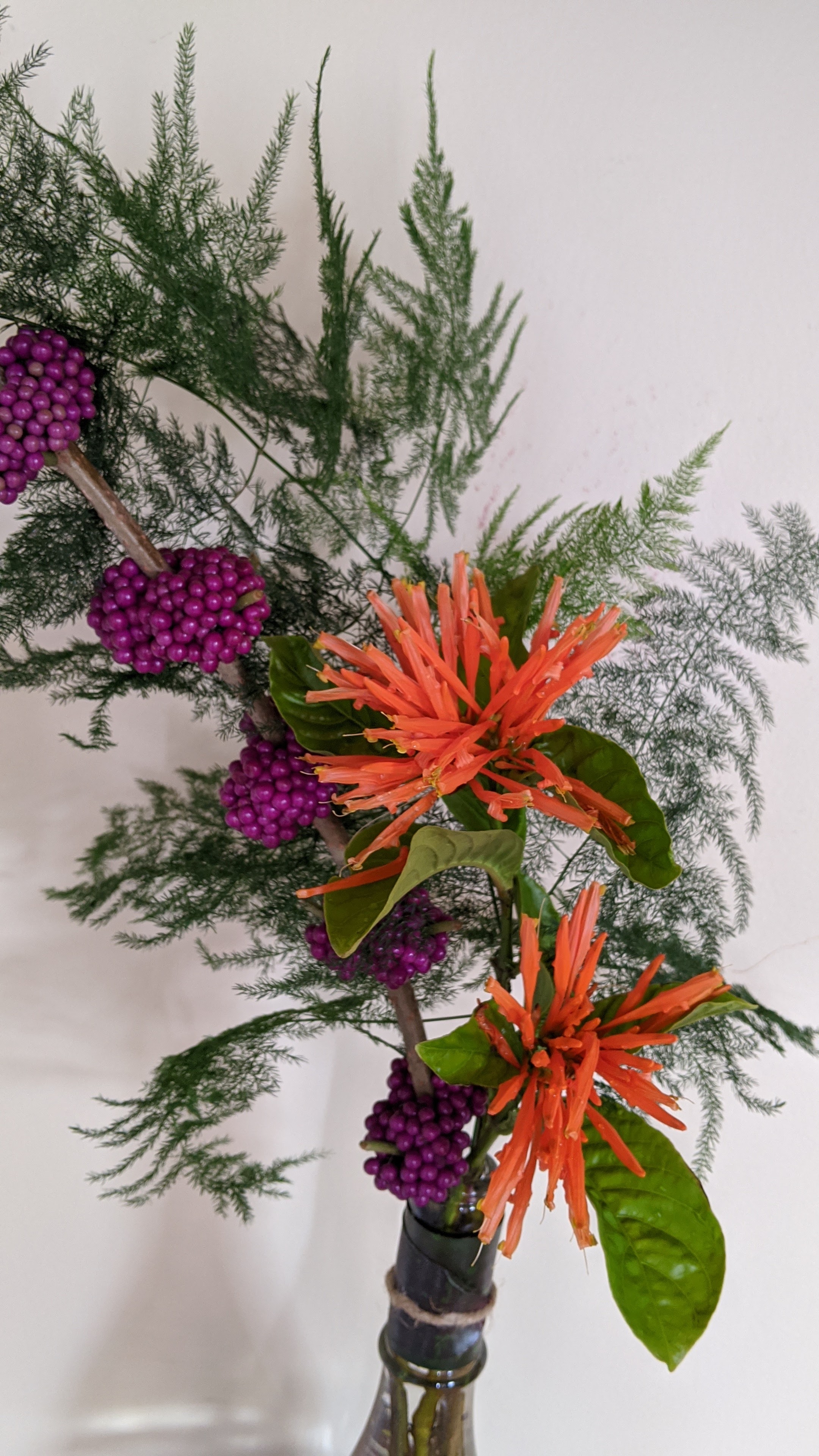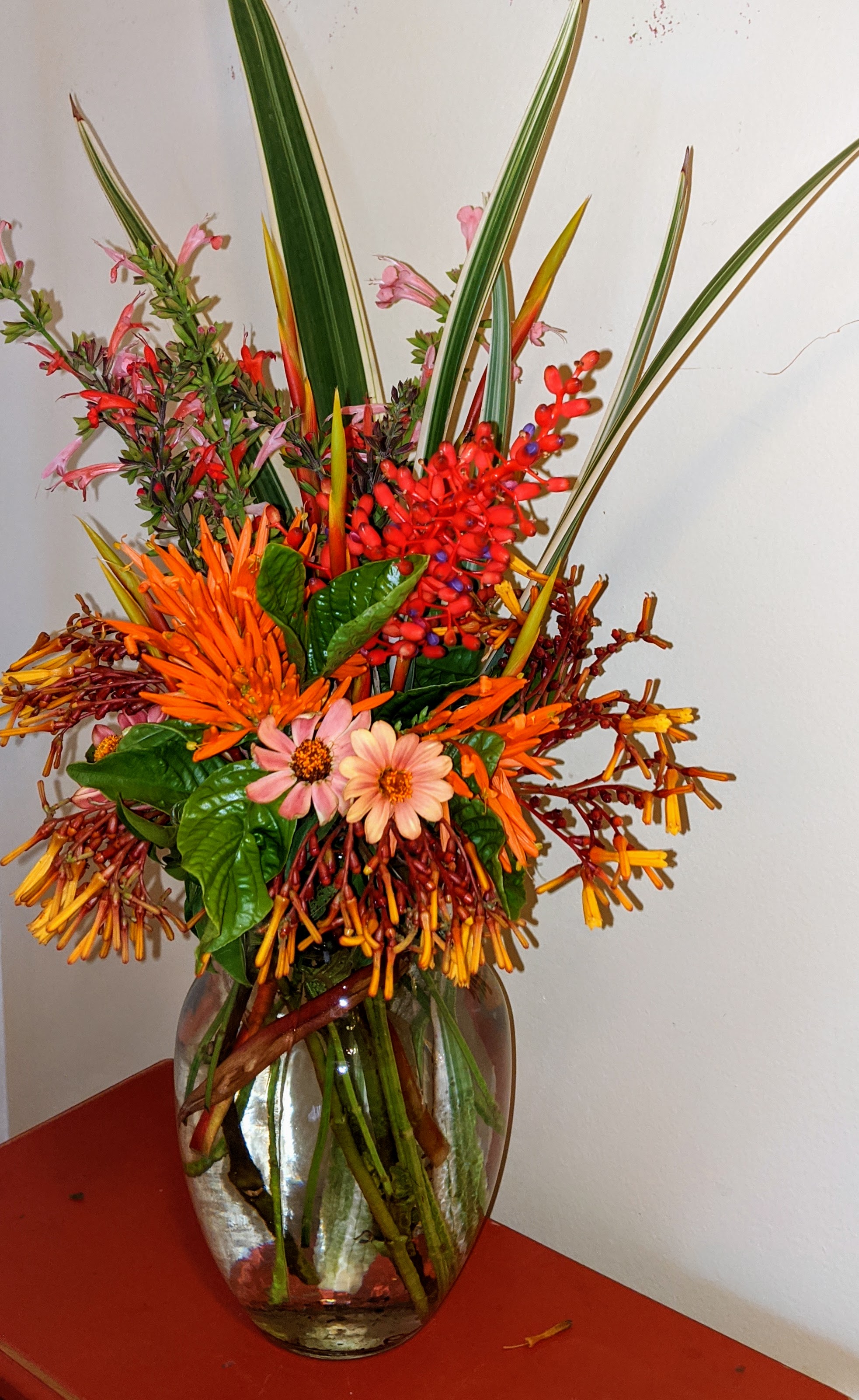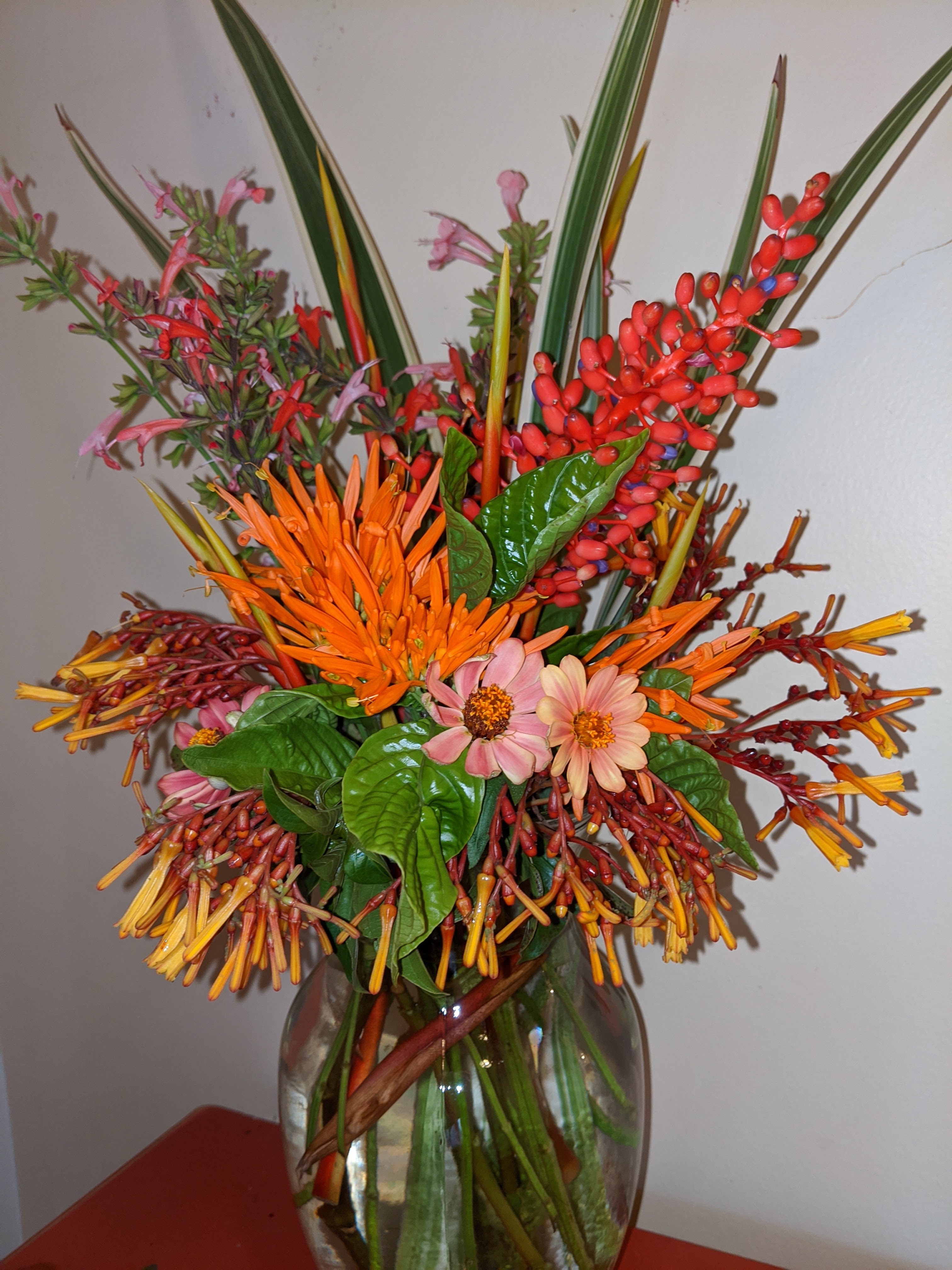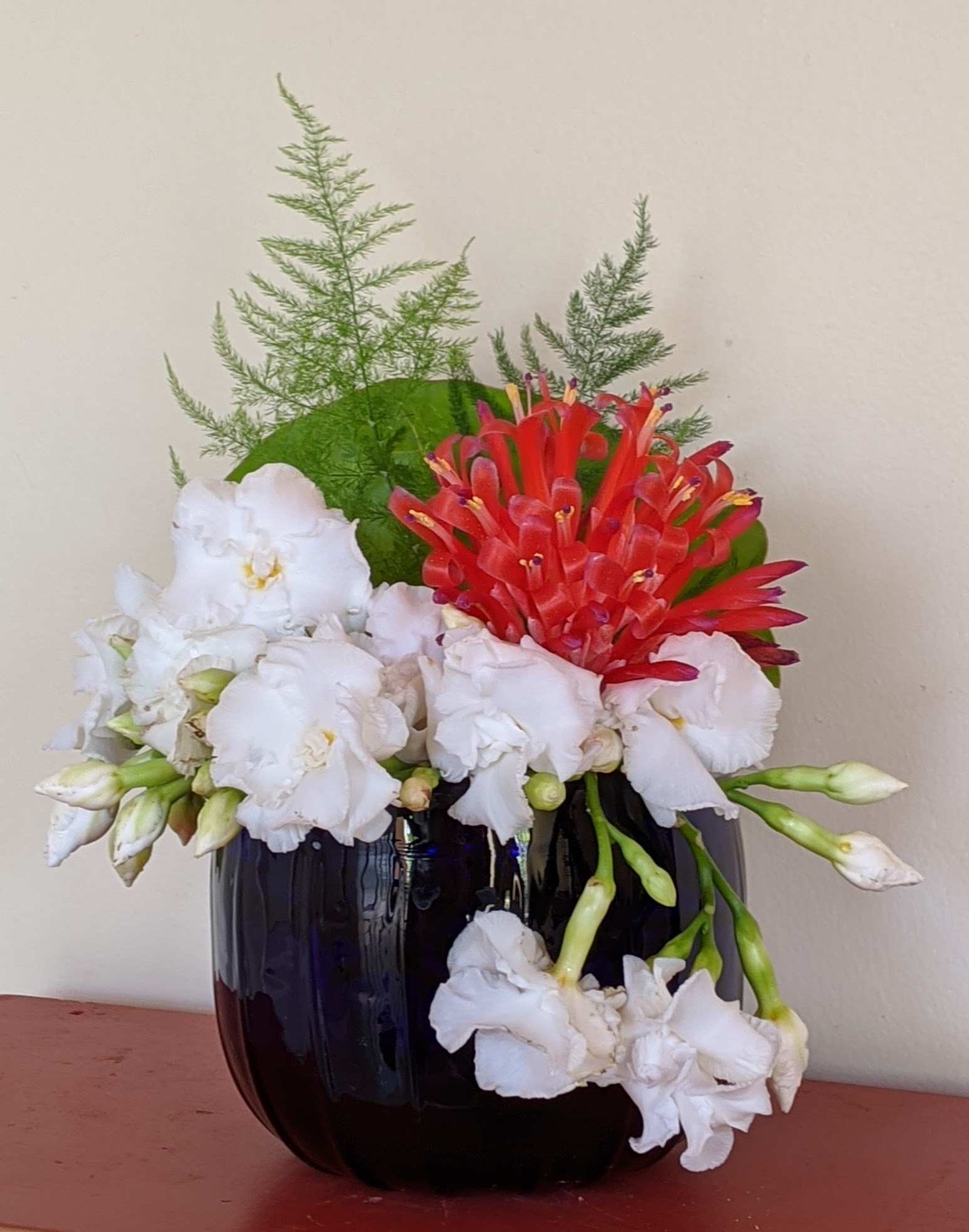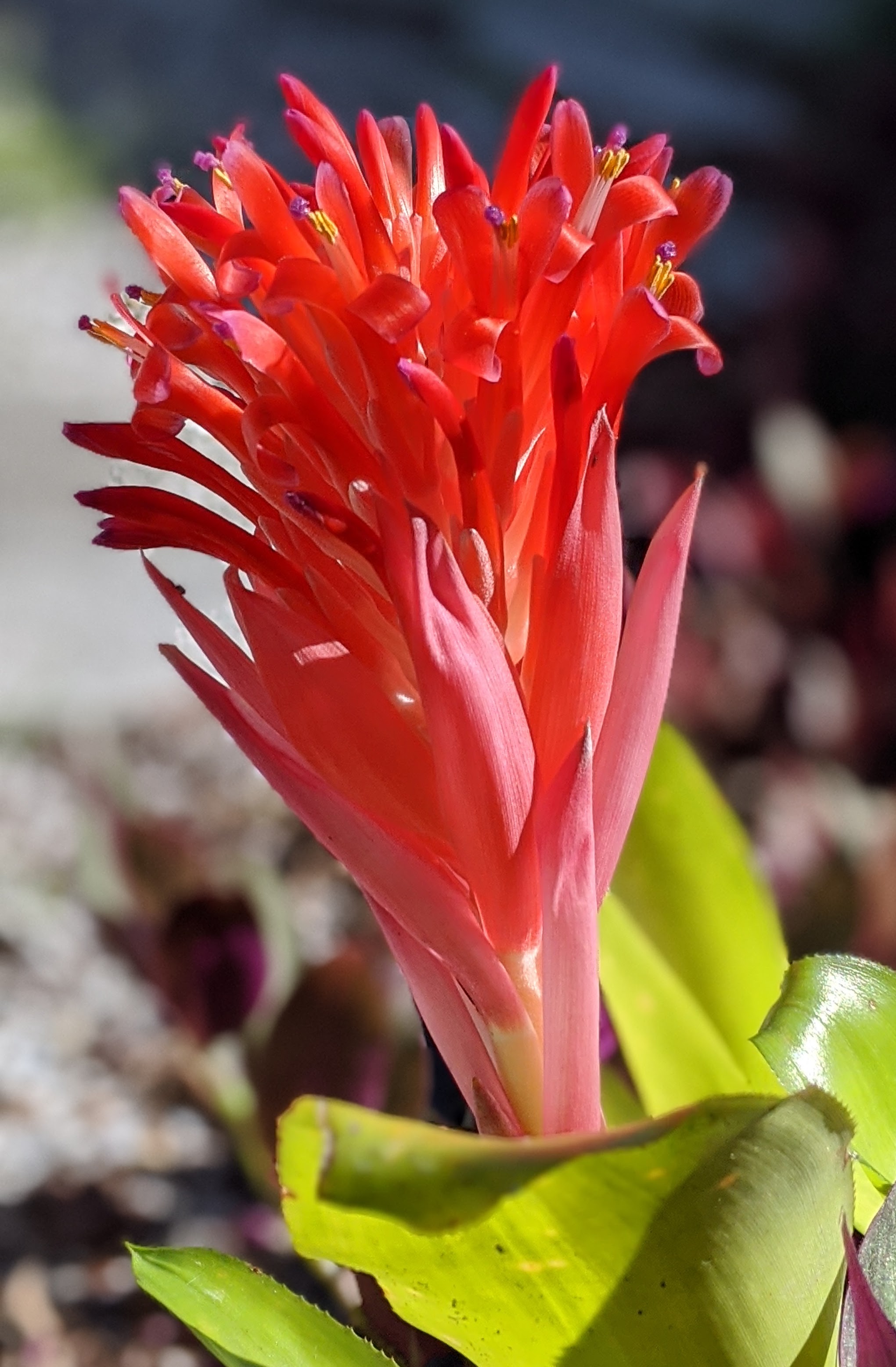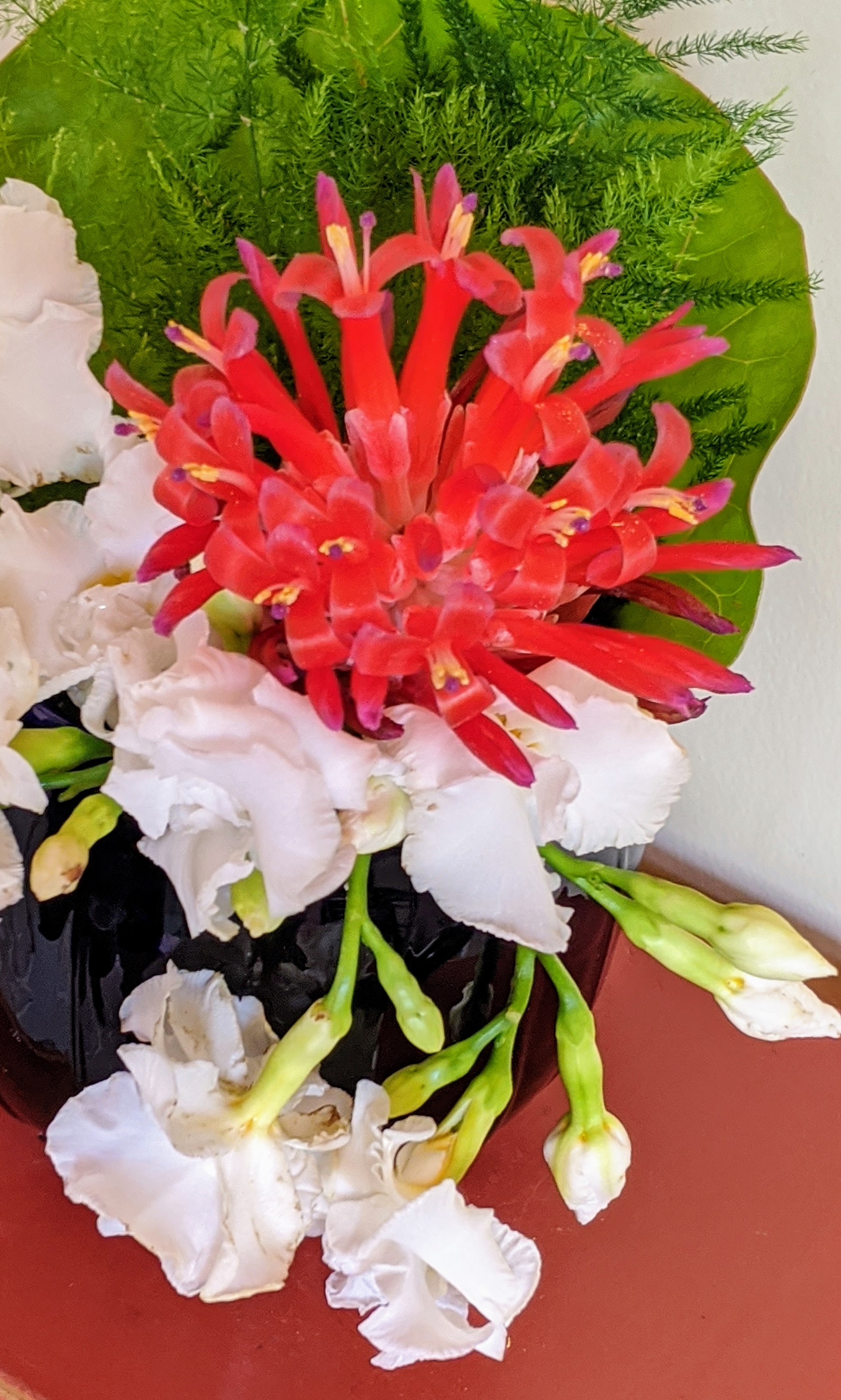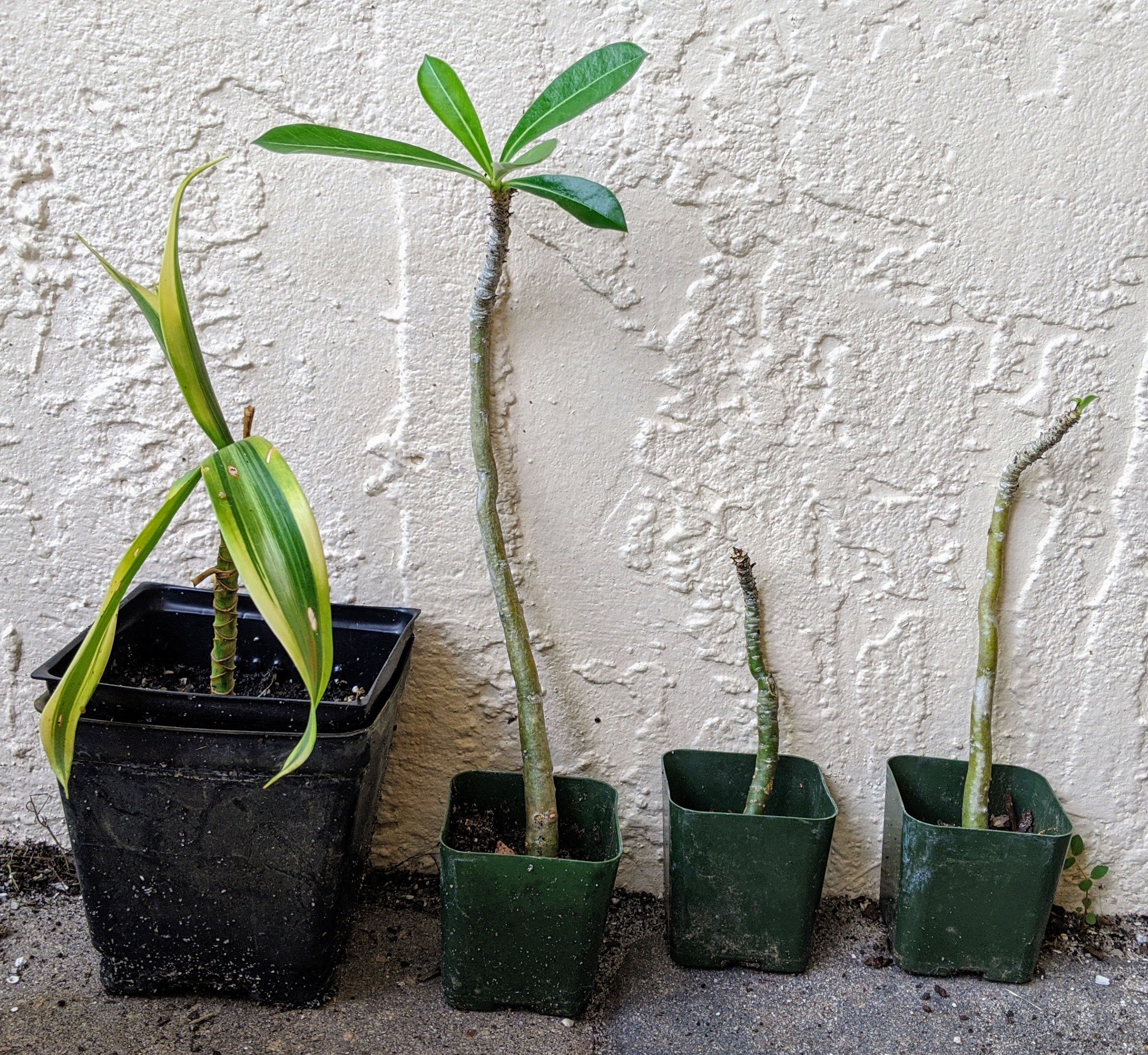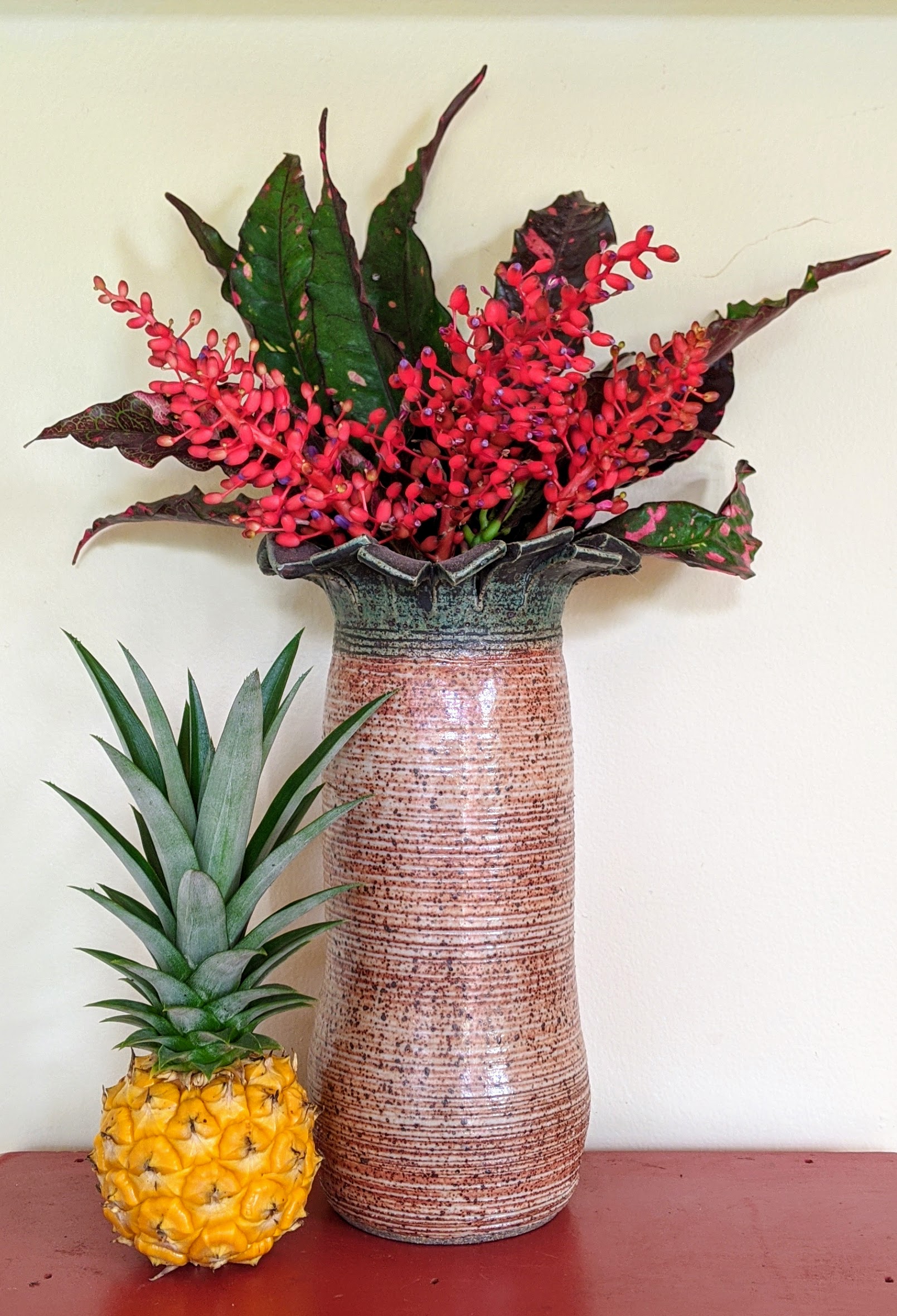


There is a yin yang aspect to my garden I had not considered until I put this vase together. The yin, female and present in even numbers must be the less tropical side of the vase. The more tropical plant (Lobsterclaw Heliconia) is the yang, the male side, represented by 5 bracts containing the flowers and the unbroken line of the stem…however, the colors don’t really work out to the Eastern philosophical concepts. Yin being represented by orange and yang, azure. I often have some difficulty combining the tropical with more familiar plant material. Maybe the balance is the difference…
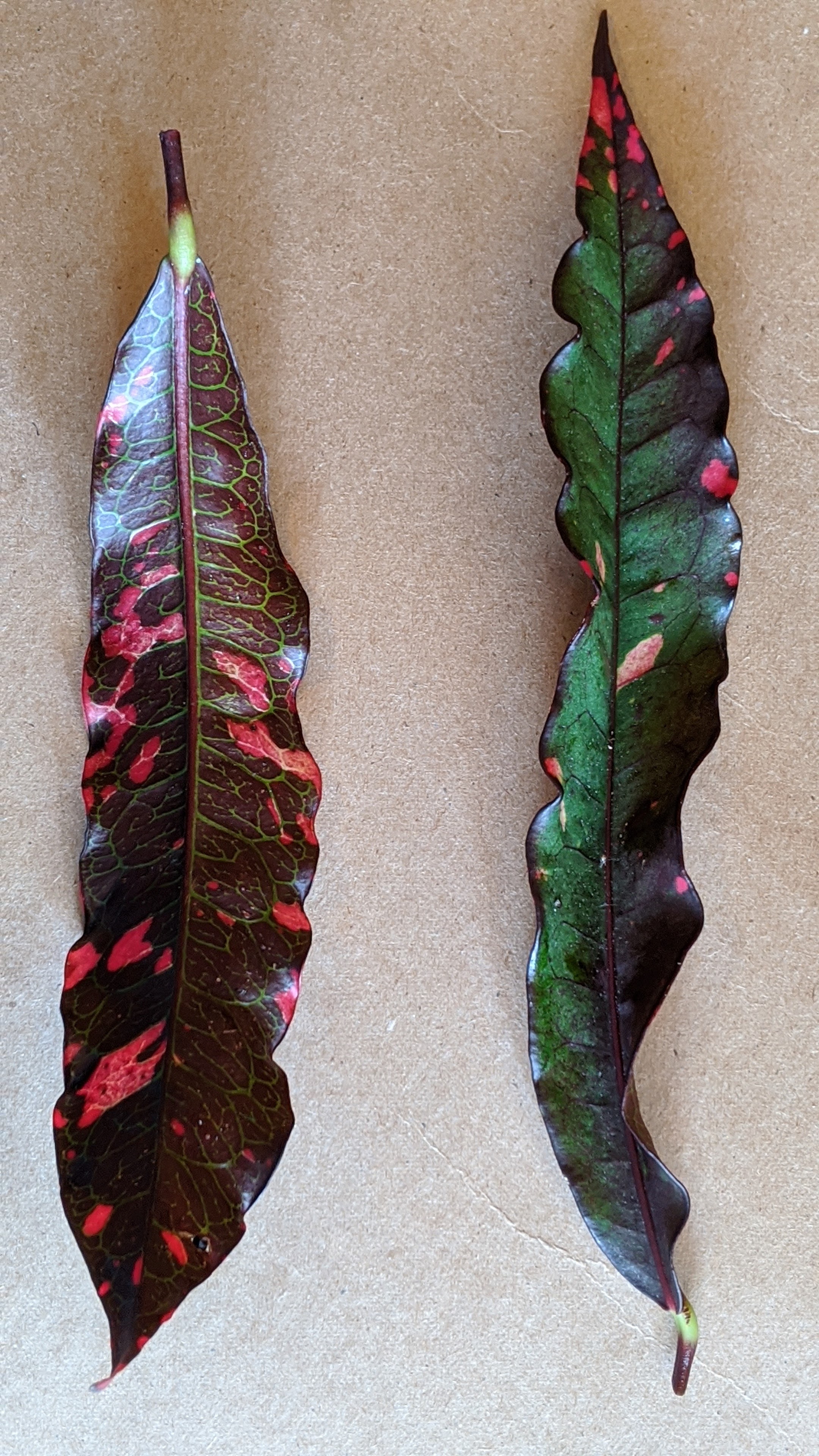
I should put the philosophical aside as the arrangement is in gold Prosecco bottle from my usually Champagne bearing college roommate. The reflection is a funhouse version of me taking a picture in my foyer. Look for the grey hair in the middle of the image.
The Vase:

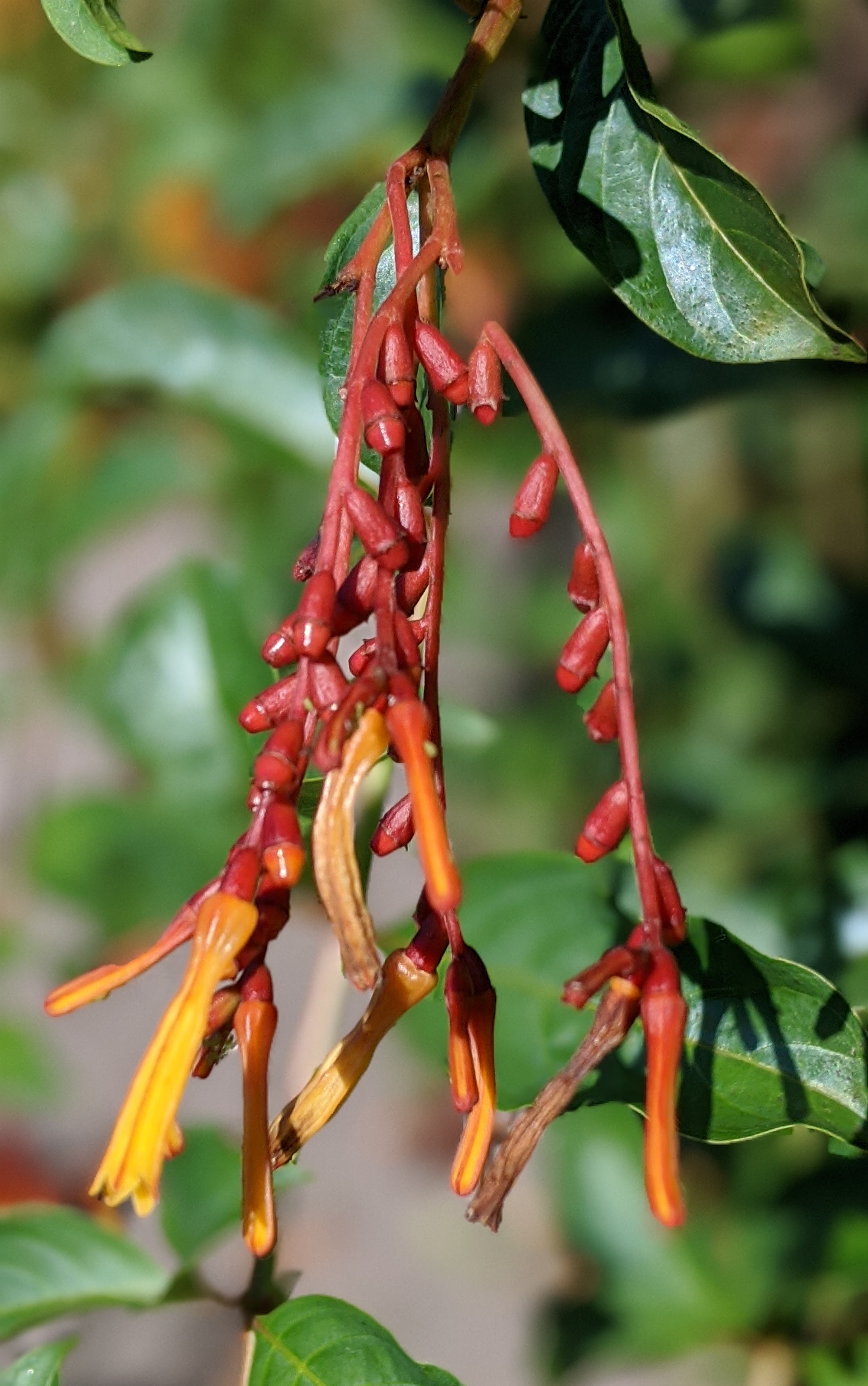
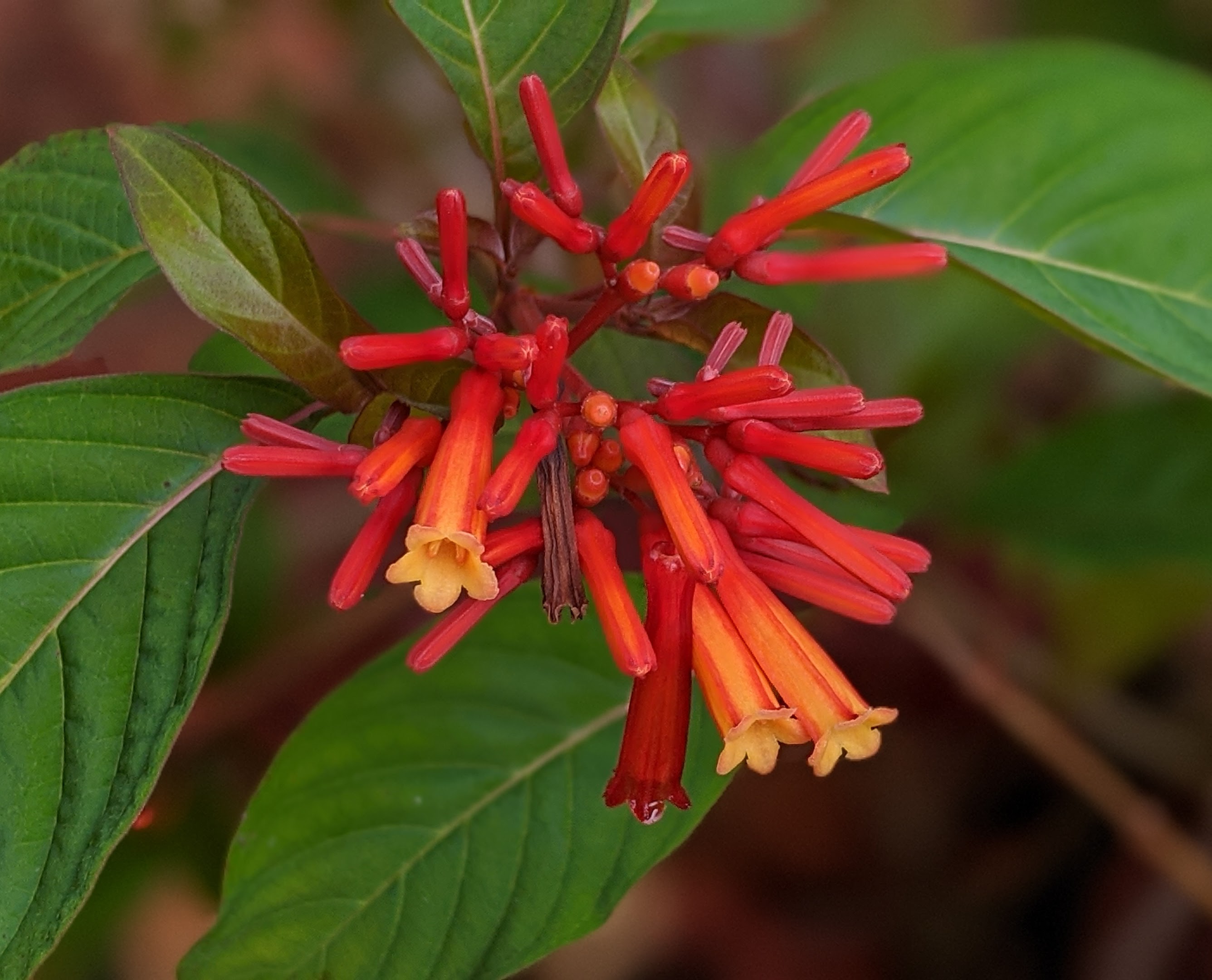
The colors reflect the Lobsterclaw Heliconia on the other side. Red flowers are from Firecracker Plant (Russelia equisetiformis); the yellow flowers are from the Florida native shrub, Thyrallis (Galphimia gracilis).

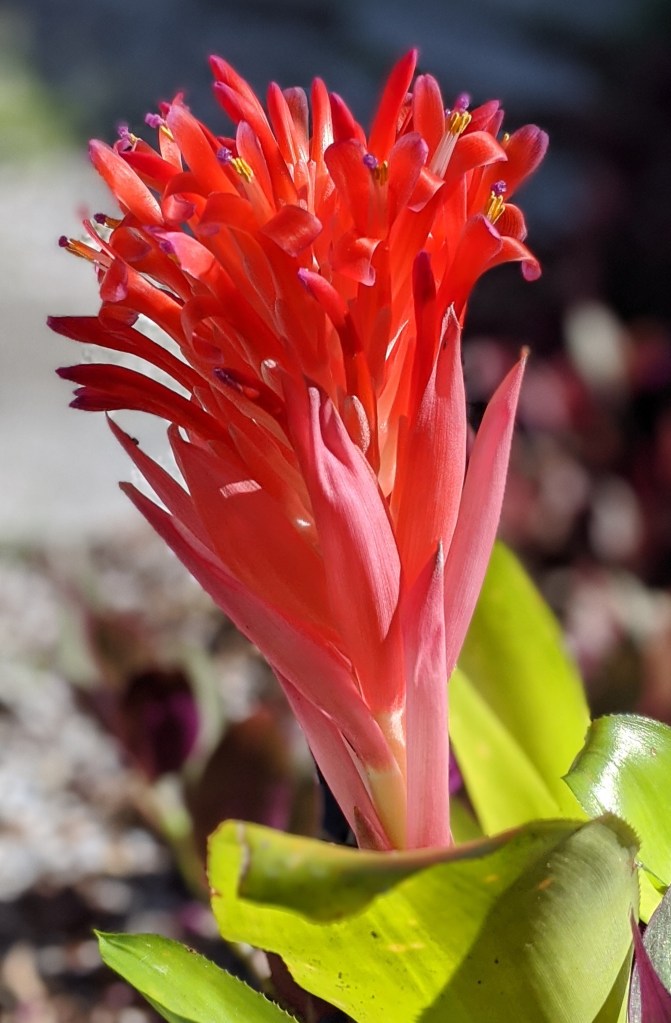
The masculine side of the arrangement. A Lobsterclaw Heliconia (Heliconia rostrata), the leaf in the bottle is also from the Heliconia.
I am considering brewing some Holy Basil tea and thinking my garden design through. It is a good time of year for retrospective in South Florida. The gardening season cranks up in 90 days. Tomato seeds are planted July 15.
Yin and yang in the garden await.
To see more vases from around the world, visit our hostess, Cathy at http://www.ramblinginthegarden.wordpress.com.
Happy Gardening!!
I started this garden several years ago, the idea was to recreate a rainforest using mostly colors and textures in shades of plum and green with a few pops of color. My Living Room looks into this space so the plants are placed around the windows to shape views from the inside and outside. Here is what I started with:

I referred to this ‘landscape’ as the beach with weeds. The glob of plant material on the right side had to be removed with a bobcat – I poked around at it with loppers for a while then gave up and had everything scraped out. The existing irrigation was capped off and I installed above ground tubing and microspray heads to keep the water off the walkway and be very efficient. The sand holds very little water and is mostly unamended – plant material was chosen carefully to cope with the conditions.

I planted the areas around the walk, and then hired a contractor to install plastic edging. I installed the fabric, then leveled the sand, added stepping stones and shell gradually. I have a crushed shell driveway and had a pile of leftover shell. This is 2018.

Later in 2018 with the walkway completed. I am not sure how long all that took, though I remember it was many tiny wheelbarrows of shell…
Here it is today, I am standing under an Avocado tree planted about 4 years ago.


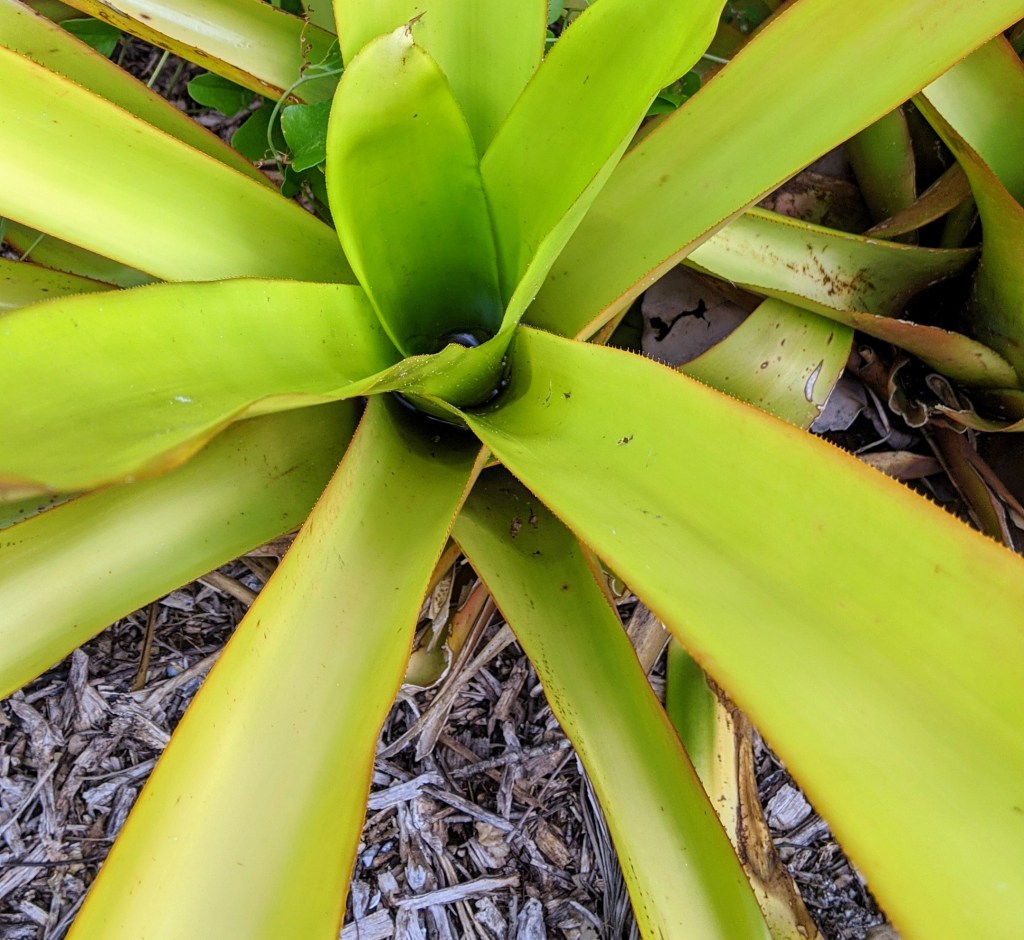
One of the plum and green Bromeliad beds:

Looking back, I am amazed at how quickly the garden has grown in and enjoy sitting in the garden with a glass of wine frequently.
For more Six on Saturday posts visit http://www.thepropagatorblog.wordpress.com…
Happy Gardening.

The Fourth of July marks the birth of American Independence from Great Britain in 1776. Usually the general public celebrates with loud fireworks and mass picnics in public parks. Many of these events have been cancelled due to Covid concerns. My greyhounds are blissfully happy (with no idea why) about no booming fireworks.
The holiday is on Saturday this week. My vase is celebrating the holiday in patriotic colors reflecting the heat in the garden with red and orange flowers. The vase is from the UK – a teapot in Blue Willow. There is even a Firecracker Plant in the vase (Russelia equisetiformis)
I have been gardening in the mornings, the end of June signals the end of tolerable weather outdoors. July and August are listed as our worst weather months despite Hurricane season peaking September 10. After over 20 inches of rain the first couple of weeks of June, the spigot got turned off and I have plants frying in the heat. Slightly windy and 90 degrees Fahrenheit will burn many plants. Surprisingly, I need to water some very tough Bromeliads later this afternoon ( and check on the irrigation)
Another view:

And closer:

The weeping red flowers are Firecracker Plant (Russelia equisetiformis); red spikes Tropical Red Salvia (Salvia coccinea); red and yellow daisies – Gallardia (Gallardia pulchella); the orange flower, Mexican Bush Honeysuckle (Justicia spicigera); grey foliage is from Licorice Plant (Helichrysum petiolare) – I can’t smell the Licorice…and a leftover Guzmania Bromeliad from last week.
Happy Gardening to all and Happy Fourth to those who celebrate it.
Thank you to Cathy at http://www.ramblinginthegarden.wordpress.com for hosting this weekly event. To see more vases follow the link.

One of the wonderful things about South Florida in summer are the tropical flowers that love heat and humidity. Above is a Desert Rose (Adenium obesum). This is native to Arabia and Africa and is a rare container plant that can stay outside all summer in the full blazing sun.

The Bougainvilleas are spilling colorful flowers on arbors and trellis. This is Miss Alice Bougainvillea, the flower is the small part, the white bracts surrounding the flower are what make the show.

Another favorite, the Bridal Bouquet Frangipani (Plumeria pudica). I have these near the entries to my house, they have a light, sweet fragrance most noticable at night or early in the morning.

This is actually fruit, Sea Grapes (Coccoloba uvifera). These grow just about anywhere in South Florida, usually seen near the coast as it is very salt tolerant. The fruit ripens to brown and tastes a bit like figs, however the seed is nearly as big as the grape – for me, it is too much trouble to eat them.

Finally, this is my favorite summer flower – my neighbor grows Cattleya Orchids in her Hong Kong Orchid Tree (Bauhinia purpurea). I am trying to get some going in a palm tree, no flowers as of yet. Here is a closer view.

That my six this Saturday from humidity central. To see more Six on Saturday posts visit The Propagator at http://www.thepropagatorblog.wordpress.com.
Happy Gardening.

I have learned to love Red Shrimp Plant (Justicia brandegeana) since taking up gardening in South Florida. My neighbor gave me a start of this several years ago and they just keep going – drought, rain, winter, summer – no problem and lots of flowers. The red flowers have been catching my eye since the onslaught of rain in June rejuvenated them.
I started with the Red Shrimp plants and just kept adding more and more foliage, then some Bromeliads and Frangipani and then some more foliage..lots of greens in this vase. The Shrimps ended up in a supporting role instead of starring in the vase. Here is a shrimpy close up.

Here is a close up of the arrangement:

The big leaf in the back is from Split Leaf Philodendron (P. selloum); there are a few bits of Burgundy Aechmea Bromeliad leaves in the back and some Red Shrimp Plants. And Asparagus Fern and Asian Sword Fern that appeared gratis in the garden. I am trying to hustle the ferns out of the garden before they take over. The big white flowers are Bridal Bouquet Frangipani (Plumeria pudica); smaller white flowers Sweet Begonias (Begonia odorata); red varigated foliage is from Louisiana Red Copperleaf (Acalphya wilkesiana). More Red Shrimp below the Frangipani and a Red Guzmania Bromeliad flower.
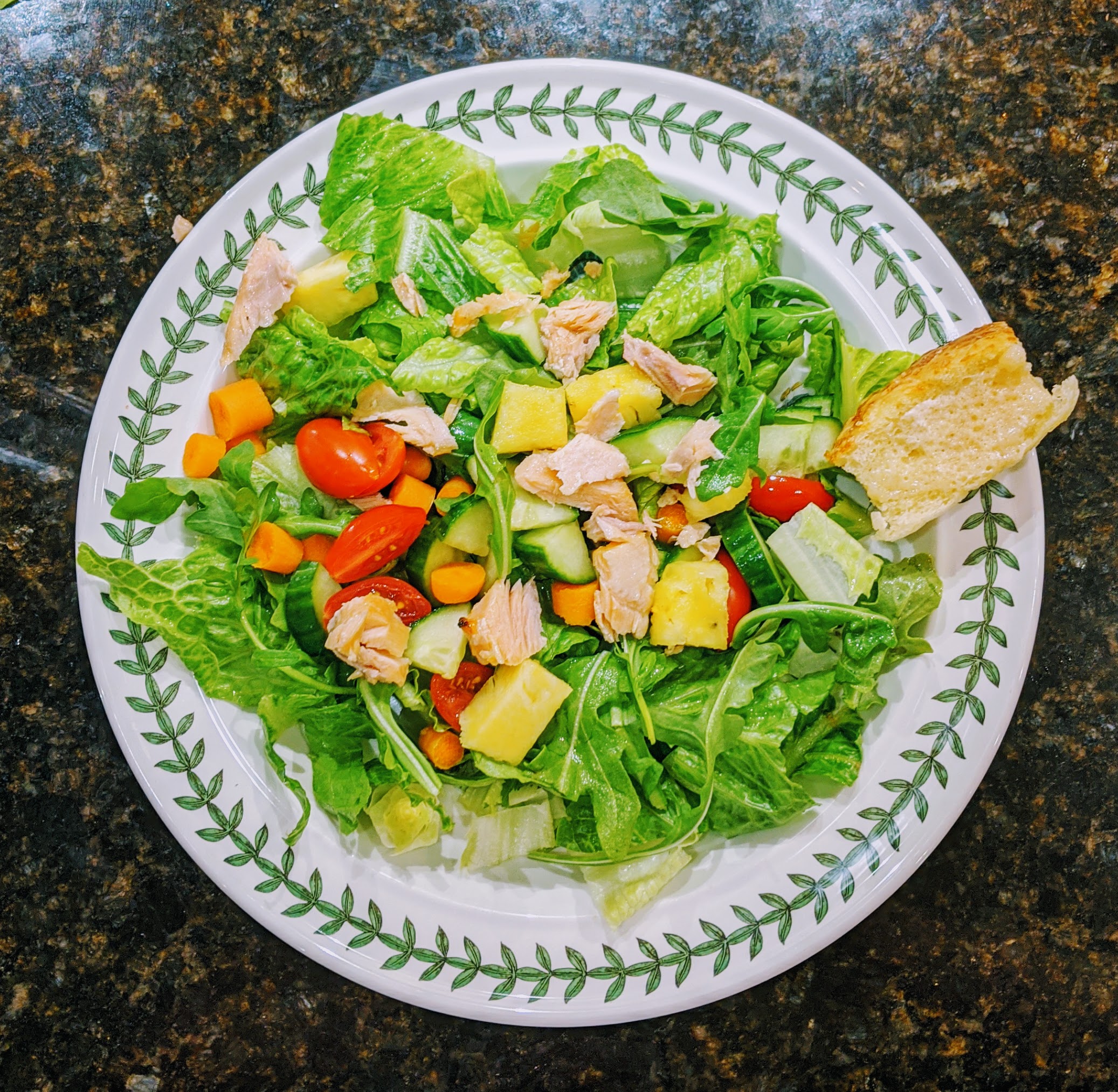
I have also learned to love Key West Pink Shrimp since moving to South Florida. They are readily available here and I can make myself a very nice meal with about four dollars worth of shrimp. My husband has odd shellfish issues, so I am the sole consumer. Here is my edible version of Shrimp and Greens.

Happy Gardening, I hope everyone finds something lovely to go with the greens in the garden. Shrimps or not.
To see more vases from gardens around the world visit Cathy at http://www.ramblinginthegarden.wordpress.com.
There is more good in the garden than bad or ugly. But there is always some bitter with the sweet, it seems. I will start with the good. With at least 20 inches of rain in June – and more on the way, I am seeing a lot of new growth and weeds! Here is the new growth on my husband’s Glenn Mango. Planted last year in honor of his father, Glenn. New growth on Mangoes is usually bronze, this is different and a pretty red.

More new growth and a summer favorite, this is the bud of a Lobsterclaw Heliconia (Heliconia rostrata).

A freshly picked Pickering Mango.

Passionfruit ripening on the vine. This plant was misidentified when I bought it..should be an interesting taste test when ripe.

Now, the bad. Papayas dropping off the tree due to Papaya Fruitflies, sometimes called Papaya Wasps as they are as big as wasps – they lay their eggs inside the fruit and the larvae hatch inside and eat the Papaya. It is important to get rid of these when they fall as the larvae mature in the ground and eat more Papayas. I seem to get one round of these in the summer. I think the lizard knows what is in there.

The ugly, Papaya Fruitfly larvae escaping, I got this one just in time. Yuck.

Happy Gardening, to see more Six on Saturday posts visit The Propagator at http://www.thepropagatorblog.wordpress.com.

It’s June, the most popular month for weddings in the US. I put together a big vase of fragrant white flowers and greenery, was ready to call it ‘Go Big or Go Home’ – then realized there were bells on the table and the crystal vase was wedding gift from a dear friend that worked with both my husband and me at the architectural firm where we met. The bells, year round residents on the table, are temple bells my father brought back from India after being stationed there during World War II.
I started to use Bridal Bouquet Frangipani but the stems are too short for this vase. What could be better for a June bride than a big bouquet of Gardenias? A closer view:

The Gardenias are Tropical Gardenias, sometimes called Florida Gardenias – like the temple bells on my table, these hail from India. Their botanical name is Tabernaemontana divaricata. Adding to the fragrance from the Gardenias, the white spikes are Sweet Almond (Aloysia virgata). A spray of chartreuse flowers from the Adonidia Palm is hiding in the foliage. The rest of the foliage is Asian Sword Ferns and a few errant palm fronds from seedling Sabal Palms (Palmetto sabal).

My foyer smells good enough to hold a very intimate wedding ceremony there. The need for witnesses might present a problem due to spatial constraints.
To see more vases from gardens around the world visit Cathy at http://www.ramblinginthegarden.wordpress.com
Happy Gardening!
We enjoyed out first Mangoes this week. We had one Pickering and one Nam Doc Mai Mango. Both were divine and worth the wait. The Pickering had a coconut taste and the Nam Doc Mai was sweet as well, without the piney taste I sometimes associate with Mangoes. This is the flower of the Nam Doc Mai.
Here is the fruit ripening.

Finally, I had to pick one because the fruit was starting to split from the 20 inch rain deluge. Here it is ripe on the counter.

There are still a few Pickering Mangoes ripening on the tree. I picked one and it shriveled a bit on the counter but was still very tasty.

Also waiting on my first pineapple.

Here is where the Nam Doc Mai ended up. As a side of Mango Salsa with Parmesan Crusted Salmon and Green Bean Salad. The Pickering Mango met a similar fate. I admit to having a considerable sampling of the two Mangoes while my husband wasn’t looking.

Happy Saturday and Happy Gardening. To see more Six on Saturday posts, go and visit The Propagator http://www.thepropagatorblog.wordpress.com.

Well, I am not literary enough to chat about the origins Of Cabbages and Kings; though I remember the line. The cabbages in my vase this Monday are in the back of the vase, a dramatically pruned frond from a Cabbage Palm seedling (Palmetto sabal). The seedlings of this palm appear sort of randomly in my garden and grow so slowly they are no cause for alarm, and I occasionally cut one for a vase. I like the graphic backdrop the palm frond provides.
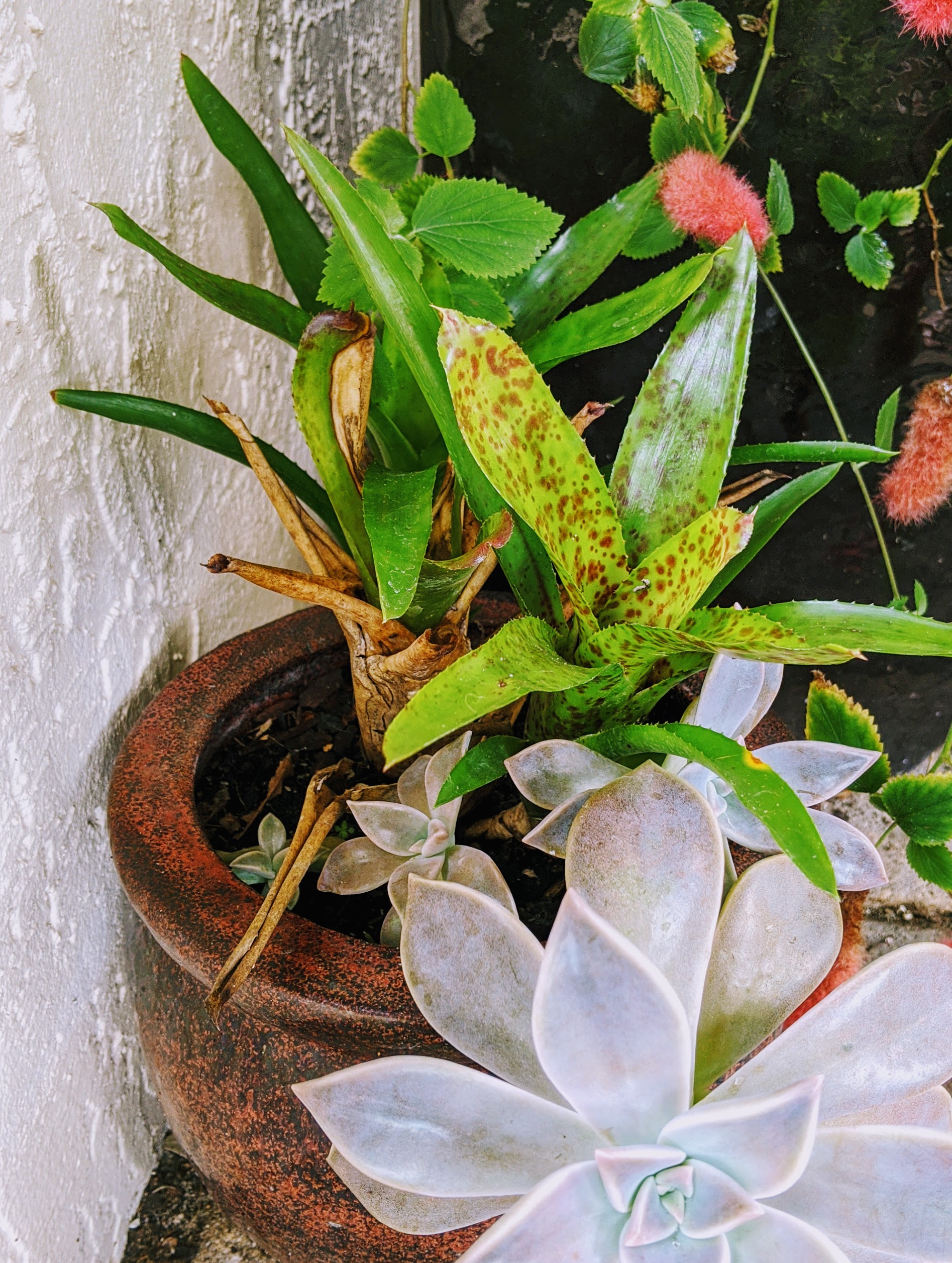
The parrot in the vase is the Parrotflower (Heliconia psittacorum). The tallest flower in yellow and red. The Parrotflower is a small Heliconia, relatively easy to grow here, but it needs a lot of water. I have just transplanted some bits into my (ha) vegetable garden to see if I can grow some for cut flowers as something else usually seems to eat my vegetables. And it is not my husband or the greyhounds. The culprits, that I am aware of, are rabbits, bobcats, armadillos and more recently iguanas. What’s a girl to do? Plant flowers these things won’t eat, of course.
Here is another view:

And a closer view:

I think the Palm frond and Parrotflowers have been covered. The other flowers are in white, flowers from an Adonidia Palm (Veitchii merrilli); the red ferny flowers are Firecracker Plant (Russelia equisetiformis) – a perennial in South Florida I used as a summer container plant further north. The red flowers at the edge of the vase are from Nodding Hibiscus (Malvaviscus penduliflorus) – so called as it seems not to have the energy to fully open.
Feeling a bit that way myself.
Hope everyone is safe and well and please stay in a bit longer…to see more Monday vases please visit our hostess, Cathy, at http://www.ramblinginthegarden.com