In A Vase on Monday – A Day at the Beach.

20161204_102207-2

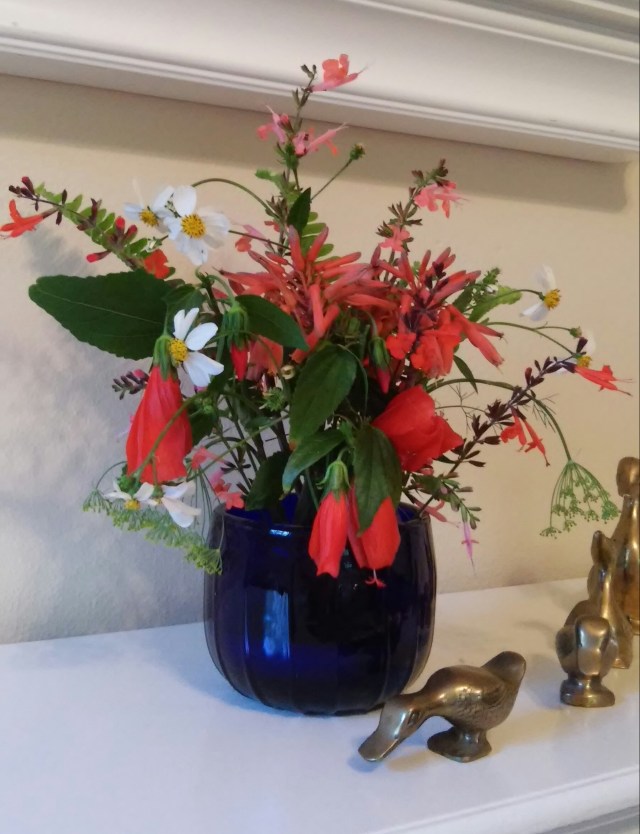
I usually conjure up my vases on Sunday morning as many things in South Florida can get wilted in the afternoon. This morning I was scratching my head as it didn’t seem to me much was going on in the garden.

As I was walking around the garden it occurred to me what a wonderful exercise  in seeing putting a vase together every week is. (This is also a flashback to design school -looking and really seeing) First, I noticed the berries on the Firebush (Hamelia patens)

20160918_151818-1

Then the fluffy seedheads on the mystery plant:

20161104_132111

Whatever this is popped up in my garden a few years ago  and I left it for the flowers or seedheads, please let me know it you recognize it. I thought it was some sort of Amaranth, but don’t really know.

20161204_102325

After finding the two base plants, I found the Red Shrimp Plants (Justicia brandegeana) and Beach Sunflowers (in yellow, Helianthus debilis) are still flowering and the thus far, oddly small Cactus Zinnias were added. Then I went around to my herb pots and snipped some Copper Fennel (Foeniculum vulgare “Purpurea”) to complete my arrangement. The flowers were placed in an vintage amber glass candlestick holder from Dansk, a favorite of my husband, repurposed for a vase on Monday.

Then it dawned on me, this was so easy it was like a day on the beach. So, I decided to go see how things were on Jensen Beach. If you are in a cold place I hope this warms your heart.


The Harbinger of Winter

20161130_095020

My Northern Hemisphere concept of the harbinger of winter has changed along with the latitude I now call home. We have Christmas Palms starting to bear red berries and many plants coming into bloom as the seasons change. A sled pulled by a team of flamingos has appeared on a front lawn up the street and the flamingos are wearing red capes! I laugh everytime I see this bit of holiday yard art.

Hong Kong Orchid (Bauhinia) trees start to flower in December and I spied my first one this morning while walking my hounds. The first one was white and as I walked back into my driveway, I noticed my neighbors purple one had just started to flower as well. In the next month or so this tree will be covered in what appears to be purple butterflies.

Winter is just around the corner.


In A Vase on Monday. Frogs and Hallelujah

20161127_125913-1

I know, your reaction was probably the same as mine. “Good Lord, what is that?”  Purple and white spotted foliage with a red, white and blue flower – who on earth could have dreamed that up?  As it turns out a guy named Don Beadle did, a famous breeder of bromeliads he created this one – the Hallelujah Billbergia. Here is a closer view of the flower:

20161127_130302-1

I bought the Billbergia a couple of years ago at a gardening show in Vero Beach, Florida. It was selected to add a tall purple accent in a terracotta wok container of bromeliads I was putting together for my front porch. I did not realize it would flower at all.

20161127_130420-1

I walked out on my porch a couple of mornings ago and thought someone had stuck something in the back of the wok planter. Upon closer inspection, I realized it was a flower, a very funky flower. So I gave it a couple of days to see what it would do and decided to cut it for my Monday vase.

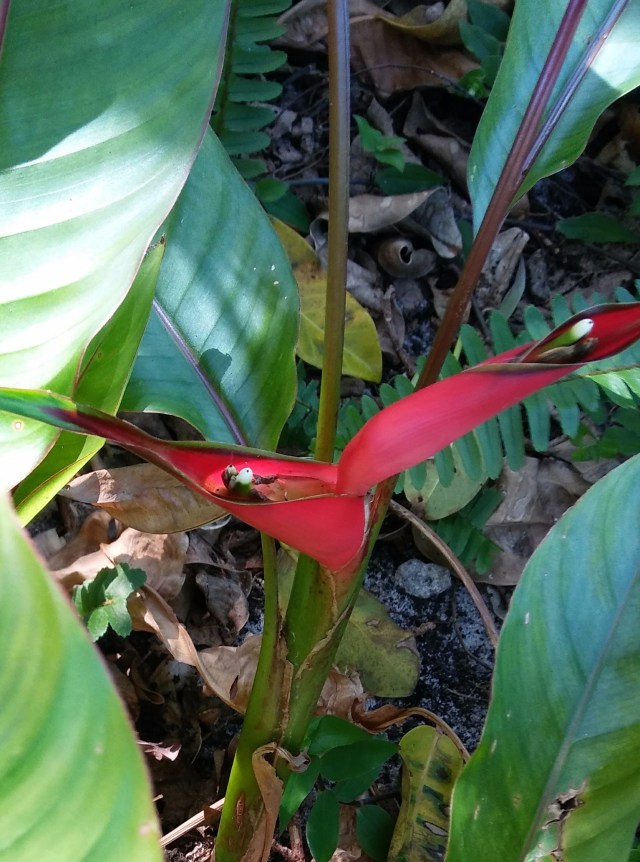
I cut it, brought it into the house and had this feeling something was looking at me. I looked down into the foliage and there was a tiny frog in the foliage surrounding the flower. The frog needed to go back outside, I took the whole thing back onto the front porch and the frog happily jumped over the wall and joined a friend in the Heliconias.

20160926_171831-3

Now there were two frogs looking at me. Hopefully, they are having some grand frog fun eating bugs in the garden. Bad bugs only, of course.

The vase in an old silver-plated something my mother bought in (her words) the junk store. I love the patina and I think it was a goblet, but at my house, it has only been used as a vase. Given the brilliant coloration of the centerpiece Hallelujah Billbergia Bromeliad adding a little green and white seemed the best option. Asian Sword Ferns and Asparagus Ferns are the greens and the white flowers at the base are Sweet Begonias (Begonia odorata “Alba”)

Hallelujah!

In A Vase on Monday. Thrift Store Finds

20161120_150944-1

Another one of those things I never knew about living in South Florida-the thrift store shopping is excellent. I suppose many estates are settled here and the population is somewhat transient as people buy and sell vacation condos don’t use them very much and then don’t want to move the furniture. A result of all this makes for some unusual and great thrift store finds. Especially if you are in the market for pseudo tropical furniture.

I was actually looking for a table lamp when I happened upon these pottery vases. I love things that are handmade and these are a bit thick and obviously hand thrown for the fun or love or it. I bought them immediately, I spent eight dollars. Well worth it. I also found a table lamp.

While winter is approaching, actual winter in South Florida is more like a really long spring. Freezes are rare and this is gardening season. Vegetable and annual seeds are started in late summer for planting now.

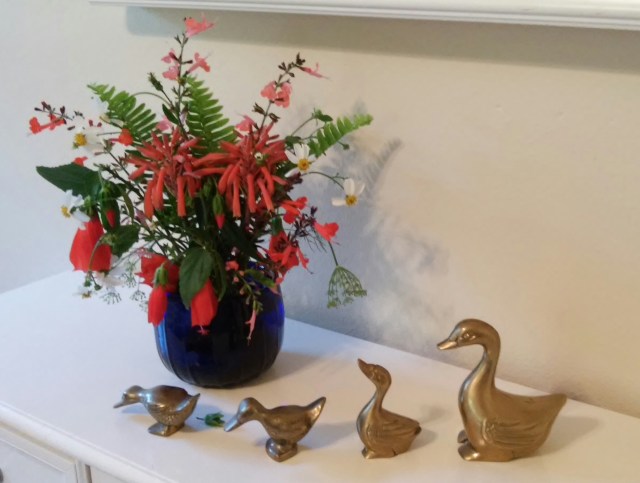
One of my new vases has my first ever Cactus Zinnias, started from seed in September, these do not look nearly as good as the ones I saw in other vases this summer, I am hoping they get bigger. Also new to the garden is the Copper Fennel, which I bought by accident thinking it was Dill for my herb pots. The Tropical Red Salvia (Salvia coccinea) and Bridal Bouquet Frangipani (Plumeria pudica) are old standbys.

Between the Zinnias, Salvias, Fennel and Frangipani the fragrance of this vase is a bit weird. Kind of medicinal.


20161120_110856-1.jpg

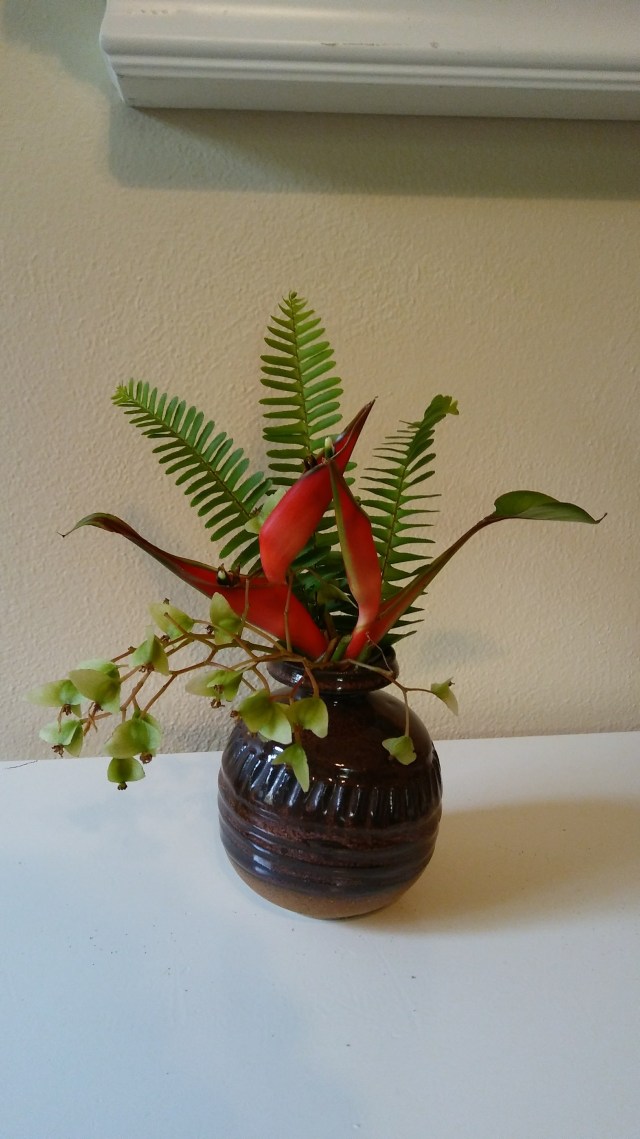
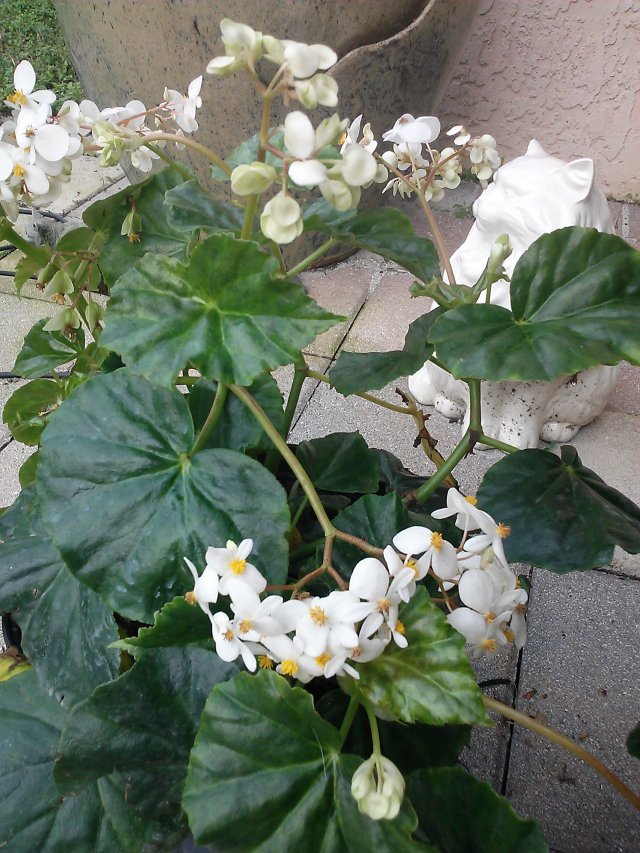
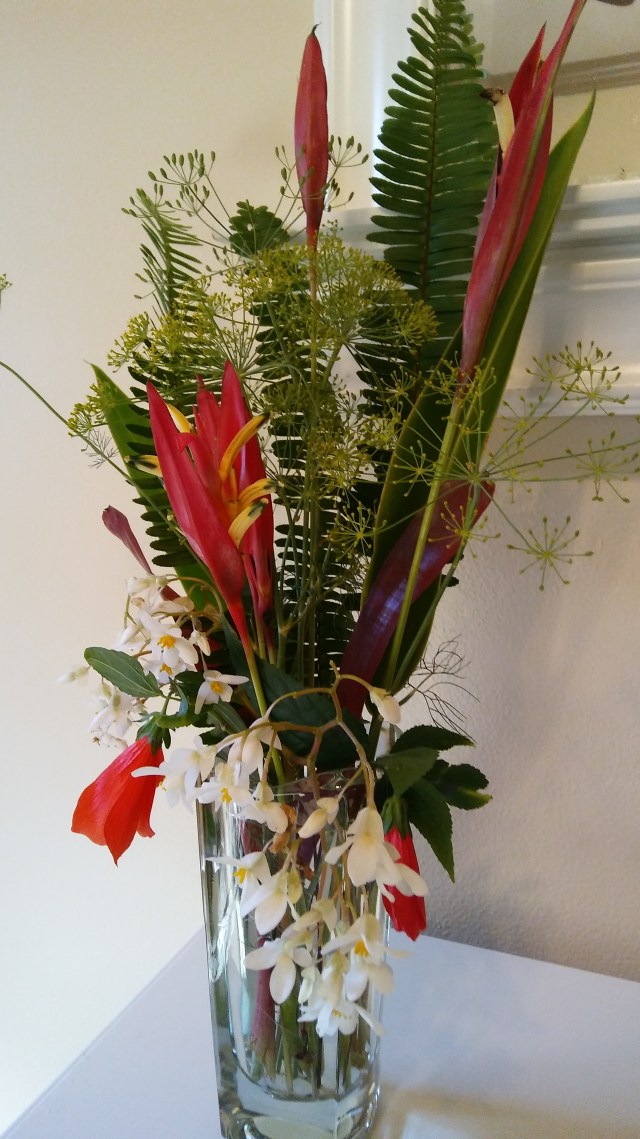
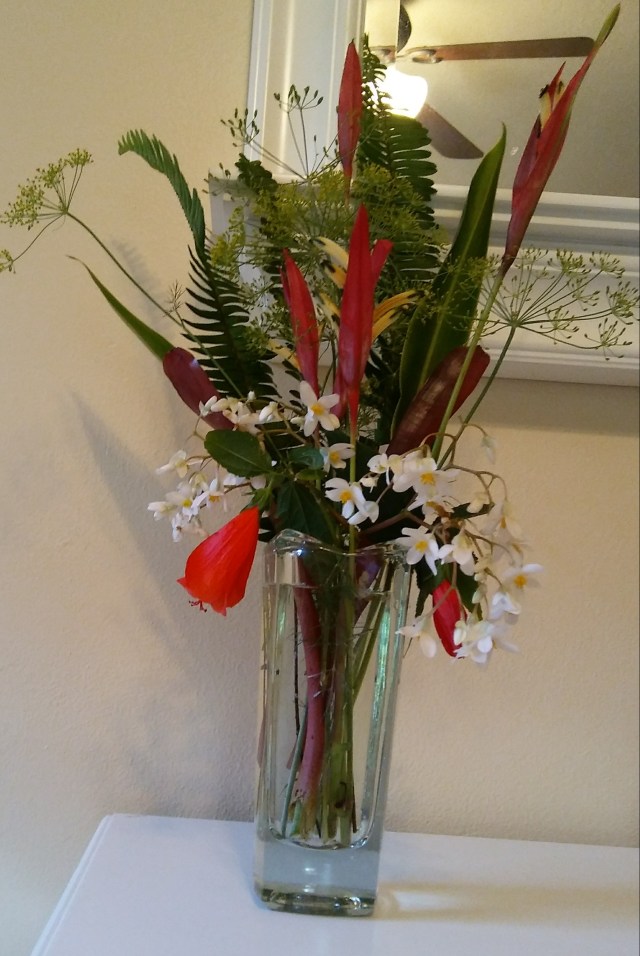
My other new vase has a more tropical feeling, I decided to try to avoid ferns for foliage today just for a change. This vase has Parrot Flower ( Heliconia psittacorum) and the foliage and flowers of Sweet Begonia (Begonia odorata ‘Alba’)

20161120_150844-1


In A Vase on Monday – A Cross Cultural Experience

20161113_151451

This is truly a cross cultural experience. The plants, while grown in South Florida, hail from both sides of our planet, Southeast Asia and Brazil. The terracotta man in the vase is an incense burner from Pier One that belonged to my brother in the late 1970’s. I am not sure exactly where he came from but the concept was Pre Columbian. I think.

20161113_121000

The red and yellow swirling crab claws are the flower of a Blanchetiana Bromeliad, a native of the eastern side of Brazil. The plant itself is about four feet tall by six feet wide. It has been flowering for about six weeks, of course the flower is on the side I can’t really see unless I am turning the compost heap. So, I decided to cut it and enjoy it in the house as long as it lasted.

20161113_121049

These Bromeliads are relatively common in South Florida and I nearly wrecked my car the first time I saw one. Talk about wild and crazy plants, the foliage can be orange, red, green or yellow and it is big. Even though I had experience with Bromeliads I didn’t realize how big they grew. Another houseplant myth busted by Tropic Florida.

The foliage is a frond of a Lady Palm (Rhaphis excelsa). This palm is native to the Rainforest in Southeast Asia, an understory plant that enjoys shade and water. Relatively hardy, it will grown north to Orlando, and is a favorite of mine for interior use as a potted plant. I bought one a couple of years ago and it sat in the pot a little too long, so it is a bit lopsided and has finally recovered its healthy deep green color and need a little trim.

Here is a shot of my Rainforest Garden, where the Lady Palm lives.

20161113_111728

In A Vase on Monday -Triple Bubbly

20161106_102518-1

This first Monday of November a challenge was issued to use threes in an arrangement. Given our now wonderful weather in Florida and the third anniversary of In A Vase on Monday I thought a celebratory arrangement was in order. Champagne is always a nice touch on a happy occasion.

Out came the flutes and the search was on for some bubbly flowers. I decided the flowers from the Firecracker Plant (Russelia) were red and bubbly enough and then added one Parrot Flower (Heliconia psittacorum) and a bit of Bromeliad foliage (Neoregelia spp) and a few sprigs of Asian Sword Fern complete the cocktail.

I found a relatively historic bottle of Cava in my refrigerator and added my mother’s relatively historic Fostoria ice bucket with matching tray to complete the vignette.

Here are the flutes without the wine. They are now perched on a table in my foyer.

20161106_103228-1

And here is a single flute:

20161106_102714

Thanks to Cathy at Rambling in the Garden blog for hosting this meme. Each Monday bloggers from around the world post arrangements from their gardens.


Cheers!

In A Vase on Monday-The Pumpkin Chronicles

20161030_125437-1

In a Vegetable on Monday, Part Two. My gourd collection from last week was looking pretty good so I decided to add to the arrangement with an heirloom pumpkin for Halloween. Today is Halloween in the US, traditionally the time to carve a pumpkin into a Jack O Lantern then go door to door seeking chocolate (or that is how I think of it).20161028_185146

This is a Jarrahdale Pumpkin, totally non traditional and it hails from Australia. My father was an enormous fan of pumpkin carving so in his honor, I carve a pumpkin every Halloween. I decided to research this one a bit to see if it was edible – it is, and reportedly has sweet, melon like flesh perfect for pies. My husband is regionally famous for his pumpkin pies – so I read on to find that I should roast the pumpkin for 20-30 minutes if I wanted to save the flesh and then scoop out the flesh and continue with my ‘decorative use’.

Upon the completion of the short roasting time, the shell had changed color a bit and the flesh was slightly softer, but not cooked, so I chiseled it out with a serrate knife, being careful to use my not so nice knife in case it snapped. The pumpkin looked a bit like a crocodile so I carved a mean face into it. The flowers may offset the meaness.

20161030_120142-1

Not so sure about the flesh, I just collected it and put in back in the oven to roast and set about arranging the flowers.

20161030_125613

Starting in the front, the yellow flowers are Beach Sunflowers (Helianthus debilis) the coral star shaped flowers are Dwarf Red Ixora, with a bit of Asian Sword Fern. The red and green leafless stems are from a Firesticks Pencil Cactus (Euphorbia tirucalli), red and yellow flowers are Parrot Flower (Heliconia psittacorum), red bell shaped flowers are from Firecracker Plant (Russelia), the grey foliage is from Flapjack Kalanchoes and a leaf from Split Leaf Philodendron (Philodendron selloum) completes the arrangement. The flowers are in a glass I put into the pumpkin, there is also a tealight candle in there, but I have mixed feelings about lighting it.

About this time, I took the pumpkin out of the oven, let it cool, had a taste and discovered it it really good and does taste of sweet melon – unfortunately, after all that I ended up with 1/2 cup of pumpkin puree. Pumpkin bread, anyone?

20151030_200543-1

Here is a much more traditional Jack O Lantern from years past, Happy Halloween!

A Plethora of Papaya

Fall is Papaya season in South Florida. My neighbor has a tree and has been sharing his bounty. These are Mexican Papayas, slightly less sweet than the more pear shaped Hawaiian Papaya – the latest one in my kitchen weighed in at 5 pounds. My neighbor uses a dehydrator to save them. Not being a fan of dried fruit, it is a challenge for me to figure out how to eat five pounds of Papaya with only two people.

20160921_153829-1

The first order of business was to bake some Papaya Raisin Bread, these freezes well and I will enjoy it for weeks. Click for recipe

The Bread:

20160923_163922

The bread used about 1/5th of the fruit. I decided to make a Grilled Chicken Salad for dinner. The chicken was marinated in balsamic vinegar, garlic, rosemary, olive oil and red pepper flakes. The salad was made with romaine lettuce, tomatoes, carrots, celery, fresh herbs, boiled eggs and yes, papaya. Divine. I had papaya and vanilla yogurt for dessert.

20160510_191710

Several times.

Faced with papaya overload and some pork chops in my refrigerator, I did some sleuthing online for another dinner dish. Aha, a stir fry -Thai Style Papaya Pork Click for recipe

20161005_191532

This was so good we made it twice.

And that was the end of the Papaya, all five pounds! Til next year.

Pineapples and their Cousins


A common element in South Florida gardens is the pineapple patch. Almost everybody has one, from a northern perspective, it seems kind of weird. Grow your own pineapples? Why not? Even one of our neighbors, his yard could be described as nouveau retch, is seen regularly hand watering his pineapples.

20160422_135000-1

Pineapples are in fact a Bromeliad, which are currently my favorite tropical perennial. Among the many Bromeliads I have planted that are purely ornamental I am afraid I have fallen prey to the trend and now have a pineapple patch between my citrus trees. I eat pineapple just about year round and the tops kept rooting in the compost heap. Unfortunately, the above is my patch, not too pretty.

Pineapples have an interesting history. Originally from the area where modern day Brazil is located, they moved via canoes paddled by traveling natives north to the Caribbean Islands where sea captains picked up on them and carried them home. One early accounting of the discovery of pineapple recounts a meal served by the Caribe tribe where a plate of pineapple rested next to a cauldron of boiling cannibalized humans. I think I would have asked for the fruit plate.

A status symbol on the dining tables of colonial America, pineapples were often rented for centerpieces and then sold after a few uses for eating. Thus the pineapple as a symbol of lush hospitality was born. The prevalence of pineapples as a decorative element may be explained by its being cheaper to carve decorative pineapples into bed posts or garden ornaments instead of renting them by the hour.

The Treasure Coast of Florida, the area I currently call home was once home to a large pineapple plantation. In 1895, Jensen Beach, Florida was named the Pineapple Capital of the World, shipping a million boxes of pineapples a year during the summer season. Later that year a devastating freeze decimated the crop, followed by a few tragic fires and fungal diseases that finished off the pineapple industry by 1920. Agricultural pursuits were redirected towards citrus. Wild Pineapple plants can still be seen on Hutchinson Island and are attributed to the original owner of the plantation, John Jensen.

Like many other popular plants, pineapples have also been bred for Ornamental use. Here are two prettier pineapple plants.


Building a Seashell Driveway

The Before Picture

The Before Picture

My husband and I bought a distressed property in South Florida. The driveway was really distressed. It took an archaeology dig to figure out where it had been and what it had been. After a bit of detective work we found a ‘Chattahoochee Stone’ pea gravel drive with a turnaround in front of the house. About 70 % overgrown with apocalypse proof weeds. The front yard became a free for all ad hoc parking area. Nobody could tell where they were supposed to park.

Part of the reason we bought this house was the garage was in the back. This is unusual in South Florida. Garage doors are usually a dominant feature of the front of the house. In some places it seems as if someone got a gigantic copier and started printing out houses with prominent garage doors. Later it dawned on me the reason for this is to provide the least amount of stormwater running off the concrete paving (the shortest possible driveway) and given the flatness of the terrain, it was also a short run to slope the driveway to provide drainage back to the street. It is also the cheapest way to get a lot of houses on a piece of property (i.e. Making the developer more money)

My husband retired and we decided to forsake the traffic and cold of the big city and moved 600 miles south from Atlanta to South Florida. The namesake of our existing driveway material, the Chattahoochee River, is a major feature in Atlanta.  The headwaters of the Chattahoochee are in the North Georgia Mountains, then it winds through Atlanta eventually pouring out into The Gulf of Mexico on the panhandle of Florida.

The driveway needed a renovation, however, it seemed a bit ridiculous, not to mention wasteful, to import pea gravel 600 miles to South Florida. Additionally, I was not enthralled with the brown pea gravel, having found it to be a fiesta of weeds in my previous garden and it cost at least 3 times what I had been paying for it in Atlanta. Based on the appearance of the existing drive it was nirvana for weeds. Not a good idea in South Florida.

The search began for new material for the driveway. The local rock here is limestone; crushed rock primarily for road construction. The rock is lumpy, starts out white and eventually looks very dirty. I didn’t like this option, but it was cheap. My next thought was pouring a concrete driveway, but, as a Very well seasoned Landscape Architect  (yes, I meant to capitalize Very for emphasis) I could tell the drainage just wasn’t going to work. In the event of rain, there would be too much water running off the driveway with nowhere to go. With the exception of the floor of our garage, not a good plan.

The driveway needed to be made of a pervious material so the rainwater could soak back into the ground rather than running off. During the course of my concrete drive design/pricing exercise I met a grading contractor who told me it was possible to build a shell driveway. What I couldn’t (and still don’t) understand was why there weren’t any of these driveways around. The only answer is they went out of style. People had been seduced by the evil brown pea gravel from the faraway Chattahoochee River.  I can only guess why. I did recall, however, over the course of my career people have waxed on romantically recalling the crunch of the pea gravel in their (perhaps very wealthy and with many yardmen) Grandmother’s yard.  This reminiscence is usually related to formal boxwood gardens in the Deep South. They never had to pull the weeds or pay for imported pea gravel.

I thought the shell was a great idea and, of course, did a bit of research. The shell used for constructing the driveway is mined about 20 miles north of my house. It is a byproduct of mining sand; five different sizes of material come out of the mine and are used for construction. The sand is used for construction and the shells are sorted out by size and intended use. My driveway is topped with ⅜” graded shell.

Shell driveways, properly constructed, last a long time. The construction method is as follows:

Grade the area and remove about 5-6’’ depth of existing soil. Compact the existing soil to receive the base material. Provide restraints around edges of driving surface to hold the loose driveway material. My driveway has pressure treated pine timber and Black PVC Landscape edging that act to hold the shell in place. I have seen drives edged with concrete curb or pavers set in mortar. This looks great and is, of course, a lot more expensive.

French drains were installed under the driving surface in areas where the water collects as it drains off the roof during a large cloudburst. Another South Florida peculiarity, no gutters, but some scuppers…you must cope with whatever comes off the roof, wherever it comes off the roof. Fortunately, I like rocks and Rain Gardens.  The drains were made from old solid walled laundry baskets with the bottoms removed then the contractor dug holes and placed them underground, filled them with gravel and topped the whole thing with filter fabric. The old gravel from the existing driveway was reused to fill the drains.

To build the driveway a 2-3” layer of crushed shell (this looks like coarse sand) is laid on top of the existing soil and pressed into place with a Bobcat. This is topped by a 2-3” layer of shell placed with a Bobcat and pressed evenly. The crushed shell course binds to itself and creates a pervious base layer. The shell course provides the driving surface. Maintenance requirements are spraying weed killer (I use the non toxic homemade vinegar solution) and raking it out every now and then. The materials firm up a great deal from cars driving on them and rain, but it is still a loose material.

I am pleased with the appearance of the shell driveway and it’s functionality. It drains perfectly and looks great. The shell also gives a great local, beachy feel to our property. And it looks really clean. It is also a very sustainable project, the majority of the materials arrived from within 50 miles of my house. The shell is a reuse product from a local mine. The driveway is pervious and most of the stormwater drains back into my property. I have two guest parking spaces and a turnaround for use when backing out of the garage. Pleasing the environment and me.

The Shell Driveway

The Shell Driveway