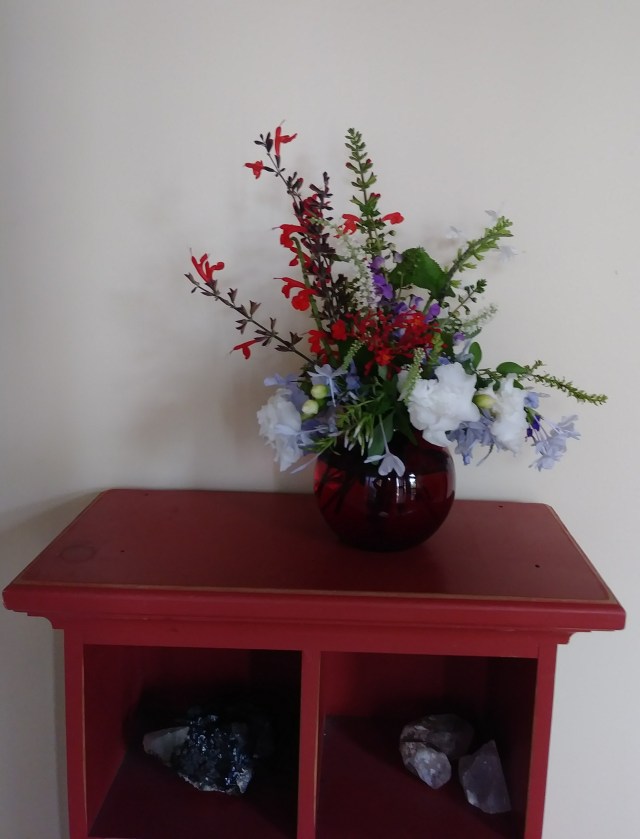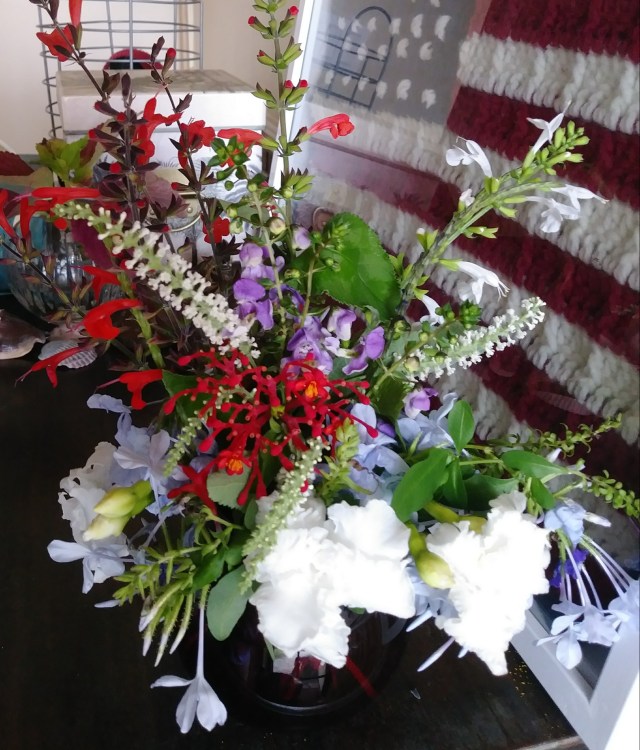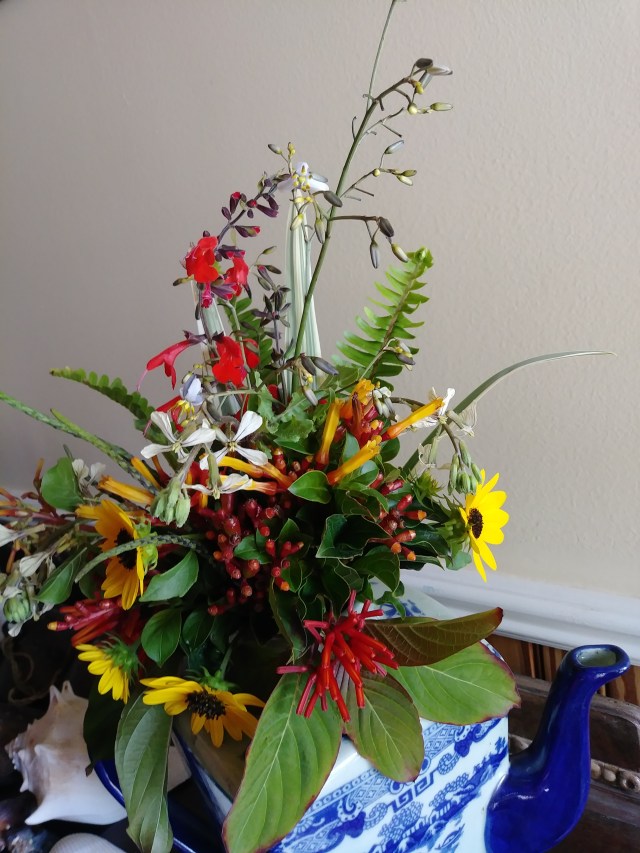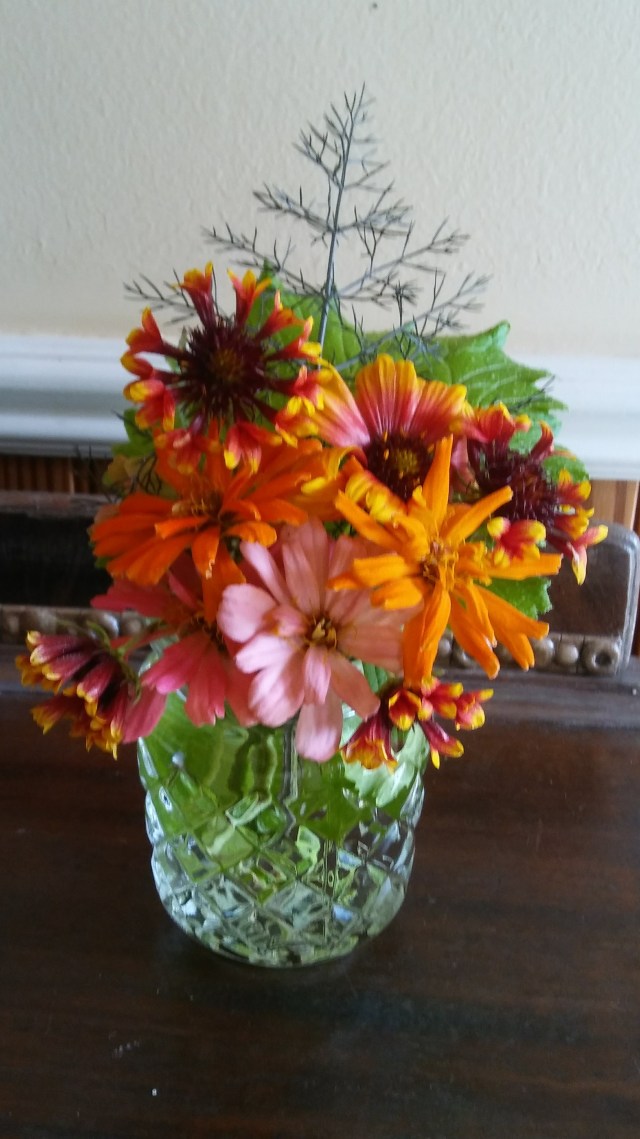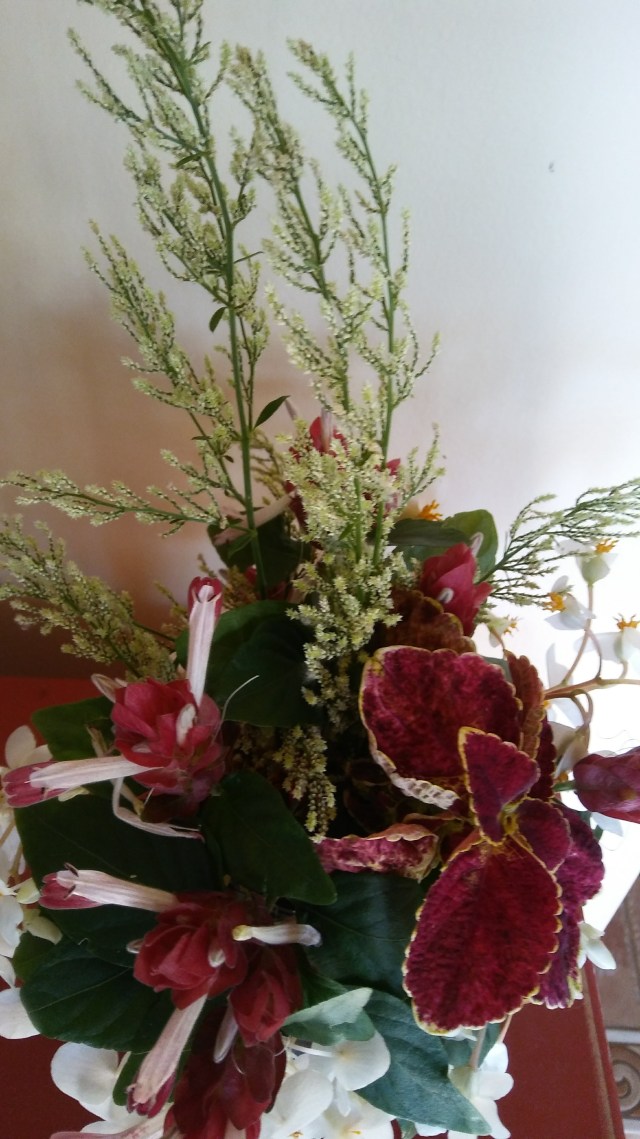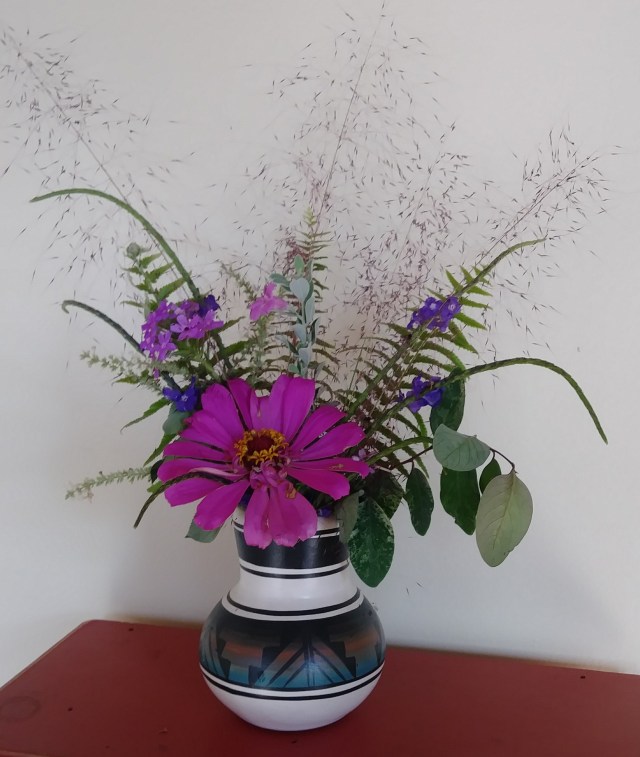
In A Vase on Monday- Soothing Relief

20170924_132227

This morning our temperatures were in the low 70’s with a nice breeze from Hurricane Maria passing by (a long way off). The humidity was down a bit as well, so I worked in the garden getting my vegetable garden going. South Florida’s gardening season is opposite most of the Northern Hemisphere. Summer vegetables are planted in September and October, so I will have tomatoes in the winter. Hopefully. Corn is not even grown in the summer here as it is too hot for the plant to pollinate.20170924_132320

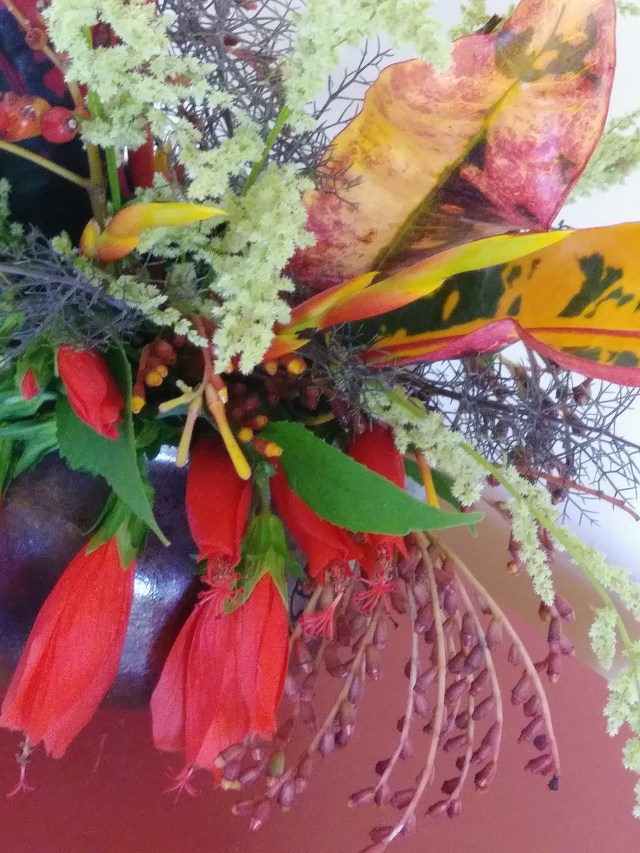
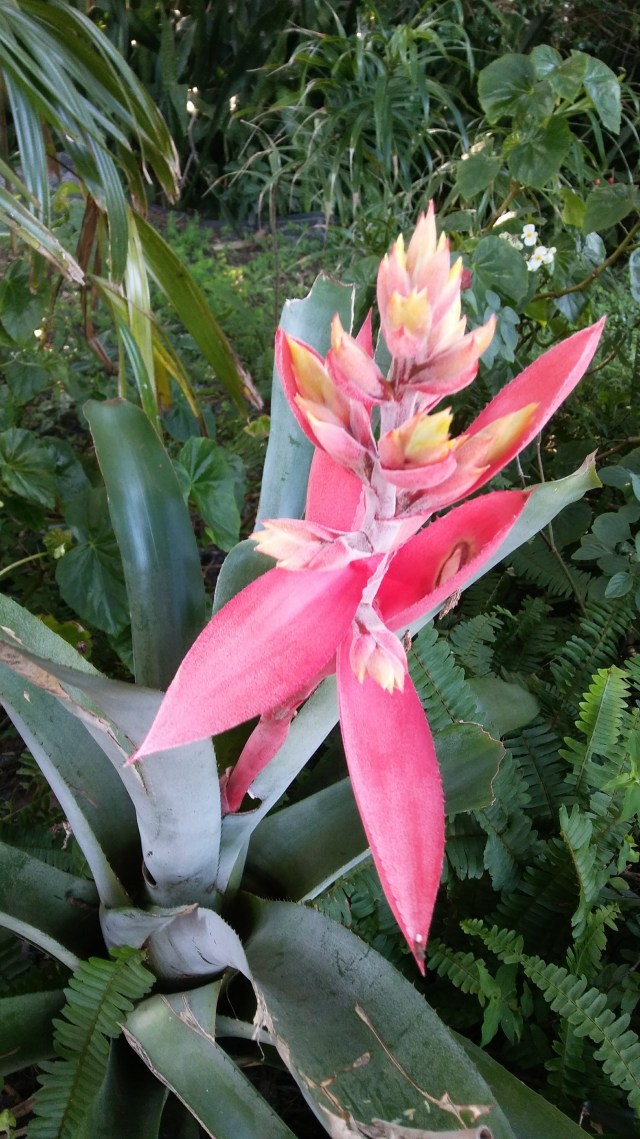
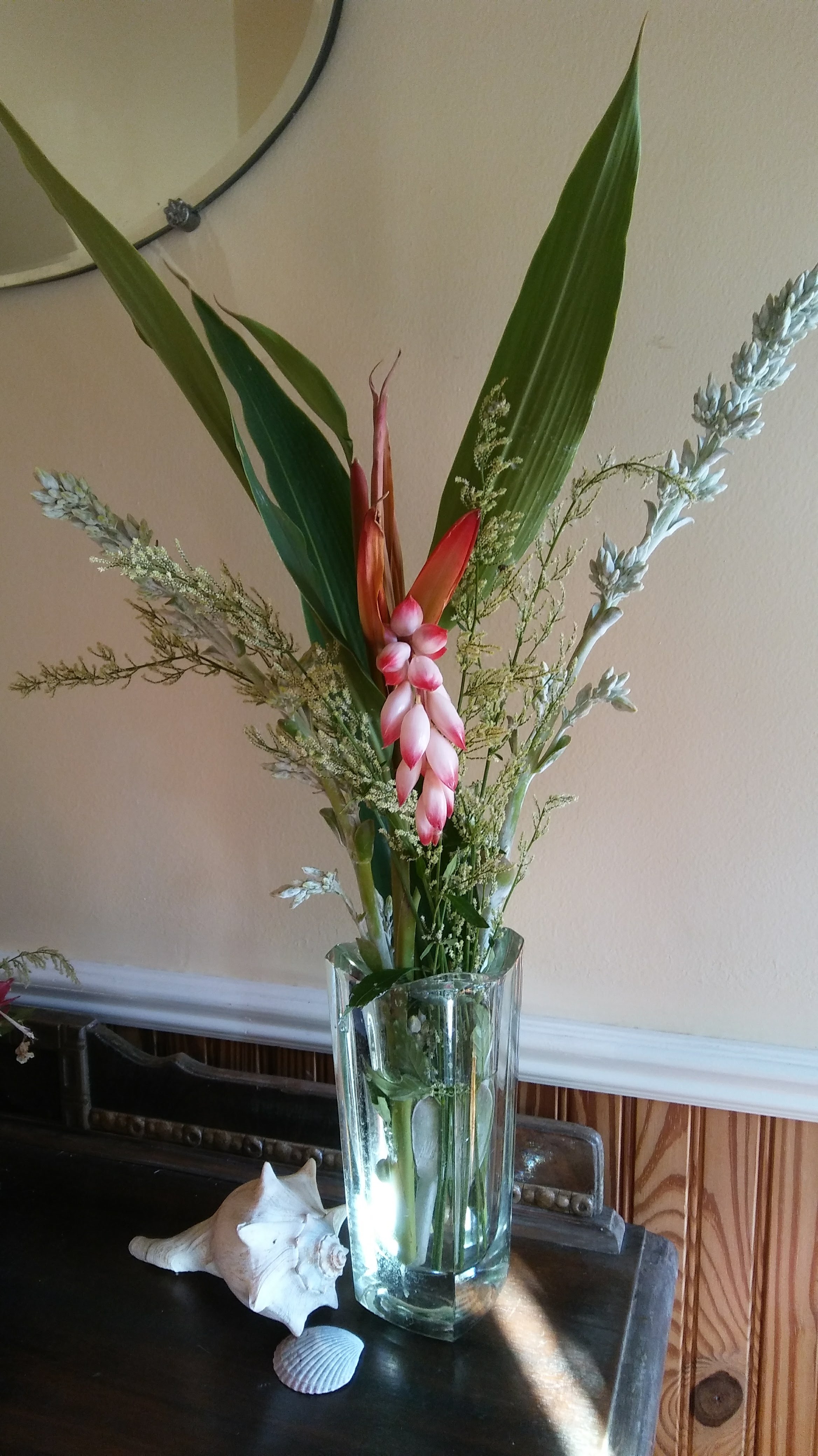
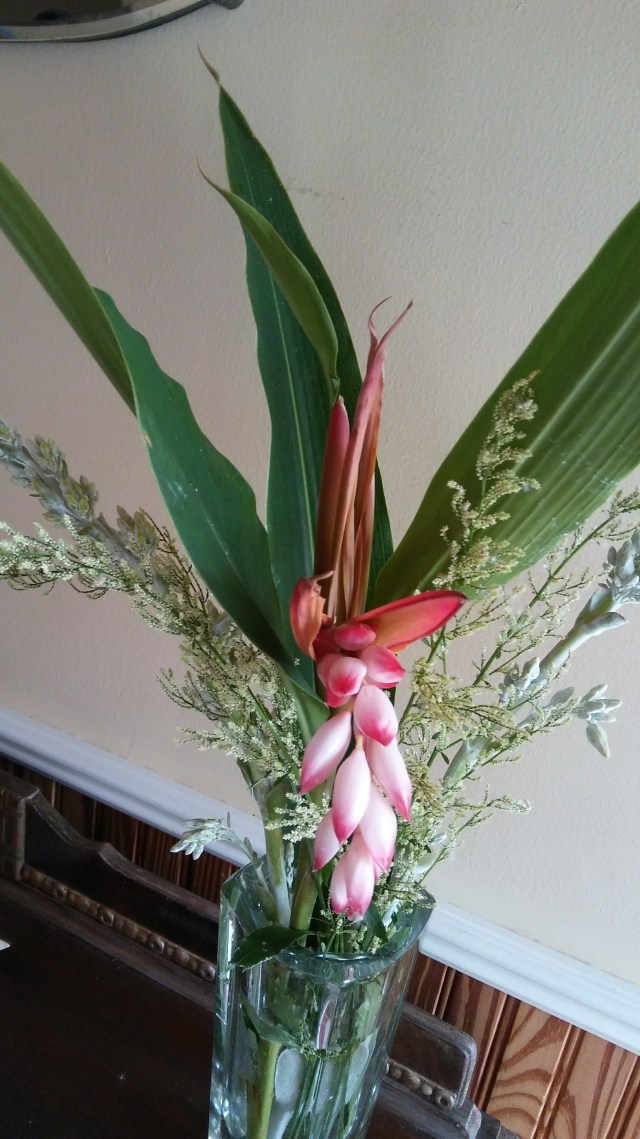
The anchor flower in this vase is a Soap Aloe (Aloe saponaria) which is supposed to be a soothing shampoo ingredient until you read up on it, seems more people are irritated by it than soothed. Stick to the Aloe Vera for relief. The Soap Aloe is the apricot and green candelabra shaped flower. The red flowers are our native Hibiscus, Turk’s Cap Mallow (Hibiscus malvaviscus). The mad funky flowers that look like Lobster Claws are Blanchetiana Bromeliad flowers – Hurricane Irma was not kind to these and I have trimmed the prettier parts for use in this vase. I have been channeling my Southern mother lately and am thinking of drying the rest and spray painting them gold for a holiday wreath. Although, that might be too funky.

20170924_132341

The vase is a big crystal affair that was a wedding gift – oh, many years ago from a dear friend who called the day before Hurricane Irma hit “just to hear my voice”, a truly lovely man. The components of the vase are of such a large scale (2 to 3 feet tall) I thought it called for the addition of some big tropical foliage. The smaller leaves in the arrangement are from Frangipani (Plumeria), the long reddish leaves from the Blanchetiana Bromeliad and the ferns are the ever present Asian Sword Ferns.

20170924_091445

The vegetable garden under construction. Hard to believe anything will grow in this ‘soil’.

In A Vase on Monday – Resilience

20170917_114703

Last Sunday we were already feeling the hot breath of Hurricane Irma. It seemed the earth was sweating, so much tropical moisture swirling in the air. Sunday and Monday were spent hunkered down indoors with two greyhounds and our cat. One of the dogs nervous, the other and the cat not so much. More about the hurricane later.

My vase, this Monday is filled with resilient plants from my garden. I had to search a bit to find likely candidates, winds burned or knocked many plants down. Amazingly the berries did not blow off the Beautyberry or the Firebush and I don’t believe the Parrotflowers even paused for Irma. Look closely at the Parrotflowers and note the tips of the flowers are burned black.

20170917_114716

The red berries in front are from the Firebush (Hamelia patens), the purple berries from the Beautyberry (Calliocarpa americana), Parrotflowers (Heliconia psittacorum) in red and yellow. Blanchetiana Bromeliad flowers are beside the Beautyberry and Asian Sword Ferns in the back for some greenery. The ferns are missing a chunk (most of them are) but are amazingly alive and green.

Hurricane Irma:

Hurricanes are generally terrifying. I experienced my first last year, Matthew. A local told me Matthew was a good starter hurricane! One of the most agonizing parts of the experience is the endless news cycle of weather forecasts. At one point 130 mph winds were forecasted for my Living Room. Eventually Irma ended up on the other side of the state. We had sustained winds of 70 mph and gusts to 100 mph off and on for a day or so. And 10 inches of rain. Adding to the fun, Alan (the nervous greyhound) dislocated his toe before the storm. His leg was ensconced in a splint that was NOT TO GET WET.

Needless to say, even though I wrapped the splint in plastic to take him outside, he took off and punctured the splints raincoat with his toenails. During the hurricane. No help available. Fortunately, I have a Facebook friend who is a vet – who advised me to take off the splint. Alan was much happier and chilled out to rest. Toe is much improved.

20170910_102604

The Garden:

The garden is surprisingly resilient. I don’t believe anything was lost to the wind – except all the leaves and foliage that was burned off. We are going to ask the Rainbow Eucalyptus to leave the garden. The top has blown out twice now and the tree just keeps getting taller and heavier.

Here is the side garden:20170915_091557

The back side of my neighbors ugly fence was completely covered with Shell Ginger, Lobsterclaw Heliconia, Bridal Bouquet Plumeria and a Mexican Bush Honeysuckle. By Friday, when I got around to pruning- all were coming back from the ground with new growth. I just cut off the dead and righted some of the Plumeria.

The hedge in back:

20170917_113104

This is a Surinam Cherry hedge, it was fully covered in foliage. The wind blew the leaves off and there is not one in sight. I have been planning to do this exact thing to the hedge and Irma saved me having to haul all the clippings to the curb. I am still contemplating what to do with this and will probably do some additional pruning.

This is a Strangler Fig, the canopy was not quite fully foliaged, but pretty close:

20170916_091137

Again, the wind blew nearly every leaf off and took them along. Saving me hours of raking and bagging! New growth is already on the tips of the branches.
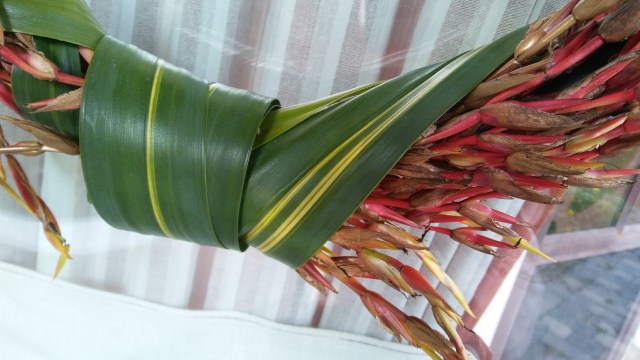
Finally, the Papaya:20170917_113014

This is a Papaya tree I started from seed last year. It is about 3 feet tall and looked dreadful until this morning. It is beginning to shed its burned foliage and producing new leaves.

Resilience. The garden seems to be doing better than we are. Still exhausted. I am told the Hurricane Hangover lasts about a week. Next week should be better. But wait, Hurricane Maria is lurking in the Atlantic. I need a chant for human resilience.
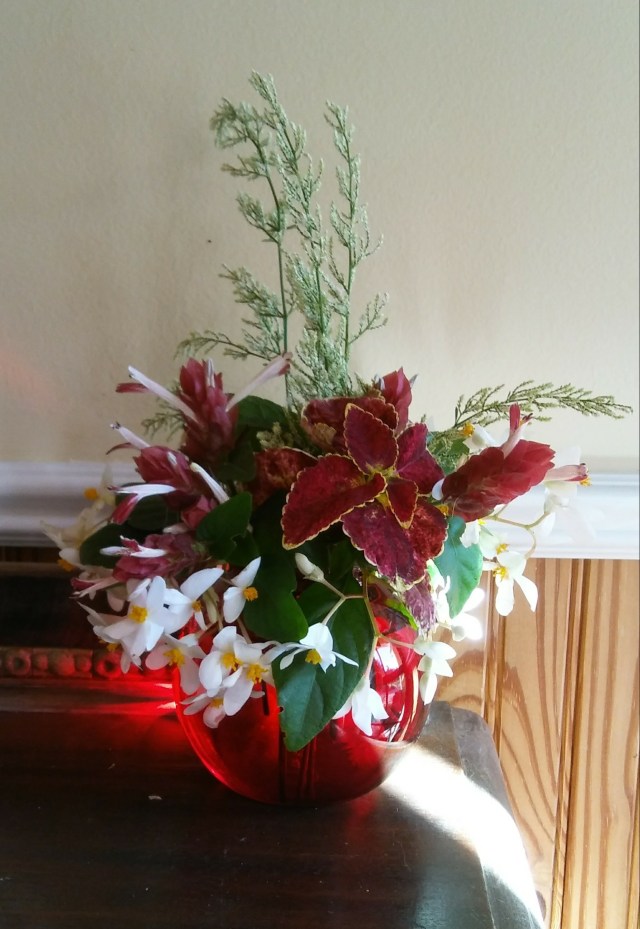
In A Vase on Monday- Trimmings

20170903_114606

I have been renovating the Greyhound Beach in my back yard this holiday weekend. It is Labor Day in the US and Monday is a national holiday. My Greyhounds, Alan and Charles, have been gleefully destroying the turf behind the patio for the past few years. The mini racetrack in the backyard – visible from space.

20160307_164454(5)-1

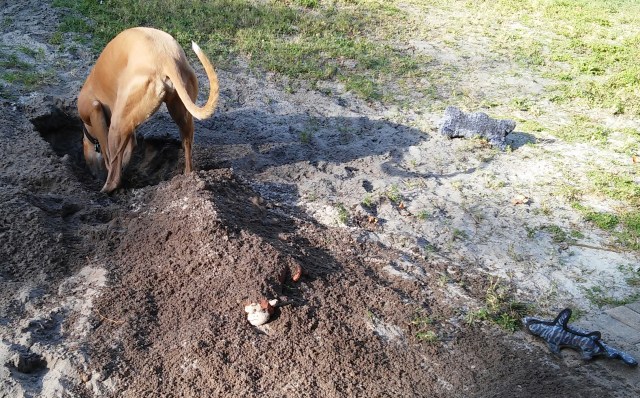
Here is Alan, with his favorite toy, Sharky, digging for reasons only dogs know. I flattened out the holes yesterday and installed edging for sod. Alan has been melancholy all day and refused to eat this morning. Later in the afternoon he relented and woofed down his dinner.

20170903_114722


Back to the title, Trimmings. As a part of my reclamation of Greyhound Beach, I decided to trim and tree form a Firebush that has overgrown its space. Trimming off armfuls of flowers. I stopped trimming to contemplate if I could shear the back of the shrub for screening and tree form the front – an Arboricultural dilemma.

This shrub was sold as a Dwarf Firebush, which actually means it gets 10 or 15 feet tall. Only in the Land of the Giants would this plant be considered dwarf. This sort of horticultural nonsense annoys me. One of the first plants installed in my garden to screen the well equipment:

CAM00121 (1)

Firebush Hamelia patens

Here it is, four years later:

20170903_164649

And I have cut four feet off the top for the past couple of years, the Greyhound Beach is visible through the shrubs.

Now, this is where the Firebush trimmings ended up- in my vase. 20170903_114540

The vase itself is an English teapot in the Blue Willow style, one of my favorite flea market finds. There are two kinds of Firebush in the vase. The dark red is the native Hamelia patens var patens. The ones from the gigantic orange Firebush are Hamelia patens, I think, botanists argue about these plants. I thought some purple was in order and added Setcresea, some variegated Dwarf Pineapple foliage and some red weeds, um, native wildflowers. The name escapes me – one of those things you think is pretty until you realize the seedheads are like dandelions and there are 10 million in your yard.

Another wonderful attribute of the Firebush. Butterflies love them. Here is a Black Swallowtail that was passing by:

20170823_155849-1

And a Zebra Longwing:

20170608_152406-1

A gigantic Firebush in the garden has some advantages.

Happy Monday.

In A Vase on Monday – Floridian Fall

20170827_103206

It’s another stormy Sunday in South Florida. Hurricane Harvey hit the Gulf Coast of Texas on Friday and is still pummeling the Greater Houston area. Our blog friend, the Automatic Gardner, is there.  According to her latest post, so far, so good. Best wishes and luck to her.

The Atlantic Hurricane Season is in full swing, peaking on September 10. So far, our area has avoided any truly stormy weather. The flowers in my vase today are all native to the area and at their best during the height of Hurricane season.

20170827_103233

All of the materials in this vase just appeared in my garden with the exception of one. Beautyberry . The purple berries come from the Beautyberry (Calliocarpa americana) I bought a few of these shrubs from a local nursery going out of business. The rest of the flowers just came up and me being me, I left these unknown plants to see what interest they brought to the garden. The orange tubular flowers are Firebush (Hamelia patens var patens), the yellow flowers are Chapman’s Goldenrod (Solidago odora), the blue flowers are Porterweed (still not sure exactly which one).

20170827_103240

The white flowers and foliage in back of the arrangement are from our native Hymenocallis latifolia (or a friend) These are sometimes called Alligator Lilies and have a lovely scent at night. I found a huge clump of these in the front garden years ago, mistook them for Amaryllis, divided them and have an enormous border of Alligator Lilies in my back garden. Soon to be spectacular, October last year we had Hurricane Matthew here and then the Alligator Lilies flowered. I was surprised, humbled and happy I had divided all of them.

I think of the components of this arrangement as a gift from Mother Nature to remind us of the good things she provides.

Hurricane season notwithstanding.

Happy Gardening.

GBFD – August 2017- Foliage of the Hellstrip

So, maybe I should ask who among us admits to having a Hellstrip? I do, mine is in the front garden along the edge of the road. About 10 feet deep, catching all the heat from the sun and pavement and not having the benefit of irrigation, I decided to plant this area with hardy, nearly indestructible plants, focusing on native plants.


The anchor plant in the Hellstrip is a Gumbo Limbo tree (Bursea simarouba) this usually gets some giggles. I like this tree and it has grown from a 2″ caliper twig to a respectable 6″ trunk in about four years. Mind you, without the benefit of regular water, I watered it, to establish it but that it. This tree is also called the Tourist Tree, if you look at the bark photo, the bark is red and peeling, like a sunburned tourist.

Below the Gumbo LImbo, Bromeliads and Native Perennials are planted. The natives were selected for their very fine texture which is fairly unusual among semi tropical plants. The Bromeliads are used for their extreme hardiness and textural contrast to the natives.

The Natives:


On the left, Muhly Grass, (Muhlbergia capillaris), the right is a Sunshine Mimosa (Mimosa strigillosa). The Muhly Grass seemingly grows almost everywhere, but many gardeners have difficulty growing it. I think the key may be locating it in a Hellstrip. Both of the plants will produce lovely pink flowers in addition to their fine texture. The other native in the garden is Beach Sunflower (Helianthus debilis)

20170720_185225The coarse green foliage of this plant is beautiful in its own right,  but really shines when contrasted with the finer textured natives.

The final members of my Hellstrip composition include Bromeliads, for their evergreen  color and contrasting texture to the native plants.


On the left, a Martin Bromeliad, medium sized and red, green and yellow striped. The center plant is a Painted Fingernail Bromeliad and the plant on the tight is a smaller red and chartreuse groundcover Bromeliad, meant to spread like groundcover. These are all passalong Bromeliads, two out of three gifted to me by friends. I am not certain of any botanical names, but I am certain they will thrive with little care making my Hellstrip seem a bit heavenly.

In A Vase on Monday – Where The Wild Things Are

20170813_122708

As these things go sometimes I started out with one idea and ended up with another. My first thought was to create a vase that looked as if it had been put together in an English garden. The English garden vase was going reasonably well until I realized the Sunflowers were full (extraordinarily full) of insects resembling Lightning Bugs. I hope they are Lightning Bugs and not a dreadful all consuming beetle. I carried several of these beetles outside and then realized the vase needed something like Artemisia or Lambs Ears, requiring a several hundred mile drive to the north.

So, I went to the back garden, where the wild things are, to search for some contrasting foliage. Looking up, I spied ripe, purple wild grapes that ramble through the Surinam Cherry hedge. The wild things are usually in the hedge eating something. Surinam Cherries, Passionfruit, rootstock Oranges and Seagrapes grow nearby. Sometimes at night it sounds like the creatures from Jurassic Park are in the garden.

The grapes are native Muscadines (Vitis rotundafolia) and the local wildlife usually gets the  fruit before I see it ripen. These look like Champagne Grapes, but taste nothing like them! Less than an 1/2 inch diameter with 3 large seeds inside, tasty but barely edible. I cut some, not very English at all and started a bigger vase for the grapes.

Into the big crystal vase they went and some tropical friends joined in:

20170813_122654

The white flowers are Bridal Bouquet Plumeria (Plumeria pudica) flourishing in the heat of August. The orange flowers, Mexican Bush Honeysuckle (Justicia spicigera). The ferns, gigantic fronds of Asian Sword Fern, I think. The big leaves are from Sweet Begonias (Begonia odorata) and the spikey foliage Dwarf Varigated Pineapple.

Here is the “English Garden” vase:

20170813_151226

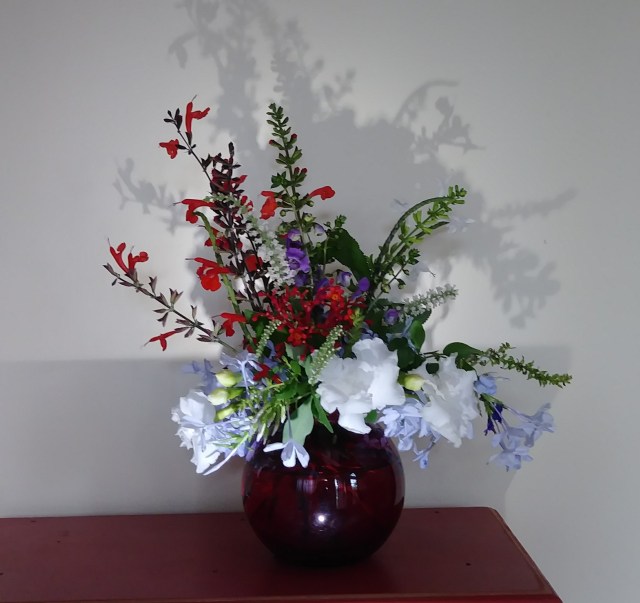
I think it could pass for Black Eyed Susans, Red Salvia, Blue Veronica and Gazanias? That’s not exactly what is in there.

Where The Wild Things Are  by Maurice Sendak was my absolute favorite book as a child. The book is now 54 years old. Maybe those creatures are living in my back garden.

In A Vase on Monday – Gardening with Armadillos

20170806_100303-1

Sunday got off to a bit of a rough start, about 3 a.m. one of my greyhounds started to run around and whine. I got up, thinking he needed to go out and opened the door – only to hear a strange sound crashing around in the garden. Decided to turn on the security lights and low and behold, I spied an Armadillo. The shelled rodent (IMO) digging beside the metal screen enclosure on our porch, bashing his shell against the metal. Driving my poor dog mad and depriving both of us our beauty sleep.

As the dog ran out the door the foolish Armadillo ran into the fenced part of our yard – who knew an Armadillo could out run a greyhound?https://en.wikipedia.org/wiki/Armadillo

Cartoon time 3 a.m. My backyard. Starring Alan the Greyhound. Shown below in his usual state. Alan is the brown dog, the other one has no interest in getting up at 3 a.m.

CAM00710

A few hours and cups of coffee later, I went to look for vase components in the garden the Armadillo had been digging in. Sure enough, he or she had been overturning Bromeliads, a favorite pastime for some reason made better by overturning burgundy or spotted Bromeliads. By trial and error, I eventually found out cardboard and mulch will keep the armadillos away, needs another application. Sigh.

20170806_100322 Seeking the components of a vase, I noted the Spathoglottis is flowering again. I know this really sounds like a disease, but is actually a lovely little Ground Orchid called Caberet. This is the second round of flowering since I planted it in January. It is the purple flower in the vase. The blue flowers are Porterweed, the jury is still out on which one and today it is really shedding for some reason. The yellow flowers are Lantana, Silvermound would be my guess for variety. The purple spotted foliage is from a Bromeliad the Armadillo overturned ‘Hallelujah’ Billbergia. A sprig of fern finishes the vase.

The Armadillo’s work last night:

20170806_101307

In A Vase on Monday – Dinner Party Vase

20170723_095434-1

I am not actually having a dinner party, although a Garlic Rosemary Pork Roast is going in the oven shortly. This blue bud vase contains a few flowers I have not cut before and I have a feeling it will not last through dinner. I call these dinner party arrangements, great for a party but not much longer. This is a better shot of the blue vase:

20170723_094812-1

I picked up the vase at a church thrift store near my house this week. There were several and after arriving home, I wished I had bought three for you know, dinner parties! Imagine three flower filled blue vases with candles in between down the center of the table. I may need a return trip to the thrift store. Here is a closer view of the flowers:

20170723_094852

The pink flowers are a new native addition to the perennial border, Sunshine Mimosa (Mimosa  strigillosa). Yes, a groundcover Mimosa and Floridians consider this a replacement for lawn. I consider it a front of the border perennial that looks a lot like a weed. Possibly it’s first appearance IAVOM. I am waiting until after dinner to see if the petals fall off. The yellow and orange flowers are the faithful Gallardias that last in a vase and the garden. The blue flowers are from (I think) the native Porterweed, there is another potentially evil Porterweed lurking about, but I can’t tell the difference and it came with a plant I bought. The pretty blue flowers make a striking vertical accent. I have used this before and I think the pretty blue part falls off and you are left with the vertical accent.

Dessert with vertical accent only.

The Bromeliad in the middle is great vase material that sometimes dries in the vase only to be spray painted gold for the holidays, Aechmea miniata, the Miniata Bromeliad.

Speaking of Bromeliads, here is the mad tropical plant of the week:

This is a Blanchetiana Bromeliad in bud, I am 5’7″ and the buds are a bit taller than me.

20170723_102030-1

I would like to share some thoughts with you all.

First, thanks to Cathy for hosting IAVOM.

I just want to say I am amazed and humbled by the knowledge and creativity I see every week.

And I love sharing these mad tropical plants with like minded people.

Happy Monday.

In A Vase on Monday -Frangipani, Foccacia and Friends


20170702_115959

Sunday morning found me baking bread to make Pulled Pork sandwiches for a friend who came down with shingles. While the bread was rising, I toured the garden to find the components of a vase. The Bridal Bouquet Frangipani (Plumeria pudica) has just started flowering in earnest and the scent wafting through the air in the early morning stopped me and my clippers.

I clipped a stem of the Bridal Bouquet Frangipani and looked around to see a Pink Desert Rose (Adenium) flowering and cut one of those to add to the vase. What vase? A small red glass one from the GoodWill (thrift or charity shop) seemed in order. Then a bit more red in the form of foliage. A few leaves of Pie Crust Croton (Codiaem varigatum “Pie Crust”) The Pie Crust Croton foliage has the unlikely color combination of red, black, green and a bit of yellow. The shrub will give you a bit of a pause when seen in the garden. The Copper Fennel (Foeniculum vulgare ‘Purpurea’) has come back with the rains and I added a bit of that for deep grey foliage, then found some errant Asparagus Fern to complete my vase. Here is a close up.

20170702_120238_Burst01

I punched the Foccacia dough down and set it into the oven to rise again and finished the arranging the vase.  Here is the finished Foccacia:

20170702_120551-1

This is a Parmesan Crusted Low Sodium Foccasia, my specialty. Here is the bad news.

I woke up the other morning feeling I needed to check on the Night Blooming Cereus:

20170629_091720

The bud was no longer on the plant. During the night something knocked off the bud! Maybe next year.

In A Vase on Monday-Ironic Architecture

20170625_125639

The occasional Architectural floral arrangement appears in my house. I would consider this one is in that style. Generally speaking, I am ambivalent about Architectural furnishings and such. After working for an Architectural firm for a few years, I determined I really did not want to see or deal with another Architect for a really long time. Then, I married one. Twenty five years ago. Ironic.

This morning, finding the Soap Aloe in bloom, I decided to feature it’s large candelabra shaped flower stalk in a tall crystal vase. This idea sent me looking for a wedding gift, said tall crystal vase, from a dear friend, yes an Architect. Not remembering where I put it, I decided it must have been broken when we moved as I haven’t seen it in ages. Went on about my arranging using another vase, finished it, decided to look in the (gasp) crystal and china cabinet and there is was, safe and sound, stowed in the back. Ironic.

20170625_154009

This is a relatively simple plant palette. In orange and candelabra, the Soap Aloe (Aloe saponaria). A frond from our native Cabbage Palm (Palmetto sabal), the long green leaf is from a Sansiveria( Mother In Law tongues or Snake Plants), the long orange leaves are from Blanchetiana Bromeliads (Aechmea blanchetiana). It seems weird to me, I can think – I need a 4 foot long bit of orange foliage for this arrangement and then find it in the garden. Not particularly ironic, just an observation.

Here is the progress on the Night Blooming Cereus, bud has doubled in size.

20170625_173605

Happy Monday.