In A Vase On Monday – Bad Berries

20181209_151104-1

Overcast could describe the usually clear sunny skies in South Florida on Sunday, I waited for some sunlight and finally took my vase outside to snap some pictures. I barely finished the photos and planting my winter containers before the proverbial bottom dropped out and was inundated with rain.

20181209_151117-1

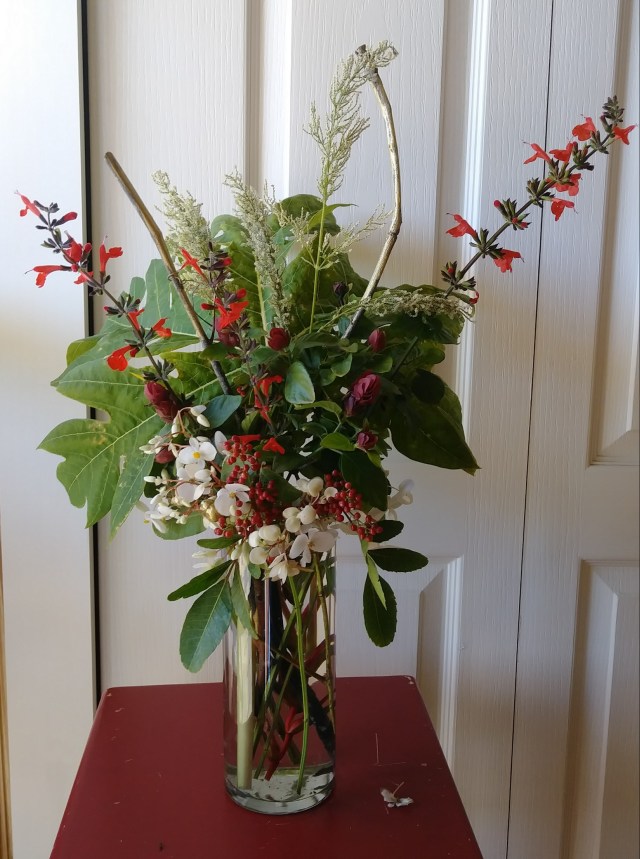
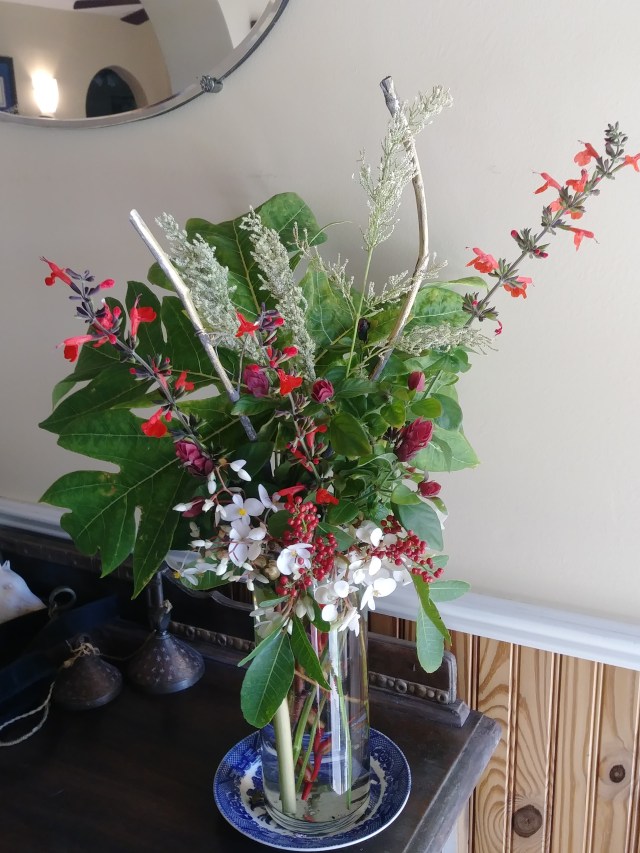
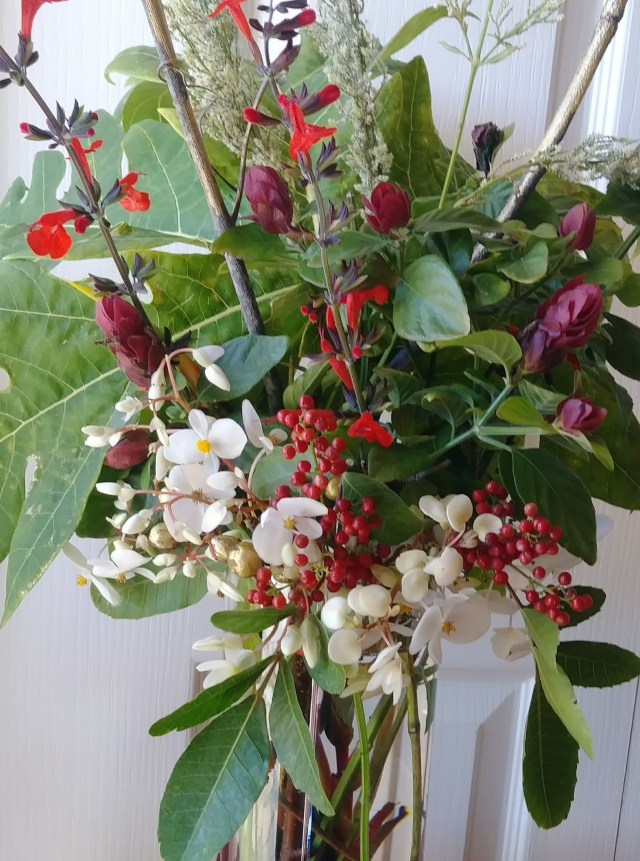
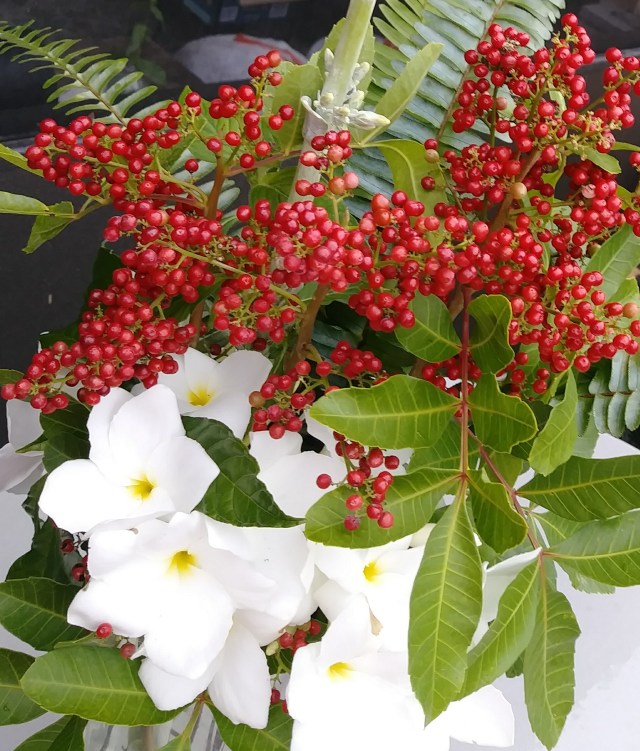
The berries in the vase are beautiful, but, unfortunately, very bad. They are from the Brazilian Pepper (Schinus terebinthifolia) an invasive plant brought into Florida in the mid 1800s – marketed as Florida Holly. Spread by birds eating the lovely berries, Brazilian Pepper now is illegal to plant and infests more that half a million acres of land in South Florida, choking everything in its wake. Someone planted five across my backyard, undoubtedly to screen the neighbors-by the time we arrived the plants were 35 feet wide and it took us at least five years to begin winning the pepper battle. A few still survive and I saved the state of Florida hundreds of trees by cutting the berries to create this vase!

The white flowers are from Bridal Bouquet Frangipani (Plumeria pudica); grey stem is a flower from the Flapjack Kalanchoe (Kalanchoe thyrsiflora); ferns are Asian Sword Ferns. It occurred to me as I was arranging this vase, a good vase is like a good pasta sauce, it takes a few more ingredients than you would think to make it tasty!

Happy Monday.img_9976.jpg

In A Vase on Monday – Winter White

20181202_112235

Winter lasted for about two days here. The temperature was 87 degrees Fahrenheit this morning. I gave up gardening in hopes of cooler weather later in the week. My vegetable seeds were planted this week along with lettuce plants (the lettuce probably has wilted and needs water by now).

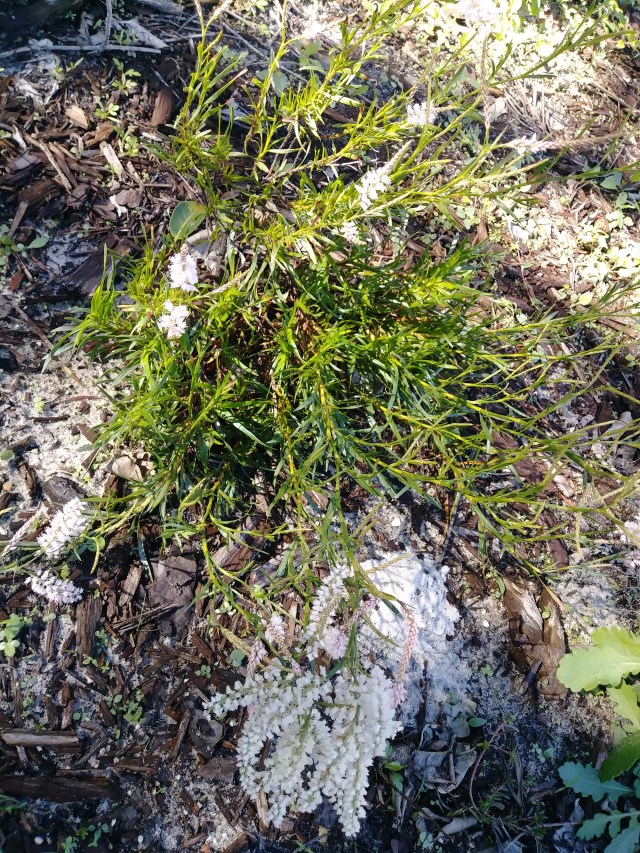
My task this morning, moving Orchids to strategic areas, so I can see the flowers from inside the house. As I was wheeling pots around, I noticed most of the flowers in the garden are white currently, no idea why. I have been watching this native wildflower called Octoberflower bloom for about a month, it started right on time, October 31st.

20181128_110712Octoberflower is native to an area called Scrub in Florida – my garden is in Scrub, so you would think these plants would enjoy my garden. Not so much.  I find them very difficult to place and grow, moving them into the native pollinator garden, one out of five made it. Although, they are great cut flowers.

20181202_111804

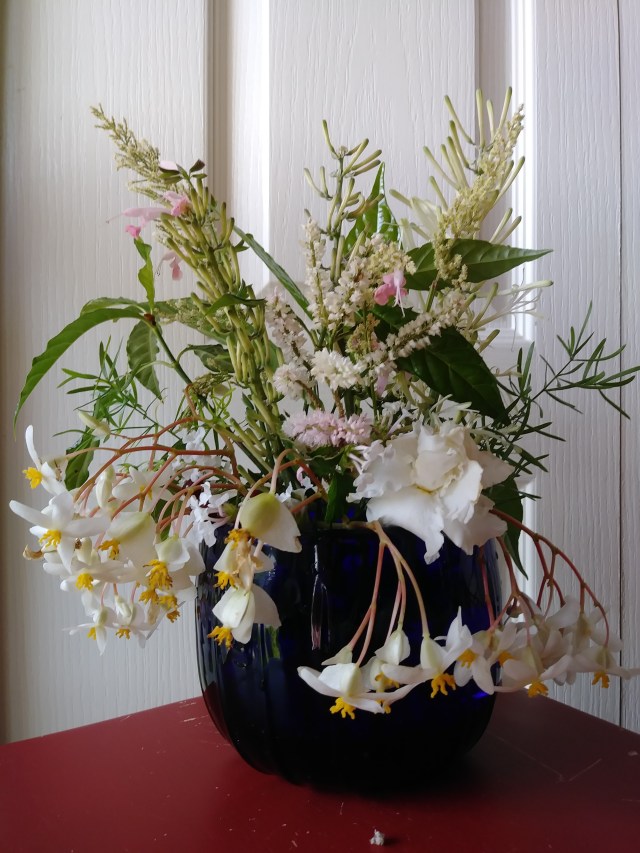
Here is a close up of the vase, the blue glass bowl, a Christmas gift from long ago. The Octoberflower is on the right side of the photo, tinged with pink. Next to those, probably the last flower of the Tropical Gardenia (Tabernaemontana divericata); draping the vase are Sweet Begonias (Begonia odorata ‘Alba’); some clusters of White Lantana (Lantana montevidensis ‘Alba’); the bigger spikey flowers are from Snake Plant AKA Mother In Law’s Tongues (Sansiveria cultivar ‘It Took Over My Yard’); smaller white spikes from Juba Bush (Iresine diffusa); a few sprigs of pale pink Tropical Red Salvia (Salvia coccinea). The foliage in the vase is Asparagus Fern (Asparagus densiflorus ‘sprengeri’) and another native, Wild Coffee (Psychotria nervosa) – the berries look like coffee, but you can tell by the botanical name, not something you want to drink.

I am from the American South. Wondering how many gardeners relate to the term ‘Winter White’?

My mother, a well raised lady of proper breeding:?! – would have said Winter White is an off white color appropriate to be worn in winter; whereas wearing pure white after Labor Day (early September) is an abomination.

Comments?


The photos, Snake Plant and Wild Coffee.

In A Vase on Monday – Winter Gardening

20181125_095403-1

The gardening season is heating up in South Florida. The reverse of most of the Northern Hemisphere, we grow vegetables in the winter as it is too hot for tomatoes or corn to pollinate in the summer. I received the last of my vegetable seeds (Haricot verte) over the weekend and will sow my vegetable garden in the next week or so.

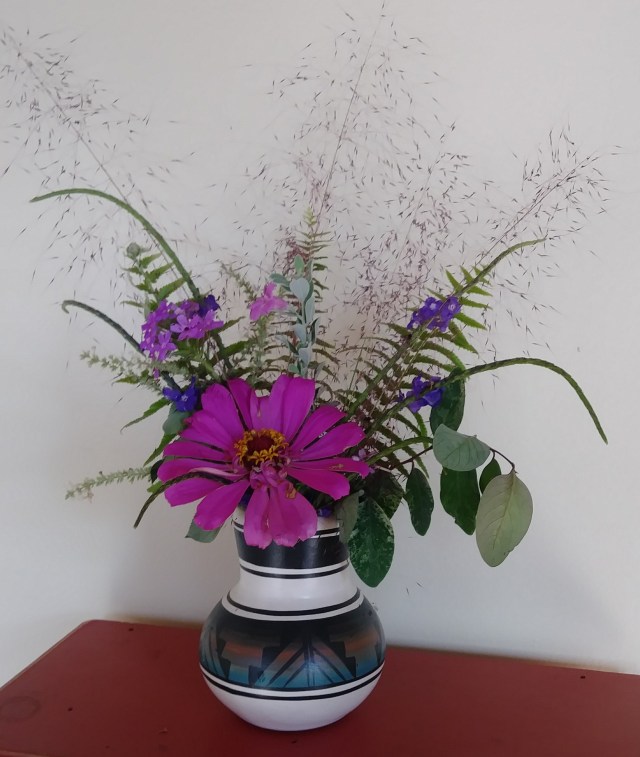
While I grow flowers year round, I plant some of the more common summer flowers in the winter. Deciding to grow some from seed this year, I have Zinnias, Asters, Petunias, Moon Vine and Coral Vine to add to the pollinator garden and cut. The seeds were planted around the first of October and my first Zinnia bloomed this week.20181121_094921_HDR-2This is a Zinna Super Cactus Lilac Emperor, an heirloom variety. It doesn’t quite resemble the picture on the packet – not nearly as stringy or cactusy (new word?) However, it may be the biggest Zinnia I have run across (4 inches wide).
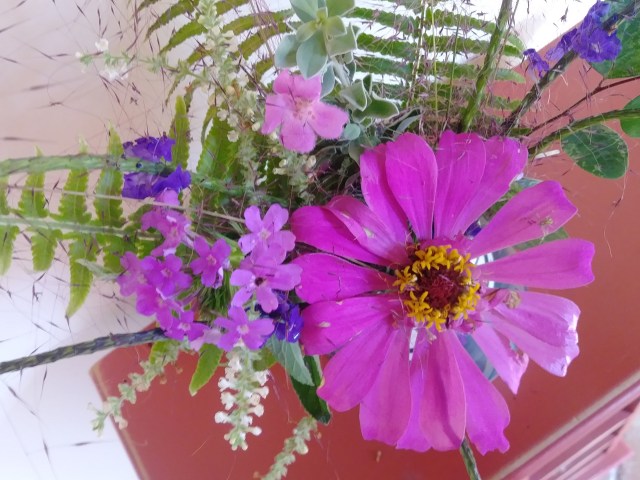
20181125_095513The vase I inherited from my mother, who bought it from the Ute Indian tribe in the Southwestern US. Accenting the Zinnia in the arrangement are in white and fragrant spikes, Sweet Almond Bush (Aloysia virgata); Purple Verbena is next, a native (Glandularia tampaensis); the deep blue flowers are from Porterweed (Stachytarpeta jamaicaensis); purple flowers with grey foliage are Barometer Bush (Luecophyllum frutescens); the background plants are Muhly Grass (Muhlbergia capillaris), Boston Fern (Nephrolepis exaltata) and a sprig of Hawaiian Snowbush (Breynia nivosa).
20181124_100258_HDR-1

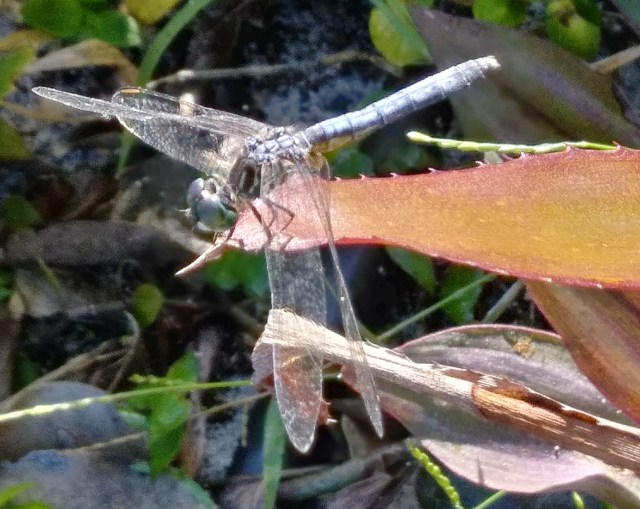
The pollinators attracted to my garden continue to amaze. We had two groups of honeybees resting in the garden and I spotted this dragonfly while weeding yesterday.

In A Vase on Monday – Semi Topiary

20181118_102923-1

It is Thanksgiving week in the US and I decided to try arranging a little topiary for the table in fall colors. I think of topiaries as clipped formally shaped affairs, this one is not. It is a casual, all native plants arrangement, more tree form than topiary.

20181118_102923-1

Three plants are used in this arrangement: the flowers and berries are from Firebush (Hamelia patens var patens) The off white flowers are from the Juba Bush (Iresine diffusa), and the stuffings (Like a Turkey!) for the vase are from Sabal Palms (Palmetto sabal) Here is a closer look:

20181118_103546_Burst01

I don’t really know what the bits from the Sabal Palm are called, the white curly stuff on top comes from the edges of the palm fronds and the brown peat moss like material (birds use it for nests) I used to fill the vase comes from the boots (where the fronds leave the trunk of the tree and cross over)

Here is the palm:

20181118_104239The pumpkin is probably an ornamental gourd that I bought at Aldi during the Halloween season. It is holding up much better than the orange pumpkins and may last until Thanksgiving. I am not too sure about using the semi topiary on the table, there were some really odd white spiders running away from me as I was taking pictures.

And Halloween is over!

Happy Thanksgiving.

In A Vase on Monday – Two Challenges

20181111_095353-1 Last week, in honor of the fifth anniversary of the meme ‘In A Vase on Monday’, Cathy, our hostess at Rambling in the Garden on WordPress challenged us to not use a vase on Monday. Hence, the watering can. My second challenge, issued by a gardening friend, to use all native wildflowers in my non vase.

The brass watering can had been around my mother’s house for so long I am not sure if I am the second or third generation to use it. I decided to leave the patina and fill it with delicate wildflowers from my garden and a few fall fruits, all from plants native to Florida – a surprisingly long plant list.

20181111_095353-1-1

As I was arranging this, I was surprised by how pretty these flowers are when closely observed. And how many flowers it took to fill the small watering can.

The purple flowers are Tampa Verbena (Glandularia tampensis); pink tubular flowers are Tropical Red Salvia (Salvia coccinea) – it seeds in red, pink, salmon and orange. The deep blue flowers are Blue Porterweed (Stachytarpheta jamaicensis); I have learned to love this plant along with the butterflies, it continues to open flowers after cutting and the stems are such a wonderful accent. The purple grasses are Muhly Grass (Muhlenbergia capillaris). I am not sure this grass does as well anywhere else but in Florida. Sharp drainage is vital, mine grows in sugar sand with no irrigation.

20181111_095559

I have finally found out what the off white spikes are – Juba Bush (Iresine diffusa), identified by a wildflower expert who said “Juba Bush is named after a Afro-Caribbean step dance, because of the way it waves in the wind” It actually does have a lovely sway in the wind – and I like the story. The ferns are Boston Fern (Nephrolepis exaltata),  porch plants the world over, these originated in the swamps of Florida and popped up in my garden. The white flowers are  Jointweed or Wireweed or Octoberflower (Polygonella robusta), started blooming on October 31!

Fruits are from the Senna ligustrina, the long brown pods. I recently added these to the garden to attract Sulphur Butterflies. They are doing their job, though I haven’t seen any caterpillars. The plants remind me of Soft Caress Mahonia, which l love but can’t grow this far south. The round fruits are from the Gumbo Limbo tree (Bursea simarouba) I love these for their names, the other one being Tourist Tree, for the red peeling bark resembling sunburned skin…

Happy IAVOM Anniversary, to see vases from around the world follow this link.More Vases

In A Vase on Monday – Things That Go Bump in the Night

20181028_132939-1

It’s that time of year, and for some reason many of my neighbors are decorating their front yards with dead pirates a la the movie ‘Pirates of the Caribbean’. Weird, a bit startling and my dog is usually spooked by these odd things hanging from trees.

I prefer the odd things that appear in my garden. The growing season is year round here in South Florida, to the point sometimes I think I hear things growing at night. Bump…must be another Avocado, Mango or Grapefruit falling outside. Or the raccoons that are eating well, everything dropped something.

20181028_133609-1

Three out of four ingredients in this vase just appeared in the garden. The blue flowers, Porterweed (Stachytarpheta) I bought. The rest are gratis from the Garden Fairy.  The red flowers, Turks Cap Hibiscus (Malvaviscus penduliflorus); the foliage hanging over the sides, seedlings from Sabal Palms (Palmetto sabal); ferns are native Boston Ferns (Nephrolepis exaltata).20181028_133148-1

Here is a close up of the Turks Cap Hibiscus,one of my favorite gifts from the Garden Fairy. These flower nearly year round and require nothing. Spooky.

20151030_200543-1

Happy Halloween from Florida.

In A Vase on Monday – Gone Native

20181021_104211-1

Rarely, I travel on business. Last week my Garden Design work took me to my hometown, Atlanta, Georgia. We abandoned Atlanta, population 5 million, for a town of 12,000 in South Florida almost seven years ago. The onslaught of the sea of humanity I encountered upon deplaning – was a bit, well, unnerving. Not to mention the detestable traffic I had to navigate to get to my garden in waiting 30 miles north of the airport.

The garden is in lovely tract of wooded land, the forest so beautiful it makes you forget the hustle and bustle of the big metropolitan area. It was wonderful to be back in the woods of my home, the land populated with large White Oak, Tulip Poplar, Hickory and American Beech trees. The woods of South Florida, in my opinion, aren’t woods at all. On the other hand, the getting there was the problem. Getting there is why I am no longer there. It made me realize I have truly gone native. Florida native.

20181021_103655-1

Everything in this vase is, unlike me, native to Florida.

The vase is a pottery pineapple, bought in Maui, Hawaii years ago. The yellow sunflowers are Beach Sunflowers (Helianthus debilis); the red flowers are Gallardia (Gallardia pulchella); purple berries are Beautyberry (Calliocarpa americana); pink flowers, Tropical Red Salvia (Salvia coccinea) – sometimes pink or orange; pinky purple grass, Muhly Grass (Mulbergia capillaris); ferns, our native Boston Fern (Nephrolepis exaltata).

20181021_103911