In A Vase on Monday – Butterscotch Pudding beats the Rose Bowl

20160521_135255-1

20160521_175109

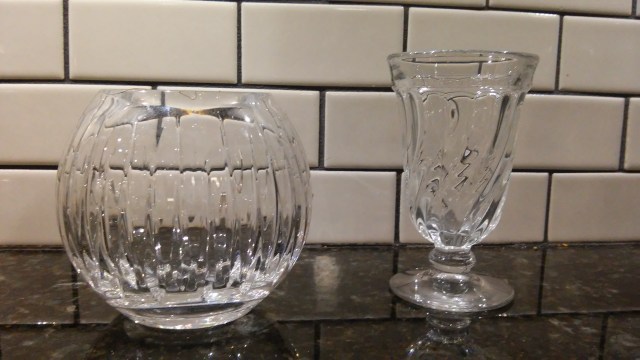
I started to use a Rose Bowl for this arrangement, but the bowl must have sensed my true feelings about Roses (too much trouble and ugly shrubs when not flowering) the flowers were just not sitting right so I had to go to a more straight sided container. See picture above, Rose bowl on the left and Fostoria on the right. The picture is to clarify which Rose Bowl  I was writing about, my husband asked if I was blogging about football this week. The other Rose Bowl is a college football game.

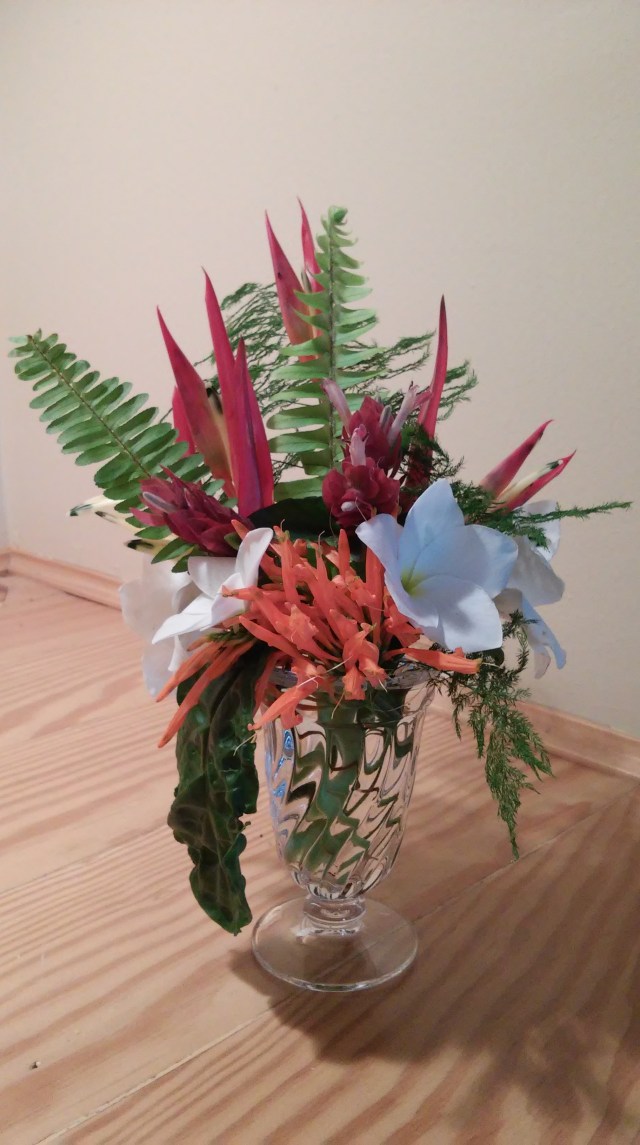
I have a set of these Fostoria glasses, inherited from my mother in law. My husband refers to these as the Butterscotch pudding bowls because that is what she served in them. I really don’t know what they are, it is an oddly sized container for food or drink but works well as a vase. Here is a better picture of the Fostoria.
20160521_135457

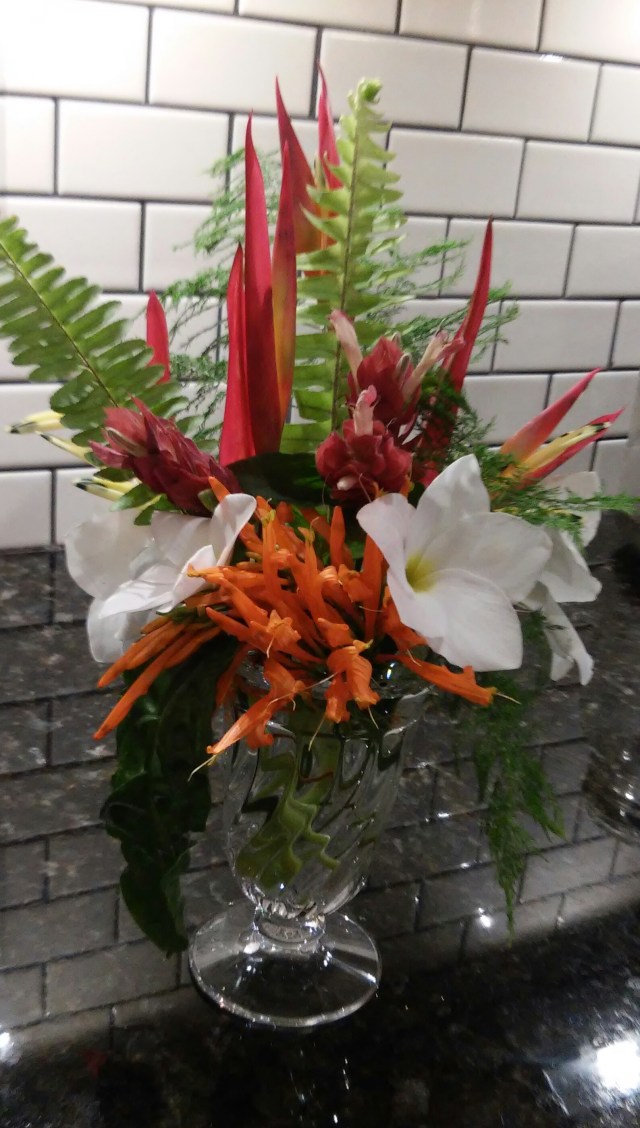
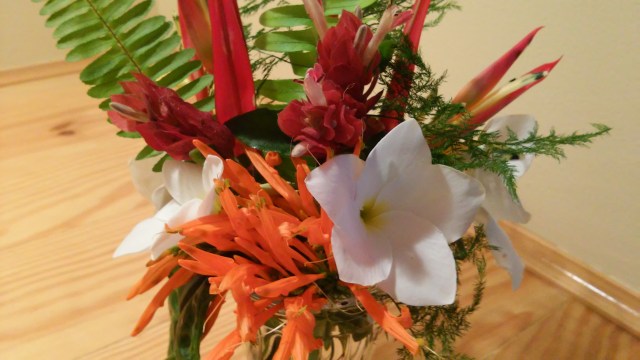
To me the star of the arrangement is a new arrival in my garden, the orange Mexican Honeysuckle (Justicia spicigera), research tells me this plant blooms nearly year round and is a desert tropical that likes regular water. I wonder what these people are smoking who come up with these descriptions sometimes, no doubt something horticultural. Regular water on your desert tropical. Apparently it comes from a weird desert.

The balance of the arrangement contains more Justicia – J. brandegeana, the Red Shrimp Plant in darker red. The lighter red is buds of the Heliconia psittacorum, the white flowers are Bridal Bouquet Plumeria (P. pudica). Greenery is Asparagus and Boston Ferns.
20160521_135509

All this talk about Butterscotch Pudding has inspired me to make some. I think from scratch……Just have to find a recipe with actual Scotch as an ingredient.



Pineapples and their Cousins


A common element in South Florida gardens is the pineapple patch. Almost everybody has one, from a northern perspective, it seems kind of weird. Grow your own pineapples? Why not? Even one of our neighbors, his yard could be described as nouveau retch, is seen regularly hand watering his pineapples.

20160422_135000-1

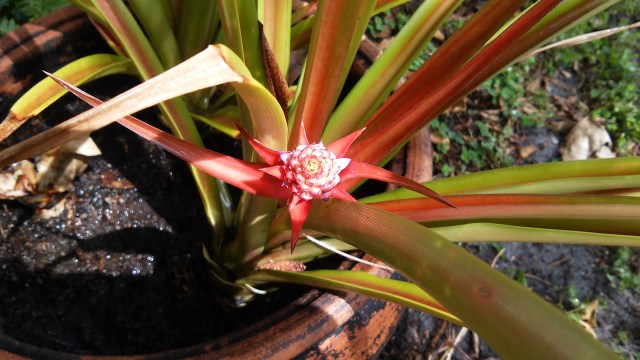
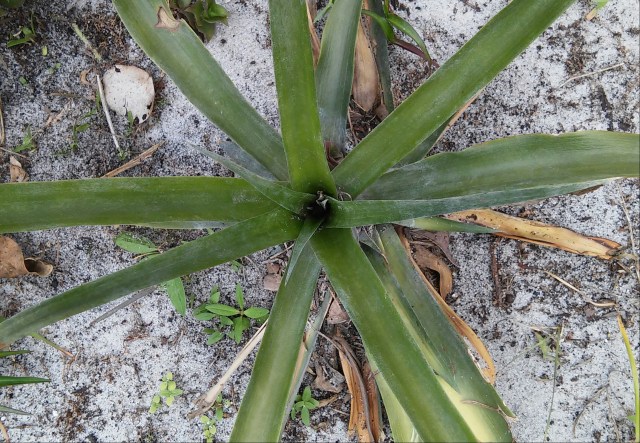
Pineapples are in fact a Bromeliad, which are currently my favorite tropical perennial. Among the many Bromeliads I have planted that are purely ornamental I am afraid I have fallen prey to the trend and now have a pineapple patch between my citrus trees. I eat pineapple just about year round and the tops kept rooting in the compost heap. Unfortunately, the above is my patch, not too pretty.

Pineapples have an interesting history. Originally from the area where modern day Brazil is located, they moved via canoes paddled by traveling natives north to the Caribbean Islands where sea captains picked up on them and carried them home. One early accounting of the discovery of pineapple recounts a meal served by the Caribe tribe where a plate of pineapple rested next to a cauldron of boiling cannibalized humans. I think I would have asked for the fruit plate.

A status symbol on the dining tables of colonial America, pineapples were often rented for centerpieces and then sold after a few uses for eating. Thus the pineapple as a symbol of lush hospitality was born. The prevalence of pineapples as a decorative element may be explained by its being cheaper to carve decorative pineapples into bed posts or garden ornaments instead of renting them by the hour.

The Treasure Coast of Florida, the area I currently call home was once home to a large pineapple plantation. In 1895, Jensen Beach, Florida was named the Pineapple Capital of the World, shipping a million boxes of pineapples a year during the summer season. Later that year a devastating freeze decimated the crop, followed by a few tragic fires and fungal diseases that finished off the pineapple industry by 1920. Agricultural pursuits were redirected towards citrus. Wild Pineapple plants can still be seen on Hutchinson Island and are attributed to the original owner of the plantation, John Jensen.

Like many other popular plants, pineapples have also been bred for Ornamental use. Here are two prettier pineapple plants.


In A Vase on Monday – Tea Stained Melange

20160508_113259

It was Mother’s Day as I was plotting my Monday vase, so naturally I thought of what my mother might like in a vase. My mother (passed nearly seven years ago) was not nearly as snooty as I am about her flowers and enjoyed just about anything she could grow successfully. I am hard pressed to think of something she really didn’t like. Growing up we always had a seemingly magical forest of Cosmos and Scarlet Runner beans to play in. Many of the plants grown in the garden would end up in a vase on Monday! She would definitely get a kick out of all my wacky tropicals and the vases every Monday.

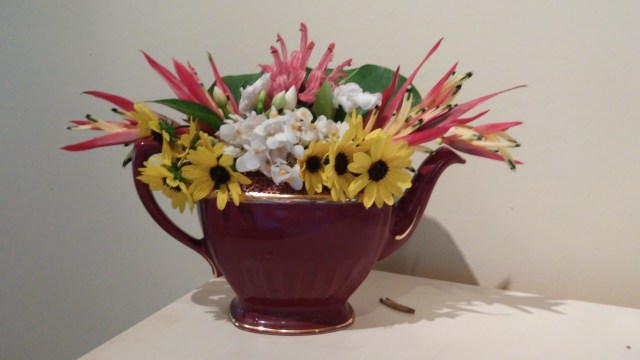
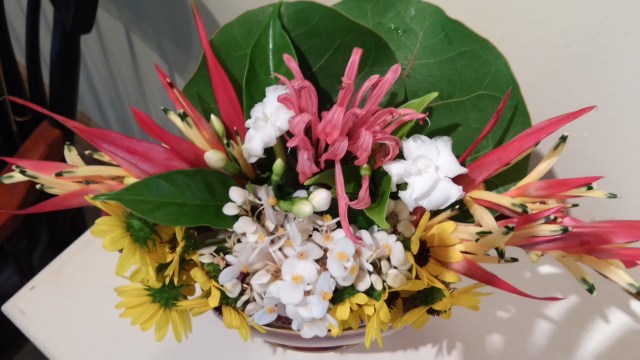
I ended up with her favorite teapot. I am fairly certain it was a wedding gift, the rim and base stained russet from untold thousands of pots of tea, many shared with me. I walked through my garden and cut everything that was in bloom and arranged it all in the teapot.

20160508_113008

The big leaves in the back are Sea Grape (Coccoloba uvifera), the pink flower in the middle is a Brazilian Plume (Justicia carnea), Florida Gardenias (Tabernaemontana divaricata) on each side in white, Sweet Begonias (Begonia odorata ‘alba’) the smaller white flowers, Beach Sunflower (Helianthus debilis) are the yellow and Parrot Flower (Heliconia psittacorum) the red and yellow on the sides. The teapot is marked Hall, made in the USA.

My husband wandered through as I was assembling the vase and asked me, aghast, ‘Is that your Monday vase?’

20160508_140846

This is a side shoot from Sweet 100 tomatoes I hope to root to extend my tomato season.

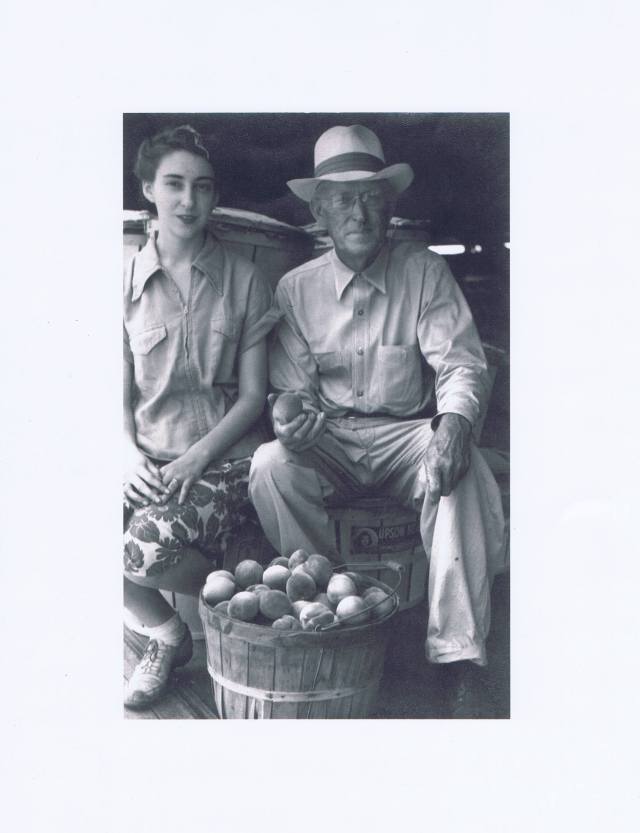
Here is my mother, ever the Southern Belle, at the peach packing house with her grandfather in the late 1940s.

CCE05082014_00000

Miss Betty and Mr. Tommy

Mom Nature Lights My Fire

This plant appeared in my garden a couple of years ago. I thought it was some sort of Amaranthus blown in from across the Atlantic Ocean and decided to leave it to see what happened. Amaranthus can have some interesting flowers (Love Lies Bleeding, etc.) The foliage started getting red around the edges, confirming my thoughts, then the stems started getting woody. Maybe it wasn’t Amaranthus at all.

Then it flowered.

20160503_182813

Definitely not an Amaranth. Not a clue what it was. So, I took this to the Native Plant Society meeting and they said Firebush. Hamelia patens var patens? I said no, it couldn’t be, this is my Firebush, Hamelia patens. Orange flowers and the leaves are half as big.

20150625_081158

Firebush and Friend

Then it dawned on me, there is a great deal of arguing about the true native Firebush. I  usually ignore this kind of argument being more designer than botanist, but think I am agreeing with the Hamelia patens var patens crowd. The orange flowering one is supposed to be from the Caribbean somewhere instead of Florida. Given the seemingly magical appearance of the patens var patens in my garden, I think that the red one is the native.

Mother Nature really is a good designer, she placed the Native Red Firebush in a bed of red and yellow Heliconias behind some yellow Beach Sunflowers and across from some red Bromeliads. Perfect.

20160504_131122-1

Now if everything would just grow together. And be happy.


In A Vase on Monday – Jungle Gardenias

20160501_110806-1

As a teenager, I determined I needed a signature fragrance (too many magazines and/or romantic stories once again) I chose Jungle Gardenia as my fragrance. Unfortunately, I soon realized most people did not want to ride in a car with me due to the robustness of the perfume.

Growing up in the Deep South, I associate Gardenias with summer and sleeping by an open window  (far away from the shrub) with breezes drifting in wafts of the fragrance of my mother’s Gardenias. A pleasant thought unless you consider the windows were open due to lack of air conditioning and July is miserably hot. Nevertheless, I have fond memories of the fragrance of Gardenias and was looking forward to the flowers on my tropical Florida Gardenias.

Florida Gardenias are different from Gardenias I grew up with. Botanically they are Tabernaemontana divaricata, native to tropical regions of India and Southeast Asia, these are tropical and frost will kill them. The Gardenias I grew up with are Gardenia jasminoides and they will tolerate some frost. The Florida Gardenia in my garden was unearthed after clearing out the overgrown missteps of a previous owner (polite description) I was surprised to find a 10 foot tall sort of oversized Gardenia growing under all sorts of junk that hadn’t seen fertilizer, water or the light of day in who knows how long. I cut off a few bad pieces and hoped for the best. It has bravely regrouped and is flowering, I hope someday it will be a nice tree form Gardenia, the foliage is lovely and somewhat bigger than G. jasminoides.

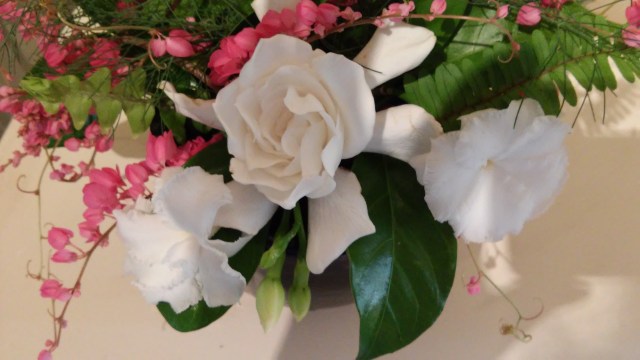
Here is a close up of the Gardenias, the Gardenia jasminoides is in the center and the Florida Gardenias are on the sides. Some people call these Pinwheel Gardenias for obvious reasons.

Rounding out the posy in pink, Coral Vine, the foliage is from Culinary Fennel and Boston Fern. The cobalt blue vase was a Christmas gift from my brother and sister in law years ago.

20160501_111106

In A Vase on Monday-Tropical Posy

20160424_171333-1

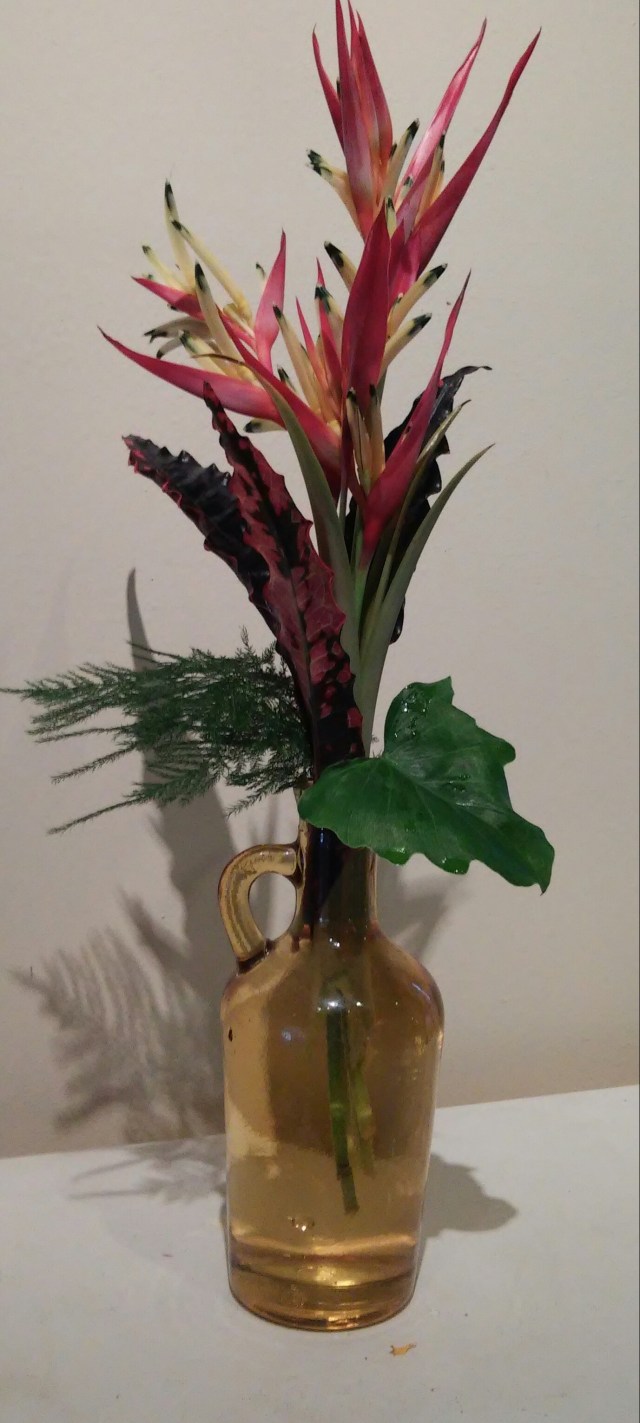
I am beginning to think I should call these posts “In a Repurposed Object on Monday”. This particular arrangement evolved as I was meandering in my garden with clippers and scissors. I was hoping for some tropical Gardenias but they are still tormenting me with only buds, no blooms.

I was enduring my usual design lecture from myself, must cut 5 flowers followed by foliages (colored)- 3 each,  with contrasting green elements 1 each (coarse and fine textured) As I gathered my elements I realized it was a tropical posy! Relying on my new posy identification skills, a nosegay was formed that was too small to be considered a bouquet. Delightful. If I ever (unlikely) marry again, I wouldn’t mind carrying this. However, a white dress would be out of the question.

The elements of my repurposed object include, the gold glass vase, which I used for a while to hold olive oil by the stove (it has a cork). I determined it would be just as easy to keep the olive oil in the cabinet in the bottle it came in and not worry about how to clean the gold bottle. Reading too many Home and Garden magazines causes these sorts of dilemmas.

The red flowers are Heliconia psittacorum, a prolific flowering perennial, the two colored foliages, in red spots are Piecrust Croton and Ornamental Pineapple in grey green. The green foliage is a Split Leaf Philodendron and Asparagus Fern. I will admit to buying the Split Leaf Philodendron (Philodendron selloum) but that Asparagus Fern just sort of pops up sometimes and I cut it for arrangements.

20160420_111314

In case you were wondering about the Ornamental Pineapple, here it is. The foliage is red and green striped and the pineapples are tiny and inedible, but very pretty. This one was gifted to me by a new gardening friend. Not a clue about the botanical name.

Gardening in the Rain

20160415_163135-1

One day this week I was waiting for the rain to start so I could go work in the garden. I stopped to think – this seems really stupid, do other gardeners do this? And then went out into a gentle rain to move some Beach Sunflower around. It has been so dry lately the sandy soil has tightened its grip on roots to the point it is difficult to pry things out of the ground. Soil is an overstatement in my garden – I should face the facts, it is Sugar Sand, white, infertile and oddly capable of growing many things. I pried some intractable Johnsonsgrass out (and threw it away) then went looking for more beautiful things.

Here is what I found:

20160415_104634

This is a Bromeliad, Billbergia pyramidalis, I think, bought as a cutting in February. I was told it would grow up the trunk of a tree. As a planted it, I was scoffing. Well, whoever told me that was absolutely correct – it is growing up the tree and much to my surprise, flowering at the same time.

This made my time in the rain worthwhile and hopefully the skies will open again soon.


In a Vase on Monday -Natives Tea Party

20160410_160949-1.jpg


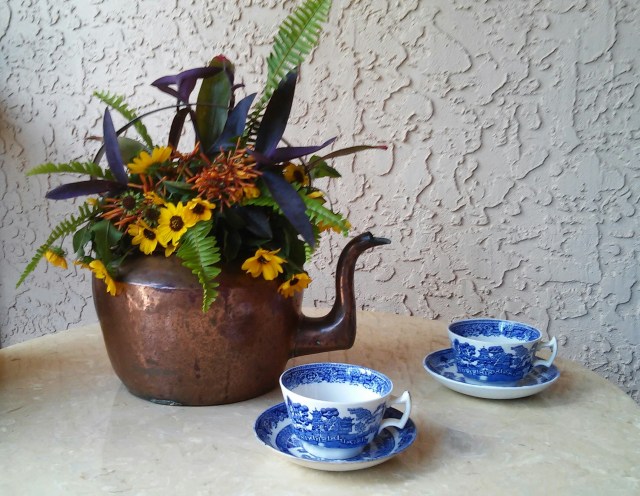
The copper tea kettle is one of my favorite things. I bought at a flea market on a weekend trip to the Appalachian Mountains many years ago. I am relatively certain it won’t hold water as it was repaired on the bottom and you can see through the repair. What is lovely about this kettle is the patina of many years of use with dents and hand crafted solder joints adding to its beauty. I can only speculate how many souls have been warmed by the contents of this vessel. The Blue Willow teacups are English and belonged to my grandmother, the saucers are too cracked to use and are kept for their patina as well.

As neither the cups or the kettle can be used for tea, this is a party for the natives. The native flowers in the kettle, of course. The arrangement is primarily native plants of South Florida, the yellow flowers are Beach Sunflower (Helianthus debilis), the orange tubular flowers are Firebush (Hamelia patens), Boston Fern, the purple foliage is Purple Hearts (Setcresea pallida), native to North America says the Florida plant database, and joining the party some Painted Fingernail Bromeliad foliage with the cerise tips, from somewhere south of the border.

As I was arranging the flowers in a pickle jar to place inside the kettle, it occurred to me I should go antiquing to see if I could find some copper friends to join the kettle.

In A Vase on Monday – Spring Renovations


20160403_135338

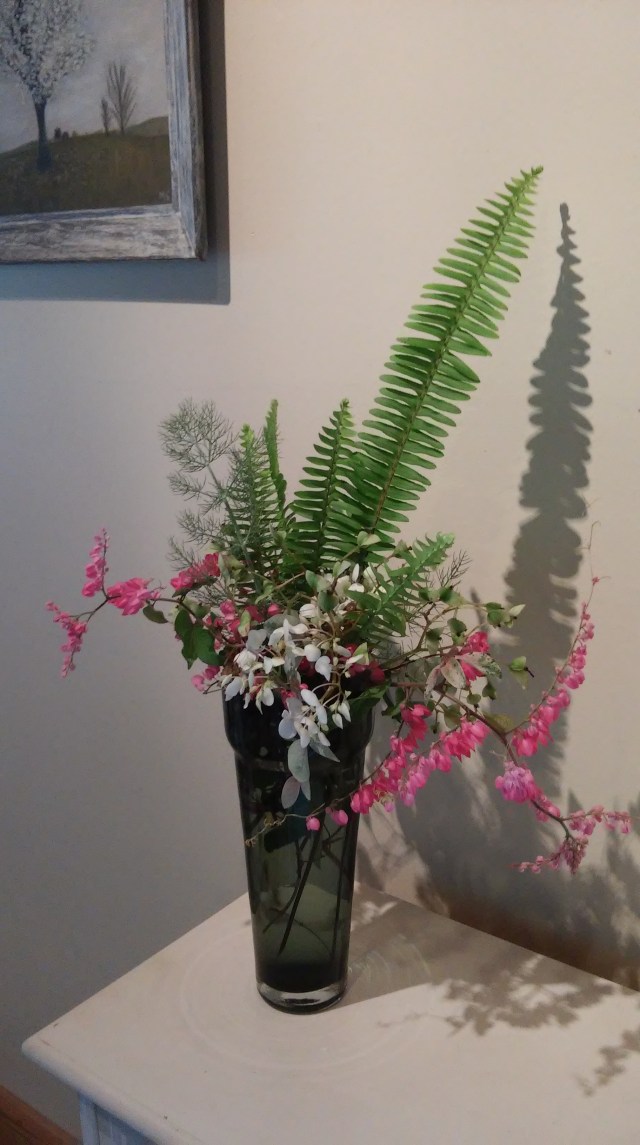
Here is the Spring part. I put this vase together and thought ‘wow, that really looks like a fresh spring arrangement’. The bright pink flowers with baby Boston fern fronds and some bits of cream Begonias and foliage spoke to me of new beginnings in the garden.

The pink flowers are a new beginning. They are from a Coral Vine (Antigon leptopus) on a nearby fence. This vine is native to Mexico and considered invasive in South Florida, the owners of the fence are snowbirds, winter visitors from the frozen north, and come to Florida for the winter. This vine is unapologetically immolated annually and I have never seen another one around. To the owner’s delight, I cut it back for the flowers. It started to flower just about the time the owners went back north, to my delight.

The rest of the arrangement is comprised of – in white and chartreuse, the flowers and seeds of the Sweet Begonia (Begonia odorata ‘Alba’). The foliage is my ever present Boston Fern, the new spring growth, some culinary Fennel and the variegated is from Hawaiian Snow Bush (Breynia nivosa)

20160403_135346

And now the renovations part. Last week I had Orchid Tree branches in this vase and they lasted precisely 50 hours. The flowers wilted despite my best efforts. The buds looked promising so I plucked the offending flowers and left the budded branches to hopefully reflower. After a couple of days I figured out this was not happening. The foliage was in such good shape I cut some Heliconias with long stems and added them to the vase, here is the result.

20160403_134911

I like this arrangement as well, it seems like the tropical version. Below is last week’s arrangement. Hopefully this one lasts longer.

20160327_142327

In A Vase on Monday – Bourbon and Branch for Easter

20160327_141901 (2)

I was born and raised in Atlanta, Georgia; the Deep South. Celebrating Easter has some traditions. There is usually an arrangement of flowers centered around Spring featuring pastel colors and bulbs, maybe some forced branches from Cherry trees if Easter is early.

The traditional Easter fare is a ham criss crossed with a knife, canned pineapple rings centered in the squares, cloves inserted (and sometimes a maraschino cherry) the entire ham is then doused in brown sugar and baked. The women are madly working in the kitchen while the men are outside having a Bourbon and Branch.

Bourbon and Branch is a cocktail, branch is water from the pure running creek in the backyard.

I have eschewed the ham tradition and the bourbon tradition. This leaves me looking for some other kind of branches as the creeks I would drink water from are few and far between. What is currently blooming in my garden is mostly orange, not what I had in mind for an Easter arrangement.

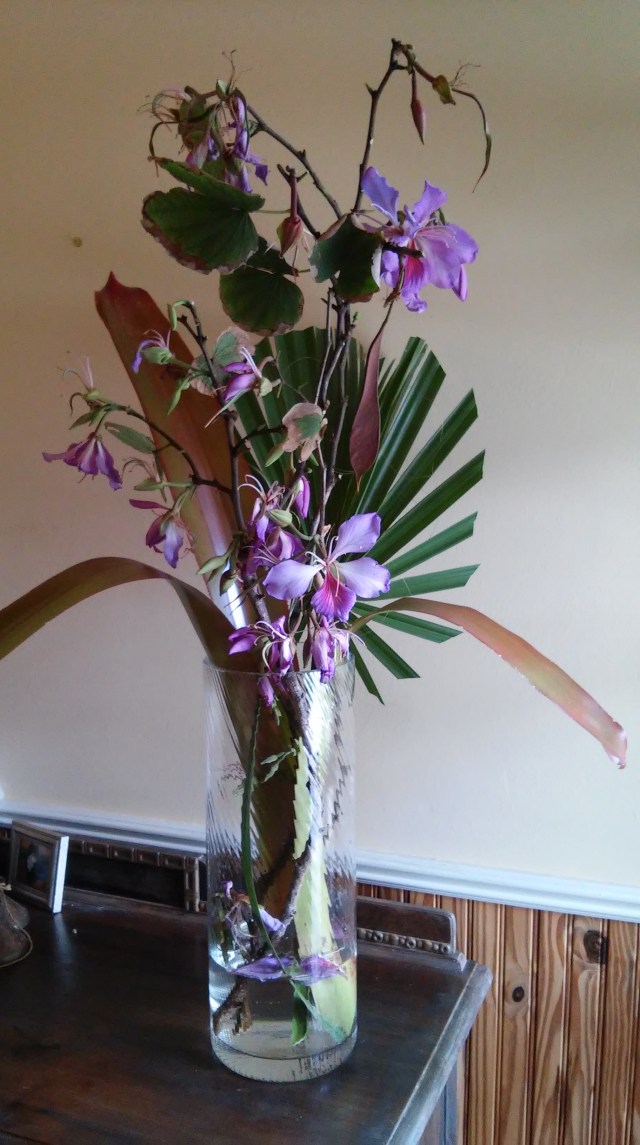
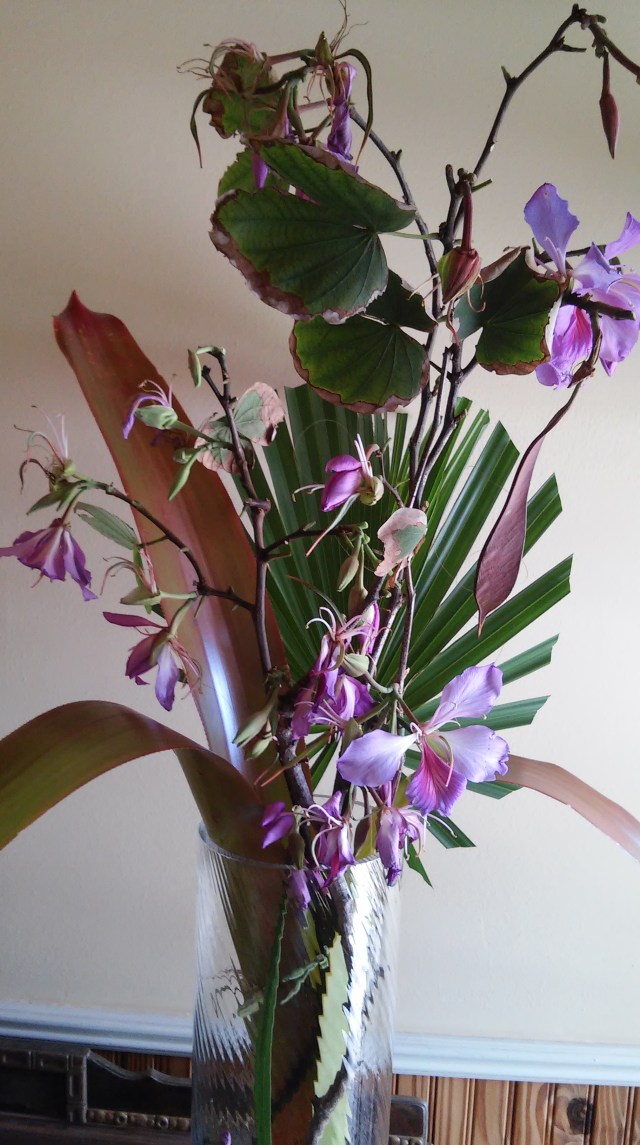
The Hong Kong Orchid tree has been flowering for a couple of weeks, a nice lavendar color and has a gnarled branch look about it. I decided to try one of those large branch arrangements that appear effortless. Ha, the branches are twisty and uncooperative and have to be pruned into submission. Then I decided to add a Palm frond, it is Easter, just a bit late for the palm part. The frond overwhelms everything so I cut it down to a smaller size and add some russet Bromeliad foliage to pick up the darker color in the Orchid flowers.

Here is the result, I thought this was a bit weird, but I like it. I left the pods and some browning foliage on Orchid tree branches and crushed the ends a bit to see if they would last longer that way. A semi traditional Easter arrangement, as I have the branch part covered, maybe I should try to find the bourbon.

20160327_142327