Cat Yoga

20160210_092000

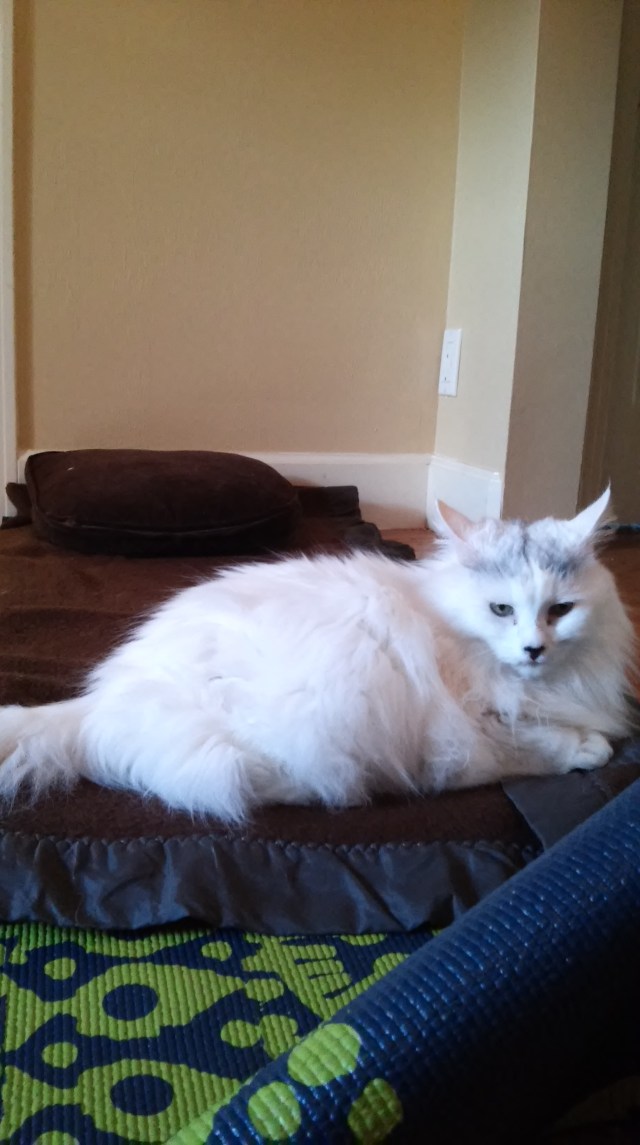
It would be an overstatement to say I practice Iyengar Yoga. I tend to fall off the yoga wagon until my shoulders demand I start practicing again. Recently the cat has decided she needs to join me, but only in the floor positions when she likes to sit on my hair, and pull?!

This cat has a past. Originally belonging to my mother and named ‘Sweetie Pie’ she is now at the ripe old age of 15 and has outlived two owners. I convinced my mother to get another cat after her beloved cat died – 15 years ago. As one of four children I was sure my older brothers or sister would take her if my mother passed on. My mother agreed, saying “I don’t want you to have Sweetie Pie because you have the two greyhounds and she looks an awful lot like a rabbit” Very true. Fine with me. I didn’t really want a cat. When my mother passed my older brother took the cat. Cheerfully.

My older brother suddenly passed on four years later – my two other siblings refused to take her so after a protracted bout with Senior Cat Rescue, I did- greyhounds and all. She arrived at my house much worse for wear, weighing six pounds and half bald she promptly stuck her too long claw through a tendon in my hand and both of us ended up at the doctor. I did not get a rabies shot, but the cat did. No good deed goes unpunished.

My husband thought having a cat named Sweetie Pie would cause others to question his masculinity, so he calls her Miss Kitty. Miss Kitty and the greyhounds have achieved detente over time and while I can’t say they like each other they tolerate each other.

Last summer I took the cat in for annual shots/vet visit. The vet looked in her mouth and said she had cancer of the soft palate and had 3 to 6 months to live. This was a bit of a shock as she looked just fine and was eating well. He showed me the tumor and told me to feed her water thinned canned cat food. The watered down cat food clearly pissed the cat off and she started eating dry food I had inadvertently left on the floor. After a few days of this, I bought some soft centered dry food and straight canned food. She ate that happily and gained more weight, now weighing about 10 pounds.

One morning a few months into the cats purported last months on earth I found a Scorpion in the house that something had bitten the head off. I am pretty sure my husband wasn’t the culprit – then the cat starting joining me for yoga. Her death sentence has passed and her mouth is clear and she eats everything I put down for her.

I am wondering if the Yoga or the Scorpion cured Miss Kitty?

In A Vase on Monday -Going Native

20160207_130423-1

One of the results of moving to Florida from a colder climate – sooner or later you go native. Winter Coats, who needs ’em? The coats are the first thing to go followed by socks, then shoes (sandals are an exception) and most long pants. One year my husband felt compelled to wear long pants twice. It was 50 degrees.

Plants for the garden are no exception. The first thing I had to quit desiring was Japanese Maples, followed by Yoshino Cherries. I got over Azaleas and Roses prior to moving south. Now and again I will suffer perennial envy, then again we have a plethora of great plants here in Florida – many are new to me.

I have always been a fan of native plants and decided to learn more about them by taking an online course about native plants on the Treasure Coast of Florida, taught by the guys behind the WordPress blog, Treasure Coast Natives. This one is for you, George.

20160207_130315-1

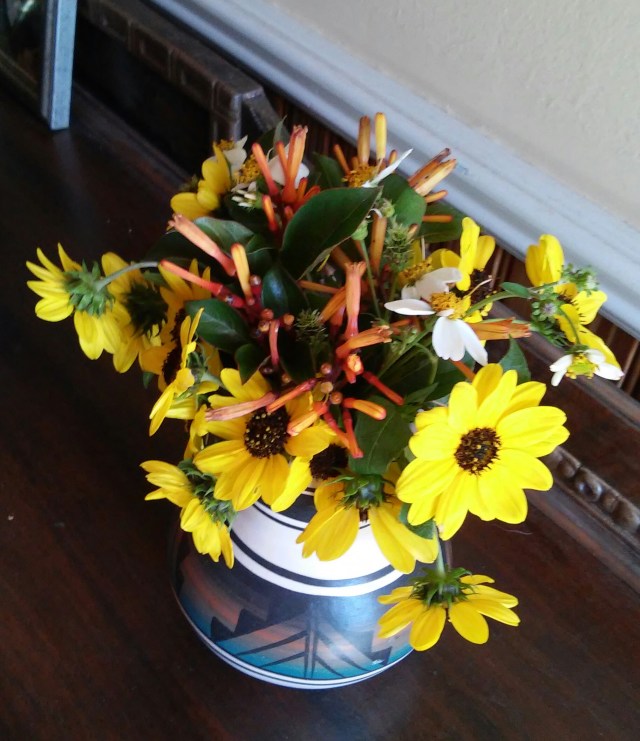
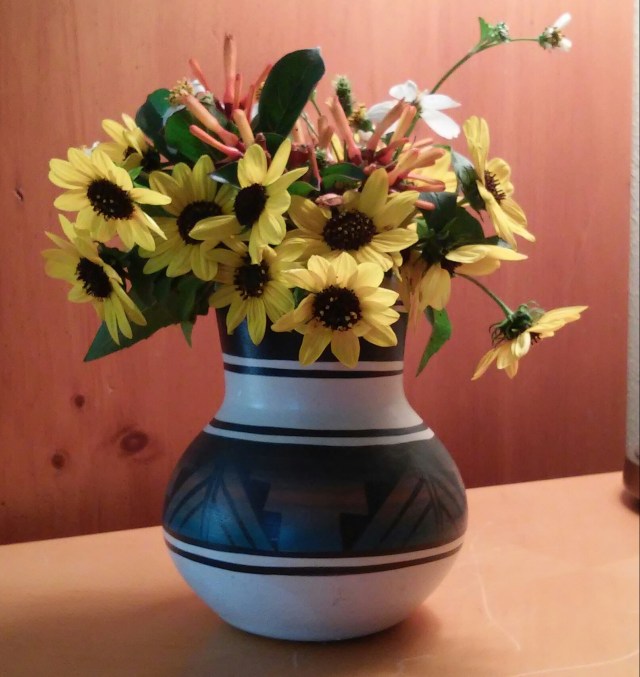
The flowers in this vase are all native and from plants included in the online course. The yellow flowers are Beach Sunflowers (Helianthus debilis), the white flowers are Spanish Needles (Bidens alba), the orange tubular flowers are Firebush, actually Dwarf Firebush (Hamelia patens) I planted the Beach Sunflowers and Firebush but the Spanish Needles appeared on their own and seed freely everywhere cursing me forever.

The vase is also a sort of native. A gift from my mother bought on one of her trips to the Southwestern United States, the vase was made by Native Americans of the Ute tribe and marked as such. One of my favorite things from my mother.

One of the benefits of native plants in the garden is the local butterflies love them. Here is a Zebra Longwing Butterfly on the Firebush:

20150625_081158

Firebush and Friend


In A Vase on Monday – Surinam Shrimp

20160131_145844-1

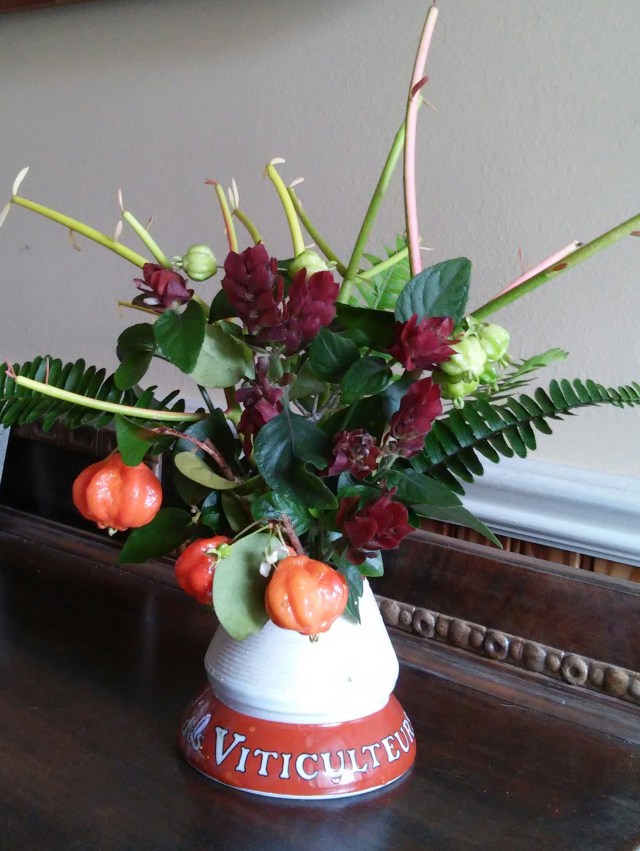
I am aware ‘Surinam Shrimp’ sounds like a dish at a Vietnamese restaurant, however the two main components of this vase are Surinam Cherries and Shrimp Plants. The Surinam Cherries are the fruit in the lower part of the arrangement.

I have a large hedge of these shrubs and was pleased to have a fruit producing hedge, thinking (silly me) the fruit could be eaten. I kept thinking the fruit wasn’t ripe or something as it tasted so bad. Finally my neighbor, a Florida veteran, picked one for me – properly ripe. Still tasted bad. I have seen the taste described as resinously bitter, and the description fits the fruit. Given the taste of the fruit and the colors in various stages of ripeness an arrangement seemed like a better use of the fruit. The rest will be left for our wildlife friends.

20160131_145457-1

Here is another view with the nearly ripe Surinam Cherry beside the vase. As for the other members of the plant crew, we have: in dark red, flowers of the Red Shrimp Plant (Justicia brandegeana); the foliage of Boston Fern and the upright sticks are from a ‘Firesticks’ Pencil Cactus (Euphorbia tirucalli ‘Firesticks’); in orange and chartreuse, the fruits of the Surinam Cherry (Eugenia uniflora).

The vase was a long ago Christmas gift to my husband from his ex-wife’s cousin! We have absolutely no idea what it is, so if anyone has a clue please send a comment. We have been wondering for years what this is. The top of the vase is much thinner than the base and has a hole in it. It reads “Gd Cafe des Viticulteurs”

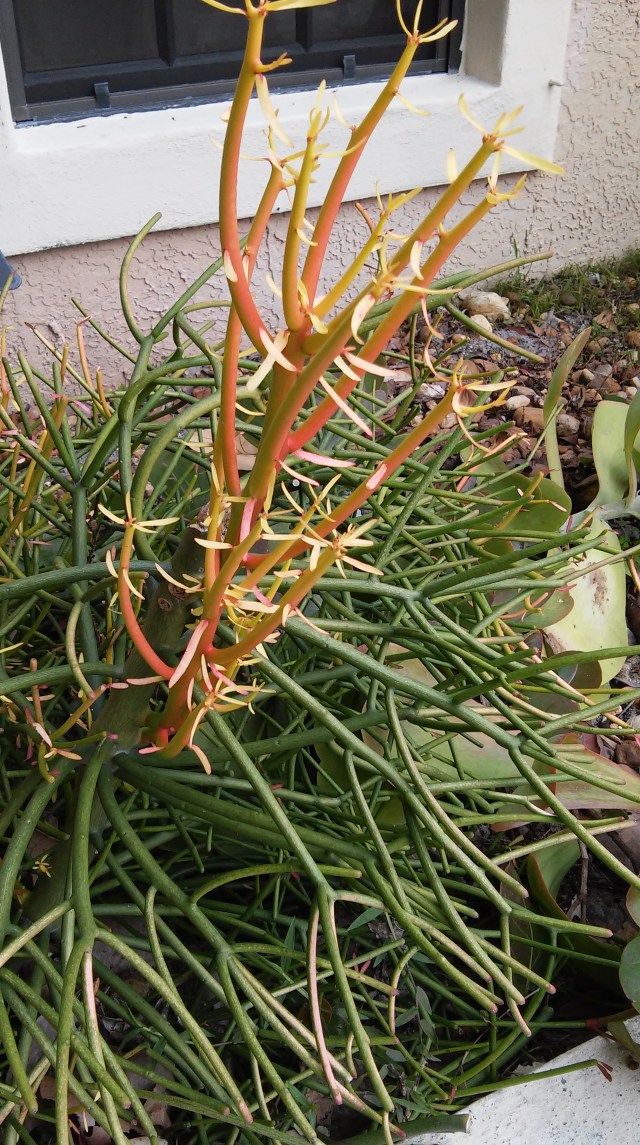
As for the ‘Firesticks’ Pencil Cactus’ here is a picture of the plant. Euphorbias still blow my mind, hello, Poinsettias? so weird- I have a few of these around the garden as they easily root from cuttings:

20160131_152001

Now I am craving some Shrimp Pasta for dinner. Without the Euphorbias, of course.

In A Vase on Monday – Plum Tropical

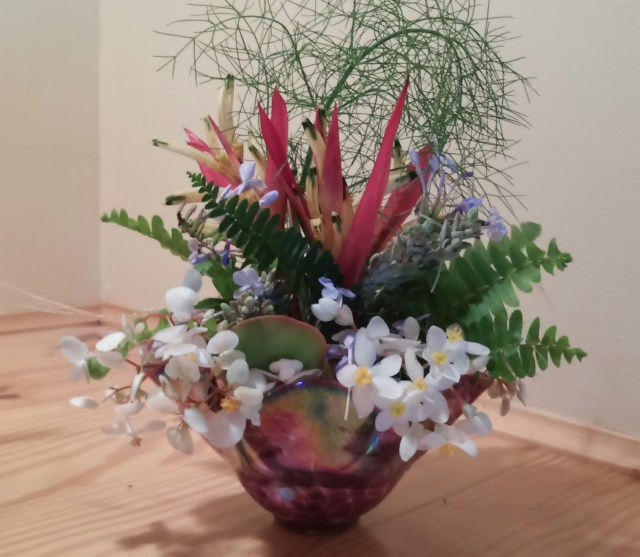
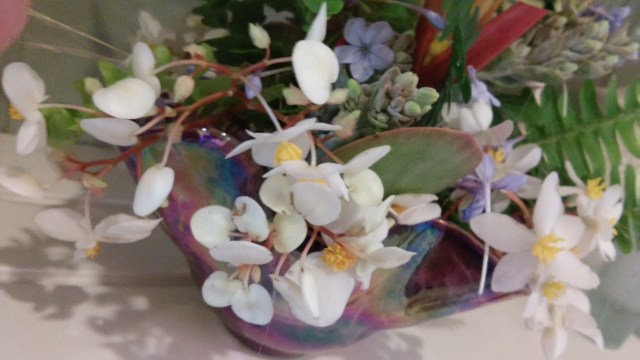
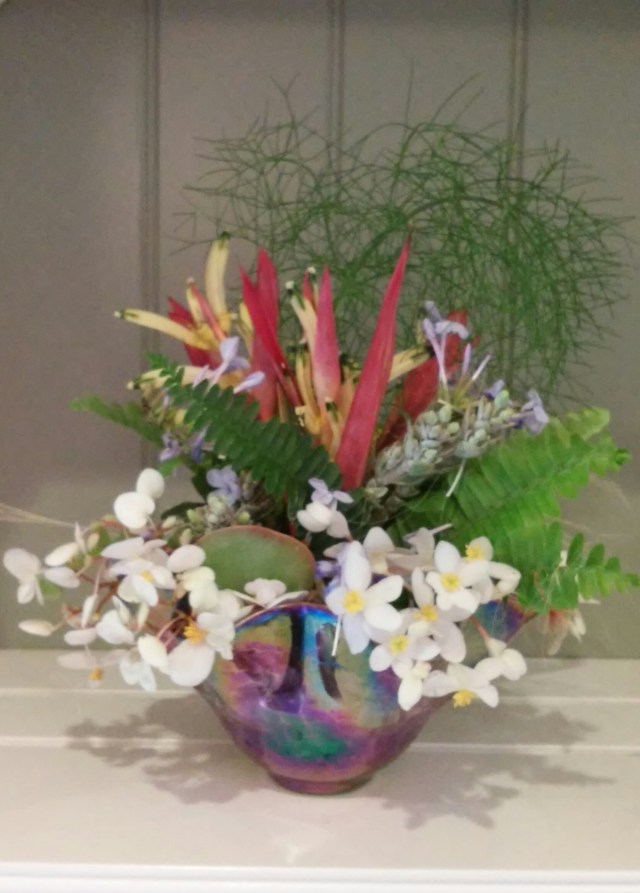
20160124_133405-1I started my Monday vase thinking I was going to have a plum and grey theme as the Kalanchoe ‘Flapjack’ plants are blooming. These are grey, somewhat otherworldly and I thought they would look great with some purple flowers in my plum blown glass bowl.
CAM00426-1

Flapjack Flowers

So, I cut some Flapjack Flowers. As all gardeners know, Mother Nature often has other plans for us. I went over to my ‘it was blooming last time I looked’ bed and no purple flowers. Plan B, the Heliconia were blooming a little as well as the Tropical Blue Plumbago. I cut some of those and proceeded to another bed and my wonderful white Sweet Begonias were blooming. For greenery, I cut some Boston Fern and from the vegetable garden a little Fennel foliage. I grew some Fennel last year and ended up with volunteers this year I am hoping to eat. I love roasted Fennel.

20160124_133757

The bowl is a souvenir from a long ago trip to the North Georgia mountains where my husband and I stopped in a local artisan cooperative. We both appreciate handmade items and have enjoyed this little bowl.

20160124_133639-1

After starting a vase around the Flapjack flowers, they are barely visible (grey flowers and succulent leaf) I think the result is more Tropical Punch or Plum Tropical.

Art in the Garden

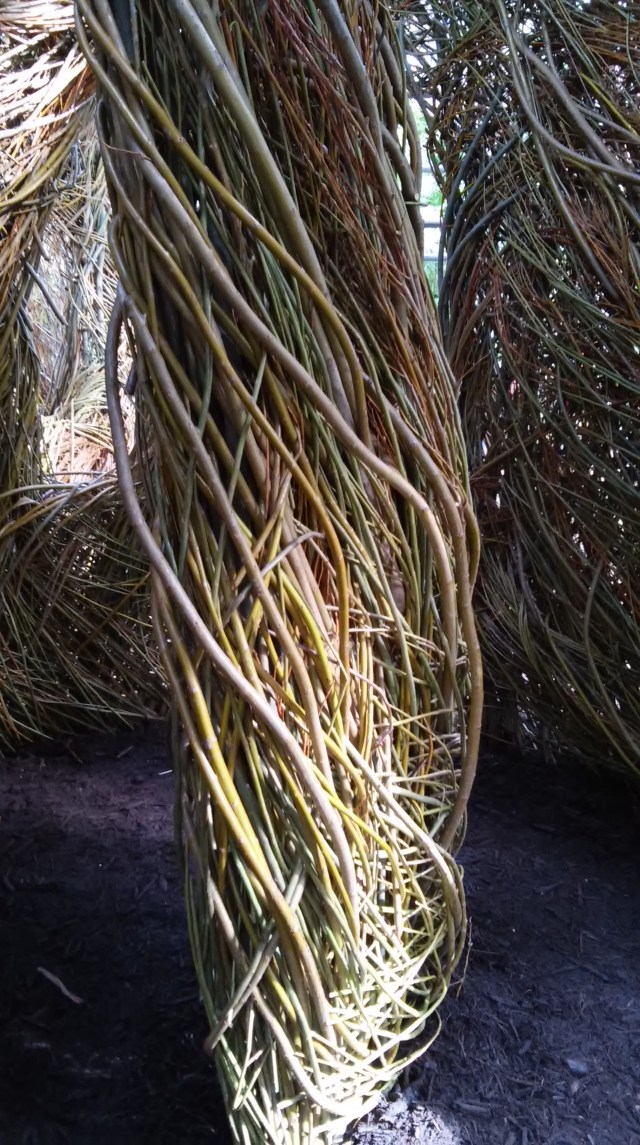
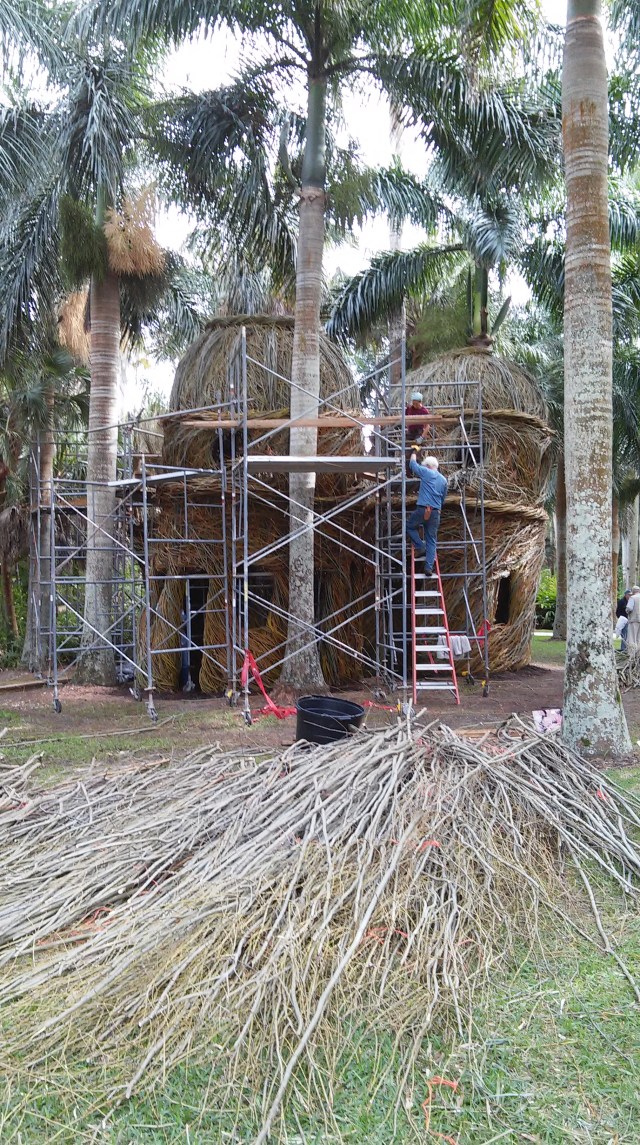
I usually write about the art of the garden, but here is a bit of art in the garden. The above photos are of a woven willow structure currently under construction at the McKee Botanical Garden in Vero Beach, Florida. This piece of environmental art is nestled in a grove of palms and constructed of willow saplings and bendable twigs woven together to form a temporary structure. The structure will eventually have three willow towers. Here is a close up of the twig structure:

20160121_142043

And here is an overall view:

20160121_141502


The artist is Patrick Dougherty and the concept is STICKWORK, here is a link to more information on the artist and installation,  http://www.mckeegarden.org/current-exhibition.php

I am usually not very enthralled with environmental art, but I love this. The organic willow towers complement the formality of the palms and I like the facts that the structure is built from willows grown in a sustainable tree farm and after a few years the structure will be evaluated to decide to keep it or compost it. I have visions of the entire thing rooting into the ground and growing a twisted fairy tale castle in the palm grove.

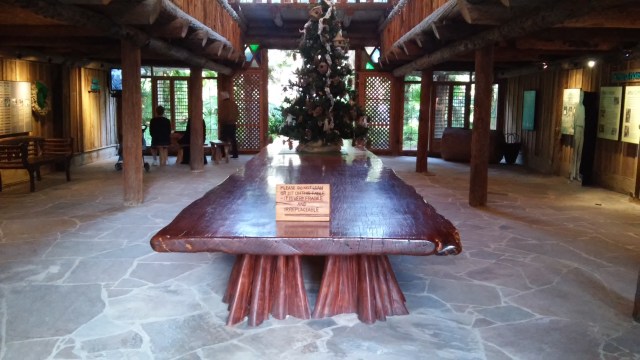
The rest of the garden has a bit of a fairy tale feel as well. Conceived by pioneer developers in South Florida during the first half of the twentieth century – the first buildings were based on Polynesian structures in keeping with the “Jungle” theme. The garden fell into disrepair and was reborn in the early 2000’s shepherded by a dedicated group of garden enthusiasts. Below is one of the original buildings, a great hall centered around a table constructed from a 38 foot long single piece of Mahogany:

20160121_145652


The rest of McKee is well worth touring and has a wealth of tropical plants. I saw many types of Bromeliads I had never seen before and an array of Palms, Orchids and tropical trees. The garden began in a mature forest hammock and boasts some incredible native trees and a pathway meandering through the garden inviting you to stop and study the flora. Here are some of my favorite photos from my trek through the garden.


In a Vase on Monday – The Wildflower Blues


20160117_154405-1

I have been watching a group of Yellow Lupines on the edges of a vacant lot nearby – thinking I could collect some seed and grow Lupines in my back garden. What I did not realize is when the seed pods are ready they explode and hurl seed far and wide. The pods exploded in my car and didn’t seem to think there was enough dirt to grow in the carpets, though there probably is as I haul dogs and plants around with equal enthusiasm. I am not sure if these plants are native to the area, but I am aware of other native Lupines in Florida; it seems peculiar as I associate these plants with Alpine meadows, the Rocky Mountains and cold, arid places. Here is another view of my three blue vases filled with native and/or wildflowers from the vacant lot.

20160117_113625

20160117_111900-1

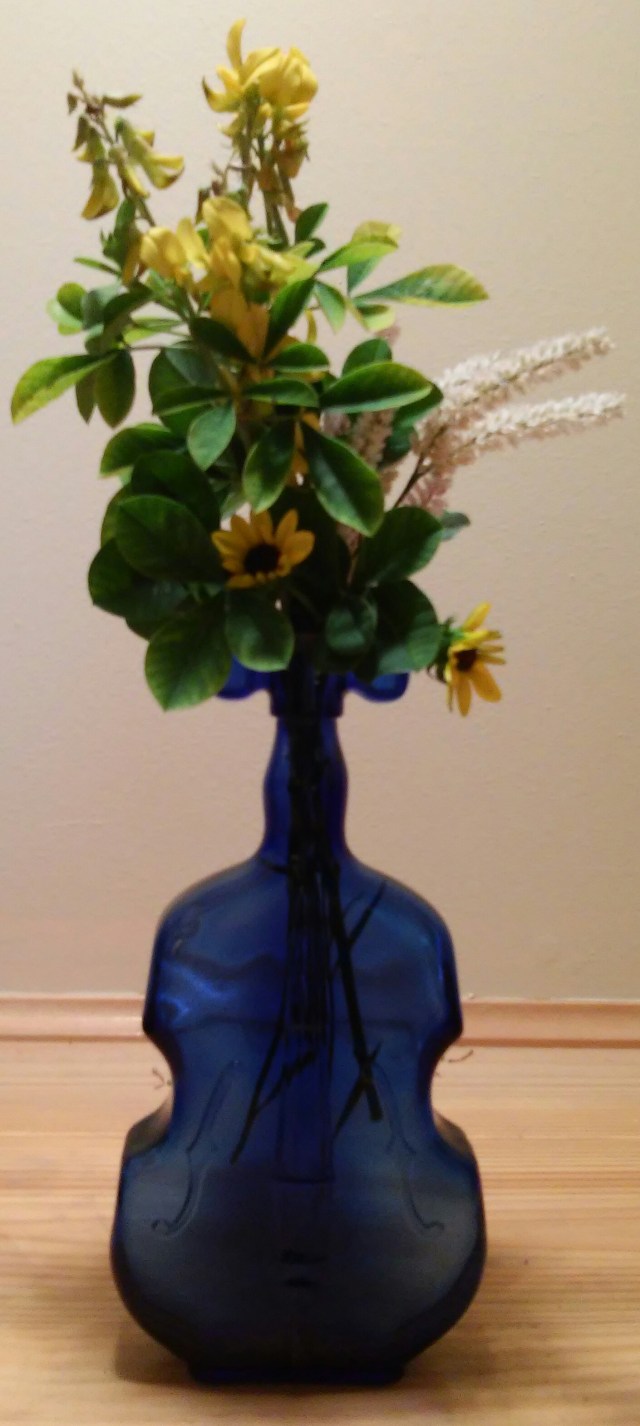
My blue vases represent three generations of women in my family, the violin belonged to my grandmother and has Yellow Lupines, the white spikes are Jointweed, the yellow daisy shaped flower is a Beach Sunflower.

20160117_114007

The tall bottle belonged to my mother and has Beach Sunflower, Yellow Lupines and seeds, background plants are Shrubby Buttonweed and Muhly Grass.

The corked bottle in the background belongs to me and holds the dried petals of all the roses my husband sent me during our courtship. The bells belonged to my other grandmother and are one of those touchstones that have been around the house as long as I can remember; my father brought them home from World War II.

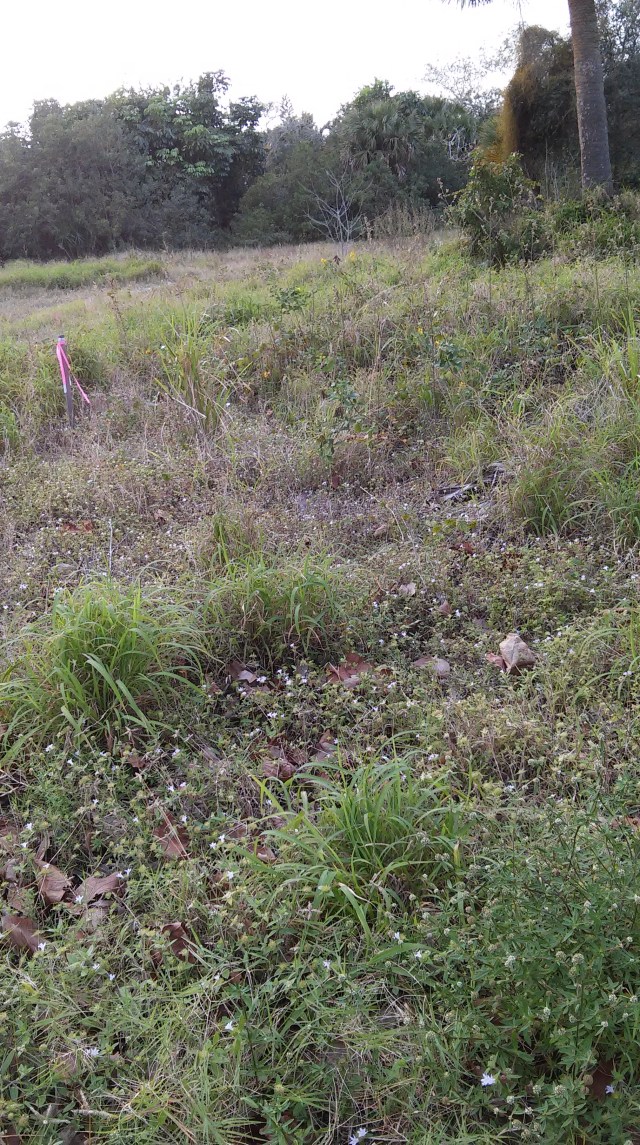
As I was writing this post, it occurred to me how much more interesting and attractive these flowers appear in their Monday vase. So, I wandered over to the vacant lot and took a before picture:

20160117_163141


All the components of the vase are in the foreground. I think I like the flowers in their blue bottles better. This leads me to ponder if more people saw native plants in a vase instead of a vacant lot – native plants might be more popular.

If you would like to see vases from the world over, stop by the comments section of  https://ramblinginthegarden.wordpress.com where Cathy hosts In A Vase on Monday – every Monday!


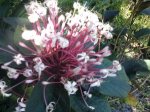
It’s Winter Starburst Clerodendrum Again

Everybody in South Florida is talking about Winter Starburst again. This time of year the shrub bursts forth with a floral display like no other. The flowers eventually spread to about 10 inches across and the shrub itself can grow to 10 feet tall. A Winter Starburst Clerodendrum in full bloom is nothing short of spectacular. A bonus to the Winter Starburst is deep green coarse textured foliage with purple backs that look great year round.

My first January in South Florida I nearly wrecked my car trying to get a good look at this shrub and figure out what it was. It is a showstopper that resembles a funky tropical rhododendron. Here’s the scoop, the botanical name is Clerodendrum quadriloculare. These shrubs are native to Southeast Asia and members of the Clerodendrum genus of plants which encompasses vines, shrubs and vining shrubs. Given their viny tendencies these plants can be troublesome in our gardens, they can spread unchecked and lend either – overgrown or if you prefer, a cottage garden vibe to your environs.

The photos above are of my late Winter Starburst. It expired last year due to poor installation and maintenance by the owner. It is true that these plants need partial shade and moist soil until well established. As I live in Scruburbia (Florida Scrub – sand, not sandy soil) I did not take the advice to heart and prepare the soil or water regularly. However, having witnessed another winter display from this shrub, I think I will try another planting or three!

In A Vase on Monday – Postcards from the Edge

20160110_144418

I should call this ‘In a Cachepot on Monday’. This is one of my favorite containers, an antique Portmerion cachepot with Lilies in a deep burgundy russet color. I bought the cachepot on one of my many ‘junk store’ missions with my mother. It is sitting on my parent’s favorite marble table with a fish tile from another mission.

My husband’s father was a great collector of Christmas Cactus. When he passed on I inherited most of the collection. It took me awhile to figure out how to take care of them so this is the last survivor. I always feel like when this one blooms, it is Glenn giving me a wink and a smile from the great beyond.

Joining the Christmas Cactus are a bit of Blue Tropical Plumbago (P. auriculata) and some Sweet Begonia (B. alba) I have no idea what type of Christmas Cactus I have.

Hopefully it blooms a little longer.

In A Vase on Monday – Tropical Tussie Mussies

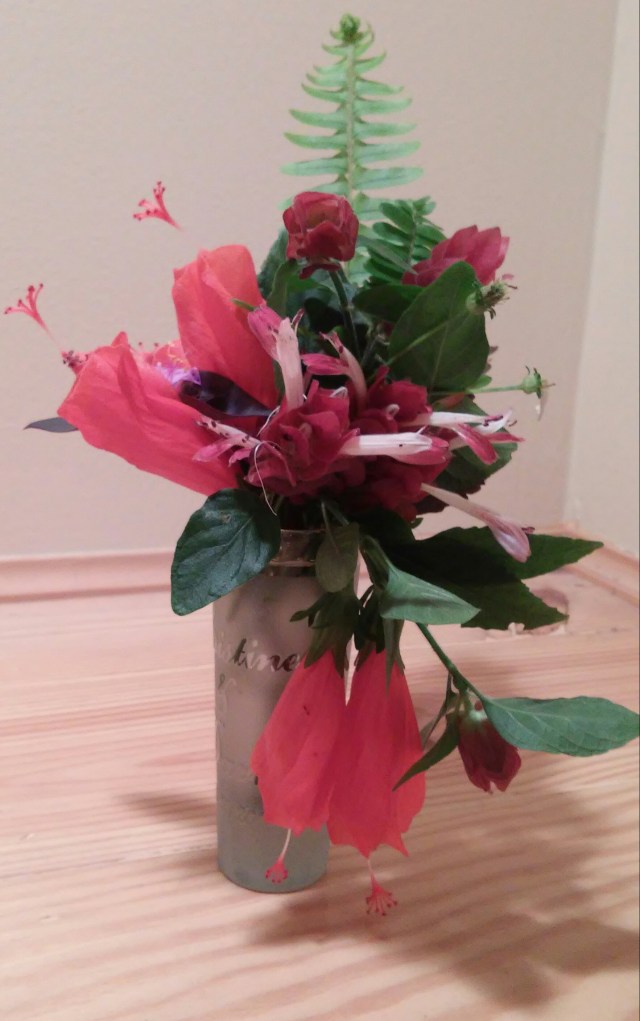
My mother always enjoyed making (really me making them while she watched) Tussie Mussies, she just thought they were ‘so cute’. I seem to have an abundance of not very long stemmed flowers so I decided to put together a Tussie Mussie or two.

20160103_105615-1


Tussie Mussie is a term for a small bouquet of flowers that has been around since medieval times, the Victorians used the selected flower type to send a message to the recipient of the Tussie Mussie. Each flower in the bouquet had a meaning. In reading the dictionary of flower meanings,  I found that Victorian England was not awash in the plants I have here in Tropic Florida. The only plant messages I could find in my Tussie Mussies are Dwarf Sunflower means adoration and Fern means magic. So, I am saying to you with flowers – I adore the magic of my garden. I can cope with that. Oddly enough, in Victorian flower dictionaries there were meanings for chickweed. If chickweed appeared in a flower arrangement I received, I would tend to think there was something wrong. The meaning from the dictionary – I cling to thee. Beware the man that sends chickweed bouquets.

20160103_105053-1

This arrangement is in a tequila shooter from my niece’s wedding; my tequila shooting days are long over but it makes a great little vase.

The plants are Turks Cap (A native mallow in Florida) the red flower, the darker red flowers are Red Shrimp Plant (Justicia brandegeana) a leaf of a Copperleaf (Acalphya wilkesiana ‘Raggedy Ann’) and a few Boston Fern fronds.

20160103_105447

I have a pair of tequila shooters, this one has a Dwarf Red Ixora, Beach Sunflower (Helianthus debilis), Coral Vine (Antigonon leptopus) and a backdrop of Hawaiian Snow Bush (Breynia nivosa)

Here’s hoping everyone is adoring the magic of the garden, this first week of 2016!

Piecrust Croton and Friends

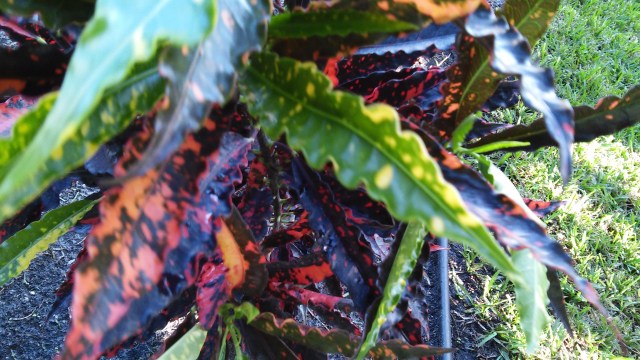
20151230_153823

Piecrust Croton

I have been reworking  the design of my front yard because the access point for the septic tank was in a lawn area and actually needed access. What this really means is once a year a 3 foot circle in the lawn  is dug up and destroyed to clean the (ewww, yes) septic tank filter. The joys of country living. I am certain I did not know septic tanks had filters prior to moving to Florida. I also realized I would like to have a pathway to the side.

For many years I have advised my clients to live in their houses for a while to see how they move around the property as sometimes a good guess just really doesn’t do the trick. The upshot is I did not take my own advice and I like to travel to my side garden (ah, future garden) more than I thought I would. Design that originates with how you live in a place is always a good plan. This may be Plan B as I did Plan A. Who knew St. Augustinegrass wouldn’t be happy over a septic tank. Oh, well. I am liking the new bed thus far.

A nod to my husbands pie making skills was the purchase of a Piecrust Croton, a multi colored tropical shrub that hails from the South Pacific. These shrubs are easy to grow and ubiquitous in South Florida. There are a few stalwart standby varieties that are common, but of course I love the weird stuff.

Here are the standard varieties:

At the top of the post is the foliage of the Piecrust – it looks like, you guessed it, Piecrust!  The rest, clicking on the picture will give the name. Being the plant freak that I am, I couldn’t resist photographing several more interesting varieties:

I  love all of these, but I think Stoplight might be the next Croton purchase on my Croton bucket list. How many people have a Croton bucket list?

Yes, the beds are getting bigger. The good news is I probably have a quarter acre left!!

Back to the inspiration for all of this, the piecrust. Here are a few of my husbands pies:

I think these merit a celebratory Croton in the front yard.

Speaking of celebratory, Happy New Year to all.