Fallout from Botanica

South Florida is rife with Garden fairs during the winter. This past weekend I went to Botanica in Port St. Lucie. Port St. Lucie is not what I would consider a garden spot, but for some reason they have a great botanical garden run by a very enthusiastic group of volunteers.

Botanica was held at the McKee Botanical Garden. At other times of the year they have a propagation area that sells rooted cuttings from their gardens. It is fun to meet fellow plant nerds and pick up a few Bromeliad cuttings.  Not this time, I pulled into the parking lot and realized this was a bigger event than a few cuttings. At least 4o vendors and a food court. I was in trouble. I had been to the bank.

I walked through most of one side and was not really tempted then through the propagation area. The prices had doubled since last summer, so I was again not tempted. Then I got to the other side of the lake..

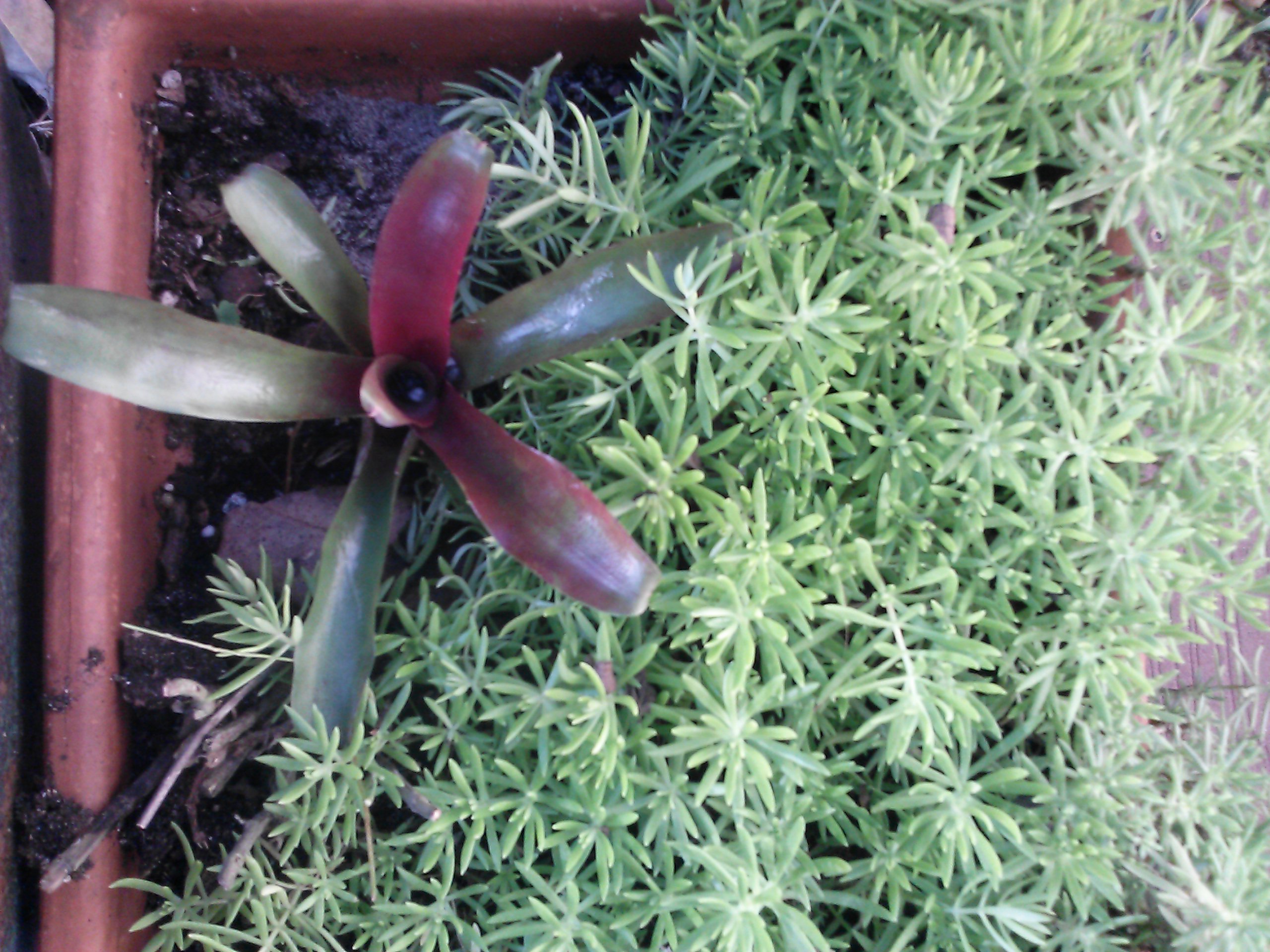
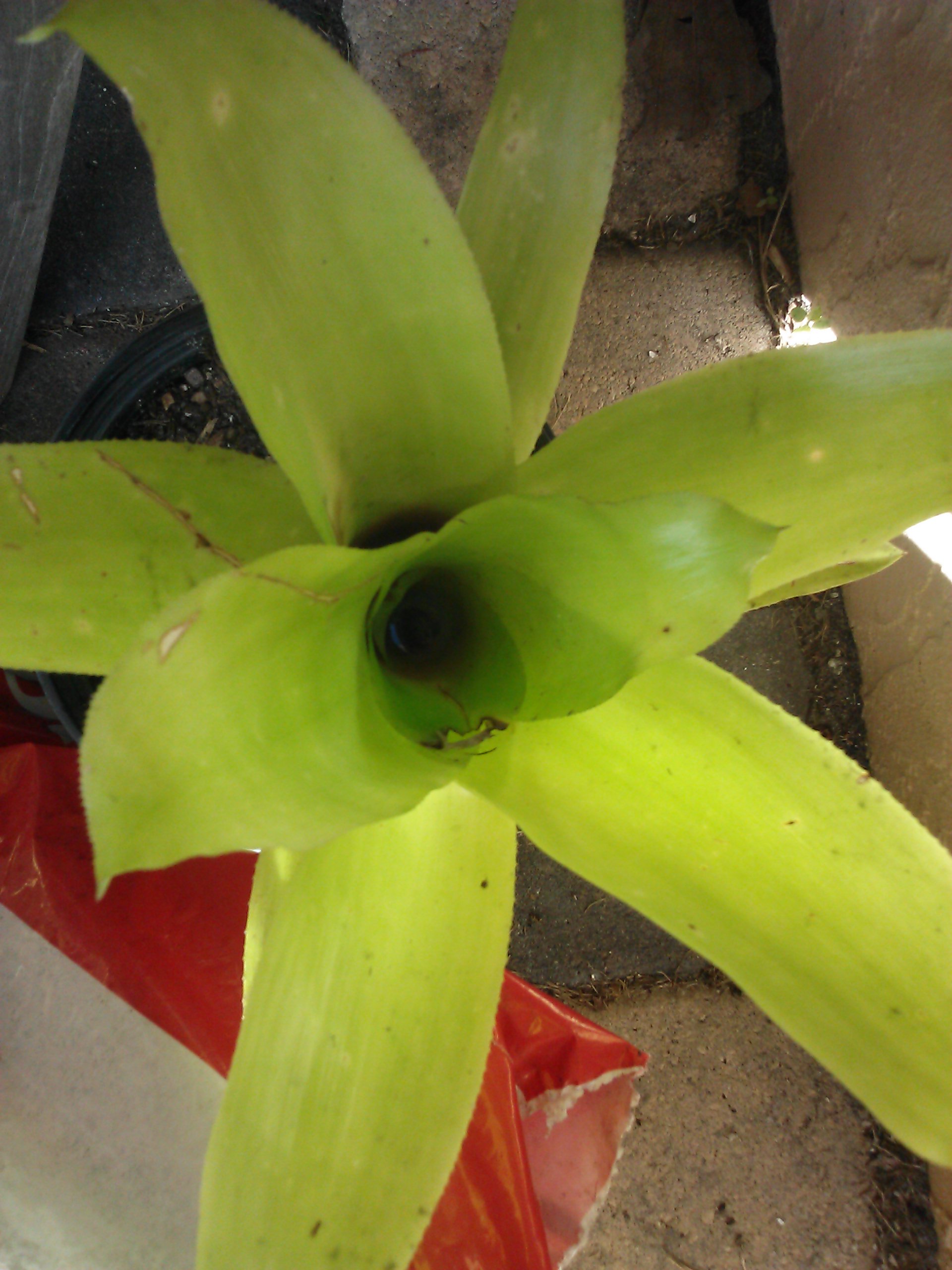
The three for 10 dollar Bromeliads! One of the issues with buying Bromeliads in this manner is the sellers tend to have no idea what kind of Bromeliad they have. The seller advised me the larger one had blue flowers and was adaptable to light. Which really means do not plant in full sun or you will charco-broil the plant and be out three bucks. The others I am pretty sure are some sort of Fireball Neoregelia, I have some similar ones in the garden. Now potted, they have joined their friends from my last foray in plant shopping at Gardenfest.
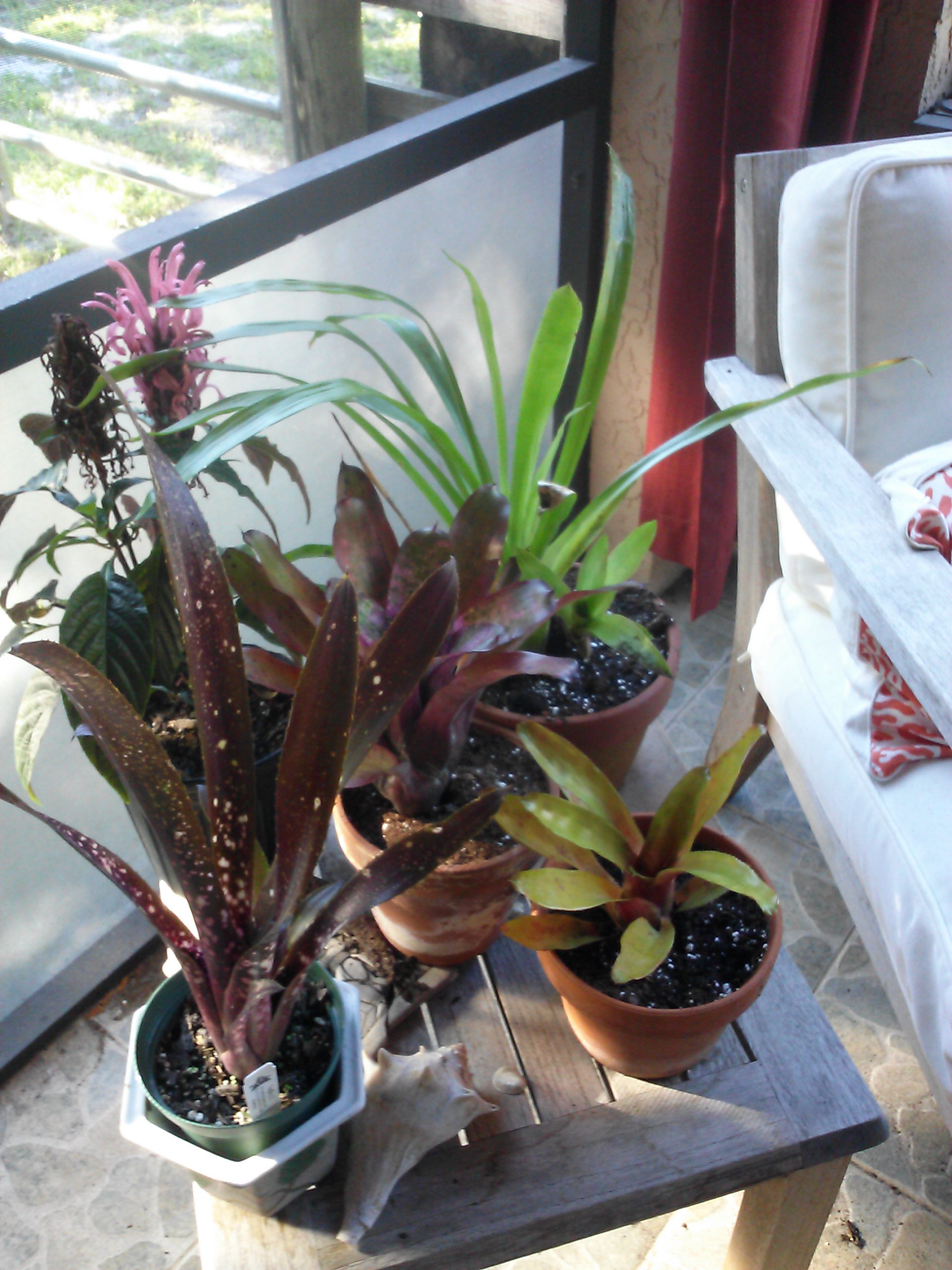
My Growing Collection

My Growing Collection

The Palm Man, I believe he was called, grows Palms in his backyard nearby. The Palms were beautiful and so were the prices. I succumbed, and bought two Palms.

One of my favorite interior Palms, a Lady Palm – I can now grow these outside, so I bought one.
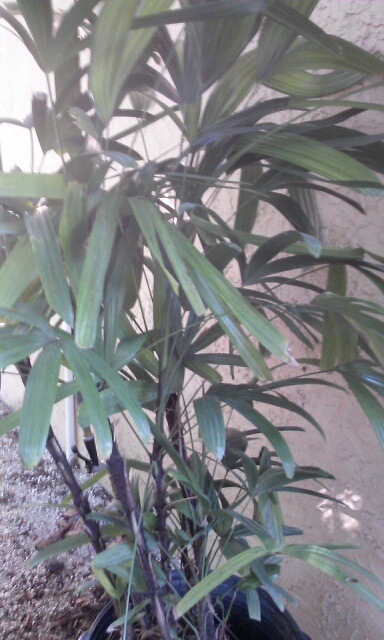
Lady Palm

Lady Palm

This is a Rhaphis excelsa, native to Southeast Asia Rainforests and highly shade tolerant. I have just the spot.

My next purchase was a Florida Thatch Palm, a new plant to me. One of the three palms native to Florida, this is a Thrinax radiata. Tolerant of sand, sea and alkaline soils. All things I have in abundance. Again, I have just the spot.
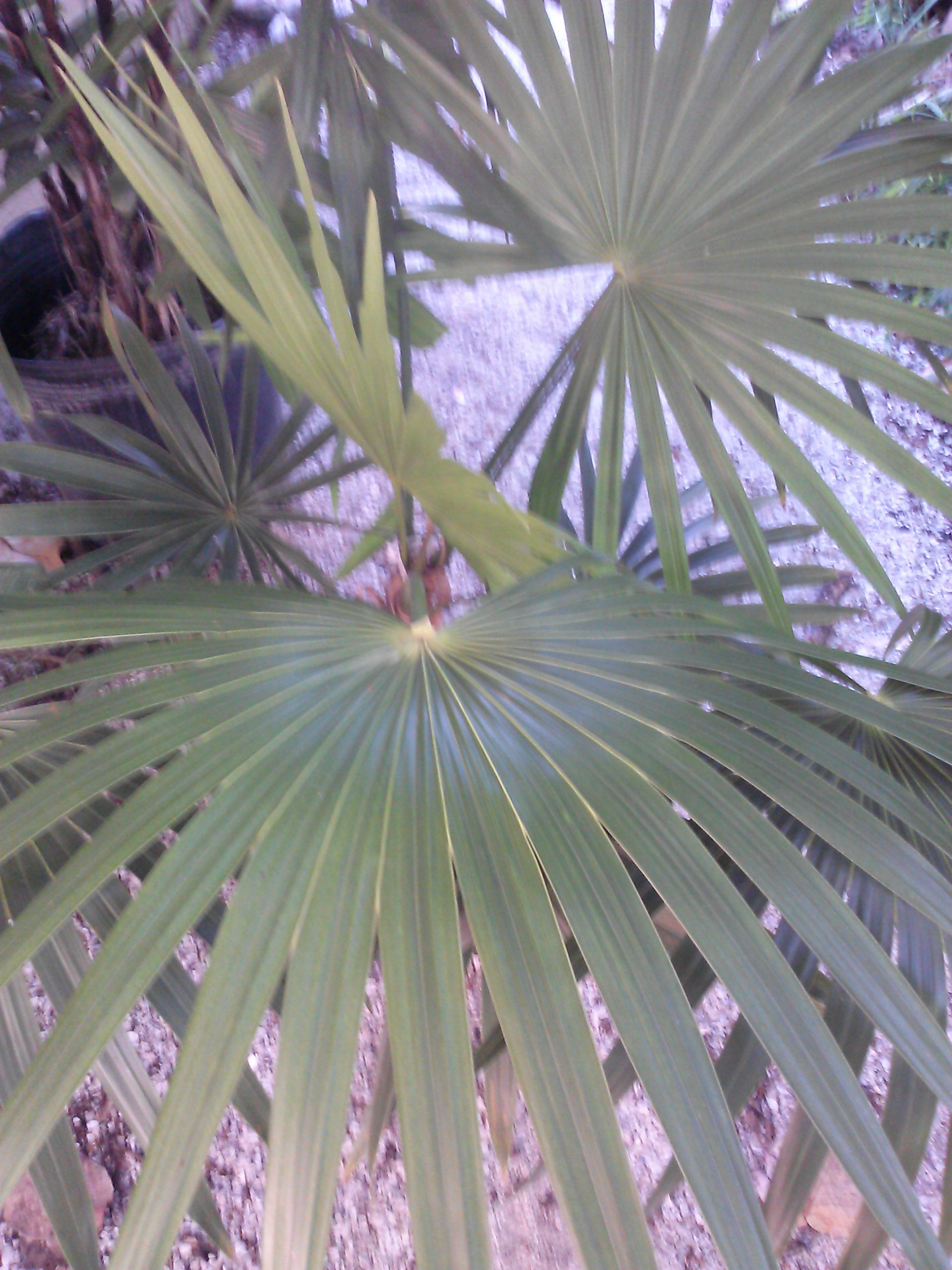
Florida Thatch Palm

Florida Thatch Palm

I did not quite violate my ‘never get a cart’ rule. Two nice young men from Junior ROTC showed up with a cart and met me at my car.

I have some planting to do this weekend, lest these palms turn into potted plants and spare parts for future use.

Proper Attire for H***strip Gardening

I learned a new term this week: Hellstrip. Hellstrip refers to the baking hot area between the street and sidewalk or driveway. A book has been published about these gardens and there is a Facebook page. Hellstrip has hit social media! Usually narrow and not easily watered these areas require some special consideration and are difficult for gardeners to conquer.

I had not realized I even had a HELLSTRIP and the truth is I kind of like it. When my husband and I bought our house there was a Jacaranda in the strip that could literally be seen through. The top of the tree had been blown out and the crotch had rotted to the point you could catch glimpses of the house through the trunk from the street. Fearing an unstructurally sound tree, I had the Jacaranda removed. What grew under the tree might kindly be referred to as sand spurs.

The sand spurs took a bit of work to get rid of as nothing really kills them except removal and they reseed heavily. Gallons of vinegar later and with the construction of a new driveway, I had a blank palette.

With a bit of research and observation I determined the plant list and began to install.

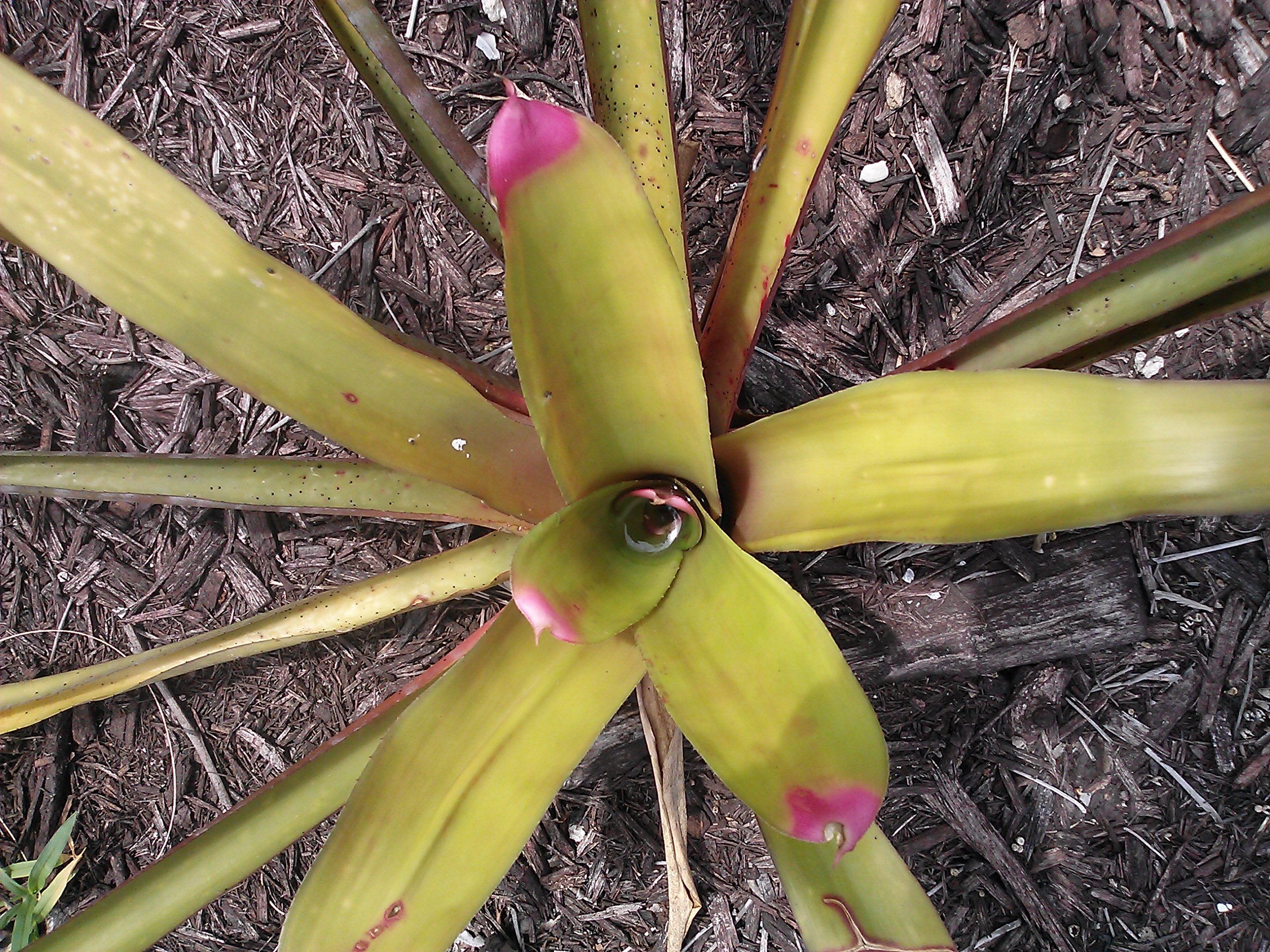
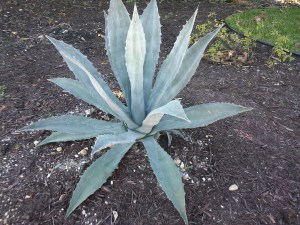
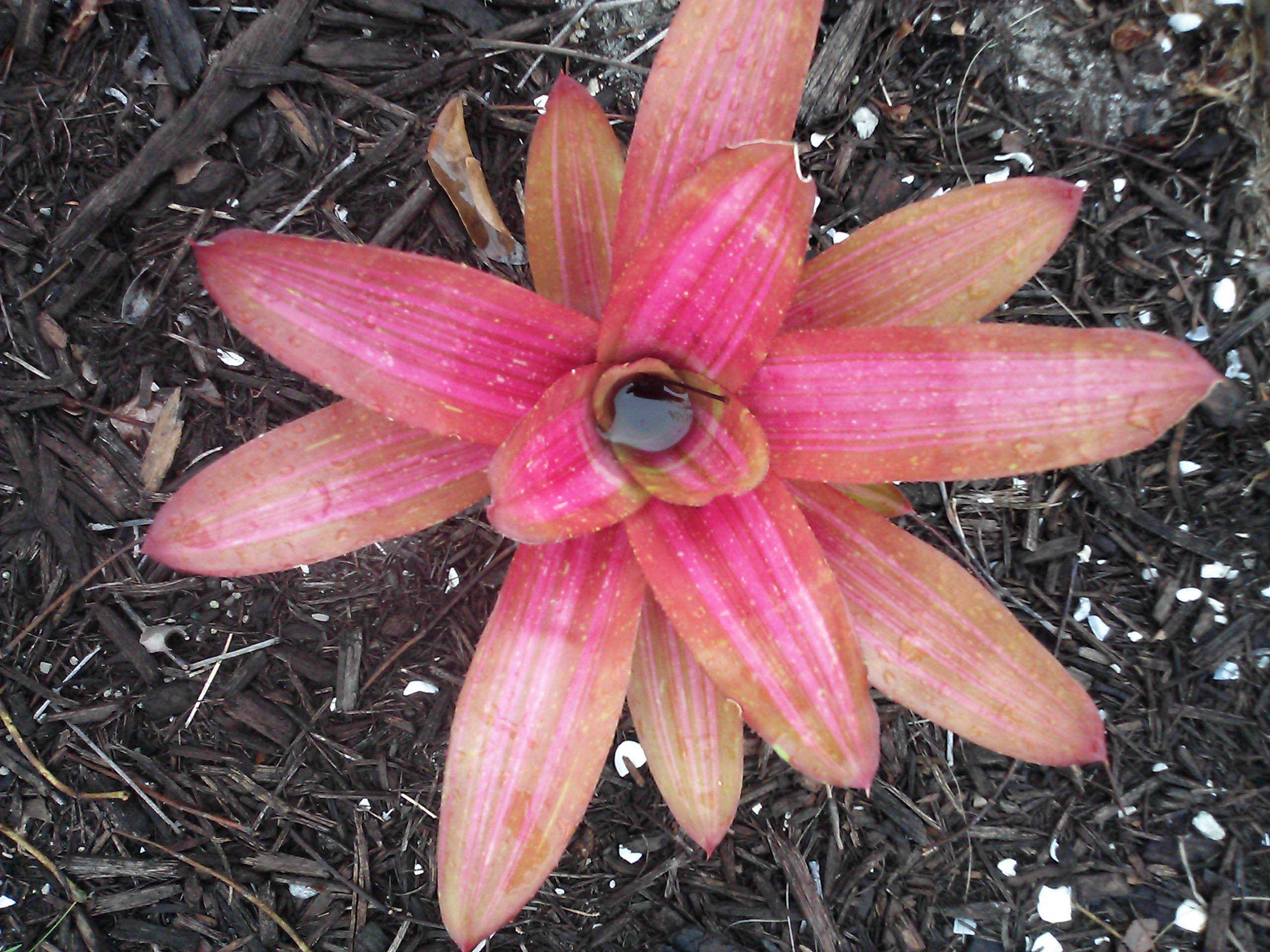
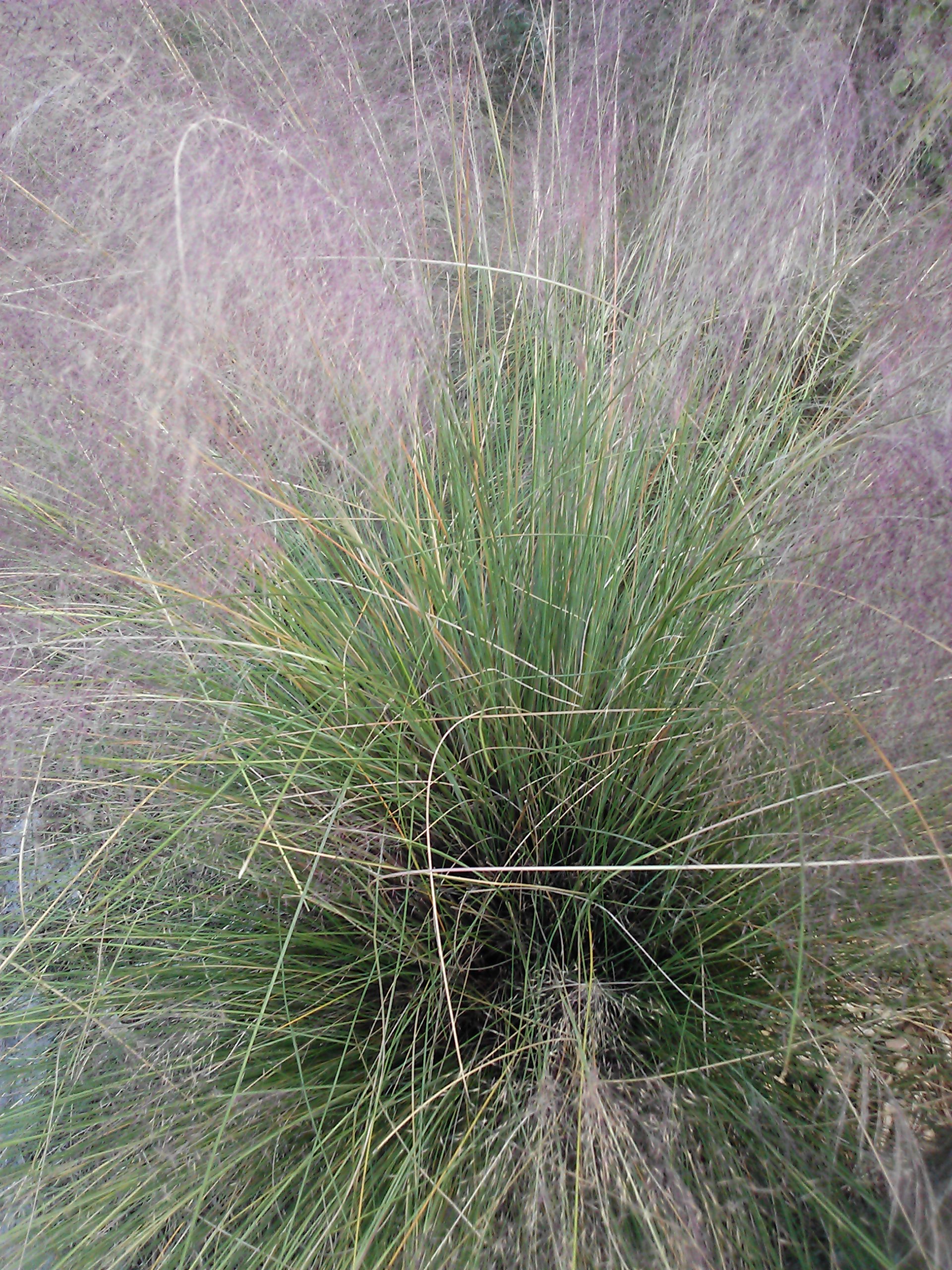
First, a native and very drought tolerant tree, The Gumbo Limbo. Gumbo Limbos are wonderful Shade Trees but pretty basic. Then to the underplantings, I searched native beach plants and looked for extremely tolerant passalongs, here is what I found:

The Sunflowers and Muhly Grass are native, the rest are imports that are very drought tolerant. Worst comes to worst, I can make some tequila from the Agave..

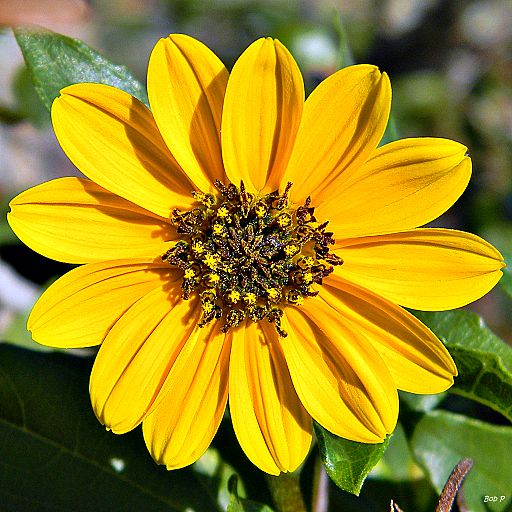
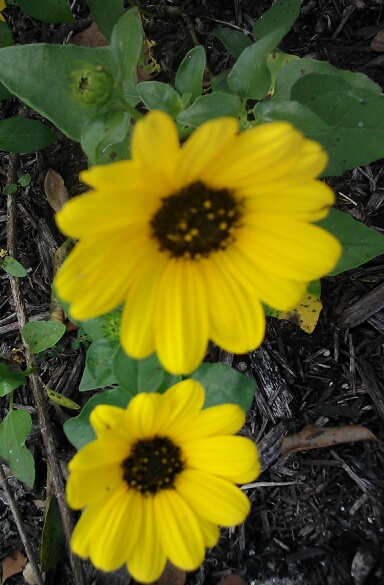
Dune Sunflower Helianthus debilis

Dune Sunflower
Helianthus debilis

Painted Fingernail Bromeliad

Painted Fingernail
Bromeliad

Blue Agave

Blue Agave

Martin Bromeliad

Martin Bromeliad

Muhly Grass

Muhly Grass

The composition might seem a bit weird, but I have color year round and throw some water around every now and again. All the plants are doing well, with no irrigation whatsoever and growing in the poorest excuse for soil I have ever encountered.

Now, the question, the attire for Hellstrip Gardening, I propose this:

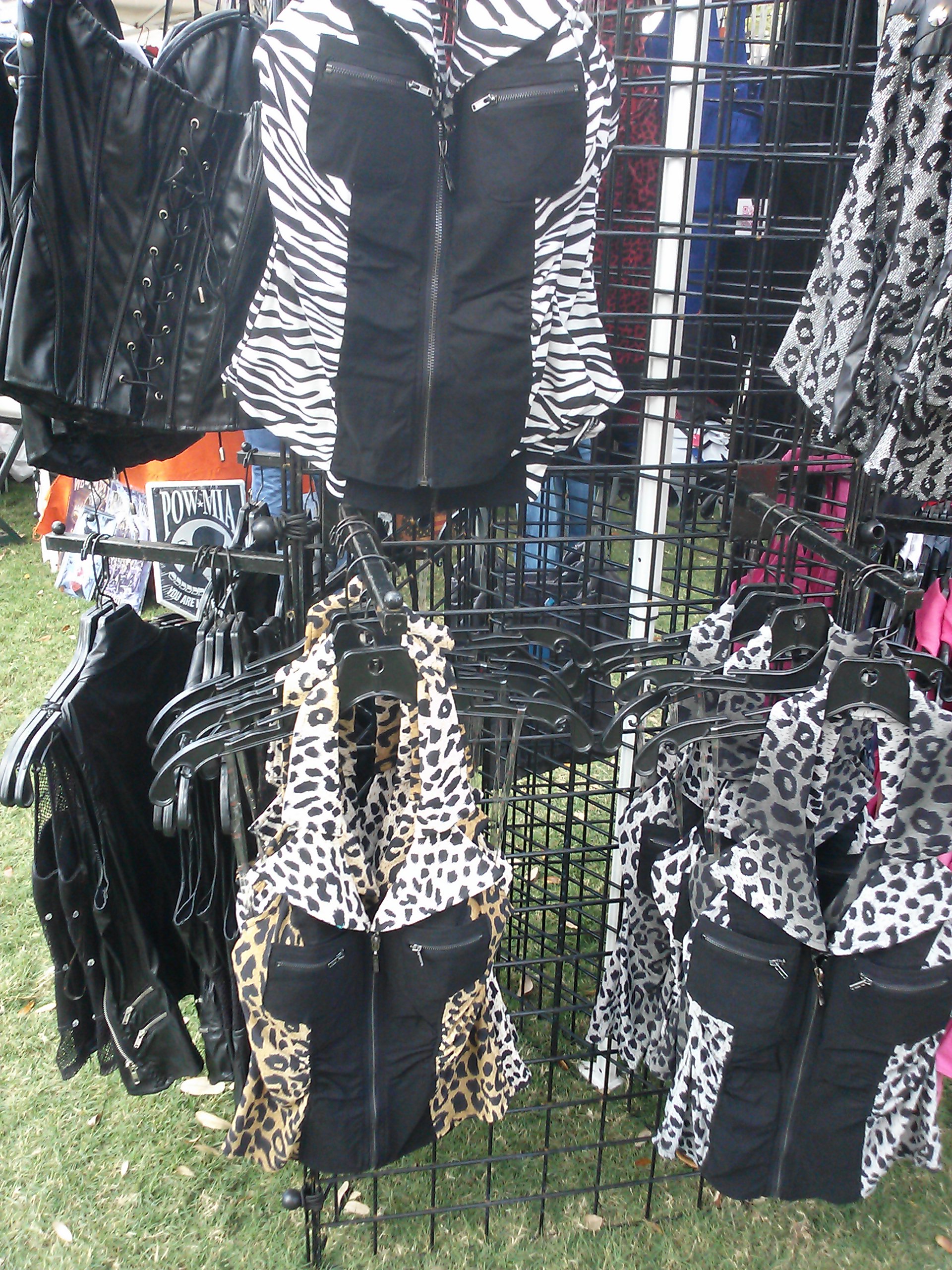
Animal Print Bustiers

Animal Print Bustiers

Maybe worn with Combat boots? I’ve been meaning to get a tattoo, maybe of my favorite Bromeliad….


New Years Day in My Garden

The turning of the year is a time for taking stock of what you have and looking forward to the future of what will be added to the garden. Here is what is currently in bloom in my garden.

This is an Aechmea Bromeliad and outstanding in its interesting flower. I have a feeling I am going to find out that is a bract or something.

Blanchetiana Bromeliad

Blanchetiana Bromeliad

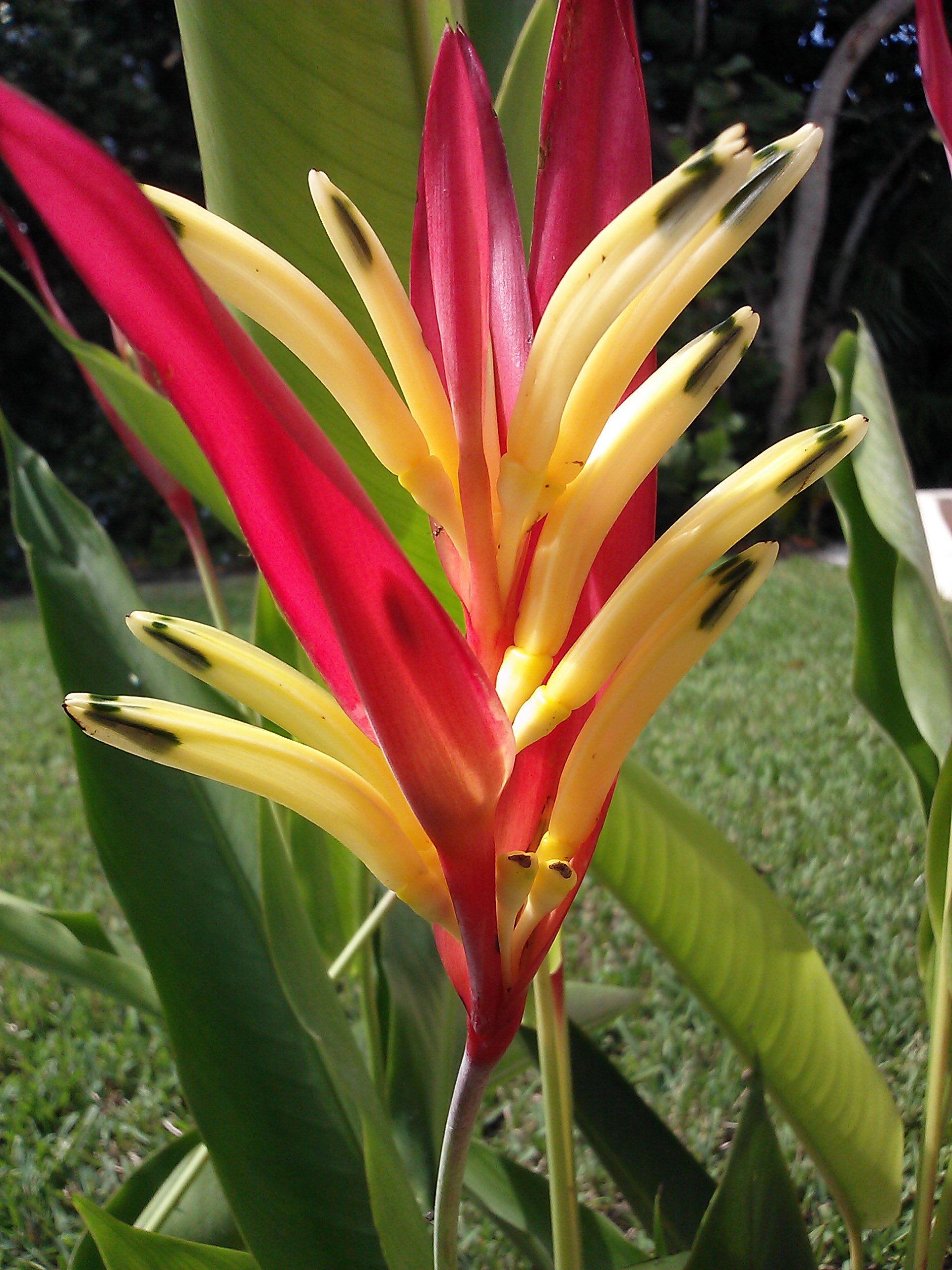
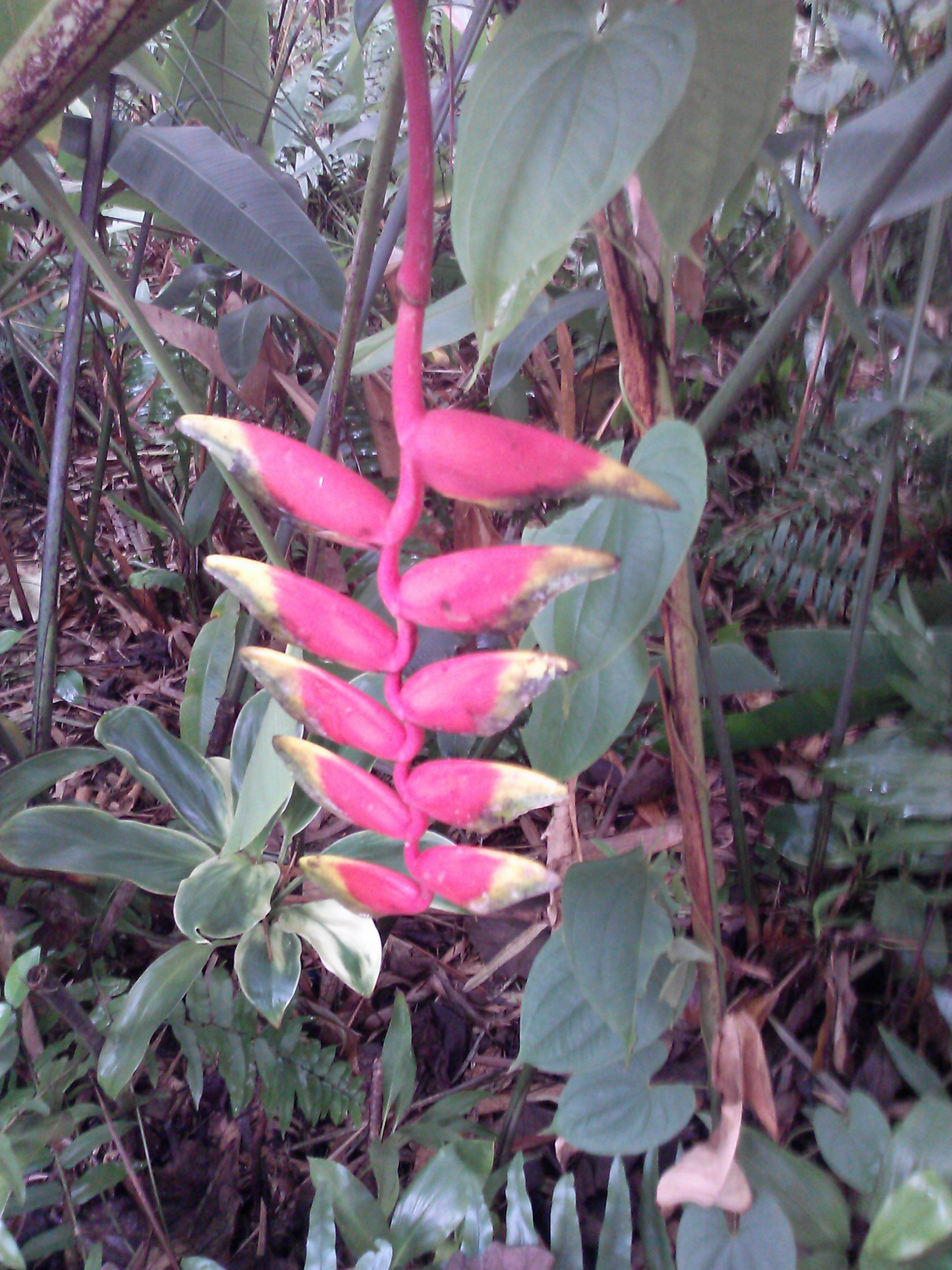
This is an unnamed cultivar of Heliconia, I see it called Parrotflower in the trade. I have yet to see a parrot.

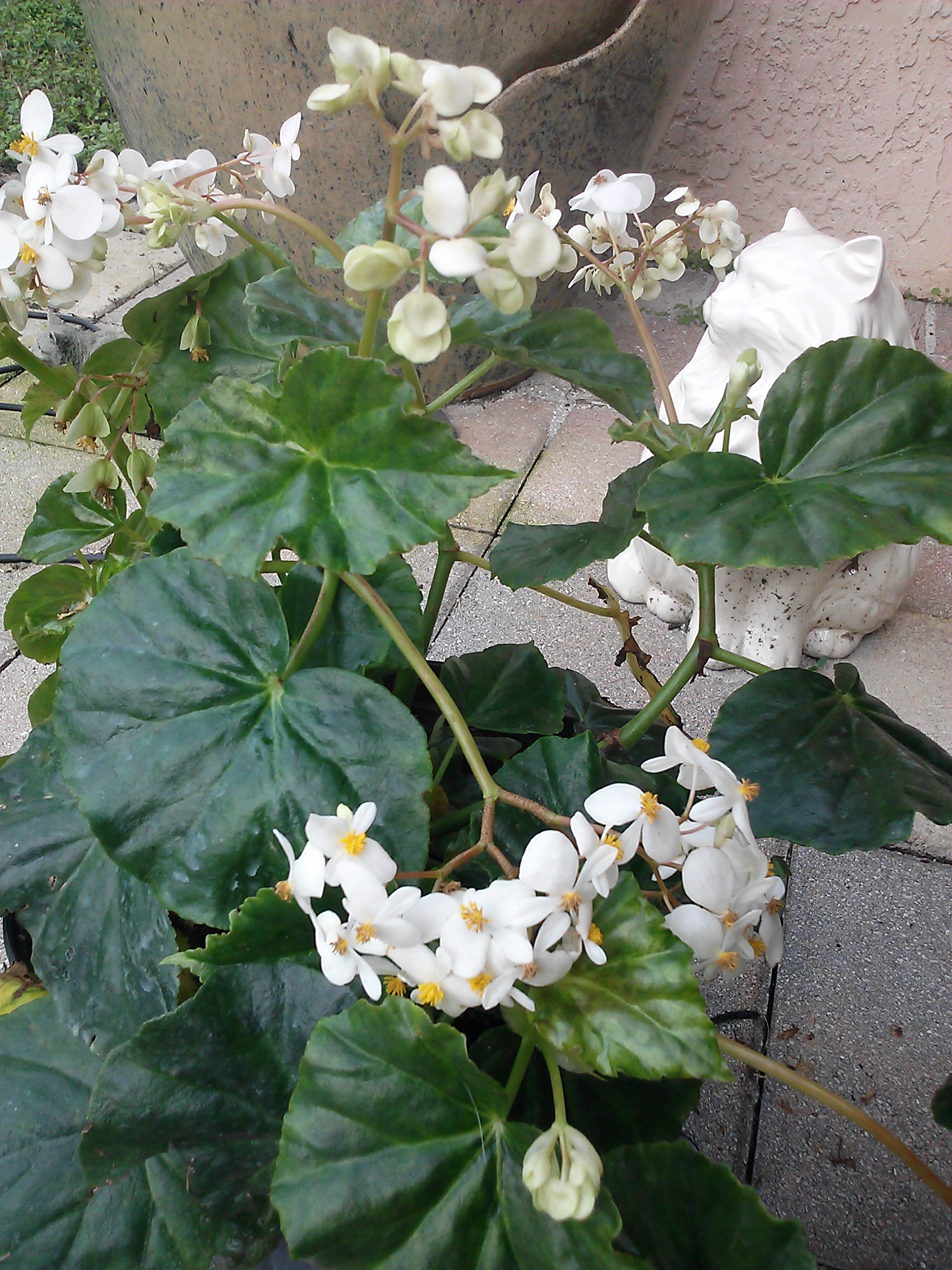
Sweet Begonias are new to me, Begonia odorata, I rarely catch the scent from this, but it has been blooming nearly nonstop since last spring.

Heliconia psittacorus

Heliconia psittacorus

Sweet Begonias

Sweet Begonias

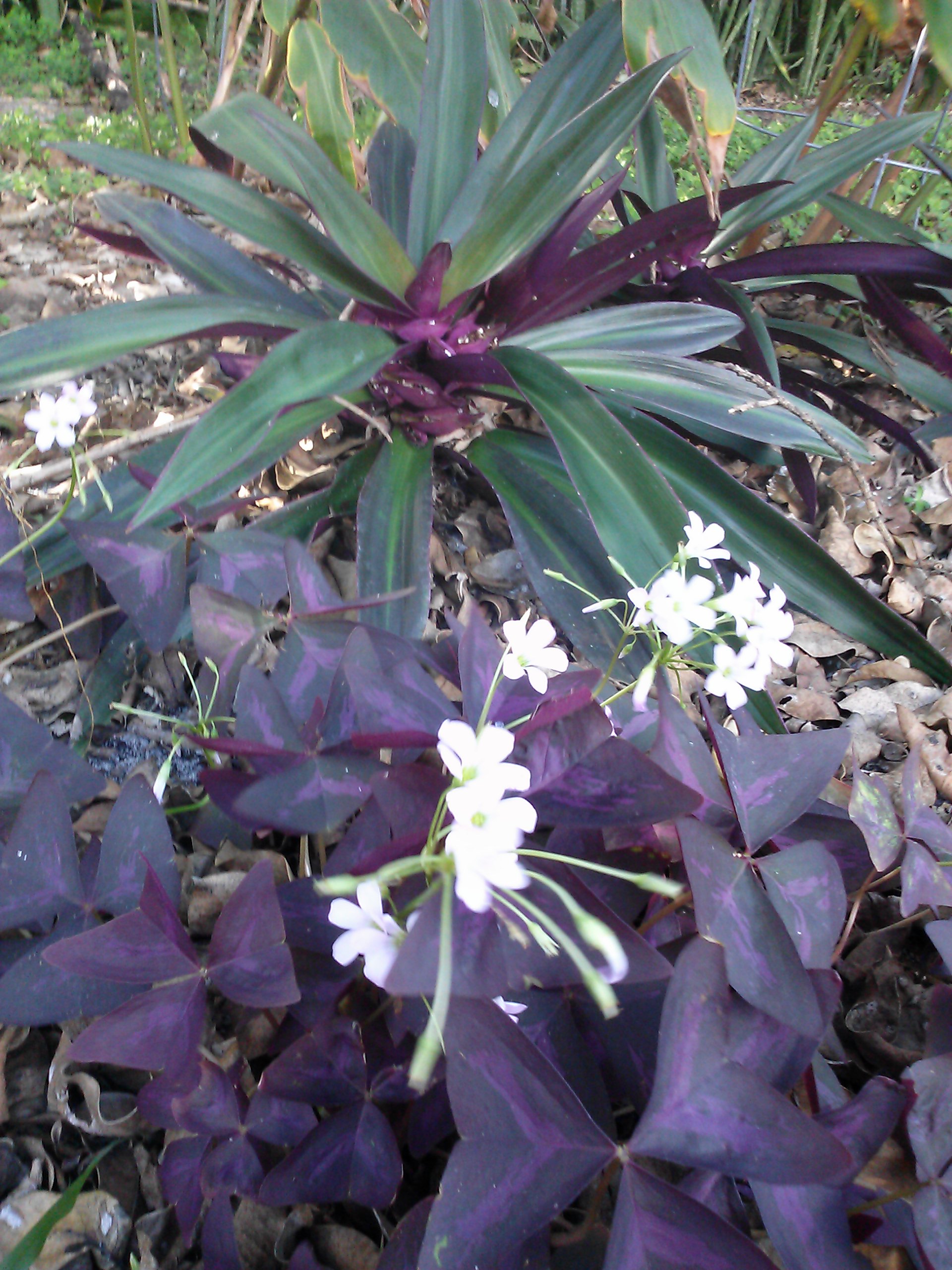
Doesn’t everyone have a Purple Oxalis?

Purple Oxalis

Purple Oxalis

This may be my new favorite plant, a native groundcover used for controlling beach erosion, the Dune Sunflower was planted in the middle of summer in an unirrigated bed by the side of the road. I bought the plants on sale for $1.oo(US) each because they looked bad and the grower wanted to get rid of them. A couple of months later and a little TLC and these are madly blooming with little care. What’s not to like?

Dune Sunflower Helianthus debilis

Dune Sunflower
Helianthus debilis

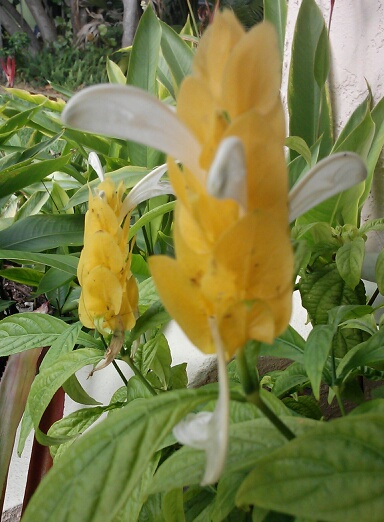
The Tibouchina is another sporadic bloomer, love the purple though. The Shrimp Plants have been blooming nearly nonstop since last spring on my porch. I have unsuccessfully tried to root them.

The Glory of the Princess Flower

Tibouchina

Shrimp Plant Pachystachys lutea

Shrimp Plant
Pachystachys lutea


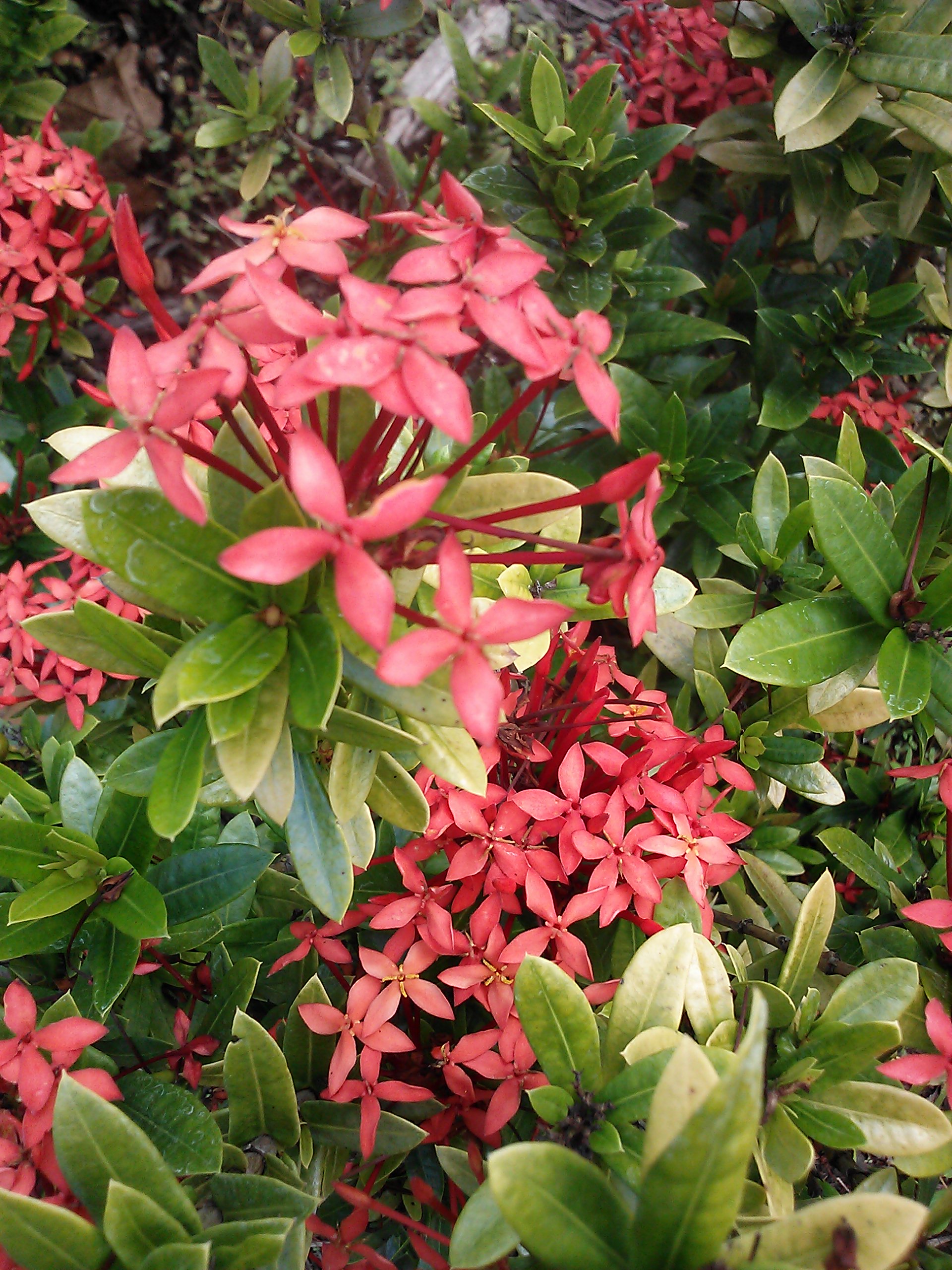
Some of these plants bloom nearly year round like the Ixora below, I call this the Azalea of South Florida because most people who garden have a few. A reliable plant that comes in several colors and sizes.

Dwarf Red Ixora Ixora taiwanensis
Dwarf Red Ixora
Ixora taiwanensis


I feel as if I have been making steady progress in the garden having started it almost three years ago. I have definitely learned a lot about tropical plant material, and am looking forward to learning more.

My next project is to divide the bromeliads as the cooler weather has them sending up pups:

Burgundy Aechmea Bromeliad

Burgundy Aechmea Bromeliad

Then replant my herb garden, I found Lemon Thyme here last week after a three year quest and am very happy.

Happy New Year and Happy Gardening.

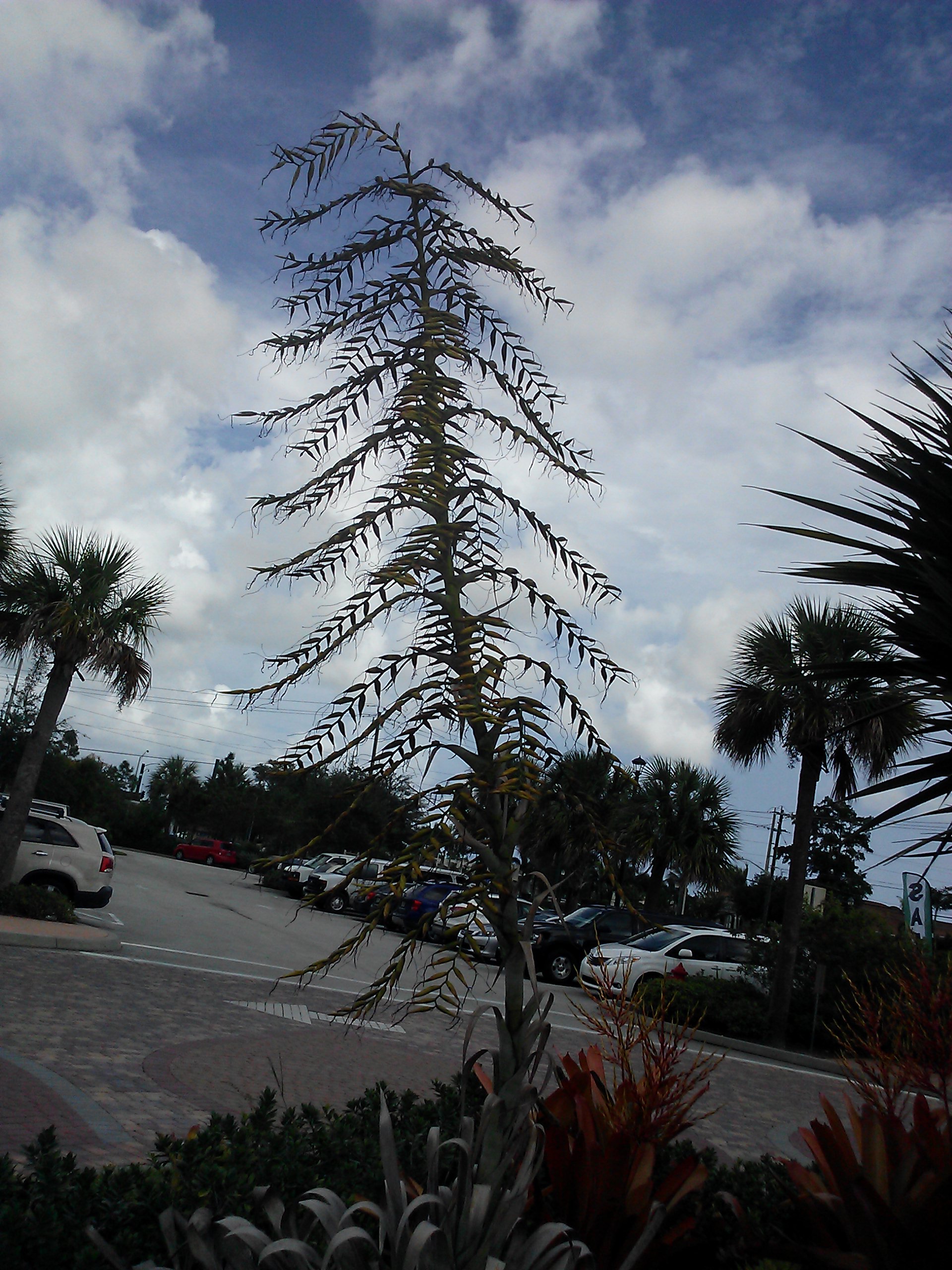
Another Bromeliad for South Florida – Aechmea blanchetiana

The Whole Plant

The Whole Plant

I found this on my doorstep earlier today and it is my birthday, so this was a great present. It is a Blanchetiana Bromeliad – another beauty from the rainforests of Brazil. The flower spike on this plant looks to be about 4 feet tall. These are fairly common on the Treasure Coast and they start blooming around Labor Day, I consider this a Fall color plant!

I know it seems weird thinking of a Rainforest plant as a Fall indicator, but, hey, they have fall in the tropics. The days shorten and things that are red and orange flower. Not much in the way of leaves changing color, but other things do.

The Flower

The Flower

The Flower is a funky thing that makes me think of crustaceans, King Crab legs or something like that. Now I just need to decide where to plant this…..

Winter Containers for South Florida

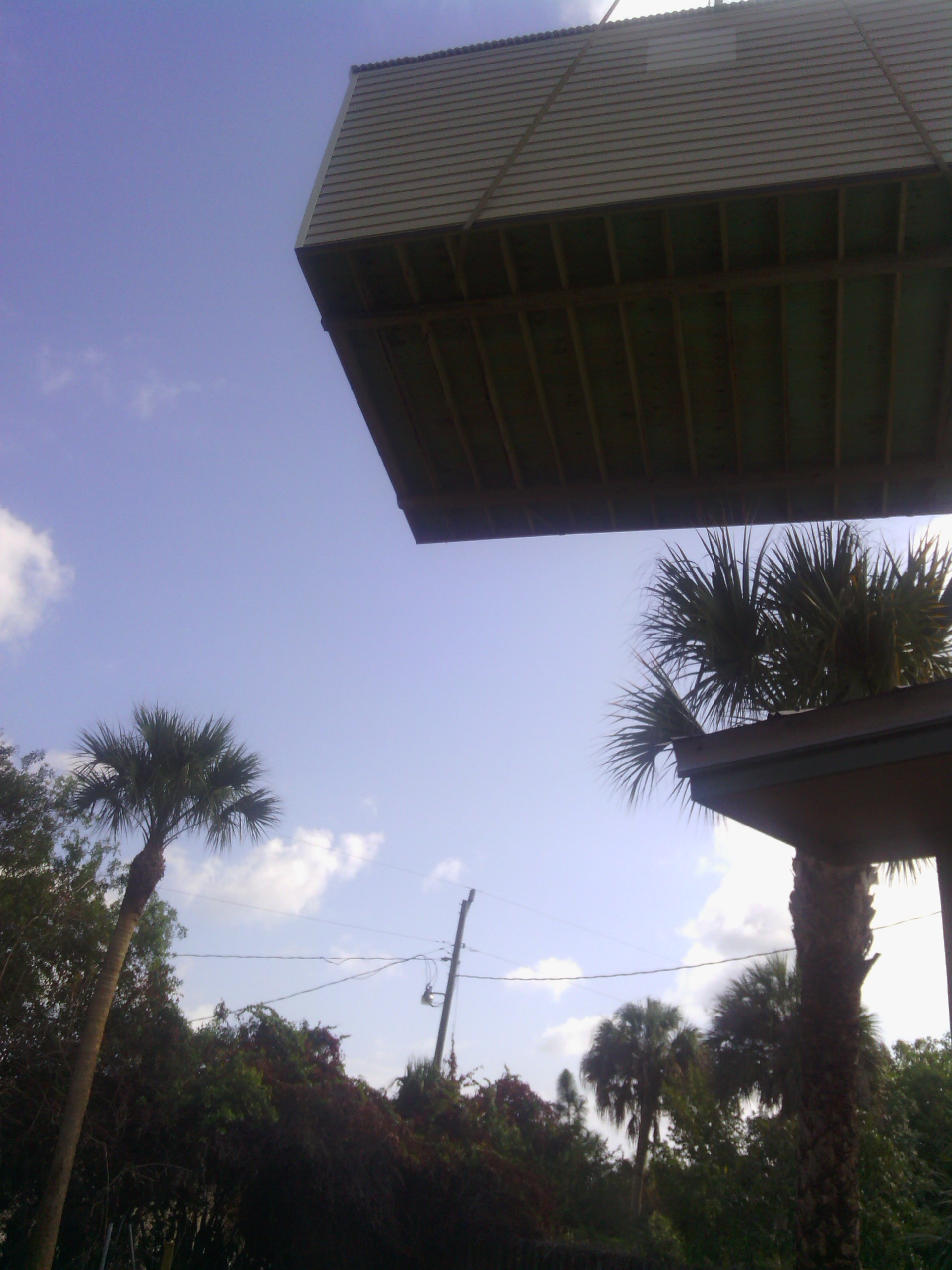
Here comes the Work Shop

Here comes the Work Shop

My husband likes to work with his hands, when we moved to South Florida there wasn’t enough room in our house for a workshop so we had one craned it. The picture is the shop being lifted over the house..I’ll get to the containers in a minute.

The shop ends up looking a bit like a trailer but with some landscaping and a porch it fits in. These sheds are fairly common in South Florida, I have never seen them before – they are even built and attached to the ground to resist hurricanes.

The whole adventure left me feeling a bit like Dorothy in The Wizard of Oz. Maybe in reverse.
After all this, my husband who has clearly been living with me too long decided he wanted some flower pots (containers if you are a landscape professional) on his shop porch. I put some containers together with the usual suspects last year sometime – yes, the annuals last that long here. It seems crazy to me as well. They last so long you get tired of them. When I lived further north I always did the containers twice a year, changed the colors with the seasons and enjoyed the variety.
Imagine my surprise when the old summer reliables, Bronzeleaf Begonias, rolled over and died in the summer heat. Time to revise thinking to plants that live in say, the Sahara. Pentas and Lantanas. I had gotten bored with Lantanas in Atlanta and really still am, they just smell funny. If I want fragrance, that is so not it.

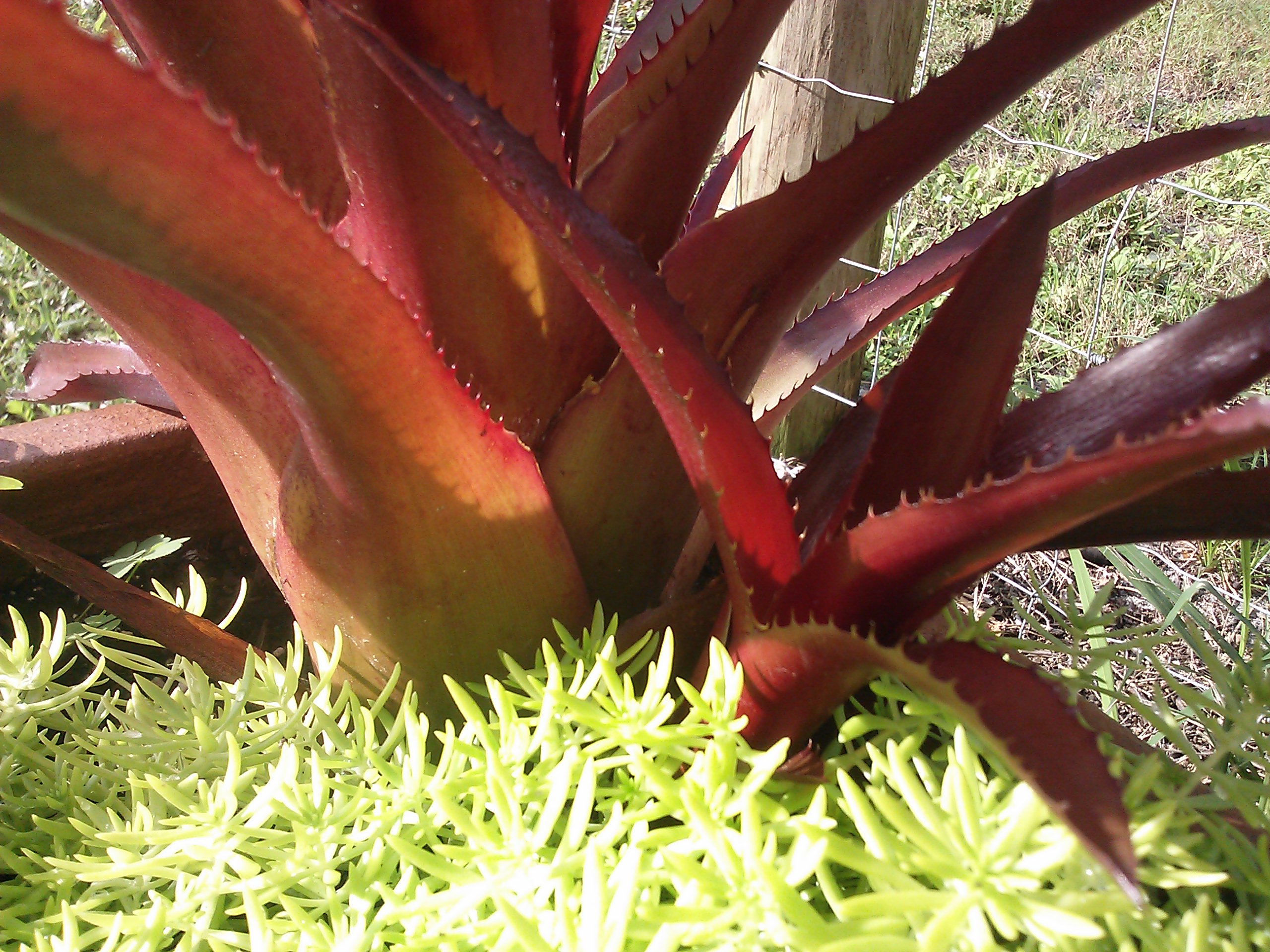
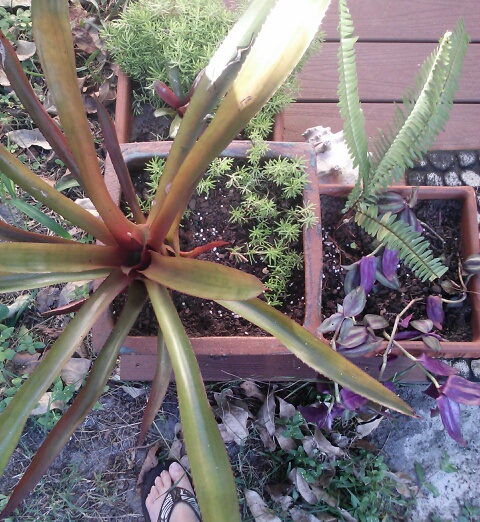
The Lantana and Pentas were pooping out so I was trolling around in our yard to see what I could find to replace the spent annuals. One of the fun things about living in Florida is you never know what you might find growing in the yard. Boston Fern grows wild in the side yard so I dug a start of that and then found some Purple Wandering Jew (Zebrina), a Burgundy Bromeliad and an unknown groundcover Bromeliad (from a garage sale) that needed to be divided  and added them to the ‘Florida Friendly’ (this is a Florida Extension Service sort of approved plant) chartreuse Sedum that was already in the pots. As an aside, who ever heard of a sedum that does well in partial shade – this does. Whatever it is.

Groundcover Bromeliad and Sedum

Groundcover Bromeliad and Sedum

Voila, a purple and chartreuse themed container garden. The Bromeliads seem to be perennial in containers – the big Burgundy one was divided from a container I have had on my front porch for a year or so – I started with one and now there are three in there. You just never know what you will find growing outside…

Newly planted containers

Newly planted containers


Regional sustainability

Cabbage Palm

There is a lot to read about sustainability these days, is it possible it is a local phenomena? It has to be. Given that the idea of sustainability is to save time, money and materials by using what is available locally – you have to find out what is around.

The LEED Initiative made popular by US Green Building Council (changing the way we think about building, they say) considers that any plant material grown within 500 miles of where you are building is locally sourced. I have to disagree with that 500 miles from where I am a greenhouse would be required to grow what grows outside here. I have learned a great number of new plants that I had never seen when I lived 500 miles north.

Florida may be different; but everywhere is different. Sunset Books made a great attempt to zonify America and came up with 36 named zones with added special zones for extreme climates?! The USDA seems to have 15 Zones. Who is right? Probably nobody.

So, I thought about what I can get here that is totally local and sustainable. Well, lots of things and these materials make my garden unique to my locale.

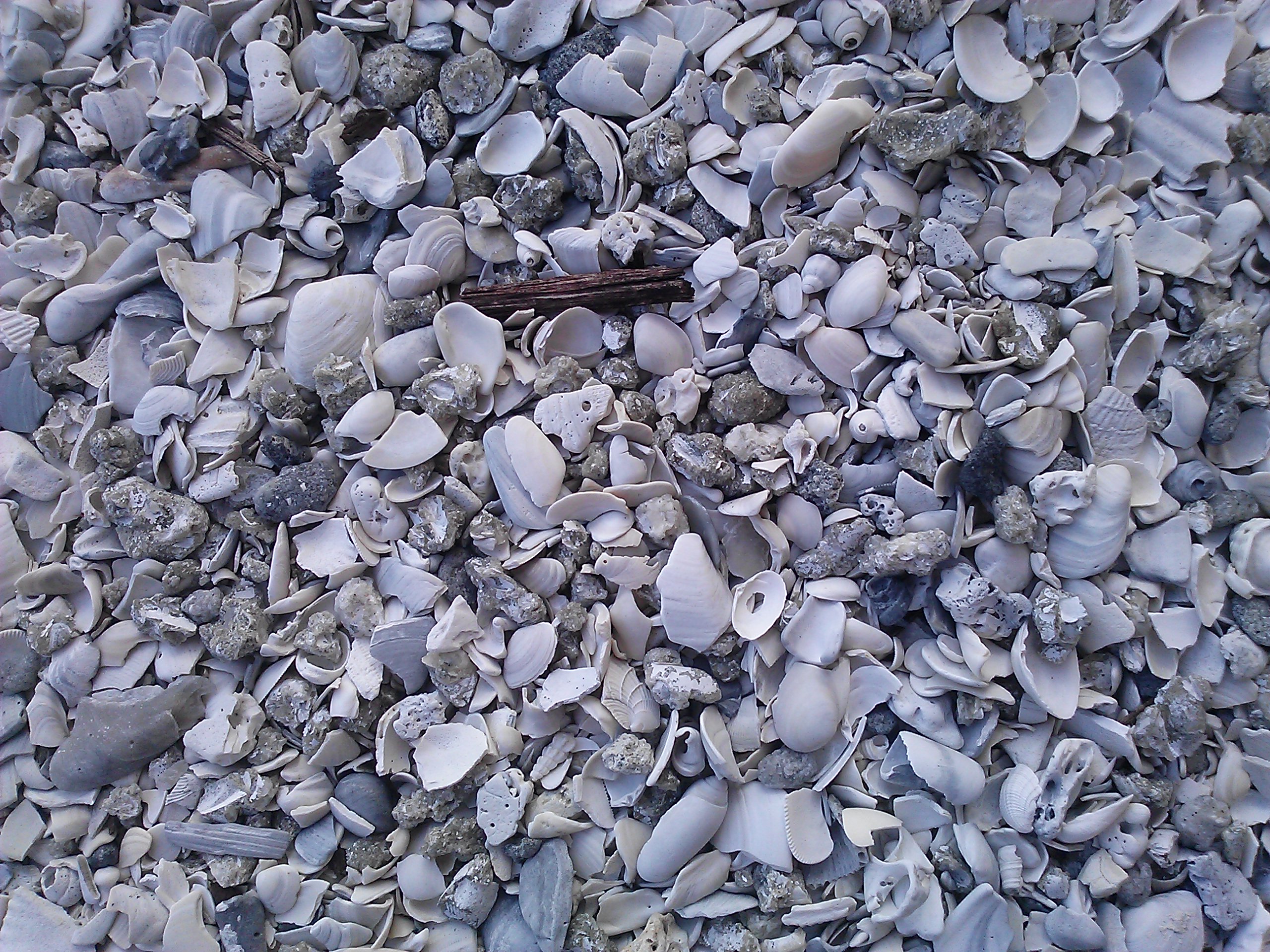
I can get great paving material from within 20 miles of my house, this is 3/8″ graded shell. Larger shell called white washed shell is available for more decorative uses.


Shell for surface of driveway

Shell for driveways, walkways, etc.

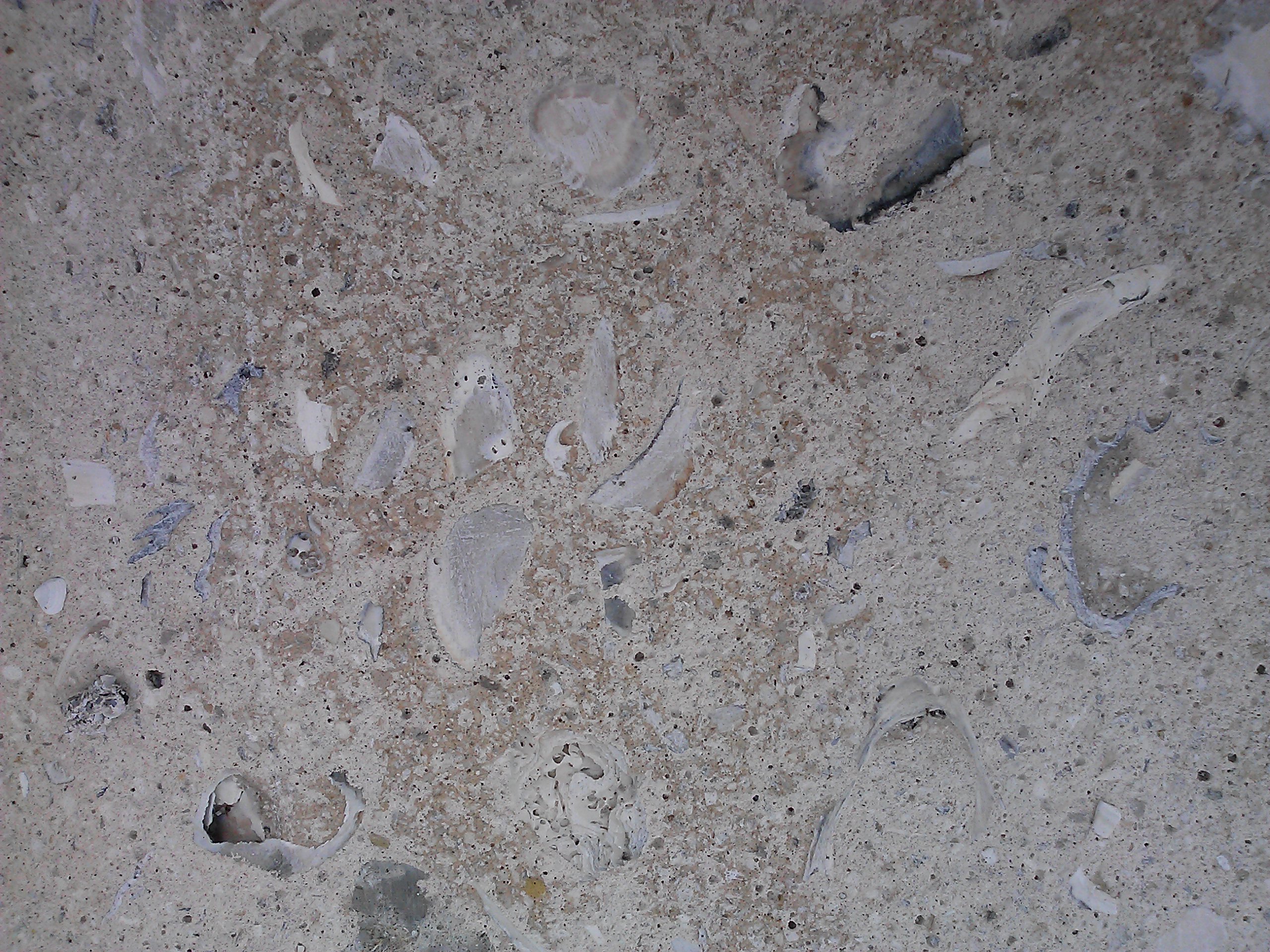
There is a place within walking distance of my house that makes stepping stones with shell in them:

Shell & Concrete Stepping Stone For Path to mailbox

Shell & Concrete Stepping Stones

Possibly a peculiarity of the area I live in; there are plant sales like garage sales almost every weekend. I rarely pay more than $5.00 for anything and talk about locally sourced. The downside to this is very few people know exactly what it is they are selling – its a Green Bromeliad. On the other hand, it is always a surprise when one of these treasures bloom. One of the joys of gardening.

The Mysterious Green Bromeliad

The Mysterious Green Bromeliad

Here is my latest purchase, a nice Chartruesy Green Bromeliad that supposedly takes full sun. That is the full extent of my knowledge, I can’t wait to see what it does. Gardening teaches patience.

Bromeliads in the Hood

Dr. Seuss

Dr. Seuss

I did my weekend garden touring at the McKee Botanical Garden in Port St Lucie, Florida. This is a surprising gem of a garden located on 20 acres in a suburban neighborhood setting. One of the interesting things about this garden, it is maintained almost exclusively by volunteers and  is beautiful. And they have lots of Bromeliads. I have no clue what that is above but Dr. Seuss almost certainly would have loved it.

McKee Botanical Garden

McKee Botanical Garden

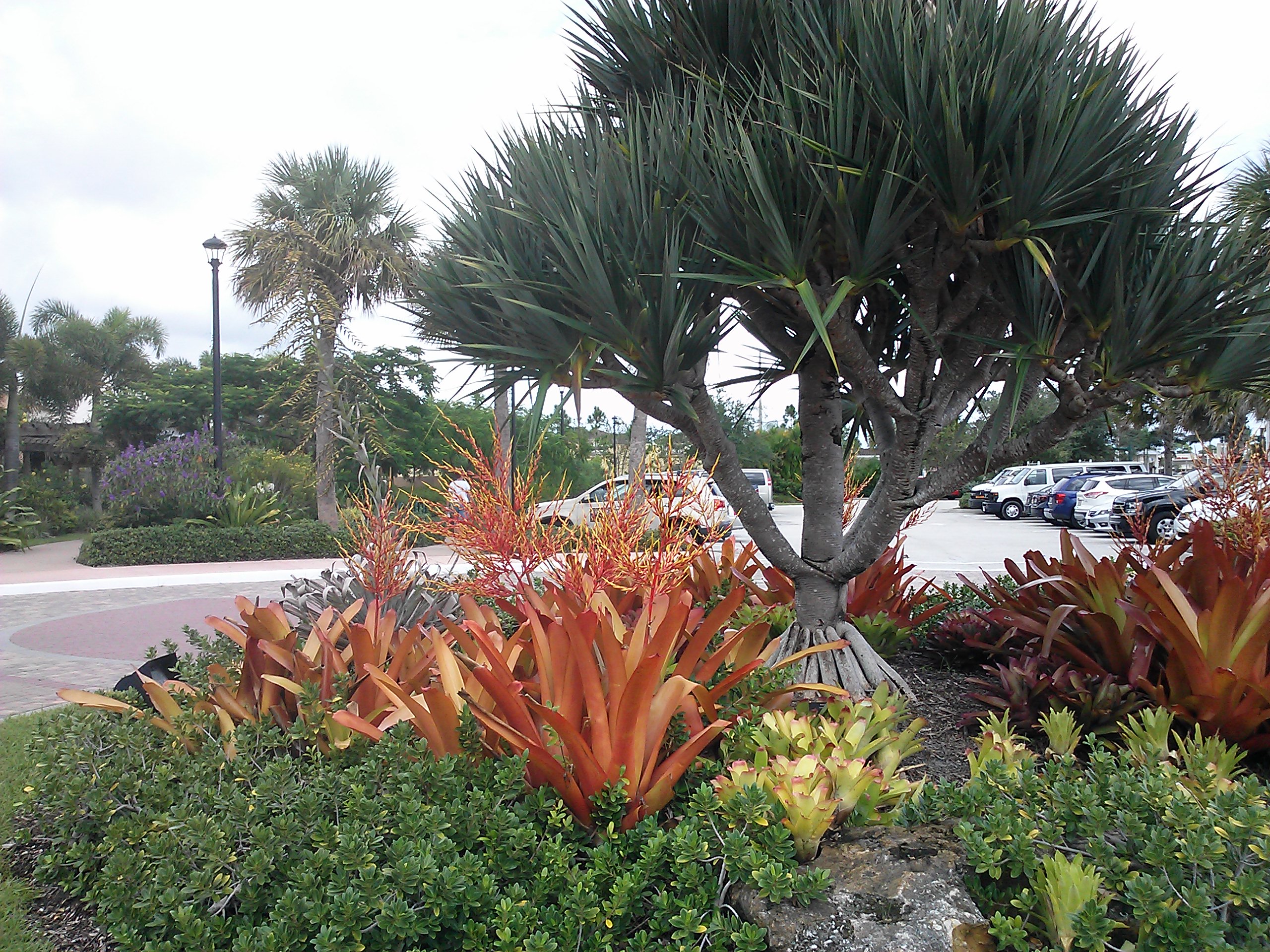
This is an island in the driveway at the  McKee Botanical Garden, the tree is a ScrewPine underplanted with Blanchiata Bromeliads and Green Island Ficus. Pretty cool.

More Bromeliad pictures from my travels:

Burgundy Bromeliad

Burgundy Bromeliad

I have seen numerous Burgundy Bromeliads around here. Guess what, the foliage is Burgundy and people will tell you they need some sun. Some being the operative word. These are, as far as I am concerned, in nearly full shade and flowering. I have some slowly frying in my front yard, am going to move them.


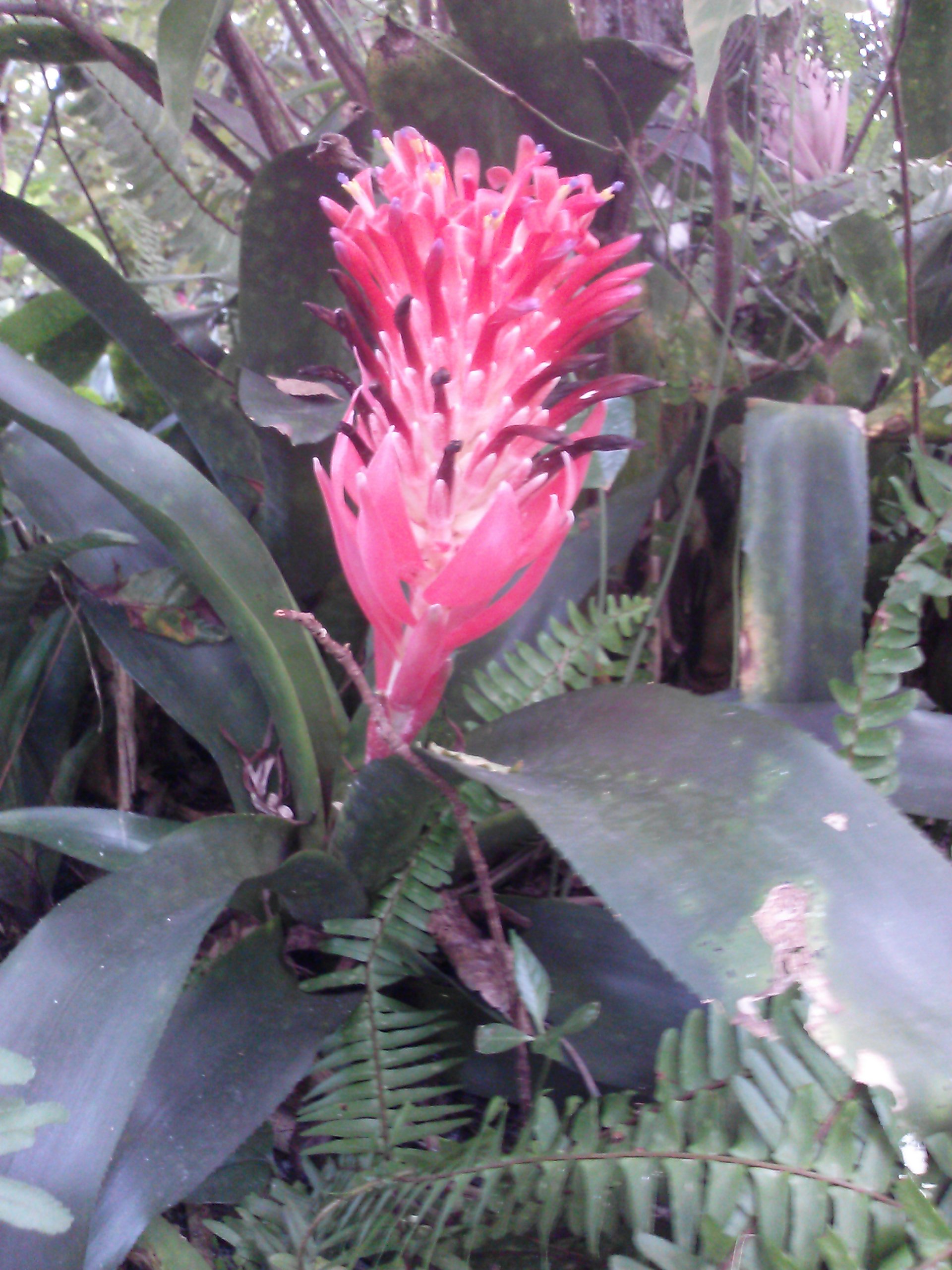
This is a bromeliad currently blooming in my neighbor’s yard. I think it is a Quesnelia-please comment if you know? I keep calling these Quesadillas and it is making me crave Mexican food…

Quesnilla?

Quesnelia?

Tropical Ranch

I went on a mini garden tour yesterday to the Tropical Ranch Botanical Garden in nearby Stuart, Florida. This is a two acre garden owned by a local couple who are Master Gardeners; they live in the garden and open it every month or so.

The garden is beautifully maintained and available for events. Here are a few plants from my meander through the garden:

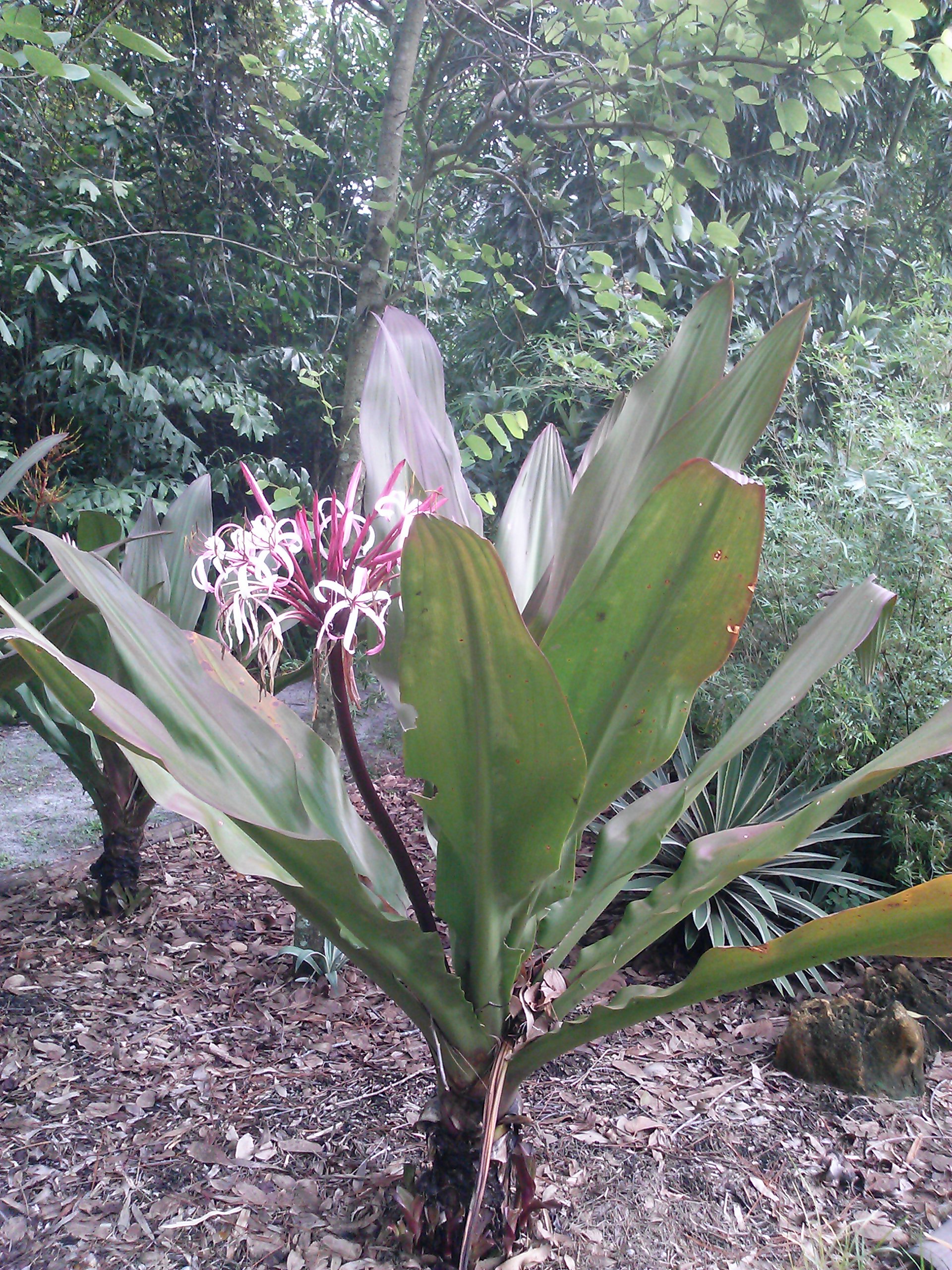
'Queen Emma' Crinum

This is a ‘Queen Emma’ Crinum – this plant is 5 or 6 feet tall.

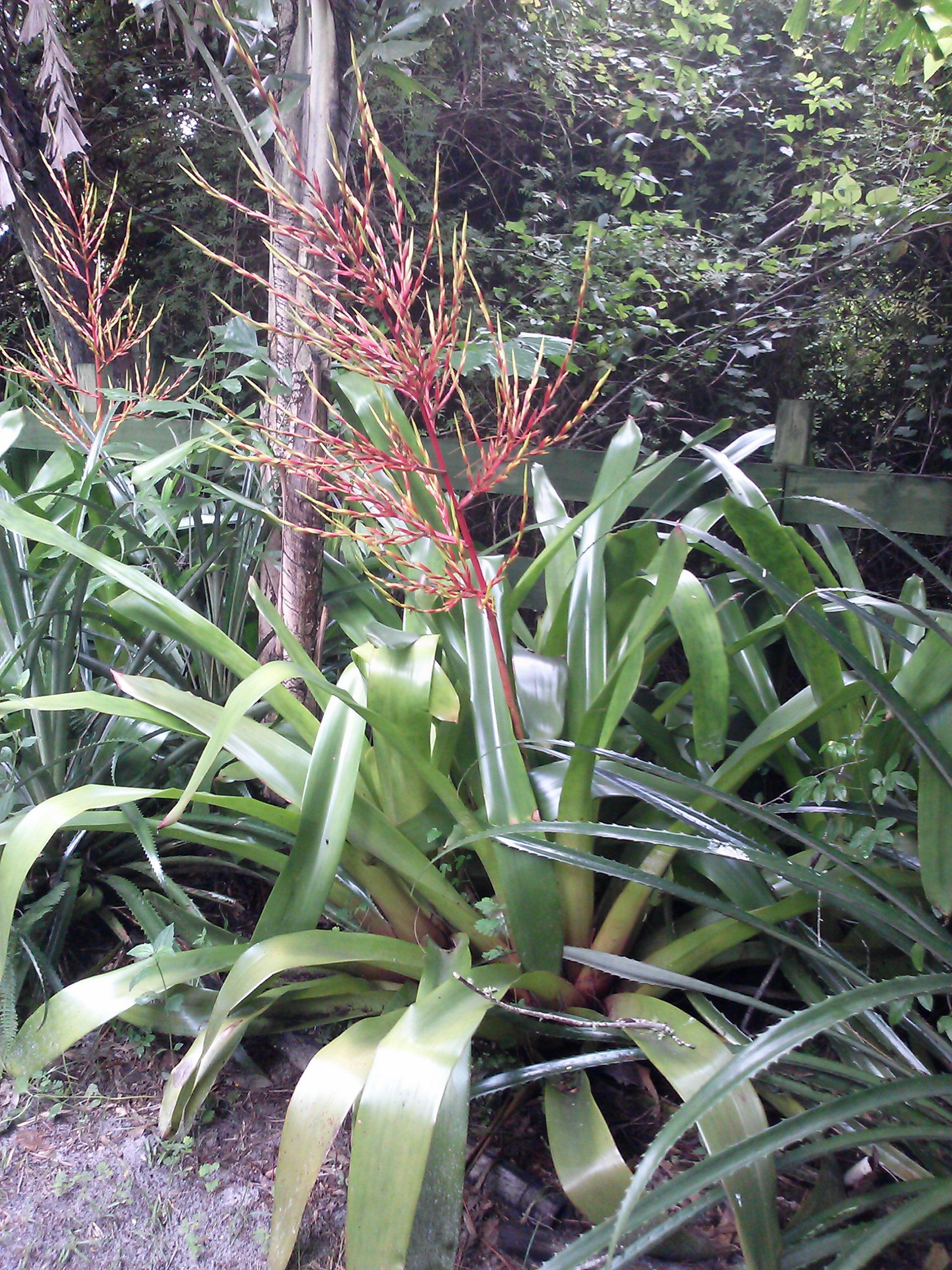
Blanchietta Aechmea Bromeliad

Blanchetiana Aechmea Bromeliad

Another enormous tropical in bloom,  these are very popular around town and are available in Lemon, Orange and Raspberry. I am not sure which one this is but, I am guessing Lemon as the leaves have a yellow cast. The flower is almost 5 feet tall and out of this world. I have had these for a couple of years and mine refuse to bloom. One of the owners told me they used to have cows – maybe that is the secret.


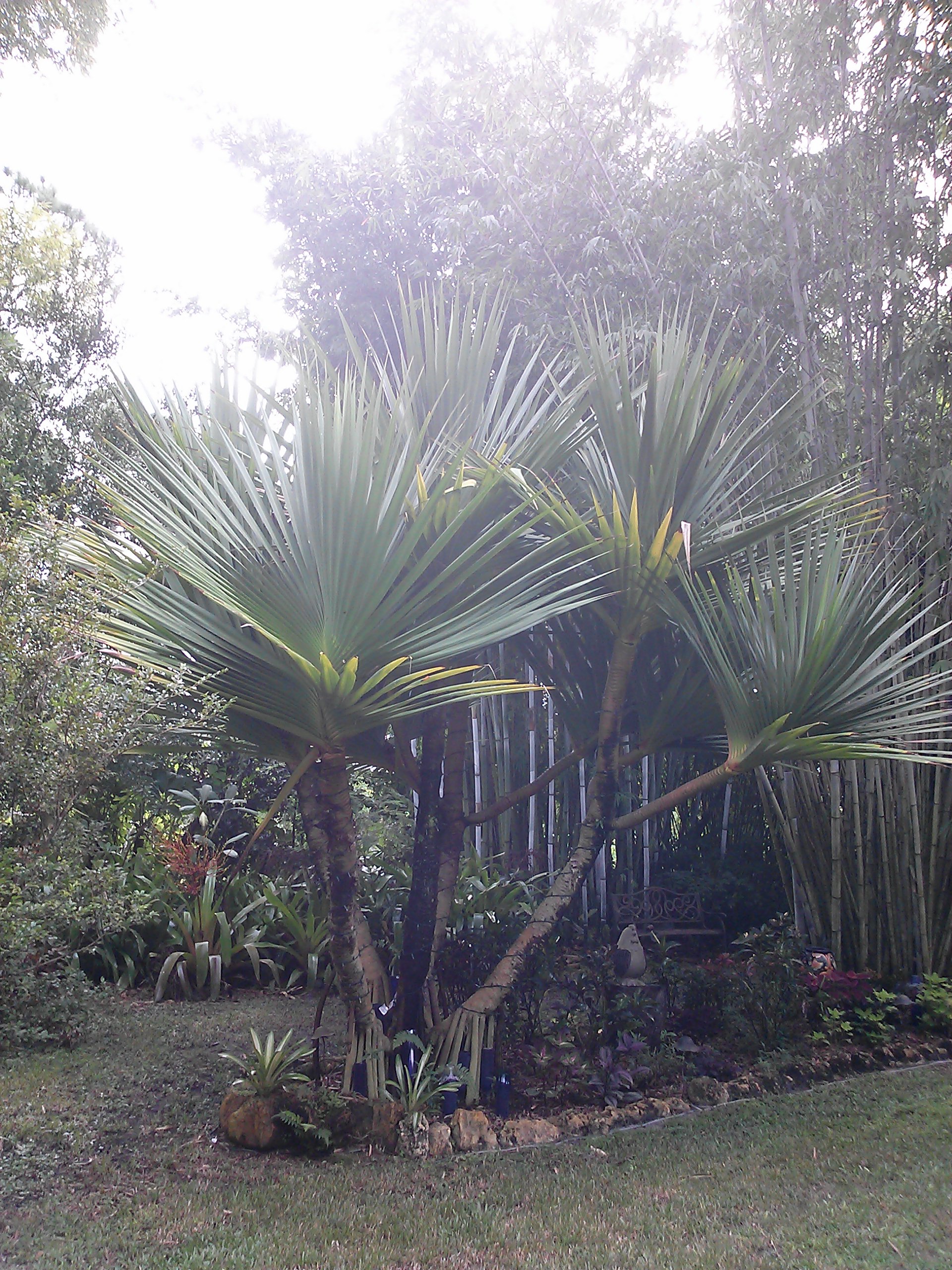
Hala

Hala 

Hawaiians call this Hala, it is used for everything from hats to huts, not native to Florida it will grow here. Floridians tend to call this Screw Pine, not sure why, it seems odd – when I first heard the term I thought it was some weird tropical version of a Japanese Black Pine, not so. I have one in my garden, it is about 12″ tall, unlike this beauty.

And last but not least, another favorite, the Heliconia. I think it is some variety of Lobsterclaw. Another thing I am waiting for a flower from; I read the other day these shouldn’t be pruned or you cut the flowers off. That could be my problem – excessive pruning. But, the plant is seven feet tall. Gardening teaches patience, right?

Heliconia

Heliconia

Bromeliad update – Matchstick and Aechmea idon’tknowwhatitis

Pink Bromeliad

Pink Bromeliad

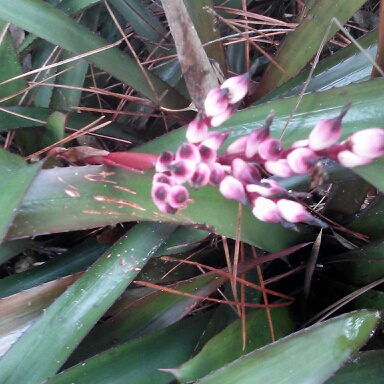
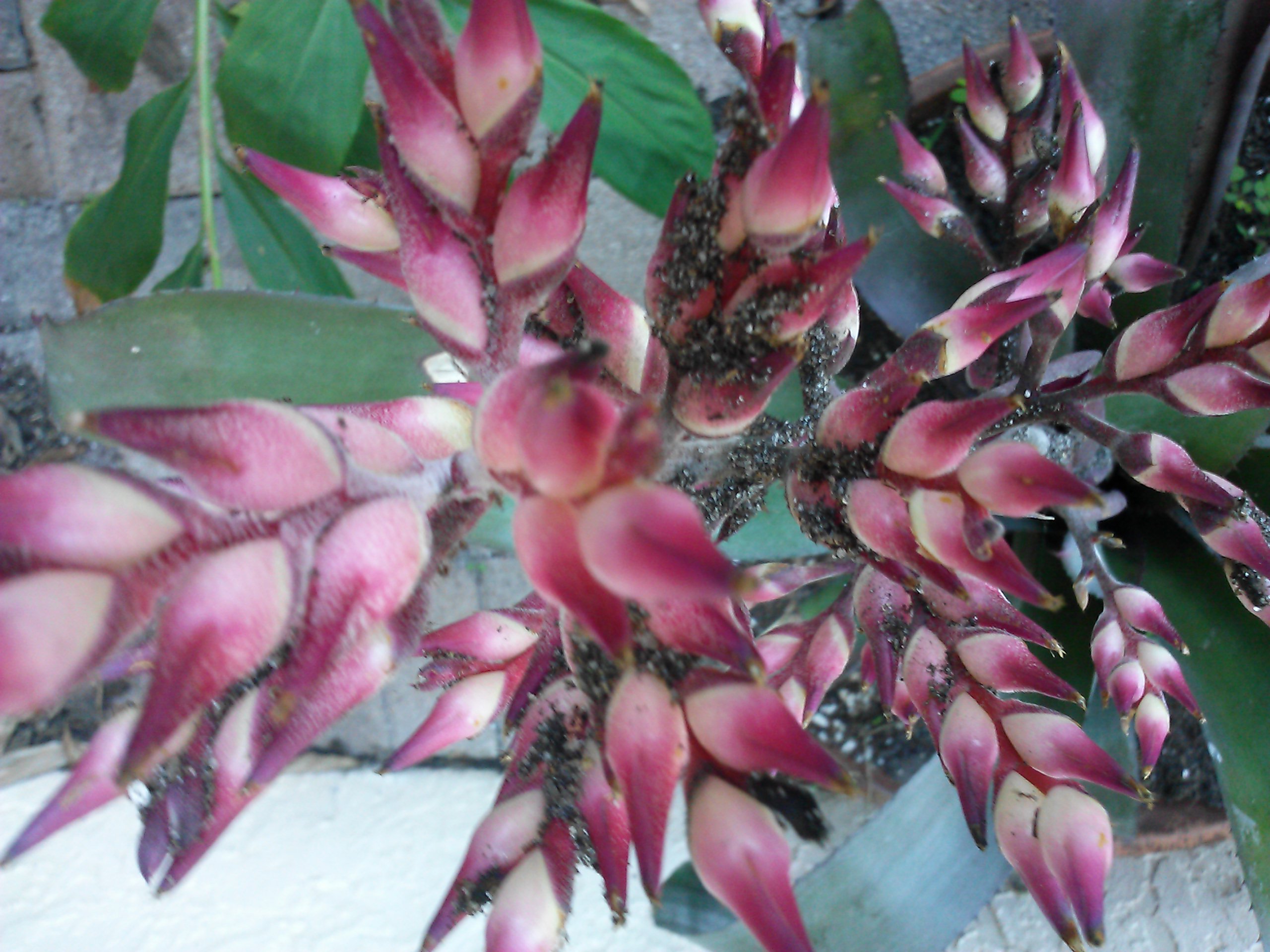
This is a close up of an Aechmea Bromeliad I bought two years ago. Totally pink and as weird looking as these things are sometimes. I used this in a an article that never got published. Being a cooperative plant it put out a pup and the mother plant died after hanging around for a while. I waited for the thing to bloom again and set in the ground in a relatively shady, sandy bed with some Bromeliad friends.

A month or so ago,  it started sending up a stalk -yes, it looked like a girl power corn cob.

Second Generation Pink Bromeliad

Second Generation Pink Bromeliad

I am calling this Aechmea idon’tknowwhatitis because the guy I bought it from did not know either. And there are a zillion of these things and from this I guess that they are not clones from the mother plant.

Here is a close up of the flower from Second Generation

Pink and Yellow Bromeliad

Pink and Yellow Bromeliad

Curiouser and curiouser, this flower just stays pink and yellow and has been around for a couple of weeks now.

An additional Bromeliad note, the Matchstick Bromeliads I planted in nearly full sun have all burned up with the exception of one that looks great. So, take the ‘this one likes the sun’ advice with a grain of salt and try a little shade.

The Sustainable Garden: Perennial Thoughts

I perennially have thoughts about flowers. In terms of sustainability I am not sure the native ones are always best. Many of the natives are simply weeds with attractive flowers or characteristics we like. I have a deep respect for Black Eyed Susan from a previous experience – as in being nearly overrun by them. I used to live in their native habitat and had bought some “improved” Goldstrum Variety and they bolted back to their native selves and then ran amok on a well drained sunny hill. A recipe for landscape disaster. As beautiful as they were in full bloom, it took a long time to get rid of the Black Eyed Susans. I could not cope with their joyful abundance anymore. So easy on the natives and seek those that do well in your climate without too much water and too much abundance. Easier to take care of and maintain.

In South Florida irrigation is a big deal. We have a rainy season and a dry season. While there are many native plants this is a tropical climate and some of them can go wild. I have found some escaped houseplants in my yard going wild. Mother in Laws tongues is an invasive species. Many plants commonly grown here will not survive without irrigation. I chose not to irrigate my entire yard to save water and to save my sanity. The areas in lawn and vegetables are irrigated; areas with lower water perennials are drip irrigated and I have some unirrigated low maintenance areas that I still want to plant with beautiful perennials. I am just looking at things a bit differently. So, I am paying close attention to who I am inviting to live in my garden.

Beach Sunflower

The Beach Sunflower from Wikipedia

I am about to plant some Beach Sunflower in an unirrigated portion of my garden, I live on a sand hill and these are native to our area – I believe if I planted them in an irrigated area I would be overrun in short order. So, it is time for some more garden experimentation. The Beach Sunflower is going to look great with the existing Blue Agave, Red Martin Bromeliad and Painted Fingernail Bromeliad. Eventually providing shade is a native Gumbo Limbo tree; if that doesn’t get you in the mood for a Margarita nothing will. All these plants are extremely drought tolerant and will survive without regular irrigation. The Gumbo Limbo and Beach Sunflower are native, the Blue Agave is from Mexico, and the Martin and Painted Fingernail Bromeliads are Neoregelia type Bromeliads that originated in South America.

Painted Fingernail Bromeliad

Painted Fingernail Bromeliad


Martin Bromeliad

Martin Bromeliad

Blue Agave

Blue Agave

It seems strange to me that Bromeliads, in my mind a rainforest plant, would thrive in the sun with little supplemental water, but they do. The Painted Fingernail Bromeliad is a passalong plant around here and I have seen large masses of it planted around mailboxes on the side of the road. A great example of a not native plant working in a sustainable way. The result of my selection of plant material is an evergreen perennial bed that blooms or provides year round color while being very drought tolerant and using very little fertilizer or maintenance.

Sustainability is about more than native plants – it is about selecting the right plants.