
Wordless Wednesday – Spring Flowers/Tropical Style
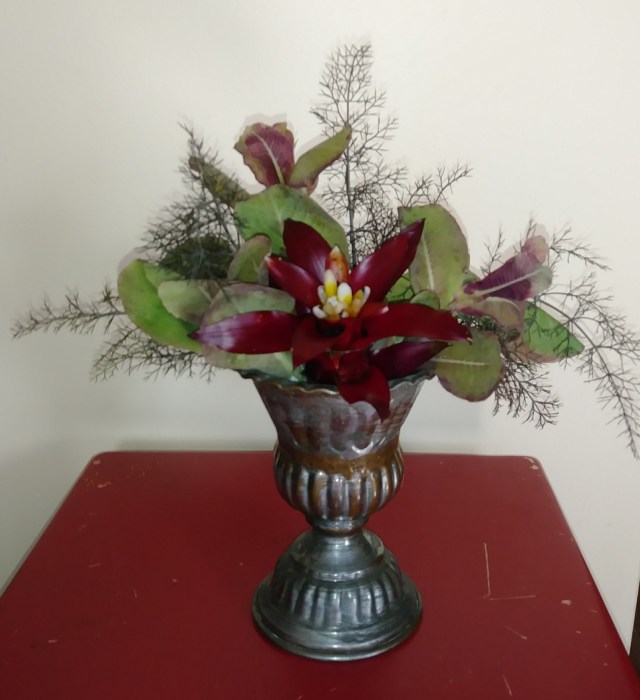
Winter in South Florida (or as I call it, Not Summer) is winding down. As I was planting my last crop of vegetable seeds, I noticed the lettuces fading and bolting. I grew Red Romaine lettuce this winter and was surprised to see how pretty the flowers are. While picking them, I could tell by the scent that the Romaine had turned bitter, no need to taste it. Even the rabbits have quit eating it and turned to munching on my Bromeliads and eating the old green beans.
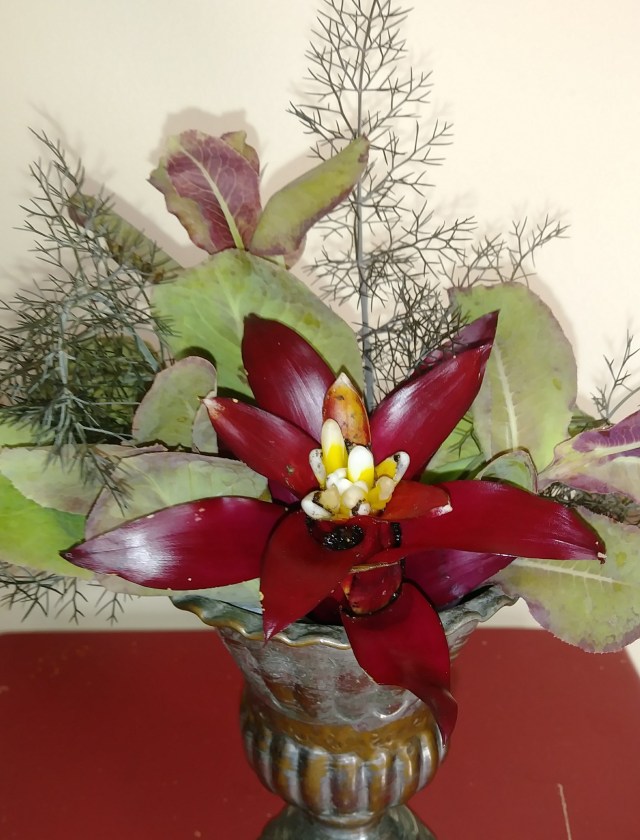 Another surprise in the garden was the emergence of 5 flowers on a Guzmania Bromeliad I left in a container for a little too long. I did not know Guzmanias would even put out multiple flowers, so I cut one since it went so well with the Romaine.
In keeping with the salad theme, I added some Copper Fennel (Foeniculum vulgare) to the arrangement. The vase is a junk store silverplate heirloom from my mother, gaining patina (rust) with every use.
Here is the Papaya update: More surprises, six fruit so far. I think there will be more.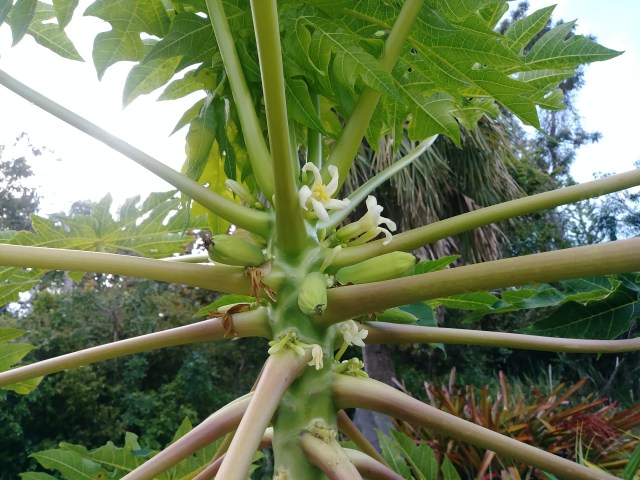
I first encountered Bromeliads as houseplants in the 1980s. Winter Gardens, Atrium and Interiorscaping were popular indoors in Shopping Malls and Office Buildings. At the time, I worked for a large Architectural firm as a Landscape Architect and designed these gardens using flowering Bromeliads as color beds in large planted areas. The Bromeliads I used primarily in these indoor plantings were Aechmea fasciata (left) and Guzmanias on the right.


Many years later, my husband and I relocated to the Treasure Coast of Florida. I was excited to learn about all the Bromeliads I could use in my garden. Houseplants rule the outdoors in South Florida. Now I have Guzmanias and Aechmea fasciatas in my garden.
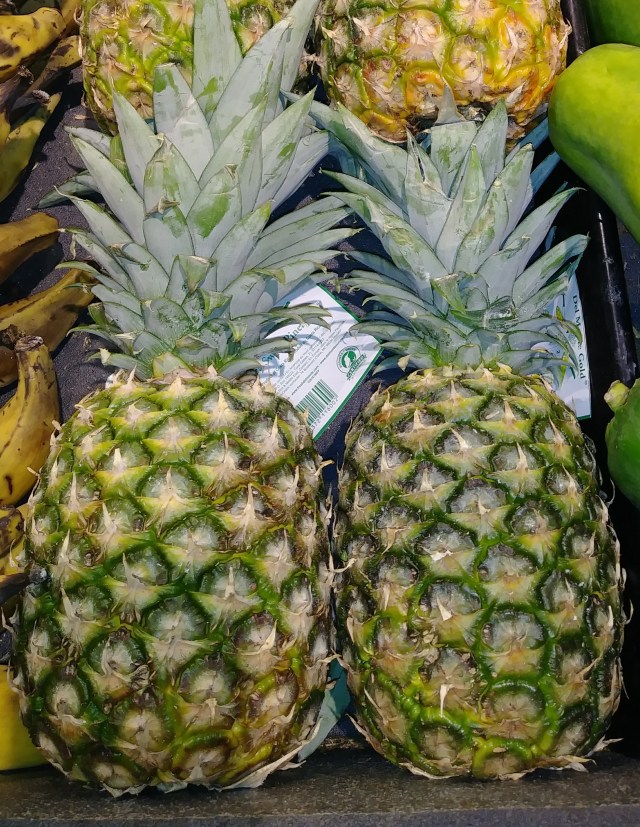
Bromeliads have a broad range of appearance. They range from highly colored foliage with flowers prized in our gardens to Spanish Moss hanging from Oak trees common in the Deep South. Bromeliads may also be found at the supermarket in the form of a Pineapple. Some are epiphytes living on trees (Spanish Moss) others are considered terrestrial and root into the ground. Bromeliads use specialized cells to collect water from the air, they also use cups to collect rainwater and derive nutrients from debris collected in the cup.
While we have several native Bromeliads in Florida (Tillandsias for the most part), most of the showy ones we use in our gardens are from further south in the tropical Americas, many of my favorites hail from Brazil. These are easy to grow, tough plants that lend a tropical touch to our gardens. I use them as the icing in the garden, like using flowering perennials further north.
Being of different origins than most perennials, Bromeliads require a bit of understanding-the plant originally purchased eventually will flower and die. This is called the mother plant generally. The mother plant flowers then begin to decline; offshoots called pups then appear around the plant. Pups can be left in place around the mother or clipped off when they reach a third the size of the mother plant. Pups removed may be replanted and usually require staking or a rock to hold them in place until they are established. Aechmea ‘Chiantinii Surprise’ with pups.
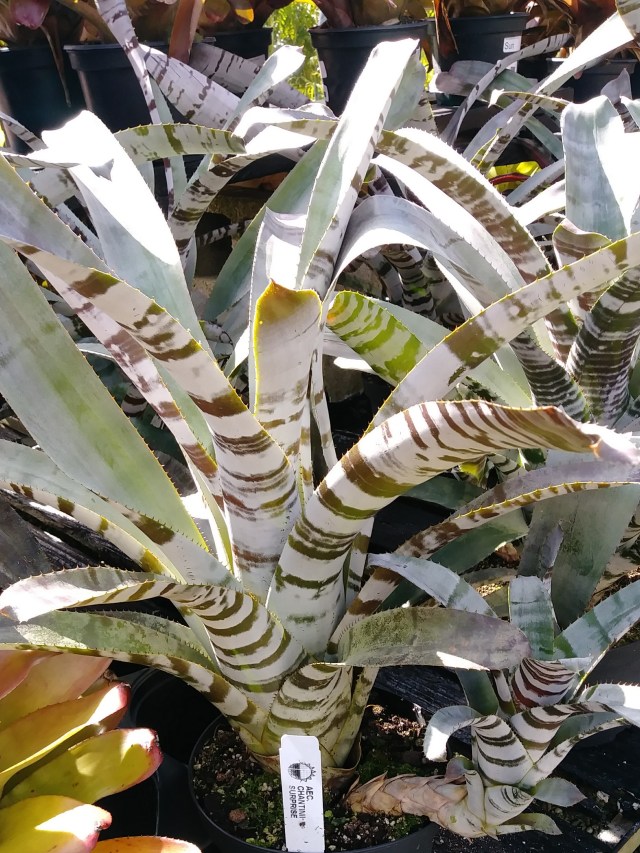
Chantinii Surprise
My transition from a houseplant tender to the garden Bromeliad enthusiast had a bit of a learning curve. Soon after moving to the Treasure Coast, the very common (here) Blanchetiana Bromeliad began blooming around town. Being a burgeoning fan of the garden Bromeliad, I nearly wrecked my car trying to get a look at the thing. Orange foliage, nearly as tall as I am with a red and yellow spike flower of a similar size. No longer in houseplant territory- this was some serious vegetation!
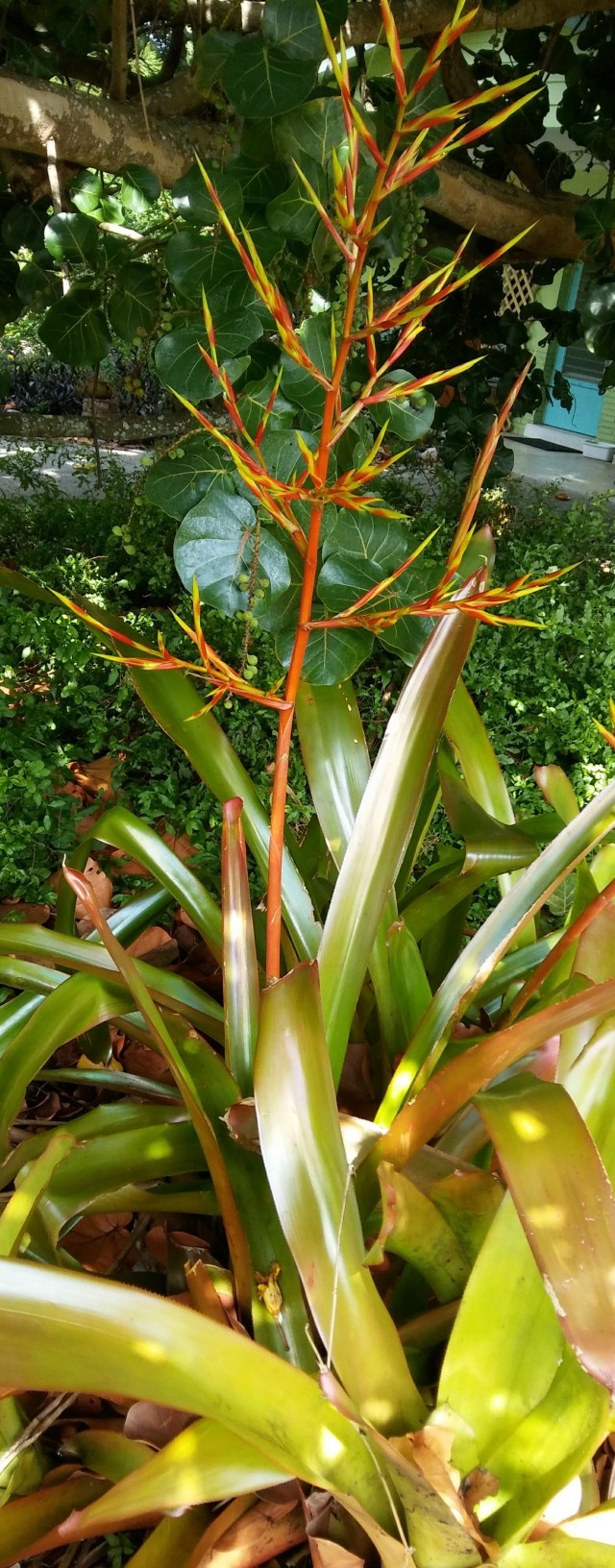
Now I make wreaths during the holidays from the flowers:

Seeking advice on the needs of these plants proved to be elusive and I began to just plant them. If someone said it needs “some sun” – this means it really needs partial shade. I charco-broiled more than one plant seeking the “some sun”. There are some reliable full sun plants; finding the right plant for the right spot is key.
Some favorite sun Bromeliads:
Some favorite shade Bromeliads:
Another key to success with Bromeliads is planting them during the proper time of year. Dividing and installing new plants in your garden should be done between November and March, the reason, to allow the plants to slowly acclimate to the sun – the sun angles in South Florida are dramatically different between summer and winter. Some of the more sun tolerant ones may be planted year round. Landscape beds near a north facing wall can be the full sun in summer and full shade in winter.
Design tips:
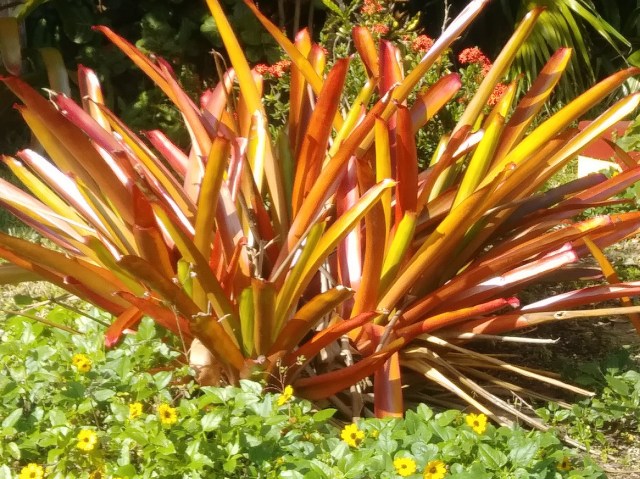
Consider the big Bromeliads exclamation points in the garden, use sparingly. Everybody can’t be the star. Even stars need a chorus. This is Aechmea Blanchetiana in a pool of Beach Sunflowers (Helianthus debilis)!
Restrain the color palette to three colors. My favorite color schemes are:
In shade to partial shade: Colors and varieties
Red/Green/Burgundy – Neoregelia ‘Maria’, Neoregelia ‘Angel Face’


Good companion plants: Coontie Palms, Ferns
Gold/ Green/ Salmony Red: Vriesea ospinae ‘Gruberii’, Neoregelia ‘Super Fireball’


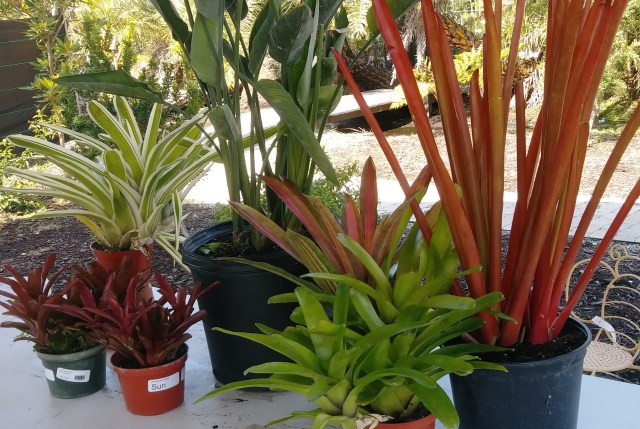
Combination of orange, red and green for sun; named from left to right
Neoregelia ‘Fireball’, Neoregelia ‘Bossa Nova’, Bird of Paradise (not a Bromeliad), Aechmea ‘Alvarez’, Aechmea ‘Red Candles’
The Bird of Paradise is shown as a companion plant example.
Bromeliads also make great container plants. Here are a few examples we put together at Pinders Nursery in Palm City, Florida for a talk I gave (about Bromeliads!) last Saturday. These container plantings last a long time, until the plant flowers or you need a change of view.
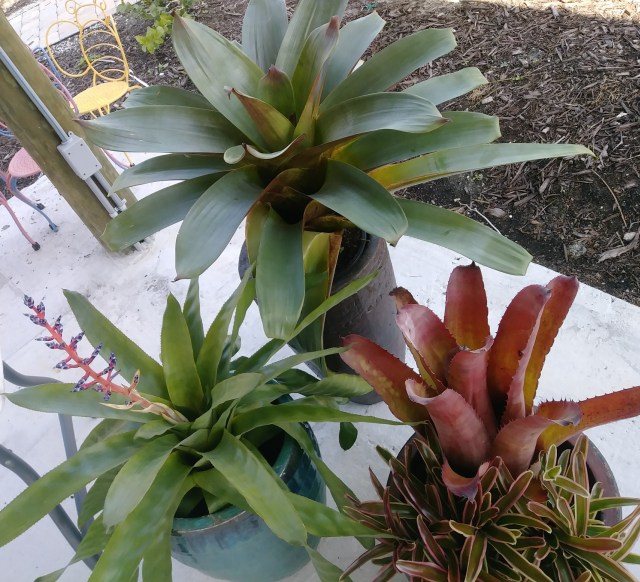
Plants are: in back ‘Imperial Red’ Alcanterea (for sun – these bloom every 10 years), in the blue container for shade, Aechmea ‘Del Mar’, the brown bowl has Aechmea ‘Bracteata Red’ and Neoregelia ‘Donger’ would take Sun.

I am bidding farewell to a flower from my Blanchetiana Bromeliad that has served me well. It opened at the end of November, I enjoyed if for a couple of weeks, then used part of it to create a wreath for Christmas. On Saturday, I cut the rest to use as part of a talk I gave about Bromeliads in the Garden.
The wreath is still on my door and has dried to a nice brown, I am still mulling whether to get rid of it

The frond in the arrangement is from a Chinese Fan Palm (Livingstonia chinensis) seedling that popped up between me and my neighbor. It gives a really tropical vibe to the area, so I left it. I figure I will long gone before it reaches full size (60 feet!) Odd for winter in South Florida, it has been raining since yesterday afternoon. The vase holds about half of the frond, I went out in the pouring rain with Loppers in search of a bold bit of foliage to contrast with the Blanchetiana flower (at least 3 feet tall). Upon lopping the frond, I spied a wasp nest in the other half. For whatever reason, the wasps were not bothered by me and I left the other half of the frond where I found it, ensuring no homeless wasps and hoping for beneficial wasps. I cut the frond in half again – one quarter is hanging over the edge and the rest is in the vase upright.
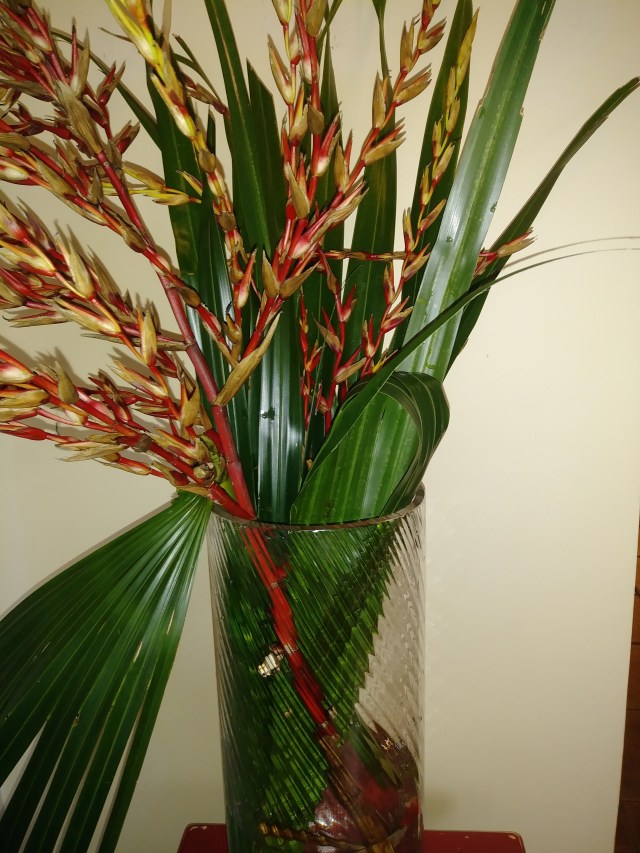
Farewell, fine Flower.

This afternoon I have been glued to the television watching Hurricane Michael make landfall about 500 miles north my garden. The sheer size of these storms always amaze me. I can feel the hot breath from Michael flowing through my garden if I step outside. Praying for those in the storm’s path.
Earlier this week I went plant shopping – heading south to the numerous nurseries supplying South Florida. Much of the plant material grown in this area is too tropical for my garden, though I enjoy looking. This is ‘instant effect’ plant material, the above Heliconia is about 15′ tall – prices are not displayed.
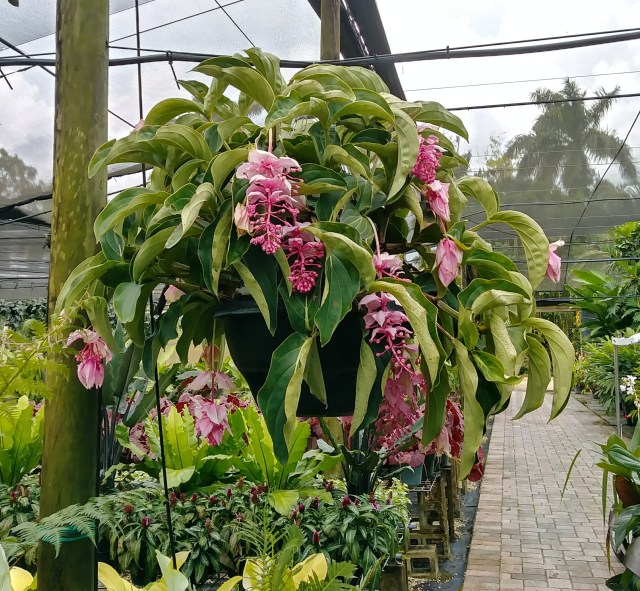
This is a hanging basket filled with Medinilla myriantha, 3 or 4 feet wide and tall. These plants are famously difficult to keep. Usually a very expensive flower arrangement.
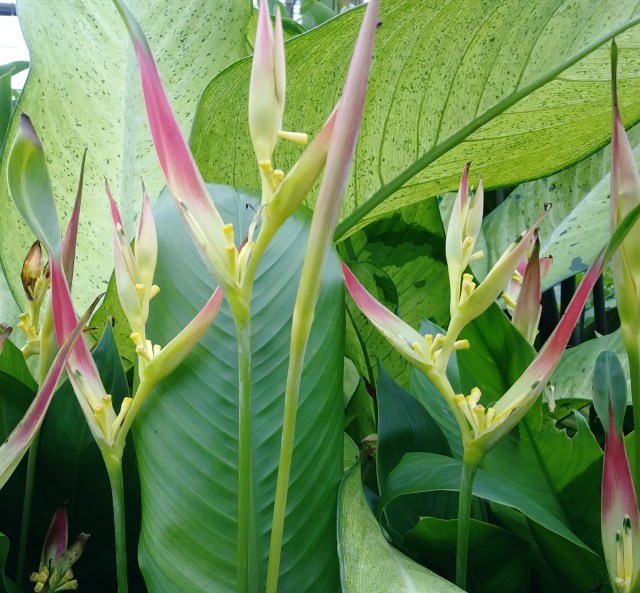
This is a pink and yellow unnamed Heliconia psittacorum. I could probably grow this one, but couldn’t lift the container it was in!

Huge, grey Bromeliad.

A Starfish Plant, variety lost to me.

Tiny Aloes.
I bought nothing at this nursery, but gained an idea for a palm tree with boots I was planning to remove (growing into power lines)
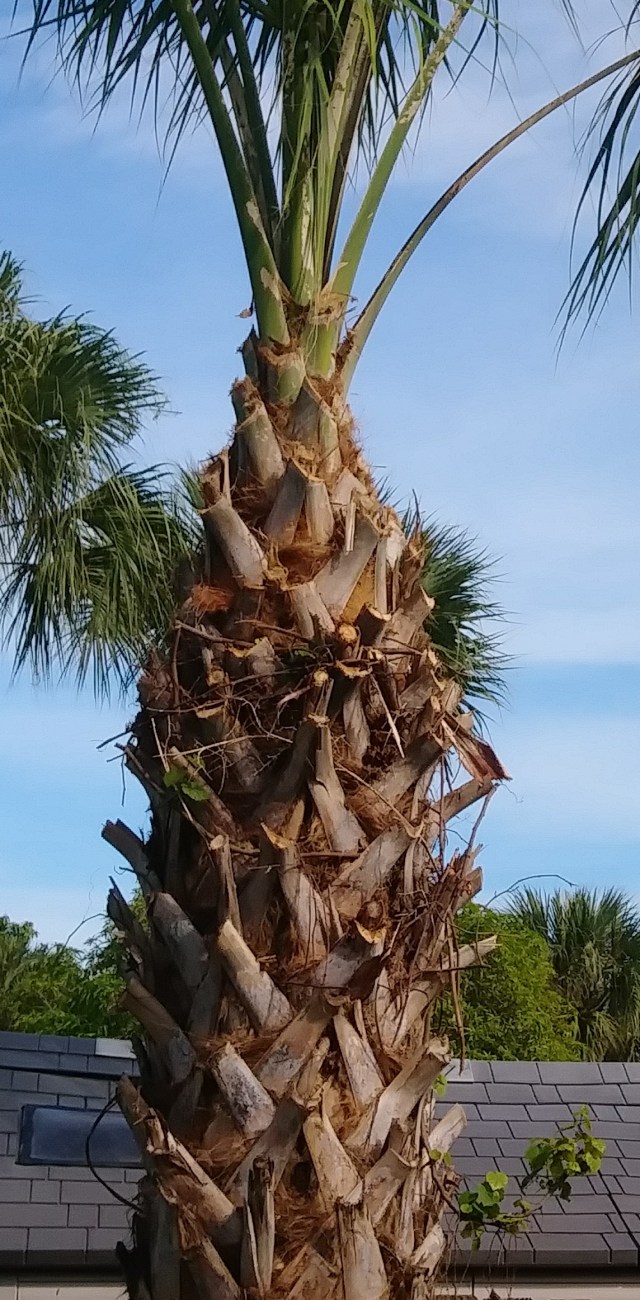
I can have the top removed and keep the trunk, then tuck Bromeliads, Ferns and Orchids into the pockets left by the boots. Like this:
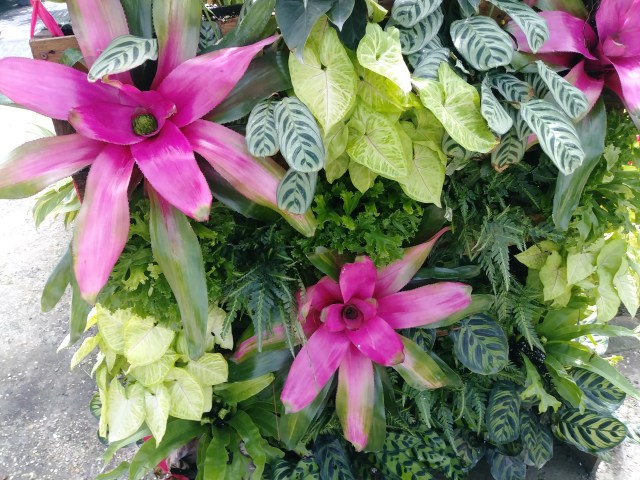
A stumpery – in tropical mode.

I am aware I have been, well, complaining about the extreme subtlety of seasonal change in South Florida. As I was putting this arrangement together today, I realized this really reflects the seasonal change in my garden. As the weather cools, a few more plants produce berries – other plants flower. With the exception of the varigated foliage (which is year round and (I know, weird) a foundation plant. The balance of the arrangement is what comprises fall color in South Florida.
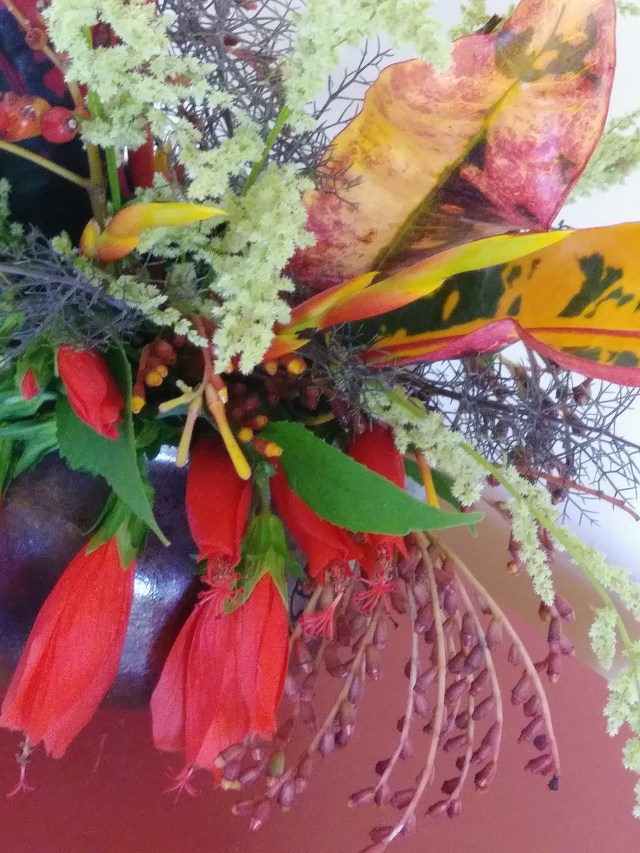
The red flowers anchoring the arrangement are Turks Cap (Malvaviscus penduliflorus); the berries are from the Firebush (Hamelia patens); the off white flowers are Wireweed (Neverlearnedthe latin); yellow and red lobsterclaws, Bromeliad Aechmea blanchetiana flowers; dark foliage is from Copper Fennel (Foeniculum vulgare ‘Purpurea); amazingly still living after supporting several generations of Swallowtail Butterflies and my flower arrangements; varigated foliage is from Mammey Croton (Codieum ‘Mammey’)
Last weeks vase is still holding up and displays more of Florida’s actual fall colors.

Not bad for Desperately Seeking Seasons.

The garage sale Bromeliads continue to amaze me. The red flowers are from Aechmea miniata, a Bromeliad I stumbled upon at a garage sale a few years ago. Five bucks is my limit for a plant unknown to me, as this one was when I found it. Bromeliads tend to run anywhere from 12 dollars for a small unnamed mystery plant at the Big Box stores to $100 and up for a named, big, lush specimen. The problem with these named, expensive plants is generally no one can tell you where they will grow “move them around til you find a place it likes” or “I think it flowers”. I am too frugal for this sort of nonsense and think if a plant is sold for prices like that you should get some reasonable directions. Or at least knowledge of whether it flowers. More Florida gardening nonsense. The market here demands nothing.

I have been trying to decide if the flowers look more like trees or broccoli. Neither, really. The flowers are crunchy and last about two weeks in a vase. The green swirling fern is a cutting of Asparagus Fern I twirled around the base of the Miniatas.
 The Miniatas are flowering madly and have been for a month or so. The tree that shades them got a fairly major pruning after Hurricane Irma last year. The normal olive colored foliage has burned from the sun (or lack of rain) but has been bravely sending up flower after flower. Time will tell what happens next should be interesting, the other Garage Sale Bromeliads are producing pups – I should have hundreds of dollars worth of Bromeliads shortly. Unfortunately, I hate having garage sales.

Sad news from my garden this week. I lost my sweetest, spotted Greyhound to bone cancer on Friday. Farewell, faithful Charles.

Charles
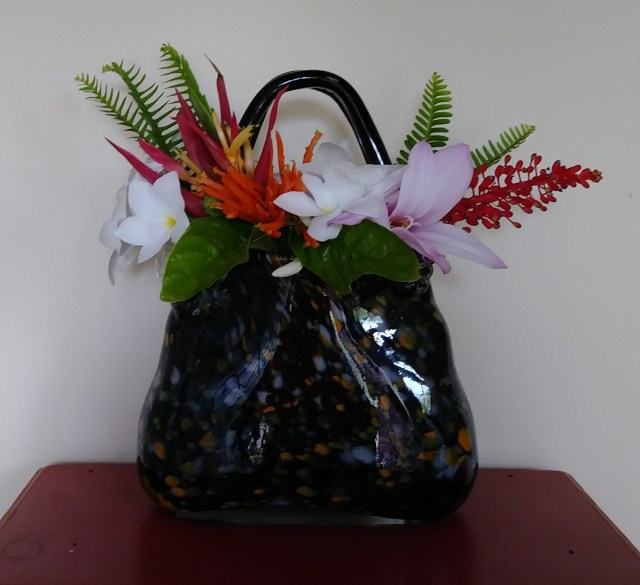
Zeus, I am told, is the Greek God of Rain. He gifted my garden with several gentle showers this week. I, in turn, was rewarded with flowers from my thirsty garden. The glass handbag was a thrift store find I happily filled with flowers.
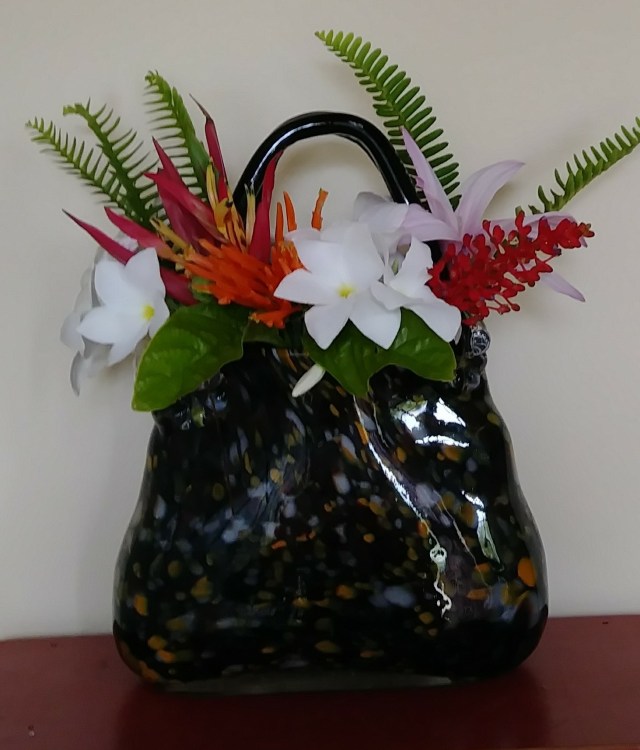
The white flowers are Bridal Bouquet Frangipani, made especially happy by the rain and flowering in earnest. I cut these to use in arrangements as they are very prolific, but a bit different in form from other Frangipanis that tend to be small, deciduous trees. These are a little more than a foot wide and planted to screen my neighbor’s fence. The fragrance is subtle, first thing in the morning when the dew is burning off the flowers – the scent (in front of my garage) divine. The foliage is also semi evergreen.

The rest of the flowers are:
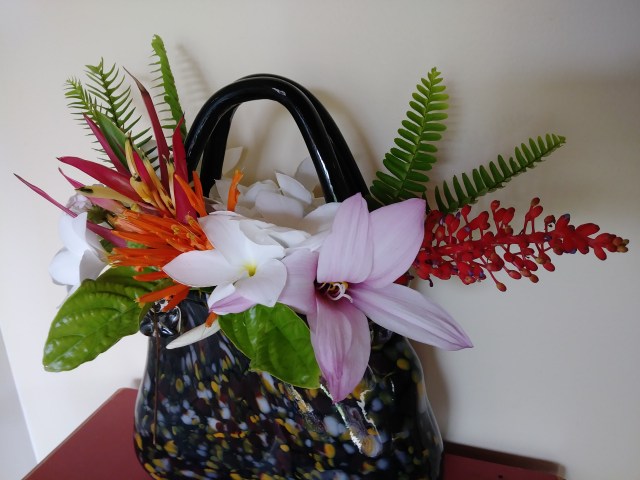
From the left side: in red and yellow Parrottflowers (Heliconia psittacorum); in orange, Mexican Bush Honeysuckle (Justicia spicigera); pink are Rain Lilies (Zephyranthes, no clue on species, but another Greek God); red flower, Miniata Bromeliad (Aechmea miniata, from last week). A few of my favorite indestructible ferns for accent.
Happy Gardening and I hope Zeus is kind to all gardens this week.
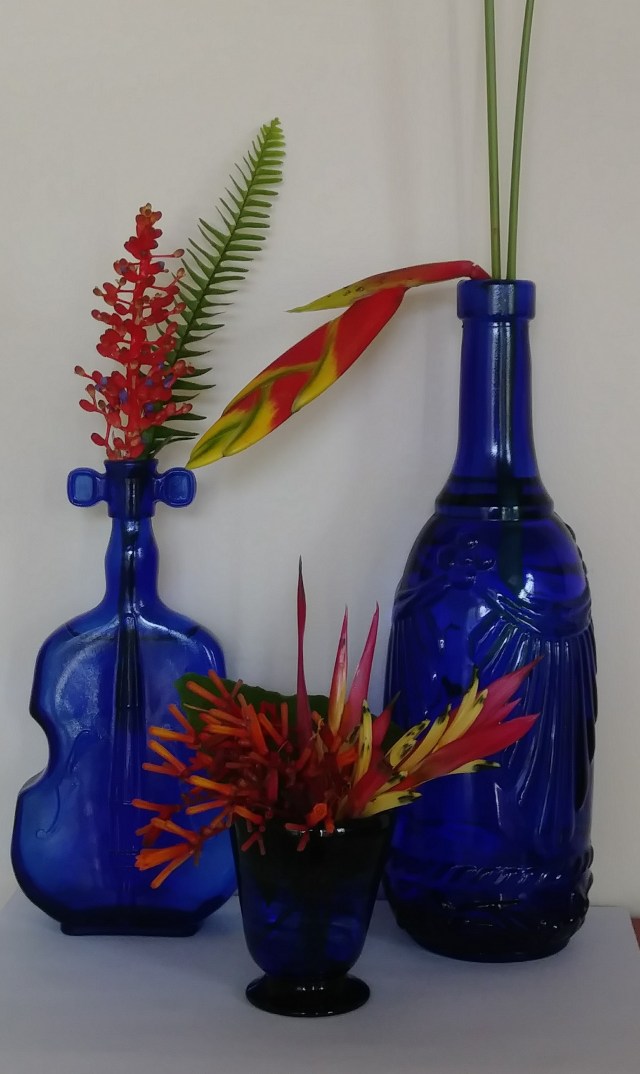
July in South Florida can give any gardener the blues. The temperatures have been in the mid 90s with a similar amount of humidity and it has basically refused to rain here despite the calendar’s insistence this is our rainy season. The tropical plants with big leaves are scorching, actually the weeds anywhere not served by our irrigation system are scorching, withering weeds incite a gleeful response from me and offset the gardening blues to a certain extent.
The summer blooming tropicals I have sited properly (always a good trick) are coping well and flowering, the others are, well, scorching. My blue vases are from the happy tropicals! The tropicals not getting quite enough water are really blue. And scorched.

The big red, green and yellow bud is from Heliconia rostrata, Lobsterclaw Heliconia. I decided to cut this just to see how long it will last. Waiting for the flower to open seems to shorten it’s vase life. It will be interesting to see if it opens as it usually takes a week or so to get this:
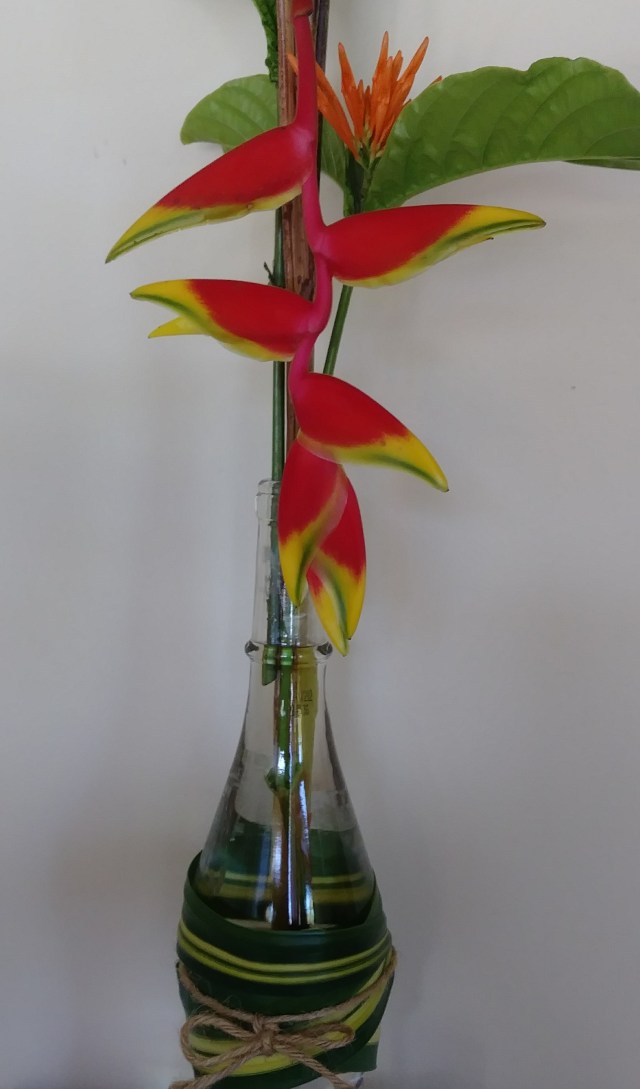
The small footed vase holds some Firebush flowers and Parrottflowers (Heliconia psittacorum) The Parrottflowers are having a tough year and seem a bit shrunken. Drought does not defeat Firebush here and they are feeding my butterfly brigade. Here is Zebra Longwing enjoying the nectar.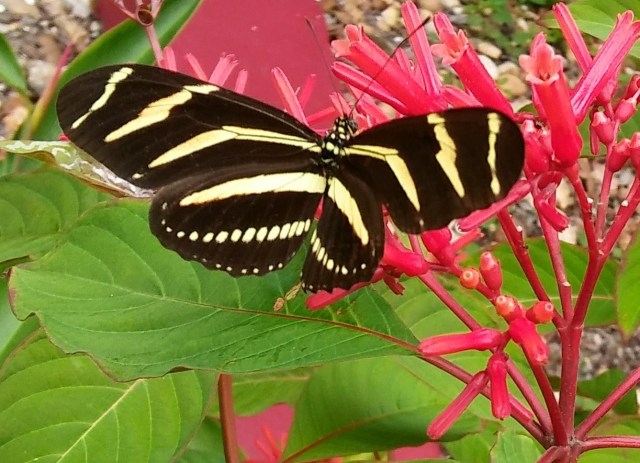
The blue violin holds a Miniata Bromeliad, the huge tree that shades this ground got a haircut from Hurricane Irma and yes, they are a bit scorched, but have graced me with a flower accompanied by a bit of Asian Sword Fern.

The blue vases are all heirlooms, the violin belonged to my grandmother, the bottle is from my mother and the footed vase belonged to my in laws. No one was scorched.
That I am aware of.


 The Shrub Queen