In a Vase on Monday – The Wildflower Blues


20160117_154405-1

I have been watching a group of Yellow Lupines on the edges of a vacant lot nearby – thinking I could collect some seed and grow Lupines in my back garden. What I did not realize is when the seed pods are ready they explode and hurl seed far and wide. The pods exploded in my car and didn’t seem to think there was enough dirt to grow in the carpets, though there probably is as I haul dogs and plants around with equal enthusiasm. I am not sure if these plants are native to the area, but I am aware of other native Lupines in Florida; it seems peculiar as I associate these plants with Alpine meadows, the Rocky Mountains and cold, arid places. Here is another view of my three blue vases filled with native and/or wildflowers from the vacant lot.

20160117_113625

20160117_111900-1

My blue vases represent three generations of women in my family, the violin belonged to my grandmother and has Yellow Lupines, the white spikes are Jointweed, the yellow daisy shaped flower is a Beach Sunflower.

20160117_114007

The tall bottle belonged to my mother and has Beach Sunflower, Yellow Lupines and seeds, background plants are Shrubby Buttonweed and Muhly Grass.

The corked bottle in the background belongs to me and holds the dried petals of all the roses my husband sent me during our courtship. The bells belonged to my other grandmother and are one of those touchstones that have been around the house as long as I can remember; my father brought them home from World War II.

As I was writing this post, it occurred to me how much more interesting and attractive these flowers appear in their Monday vase. So, I wandered over to the vacant lot and took a before picture:

20160117_163141


All the components of the vase are in the foreground. I think I like the flowers in their blue bottles better. This leads me to ponder if more people saw native plants in a vase instead of a vacant lot – native plants might be more popular.

If you would like to see vases from the world over, stop by the comments section of  https://ramblinginthegarden.wordpress.com where Cathy hosts In A Vase on Monday – every Monday!


It’s Winter Starburst Clerodendrum Again

Everybody in South Florida is talking about Winter Starburst again. This time of year the shrub bursts forth with a floral display like no other. The flowers eventually spread to about 10 inches across and the shrub itself can grow to 10 feet tall. A Winter Starburst Clerodendrum in full bloom is nothing short of spectacular. A bonus to the Winter Starburst is deep green coarse textured foliage with purple backs that look great year round.

My first January in South Florida I nearly wrecked my car trying to get a good look at this shrub and figure out what it was. It is a showstopper that resembles a funky tropical rhododendron. Here’s the scoop, the botanical name is Clerodendrum quadriloculare. These shrubs are native to Southeast Asia and members of the Clerodendrum genus of plants which encompasses vines, shrubs and vining shrubs. Given their viny tendencies these plants can be troublesome in our gardens, they can spread unchecked and lend either – overgrown or if you prefer, a cottage garden vibe to your environs.

The photos above are of my late Winter Starburst. It expired last year due to poor installation and maintenance by the owner. It is true that these plants need partial shade and moist soil until well established. As I live in Scruburbia (Florida Scrub – sand, not sandy soil) I did not take the advice to heart and prepare the soil or water regularly. However, having witnessed another winter display from this shrub, I think I will try another planting or three!

In A Vase on Monday – Postcards from the Edge

20160110_144418

I should call this ‘In a Cachepot on Monday’. This is one of my favorite containers, an antique Portmerion cachepot with Lilies in a deep burgundy russet color. I bought the cachepot on one of my many ‘junk store’ missions with my mother. It is sitting on my parent’s favorite marble table with a fish tile from another mission.

My husband’s father was a great collector of Christmas Cactus. When he passed on I inherited most of the collection. It took me awhile to figure out how to take care of them so this is the last survivor. I always feel like when this one blooms, it is Glenn giving me a wink and a smile from the great beyond.

Joining the Christmas Cactus are a bit of Blue Tropical Plumbago (P. auriculata) and some Sweet Begonia (B. alba) I have no idea what type of Christmas Cactus I have.

Hopefully it blooms a little longer.

In A Vase on Monday – Tropical Tussie Mussies

My mother always enjoyed making (really me making them while she watched) Tussie Mussies, she just thought they were ‘so cute’. I seem to have an abundance of not very long stemmed flowers so I decided to put together a Tussie Mussie or two.

20160103_105615-1


Tussie Mussie is a term for a small bouquet of flowers that has been around since medieval times, the Victorians used the selected flower type to send a message to the recipient of the Tussie Mussie. Each flower in the bouquet had a meaning. In reading the dictionary of flower meanings,  I found that Victorian England was not awash in the plants I have here in Tropic Florida. The only plant messages I could find in my Tussie Mussies are Dwarf Sunflower means adoration and Fern means magic. So, I am saying to you with flowers – I adore the magic of my garden. I can cope with that. Oddly enough, in Victorian flower dictionaries there were meanings for chickweed. If chickweed appeared in a flower arrangement I received, I would tend to think there was something wrong. The meaning from the dictionary – I cling to thee. Beware the man that sends chickweed bouquets.

20160103_105053-1

This arrangement is in a tequila shooter from my niece’s wedding; my tequila shooting days are long over but it makes a great little vase.

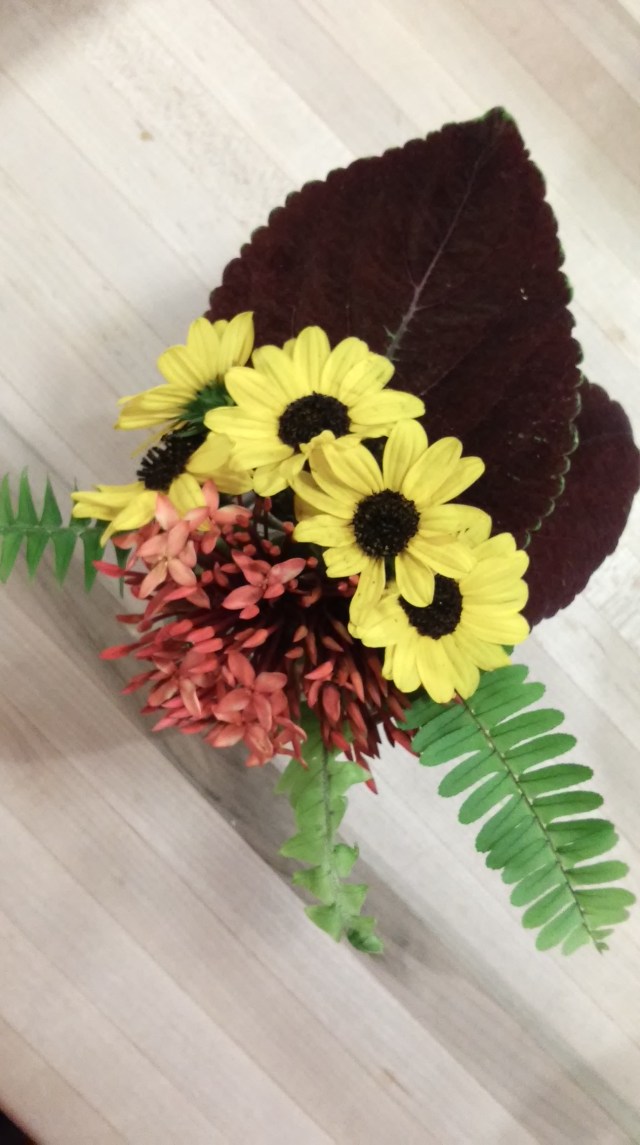
The plants are Turks Cap (A native mallow in Florida) the red flower, the darker red flowers are Red Shrimp Plant (Justicia brandegeana) a leaf of a Copperleaf (Acalphya wilkesiana ‘Raggedy Ann’) and a few Boston Fern fronds.

20160103_105447

I have a pair of tequila shooters, this one has a Dwarf Red Ixora, Beach Sunflower (Helianthus debilis), Coral Vine (Antigonon leptopus) and a backdrop of Hawaiian Snow Bush (Breynia nivosa)

Here’s hoping everyone is adoring the magic of the garden, this first week of 2016!

Piecrust Croton and Friends

20151230_153823

Piecrust Croton

I have been reworking  the design of my front yard because the access point for the septic tank was in a lawn area and actually needed access. What this really means is once a year a 3 foot circle in the lawn  is dug up and destroyed to clean the (ewww, yes) septic tank filter. The joys of country living. I am certain I did not know septic tanks had filters prior to moving to Florida. I also realized I would like to have a pathway to the side.

For many years I have advised my clients to live in their houses for a while to see how they move around the property as sometimes a good guess just really doesn’t do the trick. The upshot is I did not take my own advice and I like to travel to my side garden (ah, future garden) more than I thought I would. Design that originates with how you live in a place is always a good plan. This may be Plan B as I did Plan A. Who knew St. Augustinegrass wouldn’t be happy over a septic tank. Oh, well. I am liking the new bed thus far.

A nod to my husbands pie making skills was the purchase of a Piecrust Croton, a multi colored tropical shrub that hails from the South Pacific. These shrubs are easy to grow and ubiquitous in South Florida. There are a few stalwart standby varieties that are common, but of course I love the weird stuff.

Here are the standard varieties:

At the top of the post is the foliage of the Piecrust – it looks like, you guessed it, Piecrust!  The rest, clicking on the picture will give the name. Being the plant freak that I am, I couldn’t resist photographing several more interesting varieties:

I  love all of these, but I think Stoplight might be the next Croton purchase on my Croton bucket list. How many people have a Croton bucket list?

Yes, the beds are getting bigger. The good news is I probably have a quarter acre left!!

Back to the inspiration for all of this, the piecrust. Here are a few of my husbands pies:

I think these merit a celebratory Croton in the front yard.

Speaking of celebratory, Happy New Year to all.

In A Vase on Monday – New Years with the Natives

20151228_101640

The last vase of the year! My ode to Florida natives with friends from other places. The vase is a Christmas gift from an old friend, my college roommate and is sparkly blue mosaic. Neither of us are Florida natives.

The Florida natives in the vase are: Beach Sunflower (Helianthus debilis) the yellow daisy; Firebush (Hamelia patens) the tubular orange flower; Muhly Grass (Muhlenbergia capillaris) the pink feathery grass in the back. The non native friends are Solar Sunrise Coleus, chartreuse and burgundy leaf; Sweet Begonia (Begonia odorata ‘Alba’), the white flowers and a few pieces of Mother In Laws Tongues in the back of the arrangement (Sansiveria).

Here is a close up:

20151228_100355

I wish everyone a safe and Happy New Year! I have enjoyed comparing vases this year and look forward to next years bounty.

Treasure Coast Holiday Crafts

20151222_144818-1The Yuletide season arrives differently here on the Treasure Coast. In my neighborhood Santa arrives for a pre Christmas Eve visit driving a convertible strung with Christmas lights blaring  carols while he passes out candy. If you believe what you are seeing in the front yard light displays on Indian River Drive – The poem ‘Twas the night before Christmas would go more like this: after your stockings are hung by the chimney with care; Santa arrives in a sleigh driven by eight tiny Flamingoes!

I enjoy making things from natural materials for decorations during the holidays. While you can’t make garlands of fir in South Florida, there are many other wonderful materials that grow here and wash up on our shores for use in holiday arrangements and crafts.

As far as decking the hall with boughs of holly I have been using Florida Holly, the fruits of our much maligned invasive Brazilian Pepper. It should be noted that some people are allergic to this plant, it is a relative of Poison Ivy and causes the same rash – Mango trees are in this group of plants as well. So be careful.

20151204_155512-1

The Crystal Bowl above has Sea Grape leaves, Sea Grapes, Brazilian Pepperberries, Bridal Veil Plumeria and some Boston Fern, all from my garden.

20151219_125048-1

The wreath is mostly from my yard (Muscadine vines are overrunning the back of backyard and I repurposed some into a wreath form) The green globes are native Passionfruits (not edible and some refer to them as May Pops), some Brazilian Pepperberries and a few sprigs from our Christmas tree which I am relatively sure hails from the mountains of North Carolina.

A fun project for kids of all ages is to make seashell Christmas ornaments. Simply go to the beach, a fun project in itself, pick up some shells, rinse well with water and let them dry. Then find some glue that sticks everything together and get creative. Here are some of my creations:

20151222_144818-1

Most of all, have fun and Happy Holidays.

In a Bus on Monday

20151220_160007-1

Yes, it is actually a bus – it’s not just the crazy American blogger. This is a good sized biscuit tin repurposed as a vase. The tin was a gift to my husband from an English friend, I am not so sure about Scottish Biscuits but I love the container. The arrangement is a bit of a contraption as I wanted to save the tin-I like tins. I cut down four bottled water containers and arranged the flowers in them (inside the tin) Here is another view:

20151220_161045-1

As for the plant material, the burgundy foliage is Copperleaf, Acalypha wilkesiana, the big green foliage with white flowers is Sweet Begonia, Begonia odorata ‘Alba’ ( I can occasionally catch the scent of these, but it is very subtle) the berries are Brazilian Pepper, grey spikes are flowers of the Flapjack Plant, a variety of Kalanchoe, and as always a bit of Boston Fern.

Happy Holidays to all and Thank You to Cathy for hosting.

20151219_125048-1

Here is my front door with a wreath made from materials from my garden and a bit of our Christmas tree. It is composed of grapevine from Muscadines, Brazilian Pepperberries and Maypops (the fruit of the Passionflower – native to most of Eastern American) There are bits of Frazier Fir from our Christmas tree.

I think Santa will be able to find us now.

Merry Christmas from Amy, Alan and Charles the Greyhounds.

CAM00720-1

Charles

20151213_162756


In A Vase on Monday – The K.I.S.S. Concept

20151209_124910-1

The Monday Vase

This crystal vase was given to me by my late brother many years ago for Christmas. I know he would like it that I am using it for arranging flowers, especially during the holidays.

This is simply an arrangement of Heliconia psitticorum with its foliage and a couple of Boston Fern fronds for texture. Parrot Flowers they are called in many places. They actually do remind me of Parrots, kind of.

I attended design school about thirty years ago, Ouch! And one of my teachers favorite saying was “use the KISS concept”. This did not involve the Rock n Roll band or any crazy makeup.

It was Keep It Simple Stupid. I can relate on some levels but simple has limitations in gardening. Deep thoughts, I need to work on my Christmas tree:

20151213_162756


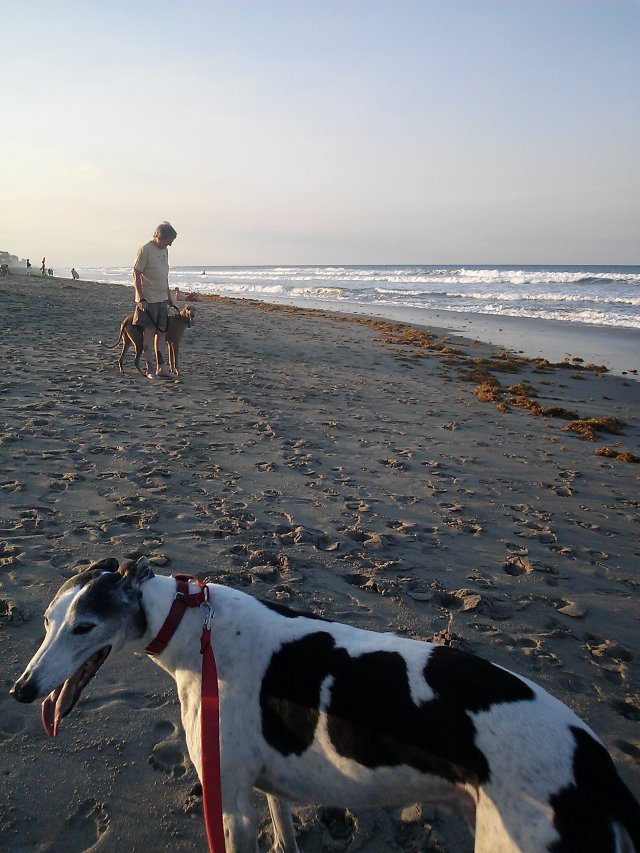
Here is my retired racing Greyhound Alan helping and wishing everyone Happy Holidays!


Bolivian Sunflowers

Bolivian SunflowerBolivian Sunflower

I have been noticing these plants for the past few years and it always seems weird to me to associate Sunflowers with December. Gigantic Sunflower Shrubs, at that. I also assumed incorrectly they were some sort of Helianthus. Not the case, this is a Tithonia, Tithonia diversifolia – the Bolivian Sunflower. In another perversity of plant naming, the Bolivian Sunflower is native to Mexico and Central America. I am fairly certain Bolivia is in South America. This could be explained by the fact that the name Mexican Sunflower is already taken from a small perennial, another Tithonia.

The Sunflower HedgeThe Sunflower Hedge

A neighbor has a hedge of Bolivian Sunflowers screening the backyard. This Sunflower hedge is at least 12 feet tall and in full bloom right now. This plant grows foliage Spring and Summer and flowers through most of the Fall and Winter. It has just really started blooming in earnest and should continue for a couple of months. Another one of those kooky benefits of living in South Florida, Sunflowers all winter.

As this plant has the potential of attaining a height of 16 feet and bears 6″ flowers profusely, I imagine it can put out quite a few seeds and offspring could become a problem. I am not sure I would try planting a hedge, but maybe installing one or two to screen a view where the lawnmower will run over any nearby seedlings. One has to practice selective lawn mower placement of plants in South Florida, if there is any question of overabundance. No winter frost has meant nothing ever dies. Or anything you want gone refuses to die.