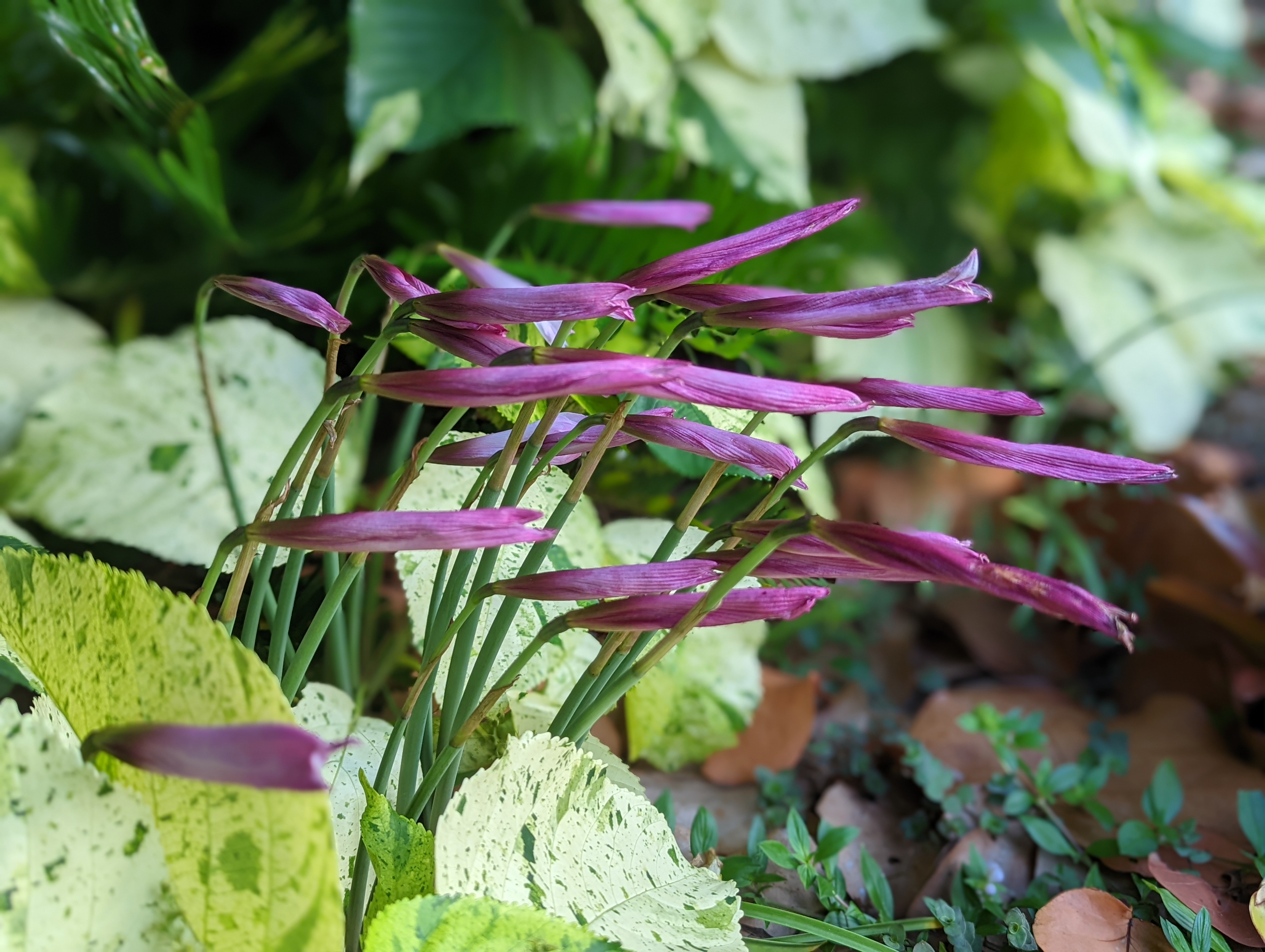
Unlike humans or maybe it is just me, flowers on tropical plants can look great for a long time, aging well. Above, the fading flowers of the relatively ephemeral Tropical Rain Lilies (Zephyranthes robusta). I enjoy these in the garden, the pink flowers celebrating rain. Here they are new:
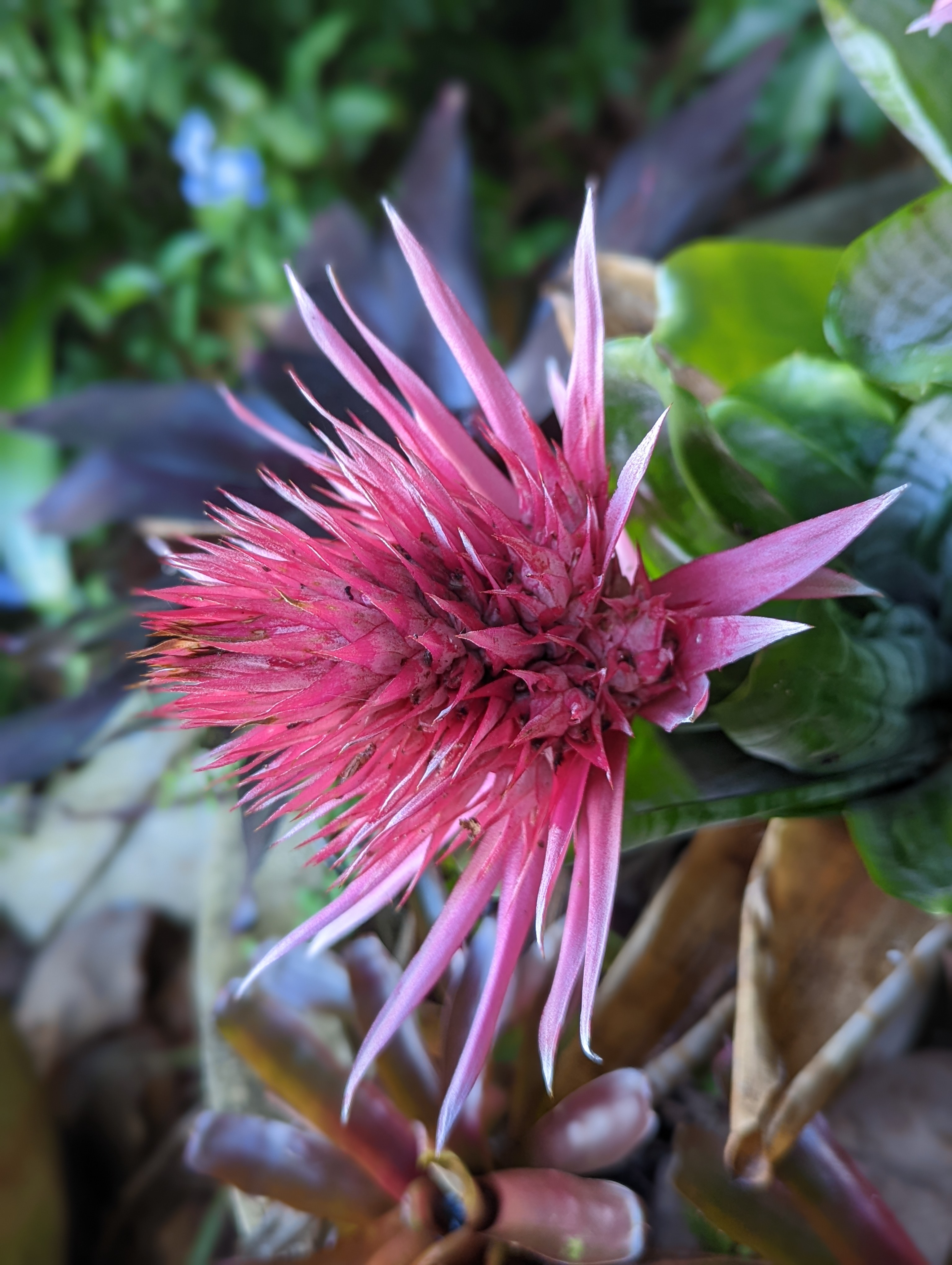
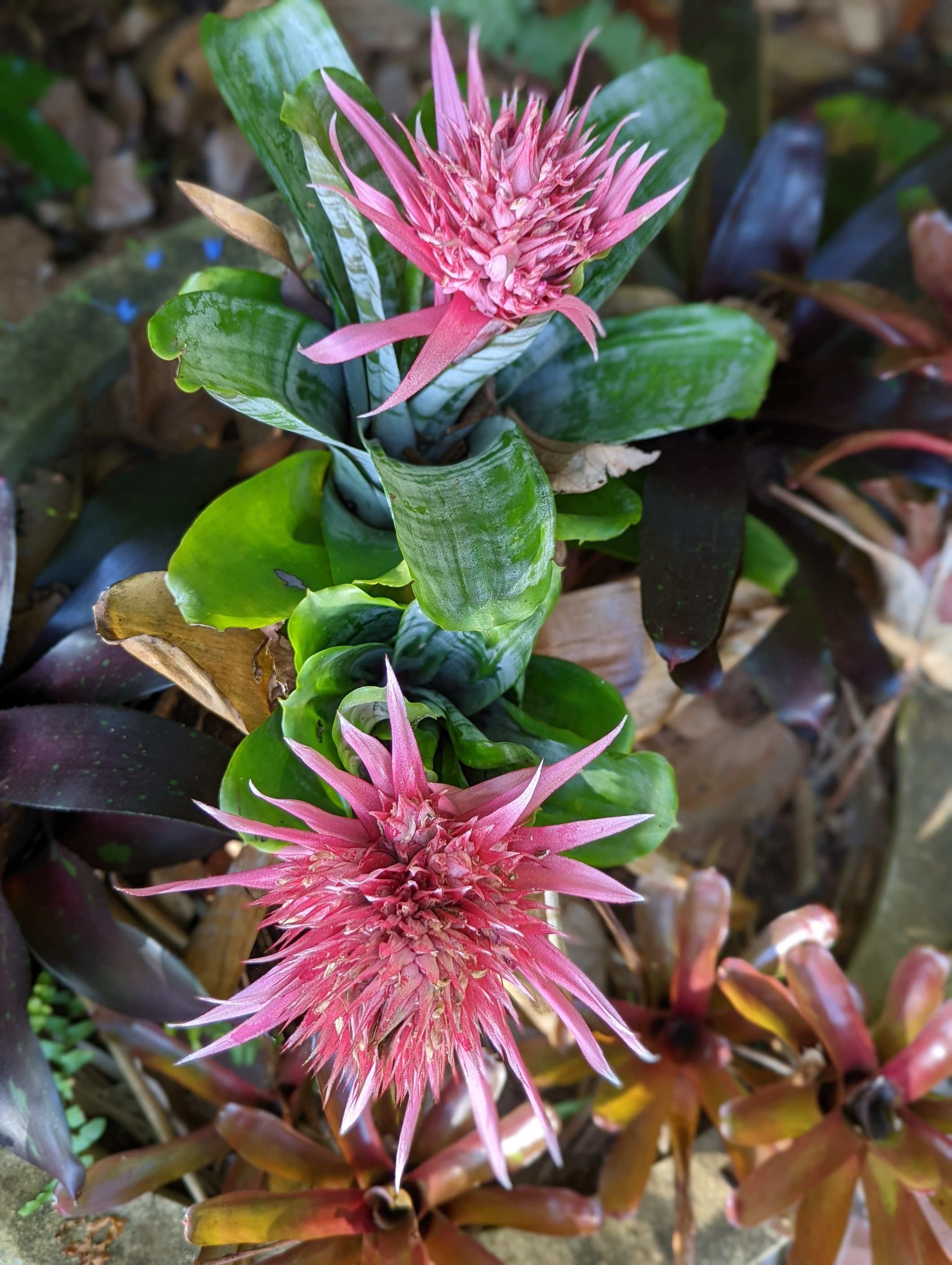
The Silver Urn (Aechmea fasciata) flower opened about a month ago. Here is it today, the pink is a bit faded, but it is still a showstopper.
The opening flower:
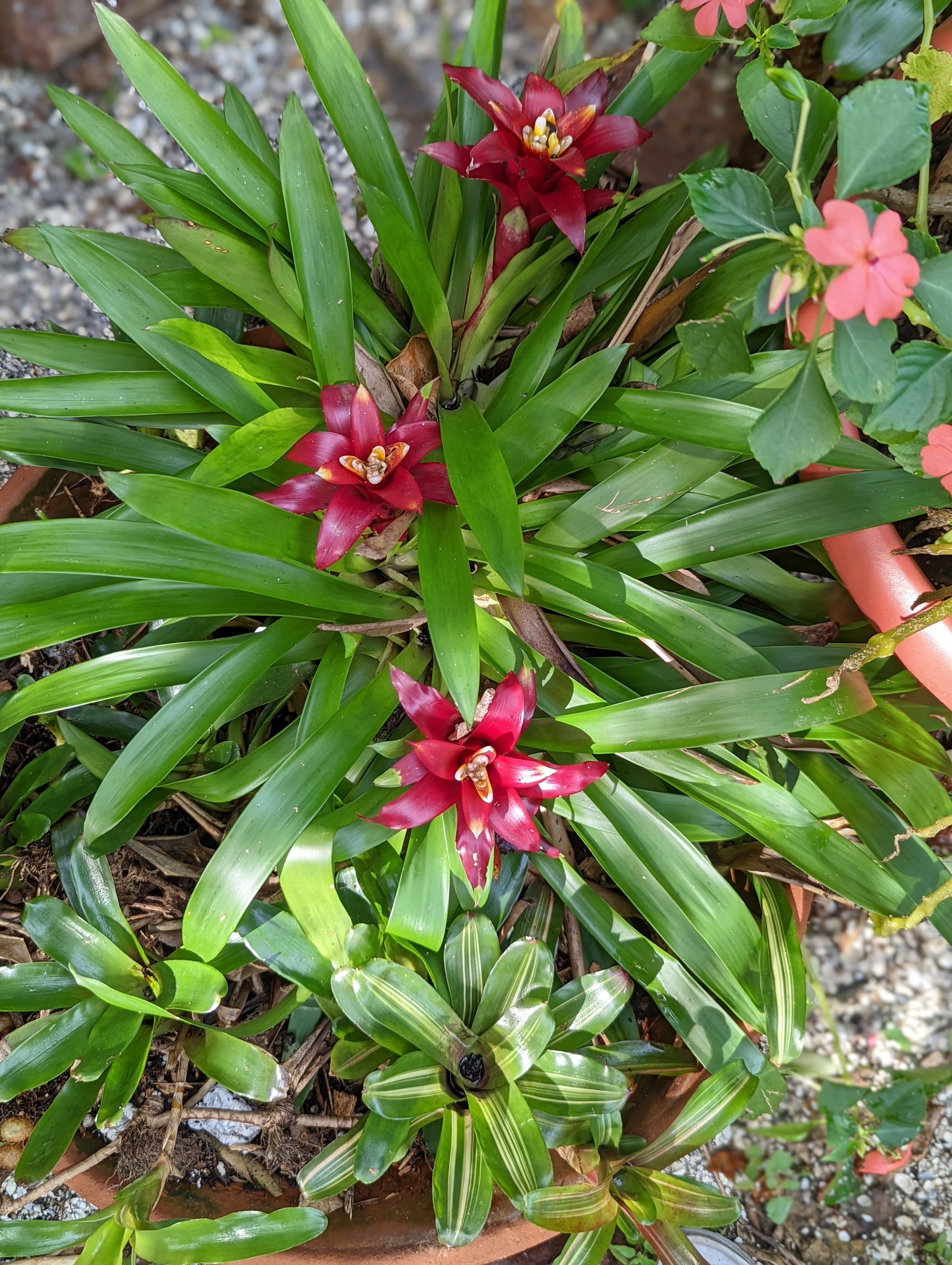
Guzmania Bromeliads are another long lasting flower. I like these at all phases. These Bromeliads actually produce brown seed heads, which is unusual as most seem to produce vegetative pups. The flowers start red and slowly fade to chartreuse. This one is mid fade.
A fresh Guzmania flower. In March!
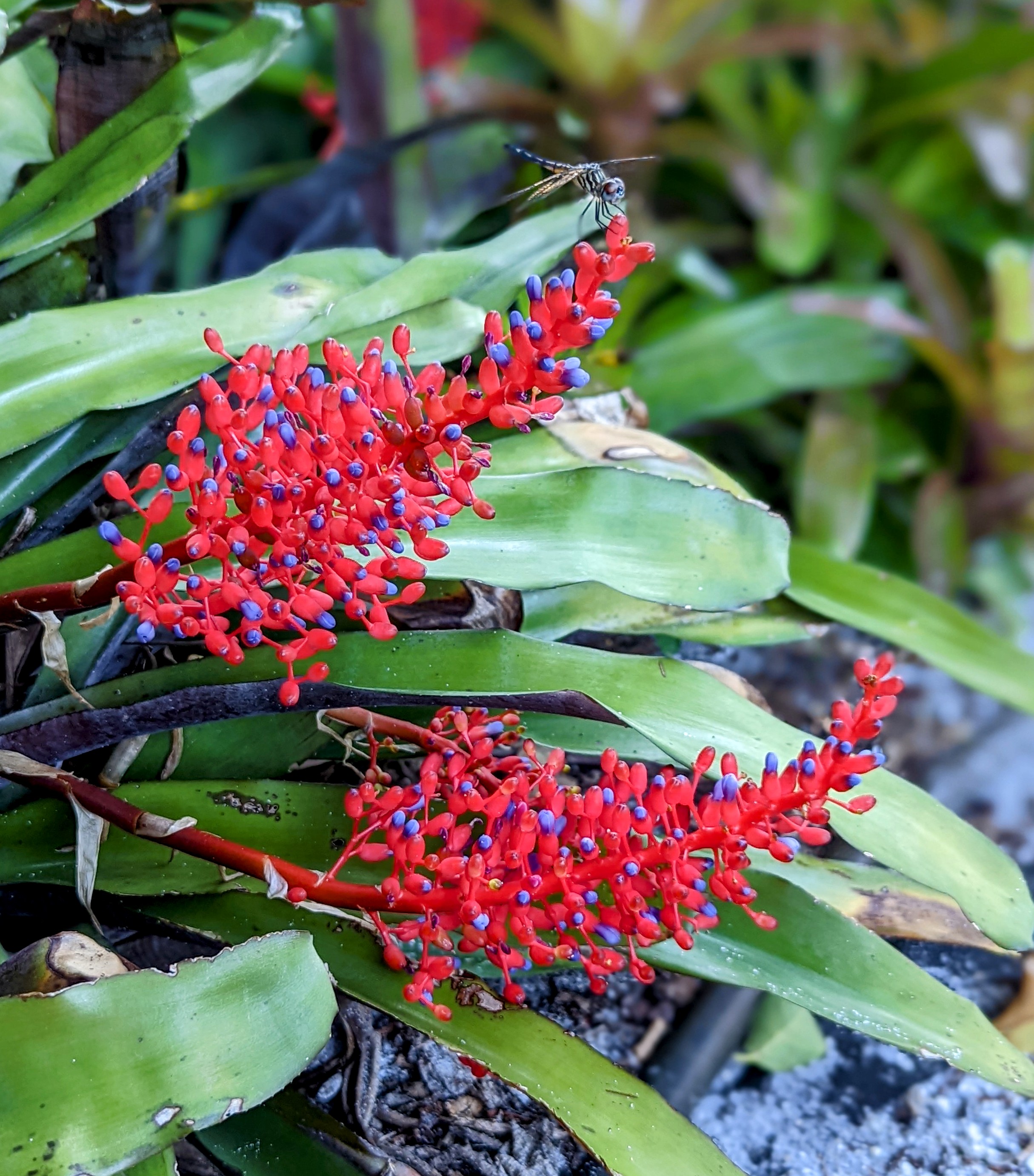
The Aechmea miniata flower, nearly full bloom with a friendly dragonfly. These are covered with blue when in full flower and slowly fade to apricot over the summer.
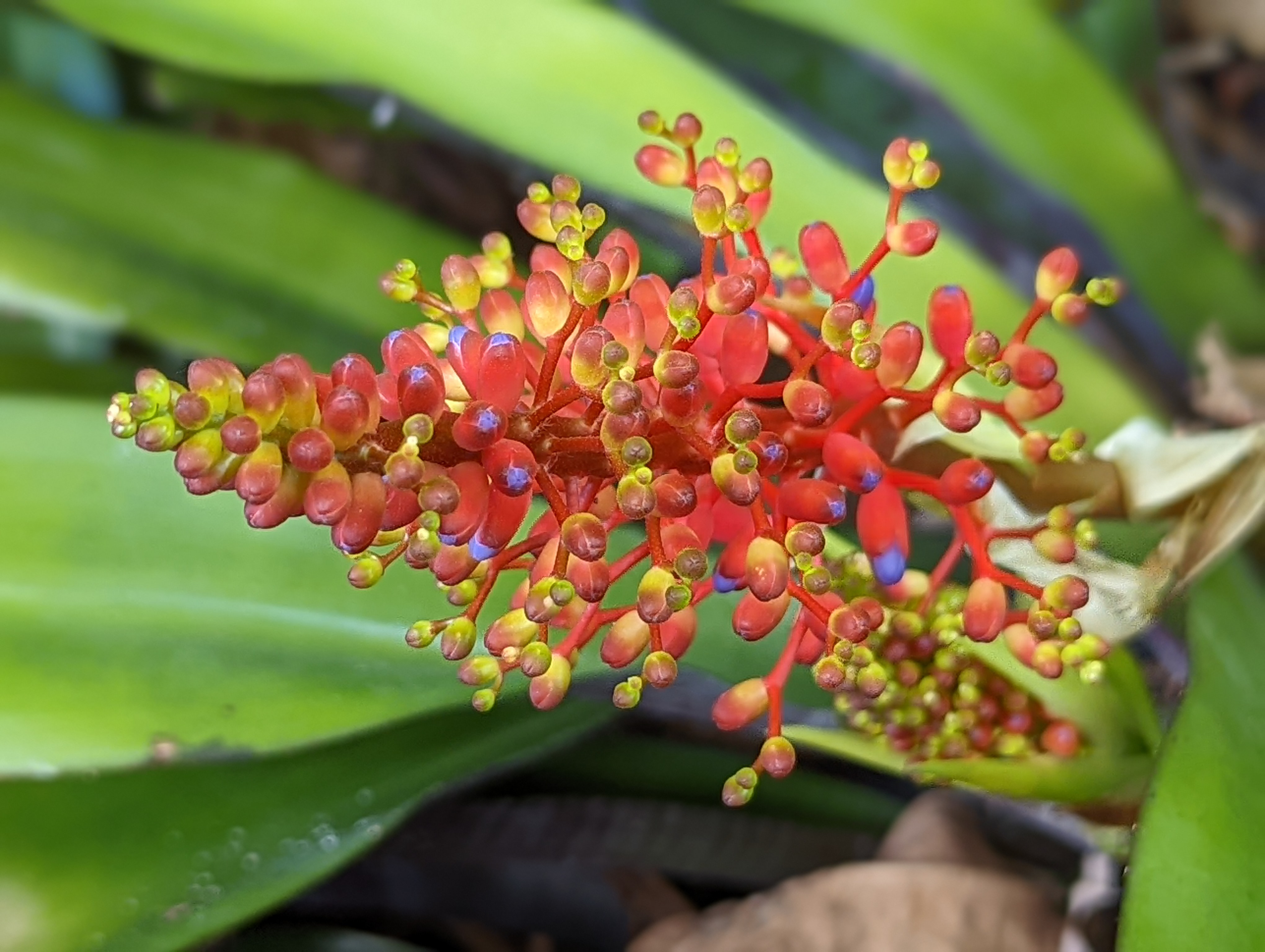
The buds from a couple of weeks ago.
Oops, I think that is Eight on Saturday. Oh, well. I am aging in the garden along with the Bromeliads…
I have been trying to grow Cactus Dahlias for years. I thought I could grow them in the ground, in amended soil. I planted tubers and thought “I will have flowers in eight weeks” Ha. This was four or five years ago. The tubers would sprout, put out a few leaves, and then die back down. A couple of times a year this happened until finally a passing critter dug them up and ate them. They hung around the garden for a few years, I kept hoping for flowers, but never got so much as a bud.
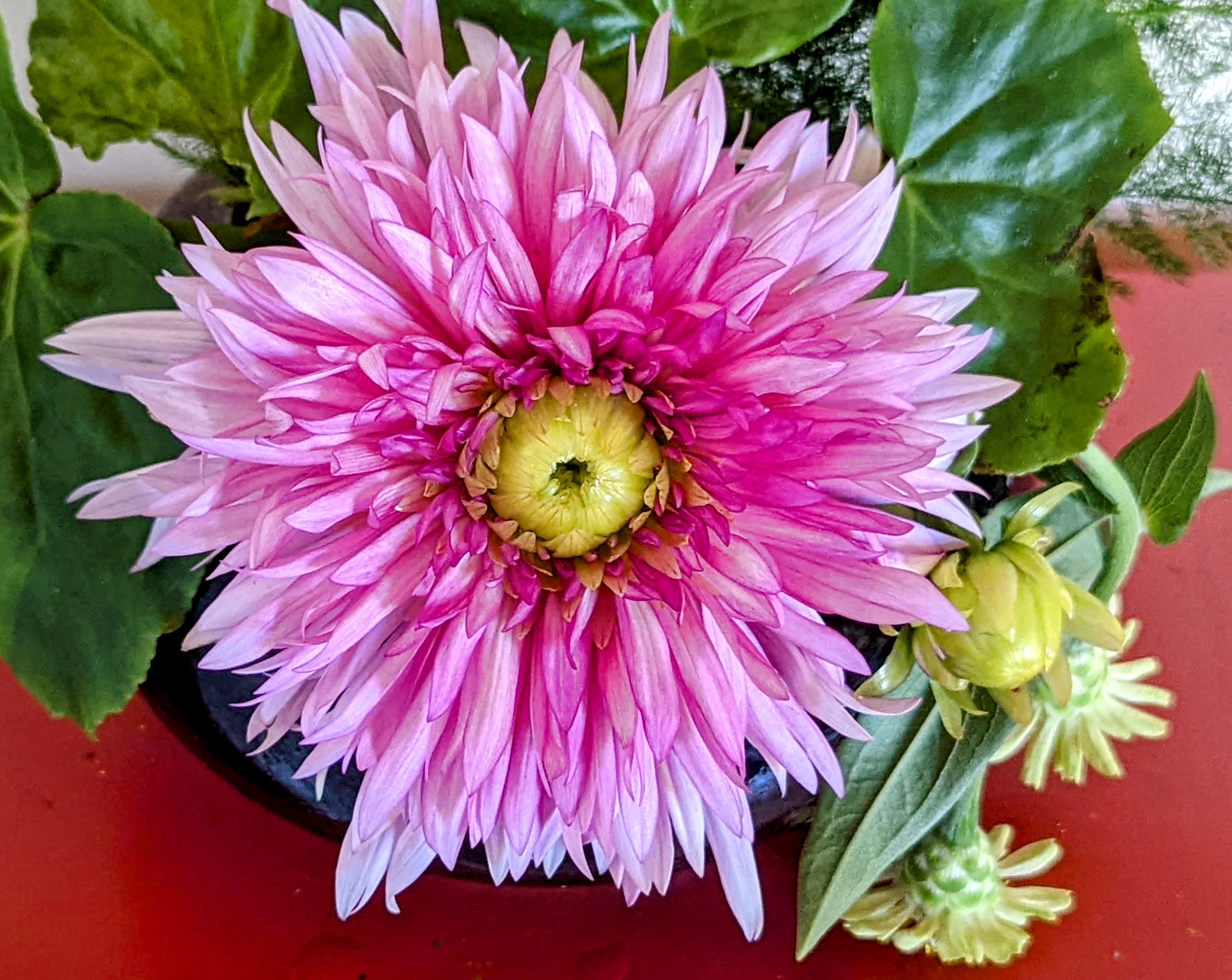
This spring I ordered some Labyrinth Cactus Dahlia tubers. I was shipped single red Dahlias and these replacement tubers are supposed to be Labyrinth. I was expecting long stemmed peach and pink mixed flowers…that is not this. This is the shortest stemmed flower I have ever cut. Maybe and inch and a half of stem and I accidentally clipped a bud while trying to cut the flower. These are pretty whatever they are, Cactus Dahlias, but not Labyrinth. Oh, well. I am still thrilled with the flower. All the stems are seemingly very short so my dreams of an overflowing bowl of Dahlias are dashed…
I am growing these in plastic pots. The tubers were planted about two months ago, so the original thought of having Dahlias in eight weeks is about right. The red singles I planted in March have burned out and gone dormant (or perished in the heat?)
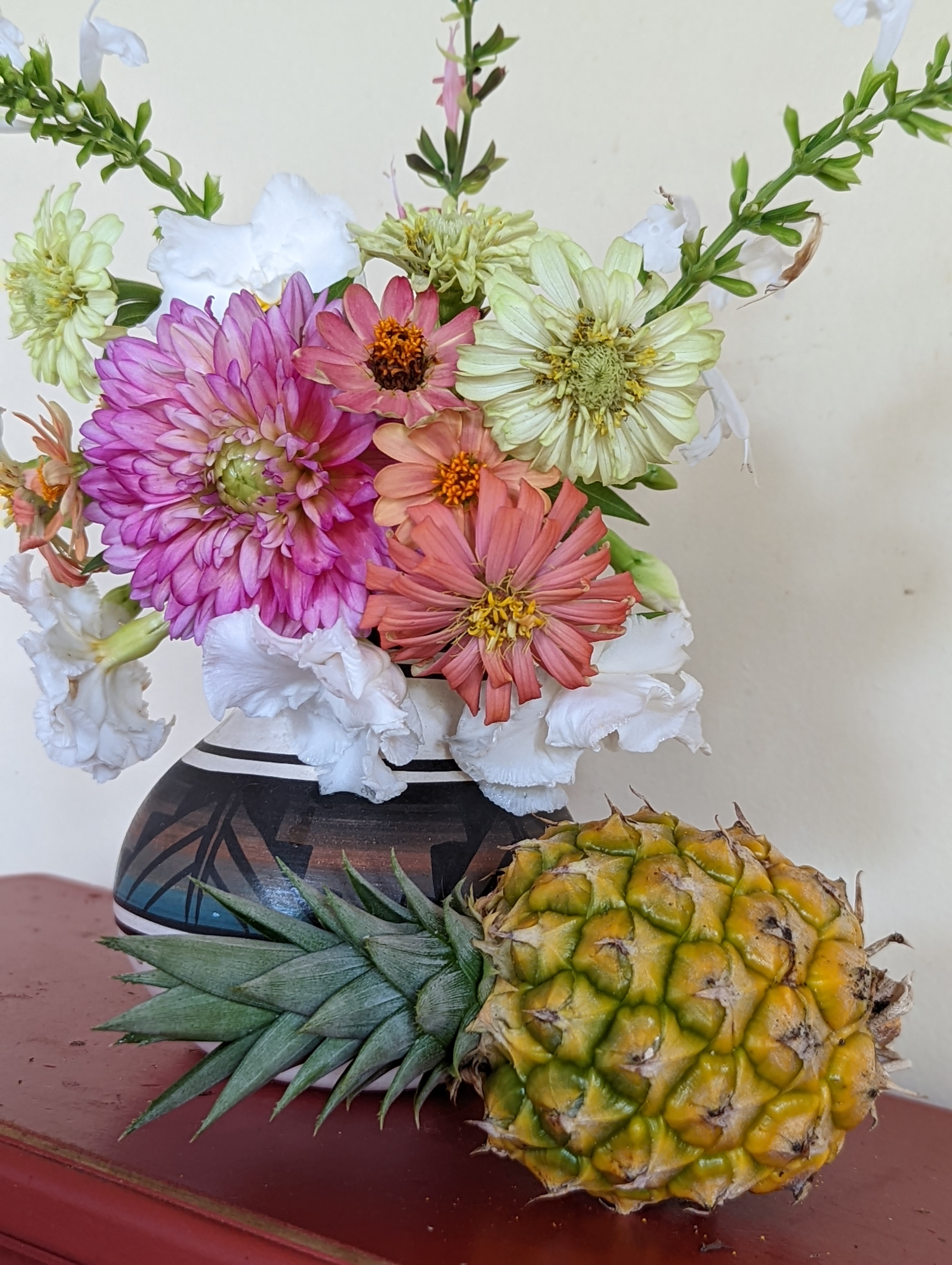
A close up:
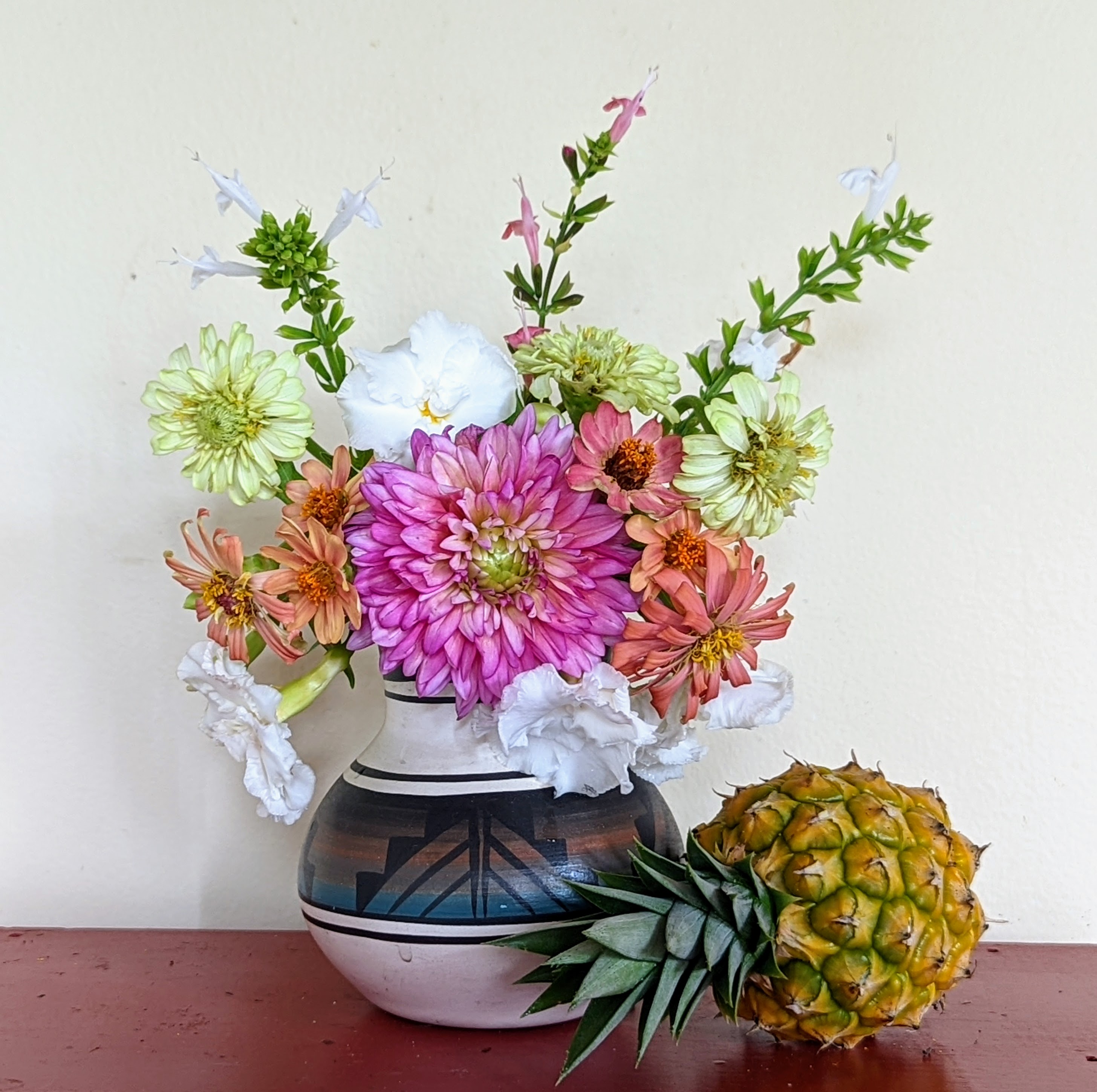
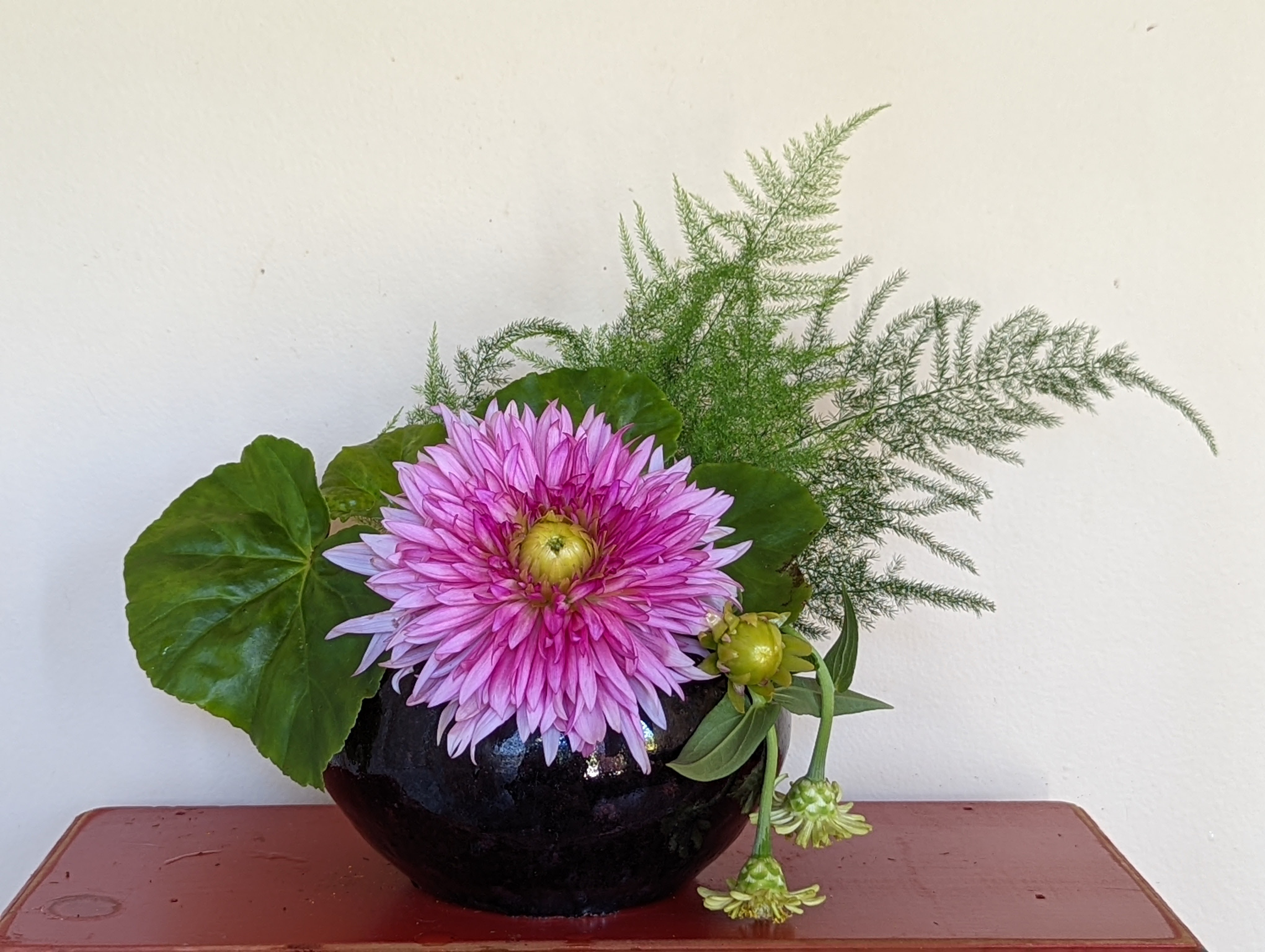
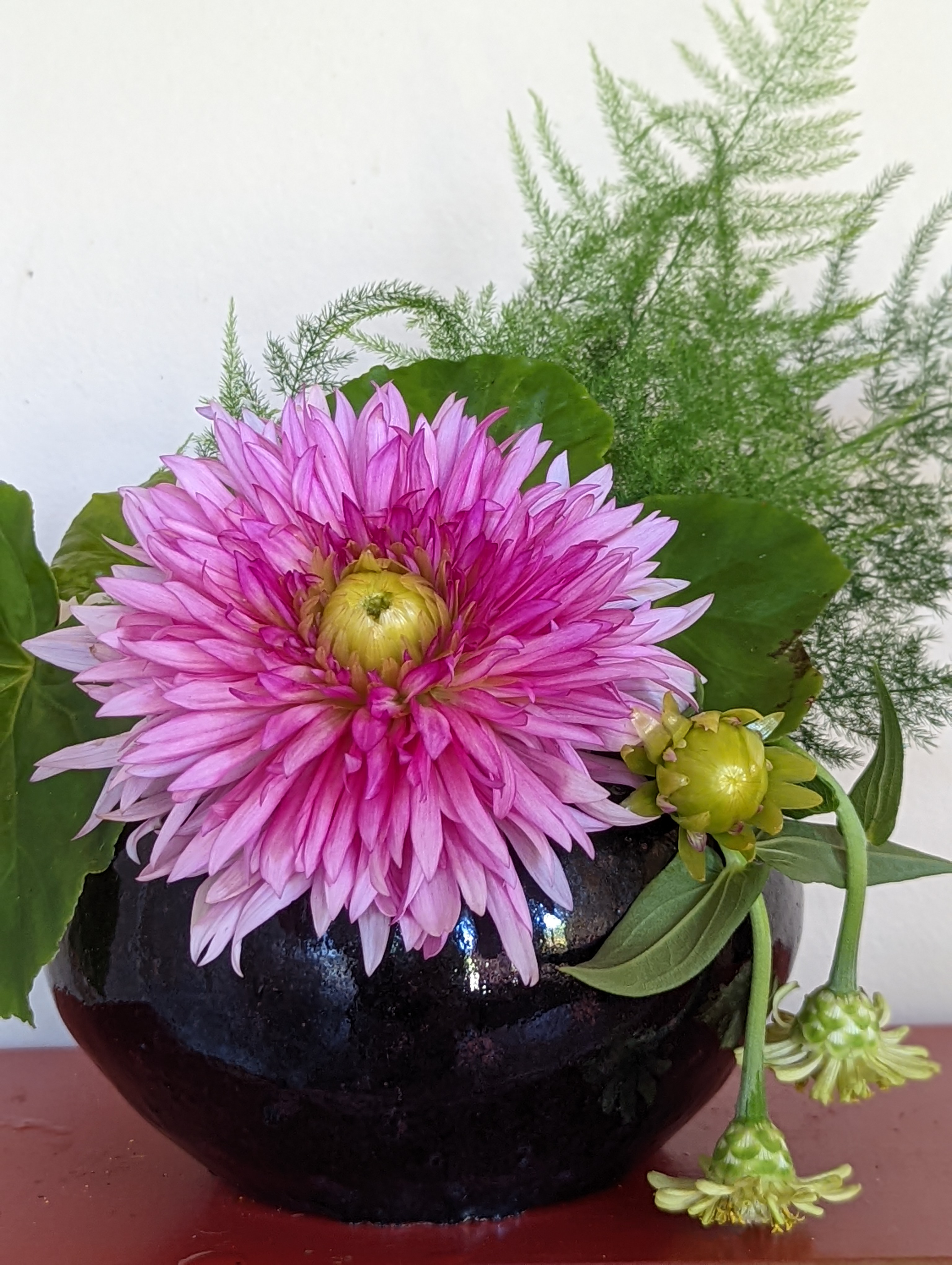
In pale purple, the Dahlia and bud. Green Envy Zinnias are hanging over the side. The foliage is Asparagus Fern and Sweet Begonia leaves. The vase is a thrift store find.
The July heat remains unabated. My garden has had no rain for two weeks! I have given up on some lawn (I use that term loosely and am happy I did not put any sod down this spring). Some of the more drought tolerant plants are looking wonderful and others have shut down to wait for rain. Fingers crossed for an actual thundershower every day! Below is my fabulous Labyrinth Dahlia, faithfully watered twice a day.
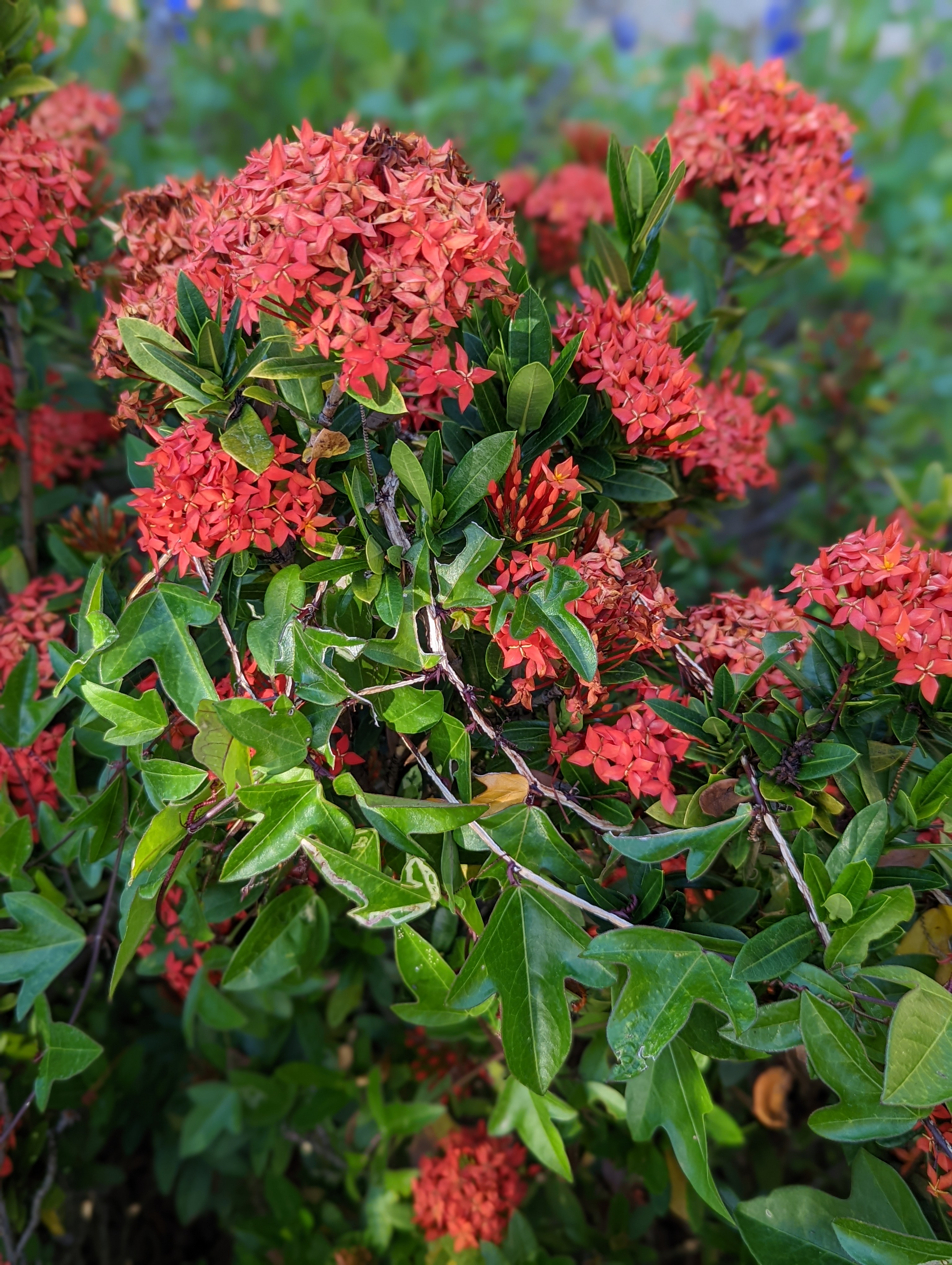
Next up, a native of the South Pacific, Dwarf Red Ixora (Ixora chinensis) – these shrug off the heat and love to flower all summer, but must be watered and fed. I have allowed our native Corkystem Passionvine to ramble through the shrubs; providing a larval food source for butterflies while the flowers from the Ixora provide nectar. The invasive lizards (only in Florida!) had staked out my Passionfruit vine and ate most of the caterpillars, so I got rid of that vine and the evil lizards haven’t figured this out – yet.
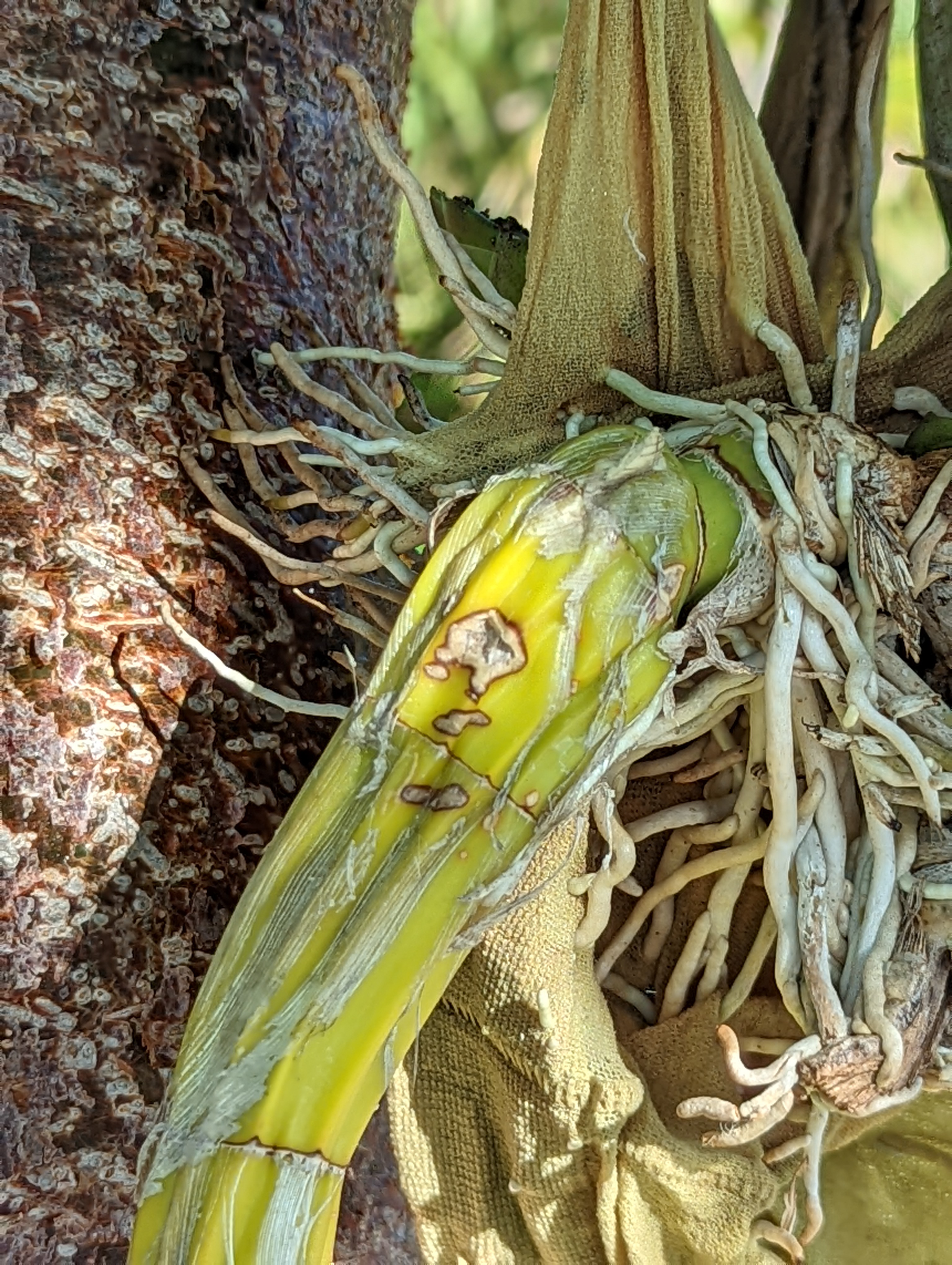
Last week I posted some pictures of the orchids growing in my Gumbo Limbo tree. Here is a close up of the roots growing into the trunk. They are not quite attached, but getting there.
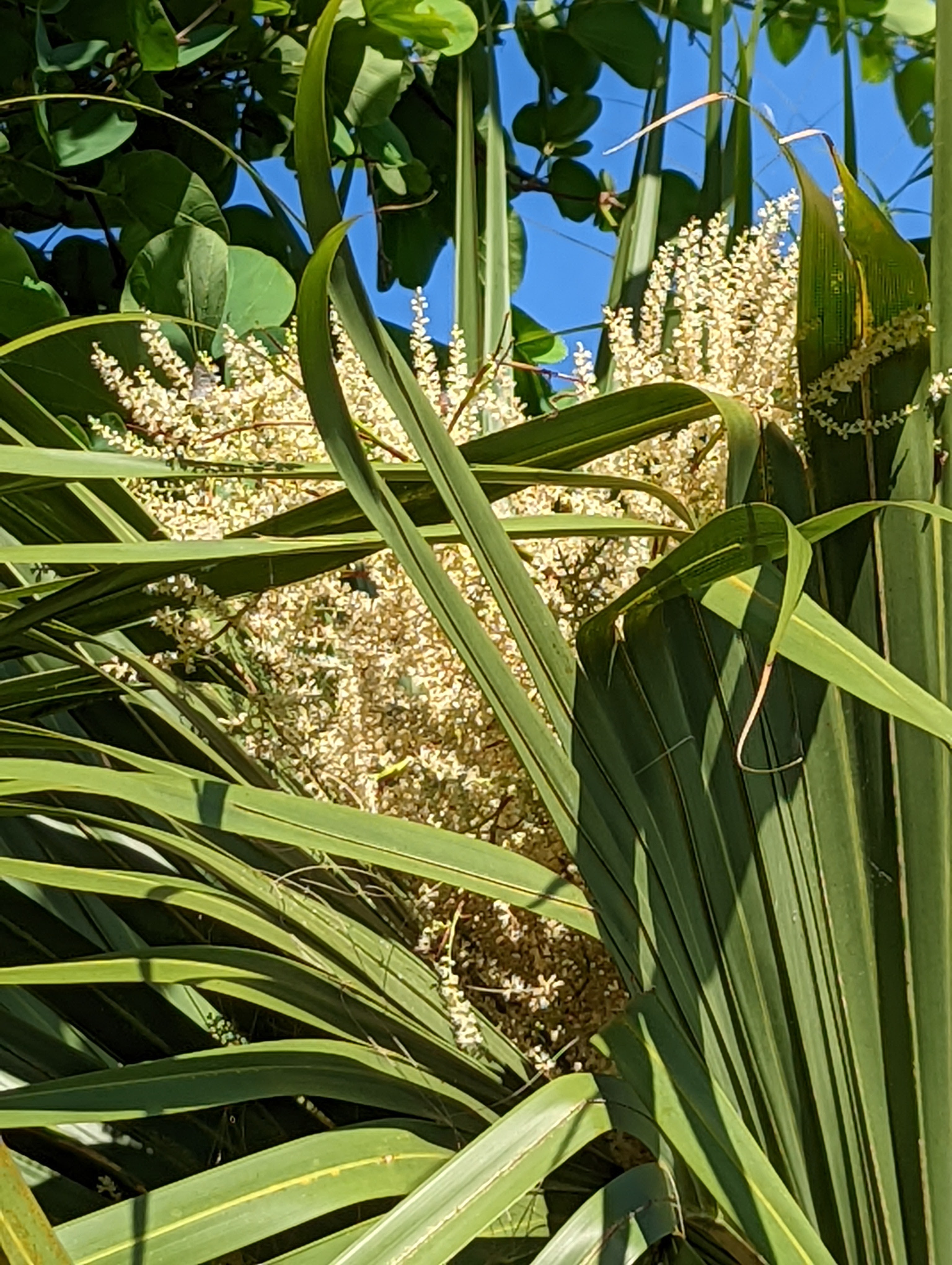
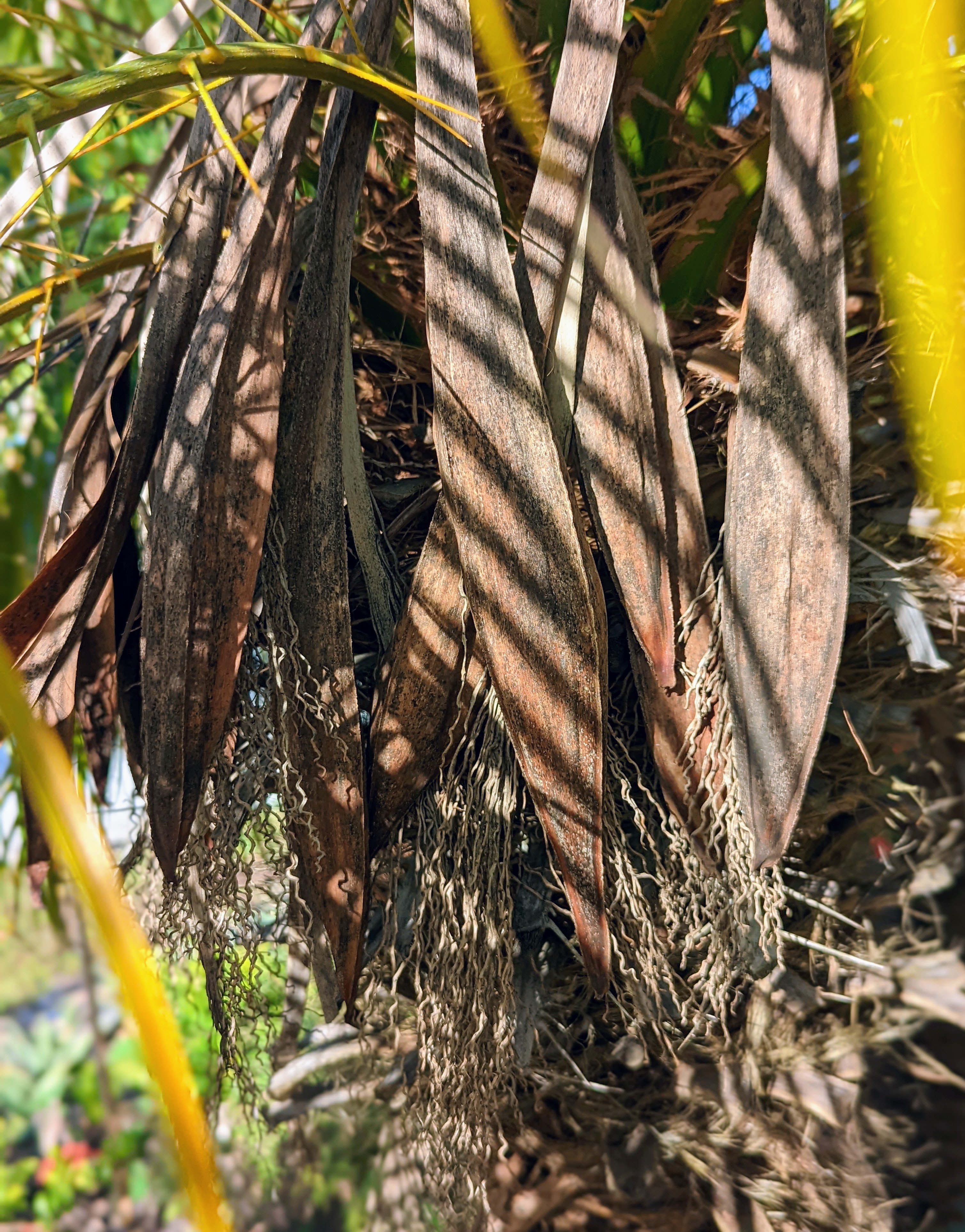
The native Cabbage Palms (Sabal palmetto) are indestructible. These are the flowers, the bees love them. Eventually, black berries are formed on long boughs from the crown of the palms. People used the skin of the berries to make flour – which must have been difficult!
Flowers on a Dwarf Pygmy Date Palm (Phoenix roebellini) This palm has male and female plants and will make dates if both are present. These are very common here and I have yet to see any dates. No idea what sex this is.
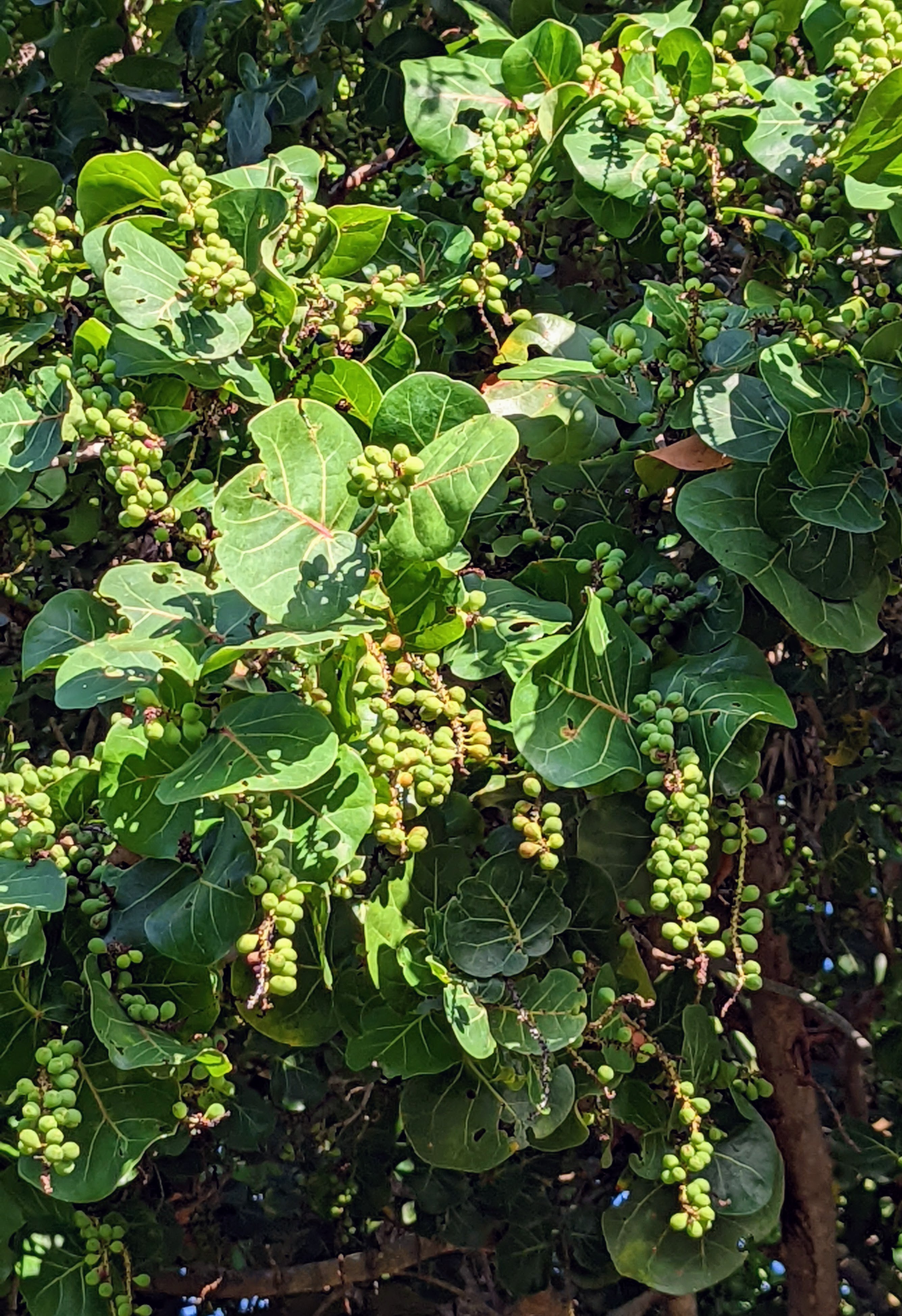
More happy natives. This is a Sea Grape (Coccoloba uvifera). These hardy plants are used for anything from clipped hedges to trees, this one is about 25 feet tall and covered in grapes. The grapes are edible with a huge seed and taste like figs. Another of those things you have to grow up eating to appreciate. I leave them for the critters. One of my greyhounds loved them and would stand under the tree and graze.
Today America celebrates its 246th birthday. My less than patriotic color scheme reflects my feelings on our current state of affairs. Pink for women and green for the environment. Blech, I have always detested politics and even more so today. My brain is still processing our backwards slide.
I am, however, quite pleased with my flowers. My quest to have flowers that survive the summer heat is continuing. Zinnias and Salvia are thriving. I have grown all from seed and will continue to do so as long as I know what to grow and when. This is usually a trickier subject than it appears. The Dahlias I started in March, flowered and fried. I started some a few weeks later and have high hopes for flowers from the few Cactus Dahlia tubers roasting in the garden. Leonitis leonurus, seemingly a good choice from South Africa, is slowly burning up in the front garden it seems, time will tell if it survives the heat.
The vase:
The vase is a retired pasta storage container. The plant palette begins with Zinnias; the peachy toned smaller Zinnias in front are ‘Profusion Apricot’; behind is my go to flower this summer ‘Green Envy’ Zinnia; the red flower draped over the rim is Coral Plant (Jatropha multifida); the orange one behind is Mexican Honeysuckle (Justicia spicigera).
The view from above:
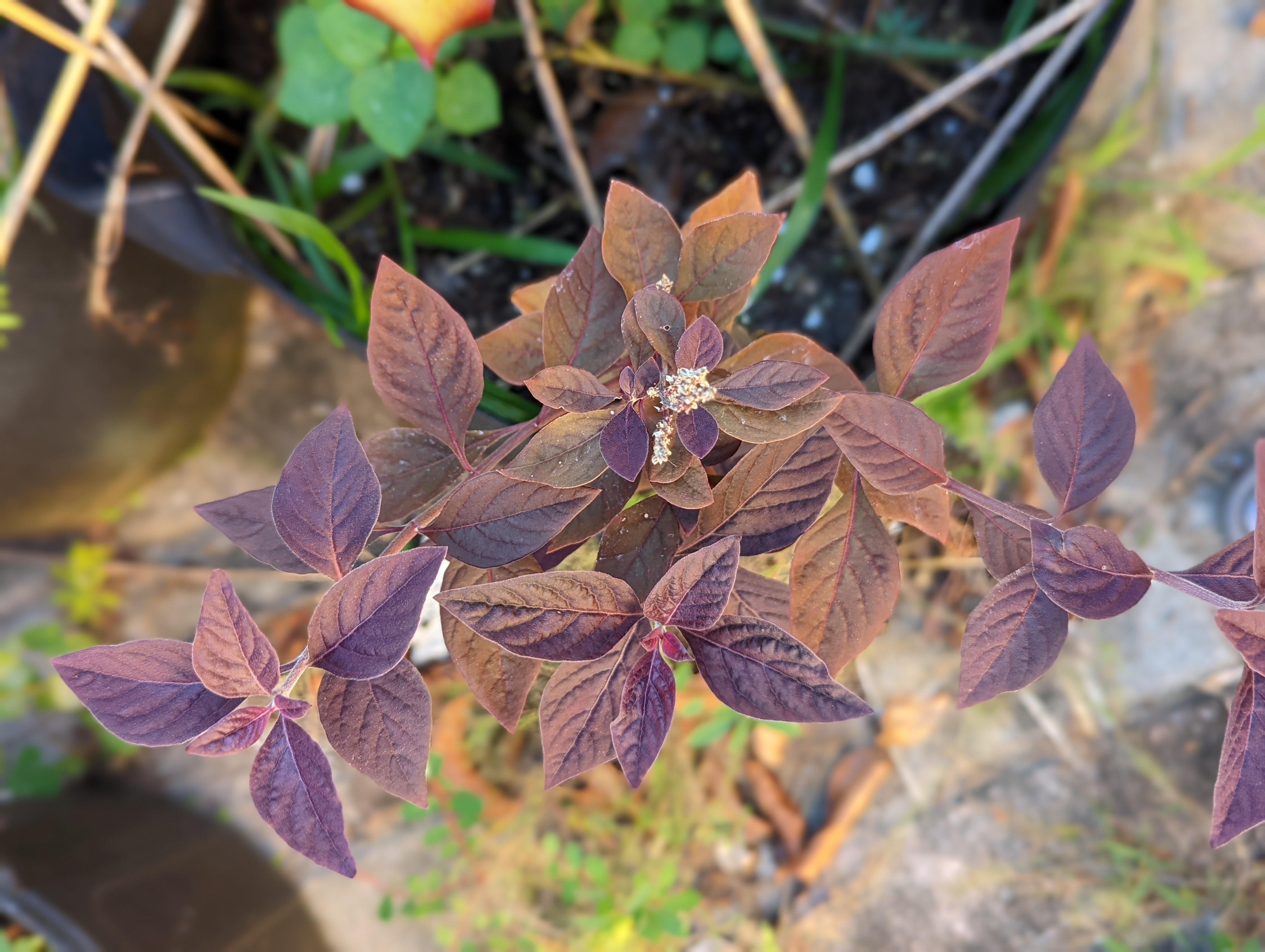
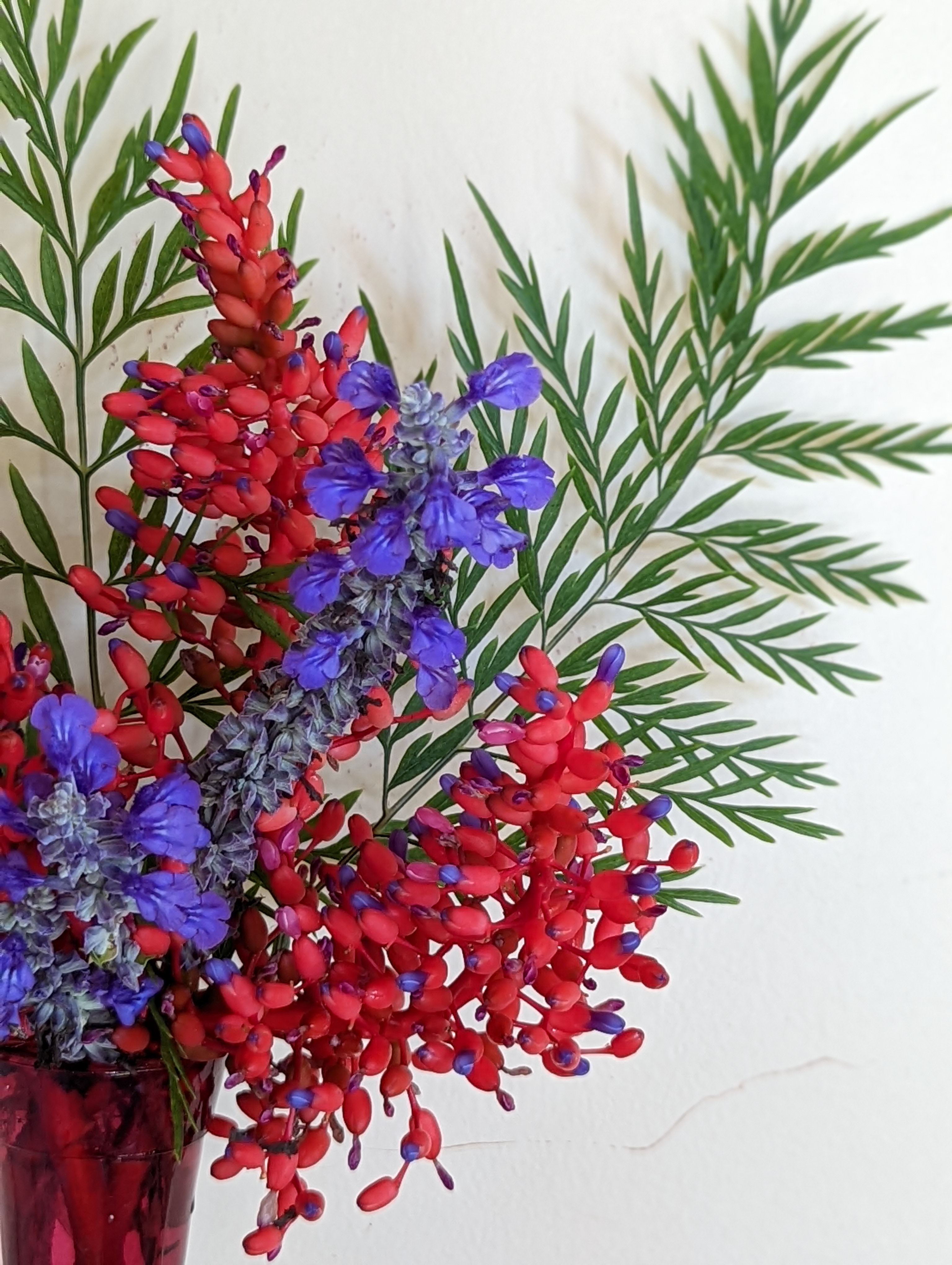
In coral and grey, Soap Aloe (Aloe saponaria); white spikes are Tropical Red Salvia (Salvia coccinea); burgundy leafy foliage is ‘Purple Prince’ Alternanthera; ferns are Asian Sword Ferns.
It is hot and dry here. The only pyrotechnics I am hoping to see today involve thunder, lightning and water falling from the sky.
Summer is an interesting time in the tropical (subtropical, really) garden. It makes me appreciate how smart plants are. The really nasty weeds make seed at the start of the rainy season (June 1) and have a long period of time to start new plants with the advantage of rain. I have been gleefully decapitating the five (yes, five and year round) varieties of crabgrass that grow in Florida in hopes of keeping the crabgrass down.
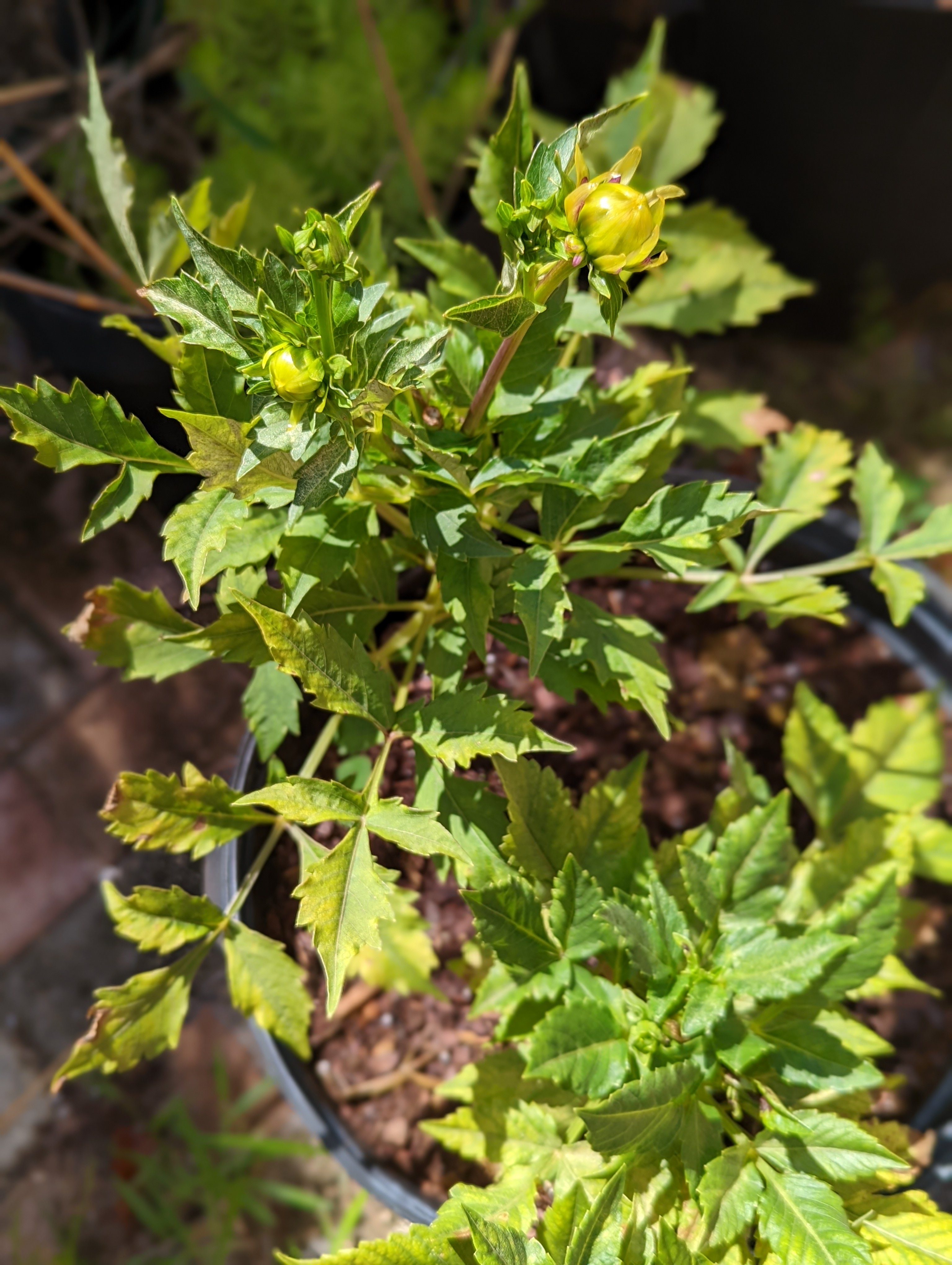
There are some more attractive budding plants in the garden. This is a Labyrinth Dahlia I have high hopes for, although I am not certain if I planted it early enough. The tubers planted earlier have already flowered and burned out in the heat.
Bromeliads poised to climb the trunks of an Adonidia Palm. This is my first trunk climbing adventure with plants, so I am looking forward to seeing what happens. These are Jill Neoregelia Bromeliads, the red centered one is the oldest, and therefore the mother plant, soon to meet its demise. Women hate this aspect of Bromeliads, the mother always dies.
Another tree climber, the Schomburgkia Orchid, is growing and has new stems coming along. I was interested to read that this orchid is native to Mangrove trees growing on the edge of the Yucatan Peninsula in the Gulf of Mexico. These are usually higher elevation orchids, it is unusual to see this type of orchid in Florida.
The bud of a Desert Rose (Adenium obesum). A Lubber Grasshopper ate all of the foliage last week.
One of my favorite summer Bromeliads and a reliable July flower, the Aechmea Miniata. In full bloom these always remind me of Red Hots candies.
That is all from here this Saturday, I am luxuriating in air conditioned space today, looking forward to future flowers and hoping for rain. To see more SOS posts, visit http://www.thepropagatorblog.wordpress.com.
Summer has turned the heat up full blast on the Treasure Coast of Florida. Daytime highs have been over 90 degrees (F) and thunderstorms pop up all afternoon. Not that my garden is getting very much rain, it seems to be missing us most days. So aggravating. So much rain and none falling where I need it.
The heat and humidity brings out the Tropical Gardenia, which was covered in flowers until I relieved it of a number of them. This Gardenia is about ten feet wide and tall and I should have taken a picture before I cut so many flowers. Oops.
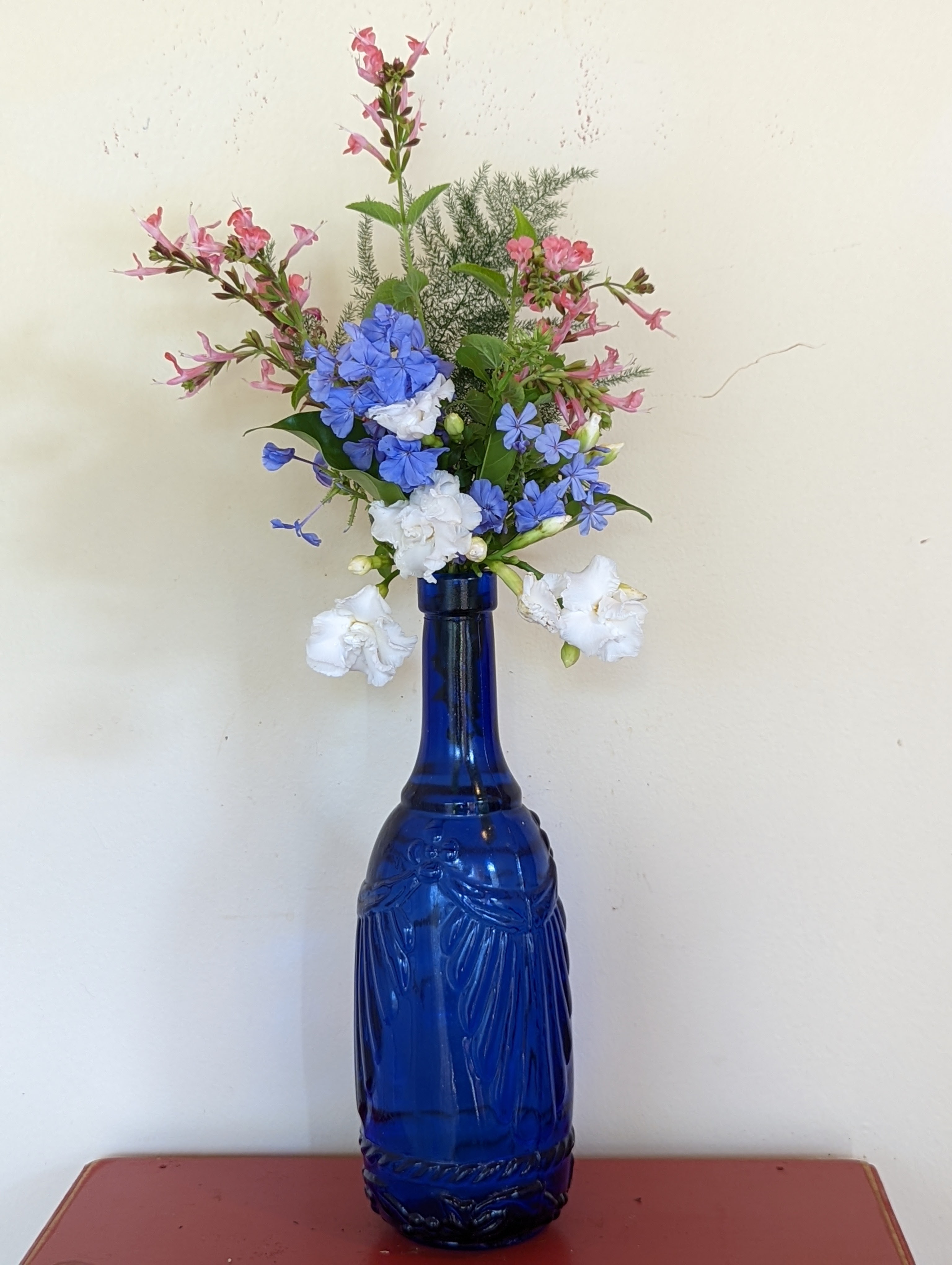
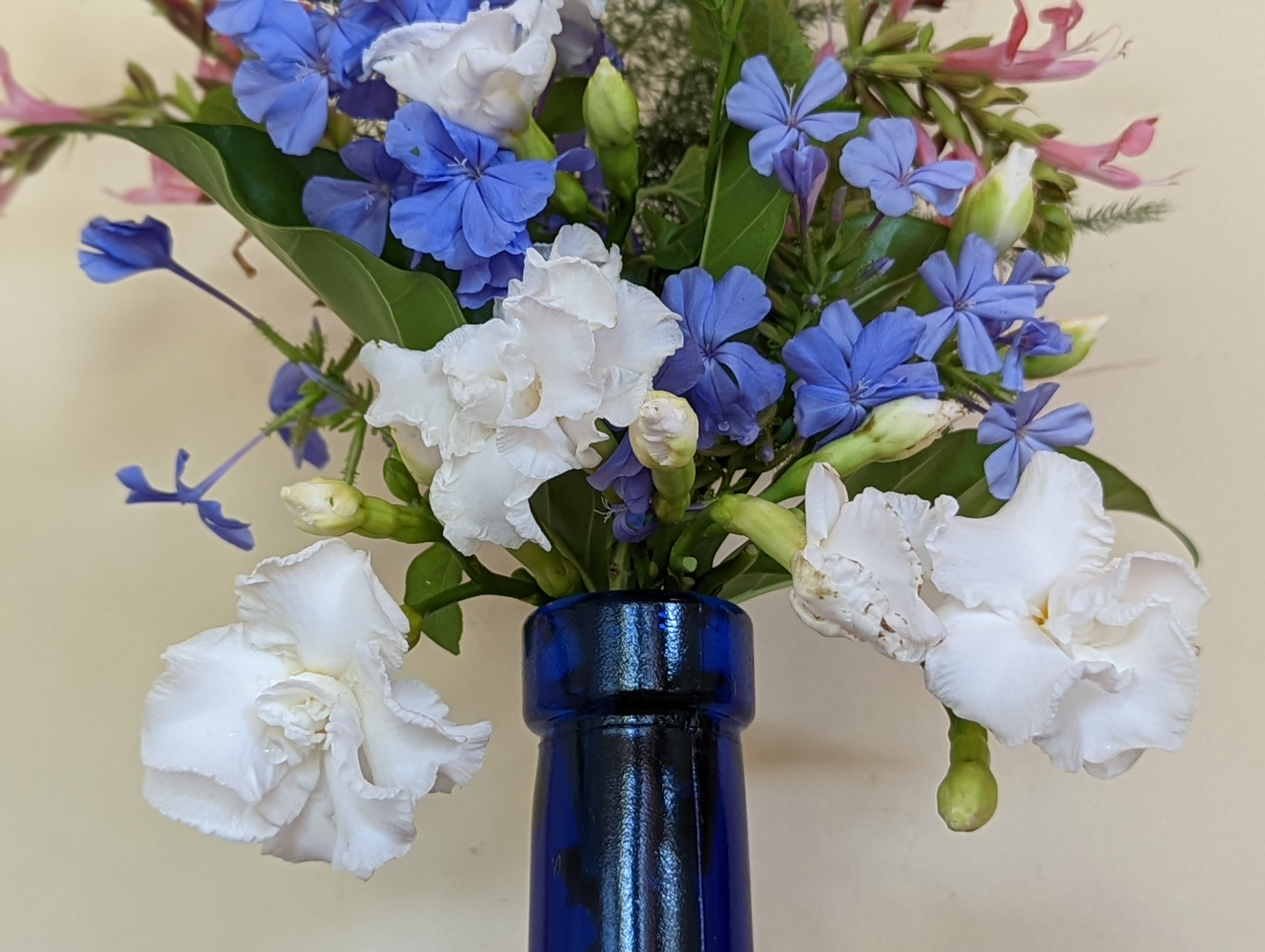
I decided to use my vintage Blue Willow teapot and add some cooling colors and fragrances to my vase. The Gardenias are a lighter version (fragrance and size wise) of Gardenia jasminoides, which I love, but its scent is overwhelming indoors and they are more difficult to grow than the Tropical version. I cut this one out of an overgrown hedge between me and my neighbor’s house, once it got its head in the sun it took off and I tree formed it. I never water it and it is perfectly happy. My kind of Gardenia.
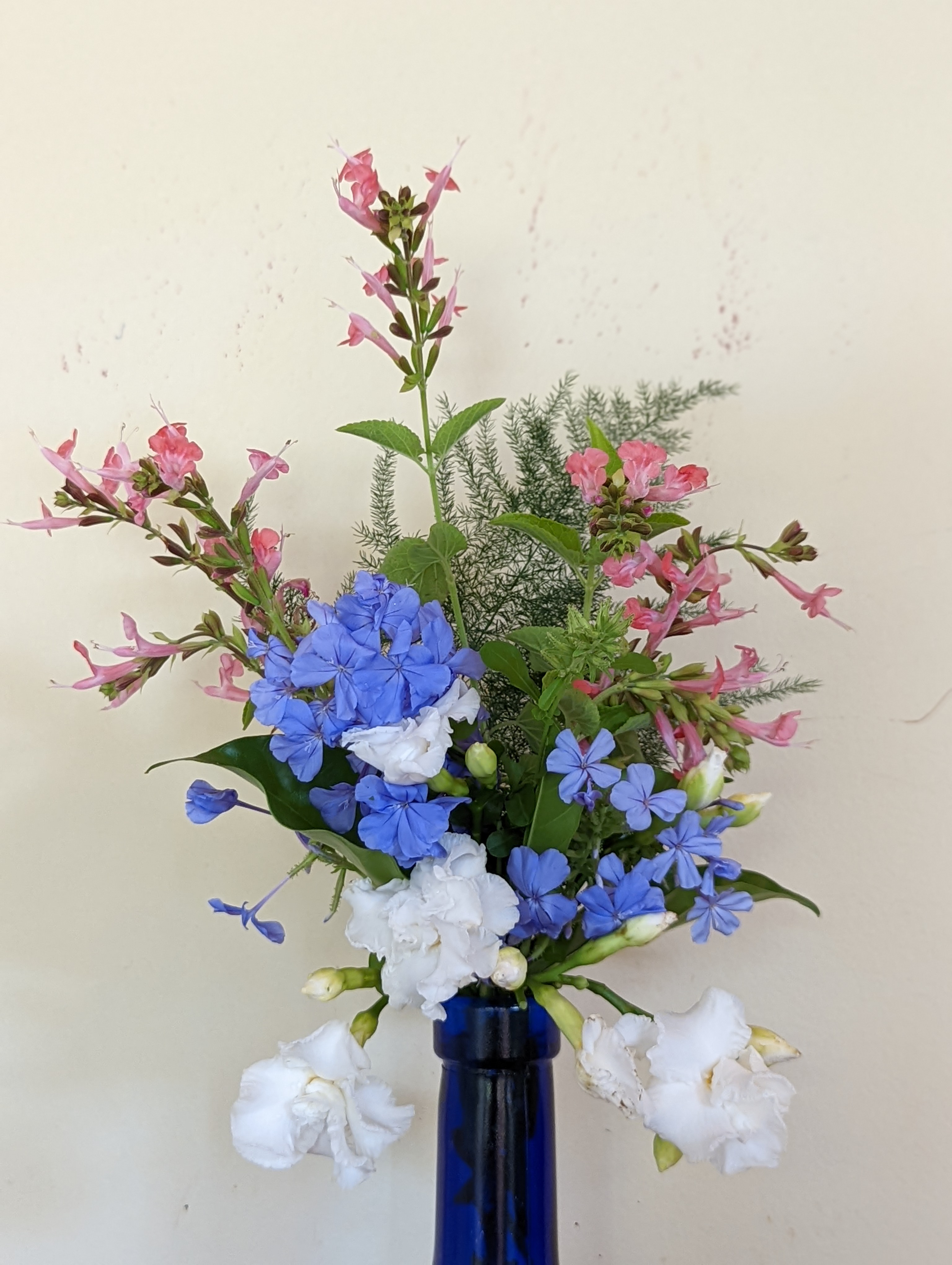
The close up:
Tropical Gardenias are Tabernaemontana diviricata; green flowers are ‘Green Envy’ Zinnias; deep blue spikes are ‘Mystic Blue’ Salvia; lighter blue flowers are Blue Plumbago (Plumbago auriculata); ferns are the evil invasive Asian Sword Ferns.
The colors and the combined fragrances of Gardenia and Salvia are adding a light sweet herbal presence to my foyer. Here is a view from above:
Another one of Florida’s many gardening peculiarities is the tendency to find (mostly) desirable plants popping up in the garden. Above is the Brown Bud Allamanda (Allamanda cathartica). These vines tend to creep around and over my neighbors fence, they end up rambling through my shrubs and I hate to cut the flowers off. Rumor has it Pygmy tribes in the Amazon use this very poisonous plant to make deadly blowdarts.
A perfectly placed white Tropical Red Salvia (Salvia coccinea). I planted the red one years ago and a white flowered one popped up in this border, accenting the peach and blue flowers.
Another dead on plant placement by bird artists. These are native Firebush (Hamelia patens). The seedlings appeared soon after we moved in, spaced perfectly for a foundation planting. These are on one side of the front porch, I found another seedling and put a matching plant on the other side.
My preferred common name for this is Inch Plant (Transcandentia zebrina). I have no idea where it came from, but it makes a great groundcover.
Another Transcandentia – T. pallida. Purple Queen, or I was taught these are called Setcresea, Purple Queen is a bit more palatable. I have these in pots and in the ground, the original ones came up under a Strangler Fig, so I guess another bird seeded plant. These seemingly will grow anywhere from sun to shade. A great low maintenance groundcover and a real pop of purple.
Wild Grapes or Muscadines (Vitis rotundafolia) This is a love/hate plant. The native Floridians will actually eat the grapes. I find them bitter, but the birds love them. The hate part, they spread ….everywhere.
I have two vases today. It may sound like wines are the topic this Monday, but that is not the case. The only commonalities with wine are both vases are bottles and feature the color red. For the most part, I can do without red wine. Though I do like to make gravy with it.
I may finally be embracing the single Red Dahlias I got by mistake. These have a tendency to look down in the garden and seemingly I am required to lie on the ground to get a good look at the flowers. I like them much better in a vase.
The vase is an olive oil drizzling bottle given to me by my mother years ago. This is what she called them, she went through a roasted red pepper (drizzling olive oil is essential for this) phase and decided all the cooks in the family needed one of these bottles. They work great for their intended purpose but are difficult to clean after a while and I keep it around for decorative and now, vase purposes.
A close up:
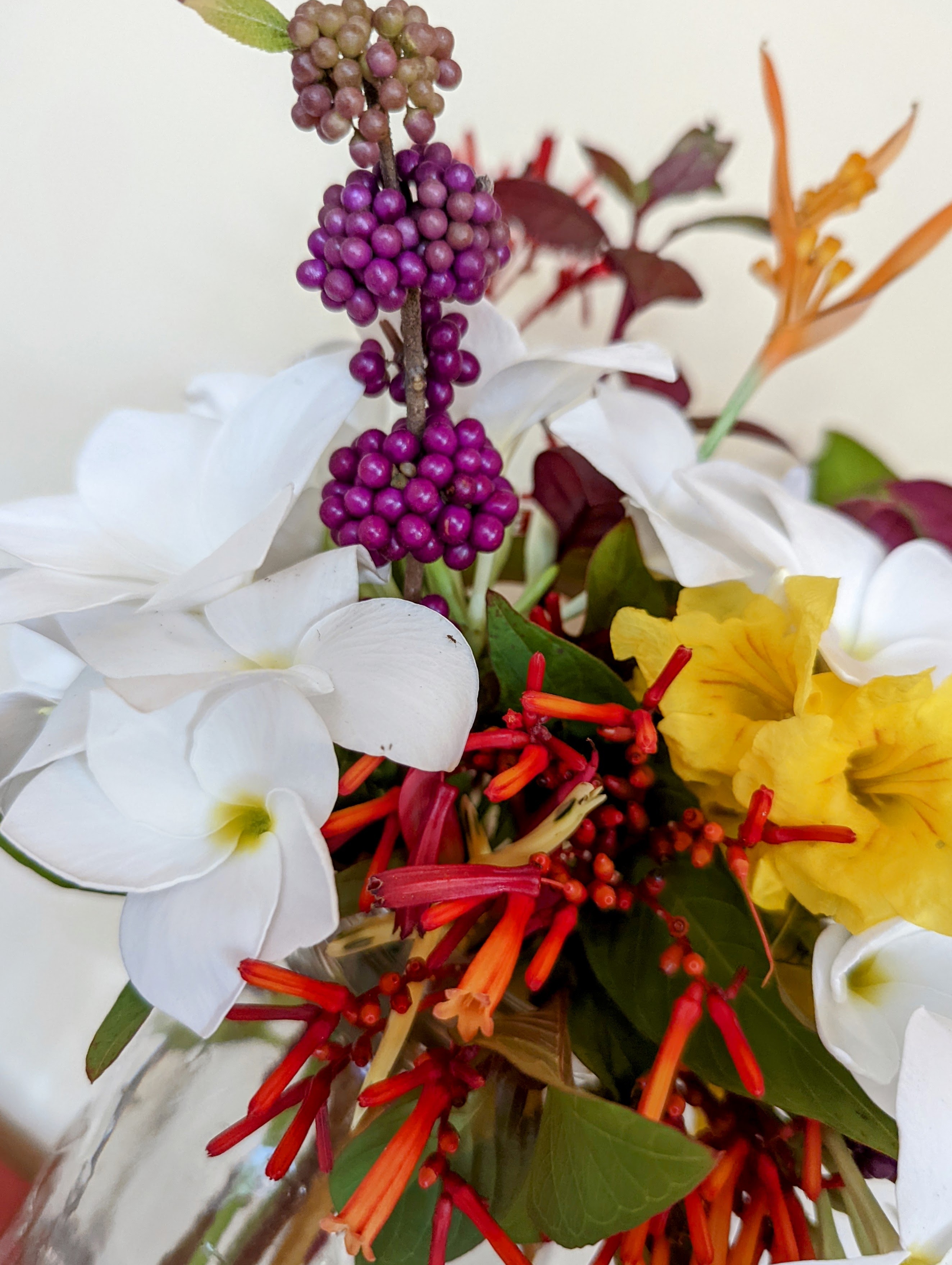
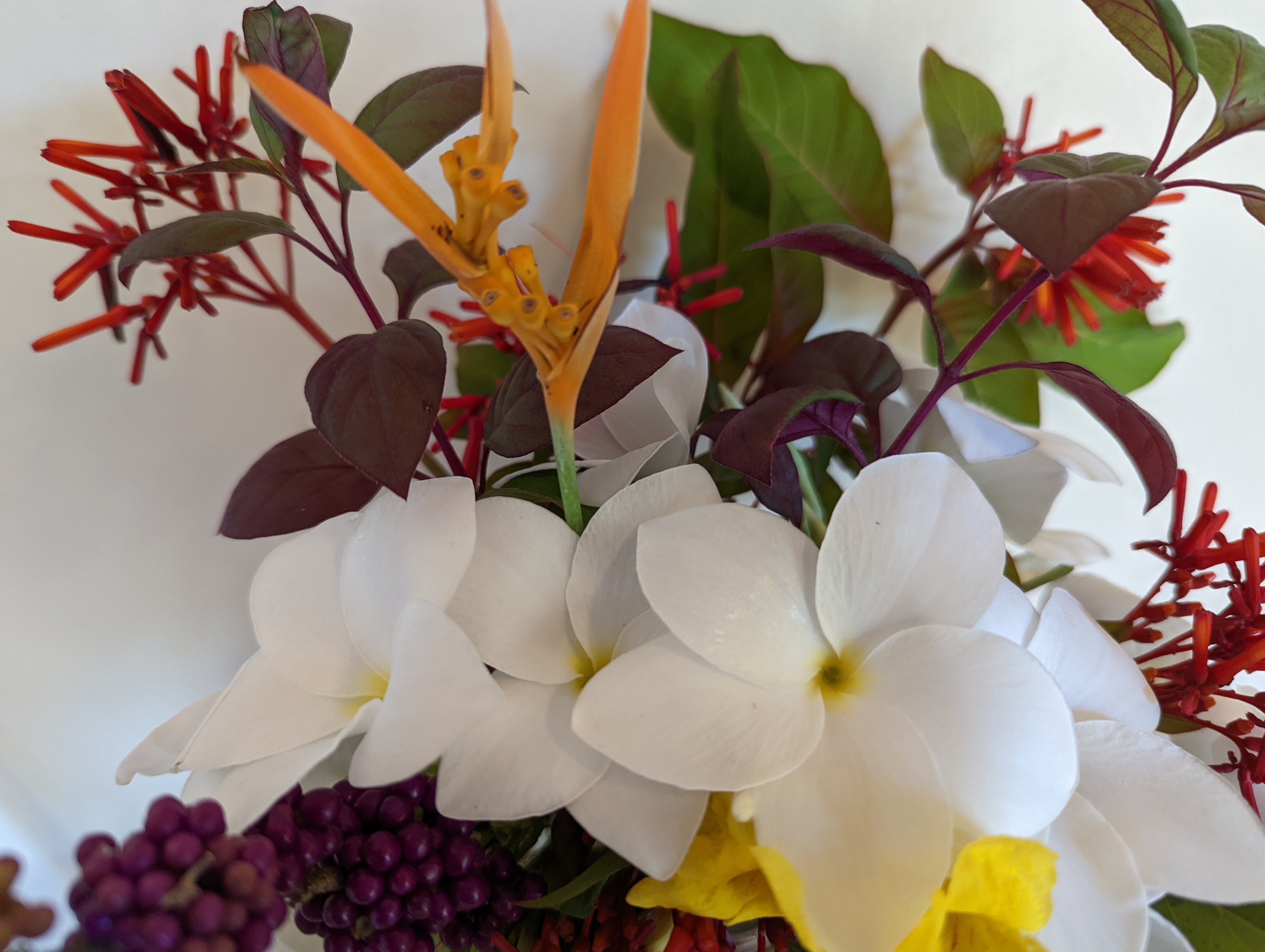
The red daisies are a Dahlia of unknown name; orange tubular flowers are Firebush (Hamelia patens); burgundy leafy foliage is ‘Purple Prince’ Alternanthera; burgundy strap like leaves are Hallelujah Billbergia Bromeliads; white spike is Sweet Almond Bush (Aloysia virgata) for fragrance.
The Next Summer Red:
I did a similar vase a couple of weeks ago. The combination of the red bottle and the tropical Heliconias is irresistible to me. This week I added some Hibiscus to enhance the tropical vibe.
A closer view:
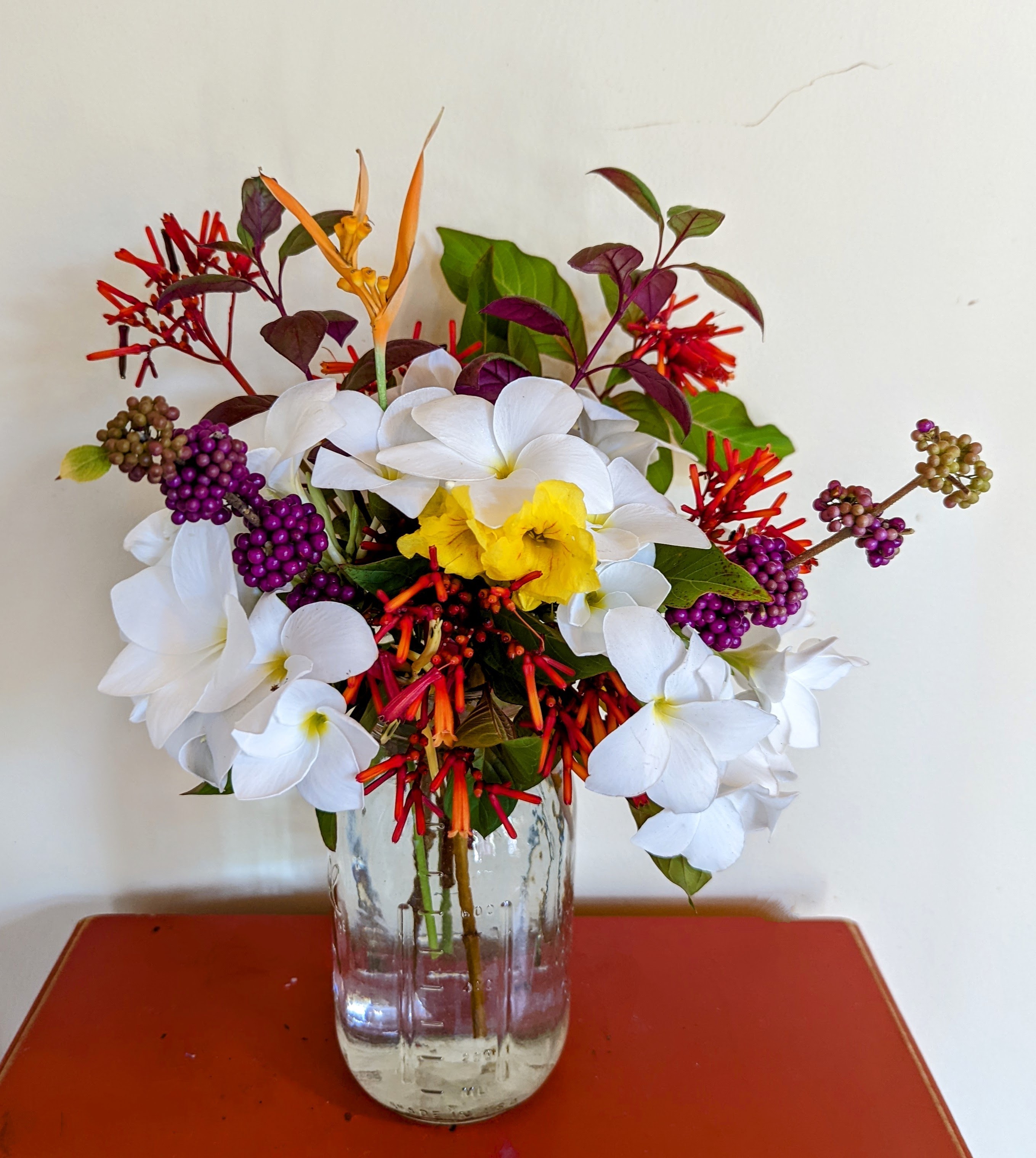
The red bottle was a dog walk find a neighbor left out as trash. The yellow and red flowers are Lobsterclaw Heliconia (Heliconia rostrata). These take their time opening, a week or two, then perversely don’t last very long in a vase. I’ll be watching to see if the one that is less open lasts longer. There are two varieties of Hibiscus here. The classic Hibiscus (the top two), a heirloom variety called ‘The President’. An ancient shrub, I think my neighbor’s grandmother planted decades ago. It sits on our property line and every now and then I cut a few. The lower one is a Nodding Hibiscus (Malvaviscus arboreus) – not actually a Hibiscus, but a Mallow and family member. These grow wild in my garden. The foliage is from the Heliconia and was cut with the flowers and left in place.
Will my Summer Reds inspire me to make gravy? Hmmm, chicken thighs in red wine gravy are a favorite. With mashed potatoes and lima beans. A definite dinner possibility.
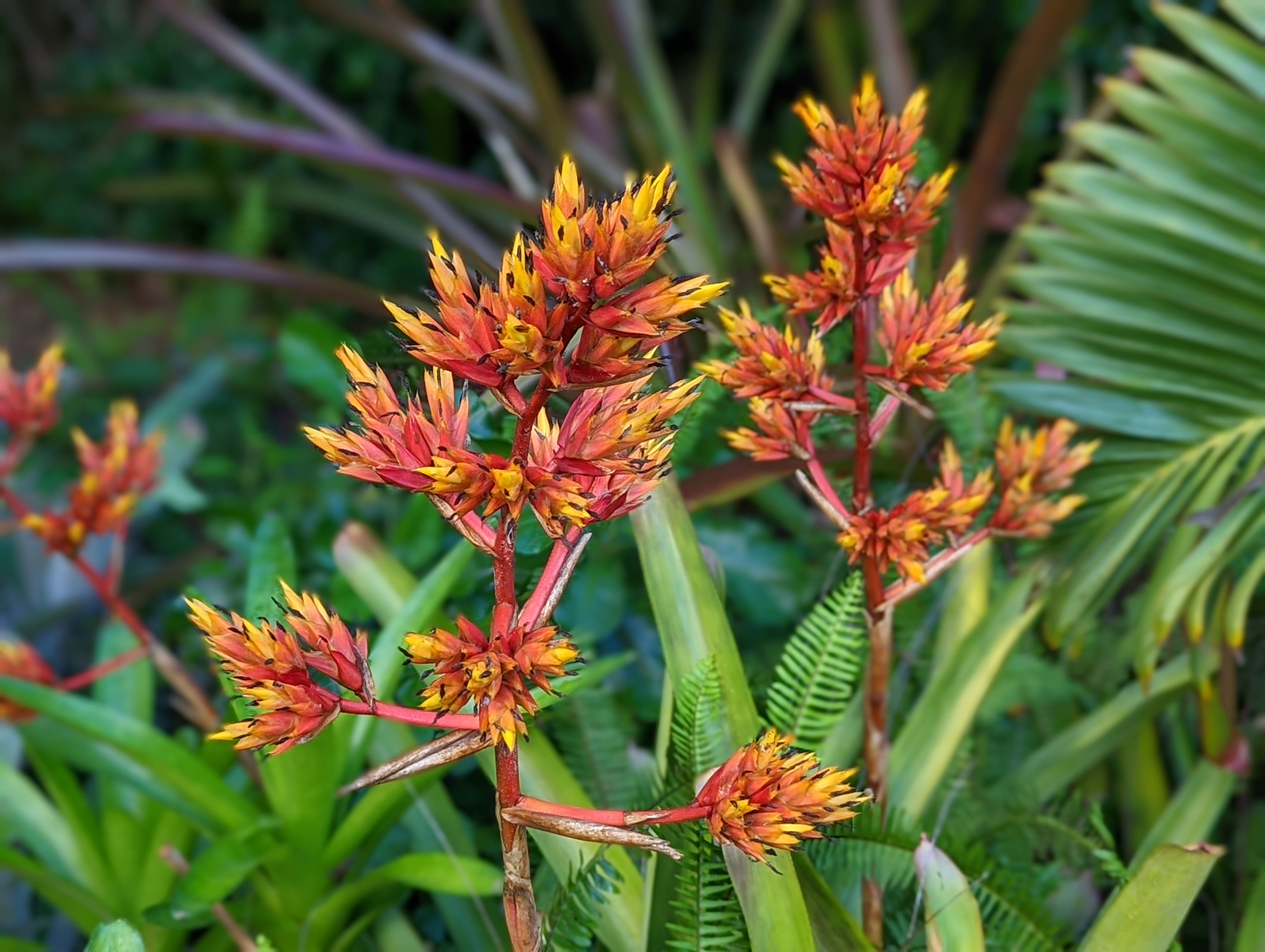
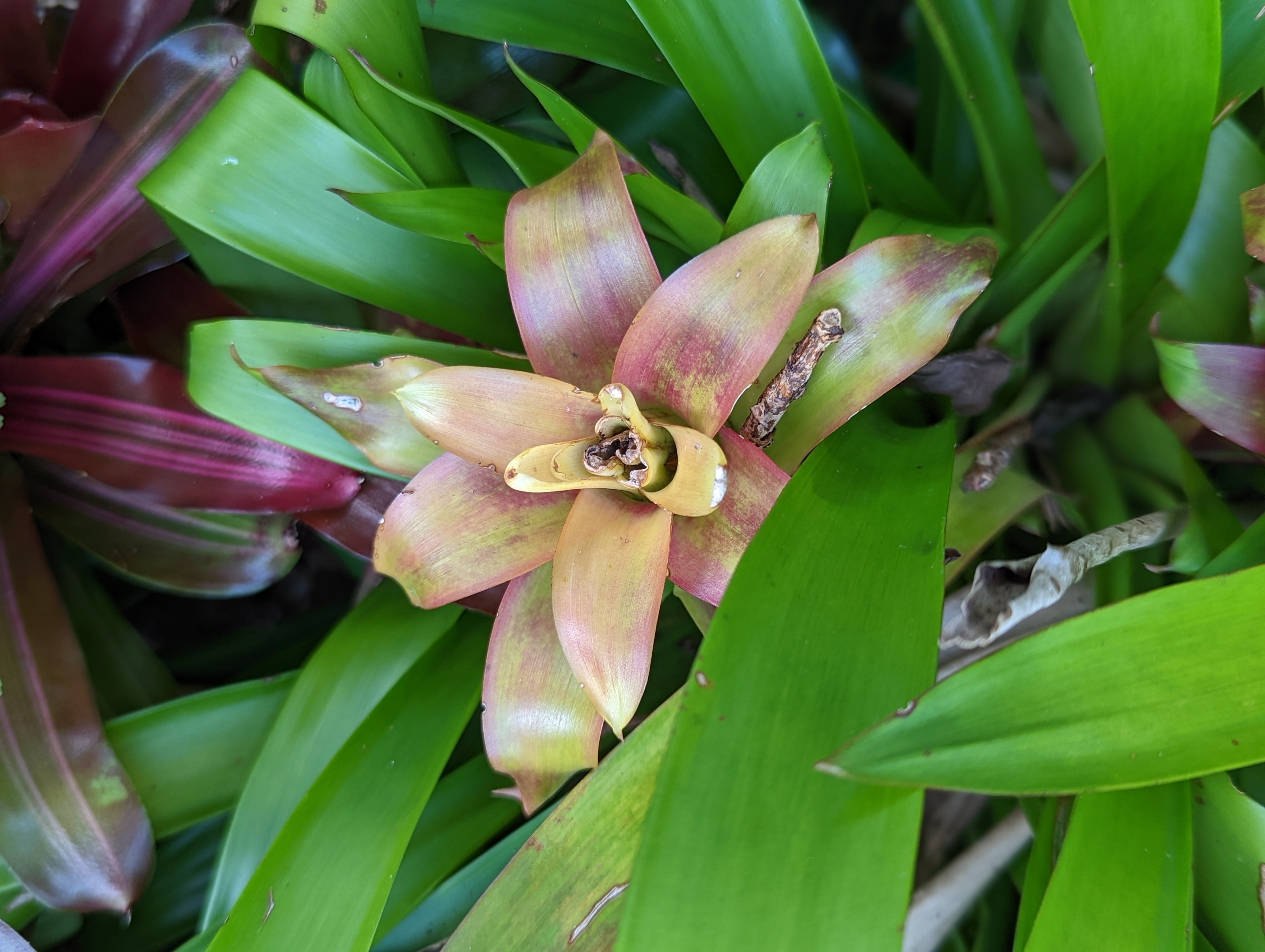
I face many quandaries when gardening. Many involve recalling the name of the plant. I finally remembered the one above is an Aechmea aquilega bromeliad, then I looked it up online and found several photos and only one looked like this? And what are the black things on the tips of the flowers- seeds? Rarely I will get a new bromeliad from seeds, but it takes forever.
These are called grass pups, they are from an Alcantarea bromeliad, as far as I know the only genus that makes grass pups. After putting them in a pot together I read they hate this and should be separated – I am thinking not since they are just starting to do well. I am not sure which Alcantarea these are, either.
Another tropical dilemma. This is a Leafless Bird of Paradise, a very interesting plant. This one is perpetually plagued with scale. I am thinking of cutting all the foliage off and letting it start over. I did this with a nearby Coontie, similarly plagued and it is much improved.
The Coontie and my big toe. Coontie (Zamia integrifolia) is a cycad native to Florida. The very poisonous roots are a source of arrowroot flour and were nearly harvested to extinction. The scale is gone.
Several blog friends asked for an update on the decapitated Papaya tree. It produced a few weak flowers and then passed on. The trunk is nearly loose enough for me to pull out.
Here is the Papaya last June, probably a month after decapitation. This is a practice endorsed by Floridians, supposedly reinvigorating the plant to produce more fruit. It seemed like a bad idea at the time.
Another thing to wonder about. What is happening here? A two headed pineapple?