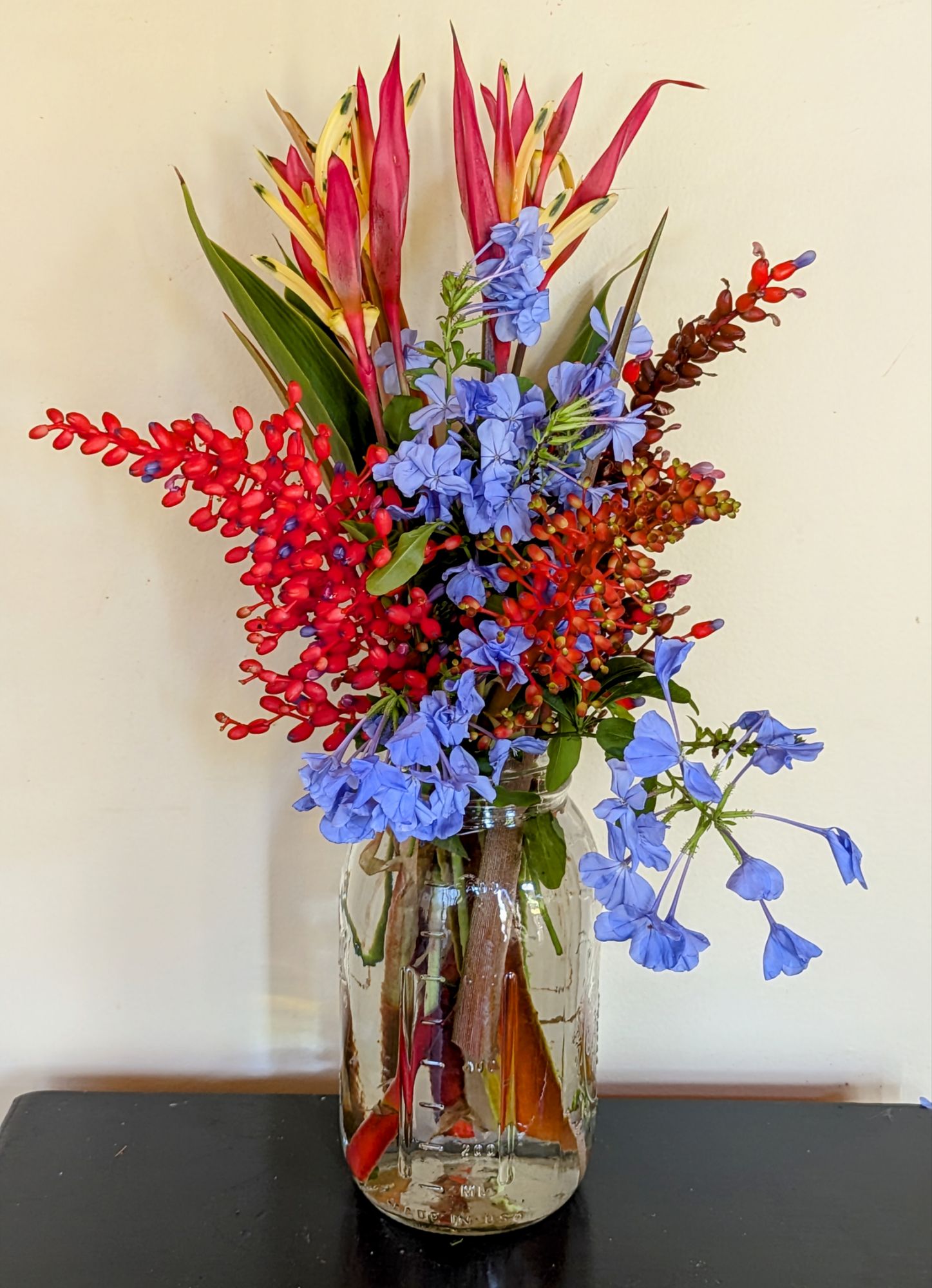
It’s high Summer, damp and humid, the tropical flowers are basking in the moisture producing bountiful flowers. For some reason a lot of these flowers are red. My theory is they are red to attract hummingbirds, seemingly a major pollinator in tropical rainforests where a lot of these plants are from. I could be wrong. I was quite surprised this morning by an aggressive Gulf Fritillary butterfly trying to get a taste of my herbal scalp conditioner!
I decided to use a primary colors theme as opposed to a patriotic one. I am finding myself embarrassed and unsupportive of what is going on in my country right now. White flowers were purposely left out. All of the plants are from elsewhere.
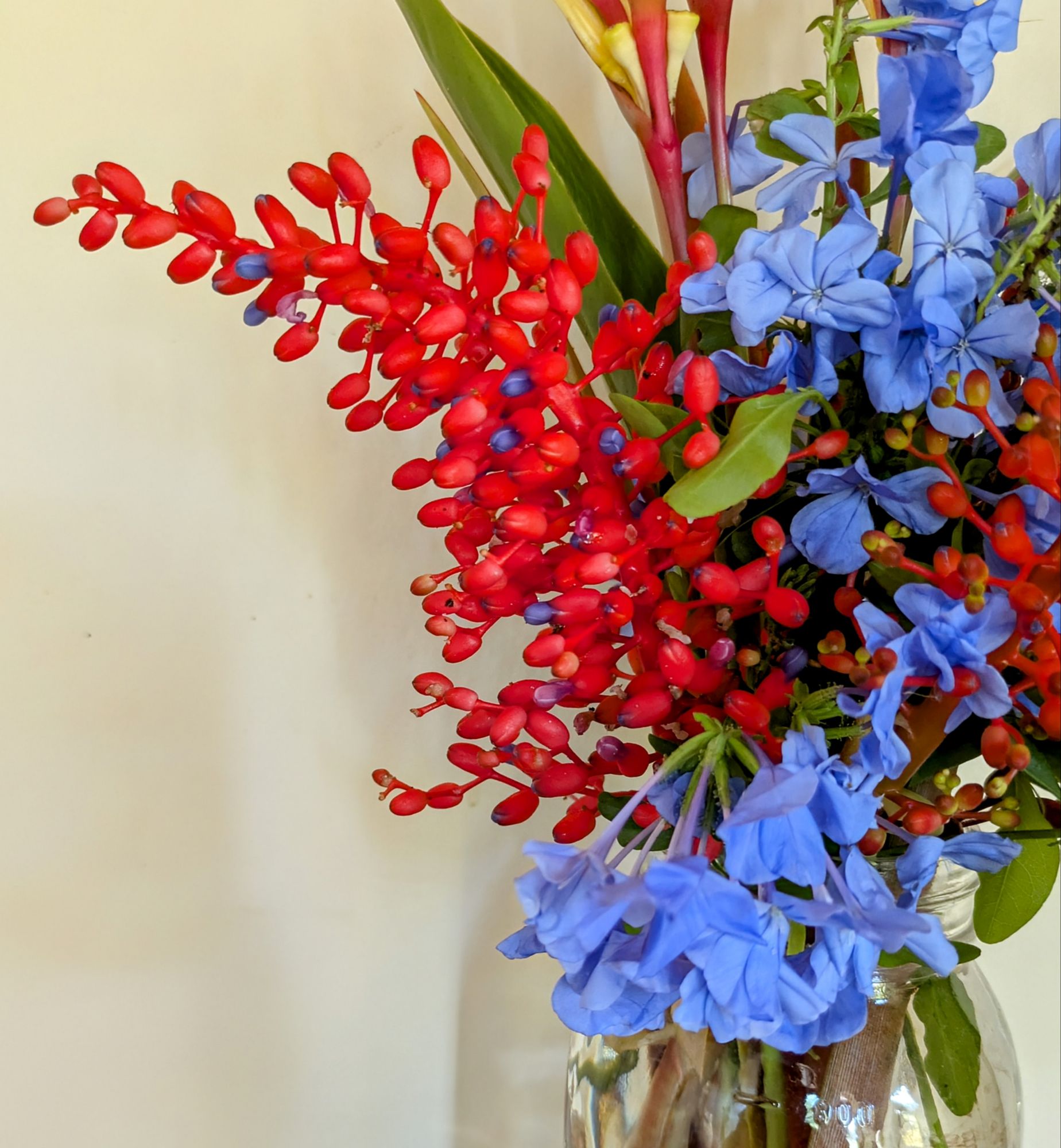
Red spikes are Aechmea miniata, from Brazil, surrounded by Blue Plumbago (Plumbago auriculata) from South Africa.
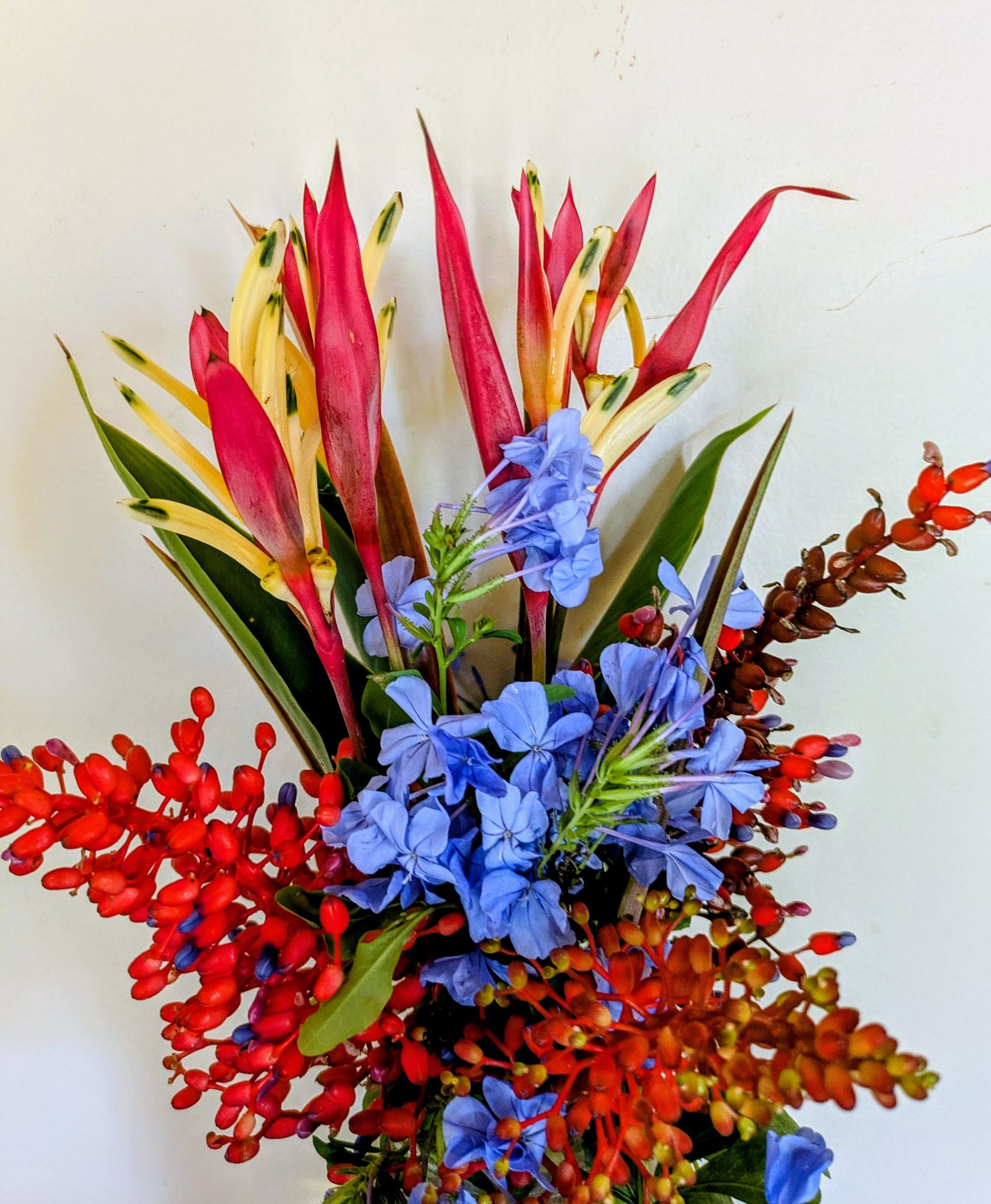
“Lady Di’ Heliconia (Heliconia psittacorum) flowers and foliage are in the background with a few spears of Miniature – “Lava” I think, Pineapple. Heliconias are from Central and South America. Pineapples hail from Brazil and Paraguay. The area I live in used to be home to huge pineapple plantations. I rarely run across pineapples in their natural state – extremely sharp foliage, probably four feet tall and mad colored, tiny fruit.
I think I have digressed enough! Follow this link RamblingintheGarden to visit Cathy’s blog and see what other gardeners have in their vases this Monday.

 The Shrub Queen
Heliconia are hummingbird flowers. Aechmea probably are also. Both are from the right region. Many butterfly flowers look like hummingbird flowers, and of course, many will take what they can get. Some of what seem to be hummingbird flowers are native to where there are no hummingbirds.
LikeLiked by 1 person
Have you seen these tropical hummingbirds that pollinate the Lobsterclaw Heliconias? They are fantastic.
LikeLiked by 1 person
No, hummingbirds are common here, but no tropical sorts.
LikeLiked by 1 person
THANK YOU SO MUCH FOR THE SEA GRAPE SEED! I am so sorry that they had been in the mail box for more than a month. I did not realize that it had been that long since I checked my mail. I found them yesterday. They were down earlier today.
LikeLiked by 1 person
That is funny about the butterfly. I never thought of them as aggressive. Speaking of what is going on, my heart is still breaking for the Texas camps (which my girls attended). They refused money for a warning system because it was from Democrats. We need to be united and do what is best for all people.
LikeLiked by 1 person
The Gulf frit males are known for aggressive mating behavior..this one was clearly going for my hair. Weird. My heart is also broken for so many children needlessly lost by a preventable disaster. If politics contributed I am more saddened. There are some truly evil people in this world.
LikeLiked by 1 person
It’s possibly as hard to find red plants for the garden as it is to find blue, if not more so, and both can make such a great contribution. I love your vibrant tropical vase this week and feel sorry that you are in a position where you feel embarrassed by your own country
LikeLiked by 1 person
Thank you, Cathy.
LikeLiked by 1 person
The touch of blue in the Aechmea is perfect with the plumbago. I’ve been thinking about replacing a reportedly highly flammable Cistus ladanifer ‘Blanche’ with a plumbago if I can find one with deep blue flowers like yours that won’t grow the size of a house.
I feel similarly about red, white and blue displays right now. It’s a very depressing time.
https://krispgarden.blogspot.com/
LikeLiked by 1 person
Thanks, Kris. I was surprised to find several cultivars of Plumbago. I think this is Imperial Blue and it grows more slowly than the straight species but is more prostrate – still pretty creepy, but I love the color.
LikeLike
Beautiful brights. That blue is a stunner. Stay in the garden and don’t read the news! If only it were that simple!
LikeLike
I considered using primary colors this week, too, but ending up elsewhere. My blues and reds wouldn’t hold a candle to yours however!
LikeLiked by 1 person
Red flowers are more likely to be pollinated by birds as they have tetrachromatic vision. Bees find it difficult to distinguish between red and green. However they are pollinated your red flowers are stunning and look amazing with the blue plumbago.
LikeLiked by 1 person
Thanks, Liz. I think you are right. Bees and butterflies go for white, blue and yellow? I think, but I see them on red, orange and pink as well.
flower omnivores?
LikeLike
Oh, that blue… it is so dreamy, even among your hot tropical reds. I am always attracted to blue flowers, but the reds are glorious – red is a little more difficult to find in European gardens and in southern Germany almost everyone relies on ‘Geraniums’ (Pelargoniums) for summer colour. It is a beautiful combination Amelia and I hope it cheers you up. 🤗 (If it is any consolation, I am embarrassed by the war-mongering government in Germany too.)
LikeLiked by 1 person
Thanks, Cathy. There is a lot of red in tropical flowers. Geraniums are a primary winter color plant here. It is a consolation! Thank you. I wish they would all stop and behave like human beings who cared about something.
LikeLiked by 1 person
I am supportive of your non-support for what is happening around the country right now. The flowers you’ve assembled are strikingly beautiful. I love, love, love the Blue Plumbago.
LikeLiked by 1 person
Thanks, Susie. Alligator Alcatraz is a little too close.
LikeLiked by 1 person
Pretty
LikeLiked by 1 person
I love the combination of cool and hot shades.
LikeLiked by 1 person
Thank you.
LikeLiked by 1 person
Fabulous colours and so artfully arranged.
LikeLike
Thank you, Noelle.
LikeLike
Oh I love the plumbago Amelia – just wish that they were hardy over here! I’m sure that there must be still a lot to be proud about when it comes to your country apart from a number of politicians 😢
LikeLiked by 1 person
Thanks, Anna . I grew them as summer annuals in Atlanta, there are some massive shrubs here, I’m trying to be positive, but it is hard.
LikeLike