In A Vase on Monday – Gingerly Simple

20170312_152353

I have been thoroughly enjoying the flowers from my Shell Ginger (Alpinia zerumbet) over the past couple of weeks. So much that most of them have ended up in vases in the house. These are interesting tropical accent plants that are fairly common in South Florida, but oddly enough a bit hard to find to buy. A couple of years ago I found one for my favorite price -five bucks at a garage sale. Sold!

Planted beside our garage to screen an ancient (and exceedingly ugly) pressure treated pine fence and doing an admirable job, reaching 6 feet high and wide in about two years. The flowers are icing on the cake. Starting as a chain of shiny pink flowers resembling sea shells (hence the name) a 6 inch long bud spills the pink shell like flowers out – then a yellow orchid like flower follows at the end.


The foliage is lush and tropical and is evergreen where I live, further north it dies back in the winter – even further north an annual. There is a variegated Shell Ginger with beautiful foliage, unfortunately it rarely flowers, but is still a great accent.

20170305_142419

20170312_105240-1So, why “Gingerly Simple”? Usually I like to stuff a variety of flowers into a vase, these I think stand alone and look better displayed in a simple vase with a few real seashells.

In A Vase on Monday – Dilly Dally Daisy?

20170305_133009-1

The Dill is still blooming madly in the herb container so I could not resist cutting some more and dilly dallying through the garden looking for something different to accompany the Dill. I added some sprigs of Rosemary from the herb containers and the rest of the vase is composed of wildflowers from the garden, some I planted and others appeared without encouragement from me.

20170305_132746-1

Joining the Dill and Rosemary are: In yellow, Beach Sunflowers (some call them Beach Daisies Helianthus debilis); in red, Tropical Red Salvia (Salvia coccinea); I planted both of these native wildflowers. In blue, the native Ageratum (Ageratum houstonianum); the white flowers are Spanish Needles (Bidens alba). The Ageratum and Spanish Needles just pop up at an alarming rate. Seemingly from thin air.

My husband’s comment about this ” a very perky arrangement” There is something cheerful and perky about wildflowers and especially daisies. There aren’t really daisies in the vase, but the resemblance is clear. The vase is a thrift store find and I like the hot colored flowers displayed in earth tone pottery. With the Rosemary, Dill and Salvia this vase is leaving a lovely herbal scent in my foyer.


In A Vase on Monday – It’s A Dilly

20170225_163423

It’s a Dilly, is that an American phrase? As far as I know, Dilly translates into it’s remarkable, notable or wonderful. Sources on the Internet say this is Canadian or American slang. Vasers will tell.

This vase is all about my herbs, I am mourning the impending passing of my Dill plant (this plant has been wonderful) this week. I love fresh Dill with salads, fish, tomato cucumber salad and on and on It has been flowering for at least a month, I keep cutting the flowers hoping for more foliage to eat – alas to no avail. So, I decided to cut most of the flowers for a vase. Some wasps seem to like the flowers as well – I left those guys alone. I hope the wasps inspire more edible Dill.

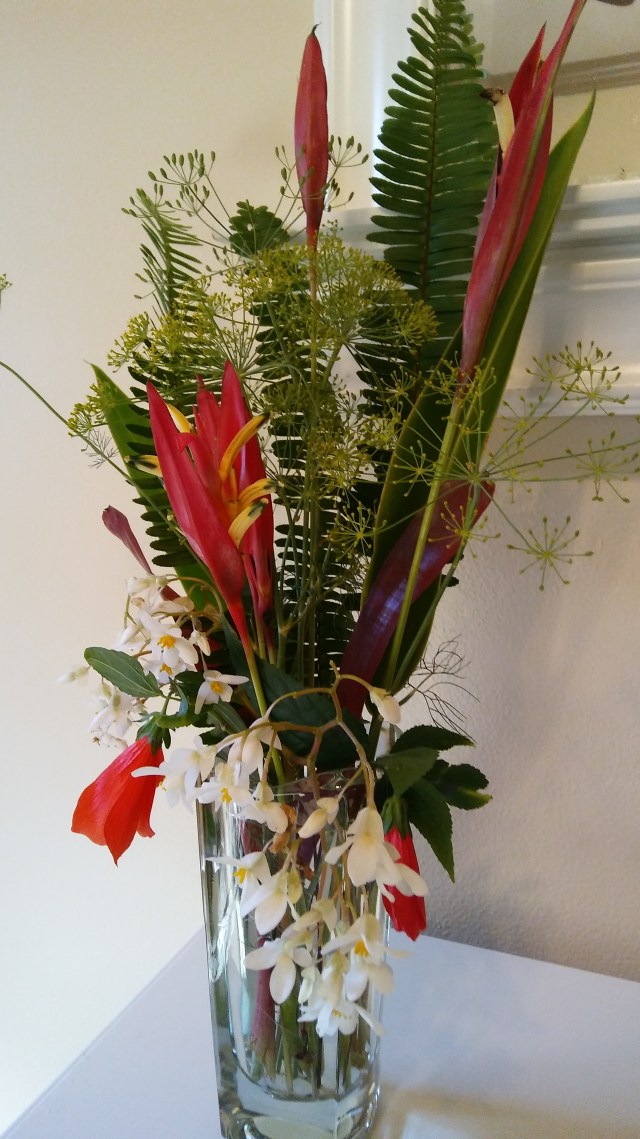
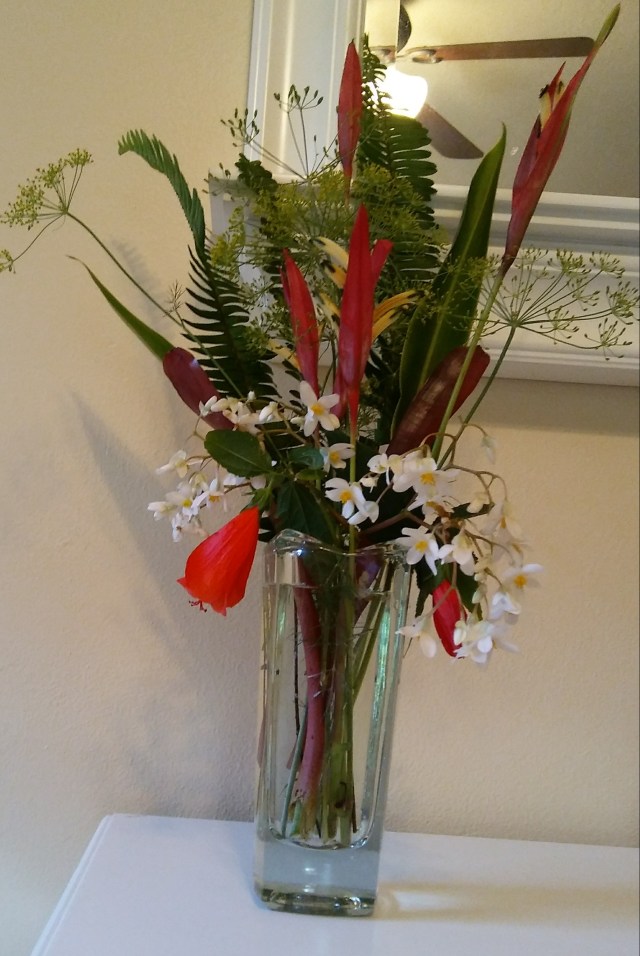
The Heliconias (Heliconia psittacorus) nearby suffered from something so I cut back and fertilized them a week or two ago. The plants are responding nicely and their flowers have joined the Dill. Sweet Begonias (Begonia odorata “Alba”) in white are flowering again and joined the dirge as well as an unnamed Bromeliad with nice red foliage and some big Ferns that popped up in the garden, again no idea what the ferns are. The red flowers are the native Turk’s Cap Hibiscus (Hibiscus malvaviscus pendiflorus)that rewards me with flowers with the least bit of attention. I watered them!

The vase is a gift from my dearly departed older brother. Always a bittersweet reminder of that makes me miss him. Though I am certain he would be happy I am using the vase and thinking of him.

Here is a close up:

20170225_163213-1

It’s a Dilly!

20170225_163154-1

In A Vase on Monday -Time In A Bottle

20170219_103124

As I was thinking about a subject for a vase, it occurred to me putting a vase together every week is a bit like saving time in a bottle. The dates are right on the blog post for reference and I  find (not being a keeper of garden journals) myself referring back to my blog to see when plants have been in bloom. The watch ( a la Salvador Dali) a gift from my father many years ago. The persistence of memory can be troubling.

20170219_133314

The largest plant in a preowned pink champagne bottle is Shell Ginger (Alpinia zerumbet). Shell Gingers were a bit of a mystery to me upon my arrival in Florida. The variegated type is commonly used as an annual further north for its foliage, but the green ones I had not encountered until I ran across one at a garage sale for (my favorite price) five bucks. Warnings are commonly issued about the size of these plants, a few years after planting it is six feet by six feet – but it also also planted in front of an ugly six foot fence. Gotta love it when a plan works out. It also appears to be on the verge of bursting into full bloom all over, however, this is difficult to discern as buds. leaves, etc look remarkably similar. If the whole thing does flower I will definitely post some pictures.

20170219_133256-1

The heirloom blue bottle (another gift from my mother) holds a new arrival to my garden, in purple, Ground Orchids, I think this is a Bletilla of some sort, but as usual no one selling these plants really knows. Ground Orchids are fairly common in South Florida and used as 18″ height perennials – mine have been placed under a Pink Frangipani, next to a plum foliaged and flowered Bromeliad of unknown origin and beside a group of the Pink Bromeliads-the flower currently displayed in the gold bottle. Alongside the mysterious Orchid we have culinary Dill flowers, pink Tropical Salvia (Salvia coccinea) and Dwarf Pineapple foliage.

20170219_133335-1

This vase contains a Billbergia Bromelaid of uncertain origins ( found thrown out with trash whilst walking my greyhounds) What I can say is I find it unreasonably sharp and beautiful. I may someday learn its botanical name, though I doubt it. In the vase there is some foliage from another, unrelated Bromeliad, a Neoregelia of the Fireball continuum I think.. And a bit of Asparagus Fern that appeared one day and I suspect my floral ambitions are keeping it at bay. The gold bottle has a cork and has served as an olive oil container.

Time in these bottles preserves mid February flowers in my garden or maybe the photos really provide the preservation. Next year will bring the answer all gardeners want to know – will it flower again?

Will our memory persist? One can hope or ask Dali.

In A Vase on Monday -Bouquet of Love


cam00399-1-1-1

Passionflower vine rambles through some overgrown shrubs in the back garden. The vines were left to ramble because the hummingbirds enjoy them and some native Passionflowers produce an edible fruit, although I have yet to figure out how to tell one from another. While standing under the shrubs channeling Sir Isaac Newton, a passionfruit fell at my feet, inspiring this vase.

20170212_101932-1

The inspiration provided, passionfruit at my feet, as Valentine’s Day is Tuesday – I thought If starting with a Passionfruit could the vase be filled with flowers that have a meaning related to love? During the Victorian era in England, flower arrangements were made to convey sentiments based on the selection of flowers and the meaning associated with a flower. For example, a bouquet of lilacs would mean first love. If you were the recipient of the Lilacs someone was telling you they were in love with you and for the first time.

Seizing the challenge, I cut a passionfruit still on the vine and searched the Victorian flower dictionary for plants with love related meanings.

20170212_101853

A close up of the plant palette and the meanings of each component:

The  red flowers are Dwarf Jamaican Heliconia (Heliconia stricta) meaning Adoration.

The orange flower is Mexican Honeysuckle (Justicia spicigera) meaning Bonds of Love.

Asian Sword Ferns meaning Sincerity.

The dark, ferny leaves Copper Fennel (Foeniculum vulgare) meaning Strength and Praise

Rosemary (Rosemarinus officinalis) meaning Remembrance

Viny plant on the right is Variegated Needlepoint Ivy (Hedera ‘Needlepoint’) meaning Friendship and Fidelity

Last but not least:

The yellow fruit is Passionfruit (Passiflora incarnata) meaning Faith

The result – a bouquet of love for Valentine’s Day from my garden. With the addition of a little something from the kitchen our celebration will be ready.

20170212_170934-1

A little chocolate to go with the flowers!

Happy Valentine’s Day.


In A Vase on Monday – Tropical Blues

20170129_133859-1

It’s Sunday afternoon in South Florida and we are having a rare rainy day with temperatures in the 40s (F). It’s damp and dreary and my greyhounds are grumpy because they have been cooped up in the house all day. Alan (the greyhound, not my husband) went into the backyard, jumped into the air put both paws over his head and threw his collar off and onto the ground burying it in the sand in disgust.

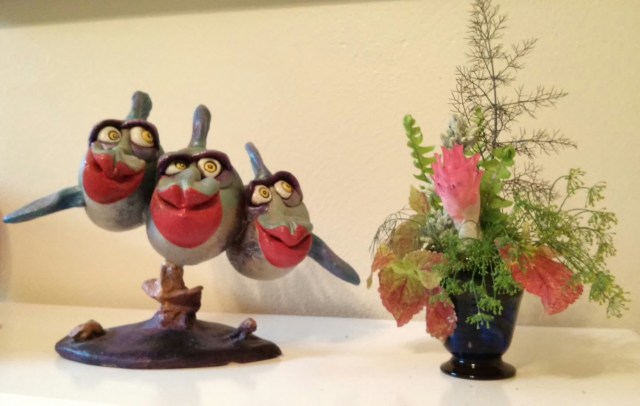
We have the tropical blues. No sun and no blue skies today. Some Kissy Fish and a new Bromeliad in a blue vase will cheer things up.

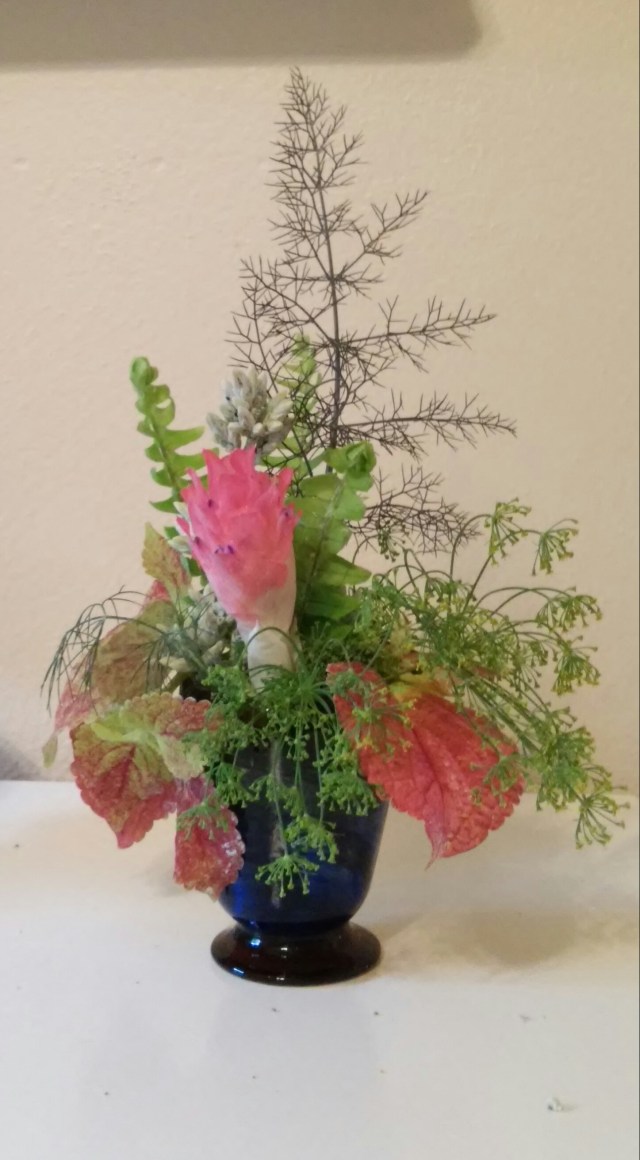
I was pleased to find the small Pink Bromeliads (Quesnelia testudo) I planted last fall starting to flower this week. Another one of my mystery plants, bought nameless (3 for five bucks!) at a Botanical Garden sale, I thought these were something else entirely, but the Quesnelia have worked out quite well and flower in mid winter here. Someday I will have a drift of Pink Bromeliads under my Shell Gingers.

20170129_133916-1

Not wishing to venture out in the rain again, I cut the rest of this vase from containers on my front porch. Joining the Quesnelia are: in pink and chartreuse foliage, Alabama Sunset Coleus; chartreuse flowers from Culinary Dill, the darker fine textured foliage is Copper Fennel from the herb containers and a bit of grey Flapjack Kalanchoe flowers and Asian Sword Fern foliage. The blue glass footed vase is a family heirloom.

20170129_133302

The Kissy Fish are part of my husband’s collection of unusual ceramics. The artist is Steven Smeltzer of Maui.

Speaking of my husband – he has been in the kitchen this afternoon seeking to cure our case of the Tropical Blues. Baking a Blueberry Pie:

20150811_142604

I am sure to feel better after dessert.

Pineapples and their Cousins


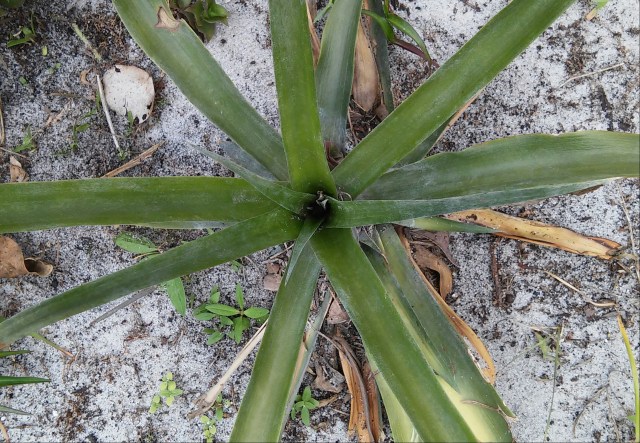
A common element in South Florida gardens is the pineapple patch. Almost everybody has one, from a northern perspective, it seems kind of weird. Grow your own pineapples? Why not? Even one of our neighbors, his yard could be described as nouveau retch, is seen regularly hand watering his pineapples.

20160422_135000-1

Pineapples are in fact a Bromeliad, which are currently my favorite tropical perennial. Among the many Bromeliads I have planted that are purely ornamental I am afraid I have fallen prey to the trend and now have a pineapple patch between my citrus trees. I eat pineapple just about year round and the tops kept rooting in the compost heap. Unfortunately, the above is my patch, not too pretty.

Pineapples have an interesting history. Originally from the area where modern day Brazil is located, they moved via canoes paddled by traveling natives north to the Caribbean Islands where sea captains picked up on them and carried them home. One early accounting of the discovery of pineapple recounts a meal served by the Caribe tribe where a plate of pineapple rested next to a cauldron of boiling cannibalized humans. I think I would have asked for the fruit plate.

A status symbol on the dining tables of colonial America, pineapples were often rented for centerpieces and then sold after a few uses for eating. Thus the pineapple as a symbol of lush hospitality was born. The prevalence of pineapples as a decorative element may be explained by its being cheaper to carve decorative pineapples into bed posts or garden ornaments instead of renting them by the hour.

The Treasure Coast of Florida, the area I currently call home was once home to a large pineapple plantation. In 1895, Jensen Beach, Florida was named the Pineapple Capital of the World, shipping a million boxes of pineapples a year during the summer season. Later that year a devastating freeze decimated the crop, followed by a few tragic fires and fungal diseases that finished off the pineapple industry by 1920. Agricultural pursuits were redirected towards citrus. Wild Pineapple plants can still be seen on Hutchinson Island and are attributed to the original owner of the plantation, John Jensen.

Like many other popular plants, pineapples have also been bred for Ornamental use. Here are two prettier pineapple plants.


Piecrust Croton and Friends

20151230_153823

Piecrust Croton

I have been reworking  the design of my front yard because the access point for the septic tank was in a lawn area and actually needed access. What this really means is once a year a 3 foot circle in the lawn  is dug up and destroyed to clean the (ewww, yes) septic tank filter. The joys of country living. I am certain I did not know septic tanks had filters prior to moving to Florida. I also realized I would like to have a pathway to the side.

For many years I have advised my clients to live in their houses for a while to see how they move around the property as sometimes a good guess just really doesn’t do the trick. The upshot is I did not take my own advice and I like to travel to my side garden (ah, future garden) more than I thought I would. Design that originates with how you live in a place is always a good plan. This may be Plan B as I did Plan A. Who knew St. Augustinegrass wouldn’t be happy over a septic tank. Oh, well. I am liking the new bed thus far.

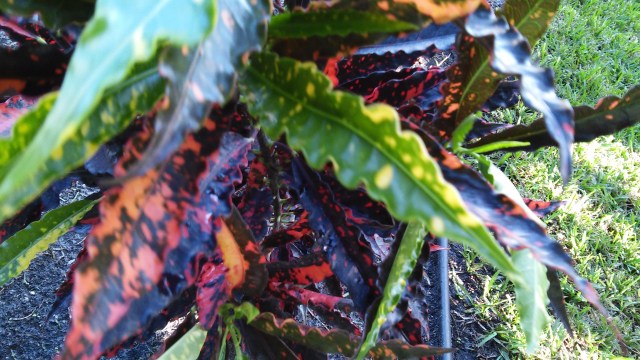
A nod to my husbands pie making skills was the purchase of a Piecrust Croton, a multi colored tropical shrub that hails from the South Pacific. These shrubs are easy to grow and ubiquitous in South Florida. There are a few stalwart standby varieties that are common, but of course I love the weird stuff.

Here are the standard varieties:

At the top of the post is the foliage of the Piecrust – it looks like, you guessed it, Piecrust!  The rest, clicking on the picture will give the name. Being the plant freak that I am, I couldn’t resist photographing several more interesting varieties:

I  love all of these, but I think Stoplight might be the next Croton purchase on my Croton bucket list. How many people have a Croton bucket list?

Yes, the beds are getting bigger. The good news is I probably have a quarter acre left!!

Back to the inspiration for all of this, the piecrust. Here are a few of my husbands pies:

I think these merit a celebratory Croton in the front yard.

Speaking of celebratory, Happy New Year to all.

Middle Age Baking – The Saga of the Guinness Cake

The Guinness Cake

The Guinness Cake

An old friend recently posted a picture on Facebook of a Chocolate Cake made with Guinness Stout (topped with Cream Cheese Frosting)

Being an affirmed chocolate lover, the pictures and the recipe sounded great; so I decided to try the cake.

Not being a Stout drinker, I needed a single beer. Well, Jensen Beach, Florida, to a certain extent, is the end of the earth, so finding a single Guinness Stout was a bit of a challenge, but I did it. Then realized I had no cocoa powder, sour cream or cream cheese.

Having collected the ingredients I set out to the library – the reason, a nearly overdue book. The second thoughts kicked in, does my refrigerator contain 10 tablespoons of butter? Better stop and get some extra. After a trip to Winn Dixie, the butter dilemma was solved. I started baking.

The first thing needed, a nine inch springform pan. I decided to measure mine, 10 inches and clearly something bad had happened to it during our move to Florida. Am I the only person in the world who uses an Engineers scale to cook? (type of ruler used by civil engineers) Put it in the sink to soak for a minute-nothing happened cementitous crud so stuck I need to get a new springform pan. Time to get out the two nine inch cake pans. I used my trusty Engineers scale to verify.

Having significantly misplaced my reading glasses – I read the ingredients and not the directions for the cake. Decided to heat the butter and cream it with the sugar, which I did. Then found the glasses and read I should melt the butter and add the Guinness – too late. I added the Guinness to the butter sugar mixture and chunks of Guinness foam sugary butter immediately floated to the top in the oddest baking misadventure I  have had to date. Imagine, Guinness stout as gigantic cottage cheese curds.

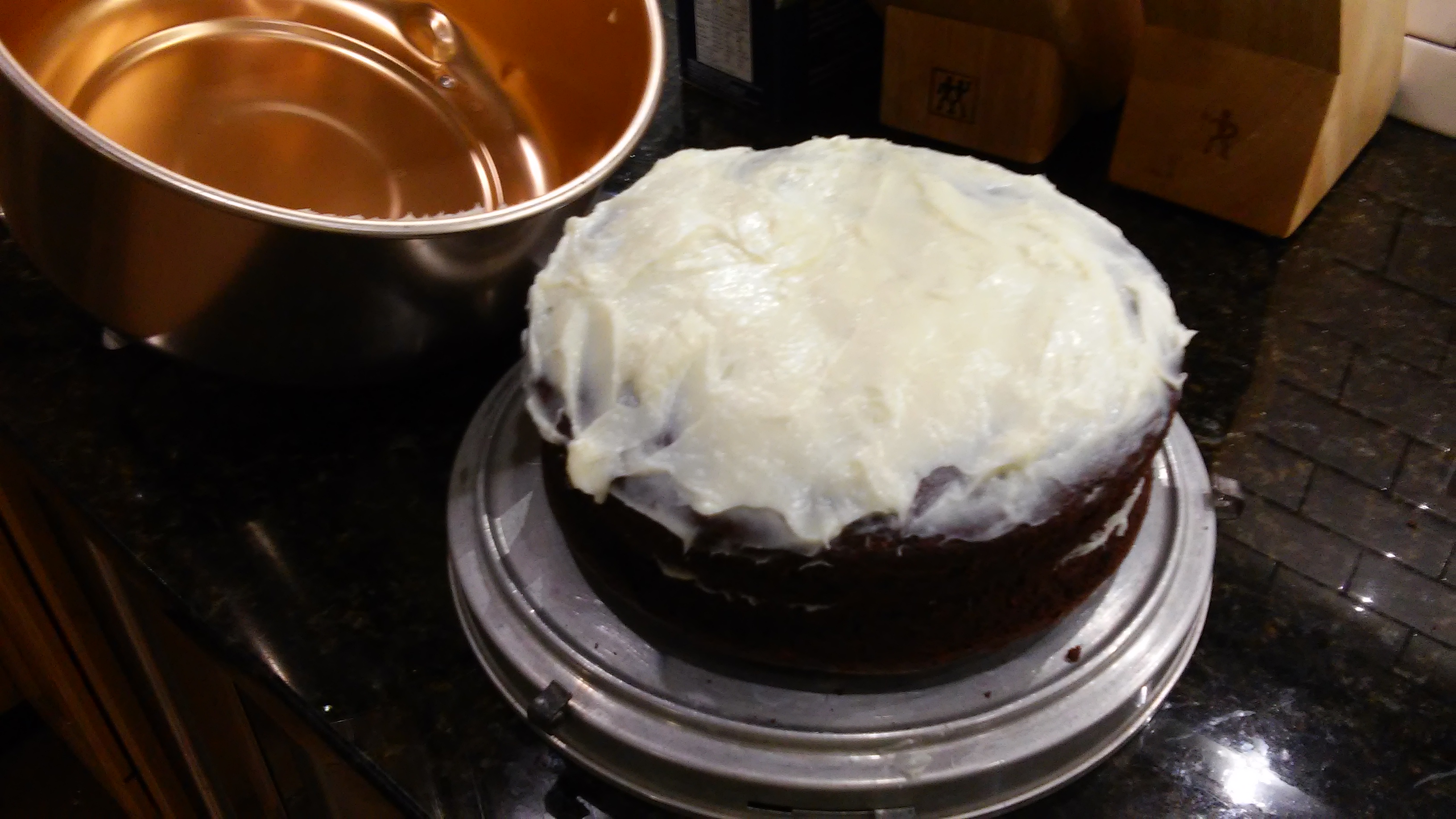
At this moment, I had a “what the hell” thought, added the dry ingredients, turned the mixer on and proceeded to not follow any directions and put the actually lovely batter into two (gasp) cake pans. Winged the cooking times and ended up with a two layer cake. Divided the frosting and finished the cake.

It was divine. I think it needs a layer of strawberry jam in the middle. Nigella describes the cake as not tasting like the stout, but having a ferrous tang. I am still contemplating that.

It is a really good cake. Here is a link to the recipe. http://cooking.nytimes.com/recipes/1875-chocolate-guinness-cake

Building a Seashell Driveway

The Before Picture

The Before Picture

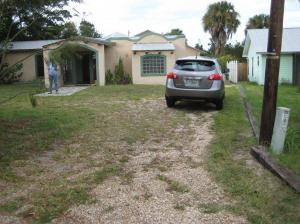
My husband and I bought a distressed property in South Florida. The driveway was really distressed. It took an archaeology dig to figure out where it had been and what it had been. After a bit of detective work we found a ‘Chattahoochee Stone’ pea gravel drive with a turnaround in front of the house. About 70 % overgrown with apocalypse proof weeds. The front yard became a free for all ad hoc parking area. Nobody could tell where they were supposed to park.

Part of the reason we bought this house was the garage was in the back. This is unusual in South Florida. Garage doors are usually a dominant feature of the front of the house. In some places it seems as if someone got a gigantic copier and started printing out houses with prominent garage doors. Later it dawned on me the reason for this is to provide the least amount of stormwater running off the concrete paving (the shortest possible driveway) and given the flatness of the terrain, it was also a short run to slope the driveway to provide drainage back to the street. It is also the cheapest way to get a lot of houses on a piece of property (i.e. Making the developer more money)

My husband retired and we decided to forsake the traffic and cold of the big city and moved 600 miles south from Atlanta to South Florida. The namesake of our existing driveway material, the Chattahoochee River, is a major feature in Atlanta.  The headwaters of the Chattahoochee are in the North Georgia Mountains, then it winds through Atlanta eventually pouring out into The Gulf of Mexico on the panhandle of Florida.

The driveway needed a renovation, however, it seemed a bit ridiculous, not to mention wasteful, to import pea gravel 600 miles to South Florida. Additionally, I was not enthralled with the brown pea gravel, having found it to be a fiesta of weeds in my previous garden and it cost at least 3 times what I had been paying for it in Atlanta. Based on the appearance of the existing drive it was nirvana for weeds. Not a good idea in South Florida.

The search began for new material for the driveway. The local rock here is limestone; crushed rock primarily for road construction. The rock is lumpy, starts out white and eventually looks very dirty. I didn’t like this option, but it was cheap. My next thought was pouring a concrete driveway, but, as a Very well seasoned Landscape Architect  (yes, I meant to capitalize Very for emphasis) I could tell the drainage just wasn’t going to work. In the event of rain, there would be too much water running off the driveway with nowhere to go. With the exception of the floor of our garage, not a good plan.

The driveway needed to be made of a pervious material so the rainwater could soak back into the ground rather than running off. During the course of my concrete drive design/pricing exercise I met a grading contractor who told me it was possible to build a shell driveway. What I couldn’t (and still don’t) understand was why there weren’t any of these driveways around. The only answer is they went out of style. People had been seduced by the evil brown pea gravel from the faraway Chattahoochee River.  I can only guess why. I did recall, however, over the course of my career people have waxed on romantically recalling the crunch of the pea gravel in their (perhaps very wealthy and with many yardmen) Grandmother’s yard.  This reminiscence is usually related to formal boxwood gardens in the Deep South. They never had to pull the weeds or pay for imported pea gravel.

I thought the shell was a great idea and, of course, did a bit of research. The shell used for constructing the driveway is mined about 20 miles north of my house. It is a byproduct of mining sand; five different sizes of material come out of the mine and are used for construction. The sand is used for construction and the shells are sorted out by size and intended use. My driveway is topped with ⅜” graded shell.

Shell driveways, properly constructed, last a long time. The construction method is as follows:

Grade the area and remove about 5-6’’ depth of existing soil. Compact the existing soil to receive the base material. Provide restraints around edges of driving surface to hold the loose driveway material. My driveway has pressure treated pine timber and Black PVC Landscape edging that act to hold the shell in place. I have seen drives edged with concrete curb or pavers set in mortar. This looks great and is, of course, a lot more expensive.

French drains were installed under the driving surface in areas where the water collects as it drains off the roof during a large cloudburst. Another South Florida peculiarity, no gutters, but some scuppers…you must cope with whatever comes off the roof, wherever it comes off the roof. Fortunately, I like rocks and Rain Gardens.  The drains were made from old solid walled laundry baskets with the bottoms removed then the contractor dug holes and placed them underground, filled them with gravel and topped the whole thing with filter fabric. The old gravel from the existing driveway was reused to fill the drains.

To build the driveway a 2-3” layer of crushed shell (this looks like coarse sand) is laid on top of the existing soil and pressed into place with a Bobcat. This is topped by a 2-3” layer of shell placed with a Bobcat and pressed evenly. The crushed shell course binds to itself and creates a pervious base layer. The shell course provides the driving surface. Maintenance requirements are spraying weed killer (I use the non toxic homemade vinegar solution) and raking it out every now and then. The materials firm up a great deal from cars driving on them and rain, but it is still a loose material.

I am pleased with the appearance of the shell driveway and it’s functionality. It drains perfectly and looks great. The shell also gives a great local, beachy feel to our property. And it looks really clean. It is also a very sustainable project, the majority of the materials arrived from within 50 miles of my house. The shell is a reuse product from a local mine. The driveway is pervious and most of the stormwater drains back into my property. I have two guest parking spaces and a turnaround for use when backing out of the garage. Pleasing the environment and me.
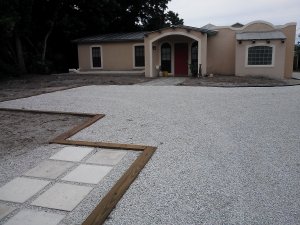
The Shell Driveway

The Shell Driveway