In a Vase on Monday – Salvia – ation

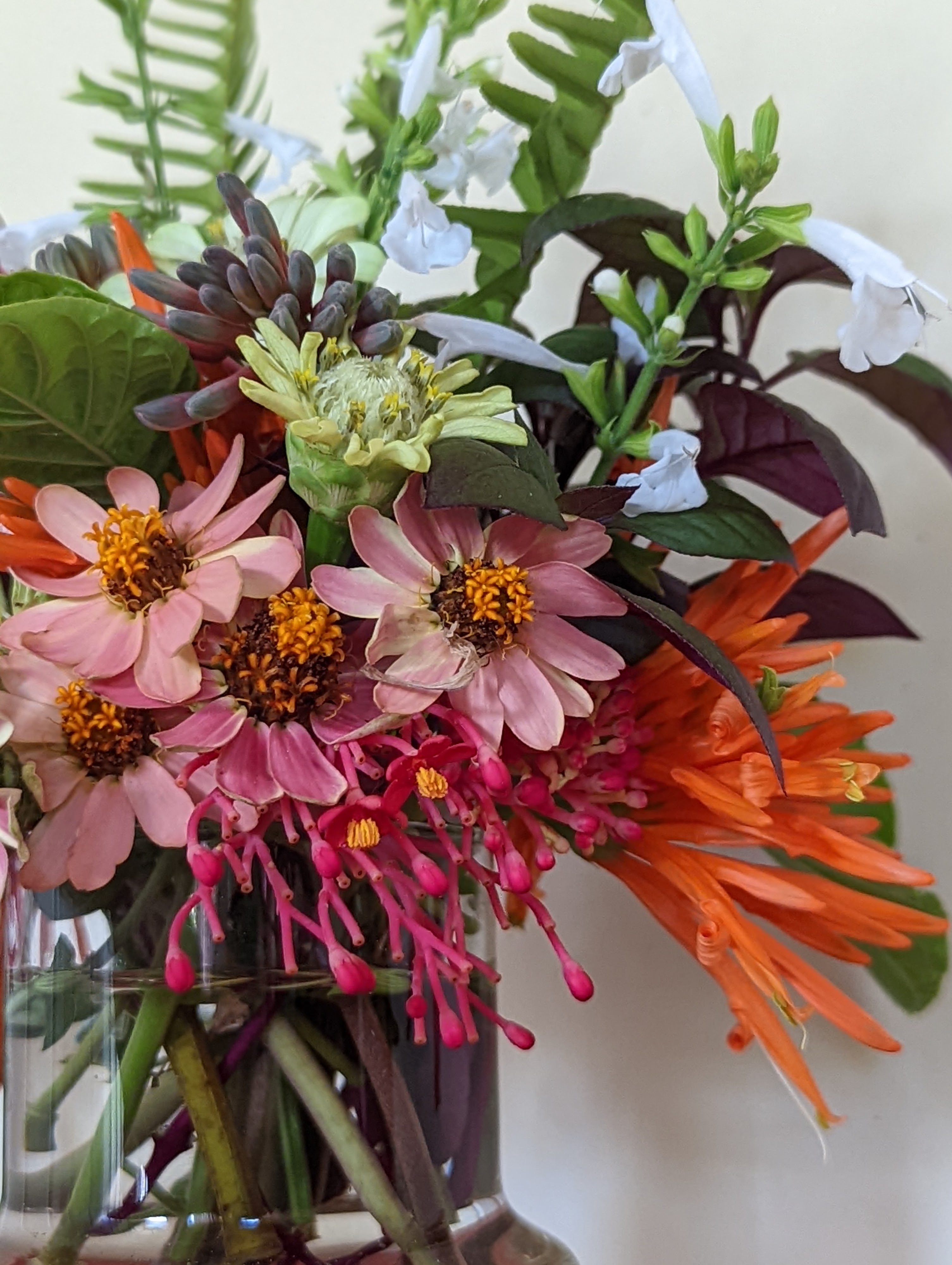
Salvias have been the salvation of a few intractable areas in my garden. The native Tropical Red Salvia (Salvia coccinea) has evolved into one of my favorite plants. It thrives in a mostly unirrigated area of my garden that is infested with soil borne nematodes. The nematodes have eaten the roots of virtually everything else I have tried there. I spent a great deal of time amending the soil and doubling the irrigation to grow vegetables – only to harvest about 3 tomatoes and watch the rest of the veg wither and die from the pests below. The salvias reseeded themselves into this space and are happily flowering away. I am glad something is enjoying all the soil amendments besides the nematodes. ‘Mystic Spires’ is the blue salvia in the arrangement, this one has been flowering in my garden since March 2021, the other one passed on this summer and this one is petering out, though I have no complaints about their performance. Surviving two Augusts in South Florida is an amazing achievement.

This is one of those dinner party vases. It looks great for a dinner party and fades a day or two later. I think the vase must have arrived with a floral arrangement at some point.

Closer views:

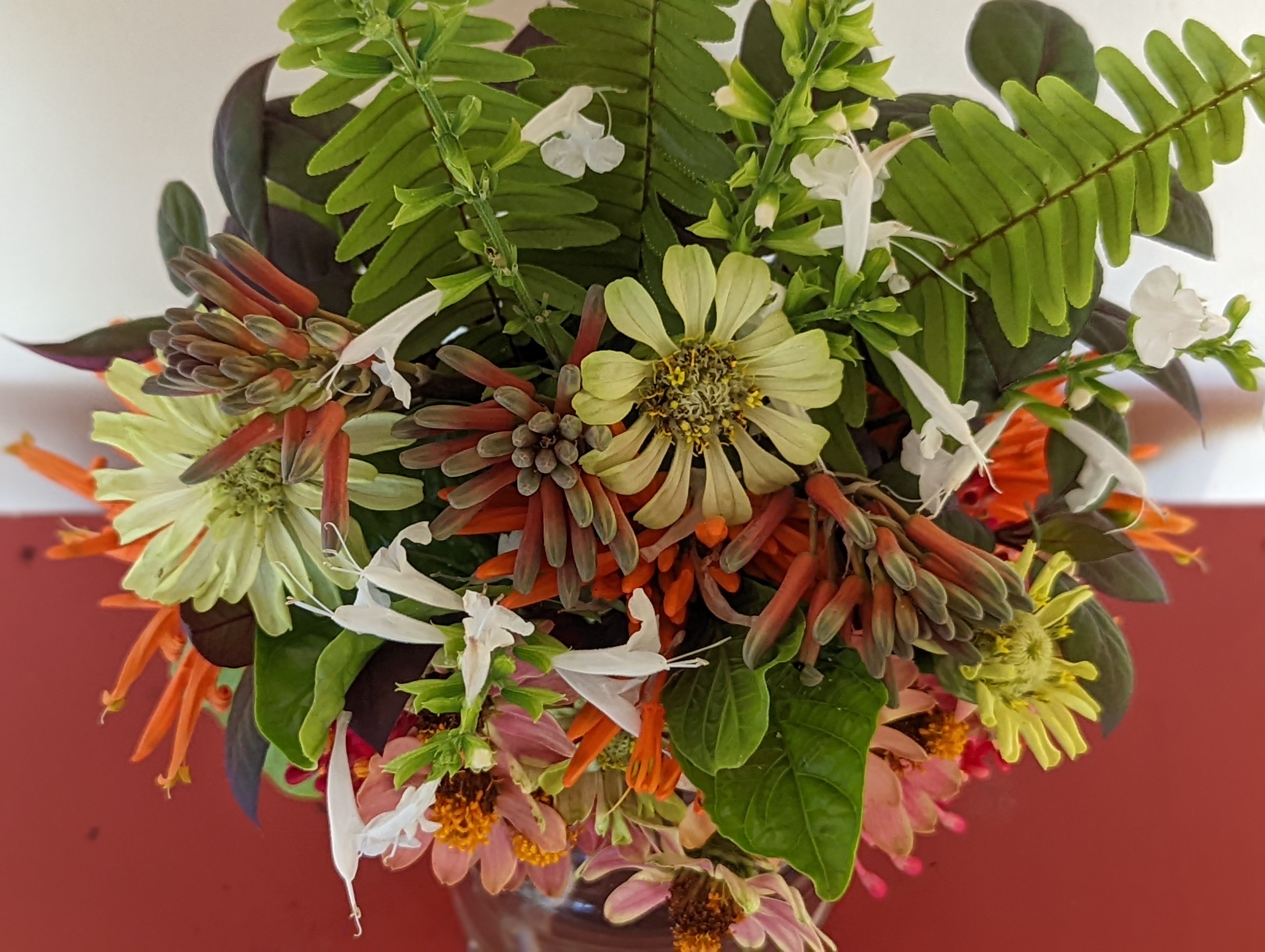
The salvias… Tropical Red Salvia (Salvia coccinea) can be white, pink, salmon or neon orange. I have yet to see neon orange, but have all the other colors. Blue salvia is Mystic Spires.

The white flower is a vinca that reseeds from somewhere around my house. It has also done well in nematode land so I let it go. This is kind of a rangy plant, so I suspect it is a parent plant of all the cultivar vincas that got loose in Florida. I see these by the side of the road. Yellow flowers are from Thyrallis (Galpinia glauca) this is a shrub that used to be considered native but is now a foreigner. Sigh.

Thank you to Cathy for hosting IAVOM. Follow this link to see more vases: http://www.ramblinginthegarden.wordpress.com

Happy Gardening!!

Six on Saturday – Natives and Friends

It is finally raining here, and in typical gardener fashion, I am going to complain – just a little too much. The weeds are going crazy and it is supposed to rain for the next several days. Fiona, the hurricane, not the greyhound. is supposed to meander by next week, undoubtedly bringing more rain. Fiona the greyhound is not terribly worried.

Back to plants and SOS. I am joining the SOS meme, hosted by Jon at http://www.thepropagatorblog.wordpress.com. To see more posts, follow the link.

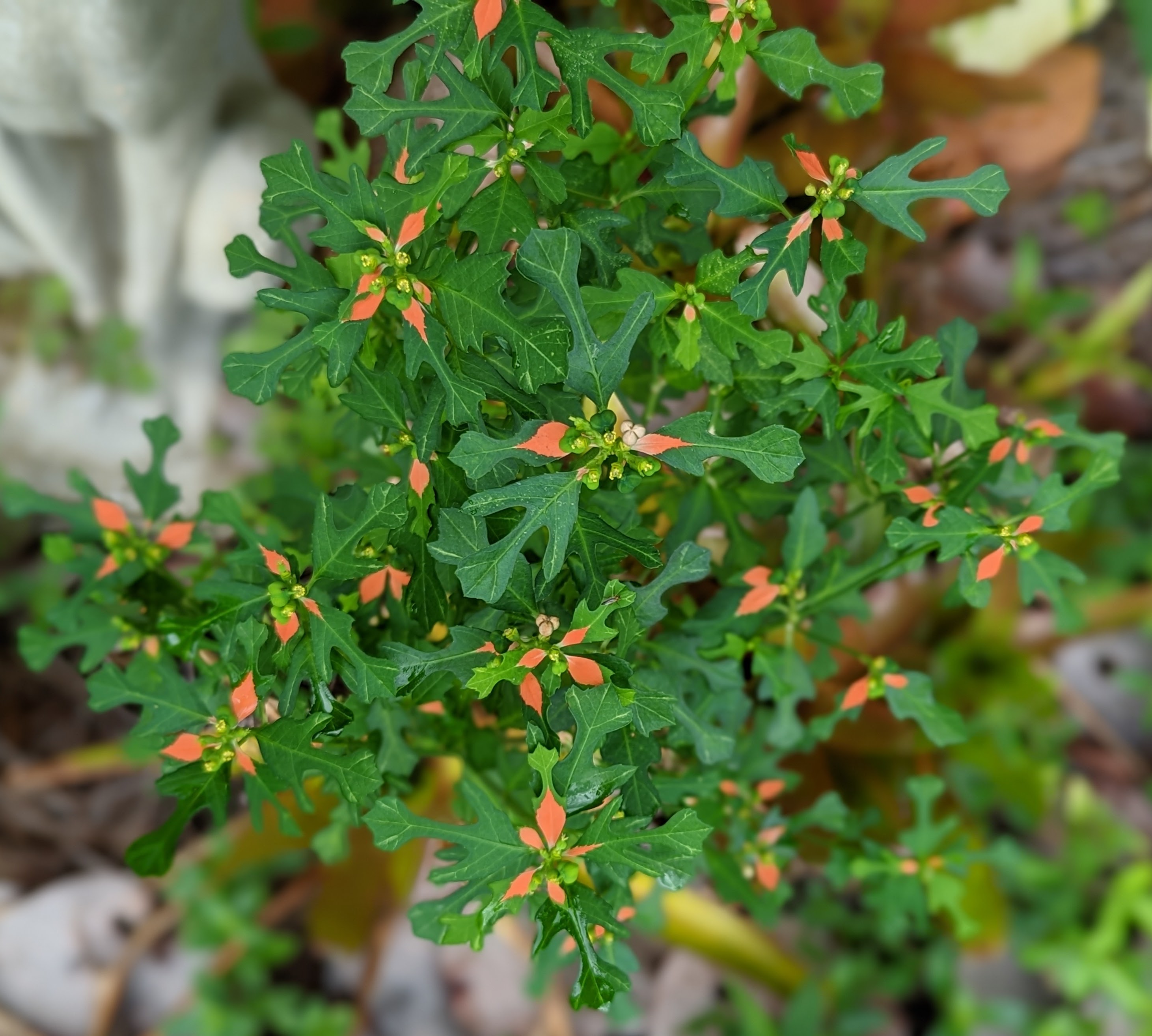
This is a native Poinsettia (Euphorbia cynathophora). These pop up here and there and do not reseed much, so I enjoy the little pop of red in the garden.

Native Dayflower (Commelina erecta). Another one that just pops up in the garden and behaves nicely.

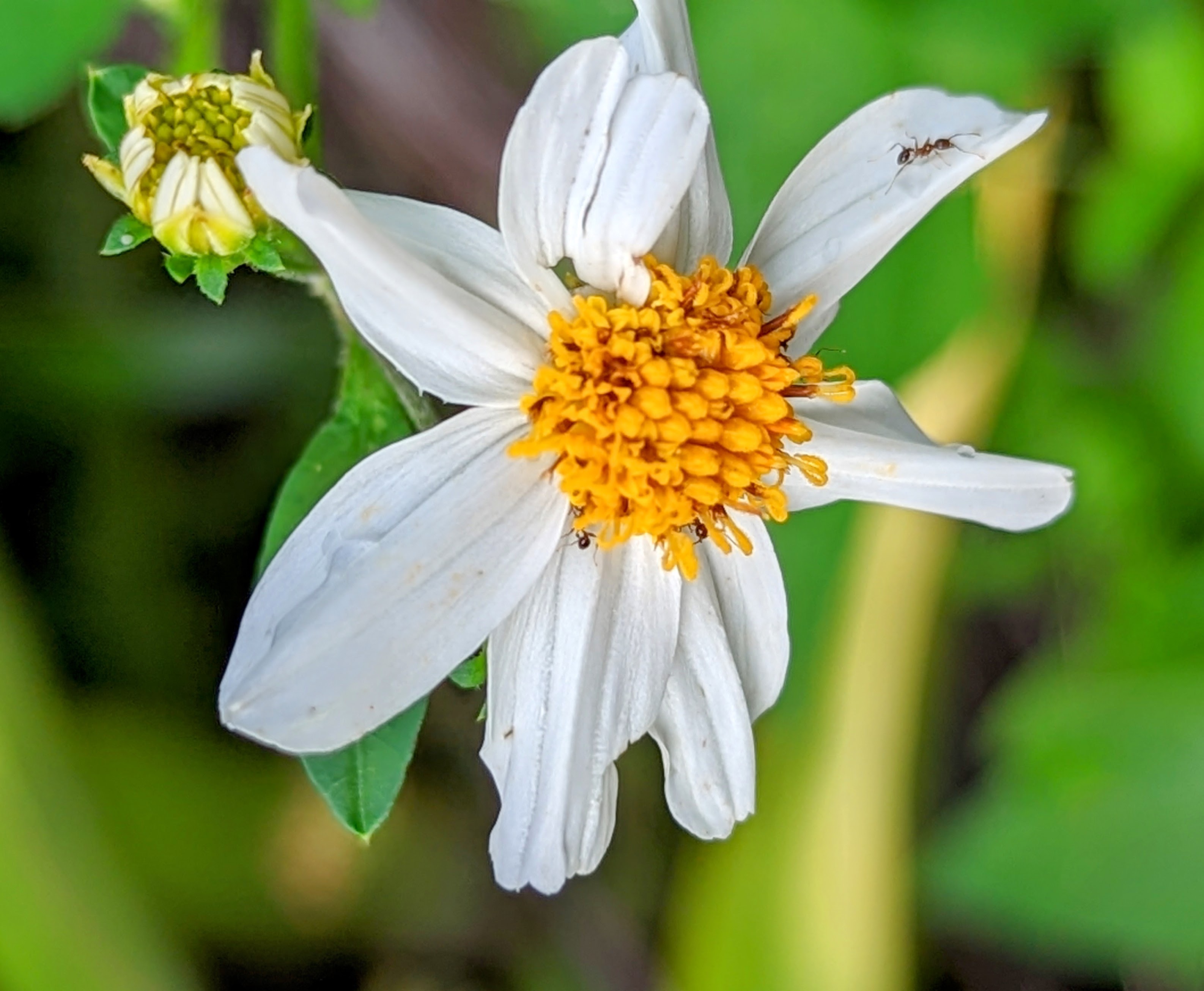
Native Bidens alba. One of the many common names is Spanish Needles, which leaves me wondering if the Spanish explorers of the Florida peninsula used the seeds for sewing. Not sure how, they are sharp, but maybe a half inch long. The one I love to hate. Reseeds madly, but so cute and the pollinators love it.

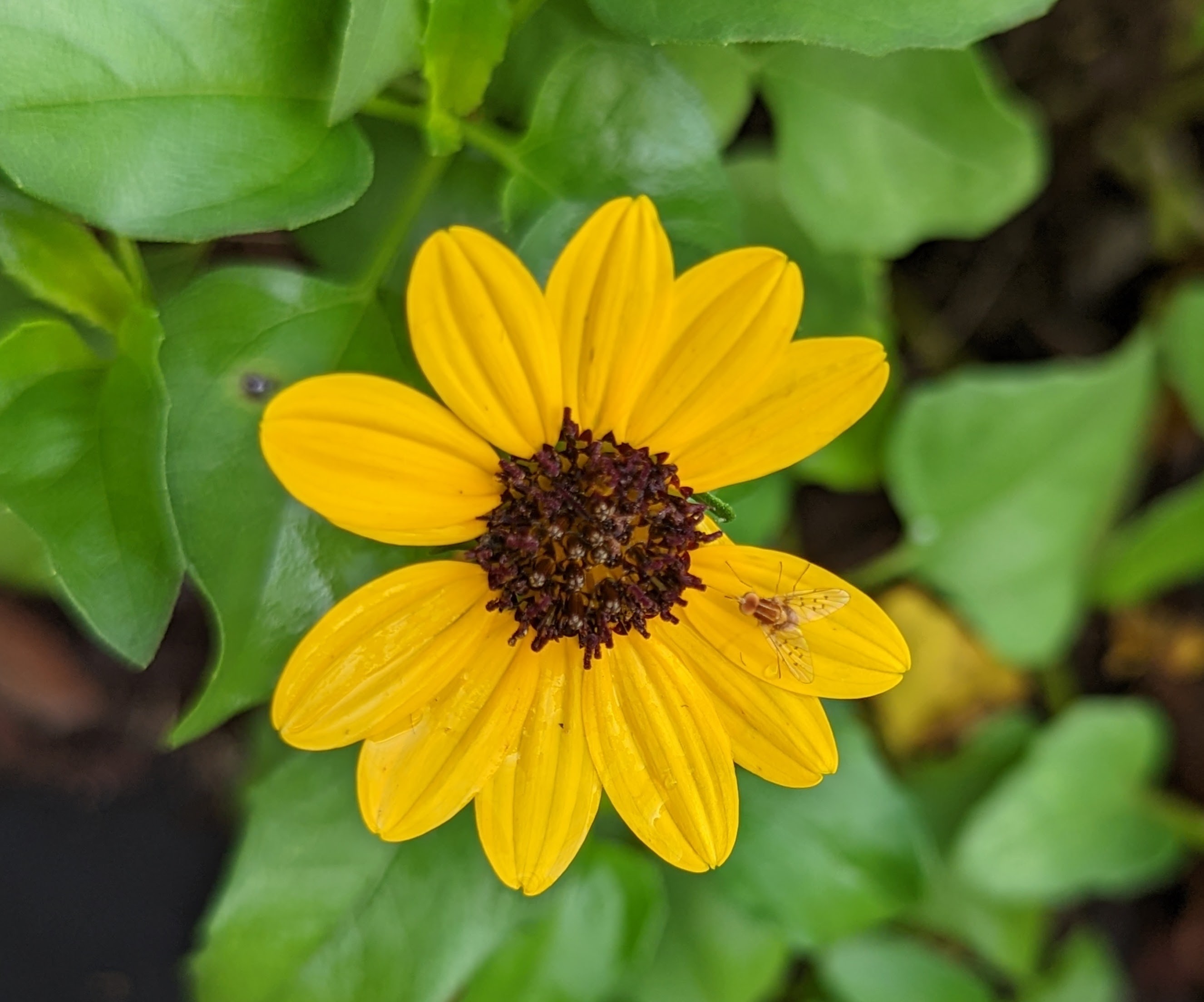
Another great native for pollinators, the Beach Daisy (Helianthus debilis). I am not sure what that bug is. These go mad during a rainy summer and once you have them in the garden (I planted them) they never go away.

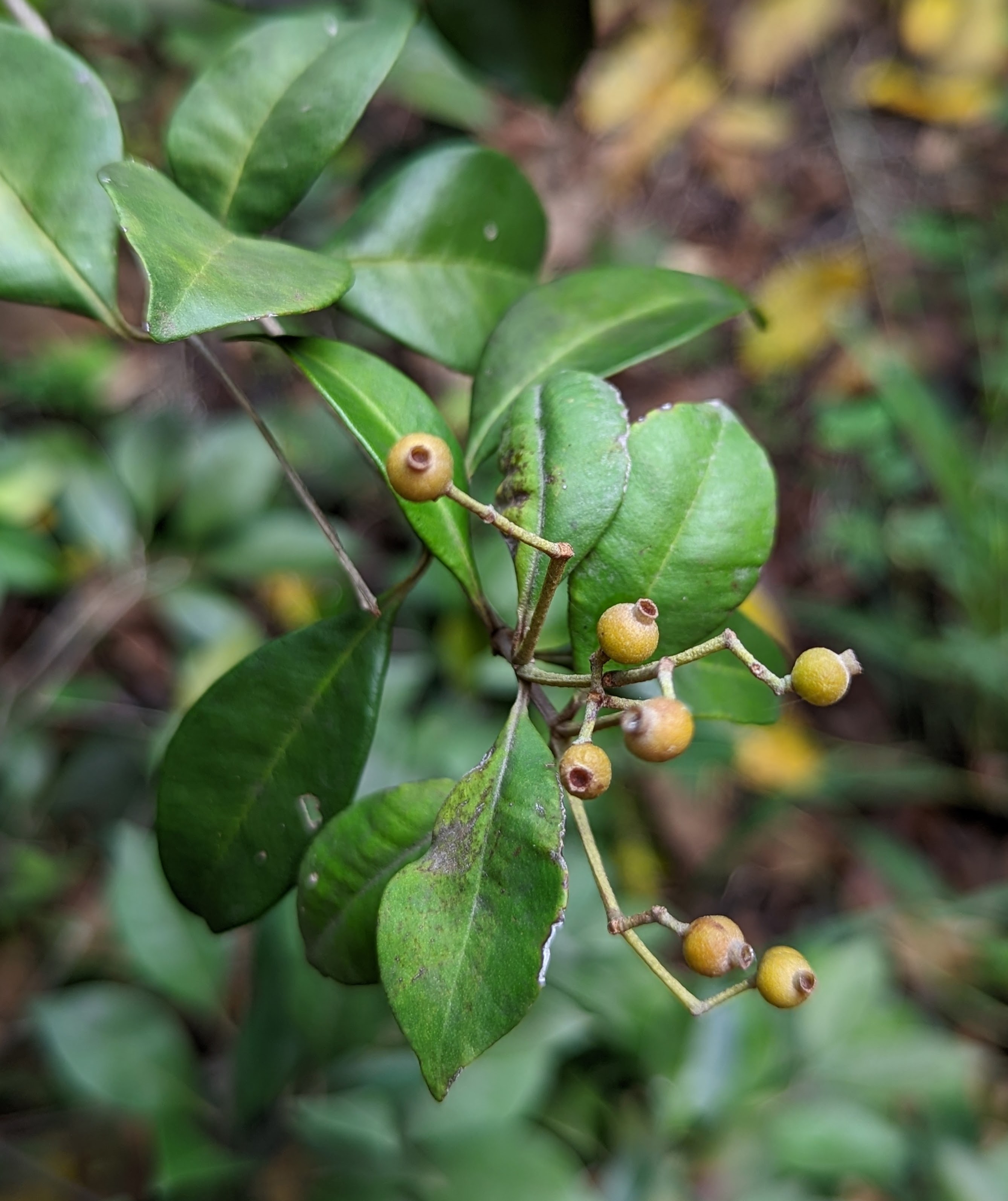
The fruits of a native Spicewood (Calyptranthes pallens) Something about this is supposed to have a spice fragrance. I have yet to find it and have had this in the garden for seven years or so. Birds like the berries.

A nice, and not native to Florida, Saturday morning surprise. This is an unnamed Cattleya orchid that regularly flowers in early September. I thought it wouldn’t flower because of the dry summer – but here it is after getting some rain and a little fertilizer.

That’s my Six for this Saturday….Happy Gardening!!!!!

In a Vase on Monday – Bougie Berries

Bougie Berries? What the flower? The leafy (or should I say bracty) white flowers in this vase are from ‘Miss Alice’ Bougainvillea. The true flowers are at the center in white and the showy parts are bracts, like Poinsettias. Floridian landscapers refer to Bougainvilleas as ‘Bougies’. I was unable to resist cutting a few branches of the Beautyberry (Calliocarpa americana) to join the Bougies.

The Bougies and Berries were cut quickly and the rest of the vase followed suit. After a very dry summer, we are experiencing an epic onslaught of humidity. My sliding glass door fogged over with moisture this morning highlighting the numerous greyhound noseprints in sweaty relief. I beat a quick retreat back into air conditioned space. Fortunately, the tropics remain quiet for this time of year and we are finally getting some rain.

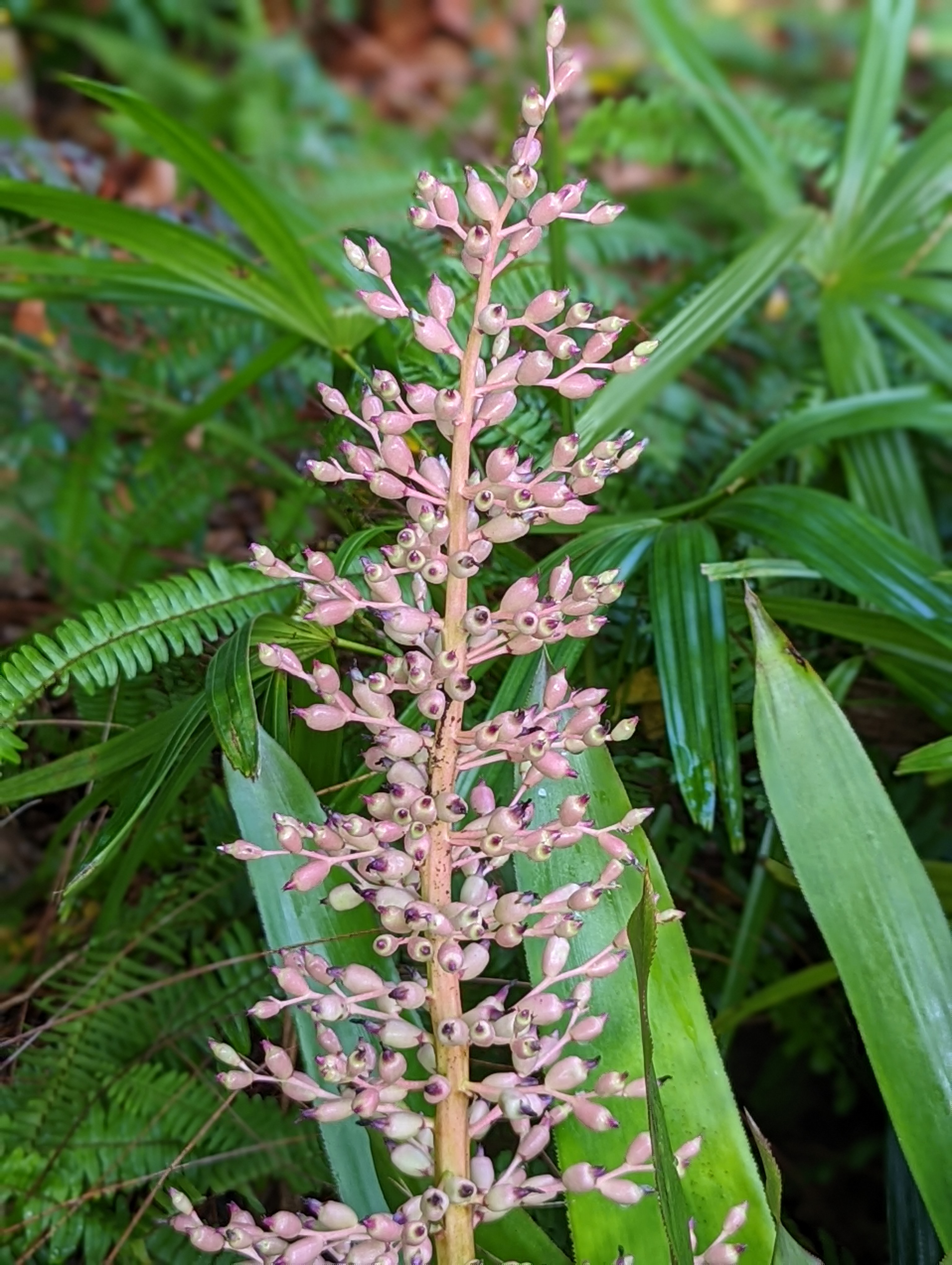
The true flowers of the Bougainvillea are visible here. White daisies are Bidens alba, a local thug and lover of humidity. Yellow spikes are bits of Aechmea blanchetiana bromeliad flowers. The greenery is Boston Fern (Nepholepsis exaltata) and a juvenile Sabal Palm (Palmetto sabal) frond.

Super drought tolerant Tropical Red Salvia (Salvia coccinea) in peach tones complete this vase. I am hoping to read about some autumnal weather on other blogs this Monday as we are sorely lacking even remote coolness. Visit our fabulous hostess, Cathy at http://www.ramblinginthegarden.wordpress.com to see other vases..

Happy Gardening!!
Six on Saturday – Raindrop Close ups

I am joining the SOS crowd this morning, celebrating a very recent rain shower in my garden. The weather guessers predicted a much wetter September (usually our rainiest month). On this third day of the month, they are right.

I have been attempting to watch the Artemis 1 rocket launch this week; depending on weather the launches are visible from my backyard. If we see them my husband is usually squealing “this is so cool!!!!” This is NASA’s run up to another manned trip to the moon in a couple of years. The first attempt was scrubbed on Tuesday and the second is scheduled for this afternoon. Currently it is overcast, so time will tell. If the weather clears and the launch happens I may see a rocket fly by this afternoon.

On to plants:

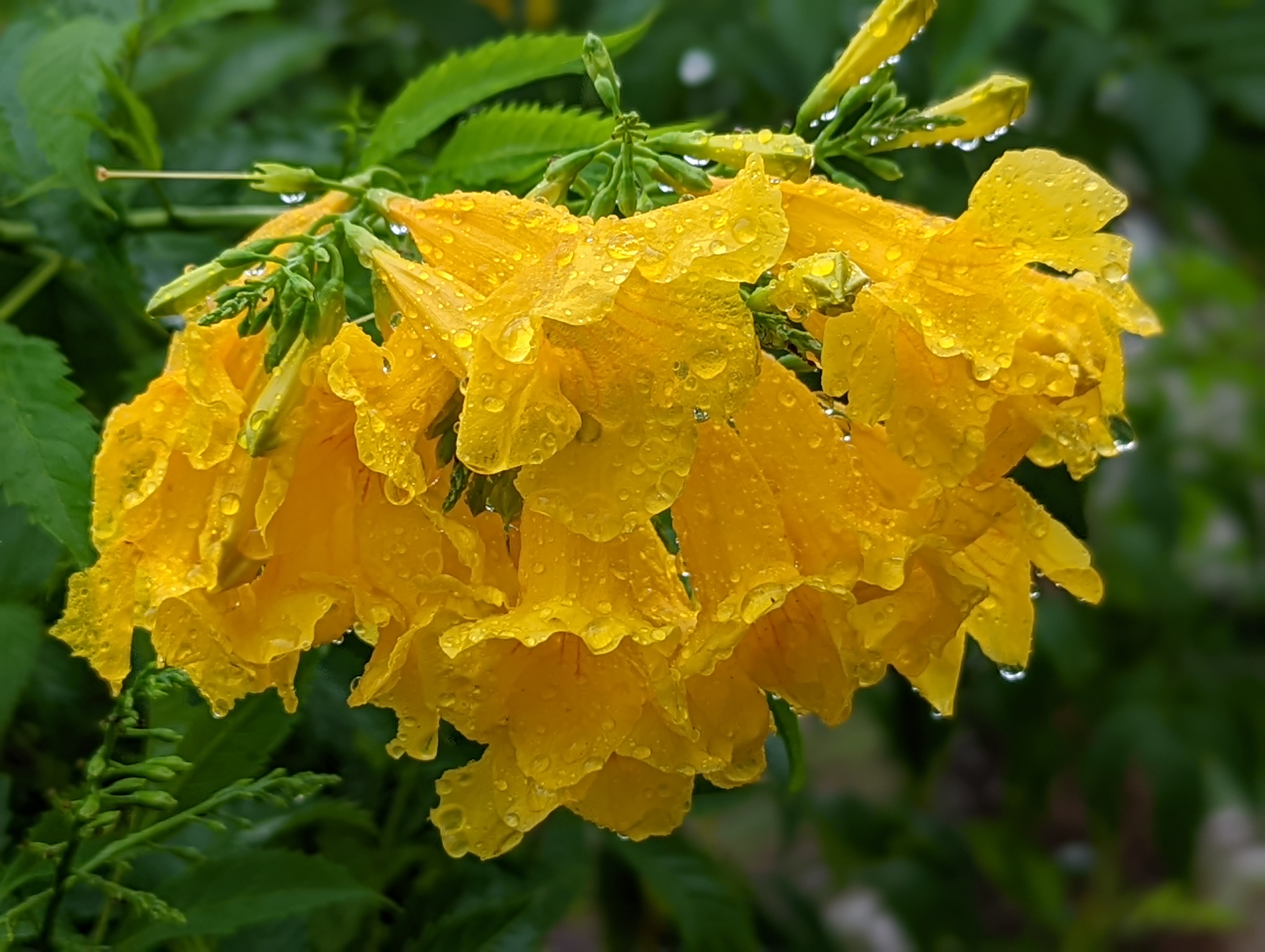
Esperanza (Tecoma stans). Sometimes called Yellow Elder. This plant amazes me. It had virtually no water and a very dry summer and it just keeps going.

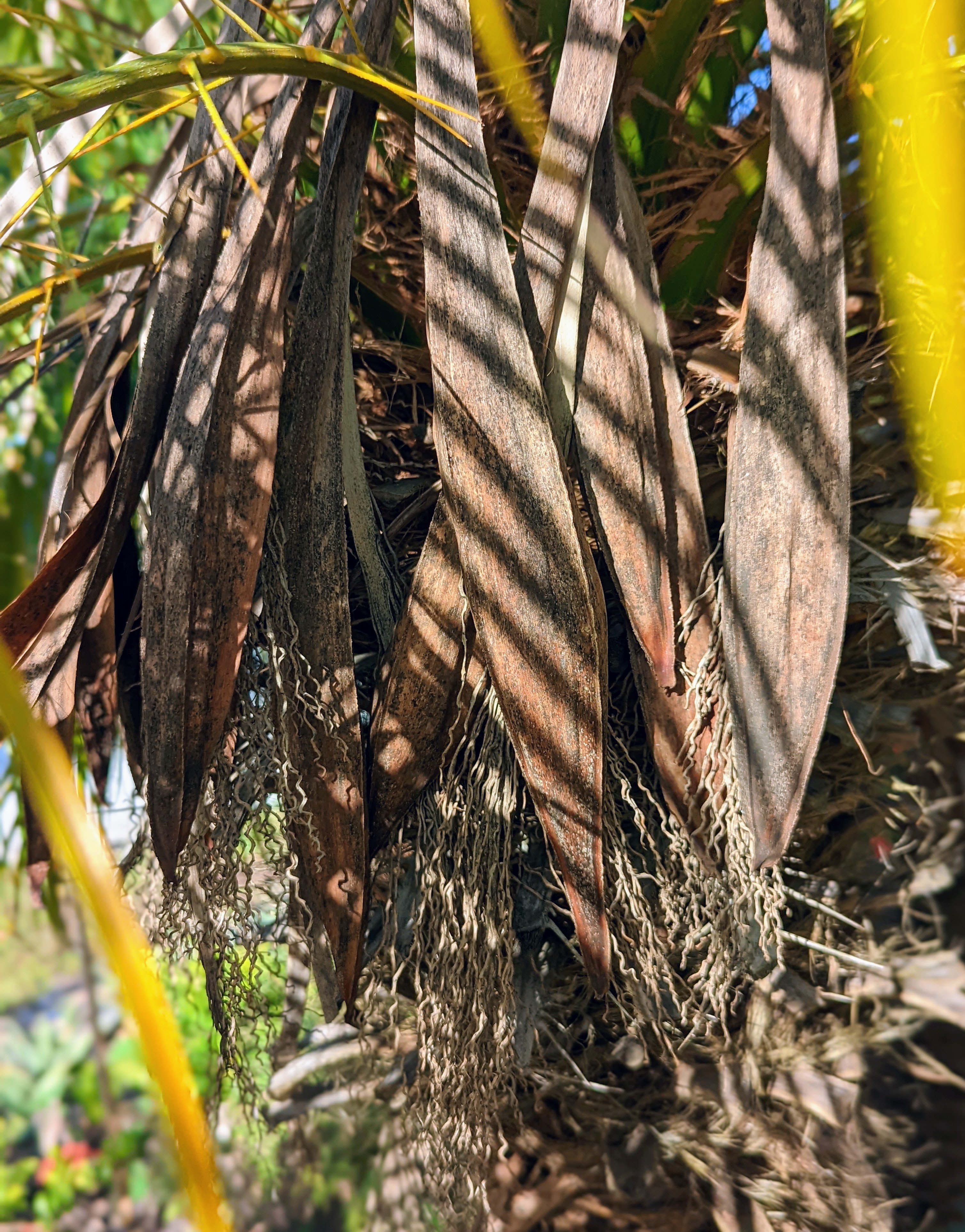
The base of Travelers Palm (Ravenala madagascarensis). Another survivor with very little watering. I love the base of these. This is a member of the Strelitzia family related to Bird of Paradise.

Aechmea rubens in the final stages of flowering. I have never heard a common name for this. This bromeliad started flowering at the end of May, lasting all summer. I am wondering if the black tips are seeds?

These bromeliads are just starting to flower. They are Billbergia pyramidalis and have many common names – Flaming Torch, Hurricane, Foolproof Plant, Summer Torch. They are foolproof if planted in the right spot. I enjoy these every fall.

A mystery bromeliad in full bloom. This has lasted most of the summer.

Dancing Ladies Ginger (Globba winitii). My garden is too dry to support these, so I grow them in a pot. The plant is dormant during the dry season, then pops up mid June and flowers late summer. A neighbor gave me this plant. I think I will upsize the pot to see the plant will spread.

That’s it from South Florida. To see more SOS posts, visit Jon at http://www.thepropagatorblog.wordpress.com.

Happy Gardening!!!

In a Vase on Monday – August Beauties

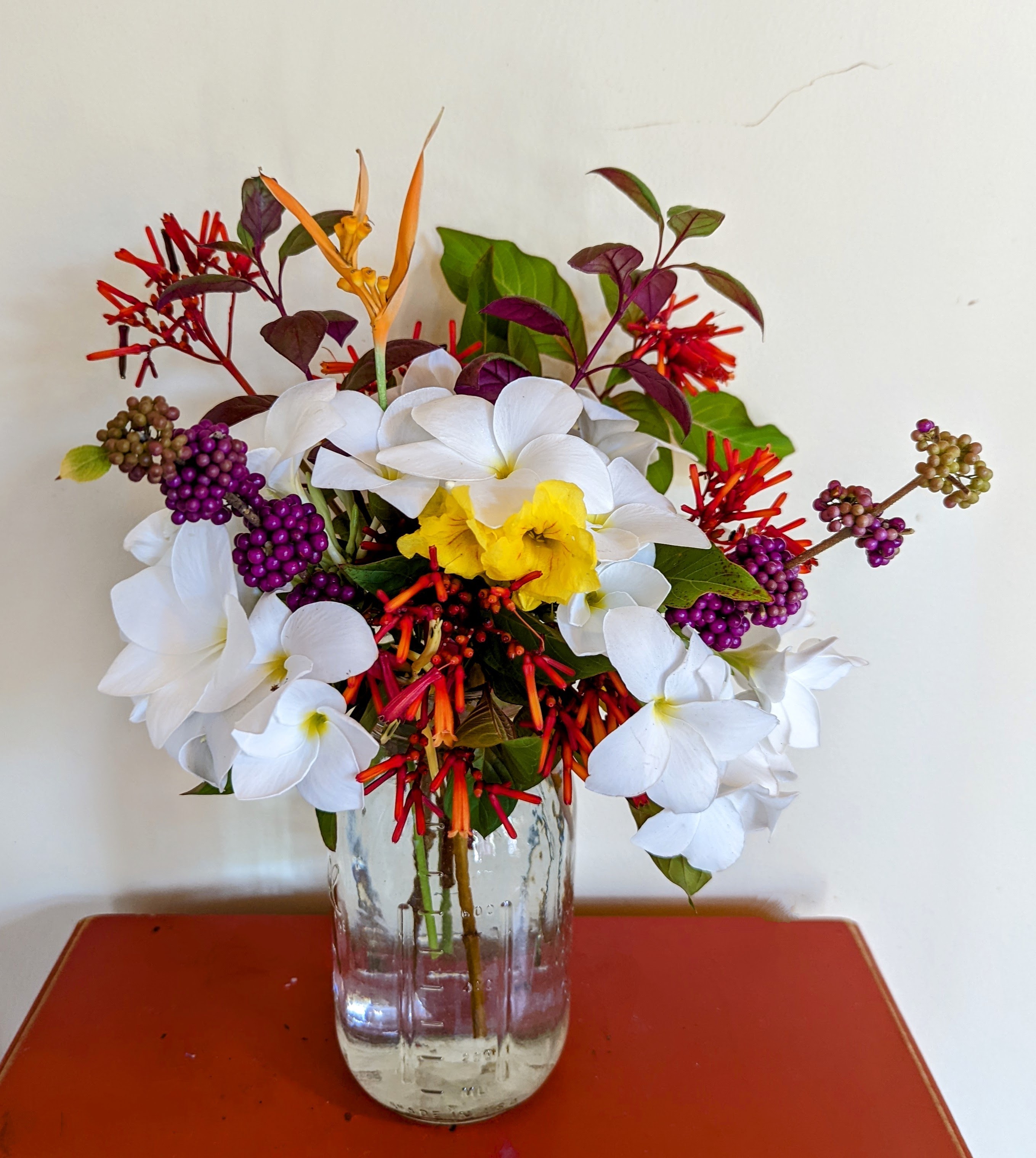
This vase accurately reflects what thrives in my South Florida garden with very little water or attention. August is the hottest month of the year, it is frequently 94 degrees in the shade (F or almost 35 C). Gardening is best abandoned for cooler days. There has also been a long dry spell here, we are 8 inches below normal on rainfall and some plants have burned up. My stalwart zinnias succumbed the first week of August, despite my best effort to hand water them, they are curled and crispy brownish tan. I left them to shade the lime green sedum in hopes of nursing it through August. The lush tropical border is a memory. The Dahlias dramatically folded their foliage up the stem and turned brown standing straight like soldiers praying to the rain gods. Bah.

Saturday night we had a refreshing rain shower and the white flowers in the vase, Bridal Bouquet Frangipani, smelled so lovely I had to cut some to bring inside. It seems the more tropical plants tolerate the dry heat a bit better than the Florida natives, which seems odd. Another gardening mystery to ponder.

Beauties in detail:

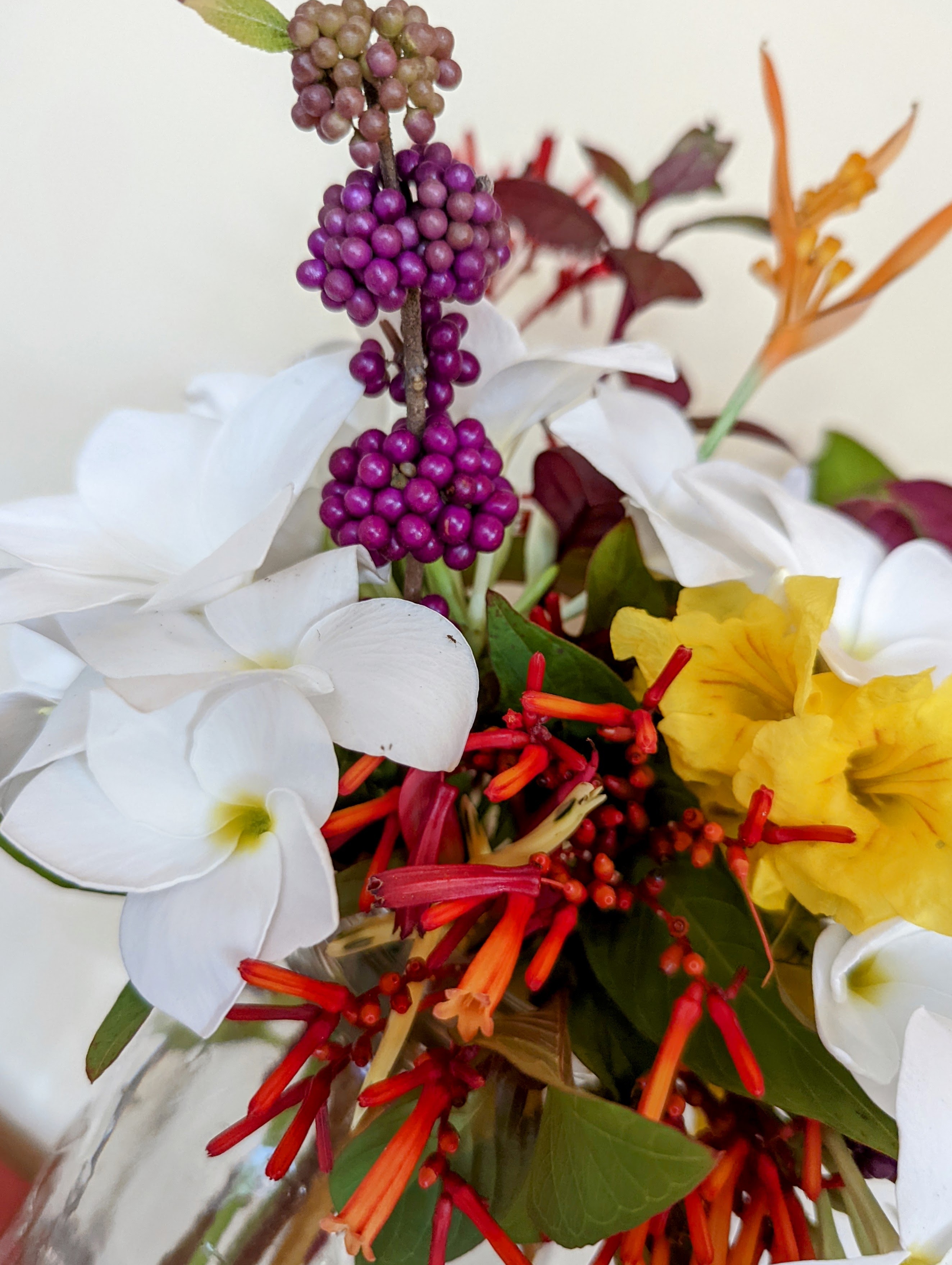
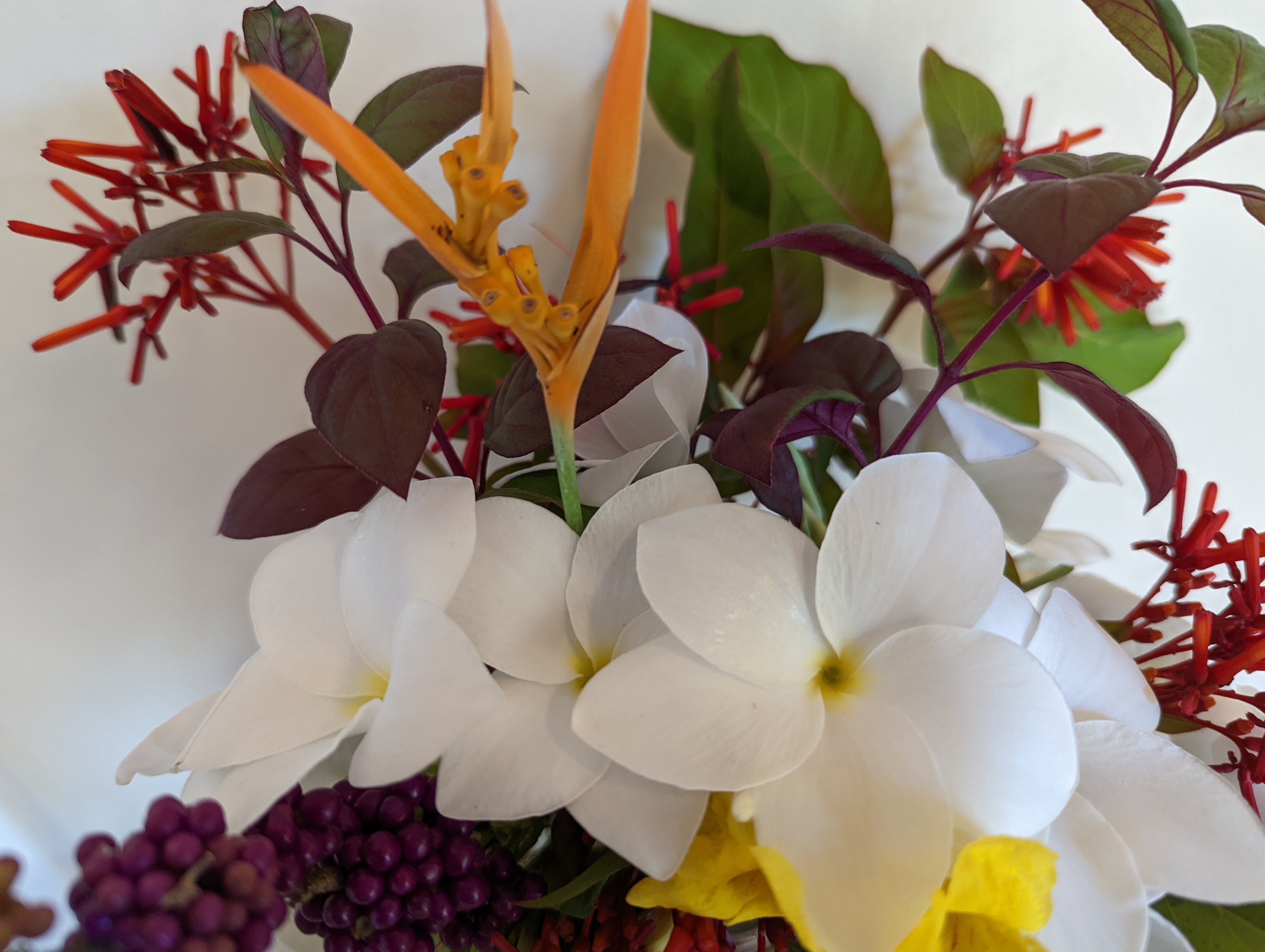
The lurid purple berries are from the Beautyberry (Calliocarpa americana); fragrant, white flowers are Bridal Bouquet Frangipani; orange tubular flowers are Firebush (Hamelia patens); yellow flowers are Esperanza (Tecoma stans).

The balance:

The peach flower is a Choconiana Heliconia (H. psittacorum ‘Choconiana’) I have tried to find out what the heck is a Choconiana to no avail. Purple foliage is from ‘Purple Prince’ Alternantera – I should admit to watering this one and keeping it in a pot in the shade. There is one in the garden, surprisingly still alive, but much smaller.

I wish everyone gentle rain, but not too much, and cooler weather. Thanks to Cathy at http://www.ramblinginthegarden.wordpress.com for hosting. Follow the link to see more vases.

Happy Gardening!!
In a Vase on Monday – The Dahlia

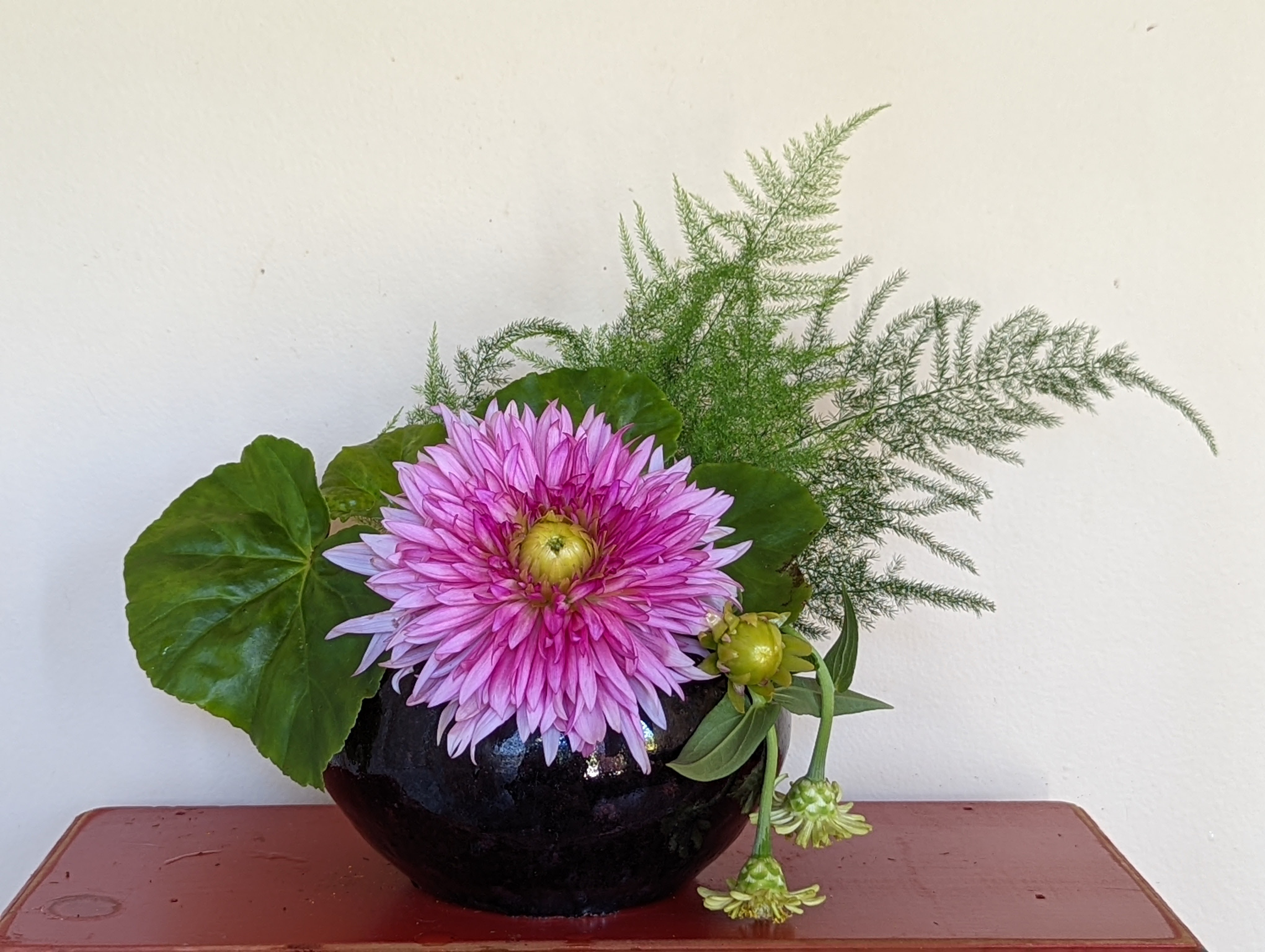
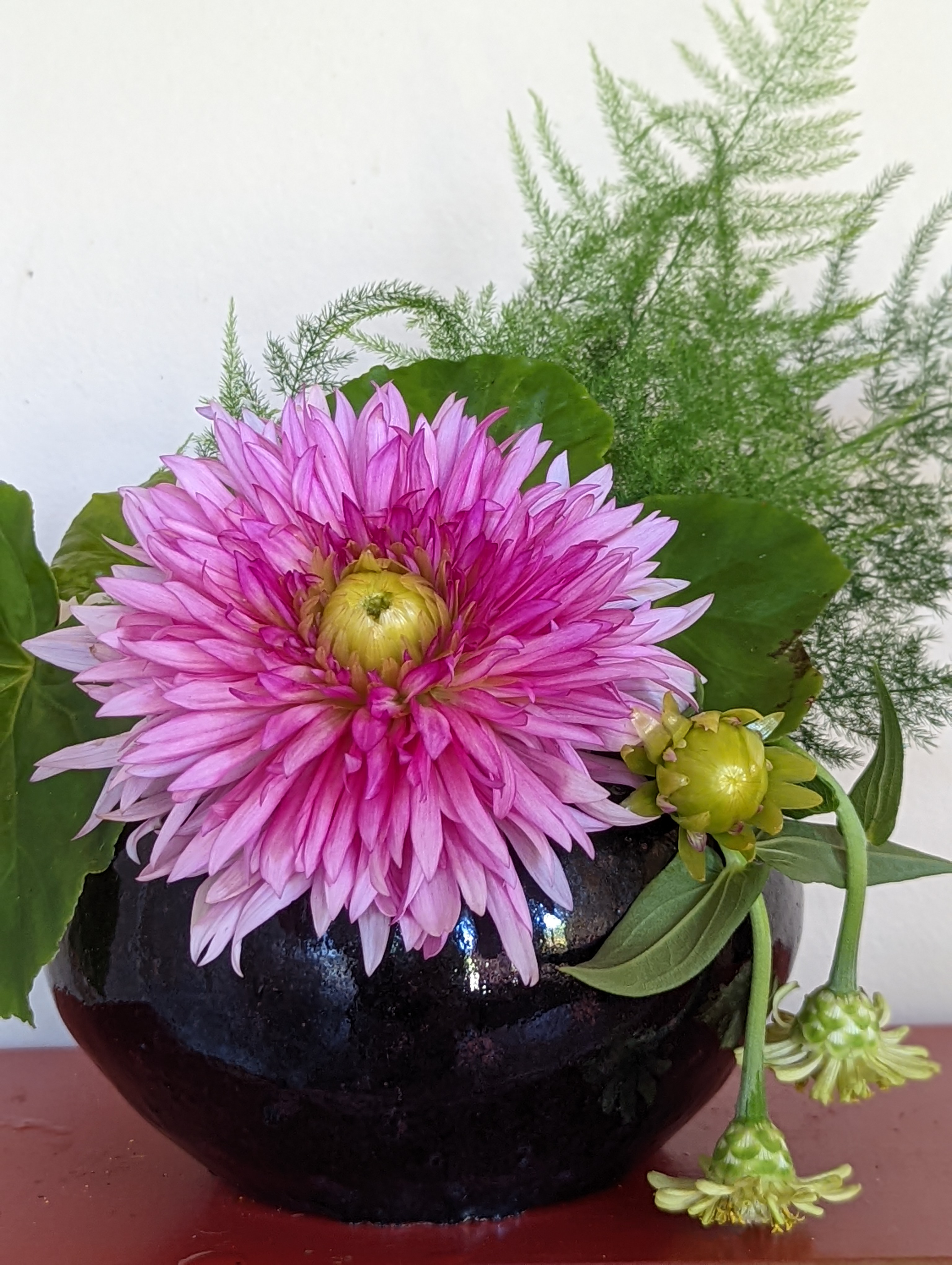
I have been trying to grow Cactus Dahlias for years. I thought I could grow them in the ground, in amended soil. I planted tubers and thought “I will have flowers in eight weeks” Ha. This was four or five years ago. The tubers would sprout, put out a few leaves, and then die back down. A couple of times a year this happened until finally a passing critter dug them up and ate them. They hung around the garden for a few years, I kept hoping for flowers, but never got so much as a bud.

This spring I ordered some Labyrinth Cactus Dahlia tubers. I was shipped single red Dahlias and these replacement tubers are supposed to be Labyrinth. I was expecting long stemmed peach and pink mixed flowers…that is not this. This is the shortest stemmed flower I have ever cut. Maybe and inch and a half of stem and I accidentally clipped a bud while trying to cut the flower. These are pretty whatever they are, Cactus Dahlias, but not Labyrinth. Oh, well. I am still thrilled with the flower. All the stems are seemingly very short so my dreams of an overflowing bowl of Dahlias are dashed…

I am growing these in plastic pots. The tubers were planted about two months ago, so the original thought of having Dahlias in eight weeks is about right. The red singles I planted in March have burned out and gone dormant (or perished in the heat?)

A close up:

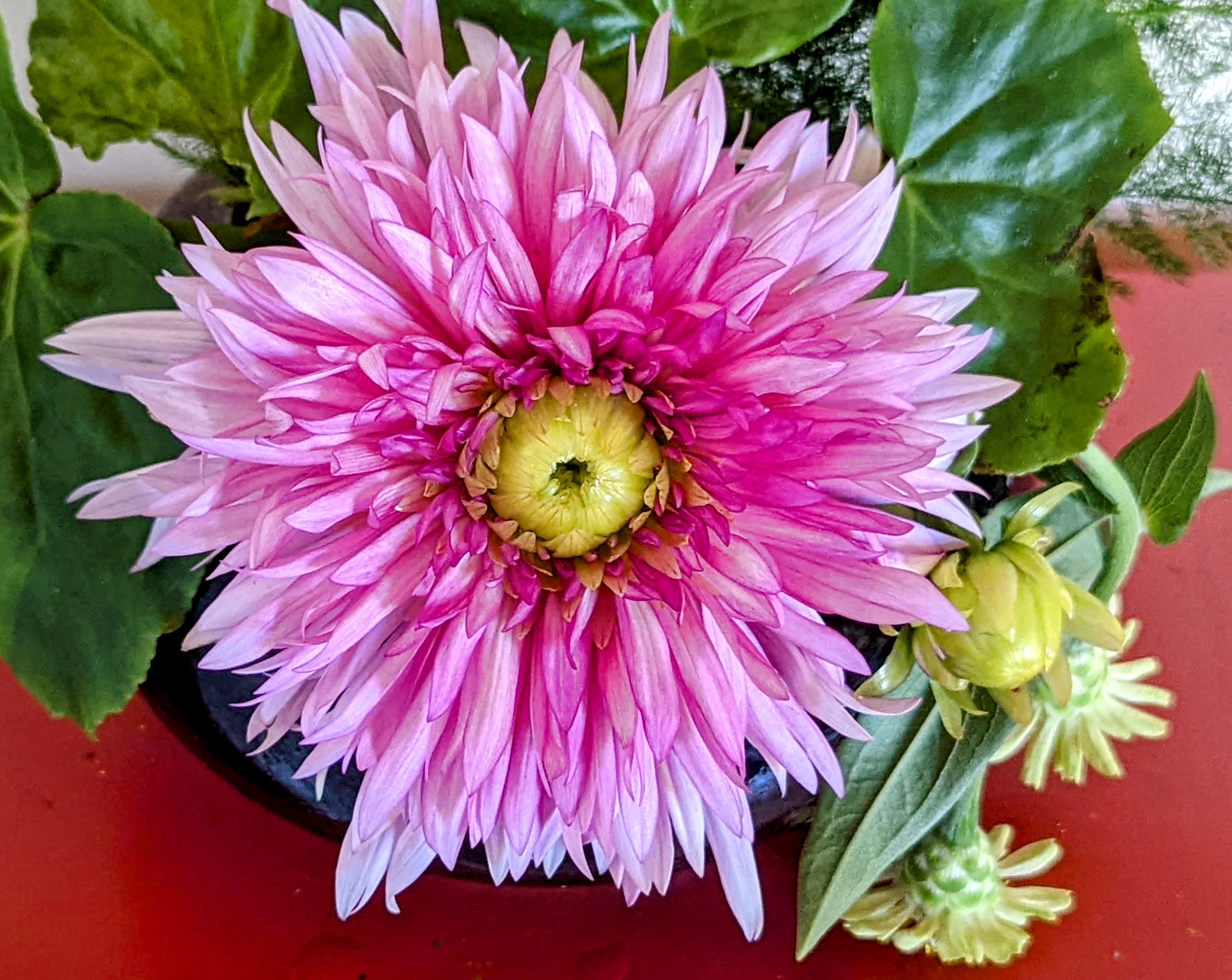
In pale purple, the Dahlia and bud. Green Envy Zinnias are hanging over the side. The foliage is Asparagus Fern and Sweet Begonia leaves. The vase is a thrift store find.

From above:

Thanks to Cathy at http://www.ramblinginthegarden.wordpress.com for hosting; follow the link to see more vases from around the world.

Happy Gardening!!

Six on Saturday – Wilting and Watering.

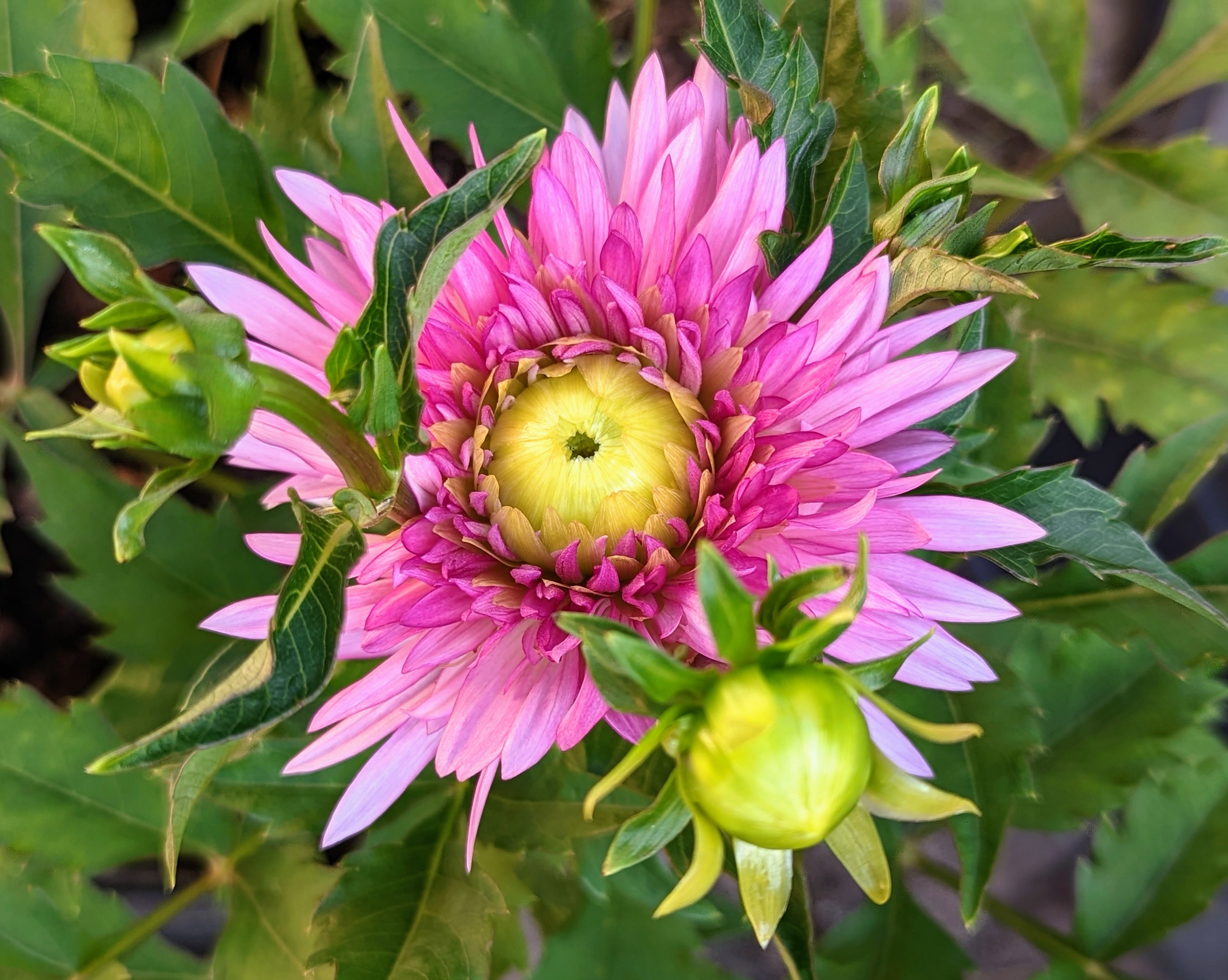
The July heat remains unabated. My garden has had no rain for two weeks! I have given up on some lawn (I use that term loosely and am happy I did not put any sod down this spring). Some of the more drought tolerant plants are looking wonderful and others have shut down to wait for rain. Fingers crossed for an actual thundershower every day! Below is my fabulous Labyrinth Dahlia, faithfully watered twice a day.

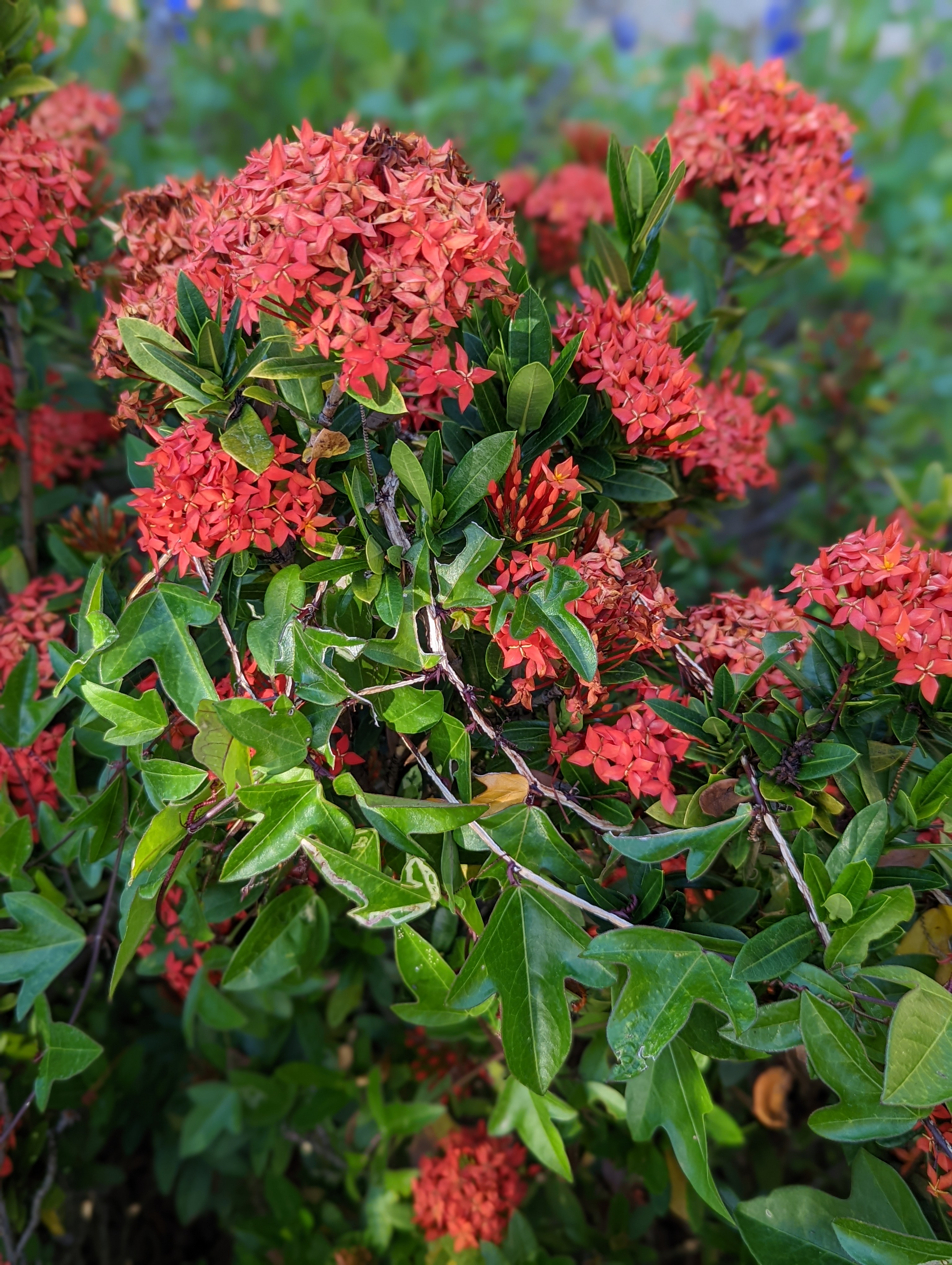
Next up, a native of the South Pacific, Dwarf Red Ixora (Ixora chinensis) – these shrug off the heat and love to flower all summer, but must be watered and fed. I have allowed our native Corkystem Passionvine to ramble through the shrubs; providing a larval food source for butterflies while the flowers from the Ixora provide nectar. The invasive lizards (only in Florida!) had staked out my Passionfruit vine and ate most of the caterpillars, so I got rid of that vine and the evil lizards haven’t figured this out – yet.

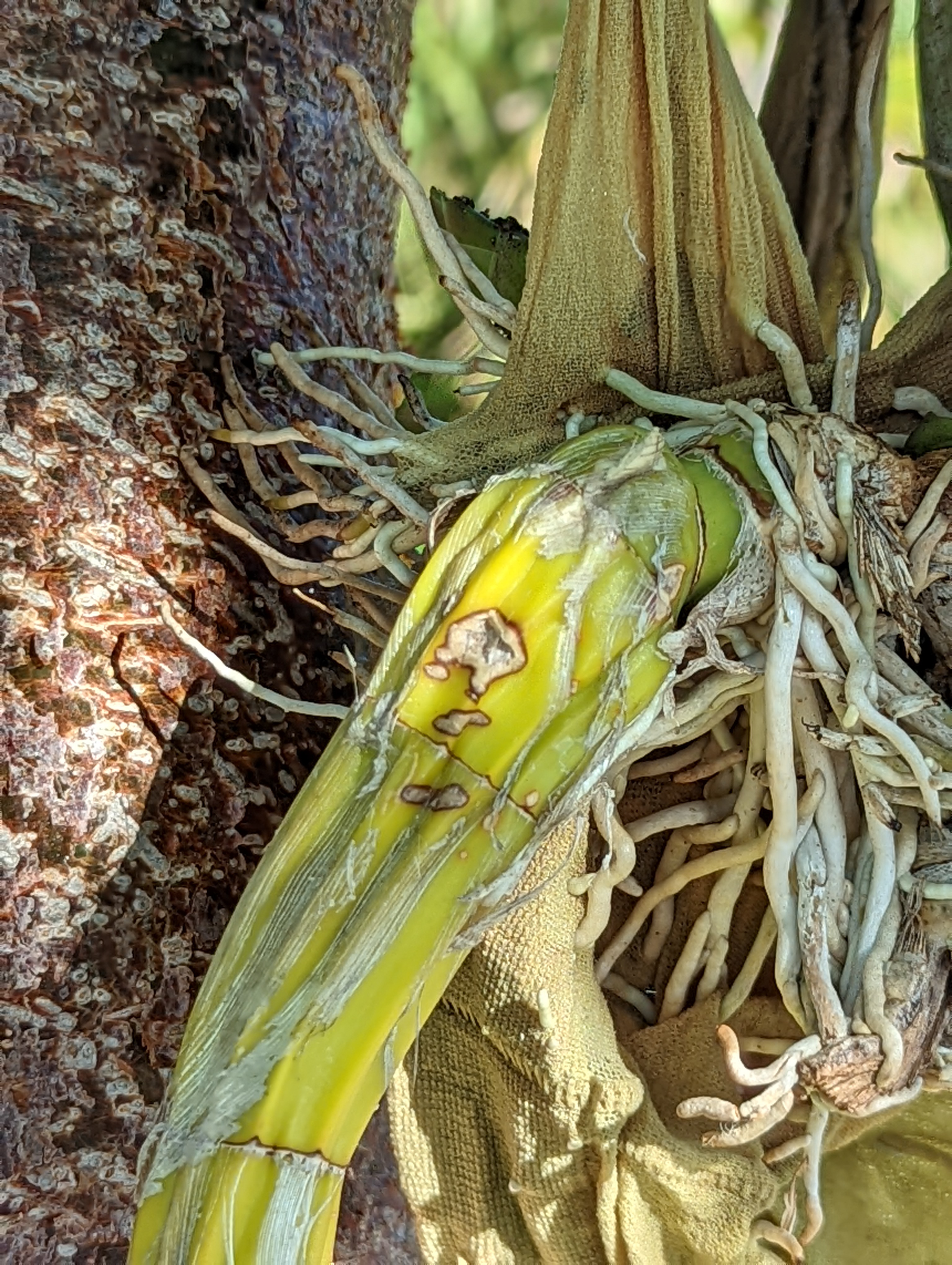
Last week I posted some pictures of the orchids growing in my Gumbo Limbo tree. Here is a close up of the roots growing into the trunk. They are not quite attached, but getting there.

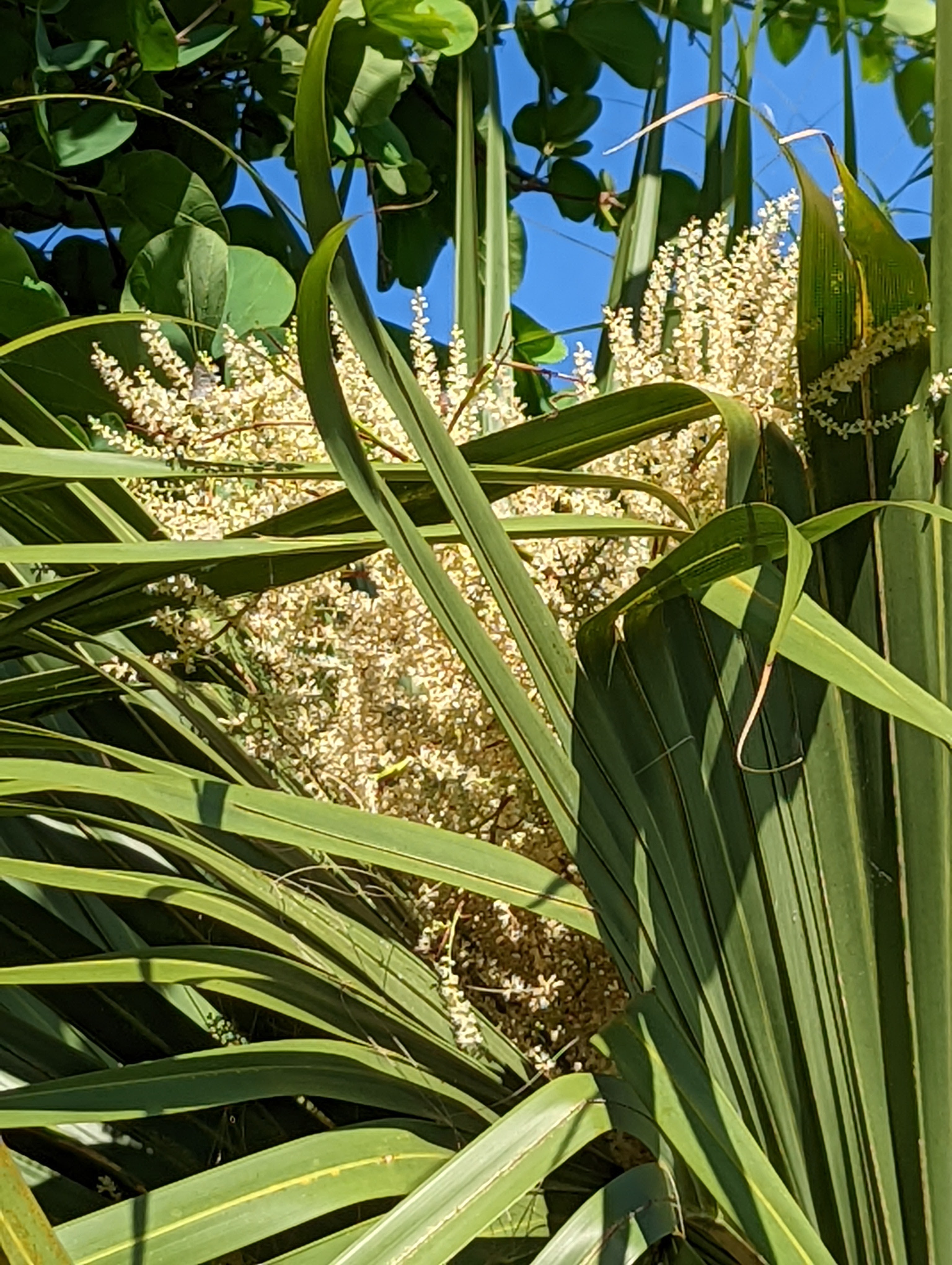
The native Cabbage Palms (Sabal palmetto) are indestructible. These are the flowers, the bees love them. Eventually, black berries are formed on long boughs from the crown of the palms. People used the skin of the berries to make flour – which must have been difficult!

Flowers on a Dwarf Pygmy Date Palm (Phoenix roebellini) This palm has male and female plants and will make dates if both are present. These are very common here and I have yet to see any dates. No idea what sex this is.

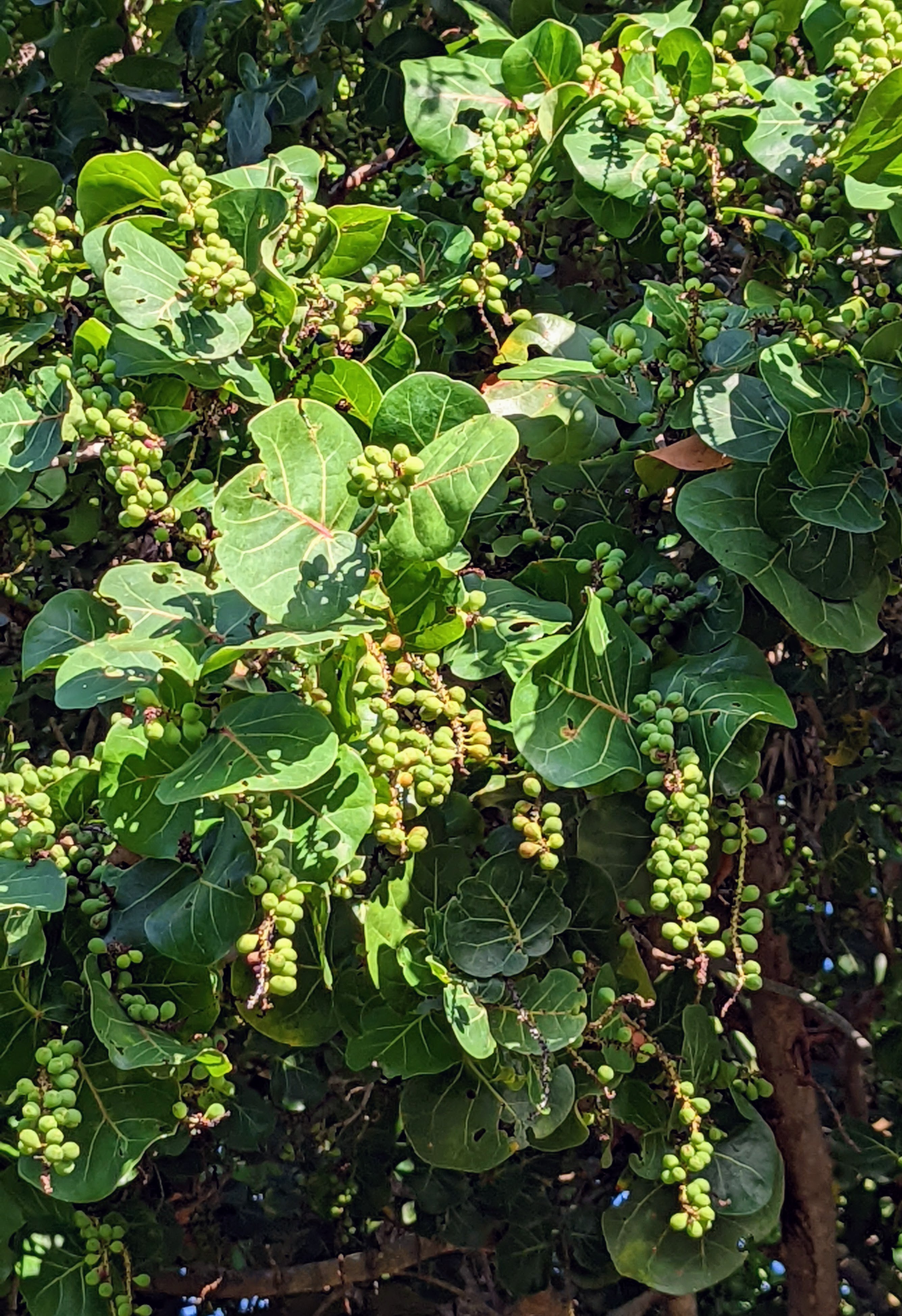
More happy natives. This is a Sea Grape (Coccoloba uvifera). These hardy plants are used for anything from clipped hedges to trees, this one is about 25 feet tall and covered in grapes. The grapes are edible with a huge seed and taste like figs. Another of those things you have to grow up eating to appreciate. I leave them for the critters. One of my greyhounds loved them and would stand under the tree and graze.

There, Six for Saturday. Rain dance starts later.

Thanks to Jon at http://www.thepropagatorblog.wordpress.com for hosting. Follow the link for more SOS posts.

Happy Gardening.

In a Vase on Monday – Floral Pyrotechnics

Today America celebrates its 246th birthday. My less than patriotic color scheme reflects my feelings on our current state of affairs. Pink for women and green for the environment. Blech, I have always detested politics and even more so today. My brain is still processing our backwards slide.

I am, however, quite pleased with my flowers. My quest to have flowers that survive the summer heat is continuing. Zinnias and Salvia are thriving. I have grown all from seed and will continue to do so as long as I know what to grow and when. This is usually a trickier subject than it appears. The Dahlias I started in March, flowered and fried. I started some a few weeks later and have high hopes for flowers from the few Cactus Dahlia tubers roasting in the garden. Leonitis leonurus, seemingly a good choice from South Africa, is slowly burning up in the front garden it seems, time will tell if it survives the heat.

The vase:

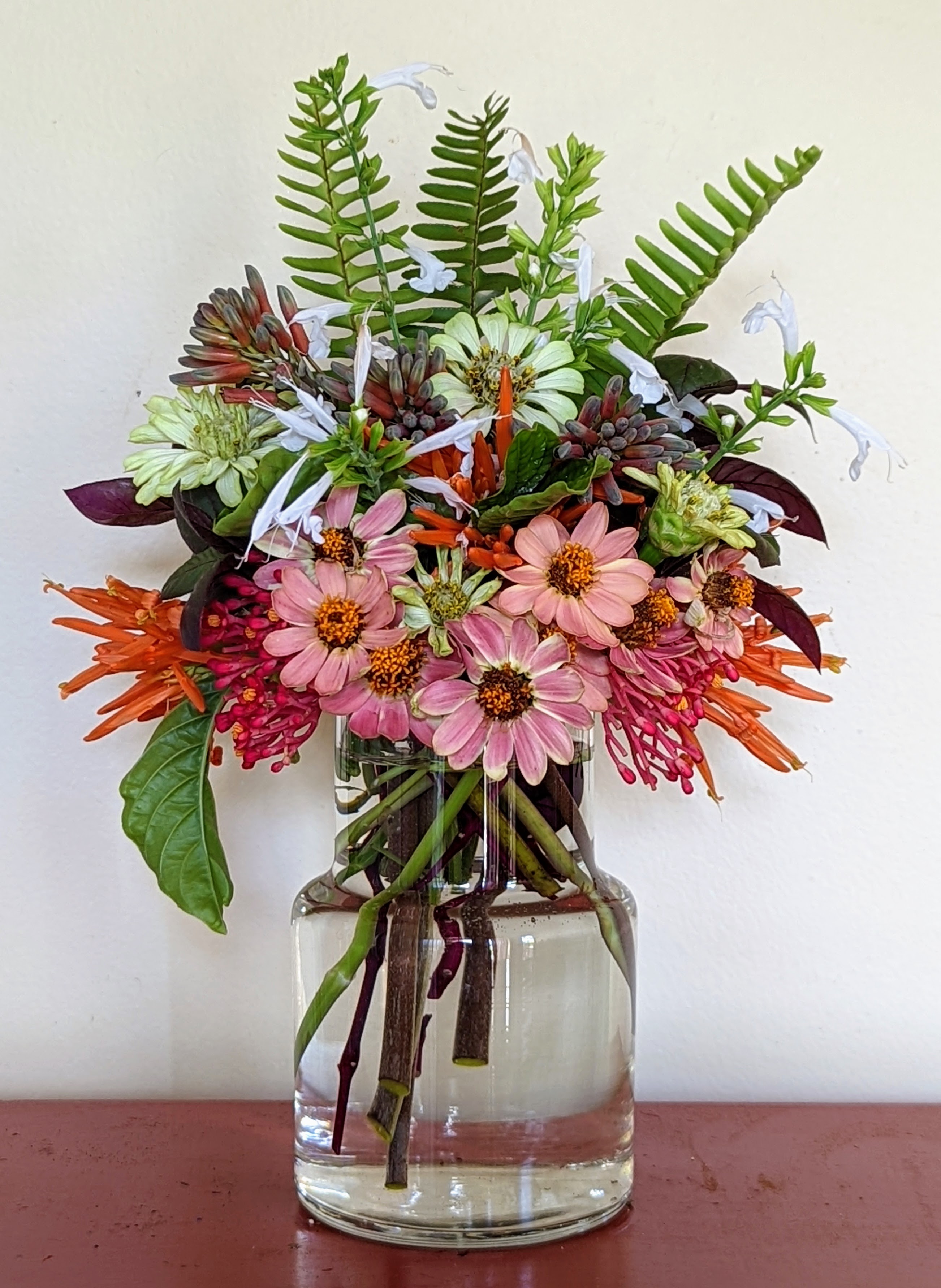
The vase is a retired pasta storage container. The plant palette begins with Zinnias; the peachy toned smaller Zinnias in front are ‘Profusion Apricot’; behind is my go to flower this summer ‘Green Envy’ Zinnia; the red flower draped over the rim is Coral Plant (Jatropha multifida); the orange one behind is Mexican Honeysuckle (Justicia spicigera).

The view from above:

In coral and grey, Soap Aloe (Aloe saponaria); white spikes are Tropical Red Salvia (Salvia coccinea); burgundy leafy foliage is ‘Purple Prince’ Alternanthera; ferns are Asian Sword Ferns.

It is hot and dry here. The only pyrotechnics I am hoping to see today involve thunder, lightning and water falling from the sky.

Thanks to Cathy at http://www.ramblinginthegarden.wordpress.com for hosting, follow the link to find more vases from around the world.

Happy Gardening!!!
Six on Saturday – Ghosts of Future Plants

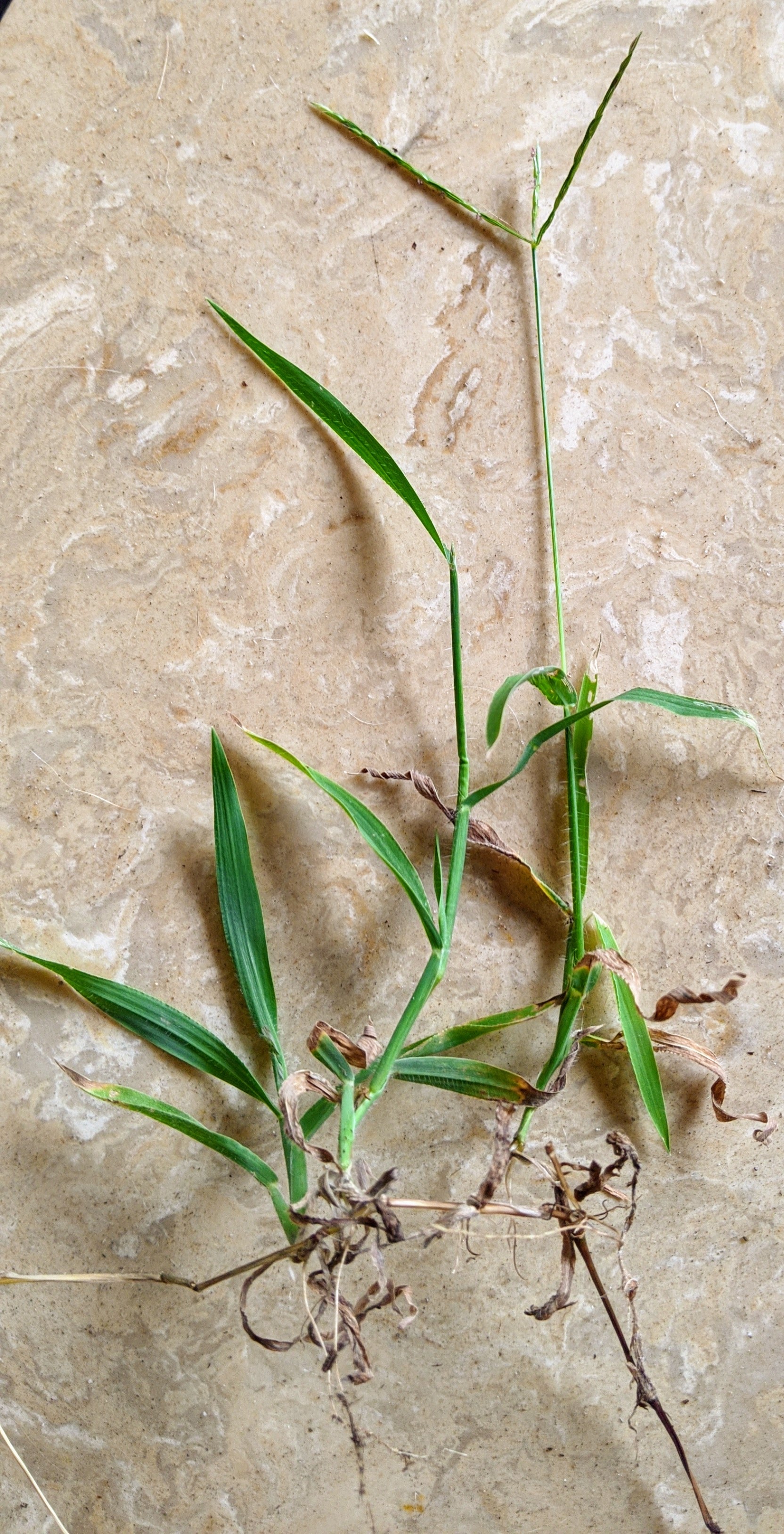
Summer is an interesting time in the tropical (subtropical, really) garden. It makes me appreciate how smart plants are. The really nasty weeds make seed at the start of the rainy season (June 1) and have a long period of time to start new plants with the advantage of rain. I have been gleefully decapitating the five (yes, five and year round) varieties of crabgrass that grow in Florida in hopes of keeping the crabgrass down.

There are some more attractive budding plants in the garden. This is a Labyrinth Dahlia I have high hopes for, although I am not certain if I planted it early enough. The tubers planted earlier have already flowered and burned out in the heat.

Bromeliads poised to climb the trunks of an Adonidia Palm. This is my first trunk climbing adventure with plants, so I am looking forward to seeing what happens. These are Jill Neoregelia Bromeliads, the red centered one is the oldest, and therefore the mother plant, soon to meet its demise. Women hate this aspect of Bromeliads, the mother always dies.

Another tree climber, the Schomburgkia Orchid, is growing and has new stems coming along. I was interested to read that this orchid is native to Mangrove trees growing on the edge of the Yucatan Peninsula in the Gulf of Mexico. These are usually higher elevation orchids, it is unusual to see this type of orchid in Florida.

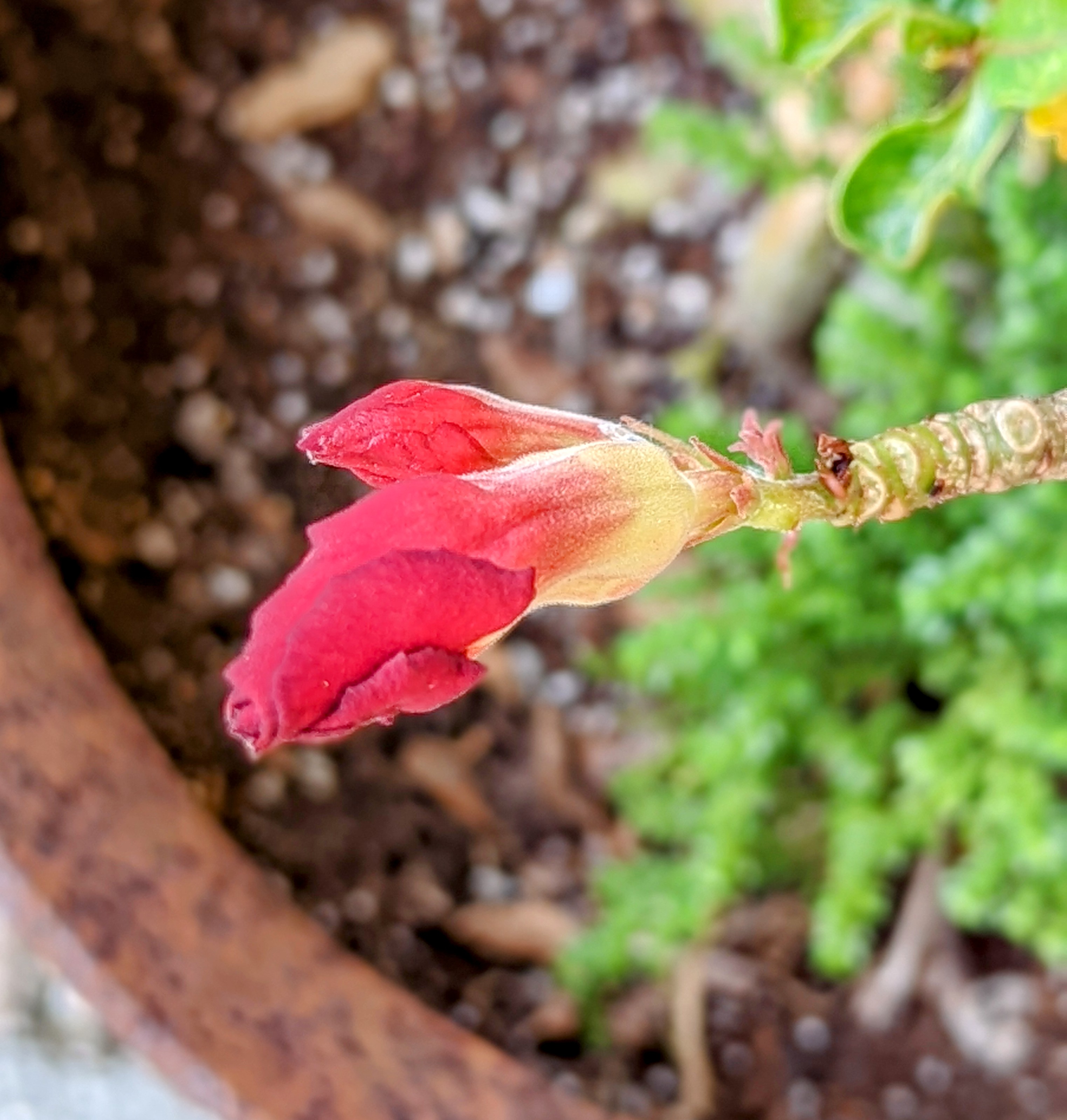
The bud of a Desert Rose (Adenium obesum). A Lubber Grasshopper ate all of the foliage last week.

One of my favorite summer Bromeliads and a reliable July flower, the Aechmea Miniata. In full bloom these always remind me of Red Hots candies.

That is all from here this Saturday, I am luxuriating in air conditioned space today, looking forward to future flowers and hoping for rain. To see more SOS posts, visit http://www.thepropagatorblog.wordpress.com.

Happy Gardening.