Ample moisture from seemingly everywhere has made June the wettest month in recent memory. The windows on my house are fogging up with the humidity in the air outside. The plants in the garden are enjoying long soaks and the tropical flowers are bursting with joy.
I am sharing my steamy, tropical joy with the SOS crowd today. To see Saturday tours from less steamy places, visit our host, Jim at http://gardenruminations.co.uk
Cattleya orchids growing on tree trunks opened their first flowers this week.
Aechmea rubens bromeliads opened this week as well. These flowers last several months and are very sharp.
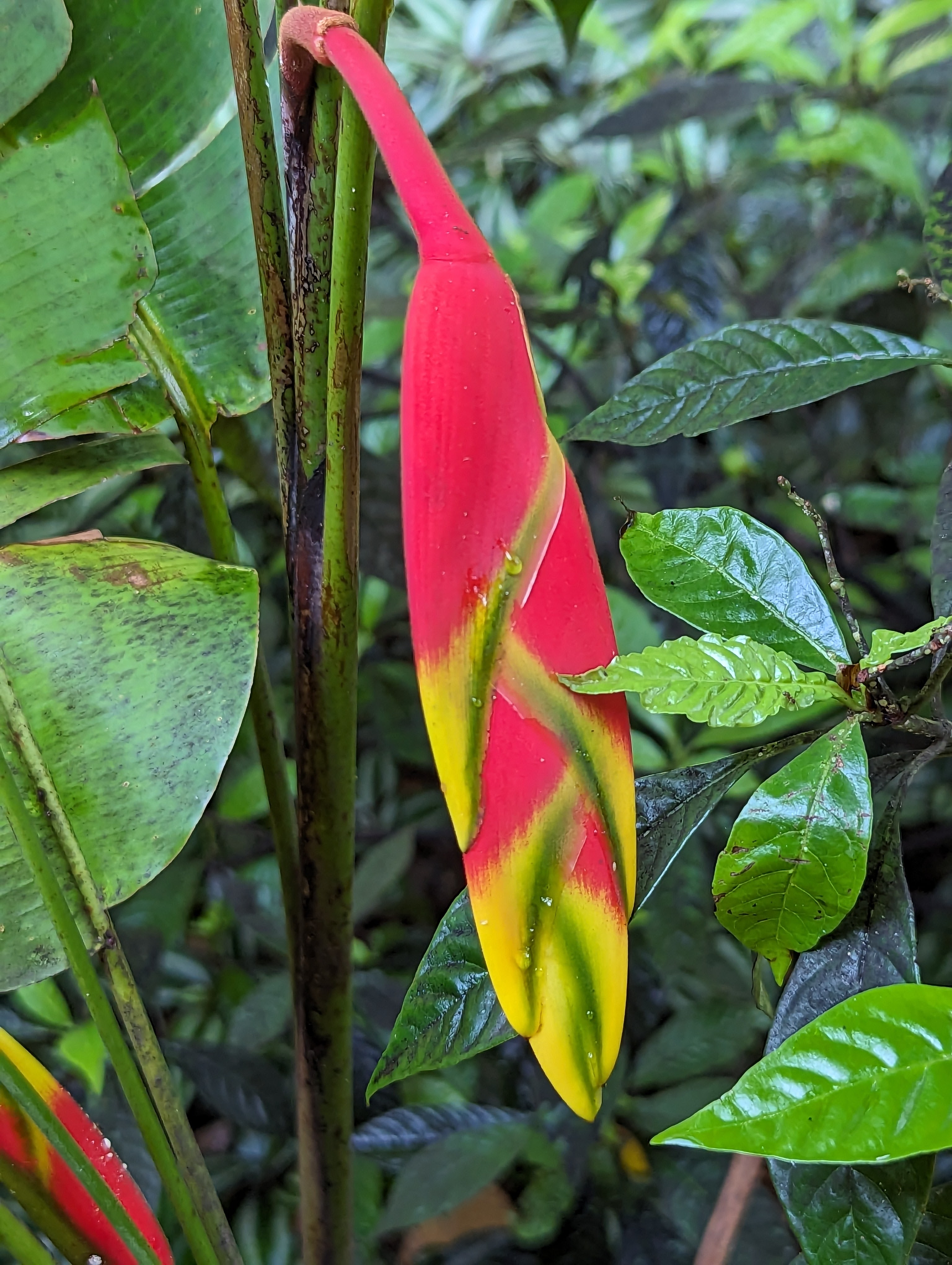
One of my summer favorites, the Lobsterclaw Heliconia (Heliconia rostrata) is slowly opening.
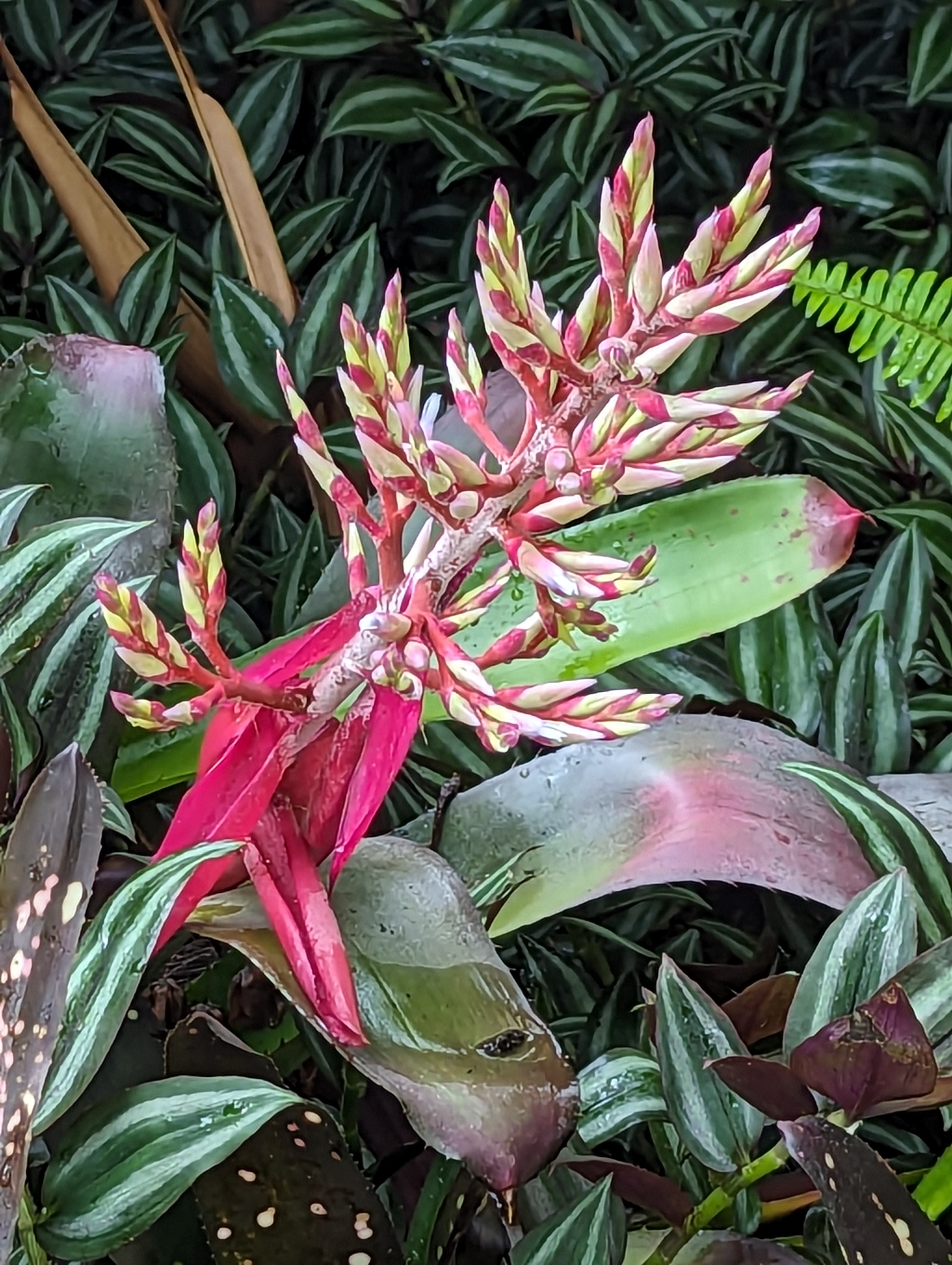
Another bromeliad, the name of this one escapes me. If I ever knew it.
Yet another bromeliad, the pineapple. This one is coming along – it was grown from the top of a grocery store pineapple, so I have no idea what it will be. These homegrown pineapples are usually very good.
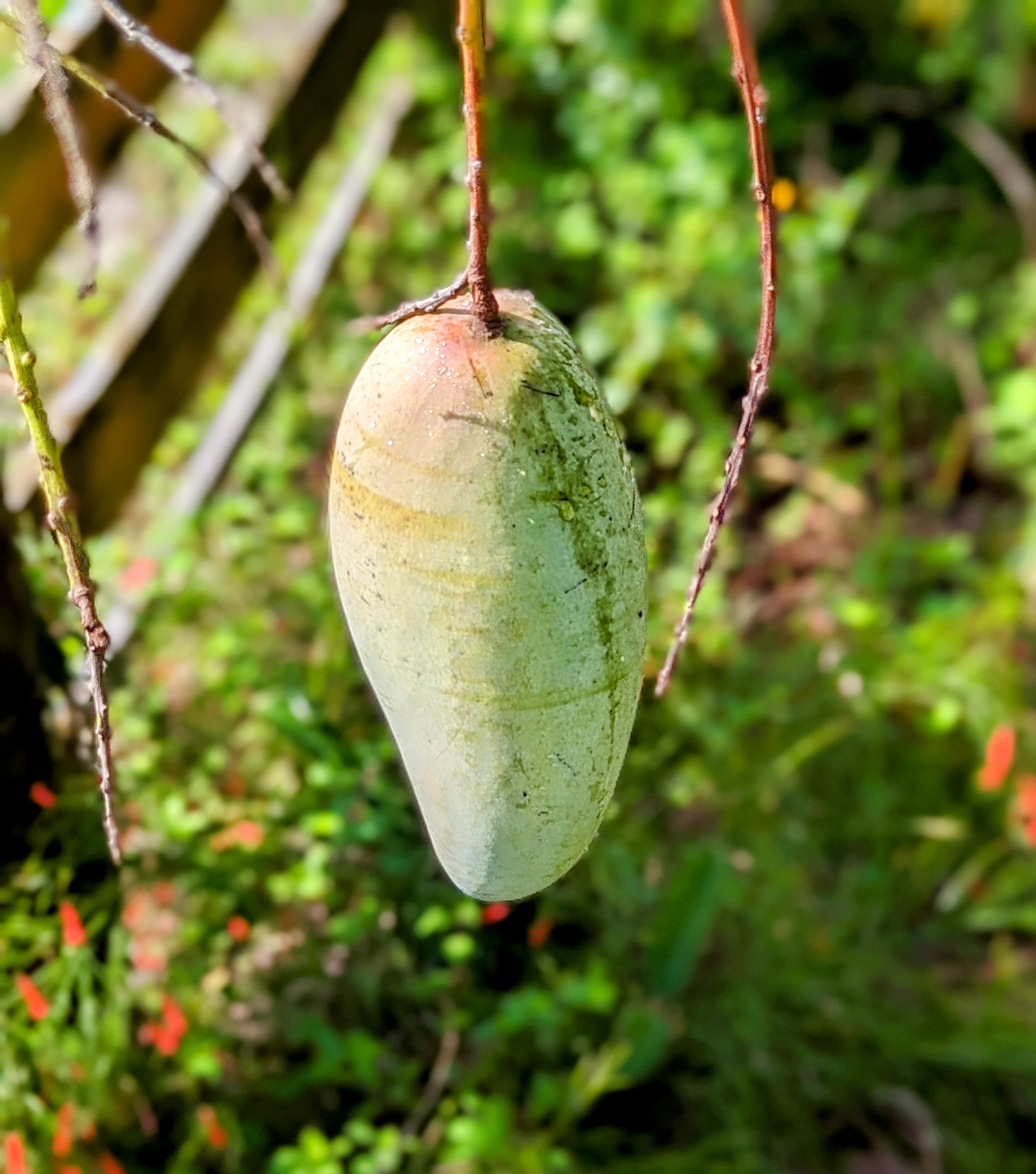
We have been eating Pickering and Glenn mangoes for a couple of weeks. This is the Thai dessert mango, Nam Doc Mai, finally showing some signs of ripening.
Rest assured that the spell check did not like that word I made up, Graptosalvia. It still doesn’t, and would not even hazard a guess at what I was trying to type. Grapto for the grey graptosedum and salvia for the flowers.
The wildflowers in my garden have responded wonderfully to my haphazard fertilizing a couple of months ago followed by lavish rain showers over the past couple of weeks. I have never seen them so big or so green. Another home run for time release fertilizer. Osmocote may be the secret for gardening on sugar sand. The succulents, graptosedum and friends, are also enjoying the heat and food. I never do anything special to the succulents and they just keep multiplying..the instructions I read on the internet for succulents boggle my mind.
The contents:
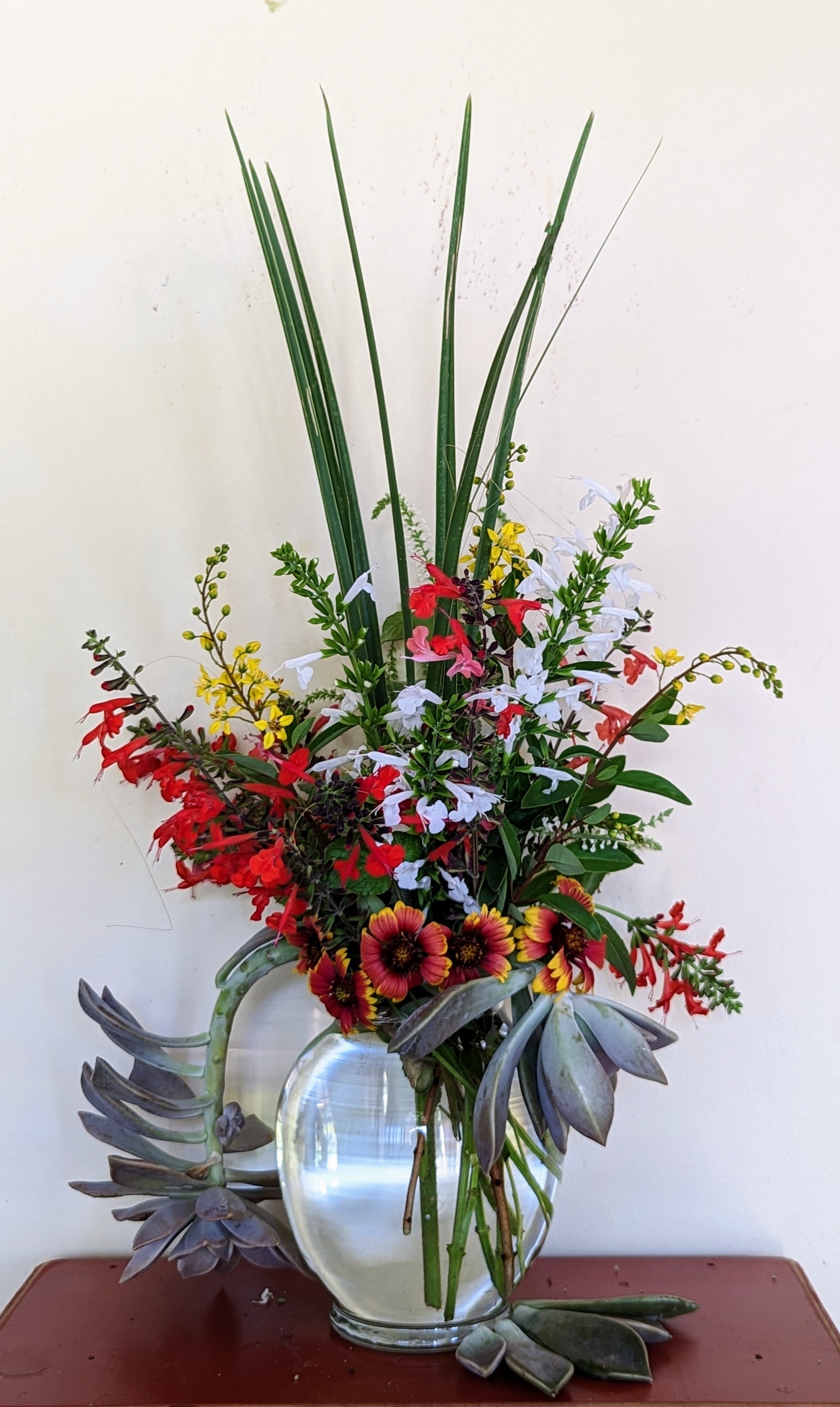
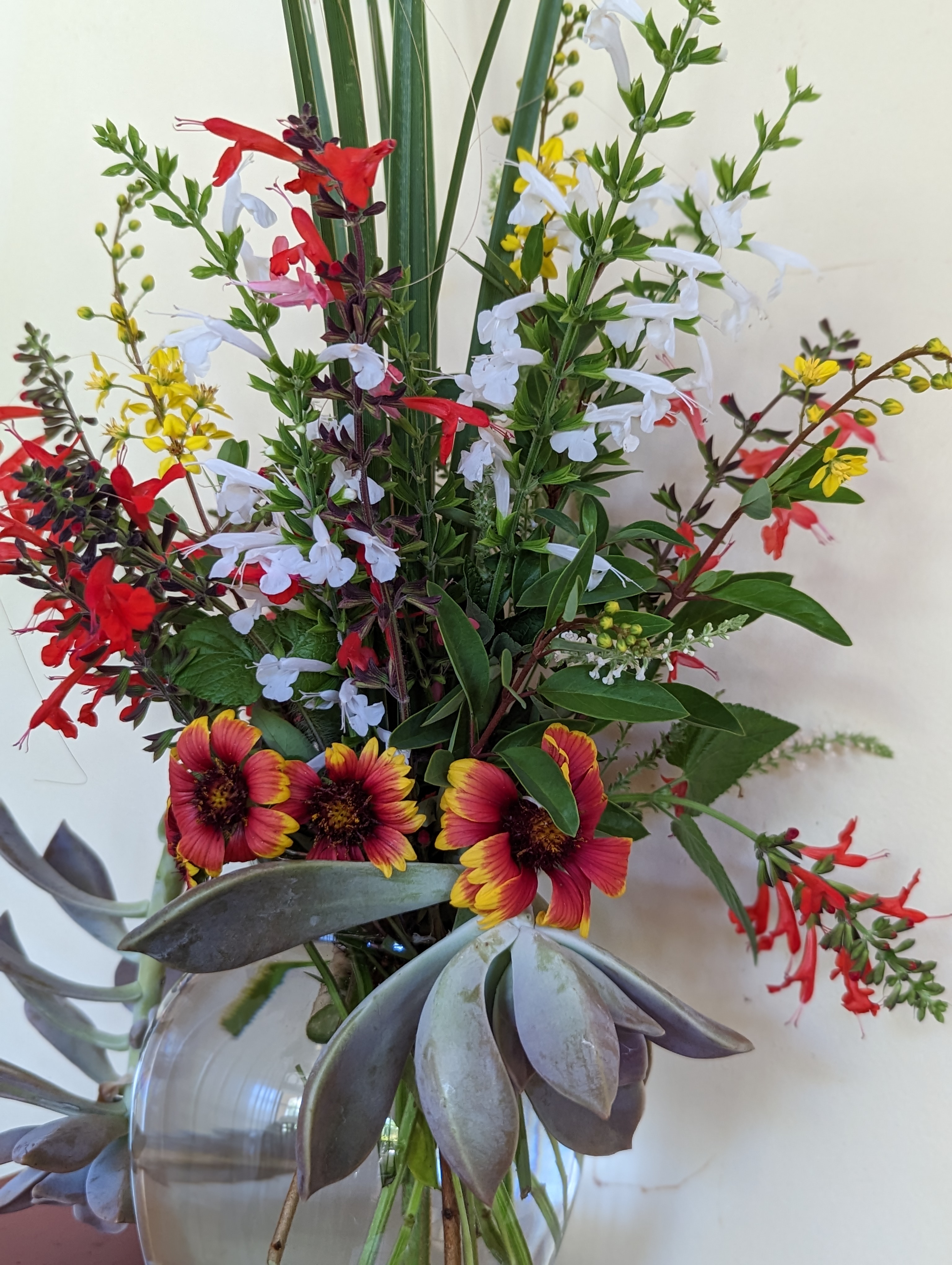
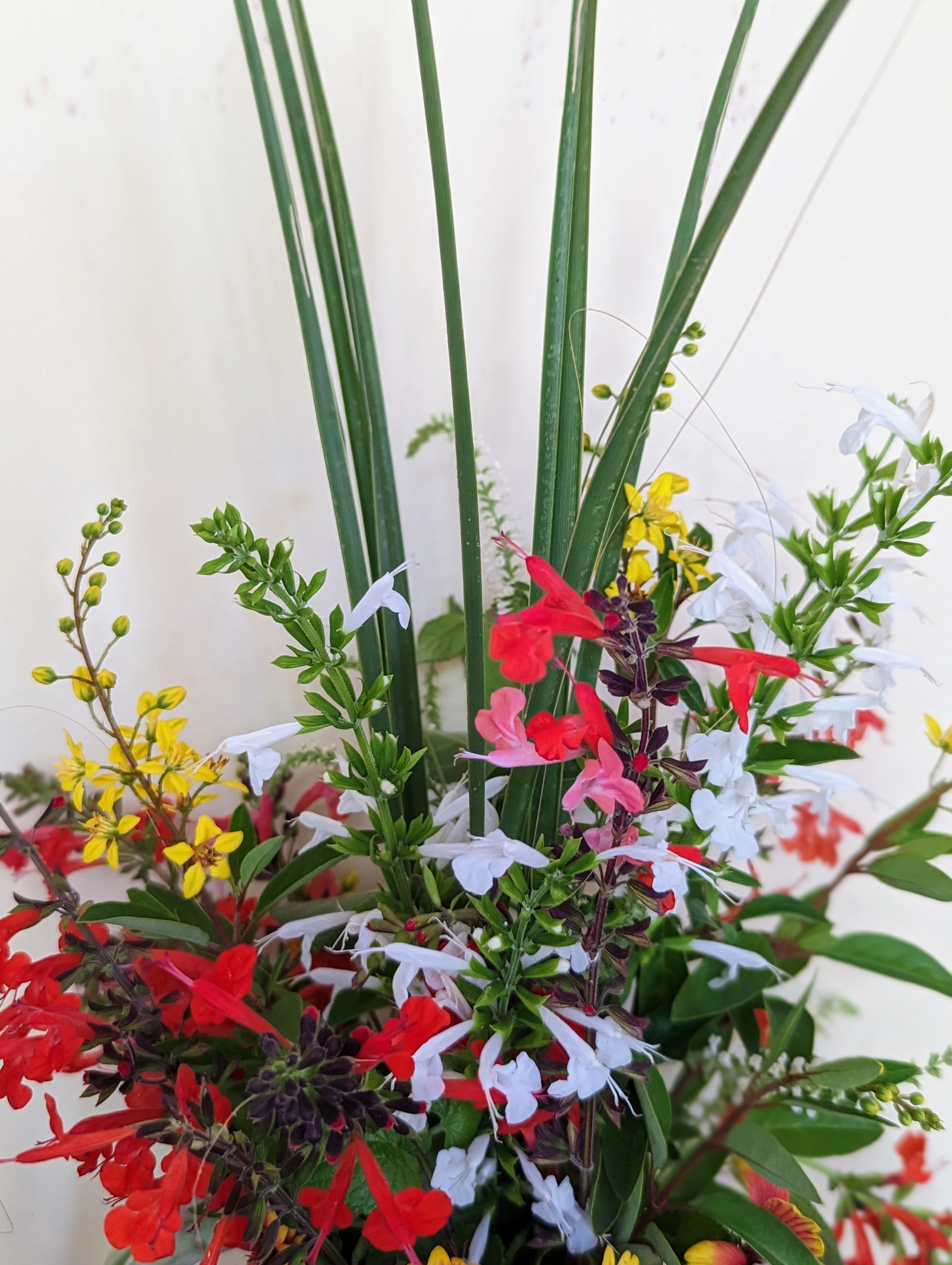
The funky foliage in the vase – two cuttings of grey graptosedum, these things tend to shed leaves as they are moved, so I arranged the lost leaves into a fan at the base of the vase. The spiky green foliage is a frond from a palm seedling stuffed between the flower stems to make them stand up straight. It looks deceptively like a spike dracaena.
The flowers:
In red, white and pink spikes, Tropical Red Salvia (Salvia coccinea); yellow flowers are Thyrallis (Galphimia gracilis), this is one of my favorite summer flowering shrubs. It would probably be taller if I did not like to cut the flowers. There are a few white spikes of Sweet Almond Bush (Aloysia virgata) and I managed to cut the Gallardias (Gallardia pulchella) off the bottom of the picture. The vase is a leftover florist vase from ..who knows where, but the perfect size.
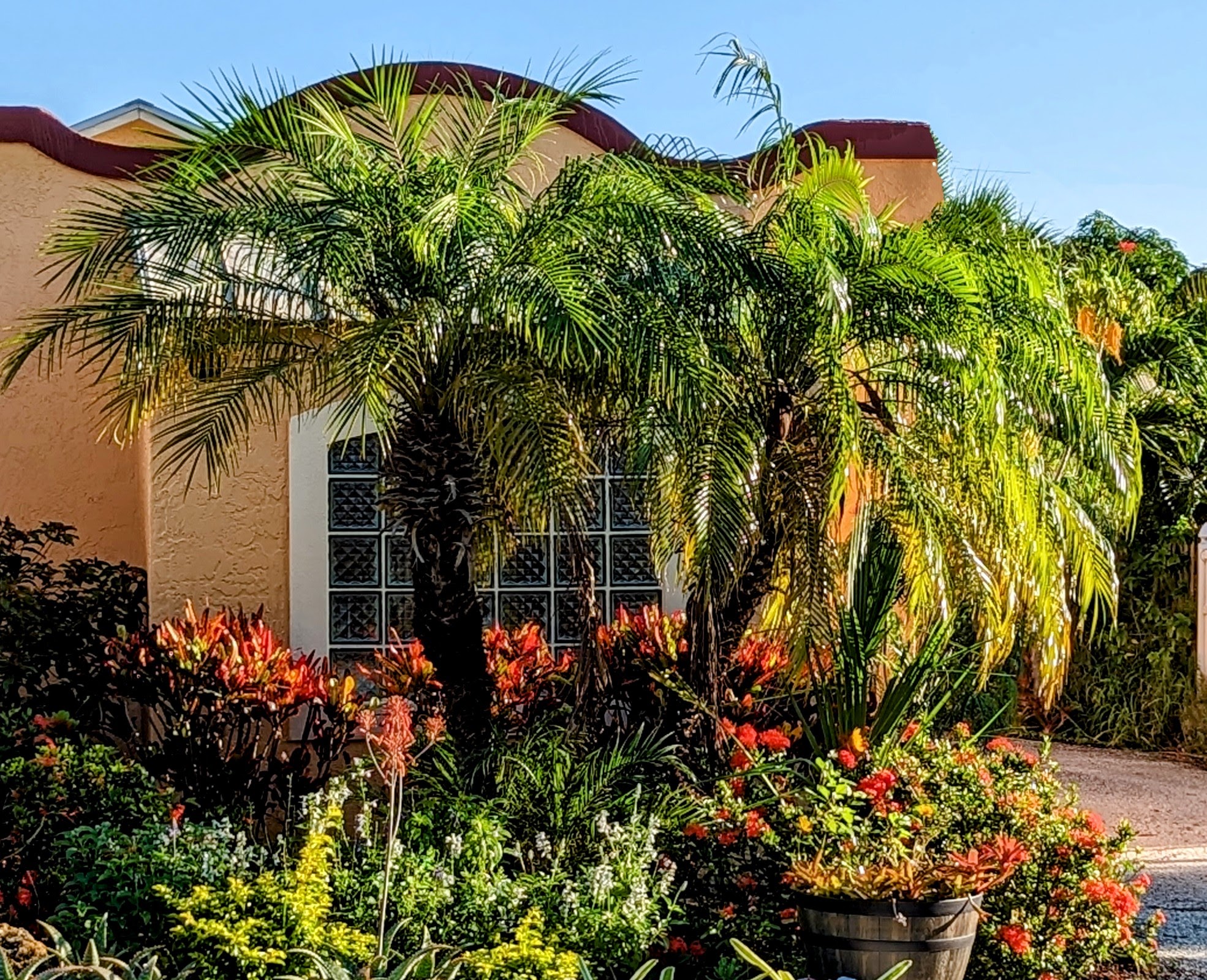
Summer is settling in on the Treasure Coast of Florida. Afternoon thundershowers are keeping the garden watered and everything is flourishing, even the weeds. Especially the weeds! Though it is very green. Palms and cycads are hard to resist planting in a tropical garden, so I have several to explore today. To see other Saturday garden explorations visit Jim at http://gardenruminations.co.uk
This is an Adonidia Palm (Veitchii merrilli). Grown from seed by my college friend Eddie, it has been in the ground for about 10 years. The off white things on the trunk are flowers, if left in place they make red fruits that look like Christmas ornaments – it is sometimes called Christmas Palm for this reason.
The Lady Palm (Rhapis excelsa). This one is starting to run in my Rainforest Garden. Super Fireball Bromeliads in the foreground.
A Bottle Palm (Hyophorbe lagenicaulis) just starting to make the bottle. The old fronds eventually fall off revealing a green bottle shaped trunk. The process takes about five years. This palm has been in the garden for at least that long, so I am hoping the fronds will come off soon. They are impossible to pull off now. One thing I have learned about palms – they are slow growing. This was a surprise.
The Dwarf Pygmy Date Palm (Phoenix roebellini). This is one of those plants that needs a friend to make dates. I have read that they will produce dates here, but have never seen any. One thing I did not realize when this was installed was the size of the thorns on the fronds, ouch!
This is a Coontie (Zamia integrifolia) an interesting cycad native to the state of Florida. These were harvested nearly to extinction in the quest to make arrowroot flour from the roots. The roots are deadly toxic and must be washed extensively before milling into flour.
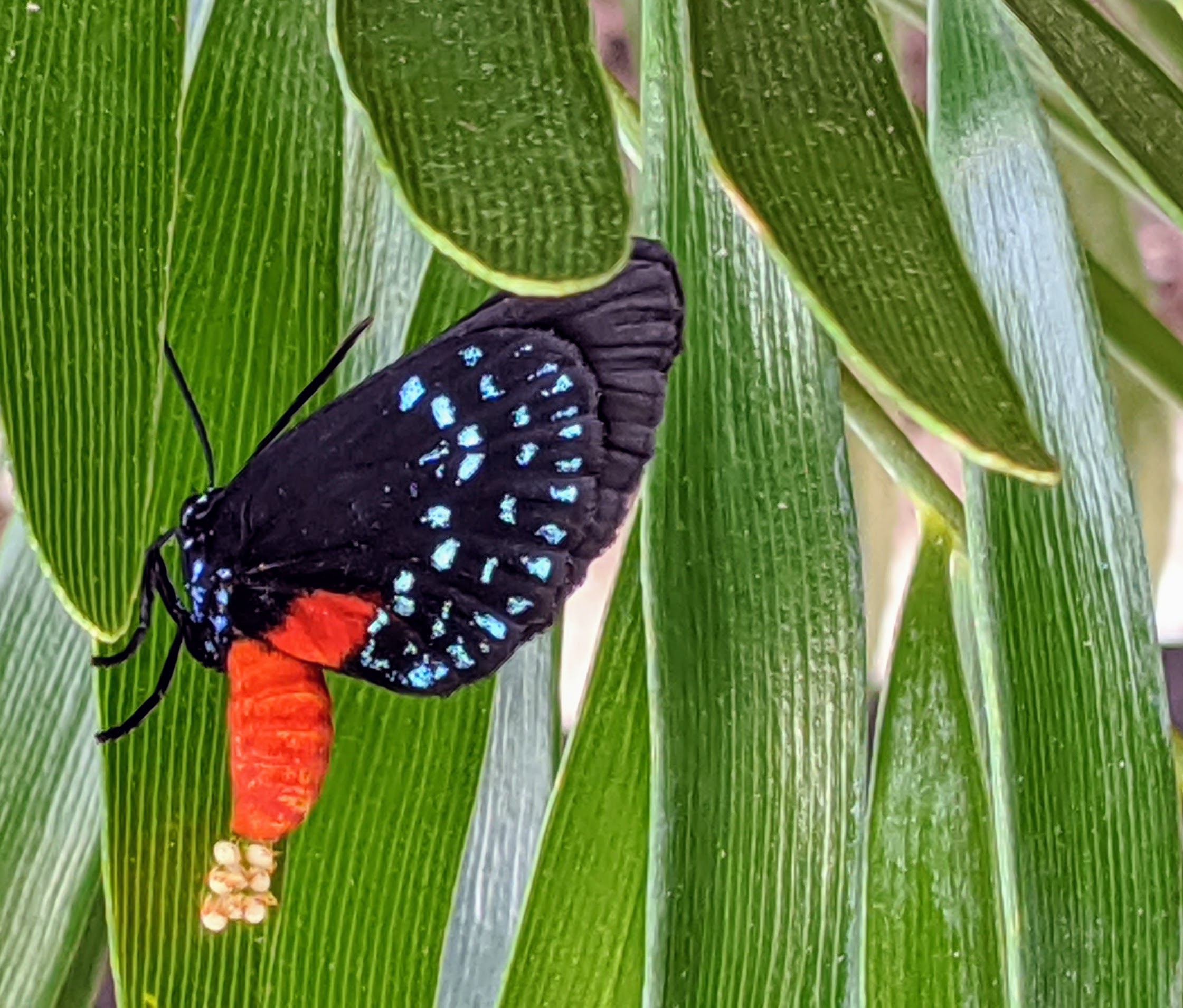
Another near victim of extinction from the arrowroot flour quest is the Atala butterfly whose larvae host exclusively on the foliage of the Coontie. The butterflies were thought to be extinct until a small group was found on an uninhabited key in South Florida in the 60s. Gardeners embraced the plight of the Atala and planted Coonties for them. The Atala population has rebounded, while still considered rare, I see them in my garden from time to time.
The Atala butterfly laying eggs…
Atalas are around in January or June here; so I look for them every day. So far, I have seen some cicadas in the Coontie. Hope springs eternal.
That is all from palm infested South Florida this Saturday. I hope everyone is enjoying summer and experiencing garden happiness.
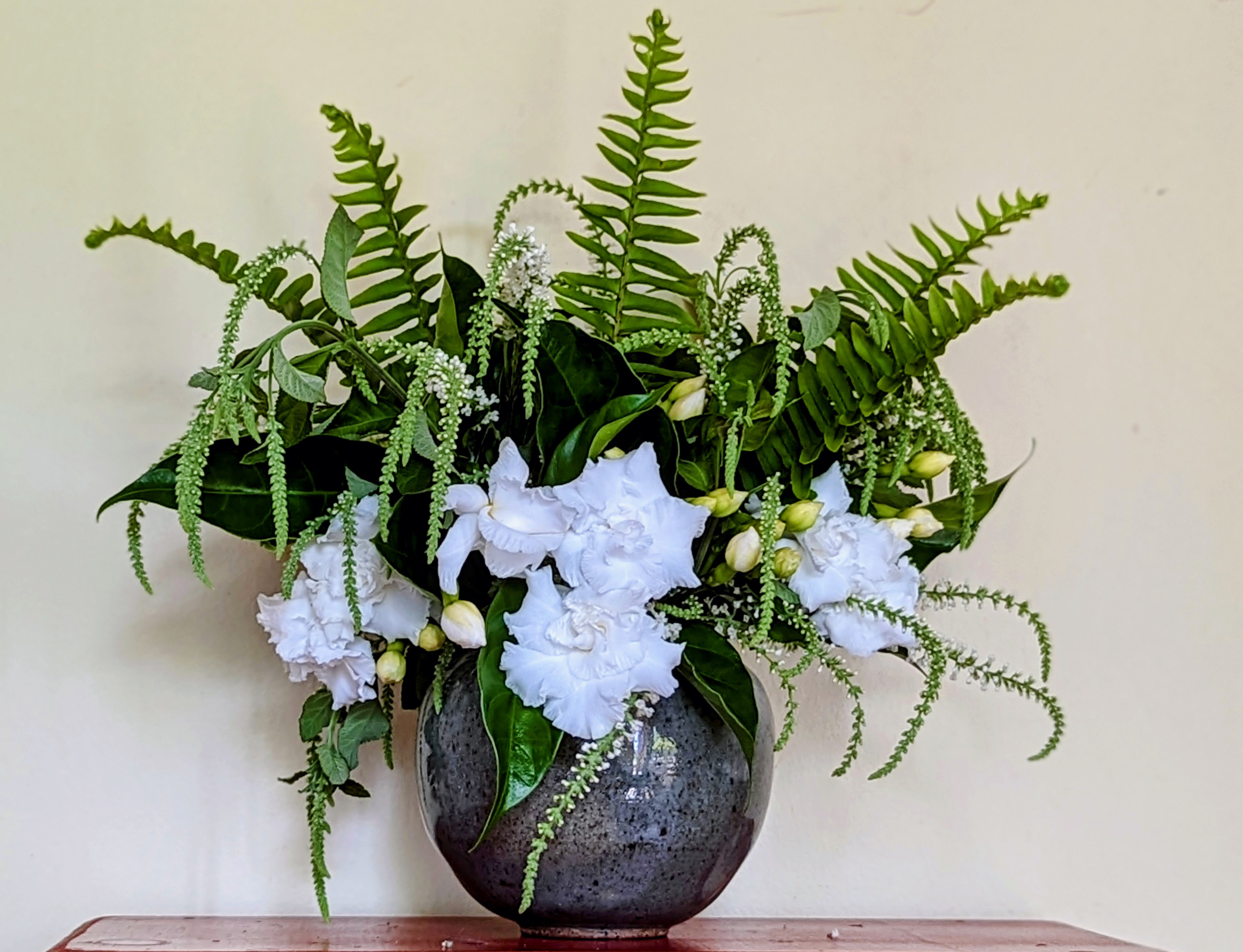
I was inspired to cut some Tropical Gardenias after they started flowering in earnest. Several afternoon thunderstorms provided the inspiration for the flowering, I think. As I was gathering gardenias it occurred to me it felt like I was carrying a bridal bouquet and it certainly looks like one. This is not a proper hand tied bouquet – it is rubber band secured. The gardenias exude a sticky sap, I am not sure how good this would be to carry down the aisle. They also brown quickly like the more common gardenias. With the addition of the Sweet Almond flowers, the fragrance is amazing.
A closer view:
A closer view:
The vase is a thrift store find I have enjoyed for years. I love the sprays of buds on the Tropical Gardenia (Tabernaemontana divaricata), they last longer than the flowers and rarely open. The white spikes are the very fragrant Sweet Almond Bush (Aloysia virgata). I cut these back about two months ago and they have grown four feet and need another trim. Abundant rain in South Florida is a plant stimulator, I am not sure I even fertilized these. Greenery is from the gardenia and Asian Sword Ferns.
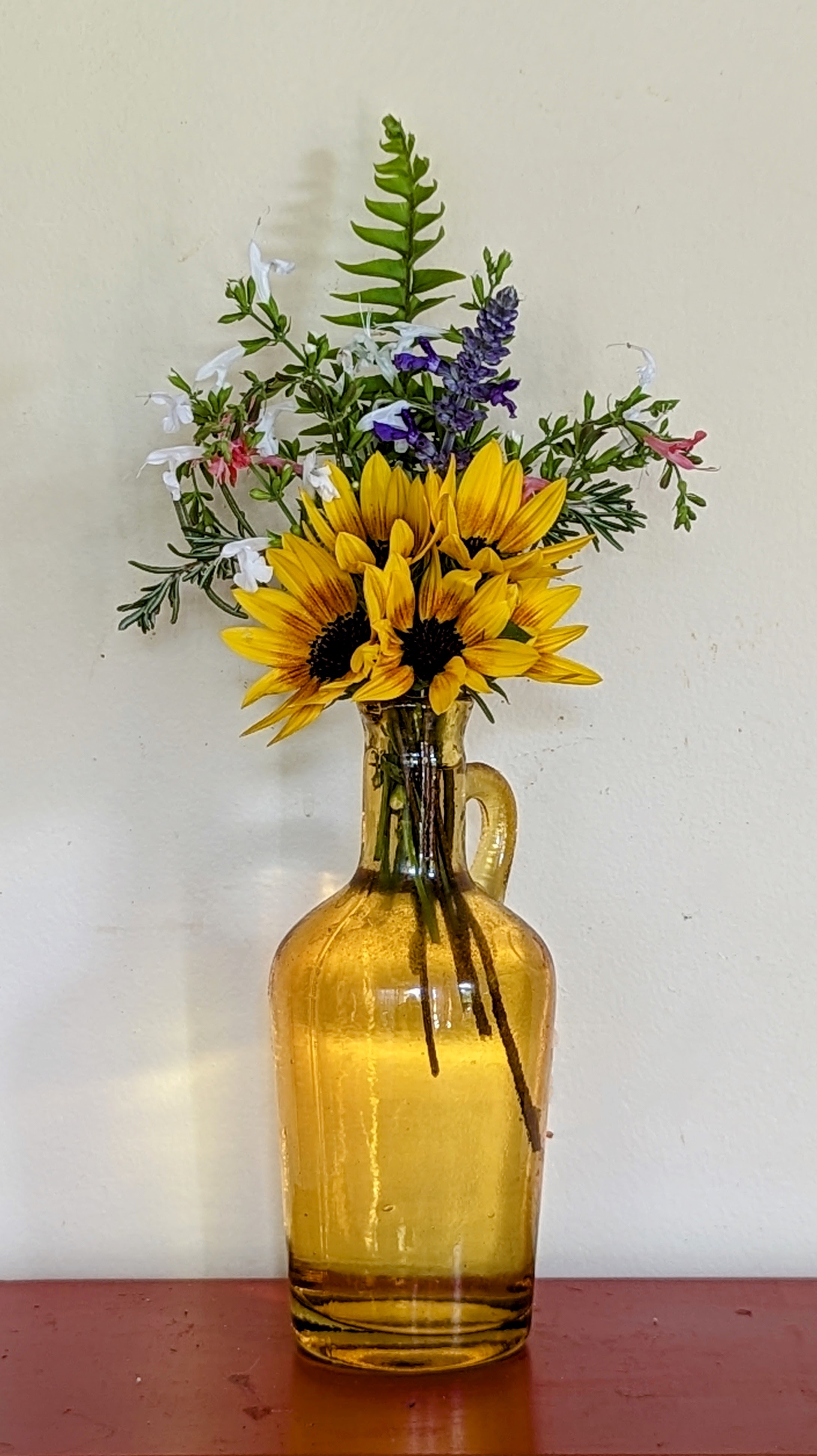
I needed some color and also needed to deadhead the Brown Eyed Girl Sunflowers, so I made another little vase. Continuing the wedding theme, these are for the tables at the reception..
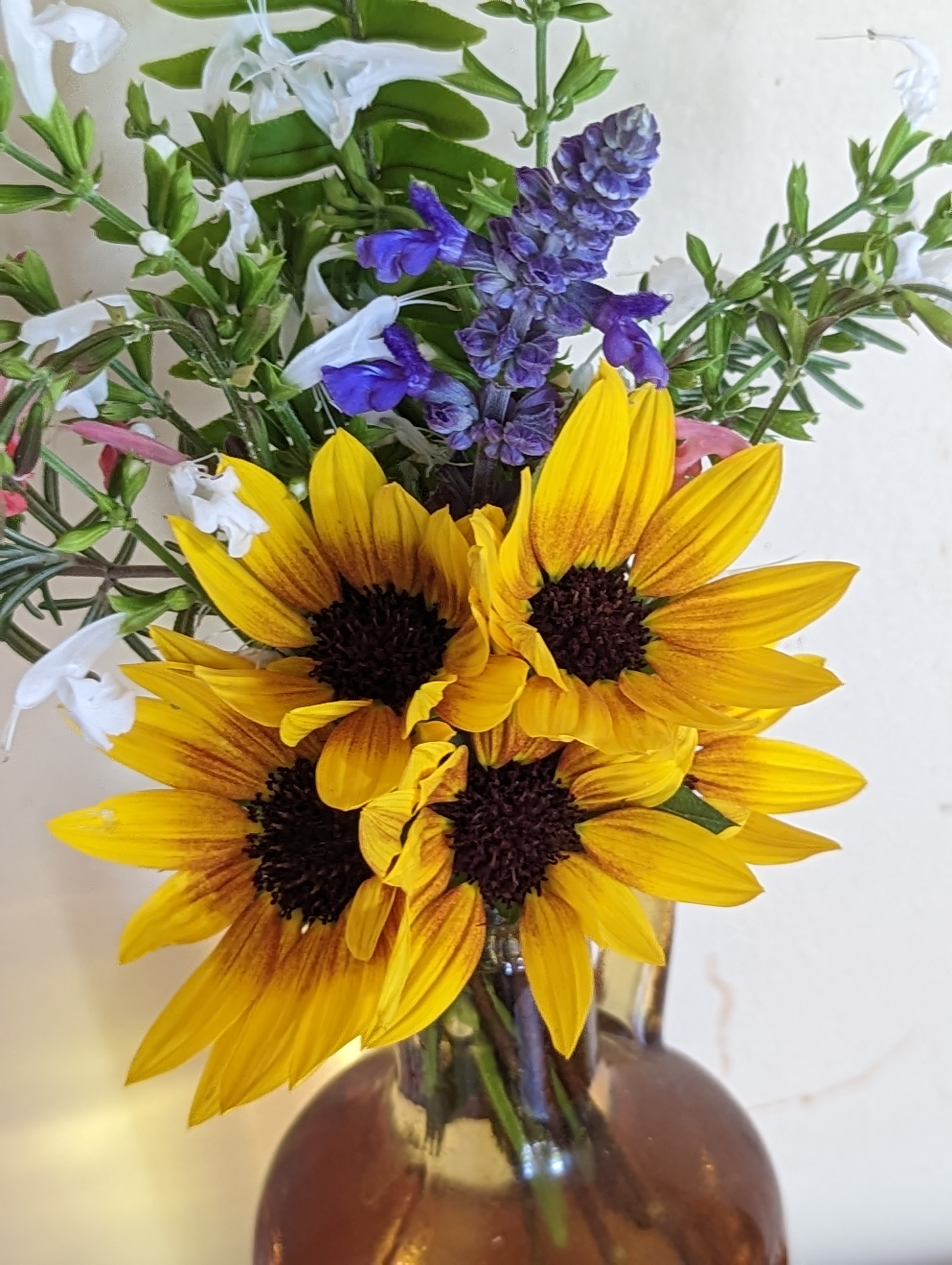
The vase is a Pier One oil jar from who knows when. I trimmed the sunflowers as they needed some air to hopefully help with their tendency for powdery mildew. It has been raining too much to do anything else about the mildew. A few snips of Salvia are included: in blue, Mystic Spires; in white and pink, Tropical Red Salvia. Greenery is a bit of Asian Sword Fern and a few stems of Blue Lagoon Rosemary.
A closer view:
My wedding plans are complete! More than 30 years ago, anyway. Thanks to Cathy at http://ramblinginthegarden.wordpress.com for hosting this weekly meme. Visit Cathy and find more vases to explore.
The weekly garden tour commences now. So many tropicals coming to life with the onset of the rainy season in South Florida. It has been stormy all week and the first named tropical storm of the year appeared in The Gulf of Mexico this week – Arlene. The storm is a long way from here and set to wind down into a tropical depression before making landfall in Cuba with a lot of rain. The first thing I spied when powering up the computer this morning was a Coastal Flood Watch; rainy season is definitely here.
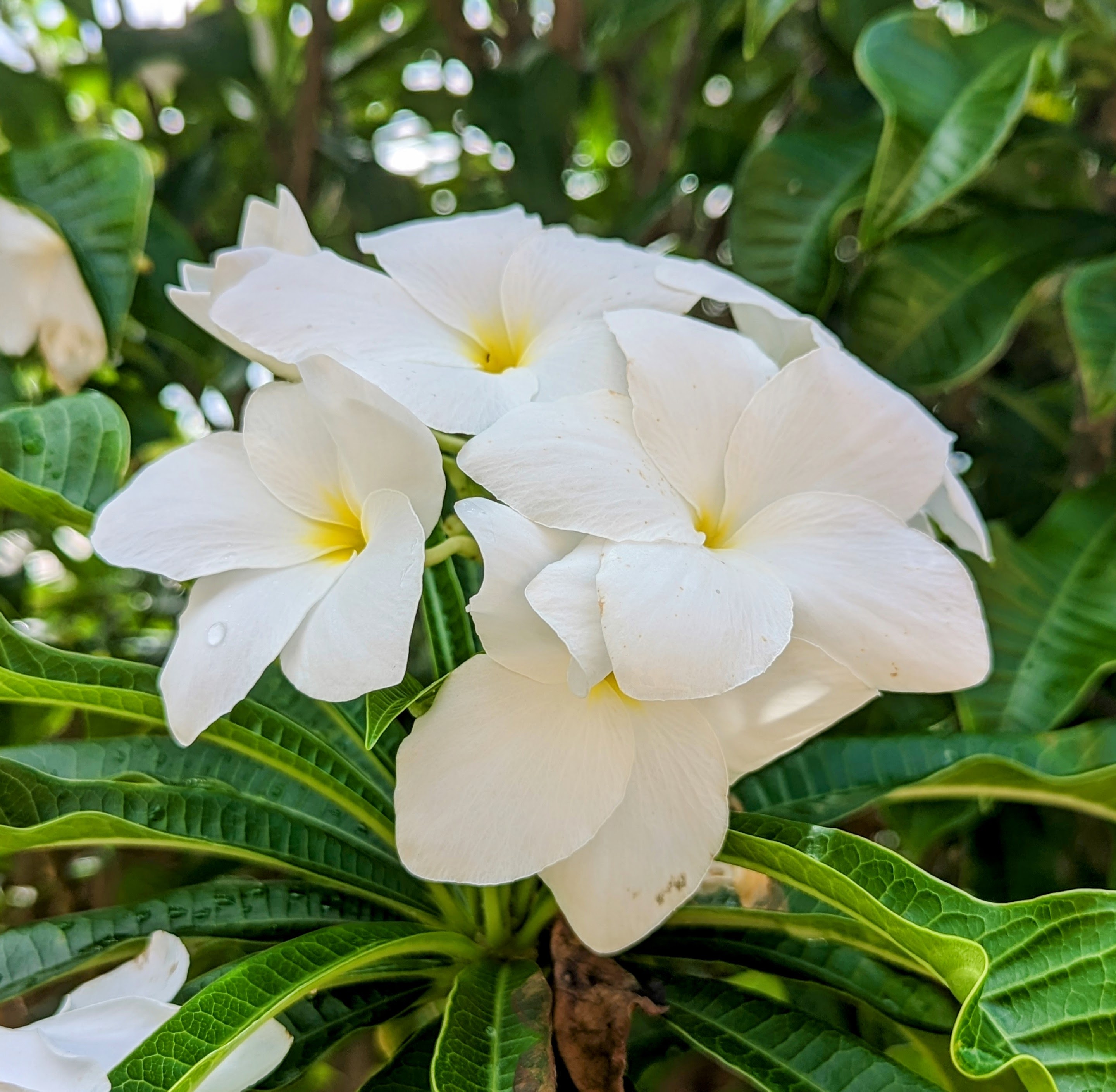
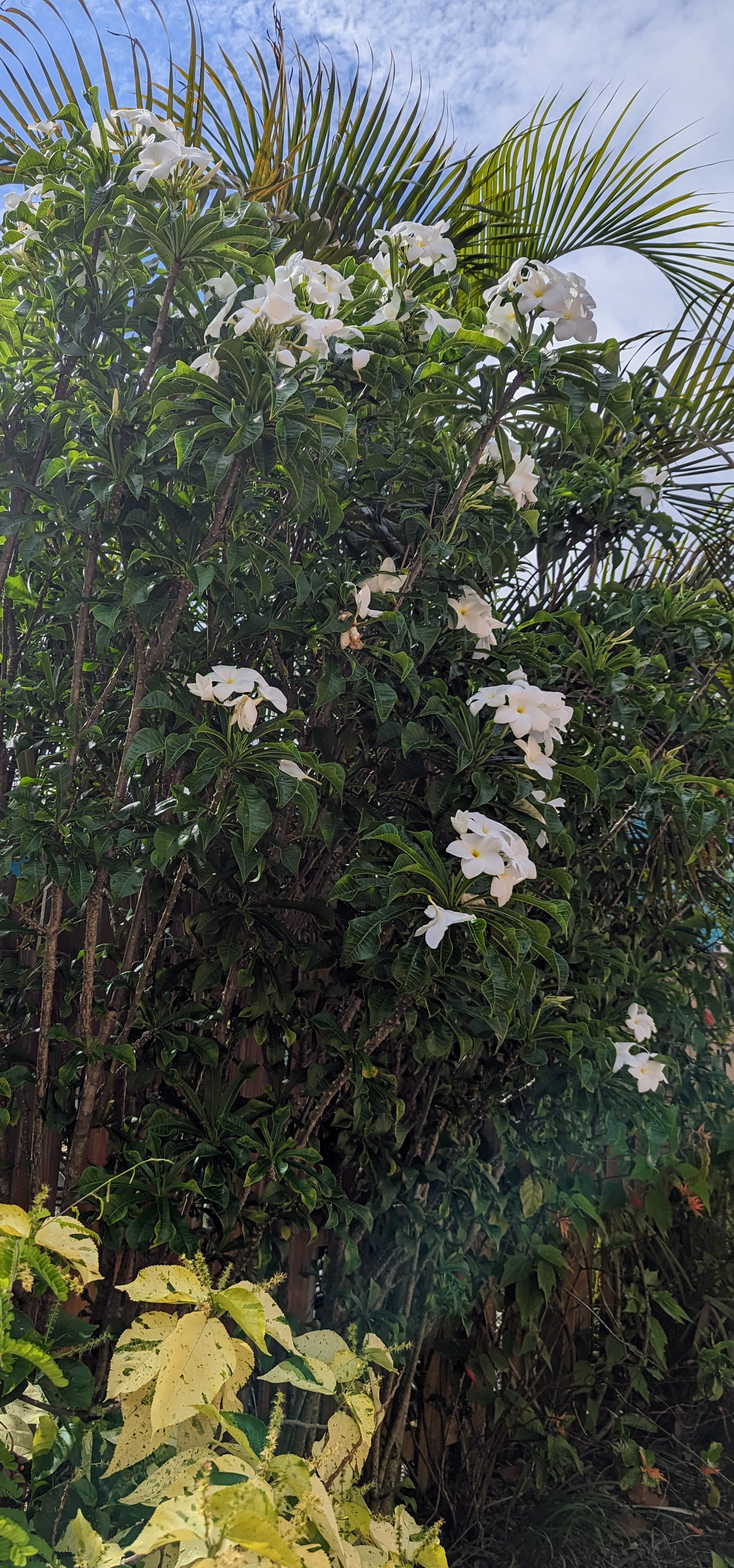
The Frangipani hedges are flowering. This is Bridal Bouquet Plumeria (Plumeria pudica). I have these in front of wood fences that aren’t so pretty. They are columnar plants about 8 feet tall and 2-3 feet wide. These are unusual as they are semi evergreen.
The Frangipani hedge with a Java White Copperleaf shrub accent.
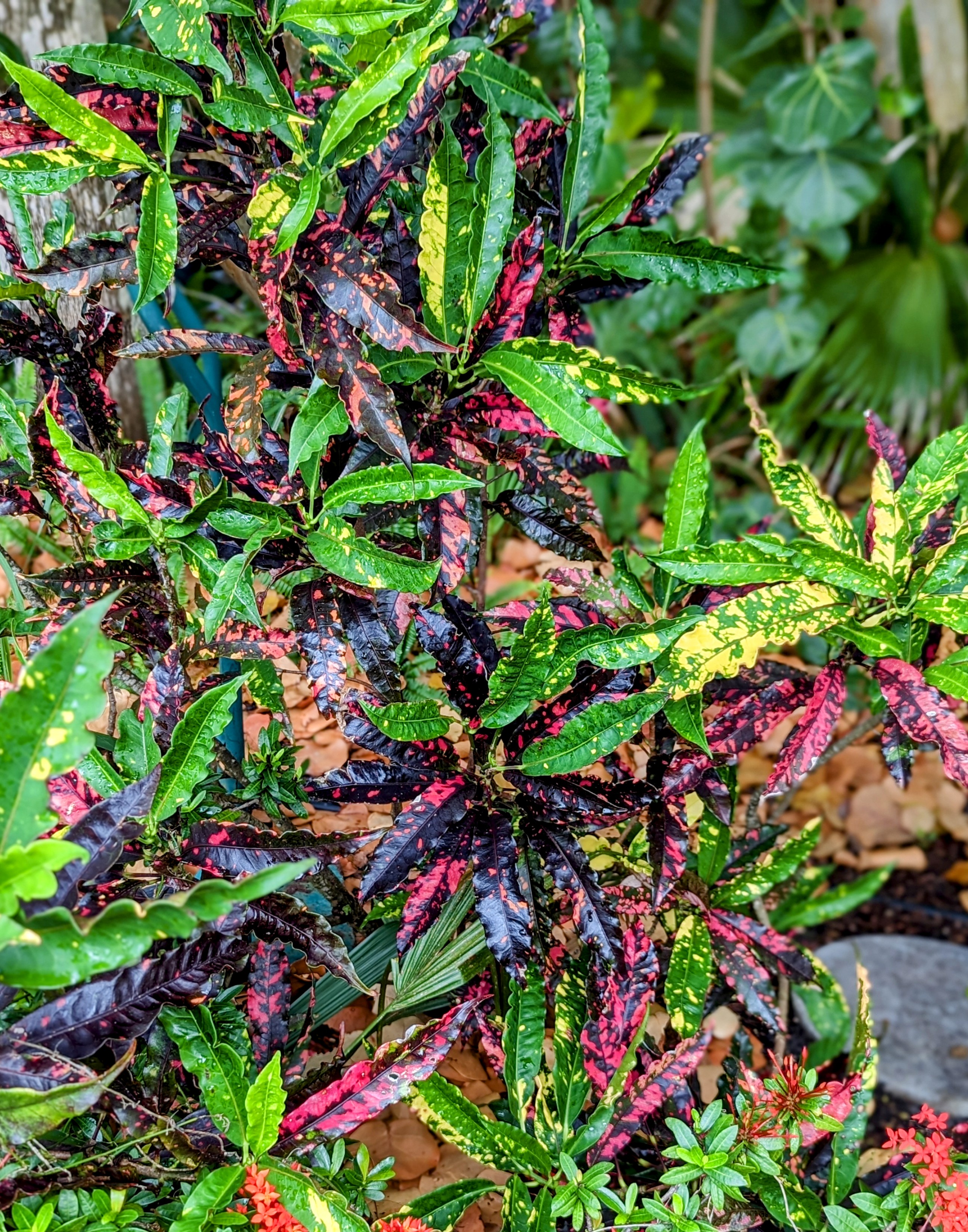
A psychedelic Aucuba? No, this is a Pie Crust Croton. Named as the edges of the leaves are crimped like – pie crust. New growth is yellow and will mature into a mostly red and black shrub later in the season.
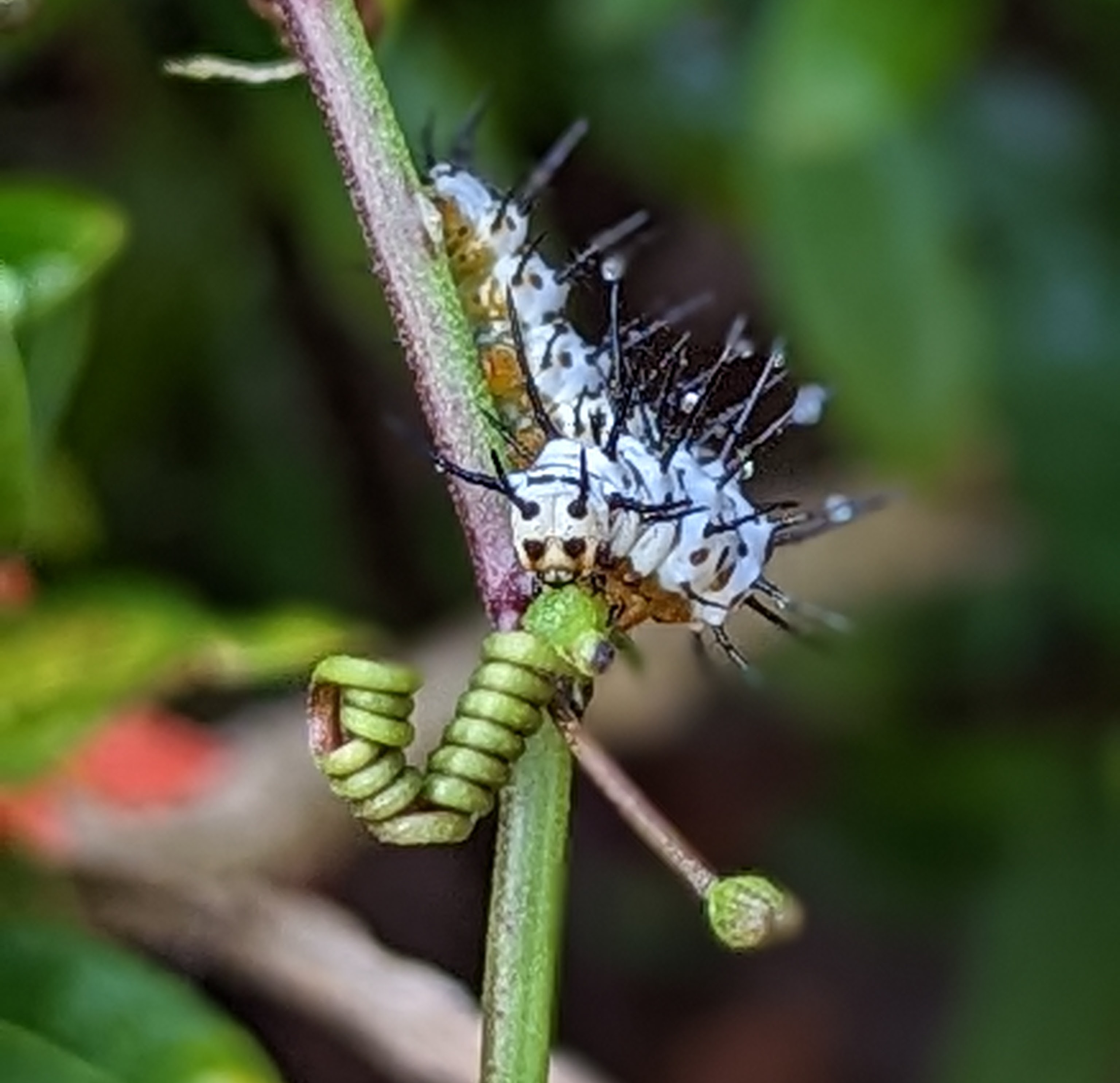
In the above image you can see a bit of an orange flowering shrub – this is a Dwarf Red Ixora, a butterfly nectar source. I let the larval host plant, Corkystem Passionflower, a vine, ramble through the shrubs for the Zebra Longwing butterflies to lay eggs on. This is the first caterpillar I have spotted this season, though the butterflies have been out in force.
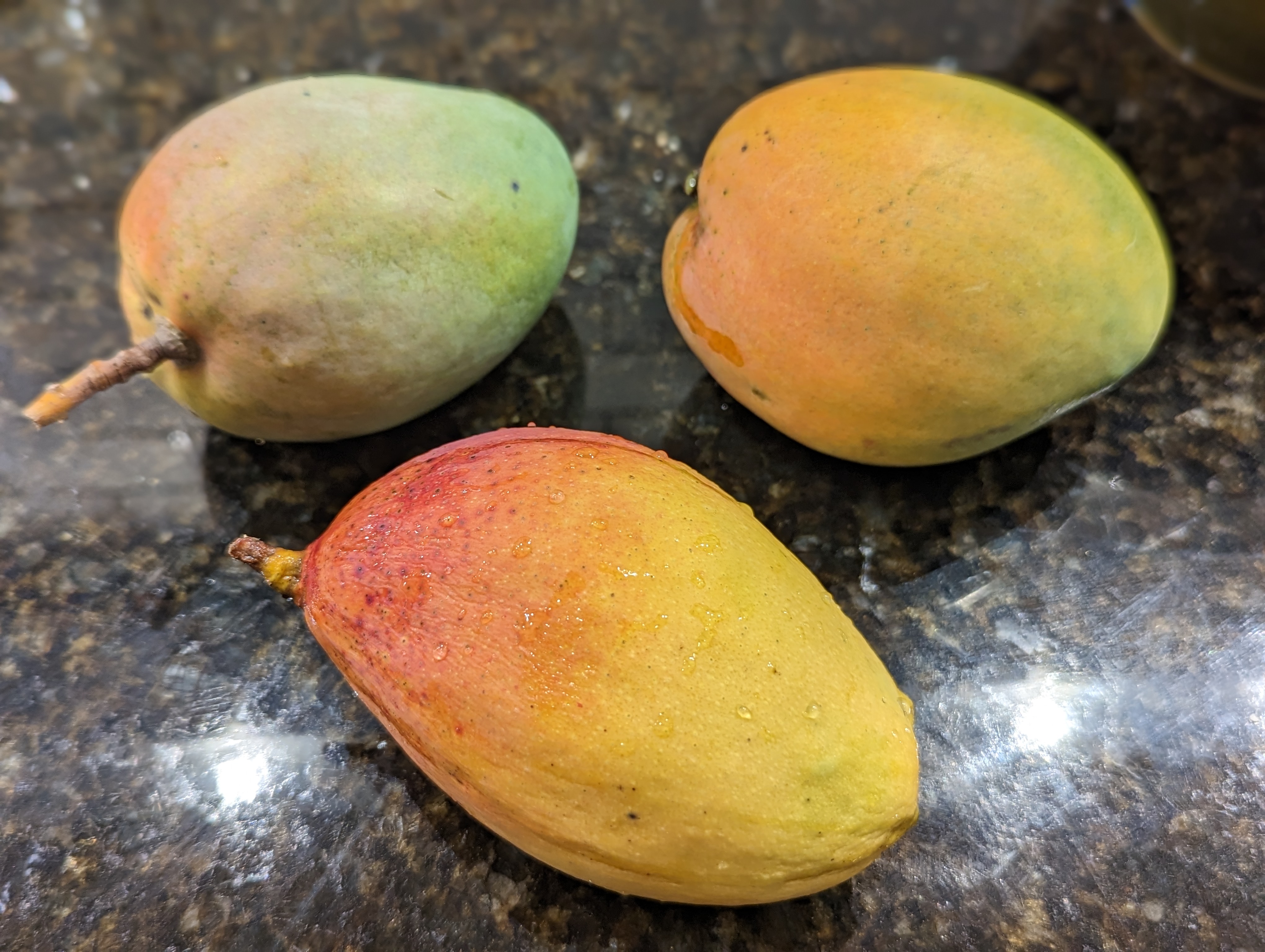
I am finally picking a few mangoes. They are delicious. The lower mango is a condo mango, Pickering. The others, Glenn Mango, a big tree. Condo mangoes are usually less than 6 feet tall.
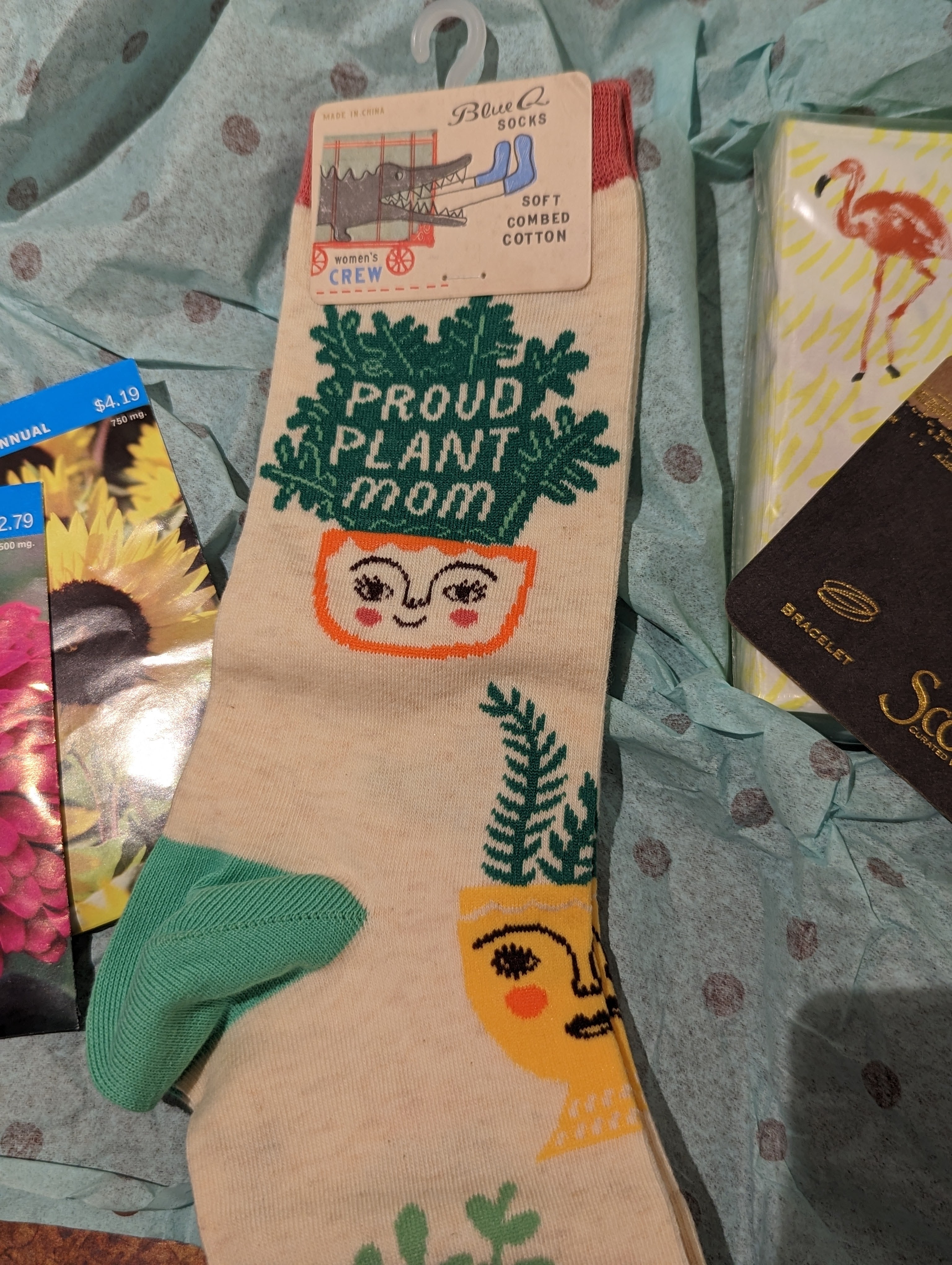
And just for fun, a gift from my friend Lu. Gardening socks!
That is all from the moist South Florida. Thanks to Jim for hosting and…
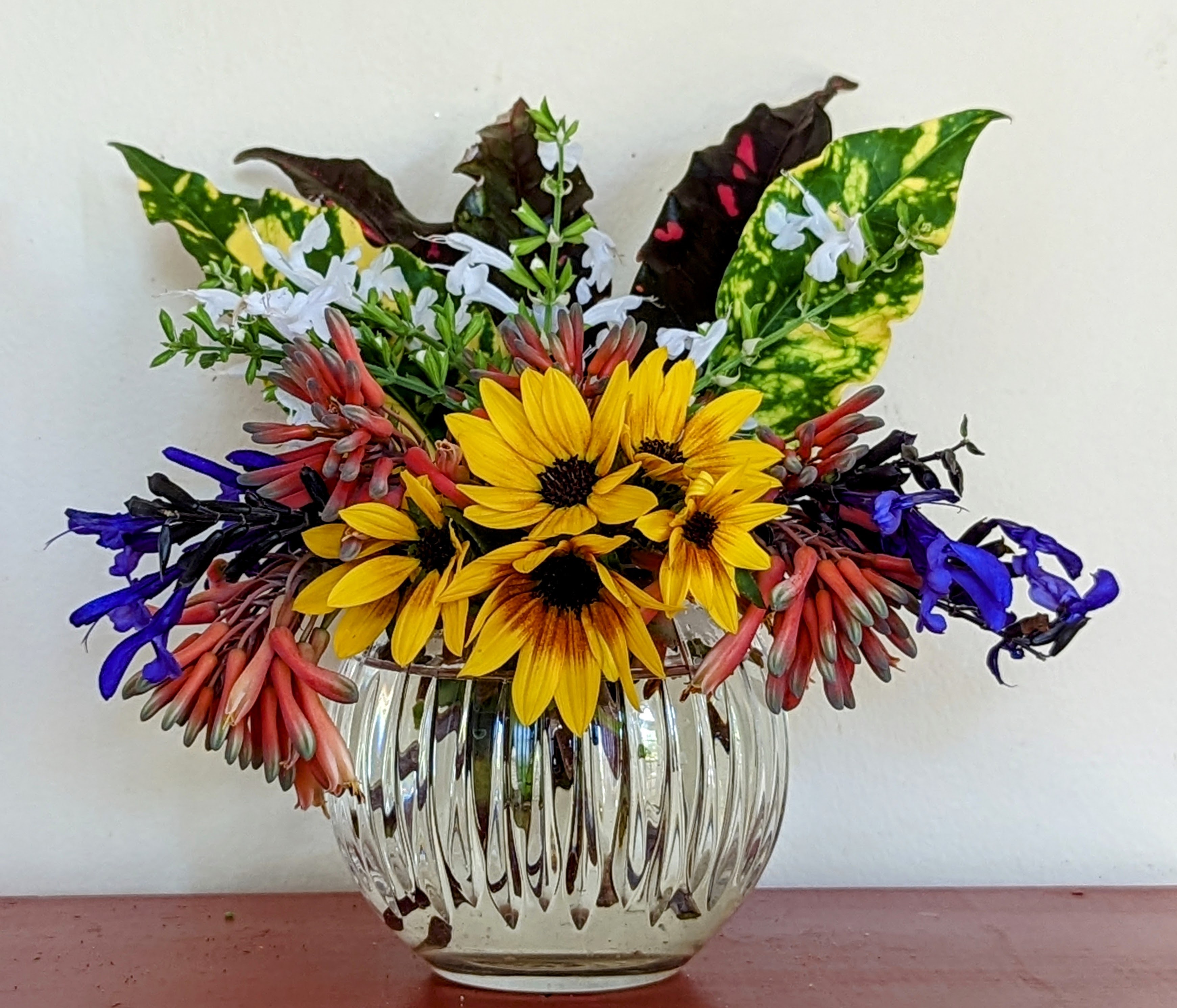
I decided to celebrate summer with a colorful vase after the garden served up a batch of bright colors this week. I think the garden is celebrating a few soaking rains. The difference between hand watering and rain always surprises me – it seems all the plants enjoyed it from the fruit trees to the succulents. The mango trees are covered with fruit, I managed to give them their summer feeding before the rains started and now they are putting out new foliage. The mangoes are beautiful, but still hard as rocks. More gardening patience required. The Brown Eyed Girl Sunflowers are back in action. I added them to two vases this week, this one and a birthday vase for my neighbor.
A closer view:
The vase is a crystal rose bowl that belonged to my mother. Gracing the rose bowl front and center are the BEG Sunflowers in yellow; salmon flowers with green tips are from Soap Aloe (Aloe saponaria); blue flowers are Black and Bloom Salvia.
The back of the vase has two colors of foliage from Pie Crust Croton, a mad tropical shrub about five feet tall currently. The yellow and green foliage is new growth and the darker is the mature foliage. The shrub resembles a psychedelic Aucuba. White flowers are from the stalwart Tropical Red Salvia (Salvia coccinea, the white version)
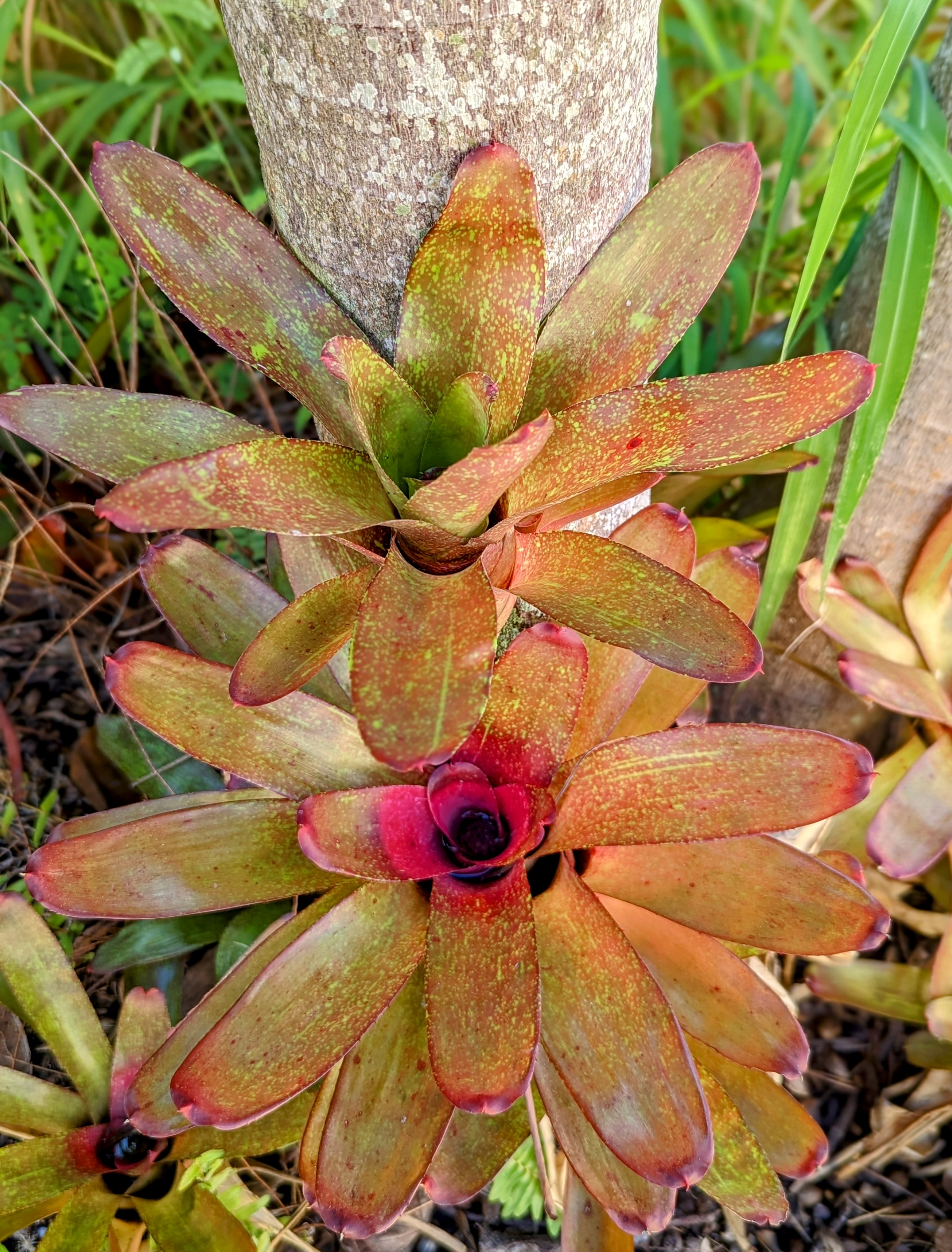
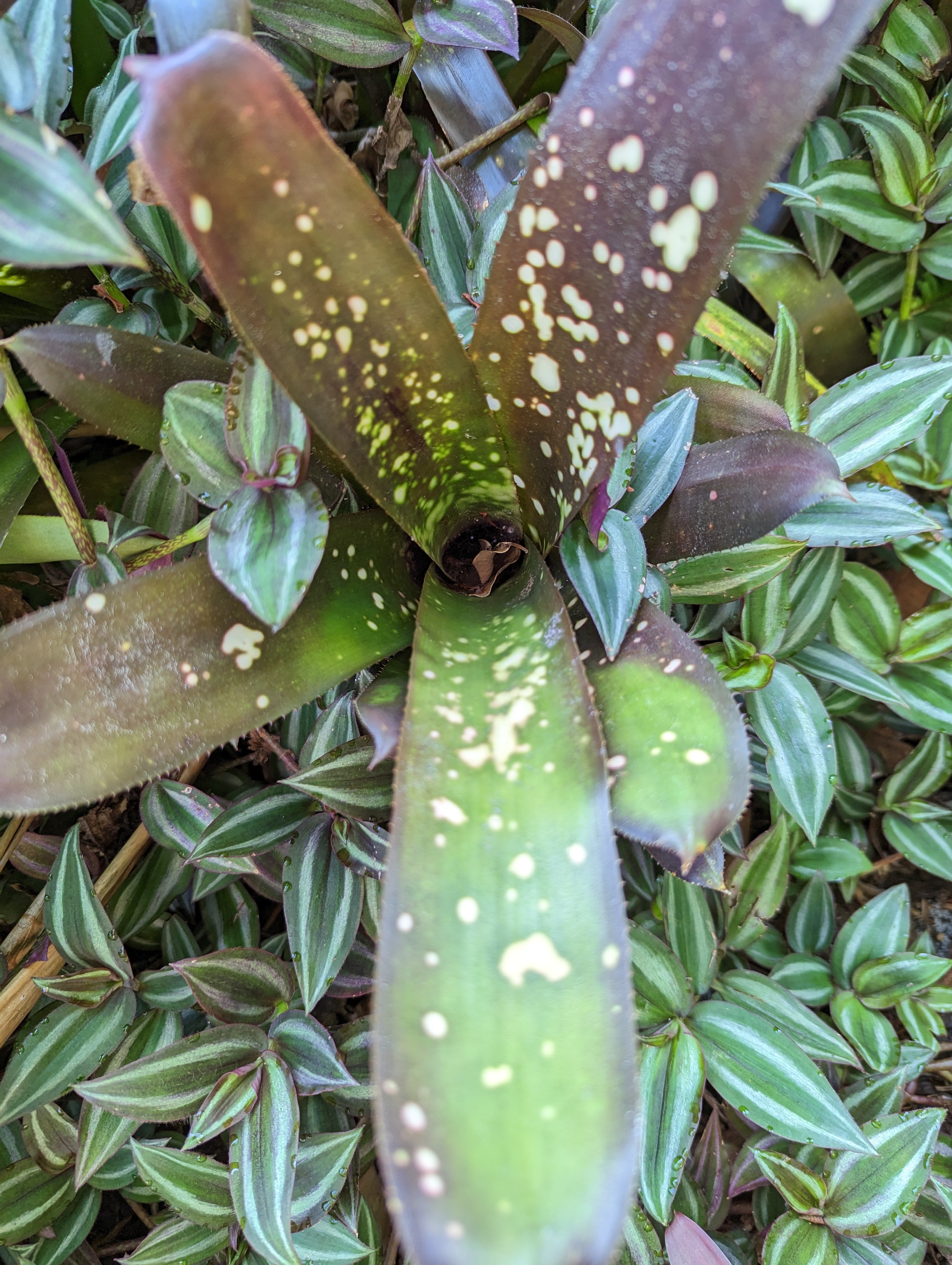
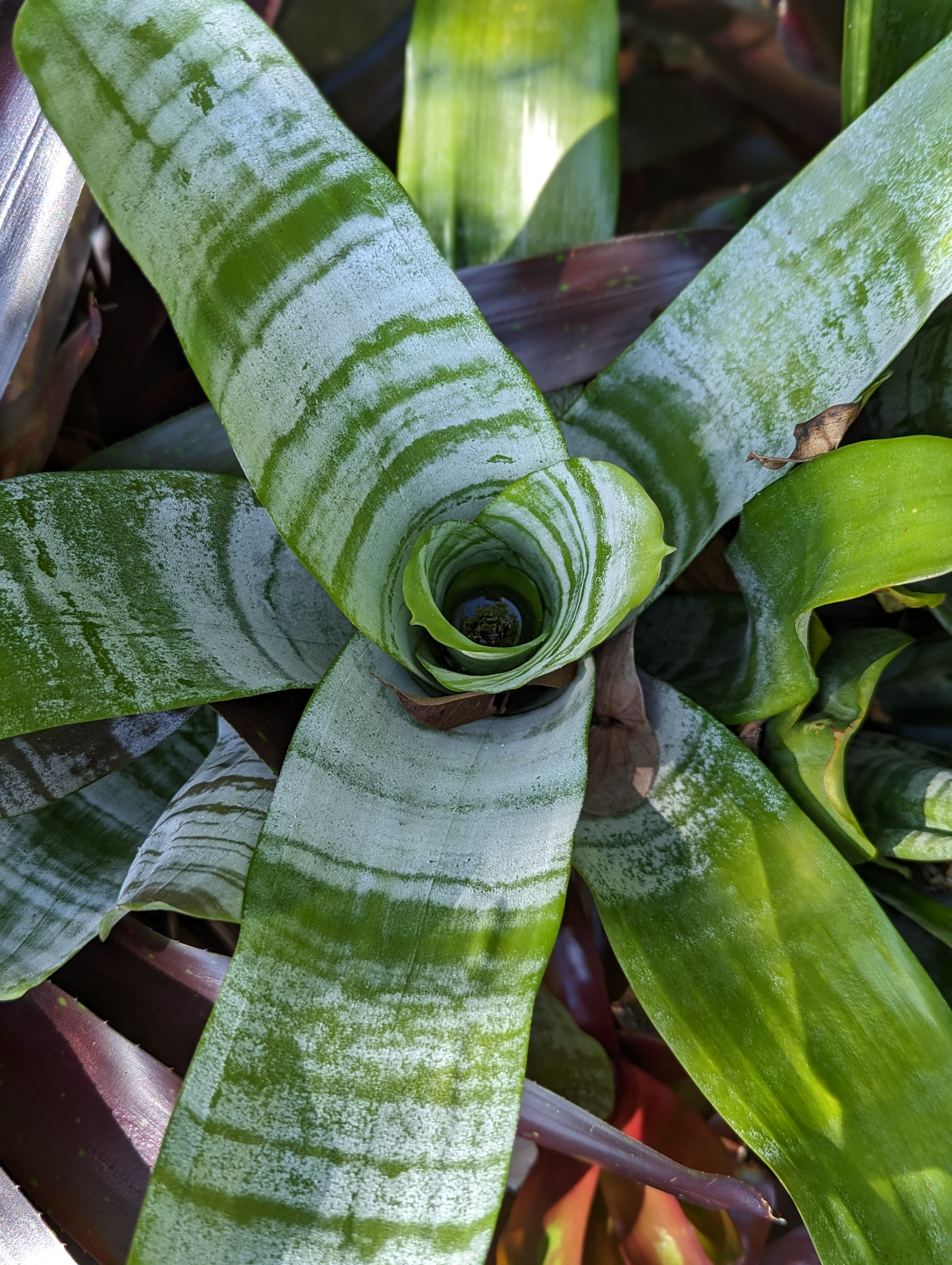
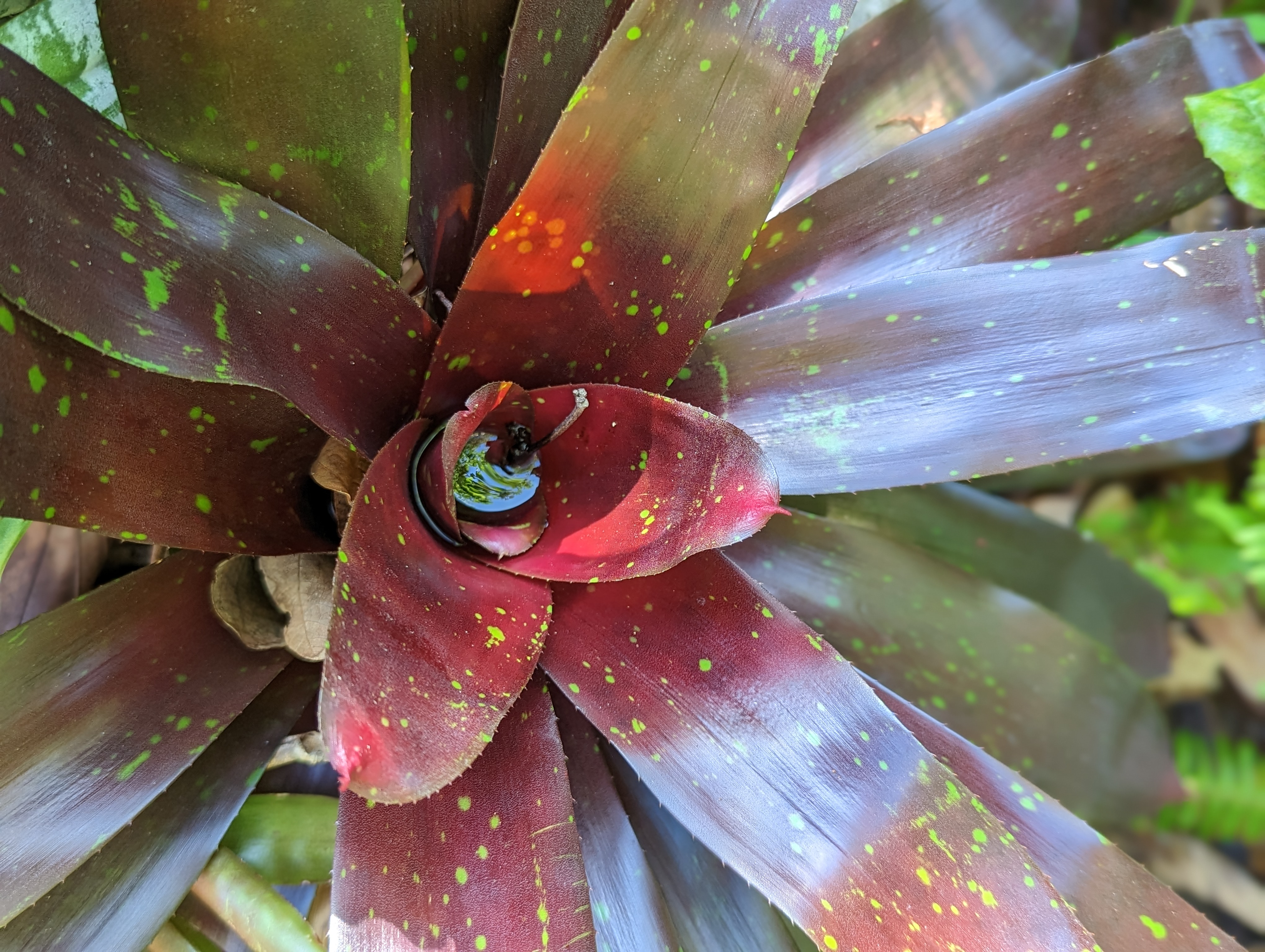
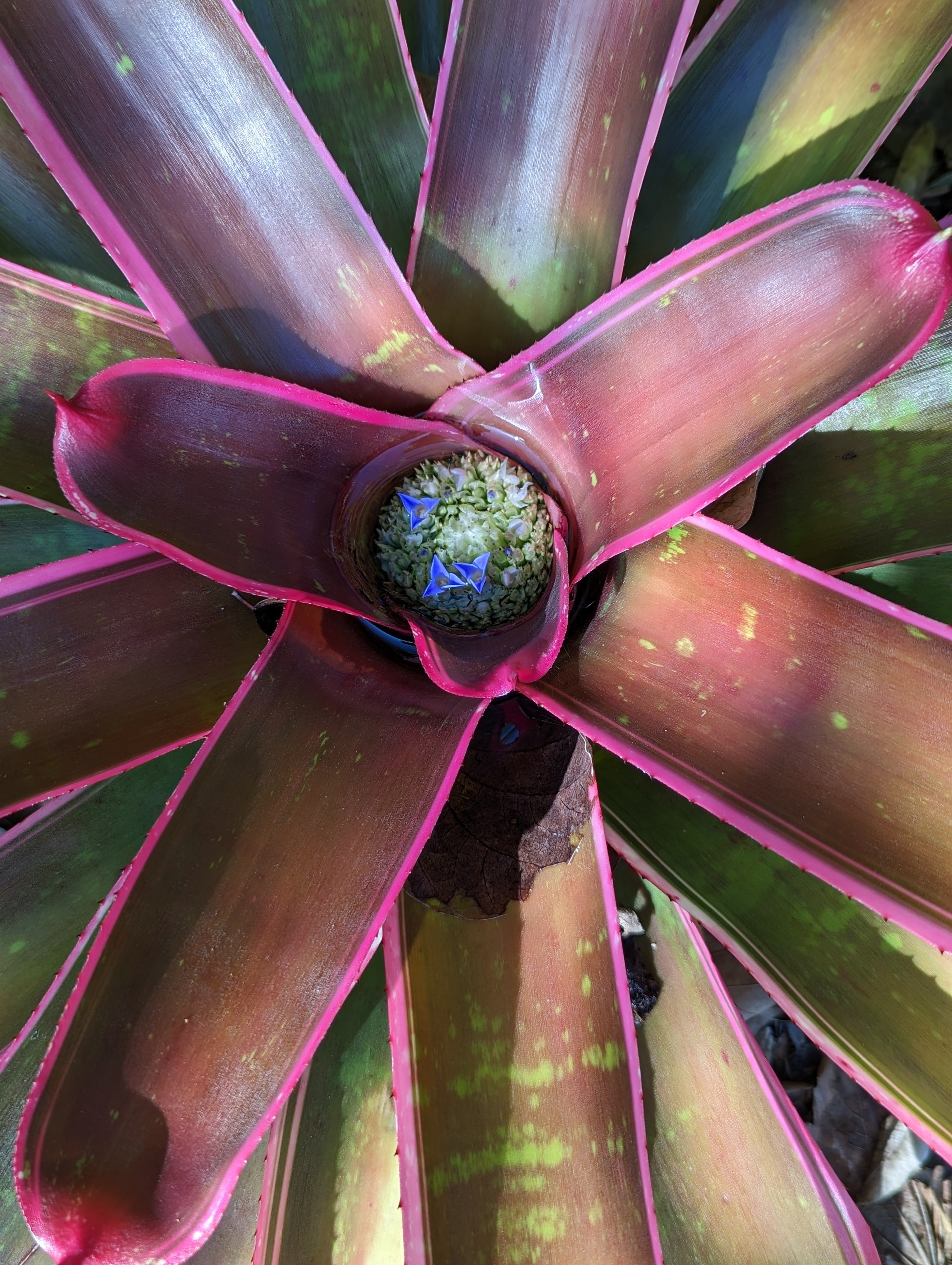
It’s time for the weekly visit with other SOS gardeners. My South Florida garden received plentiful rain this week, the plants enjoyed it and are starting to show their summer colors. Bromeliads in the garden change colors with the seasons. Some in the winter and others in summer. The color change I notice most is from green to red (and back). Markings on the foliage that change vary from spots to streaks to bands of color.
‘Jill’ Neoregelia climbing a palm trunk. The foliage tips and cups on this one deepen in color in the summer.
‘Hallelujah’ Billbergia. These tend to go a bit green in the summer. The purple color deepens in winter.
Aechmea ‘fasciata’. The bands of grey coloration sharpen with warm weather, these produce big pink flowers every other summer. Also known as the Silver Urn Bromeliad.
‘Luca’ Neoregelia, one of my favorites, is almost too dark but the chartreuse spots lighten things up.
An unknown Neoregelia in flower. This one has pink stripes in sunny areas and white in shady areas.
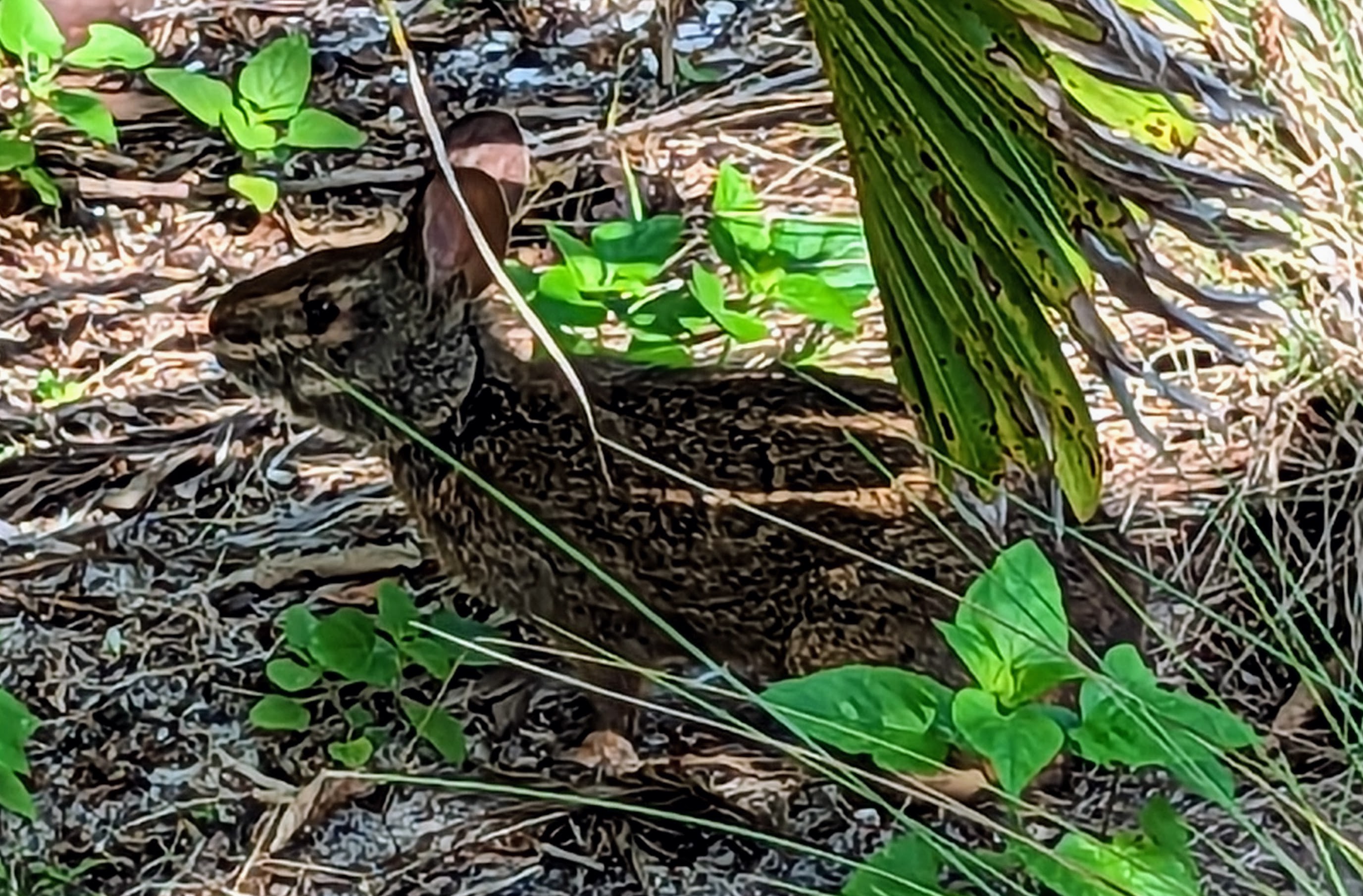
The bunny, we have had a banner year for bunnies. Fortunately, they like weeds and are eating something in the so called lawn while tormenting Fiona the Greyhound. This is a Marsh Rabbit. I am impressed with the camouflage, I could not see the rabbit as I was taking a picture of it.
That is my Six for this Memorial Day weekend Saturday. Thanks to Jim for hosting.
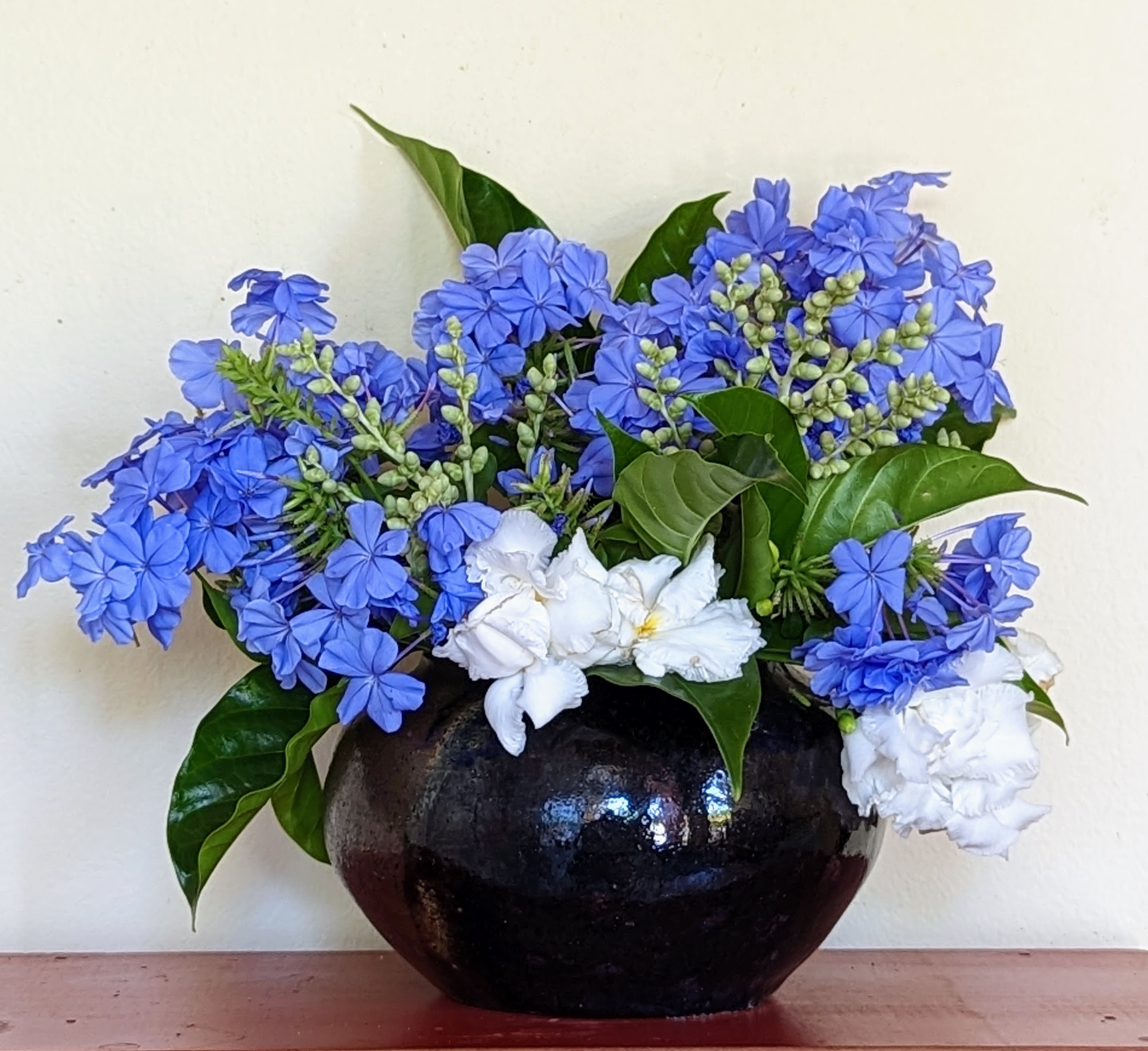
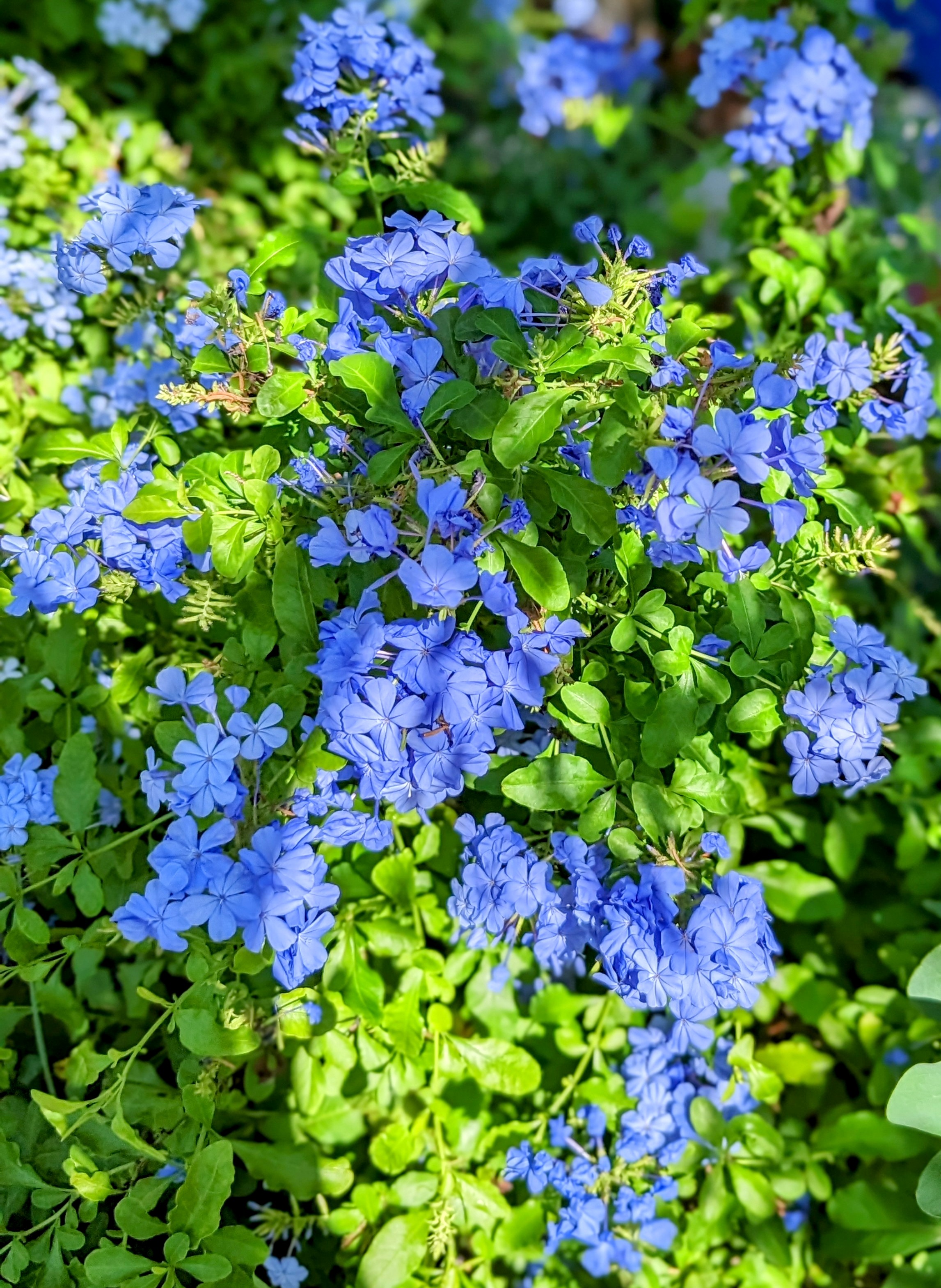
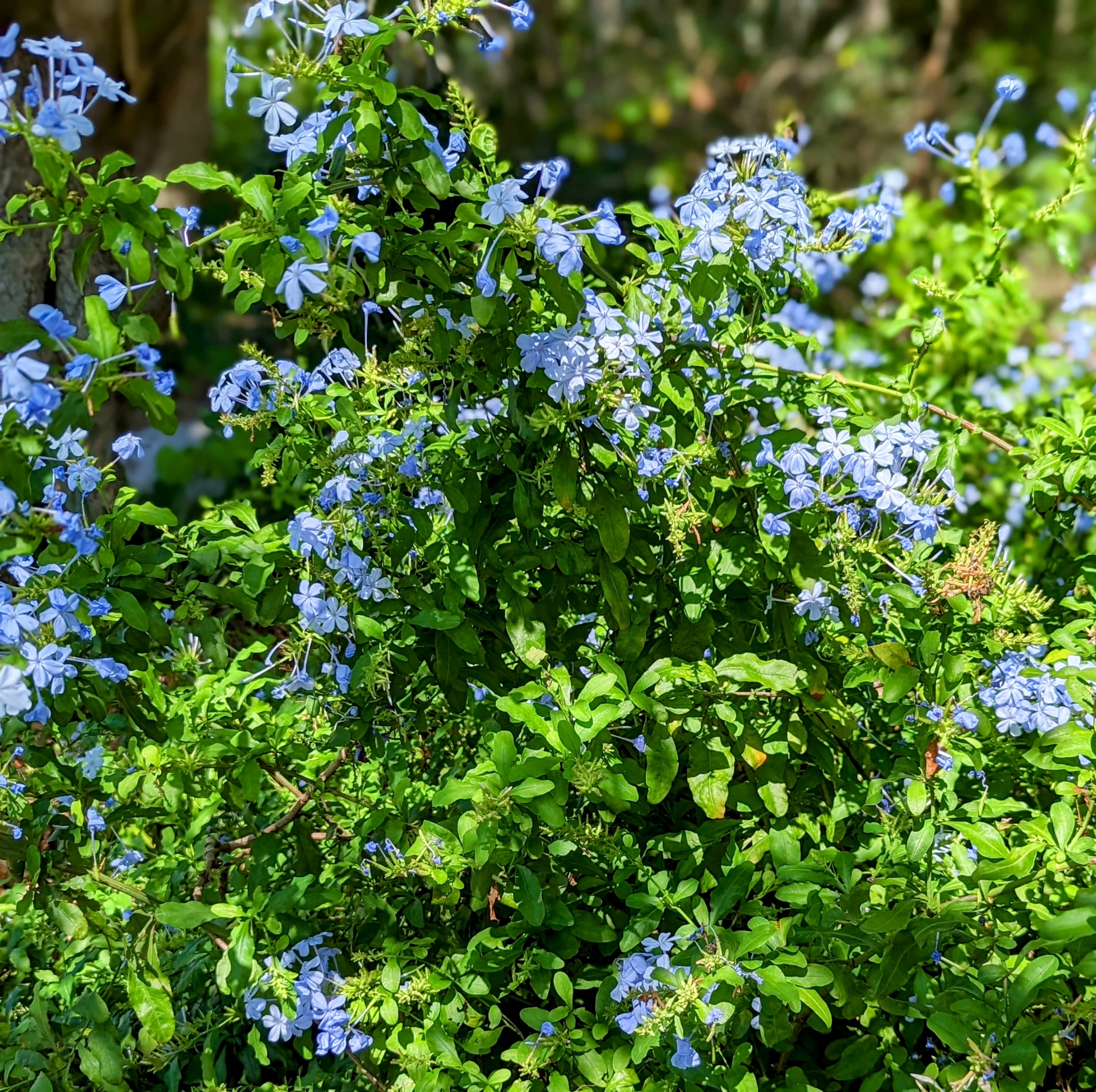
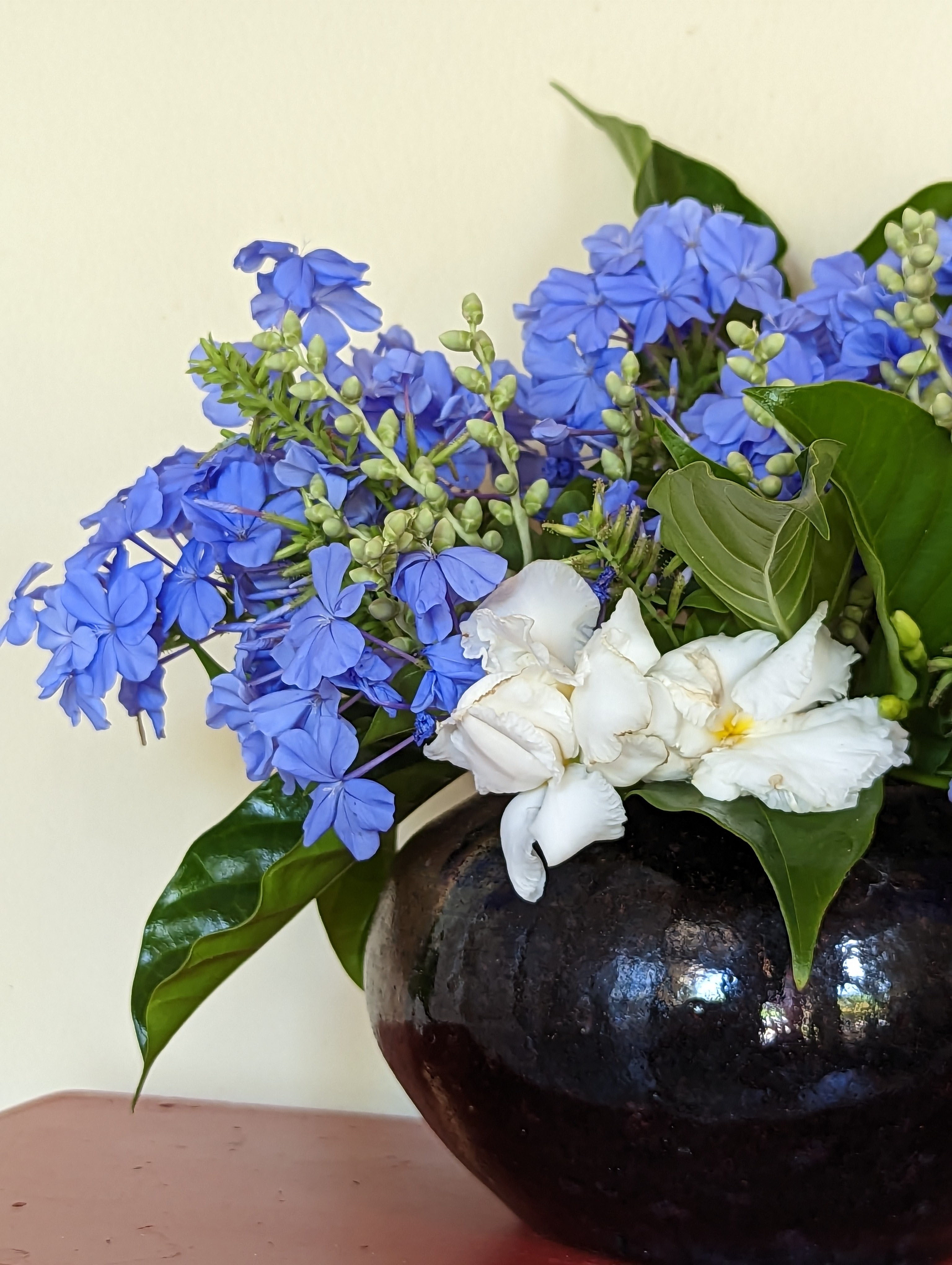
I am very pleased with my Plumbago shrubs this year, they have burst forth with a display of flowers like no other. Why this happened is another mystery of the gardening universe. They inhabit the “hell strip” – a dry area between the street and my driveway. There is no irrigation, I am pretty sure I forgot about the fertilizer and they are growing under some good sized trees. Yet they prosper. My neighbor gave me the original shrub about 10 years ago, offspring of the one her grandmother planted in the 60’s. I added a darker blue variety last year and that is what I have in the vase.
The two Plumbagos, the darker one on the left. The lighter blue one is at least eight feet wide and five feet tall.
A closer view of the vase:
I was taught in my college perennial garden design class (by a very old school design professor) that the classic Southern (the Southeastern US) summer color scheme for a garden is yellow, blue and white. I decided against the yellow in favor of grey green. I am pretty sure my professor wouldn’t consider Florida part of the south, so he is probably not spinning in his grave over the lack of yellow. The only yellow in the garden currently is daisies and the shape of the flower needed to provide some contrast as all the other flowers are daisy shaped.
The gray green flowers are the buds of the Adonidia Palm (Adonidia veitchii). The flowers eventually open, turn nearly white and then produce bright red fruit. The white flowers and glossy green foliage belong to the Tropical Gardenia (Tabernaemontana divaricata). The vase was a thrift store find I have enjoyed immensely. It is my favorite for the Gardenias as they lounge over the side so well.
That’s all from my simmering summer South Florida garden. Thanks to Cathy at http://ramblinginthegarden.wordpress.com for hosting. To see more vases follow the link.
Memorial Day usually kicks off the summer season in the US. Memorial Day is next Monday, as usual Florida starts summer early. It has been pleasant here, mid 80s (F) daytime highs and thunderstorms breaking up our usual dry May weather and giving the garden a few good soakings.
For a global view of gardens in early summer, late spring everywhere else in the Northern Hemisphere, follow the link and see more SOS posts. http://gardenruminations.co.uk
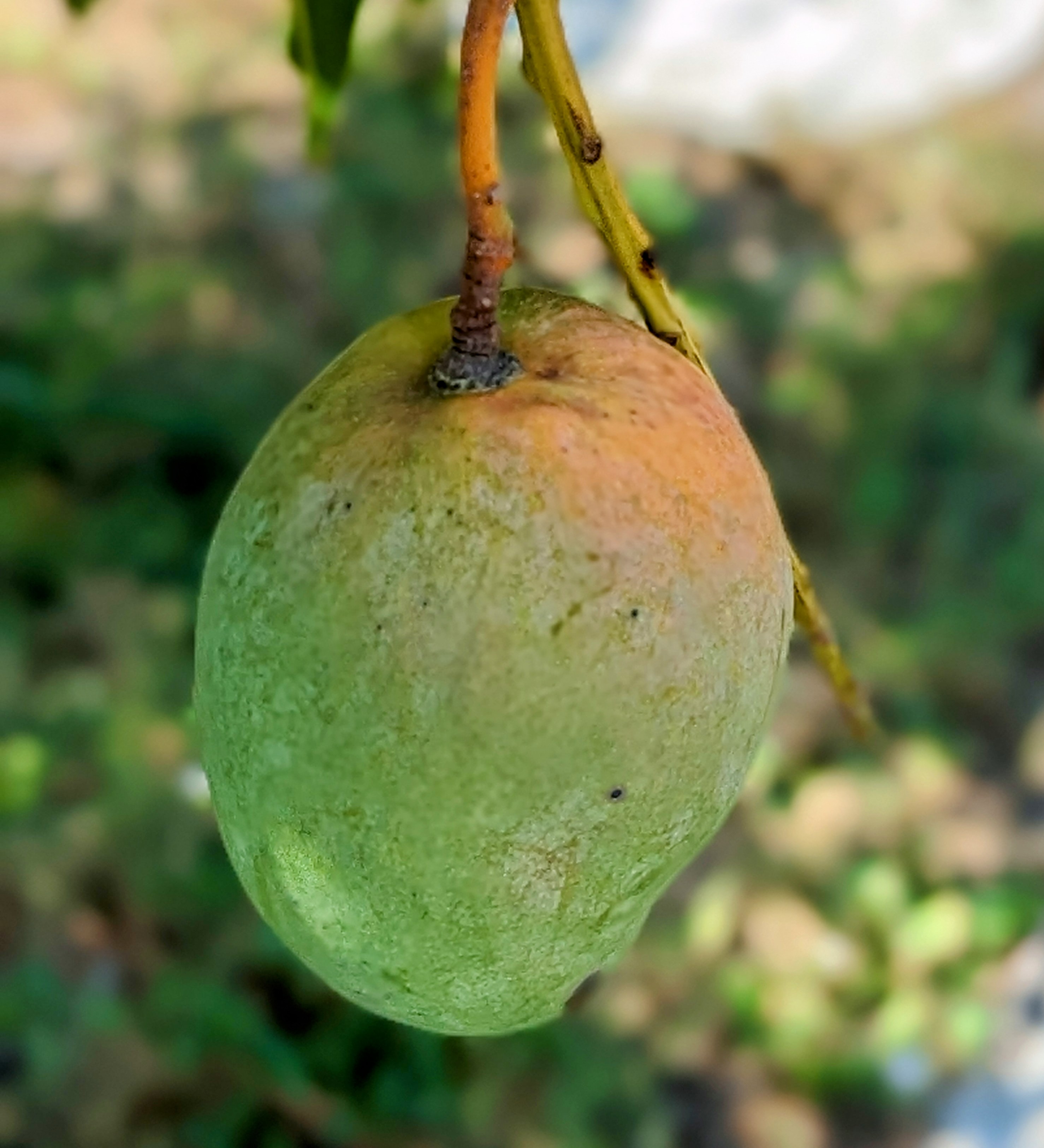
The mangoes continue to mock me, almost ripe. We have eaten one. I shared a bowl of mango salsa with my husband, served as a side dish with roasted steelhead trout. It was delicious. These will be picked when the blush is covering most of the fruit. Several friends have advised they pick them when the squirrels start eating them.
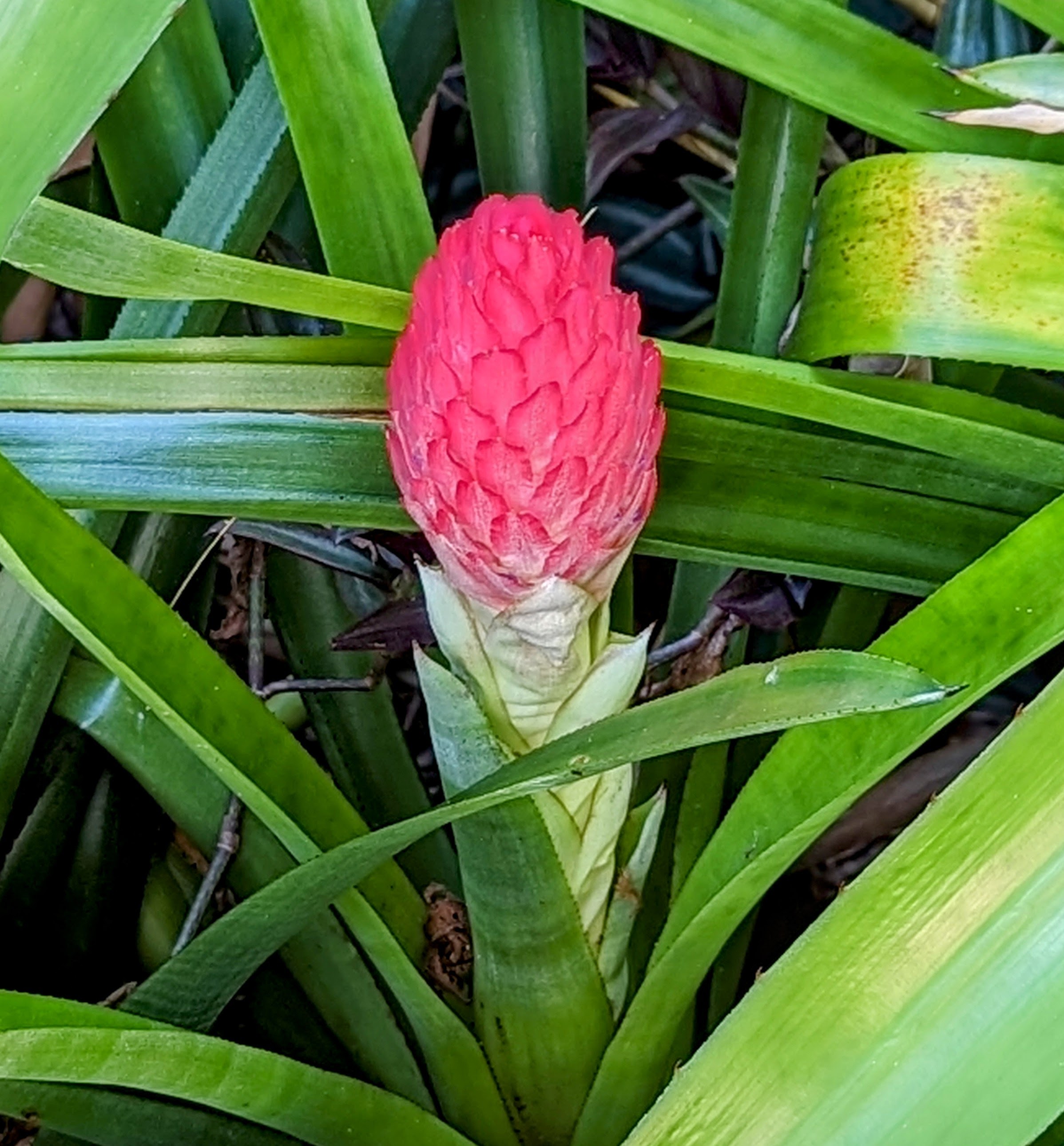
Another out of season bromeliad. This one, Quesnelia testudo, usually (and did) bloom in February. Last week the September broms were flowering. I don’t know what to think about this.
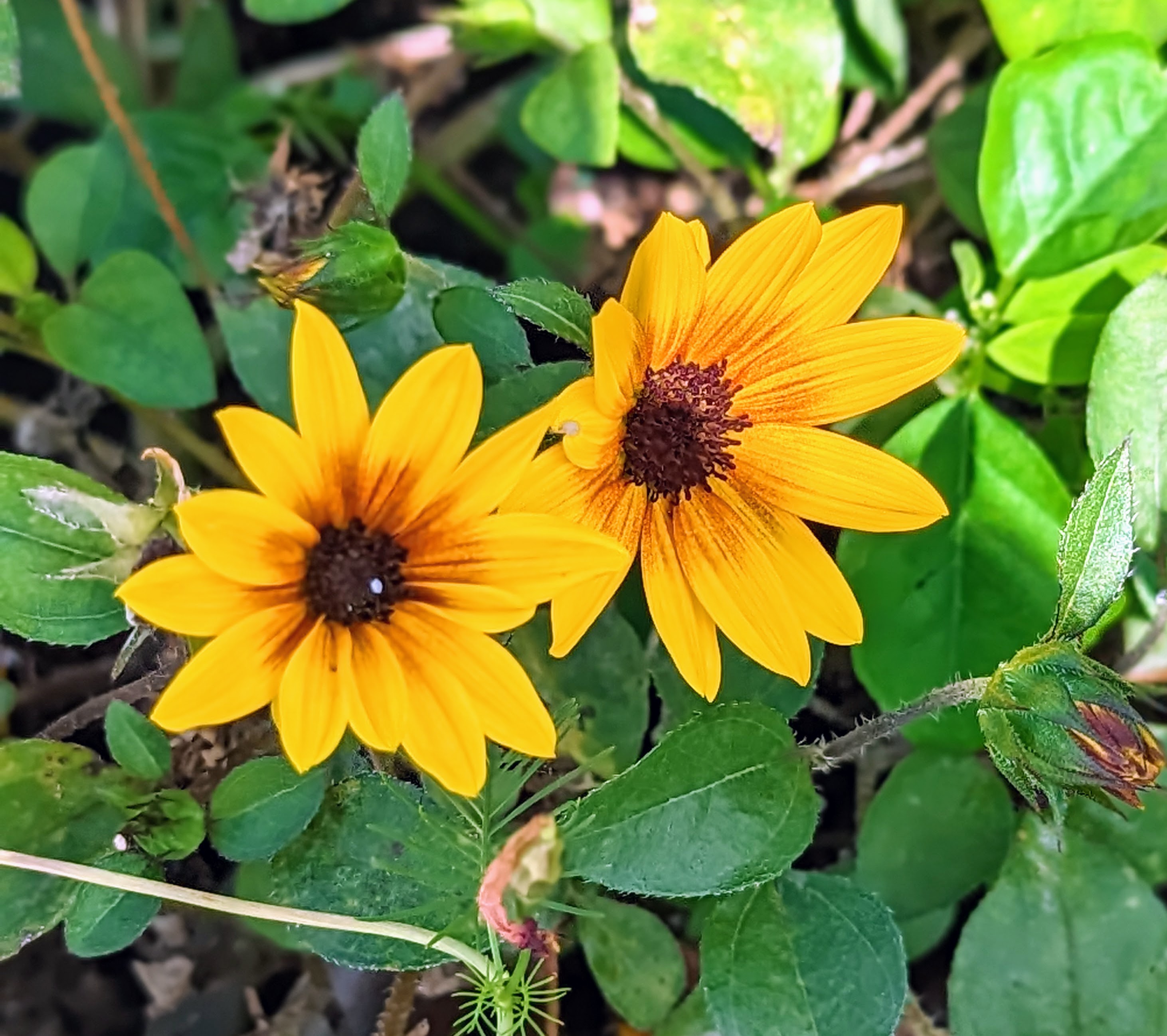
Brown Eyed Girl Sunflowers have given me a lot of flowers this year. They seem to be gearing up for summer with another flush.
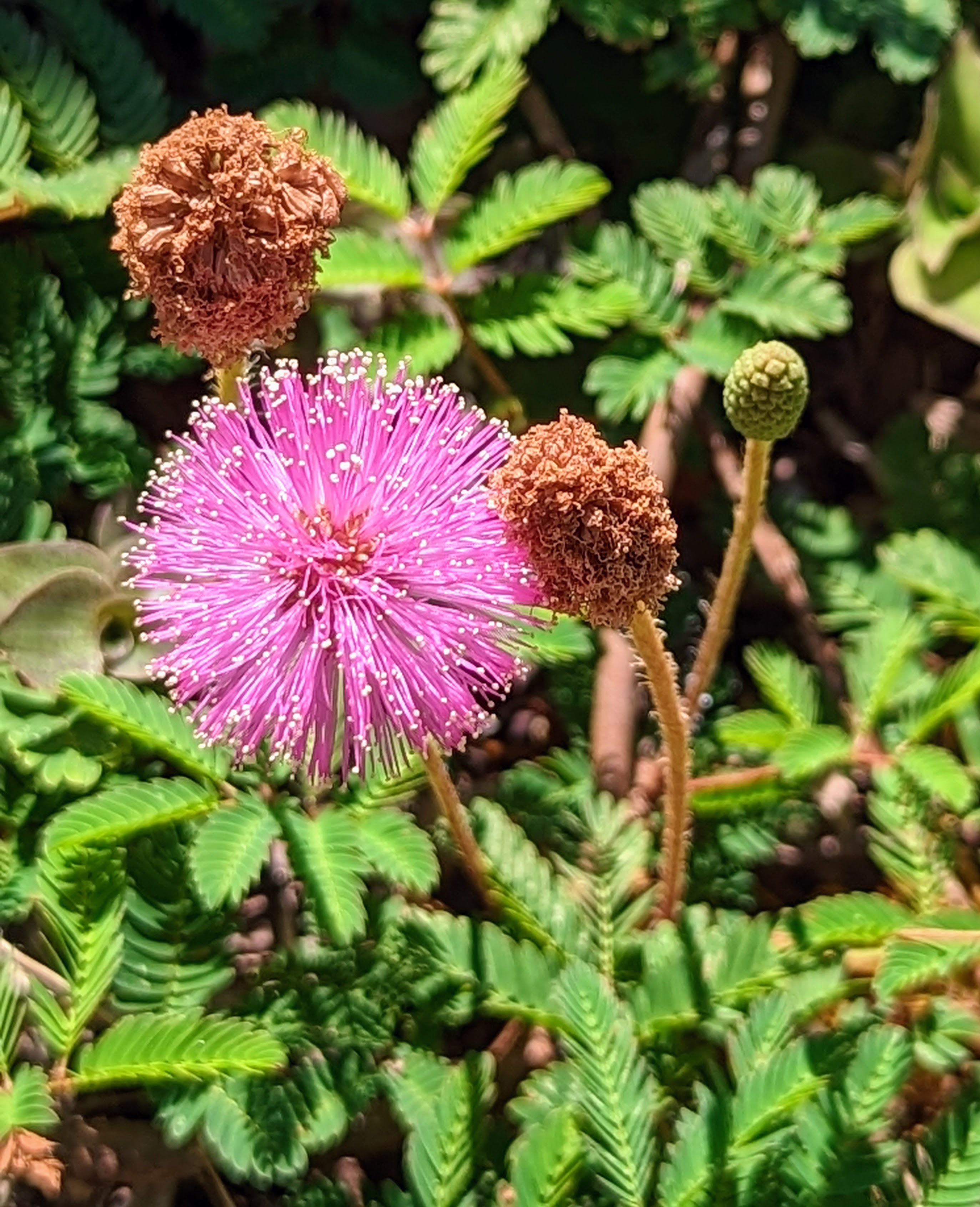
Another sure sign of summer. The Sunshine Mimosa (Mimosa strigillosa) is on the move and flowering. This is a low native groundcover pushed as a lawn alternative. Unfortunately it is not evergreen and looks dreadful for several months, now it looks great and is running amok in the garden.
With the rain this week the Plumbago (Plumbago auriculata) has burst into flower. I have two varieties, this is the old fashioned pale blue.
This is a newer variety of Plumbago. I am not sure of its name, or if it has one. This one is more reminiscent of hydrangeas to me. I am too far south to have much success with hydrangeas, so this is a good alternative.
I have two Indian elements in my vase today. First, the vase itself was made by the Ute tribe of Utah in the US. They still call themselves Indians so I think it is okay if I do. They also refer to themselves as the Ute People, which I like better. The second, the red and yellow daisies are called Indian Blanket (Gallardia pulchella). The flowers are native to the Great Plains in the US, though they have naturalized throughout the country right down to my garden. These reseed and required no maintenance and are relatively well behaved. What’s not to like? I was searching for a rust colored flower to accent the vase and was happy to find several groups in bloom.
The sage in the vase is not wisdom, but Salvia. Two kinds, Black and Bloom and Roman Red. The red exudes the fragrance of culinary sage.
A closer view:
Brown Eyed Girl sunflowers (in yellow) have reappeared after taking an extended break from flowering. I am reserving judgement on these. They were great for about six weeks, then stopped flowering for about the same amount of time and are loaded with flowers again. Time will tell. For those who were intrigued by the Golf Beauty Craspedia, it has passed on, leaving me to believe it is a cool season annual in South Florida. I will be interested to see the progress of others with Craspedia this summer. The deep blue flowers are Black and Bloom Salvia; the lighter blue flowers are Plumbago (Plumbago auriculata). Shiny foliage is from Wild Coffee (Psychotria nervosa), a native shrub I have for butterfly habitat. Evidenced by the botanical name, you can drink it, but shouldn’t.
The rest of the crew. Standing in back in red, Roman Red Salvia; white spikes are from Sweet Almond Bush (Aloysia virgata)
















 The Shrub Queen