In A Vase on Monday – Alpinia Joy

20160318_144417

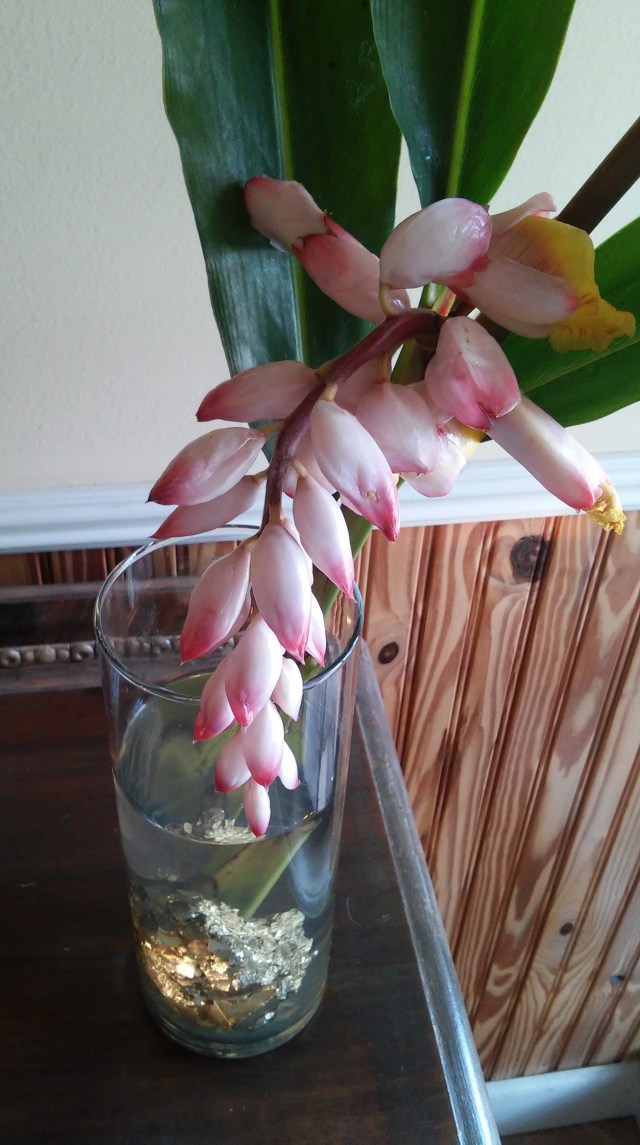
No, that is not Almond Joy or Alpine Joy, it is Alpinia Joy. Alpinia zerumbet to be exact. The Shell Ginger. One of my garage sale finds from a few years ago; the plant is well known for taking two years to flower and this one was true to form. I have been waiting and finally got a flower.
20160318_164710

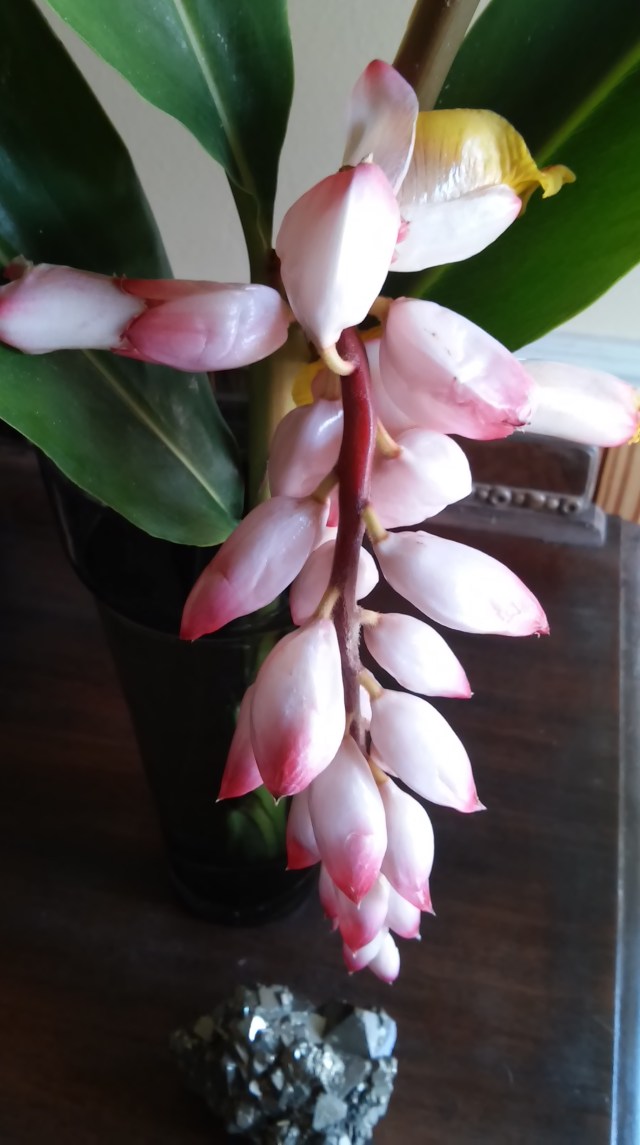
It takes about a week to fully bloom and bit by bit peeks out from under the foliage. There is a lovely ginger scent when the plant is cut, although a member of the Ginger family it is not a culinary ginger.

The rock that keeps appearing is a hunk of Fool’s Gold from my father’s (the geologist) collection of obscure mineral crystals. I was looking for some marbles to use in the vase to hold the stem, I have some lavendar ones somewhere. I knew where they were before we moved – so inspiration struck and I thought to use the Fool’s Gold vaguely remembering something bad happens to it in water. It is a Pyrite, iron sulfide, I think, and what happens is instantaneous rust when it gets wet. I suspect it would have killed the flower if I had left it in the water. I was also left with the dilemma of how to get the sharp bits that fell off  out of the stainless steel sink without scratching the sink. After everything was rinsed and clean, it dawned on me,  I really didn’t have an arrangement at all.

Back to the garden, fortunately spring brings some interesting flowers into bloom.

20160320_143316

Contents of this vase are:

Soap Aloe flowers (Aloe saponaria), in the foreground; Parrots Flower (Heliconia psittacorum) and foliage; the orange foliage is from Blanchetiana Bromeliad (an Aechmea type)

The vases are both from a simple design phase I went through in the 80s. Less is more or less is a bore depending on how you look at it. The flowers are the focus if these vases are used.

Here are both vases and the Fool’s Gold:

20160320_143814

Moral of this story, no iron minerals in your vases. Fool’s Gold is named for a good reason.

Rock on.

In A Vase on Monday – Refugees from the Potting Bench

20160313_103341-1

I have had a trying dental week, culminating in a root canal followed by pain medication. Never having experienced a root canal, I had not realized the need for pain medication. Vicodin and I usually do not get along, but the drug came highly recommended by the doctor and his staff, so I relented and took some. My problem with these sorts of medications is – if 3 steps are needed to complete a task, only 2 are retained by my mind. Example, to set the timer on the stove it has to be turned on, time set, then started. The loss of any step results in no time. Then you are left wondering if the pasta is done and when you started it. On the other hand, the teeth feel really fine. I have, wisely, stayed away from my car.
I awoke this morning feeling much better, put some cat food in my cereal bowl, got a fork to eat it, then realized it was time for more coffee and a walk around the garden.

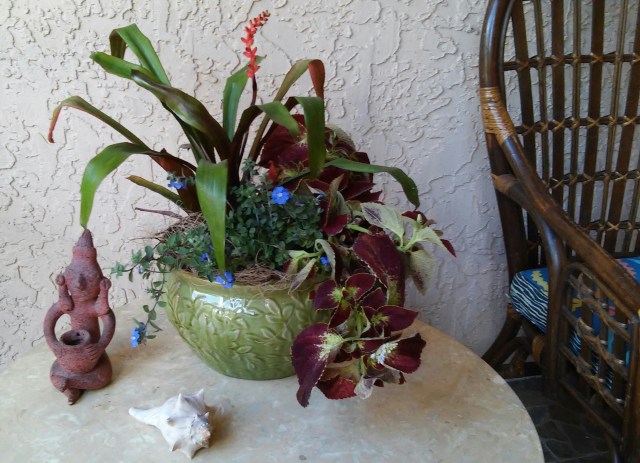
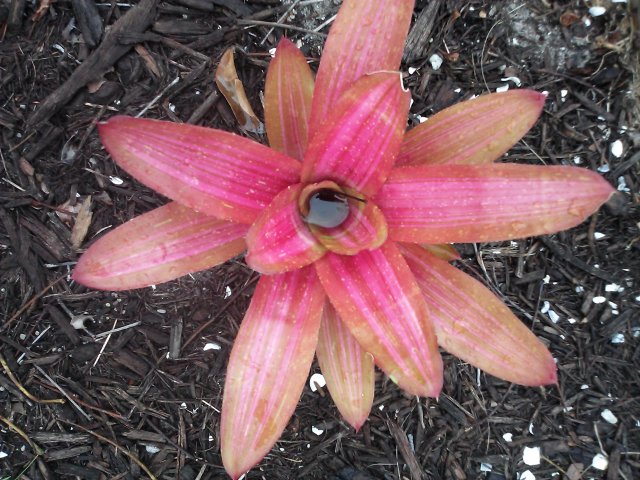
The search for vase materials was on and I stopped at my potting bench where all my plant refugees looking for a home live until they are planted. Sometimes it takes years to find a home as I tend to buy plants without considering where they should go. This Bromeliad had bravely put up a flower after languishing on the bench for quite some time. The fluorescent salmon color is quite lovely. Here is the unnamed Bromeliad, I think it is an Aechmea, burgundy and olive green foliage accent the salmon flower:

20160311_090319 (1)

20160313_102733-1

At the same time I have been rooting some cuttings from an overgrown Solar Sunrise Coleus and thought they looked nice together in this big olive green container I bought at GoodWill (charity shop). The Blue Daze Evolvulous was  left over from a new bed that I am working on in the garden.

I like the combination and have added some other refugees for company. The shell is from the ocean, of course, and the pseudo Mayan sculpture is an incense burner from my brother, circa 1975 and Pier One. I keep this around for sentimental reasons, and it looks great with the Salmon Bromeliad.

In case of culinary concerns, I gave the cat the cat food and she was quite happy, had another cup of coffee and no more Vicodin. Now all I need is a filling to seal the root canal. Joy and Bliss later this week.


In A Vase on Monday -The Bovine Micro Meadow

20160306_160023

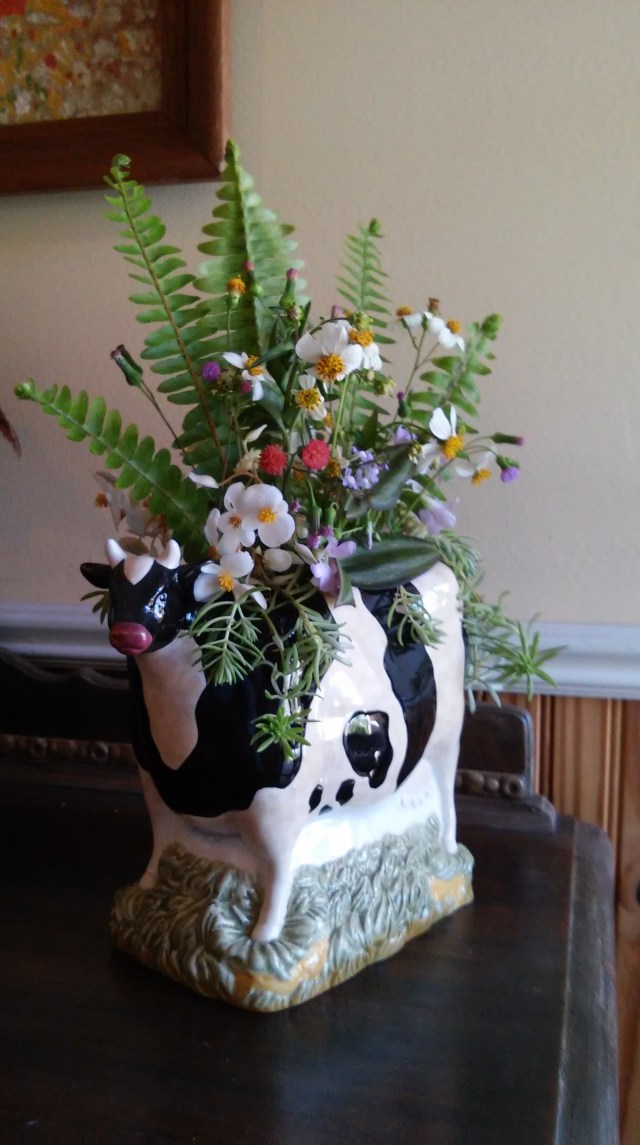
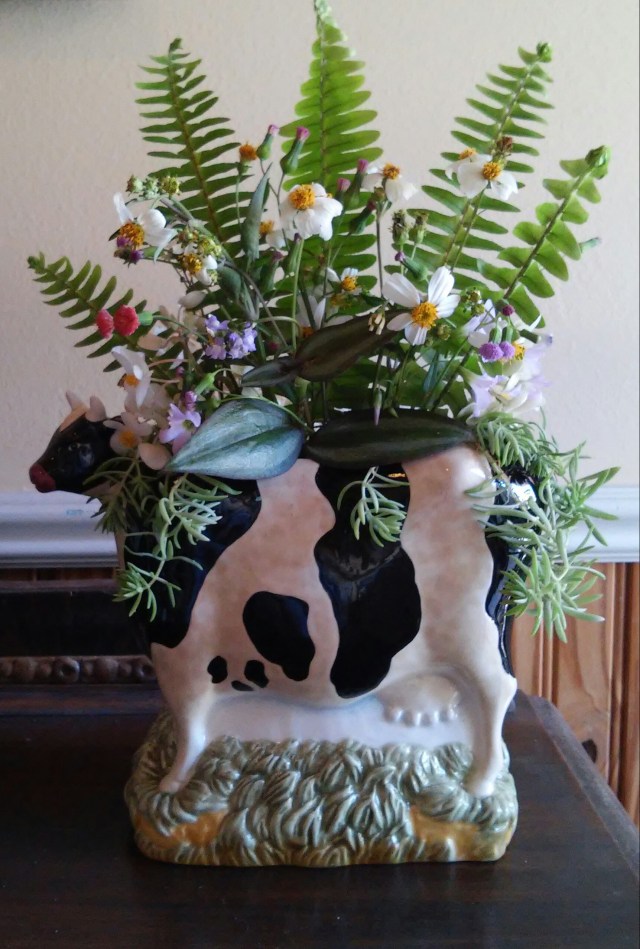
Here is another member of my cow family. A real cow vase. I have a matching hand soap dispenser. I bought the set in a store that sells samples. My suspicion is the vendor figured the market for a matching set of cow vase and soap dispenser was limited and stopped with the samples. I have enjoyed these, although the vase is oddly constructed and difficult to arrange flowers in – mostly it sits on the shelf and exudes bovine loveliness.

20160306_155833-1

The idea for this was based on cows grazing in a meadow. The micro meadow is a tiny representation of what grows in my meadow. The “lawn” in my back yard is truly appalling, so I have many meadow plants. I am not terribly bothered by this as lawn beauty in South Florida is difficult to attain without loads of water and chemicals. Meadow it is. Mown intractable weeds could be another term used to describe the “lawn” My younger greyhound has beaten a perfect racing track into part of it. Flowering meadow plants and sand are for the greyhounds, my gardens are kept away from thundering paws.

20160306_155933

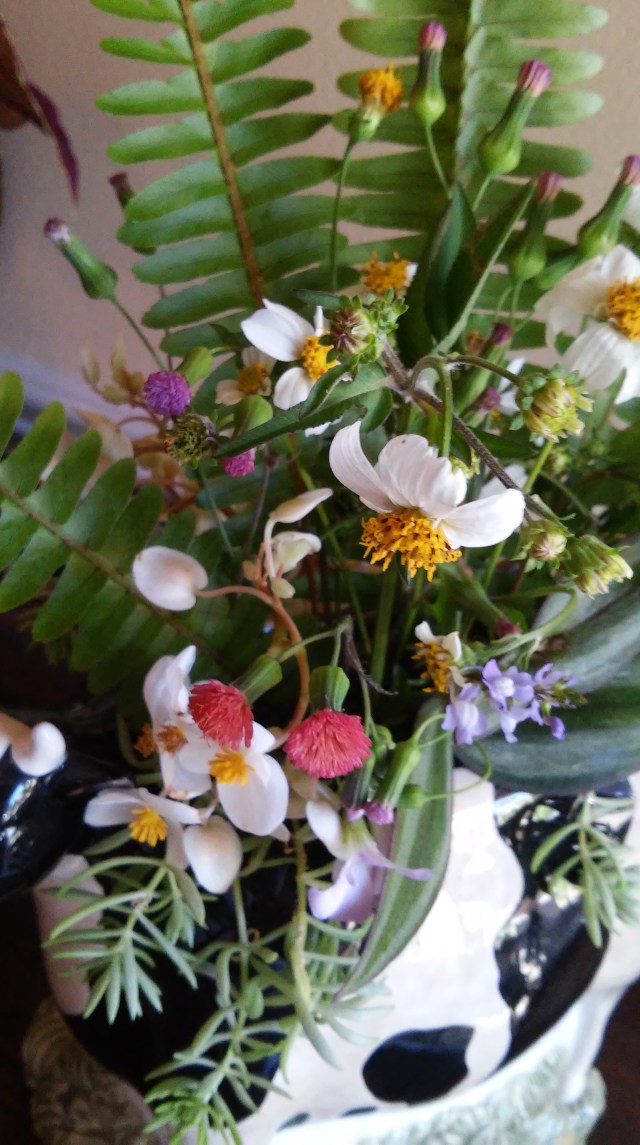
Here is a close up of the plants. There is some Florida friendly Chartruese Sedum at each end (friendly is propaganda from our Extension Service – the plant grows great in a pot with potting soil, if put in the garden a very different story), Sweet Begonia and Spanish Needles in white, the purple and red plants are pretty ( a weed I am not sure I want to identify) but I have been trying to eradicate them and they are frighteningly prolific. Boston Fern and the Wandering Jew (Transcandentia zebrina) just pop up in the meadow. Strange but true.

And my favorite cow family member:


My cow dog, Charles the Greyhound, racing name GLO Cornjacker, a dear friend and companion for the past six years; he retired from racing in 2010 and is nearly ten years old.

He hangs out in the meadow frequently and sometimes snacks on it.


Bromeliads for the Treasure Coast- Divide and Conquer

I have learned a great deal about Bromeliads since starting my garden four years ago. Prior to moving to Florida, I only knew a few varieties of Bromeliads and this was from designing shopping mall interiors in the eighties. Guzmanias were (and still are) a great plant for interiorscape. Oddly enough, while they will grow here, I have no Guzmanias. I think they are kind of boring. I like the kind of indestructible, passalong, highly reproductive Bromeliads. The kinds you don’t see in shopping malls. The more unusual the Bromeliad, the better. This could prove to be a bad idea in the long run. I could grow really old here and end up with Martian Planet landscape.

Bromeliads above are: the flower of a Painted Fingernail Aechmea, a common passalong in South Florida, the spotted one is a common Neoregelia (from a garage sale) of some sort, the burgundy one is Burgundy Aechmea. The below Bromeliad is a ‘Blanchetiana’, another Aechmea passed along to me from a neighbor. All thrive here with little care.

My latest venture in the garden has been to add swirling patterns of shells and rocks weaving through the garden. First, I like shells and rocks and second, I detest mulch, not for looks, but for me having to schlep bags of bark through the yard – usually when the weather is tropical steaming. I really just won’t do it and go back inside and plot some other indoor task. The result of this is weedy unkempt beds. So the strands of rocks and shells are being woven through the garden and ribbons of groundcover and tightly planted perennials are going to be installed to hopefully cut down on the maintenance (weeding) and the mulching. I have placed cardboard boxes under all of it to hopefully break the weed cycle.

The correct time of year to divide Bromeliads is the beginning of the growing season, which in South Florida is Fall/ Winter. I have been working on doing this and have divided several and (here’s a surprise) bought some pups last week at the botanical garden. Neoregelia Martin and the popular Blanchtiana Aechmeas have been divided and installed in their shell garden. Both these Bromeliads flourish in full sun, the Blanchetianas are available in Orange, Lemon and Raspberry. I have an Orange and Lemon, I am not quite sure about the Raspberry. The divided Bromeliads are in the left picture; here is a close up of Martin, who is a Neoregelia – doesn’t flower, but the foliage and sun tolerance make Martin worthwhile to have in the garden.

CAM00253

I am trudging onward in dividing, but have yet to conquer.

In A Vase on Monday – The Ephemeral Martini

20160221_133224

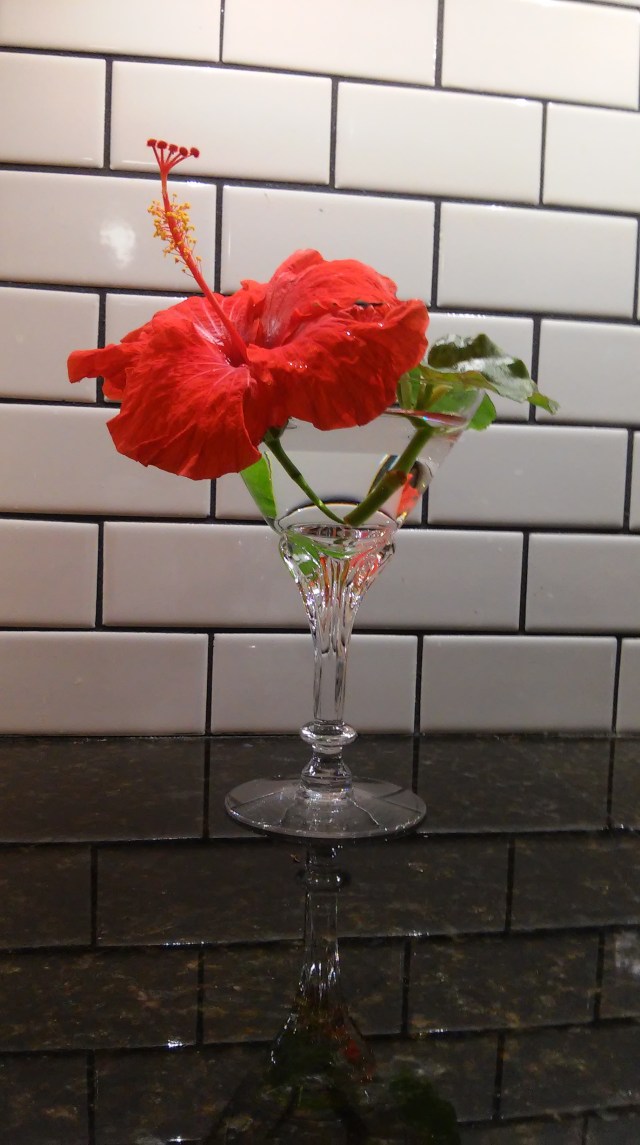
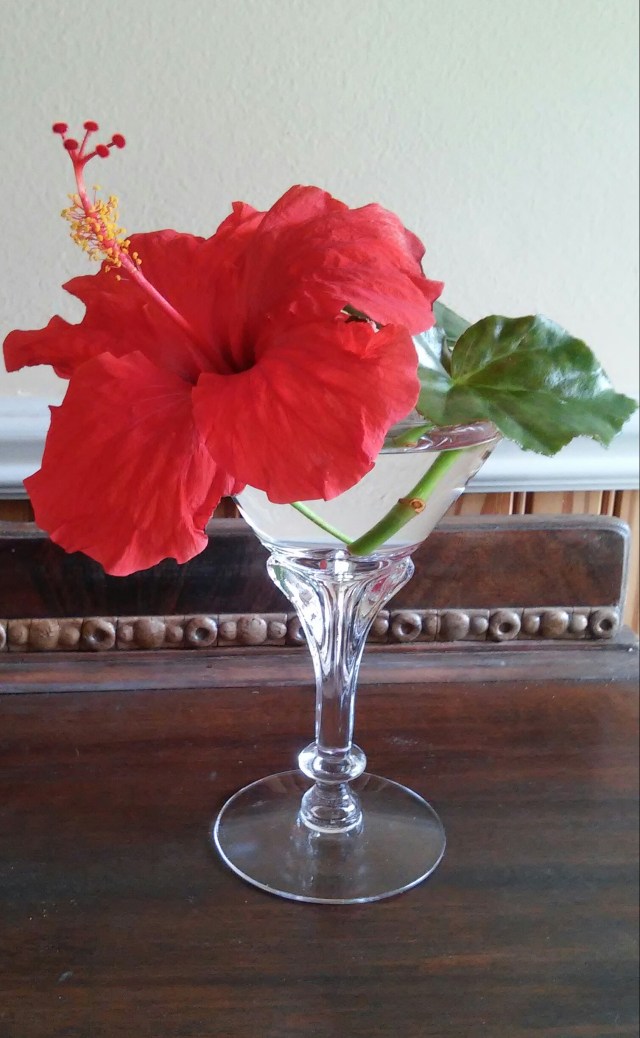
As usual, I started out with one idea and ended with an entirely different vase. I was walking my dogs this morning and noticed this particularly lovely Hibiscus flower.

A Hibiscus flower in South Florida is not particularly notable, but this shrub is really amazing. An old variety planted in the 60s by my neighbor’s grandmother, this shrub lives on the edge of my front yard – unirrigated, unfertilized, and thriving in near total shade (everything one is not supposed to do to a Hibiscus) This heirloom delight blooms off and on all year to the point I hardly notice it.

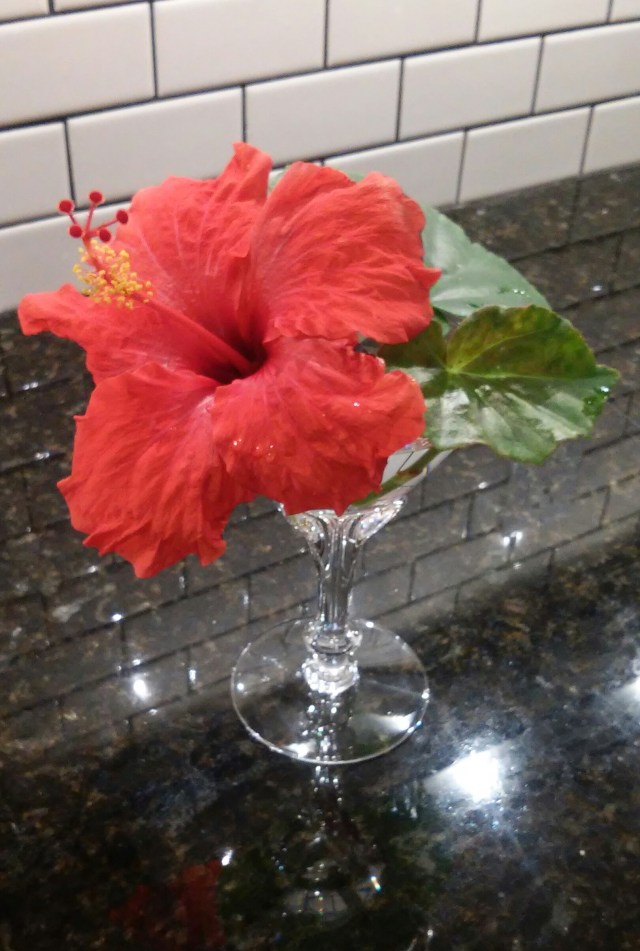
I plucked the flower and put it in a brown pottery vase, this just didn’t look right. The festive red tropical flower needed some party vibes. I decided one of my mother’s crystal Martini glasses would be the proper setting – an heirloom for an heirloom, and loved the result:

20160221_133354-1.jpg

I added a bit of Sweet Begonia foliage and that was it. I was confused for a long time about the Martini glasses, I think they were a wedding gift to my parents when they married in the 1950’s. My grandmother was a teetotaling Southern Baptist and my mother always referred to these as ‘fruit compotes’; imagine my surprise when I learned of Martinis and their proper stemware. I suspect some Gin and Vermouth has been in these glasses at some point because I can remember the cocktail parties.

20160221_141835-1

The ephemeral nature of this is these flowers are known to only last one day. I will have to wait until nightfall to see what transpires.


In A Vase on Monday -Caribbean Delight

20160214_144402-1

This is a Caribbean Delight as the centerpiece of the arrangement is a Dwarf Jamaican Heliconia (Heliconia stricta) – I believe. The lady I bought this from didn’t seem entirely sure of the ID and I have never seen one before. I am, however, a sucker for a well priced Heliconia and hopefully the garden will not overrun with Dwarf Jamaicans. Heliconias can be pretty creepy.

20160214_144036

The dark foliage is from Piecrust Croton (Codiaeum variegatum  ‘Piecrust’) and I love the contrast. The fine textured foliage is  Asparagus Fern (Asparagus aethiopicus). The Croton I planted, the Asparagus Fern just appeared in the back garden one day. I cut some every now and again and that seems to keep it in bounds. Asparagus Fern is rumored to be invasive, I think the spot it popped up in is not its happy place.

The crystal Rose Bowl belonged to my mother, I think I bought it for her – but that memory just won’t quite gel. It is a nice crystal Rose Bowl. I have Rose issues so it is unlikely to ever see any Roses. I am quite happy about the Heliconias – at least they are red!

It is Valentine’s Day as I write this. This vase is going to be our centerpiece for dinner.

20160214_153442

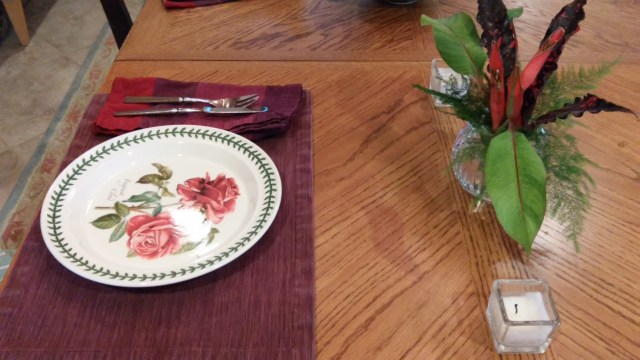
Here’s the table setting Portmerion Rose China and here is dinner:

CAM00152

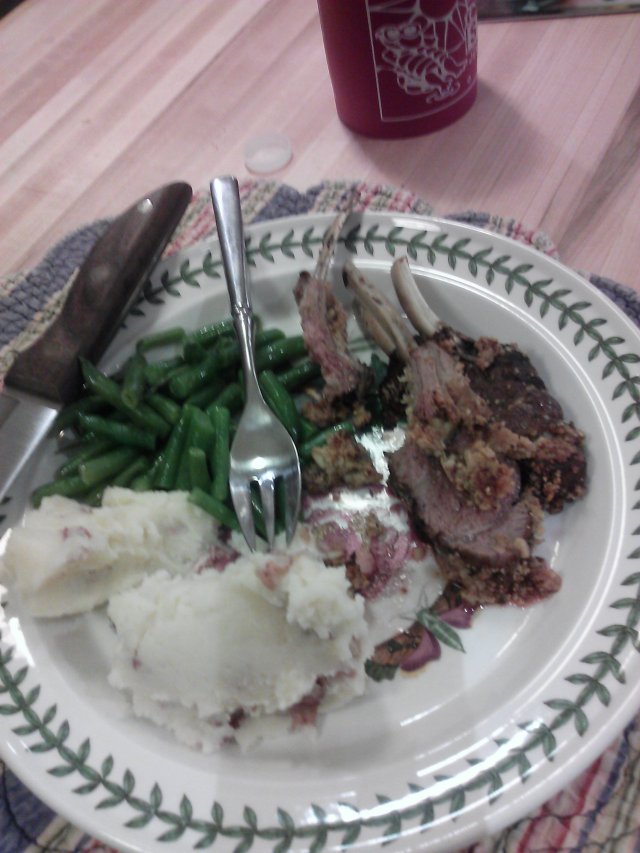
Mustard crusted Rack of Lamb, Mashed Potatoes and Steamed Green Beans. Not particularly Caribbean, but oh so good. Followed by Chocolate Brownies with Vanilla Ice Cream. Hope everyone had a great Valentine’s Day.


In A Vase on Monday – Surinam Shrimp

20160131_145844-1

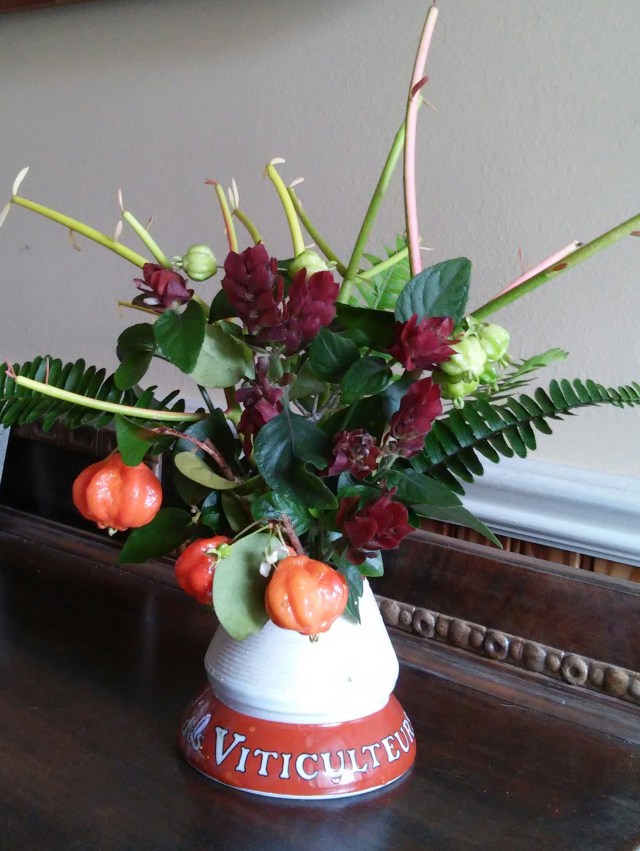
I am aware ‘Surinam Shrimp’ sounds like a dish at a Vietnamese restaurant, however the two main components of this vase are Surinam Cherries and Shrimp Plants. The Surinam Cherries are the fruit in the lower part of the arrangement.

I have a large hedge of these shrubs and was pleased to have a fruit producing hedge, thinking (silly me) the fruit could be eaten. I kept thinking the fruit wasn’t ripe or something as it tasted so bad. Finally my neighbor, a Florida veteran, picked one for me – properly ripe. Still tasted bad. I have seen the taste described as resinously bitter, and the description fits the fruit. Given the taste of the fruit and the colors in various stages of ripeness an arrangement seemed like a better use of the fruit. The rest will be left for our wildlife friends.

20160131_145457-1

Here is another view with the nearly ripe Surinam Cherry beside the vase. As for the other members of the plant crew, we have: in dark red, flowers of the Red Shrimp Plant (Justicia brandegeana); the foliage of Boston Fern and the upright sticks are from a ‘Firesticks’ Pencil Cactus (Euphorbia tirucalli ‘Firesticks’); in orange and chartreuse, the fruits of the Surinam Cherry (Eugenia uniflora).

The vase was a long ago Christmas gift to my husband from his ex-wife’s cousin! We have absolutely no idea what it is, so if anyone has a clue please send a comment. We have been wondering for years what this is. The top of the vase is much thinner than the base and has a hole in it. It reads “Gd Cafe des Viticulteurs”

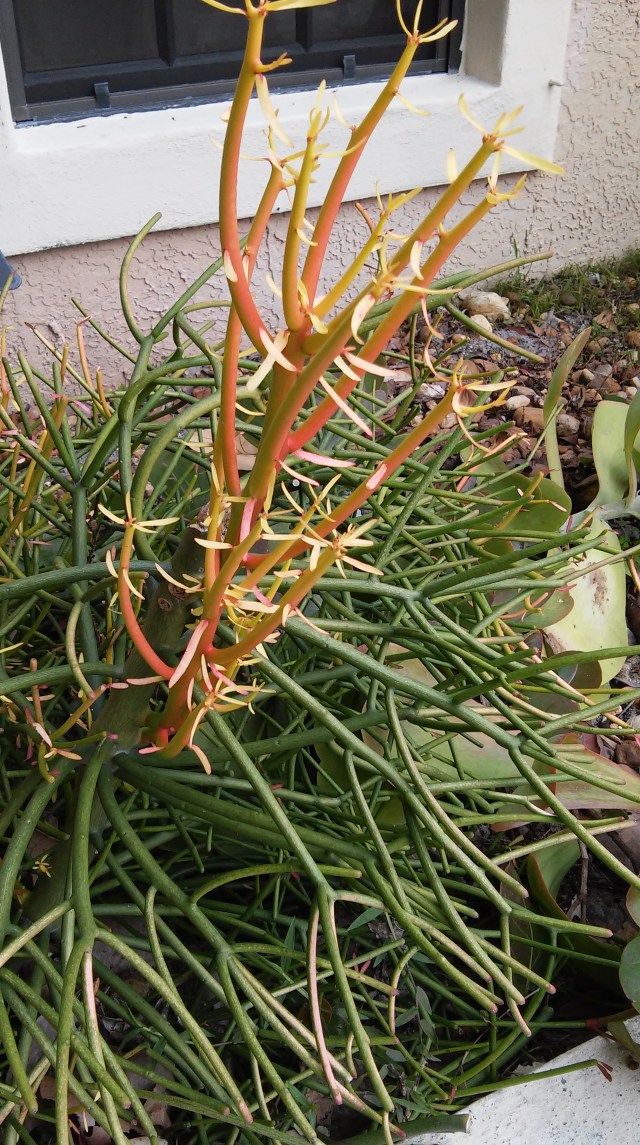
As for the ‘Firesticks’ Pencil Cactus’ here is a picture of the plant. Euphorbias still blow my mind, hello, Poinsettias? so weird- I have a few of these around the garden as they easily root from cuttings:

20160131_152001

Now I am craving some Shrimp Pasta for dinner. Without the Euphorbias, of course.

Art in the Garden

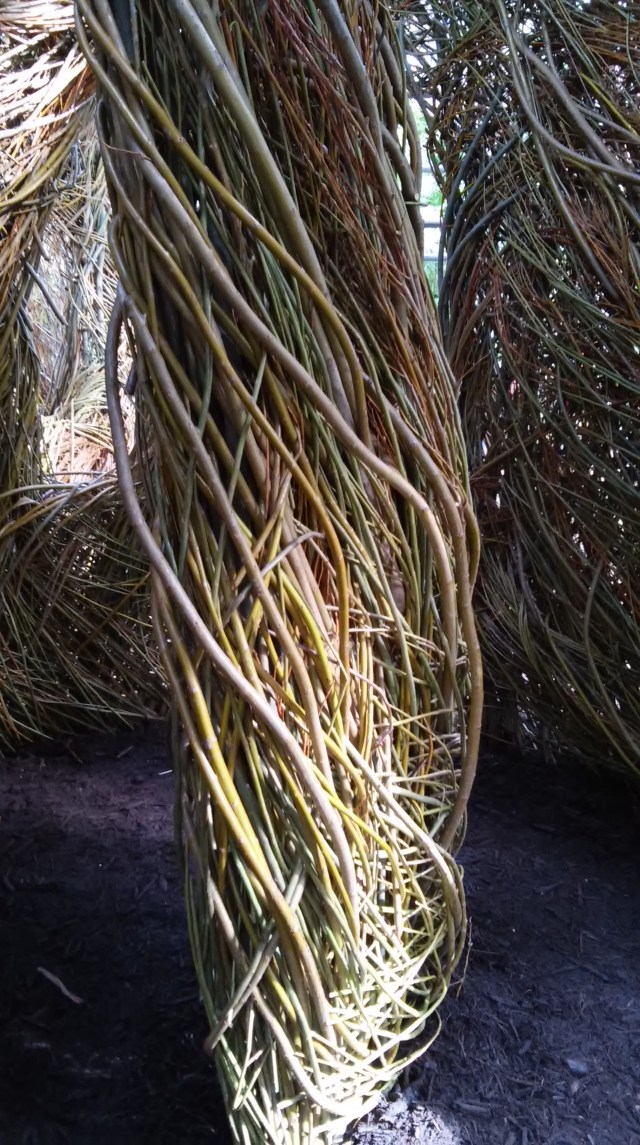
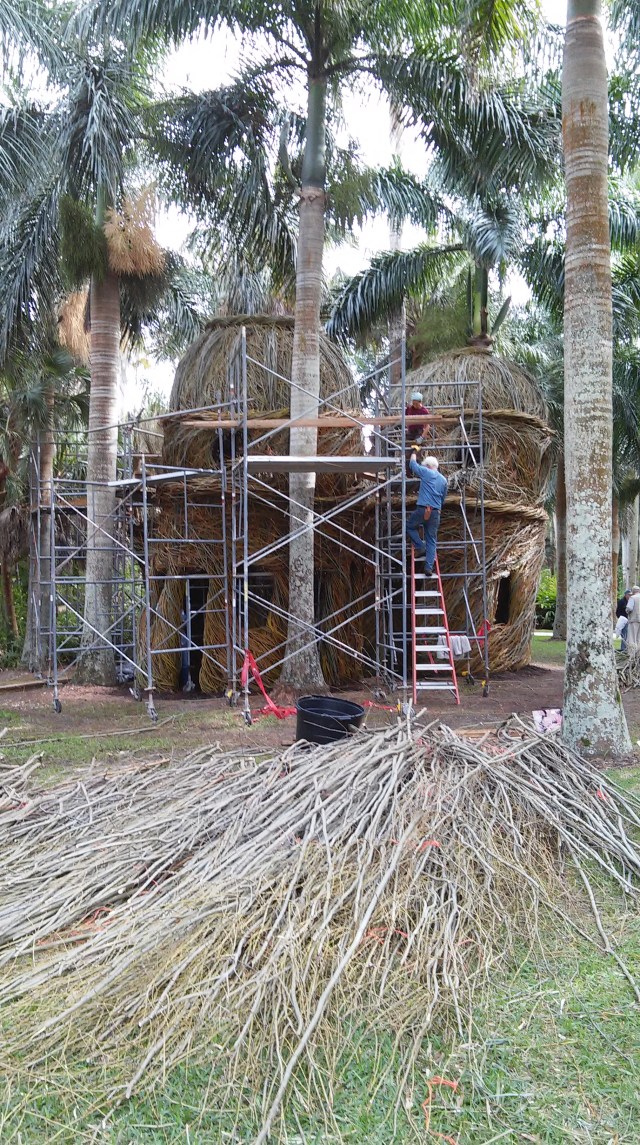
I usually write about the art of the garden, but here is a bit of art in the garden. The above photos are of a woven willow structure currently under construction at the McKee Botanical Garden in Vero Beach, Florida. This piece of environmental art is nestled in a grove of palms and constructed of willow saplings and bendable twigs woven together to form a temporary structure. The structure will eventually have three willow towers. Here is a close up of the twig structure:

20160121_142043

And here is an overall view:

20160121_141502


The artist is Patrick Dougherty and the concept is STICKWORK, here is a link to more information on the artist and installation,  http://www.mckeegarden.org/current-exhibition.php

I am usually not very enthralled with environmental art, but I love this. The organic willow towers complement the formality of the palms and I like the facts that the structure is built from willows grown in a sustainable tree farm and after a few years the structure will be evaluated to decide to keep it or compost it. I have visions of the entire thing rooting into the ground and growing a twisted fairy tale castle in the palm grove.

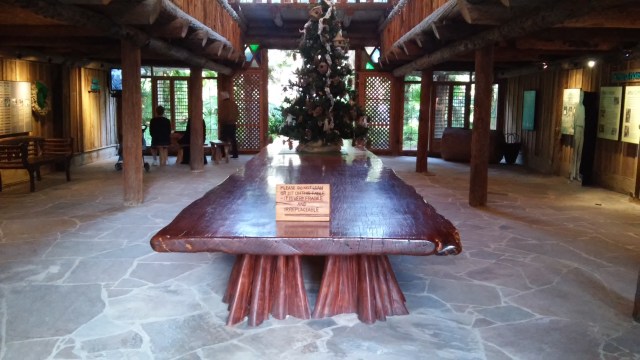
The rest of the garden has a bit of a fairy tale feel as well. Conceived by pioneer developers in South Florida during the first half of the twentieth century – the first buildings were based on Polynesian structures in keeping with the “Jungle” theme. The garden fell into disrepair and was reborn in the early 2000’s shepherded by a dedicated group of garden enthusiasts. Below is one of the original buildings, a great hall centered around a table constructed from a 38 foot long single piece of Mahogany:

20160121_145652


The rest of McKee is well worth touring and has a wealth of tropical plants. I saw many types of Bromeliads I had never seen before and an array of Palms, Orchids and tropical trees. The garden began in a mature forest hammock and boasts some incredible native trees and a pathway meandering through the garden inviting you to stop and study the flora. Here are some of my favorite photos from my trek through the garden.


In a Vase on Monday – The Wildflower Blues


20160117_154405-1

I have been watching a group of Yellow Lupines on the edges of a vacant lot nearby – thinking I could collect some seed and grow Lupines in my back garden. What I did not realize is when the seed pods are ready they explode and hurl seed far and wide. The pods exploded in my car and didn’t seem to think there was enough dirt to grow in the carpets, though there probably is as I haul dogs and plants around with equal enthusiasm. I am not sure if these plants are native to the area, but I am aware of other native Lupines in Florida; it seems peculiar as I associate these plants with Alpine meadows, the Rocky Mountains and cold, arid places. Here is another view of my three blue vases filled with native and/or wildflowers from the vacant lot.

20160117_113625

20160117_111900-1

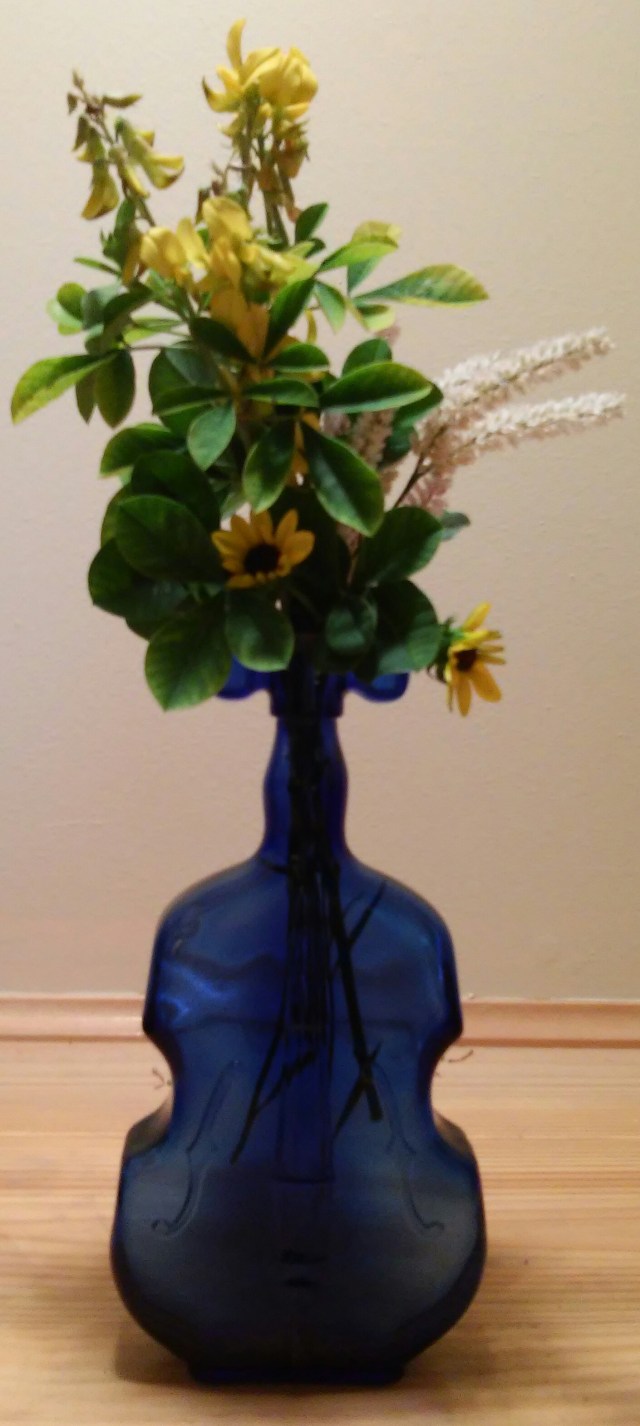
My blue vases represent three generations of women in my family, the violin belonged to my grandmother and has Yellow Lupines, the white spikes are Jointweed, the yellow daisy shaped flower is a Beach Sunflower.

20160117_114007

The tall bottle belonged to my mother and has Beach Sunflower, Yellow Lupines and seeds, background plants are Shrubby Buttonweed and Muhly Grass.

The corked bottle in the background belongs to me and holds the dried petals of all the roses my husband sent me during our courtship. The bells belonged to my other grandmother and are one of those touchstones that have been around the house as long as I can remember; my father brought them home from World War II.

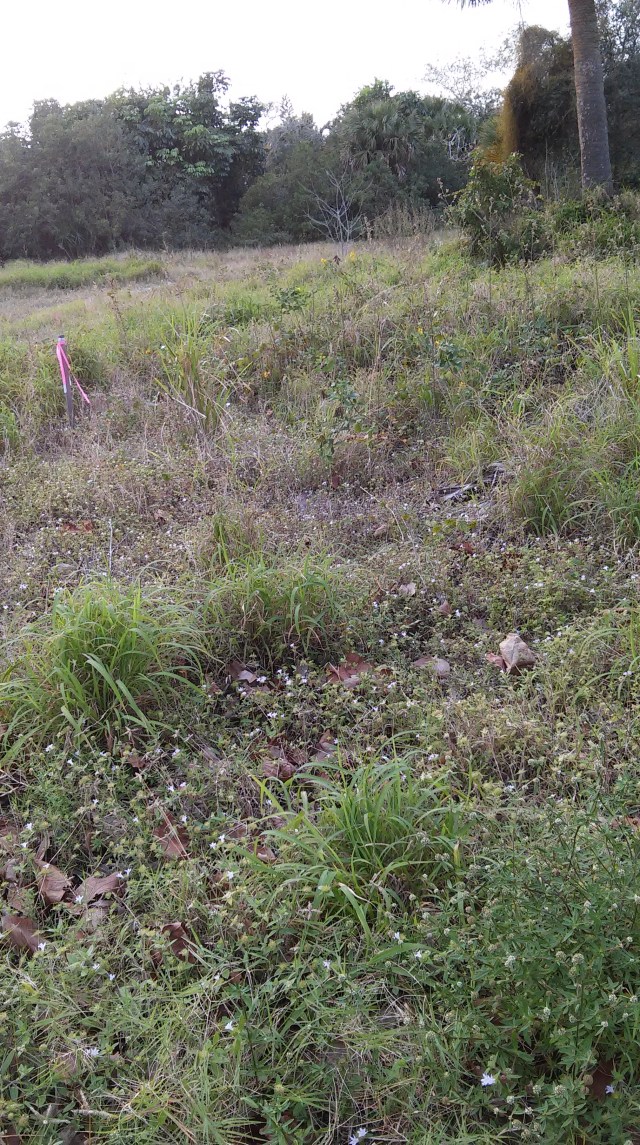
As I was writing this post, it occurred to me how much more interesting and attractive these flowers appear in their Monday vase. So, I wandered over to the vacant lot and took a before picture:

20160117_163141


All the components of the vase are in the foreground. I think I like the flowers in their blue bottles better. This leads me to ponder if more people saw native plants in a vase instead of a vacant lot – native plants might be more popular.

If you would like to see vases from the world over, stop by the comments section of  https://ramblinginthegarden.wordpress.com where Cathy hosts In A Vase on Monday – every Monday!


Piecrust Croton and Friends

20151230_153823

Piecrust Croton

I have been reworking  the design of my front yard because the access point for the septic tank was in a lawn area and actually needed access. What this really means is once a year a 3 foot circle in the lawn  is dug up and destroyed to clean the (ewww, yes) septic tank filter. The joys of country living. I am certain I did not know septic tanks had filters prior to moving to Florida. I also realized I would like to have a pathway to the side.

For many years I have advised my clients to live in their houses for a while to see how they move around the property as sometimes a good guess just really doesn’t do the trick. The upshot is I did not take my own advice and I like to travel to my side garden (ah, future garden) more than I thought I would. Design that originates with how you live in a place is always a good plan. This may be Plan B as I did Plan A. Who knew St. Augustinegrass wouldn’t be happy over a septic tank. Oh, well. I am liking the new bed thus far.

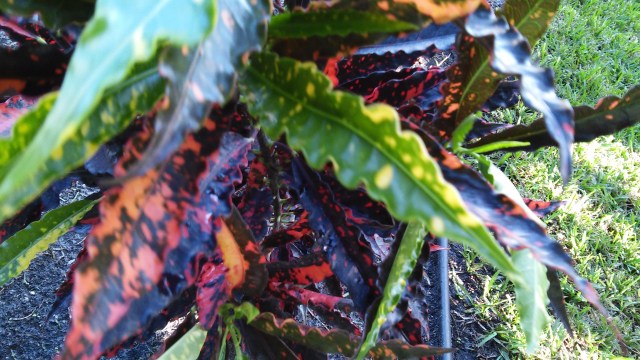
A nod to my husbands pie making skills was the purchase of a Piecrust Croton, a multi colored tropical shrub that hails from the South Pacific. These shrubs are easy to grow and ubiquitous in South Florida. There are a few stalwart standby varieties that are common, but of course I love the weird stuff.

Here are the standard varieties:

At the top of the post is the foliage of the Piecrust – it looks like, you guessed it, Piecrust!  The rest, clicking on the picture will give the name. Being the plant freak that I am, I couldn’t resist photographing several more interesting varieties:

I  love all of these, but I think Stoplight might be the next Croton purchase on my Croton bucket list. How many people have a Croton bucket list?

Yes, the beds are getting bigger. The good news is I probably have a quarter acre left!!

Back to the inspiration for all of this, the piecrust. Here are a few of my husbands pies:

I think these merit a celebratory Croton in the front yard.

Speaking of celebratory, Happy New Year to all.