In A Vase on Monday -Going Native

20160207_130423-1

One of the results of moving to Florida from a colder climate – sooner or later you go native. Winter Coats, who needs ’em? The coats are the first thing to go followed by socks, then shoes (sandals are an exception) and most long pants. One year my husband felt compelled to wear long pants twice. It was 50 degrees.

Plants for the garden are no exception. The first thing I had to quit desiring was Japanese Maples, followed by Yoshino Cherries. I got over Azaleas and Roses prior to moving south. Now and again I will suffer perennial envy, then again we have a plethora of great plants here in Florida – many are new to me.

I have always been a fan of native plants and decided to learn more about them by taking an online course about native plants on the Treasure Coast of Florida, taught by the guys behind the WordPress blog, Treasure Coast Natives. This one is for you, George.
20160207_130315-1

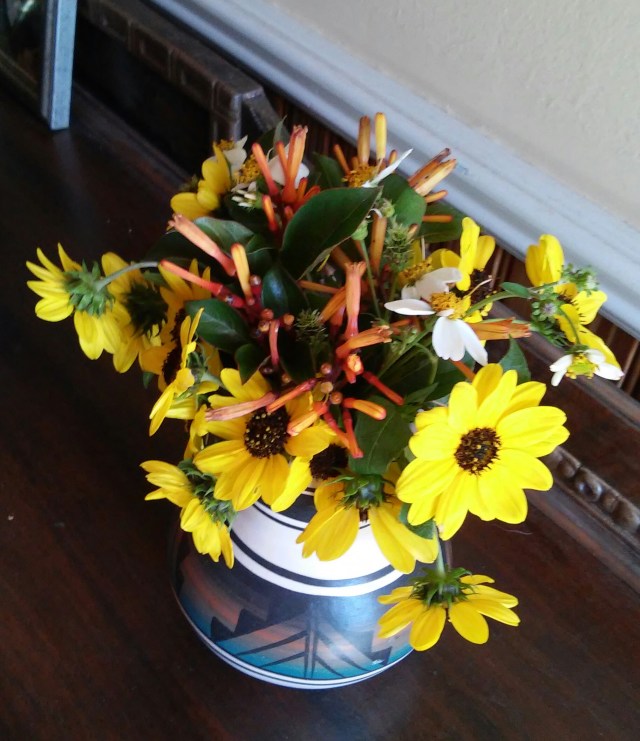
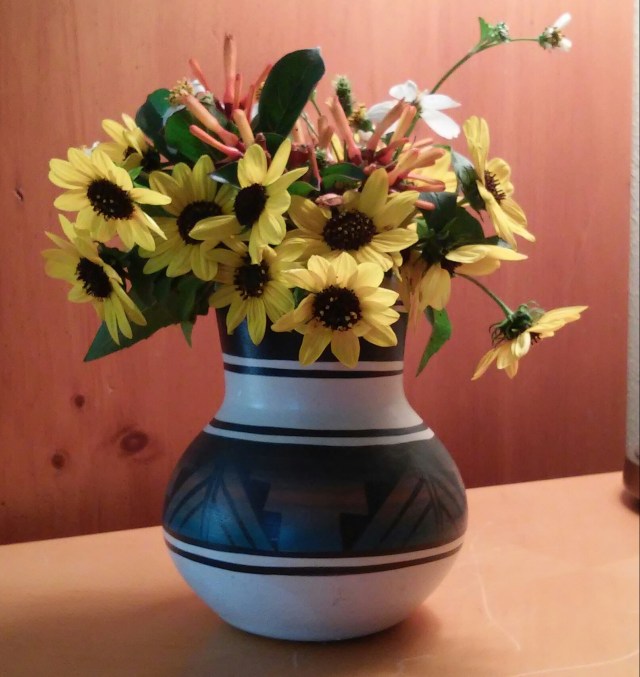
The flowers in this vase are all native and from plants included in the online course. The yellow flowers are Beach Sunflowers (Helianthus debilis), the white flowers are Spanish Needles (Bidens alba), the orange tubular flowers are Firebush, actually Dwarf Firebush (Hamelia patens) I planted the Beach Sunflowers and Firebush but the Spanish Needles appeared on their own and seed freely everywhere cursing me forever.

The vase is also a sort of native. A gift from my mother bought on one of her trips to the Southwestern United States, the vase was made by Native Americans of the Ute tribe and marked as such. One of my favorite things from my mother.

One of the benefits of native plants in the garden is the local butterflies love them. Here is a Zebra Longwing Butterfly on the Firebush:

20150625_081158

Firebush and Friend
 

Art in the Garden

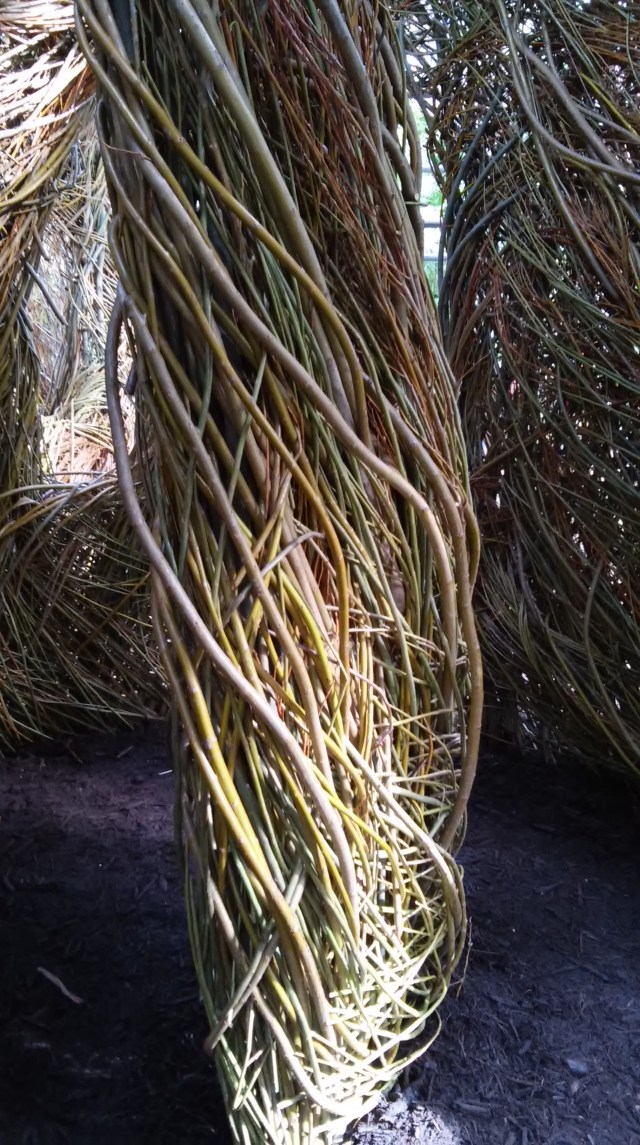
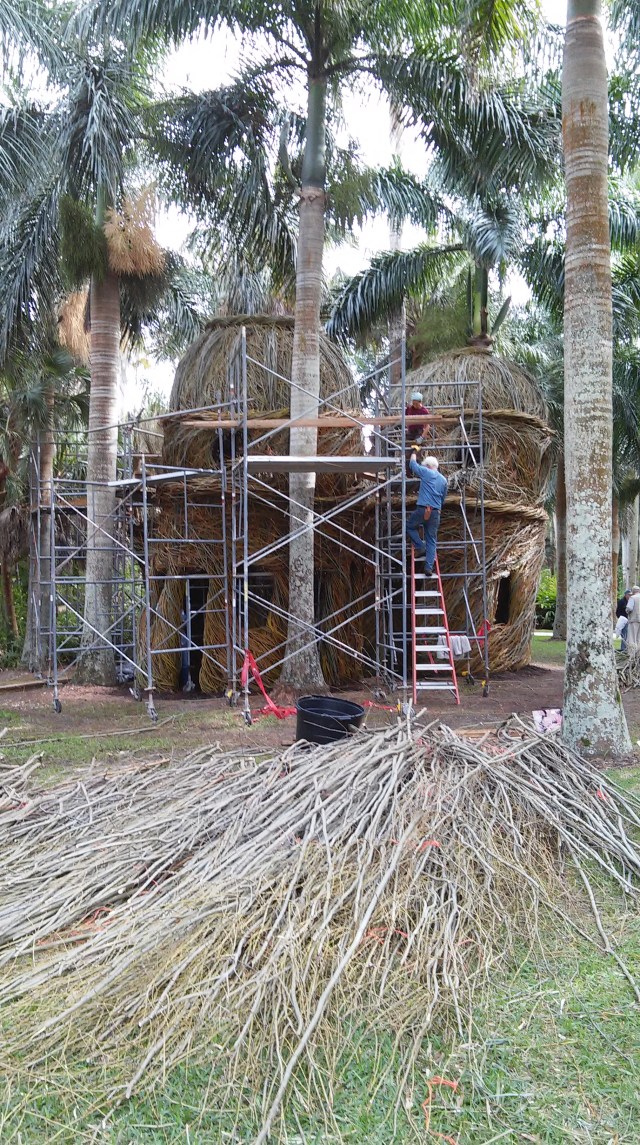
I usually write about the art of the garden, but here is a bit of art in the garden. The above photos are of a woven willow structure currently under construction at the McKee Botanical Garden in Vero Beach, Florida. This piece of environmental art is nestled in a grove of palms and constructed of willow saplings and bendable twigs woven together to form a temporary structure. The structure will eventually have three willow towers. Here is a close up of the twig structure:

20160121_142043

And here is an overall view:

20160121_141502


The artist is Patrick Dougherty and the concept is STICKWORK, here is a link to more information on the artist and installation,  http://www.mckeegarden.org/current-exhibition.php

I am usually not very enthralled with environmental art, but I love this. The organic willow towers complement the formality of the palms and I like the facts that the structure is built from willows grown in a sustainable tree farm and after a few years the structure will be evaluated to decide to keep it or compost it. I have visions of the entire thing rooting into the ground and growing a twisted fairy tale castle in the palm grove.

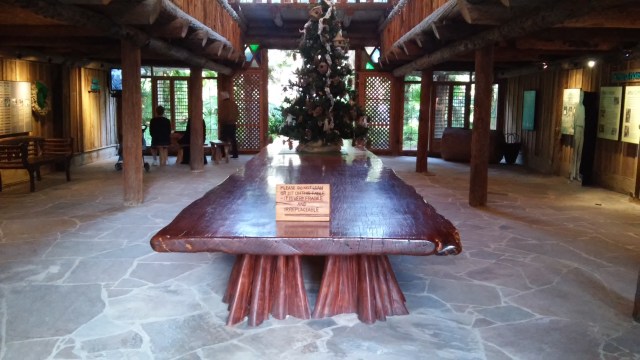
The rest of the garden has a bit of a fairy tale feel as well. Conceived by pioneer developers in South Florida during the first half of the twentieth century – the first buildings were based on Polynesian structures in keeping with the “Jungle” theme. The garden fell into disrepair and was reborn in the early 2000’s shepherded by a dedicated group of garden enthusiasts. Below is one of the original buildings, a great hall centered around a table constructed from a 38 foot long single piece of Mahogany:

20160121_145652


The rest of McKee is well worth touring and has a wealth of tropical plants. I saw many types of Bromeliads I had never seen before and an array of Palms, Orchids and tropical trees. The garden began in a mature forest hammock and boasts some incredible native trees and a pathway meandering through the garden inviting you to stop and study the flora. Here are some of my favorite photos from my trek through the garden.


In a Vase on Monday – The Wildflower Blues


20160117_154405-1

I have been watching a group of Yellow Lupines on the edges of a vacant lot nearby – thinking I could collect some seed and grow Lupines in my back garden. What I did not realize is when the seed pods are ready they explode and hurl seed far and wide. The pods exploded in my car and didn’t seem to think there was enough dirt to grow in the carpets, though there probably is as I haul dogs and plants around with equal enthusiasm. I am not sure if these plants are native to the area, but I am aware of other native Lupines in Florida; it seems peculiar as I associate these plants with Alpine meadows, the Rocky Mountains and cold, arid places. Here is another view of my three blue vases filled with native and/or wildflowers from the vacant lot.

20160117_113625

20160117_111900-1

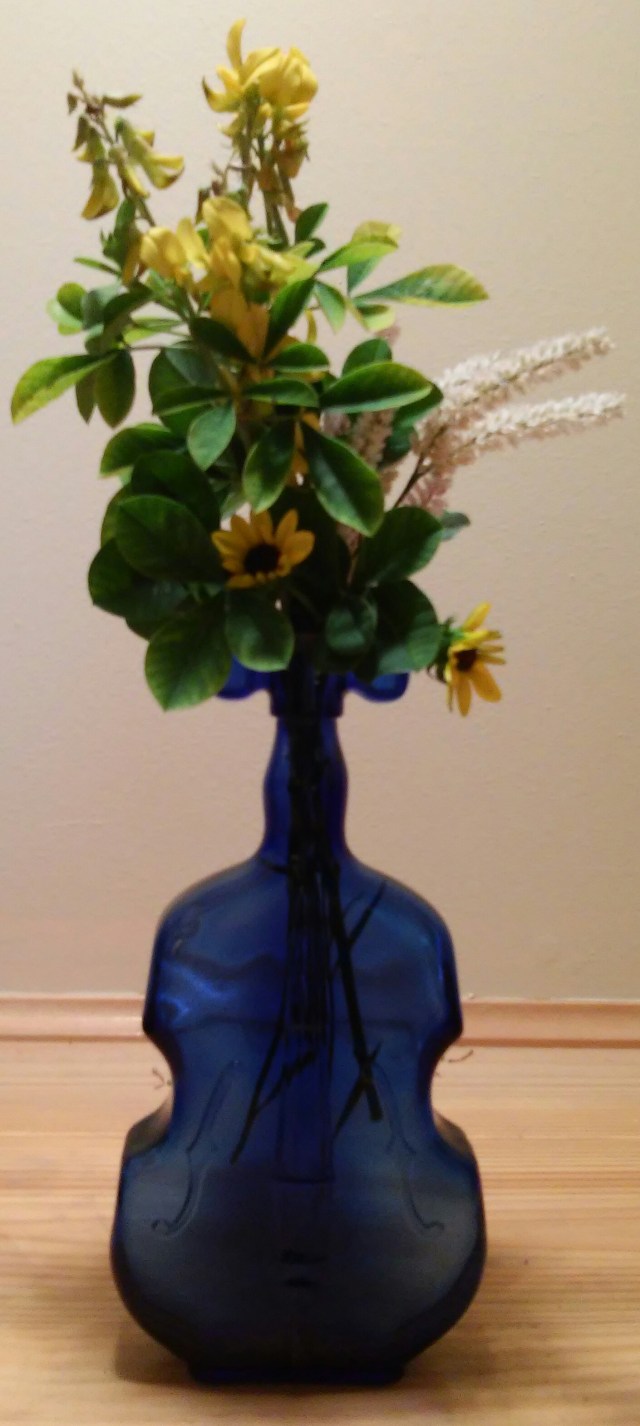
My blue vases represent three generations of women in my family, the violin belonged to my grandmother and has Yellow Lupines, the white spikes are Jointweed, the yellow daisy shaped flower is a Beach Sunflower.

20160117_114007

The tall bottle belonged to my mother and has Beach Sunflower, Yellow Lupines and seeds, background plants are Shrubby Buttonweed and Muhly Grass.

The corked bottle in the background belongs to me and holds the dried petals of all the roses my husband sent me during our courtship. The bells belonged to my other grandmother and are one of those touchstones that have been around the house as long as I can remember; my father brought them home from World War II.

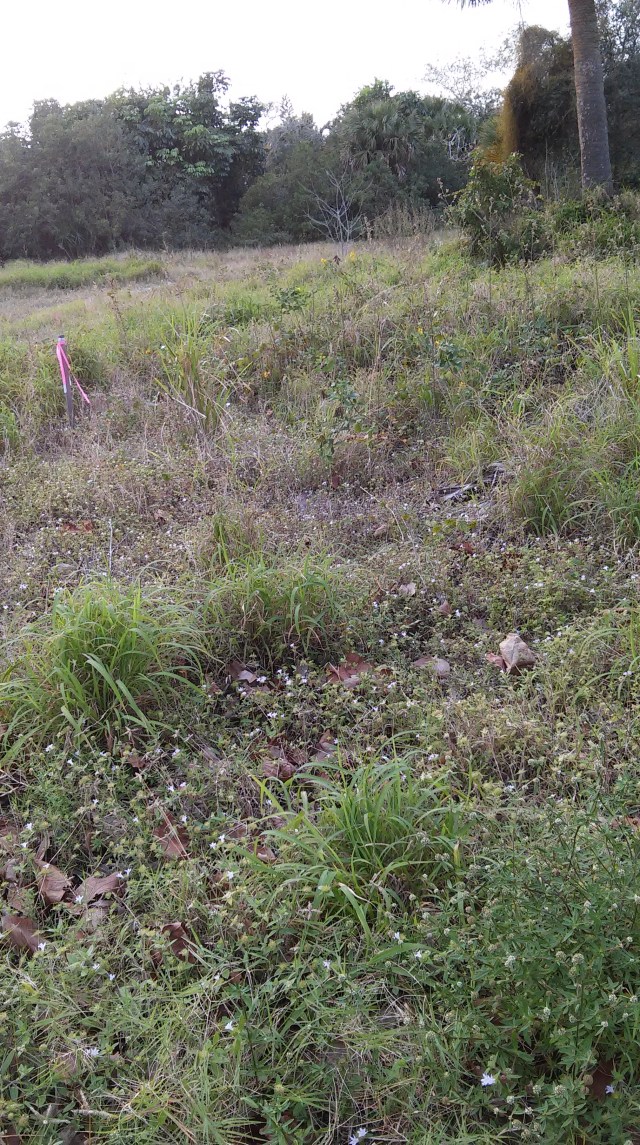
As I was writing this post, it occurred to me how much more interesting and attractive these flowers appear in their Monday vase. So, I wandered over to the vacant lot and took a before picture:

20160117_163141


All the components of the vase are in the foreground. I think I like the flowers in their blue bottles better. This leads me to ponder if more people saw native plants in a vase instead of a vacant lot – native plants might be more popular.

If you would like to see vases from the world over, stop by the comments section of  https://ramblinginthegarden.wordpress.com where Cathy hosts In A Vase on Monday – every Monday!


Piecrust Croton and Friends

20151230_153823

Piecrust Croton

I have been reworking  the design of my front yard because the access point for the septic tank was in a lawn area and actually needed access. What this really means is once a year a 3 foot circle in the lawn  is dug up and destroyed to clean the (ewww, yes) septic tank filter. The joys of country living. I am certain I did not know septic tanks had filters prior to moving to Florida. I also realized I would like to have a pathway to the side.

For many years I have advised my clients to live in their houses for a while to see how they move around the property as sometimes a good guess just really doesn’t do the trick. The upshot is I did not take my own advice and I like to travel to my side garden (ah, future garden) more than I thought I would. Design that originates with how you live in a place is always a good plan. This may be Plan B as I did Plan A. Who knew St. Augustinegrass wouldn’t be happy over a septic tank. Oh, well. I am liking the new bed thus far.

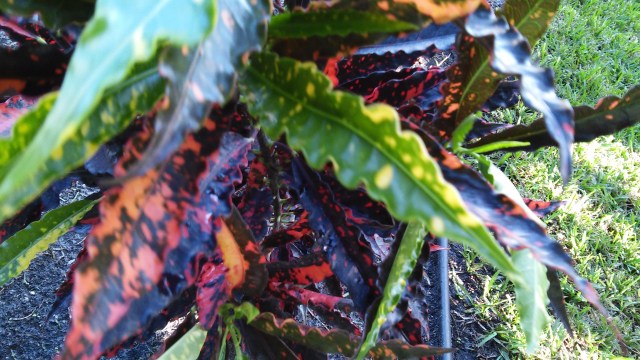
A nod to my husbands pie making skills was the purchase of a Piecrust Croton, a multi colored tropical shrub that hails from the South Pacific. These shrubs are easy to grow and ubiquitous in South Florida. There are a few stalwart standby varieties that are common, but of course I love the weird stuff.

Here are the standard varieties:

At the top of the post is the foliage of the Piecrust – it looks like, you guessed it, Piecrust!  The rest, clicking on the picture will give the name. Being the plant freak that I am, I couldn’t resist photographing several more interesting varieties:

I  love all of these, but I think Stoplight might be the next Croton purchase on my Croton bucket list. How many people have a Croton bucket list?

Yes, the beds are getting bigger. The good news is I probably have a quarter acre left!!

Back to the inspiration for all of this, the piecrust. Here are a few of my husbands pies:

I think these merit a celebratory Croton in the front yard.

Speaking of celebratory, Happy New Year to all.

Ahh October

While it seems winter is bearing down on the Northern Hemisphere, things are looking up here in South Florida. The oppressive heat is abating and I have been madly renovating my screen porch furniture in preparation for our gardening season. All new cushion covers and some new (to me) vintage Rattan furniture for lounging. Temperatures are hovering in the 80’s (Fahrenheit, Centigrade confounds me) so it is becoming very pleasant.

I am always looking for signs of Fall here and the pickings aren’t as slim as I once thought. It is your perception that must change. I associate the Royal Ponciana tree with the beginning of Summer.  Their cousin of a different genus, Dwarf or Cuban Ponciana start blooming in earnest in October. The harbinger of Fall:

Dwarf Ponciana Caesalpinia pulcherrima

Dwarf Ponciana
Caesalpinia pulcherrima

These trees are smaller than but similar to the Royal Poinciana, and varieties are available with yellow and coral flowers as well as the red mixed which is most commonly seen. Other things I am now considering fall color are certain Bromeliad flowers (Aechmea blanchetiana) and Bird of Paradise. The tropical Golden Rain Tree (Koelrueteria bipinnatus) is just starting to flower here. In December the pods on the Raintree give us a little more Autumnal feeling.

Blanchetiana Bromeliad

Blanchetiana Bromeliad

Tropic Florida does have some more typical fall fruiting plants. The Beautyberry, Callicarpa americana, native to a large part of the Eastern United States is common here as well. The red berries are from our native shrub, Wild Coffee, Psychotria nervosa. I have seen Beautyberry Jelly but never consumed any and supposedly the Wild Coffee has psychedelic effects so coffee brewed with something other than the Wild Coffee berries is a better idea. Blueberry Scones and Starbucks coffee are more in my line of thinking for breakfast fare.

Beautyberry

Beautyberry

Wild Coffee

Wild Coffee

I know that if I wait long enough, I will spy a Red Maple with some dull purple Fall color, usually in December and in a swamp somewhere. But with all these other Fall beauties I am not missing the Maples – Much.