In a Vase on Monday – Propavasing

Here’s a new word for you. Propavasing. This occurs when taking cuttings to root in water, followed by finding a few clean vases around the kitchen sink, plonking and fluffing the cuttings – voila!

The cuttings:
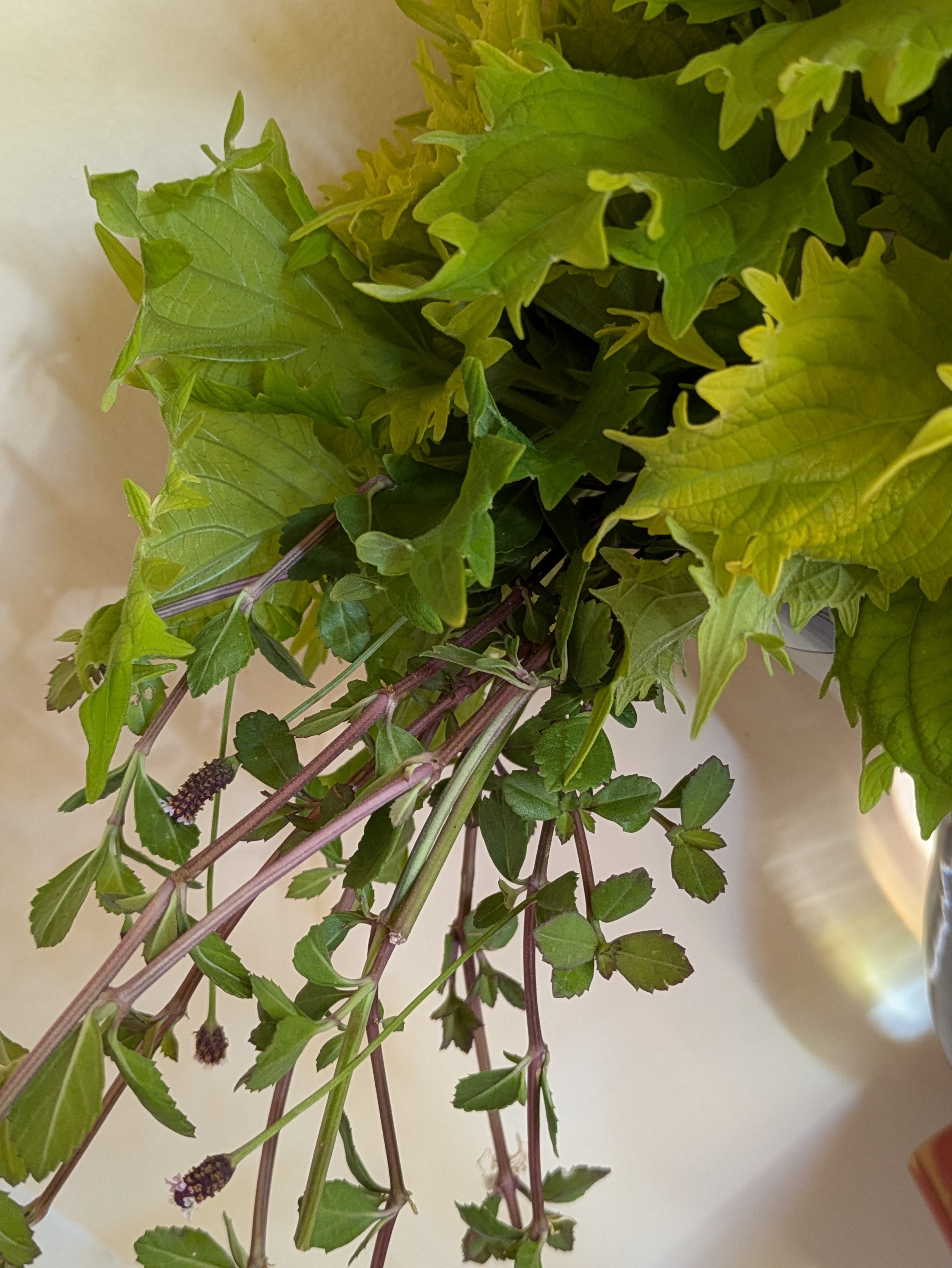
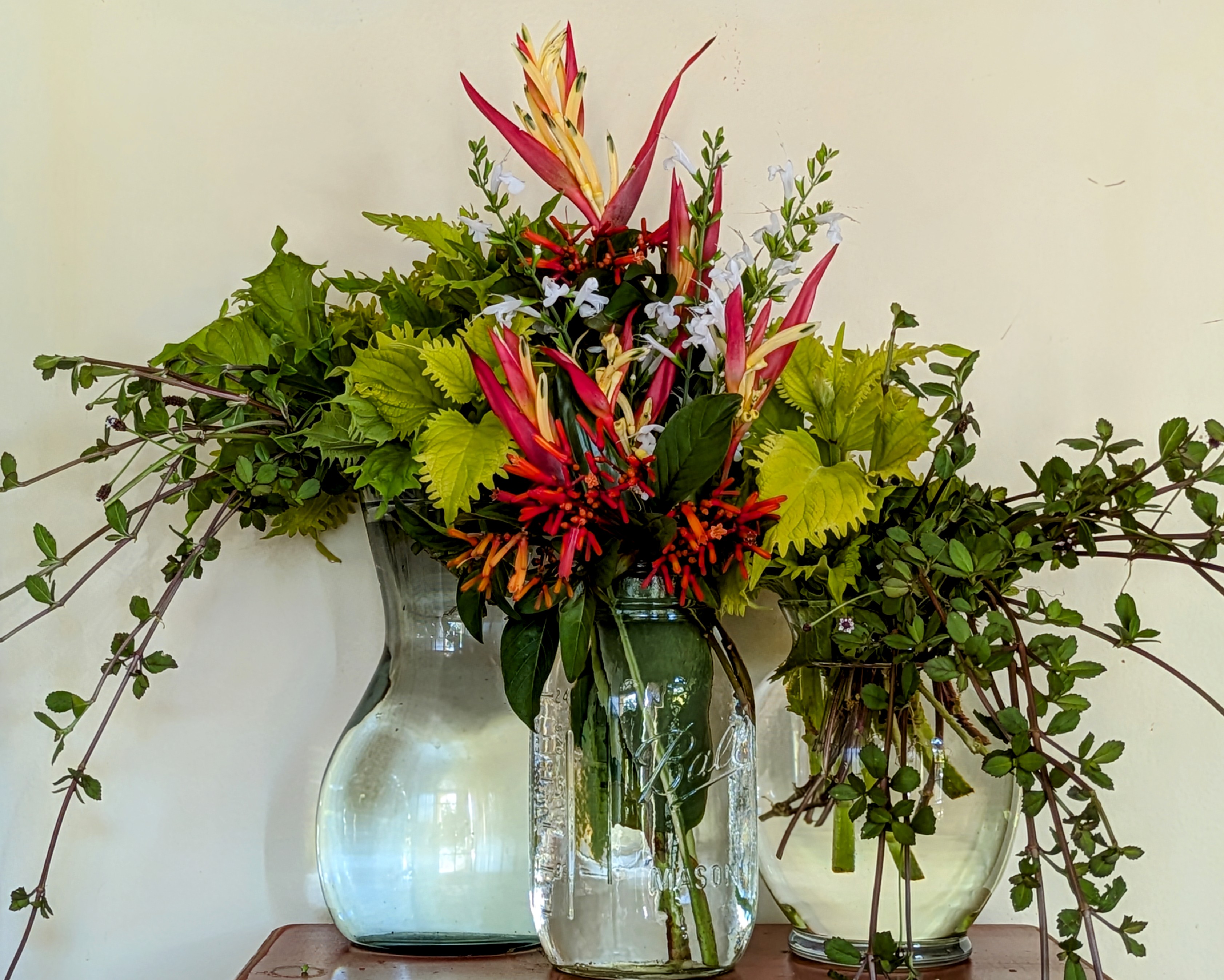
I left some chartreuse coleus in a few pots to dress up later for winter container plantings. Not a good idea – especially when combined with leftover moldy zinnias I let go to seed, hoping for some more hot pink/orange flowers next year. The seeds aren’t quite made yet, but the chartreuse coleus is definitely done. Hence the cuttings.

The vining plants are Turkeytangle Frogfruit (Phyla nodiflora). I have been propagating these and creating a lawn of curated weeds in the front garden. I am very happy with my ‘lawn’ and the butterflies are loving it. TTFF hosts three different types of local butterflies.

The flowers:
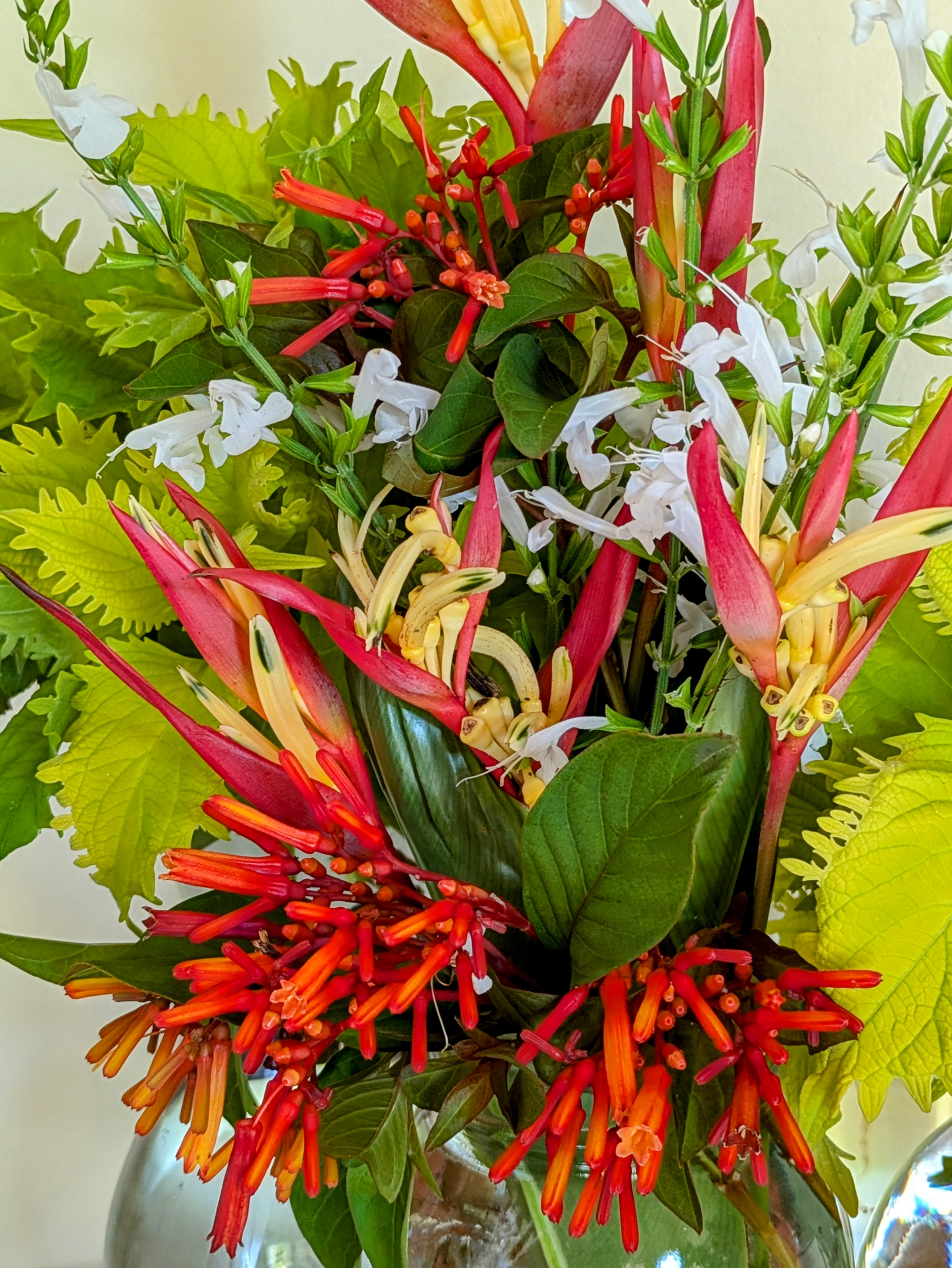
Orange tubular flowers are Firebush (Hamelia patens); red and yellow flowers are ‘Lady Di’ Heliconias (Heliconia psittacorum); white flowers are Tropical Red Salvia (Salvia coccinea).

It’s still summer here. The fall colors are not making me feel cooler.

Visit Cathy at RamblingintheGarden for a whirlwind garden tour via vases.

In a Vase on Monday – Light My Fire

I must have been inspired by Cathy’s “Hunk of Burning Love” vase a couple of weeks ago when the title popped into my brain. I admit to loving The Doors and their iconic song “Light My Fire” from (gasp) 1967. This song has been haunting my consciousness for decades. I guess it’s the organ solo. My garden seems to be reflecting the mood, producing fiery flowers as summer winds down.

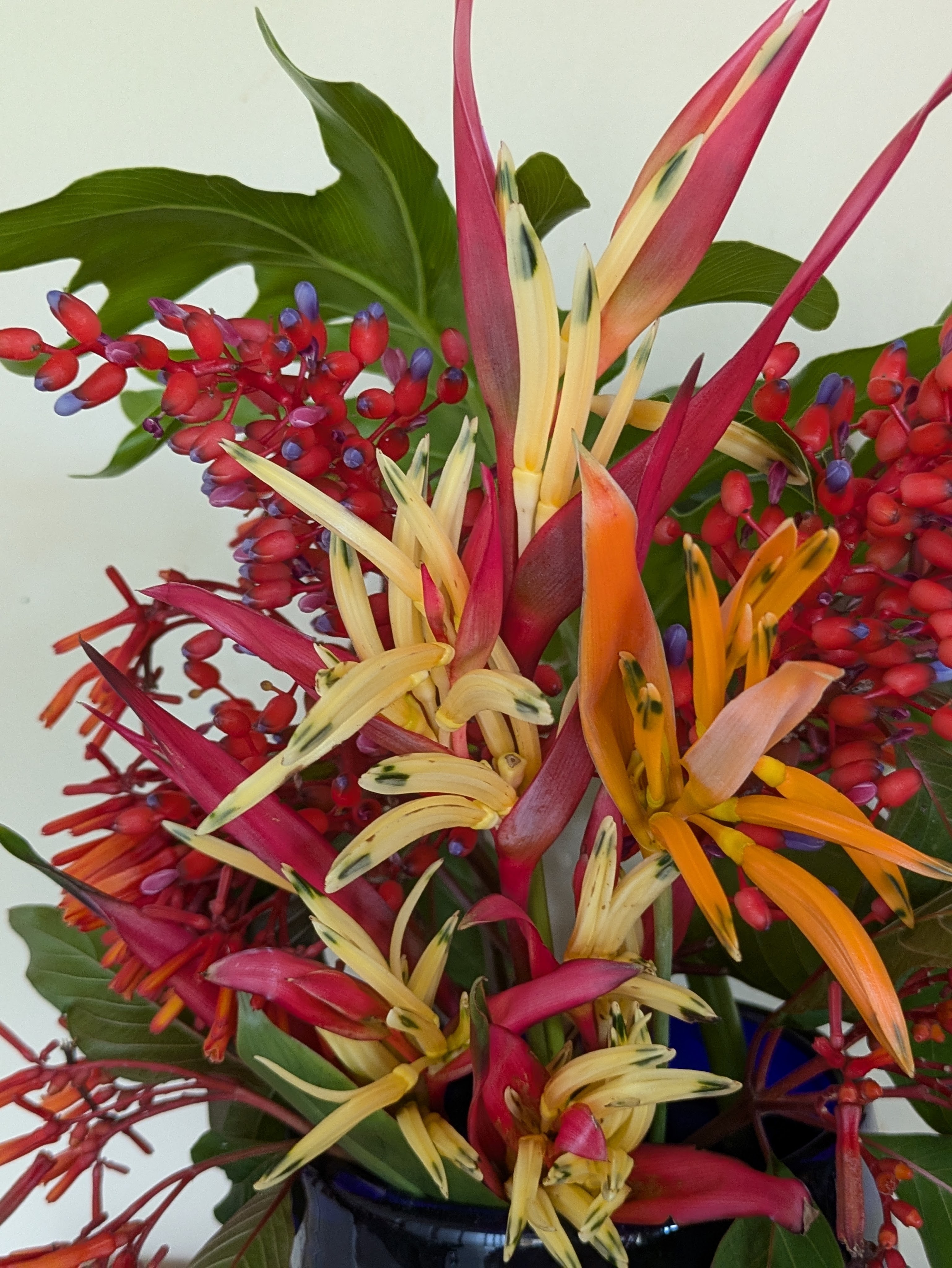
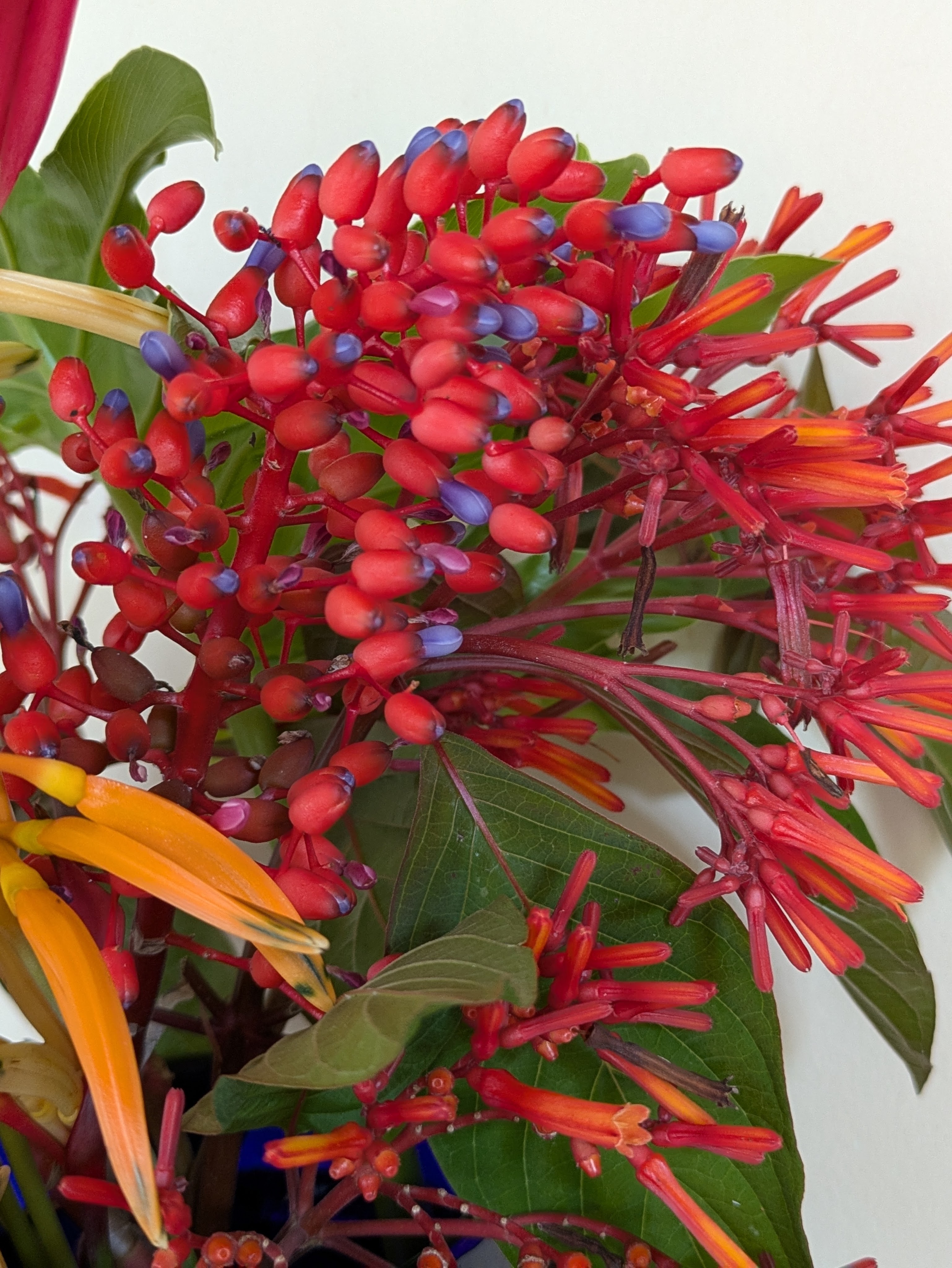
Some close ups, sans Jim Morrison.

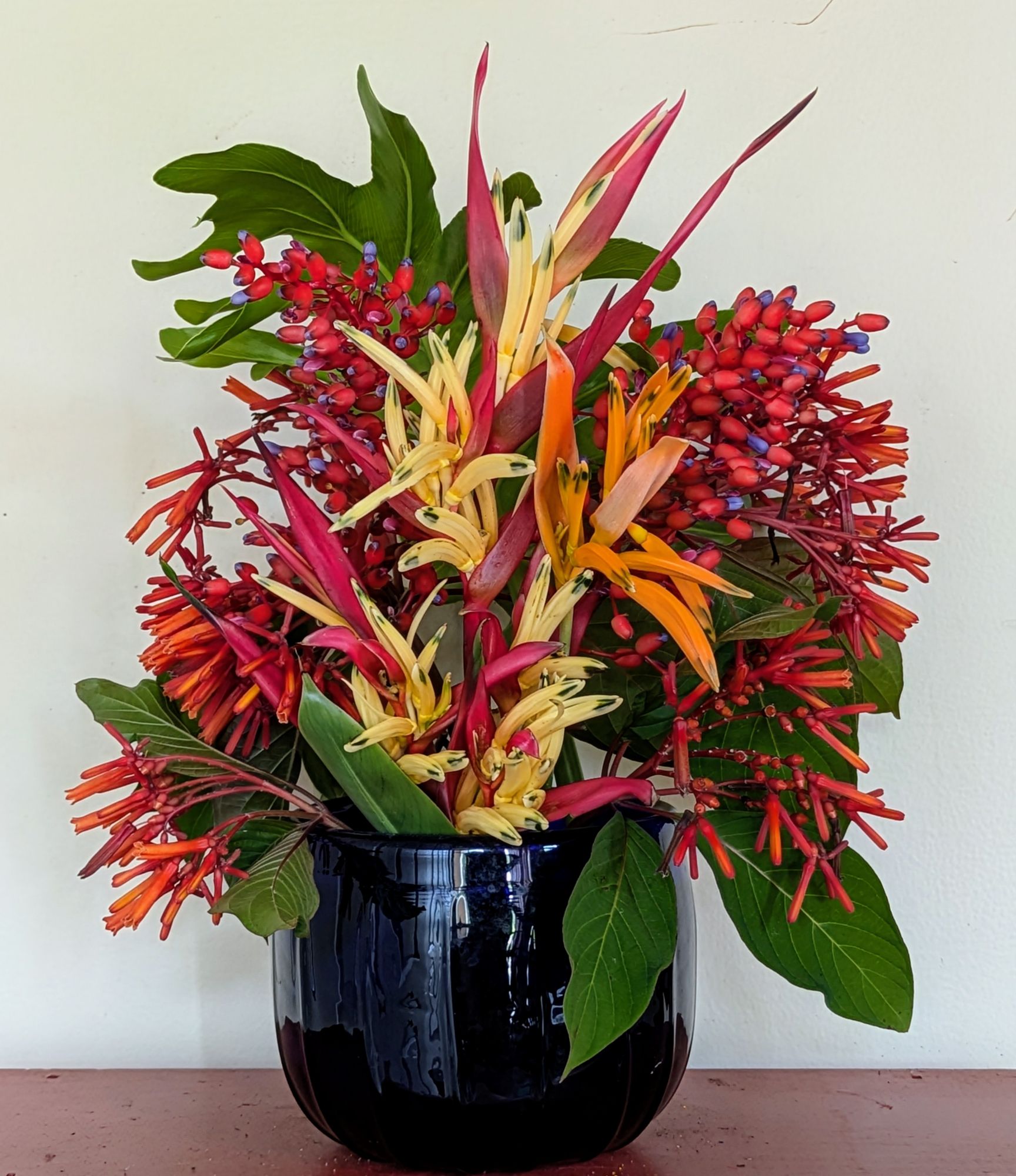
I have been enjoying cutting Heliconias (Heliconia psittacorum) this summer in all their flaming glory; two varieties here – ‘Lady Di’ in red and yellow and ‘Choconiana’ in orange. The big leaf in the background is a Split Leaf Philodendron (Philodendron selloum).

Orange tubular flowers are, appropriately, Firebush (Hamelia patens var patens); red flowers with blue tips are Aechmea miniata bromeliads. The blue vase was a gift I have enjoyed tremendously over the years.

That’s all this Monday morning from scorching South Florida. Follow this link RamblingintheGarden to visit Cathy and peruse vases via comment links.

In a Vase on Monday – BananaRama

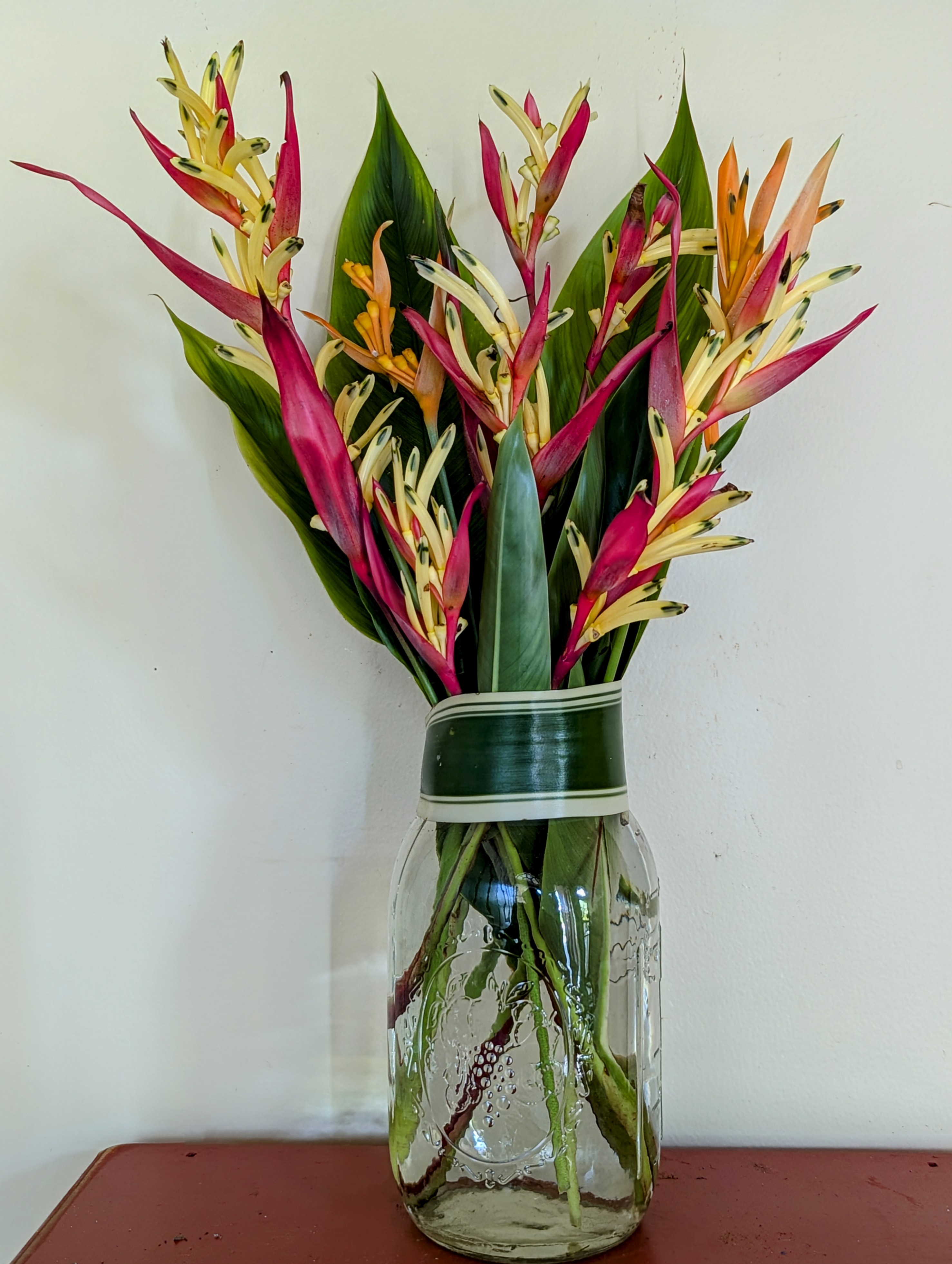
A simple summertime vase of tropical flowers. Step back and it looks like bunches of bananas. Or, depending on your flight of fancy, a flock of parrots. This is a mason jar filled with Heliconia psittacorum, common name, Parrotflowers. A favorite perennial in tropical gardens, these can run rampant when in their happy place – at my house beside the front porch suits them perfectly.

A closer view of the Heliconias accented with their own foliage. I covered the rim of the mason jar with a band of varigated bromeliad foliage – channeling my mother “because it just looked tacky.”

That’s all from the doldrums of summer dog days in South Florida. To view more temperate vases follow this link to Cathy’s garden.

Happy Gardening!

In a Vase on Monday – Ladies of the Front Garden

I begin to more fully appreciate the occupants of my garden near the front door as summer embraces my garden in full heat and humidity. Embraces may be too delicate a word, bringing the hammer down is more accurate. I enjoy these two ladies growing near my door in the garden and in a vase this Monday.

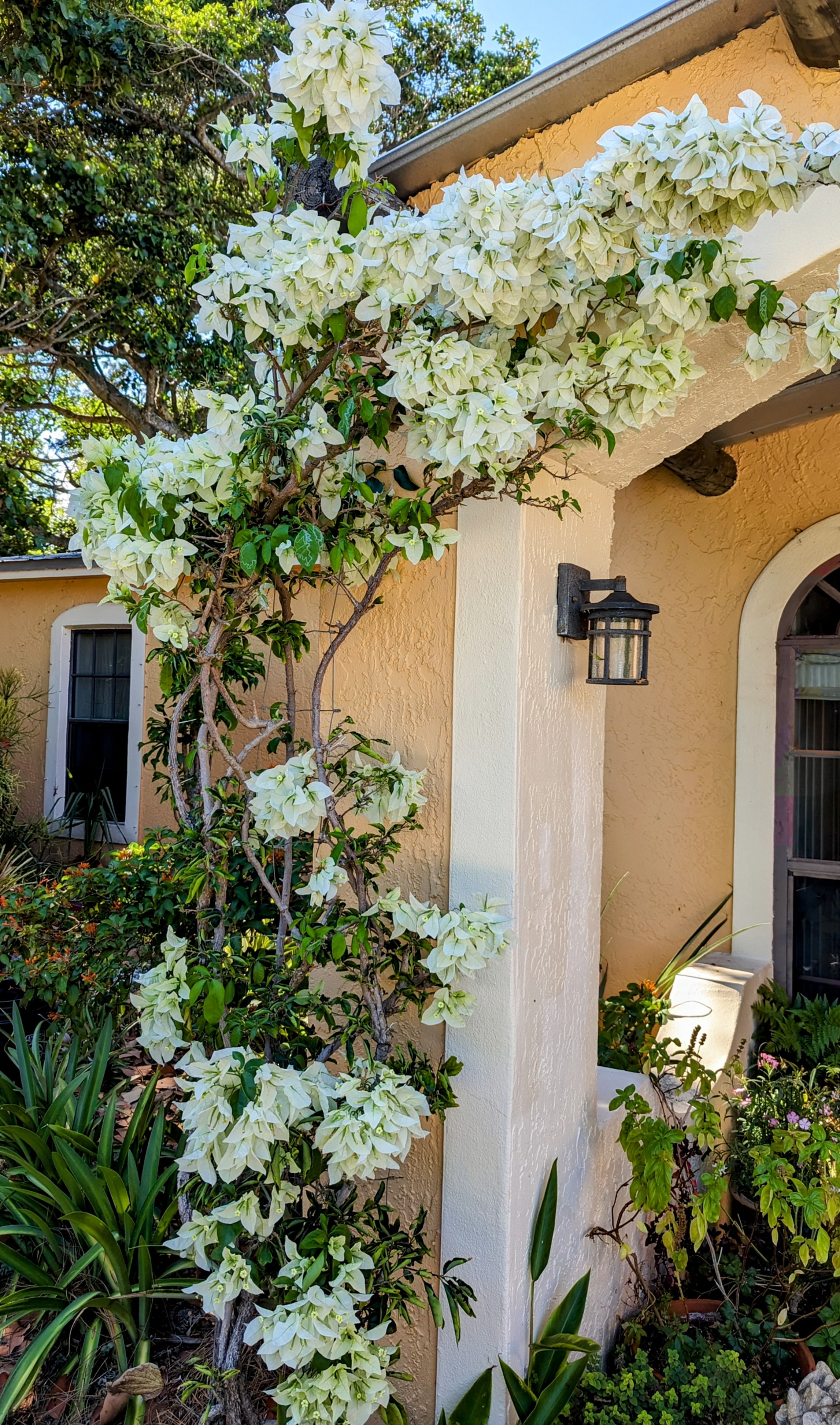
Miss Alice Bougainvillea in white and Lady Di Heliconias relish the heat and don’t even break a sweat being beautiful in summer. Both of the ladies have the ability to flower year round but seem to enjoy the summer most for showing off. I did not realize Miss Alice was a big bract (?) Bougainvillea until I was researching who Alice might be.

Miss Alice in full glory. Who Miss Alice is remains a mystery.

We were hoping for some rain this week in Central and South Florida after a droughty spring. If the predictions are right we will have a full season’s worth of rain this week. Seven to twelve inches is forecast. I guess I can put up the hose for a bit.

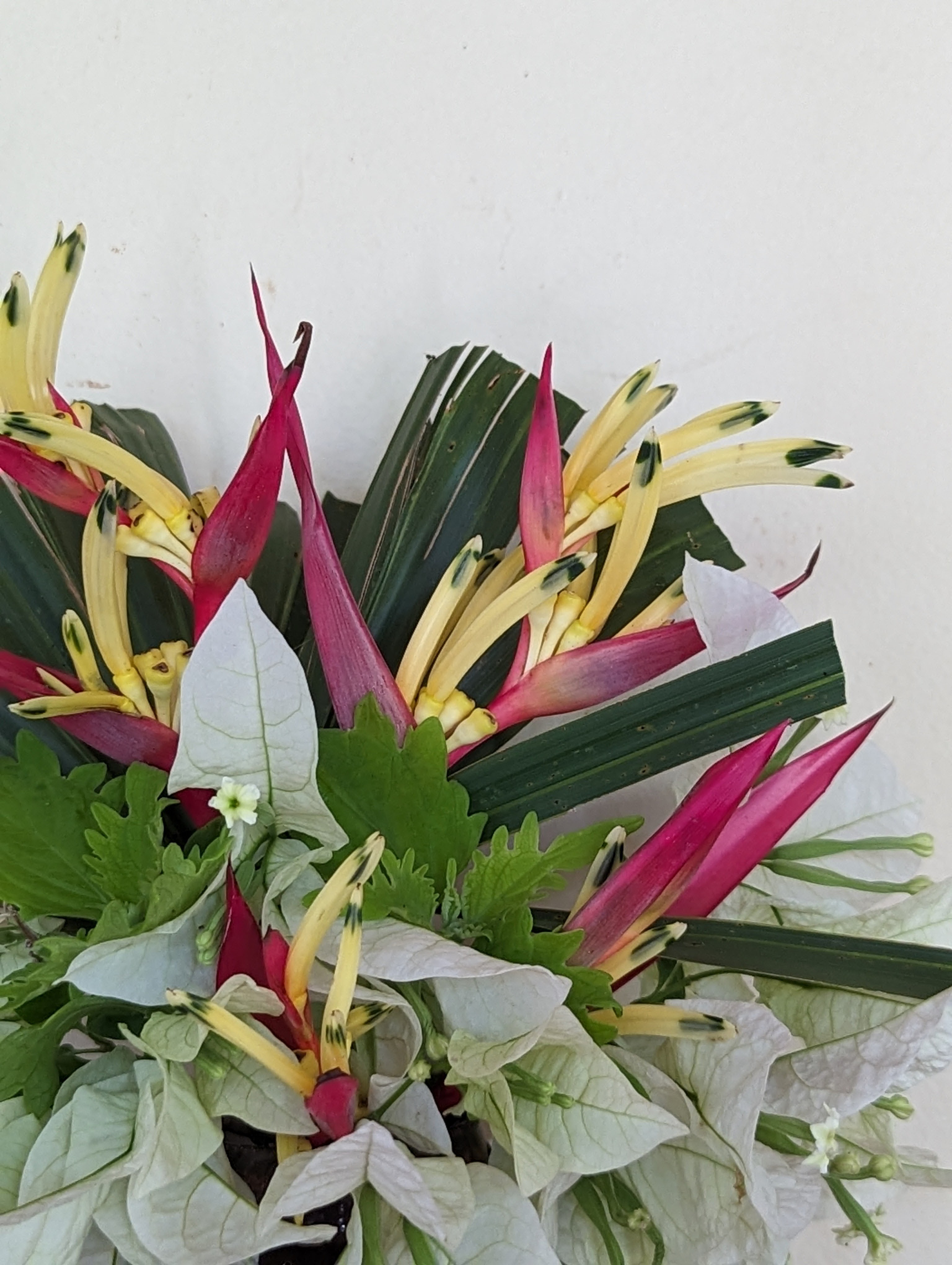
Lady Di Heliconias (Heliconia psittacorum) in red and yellow are nestled in a frond from a Sabal Palm seedling.

Miss Alice Bougainvillea bracts and true flowers with a few sprigs of charteuse coleus. The vase was inherited from my mother.

That’s all from South Florida. We will be frying, steaming or sauteing in the garden this week. To see more vases visit Cathy at ramblinginthegarden

In a Vase on Monday – In a Pickle

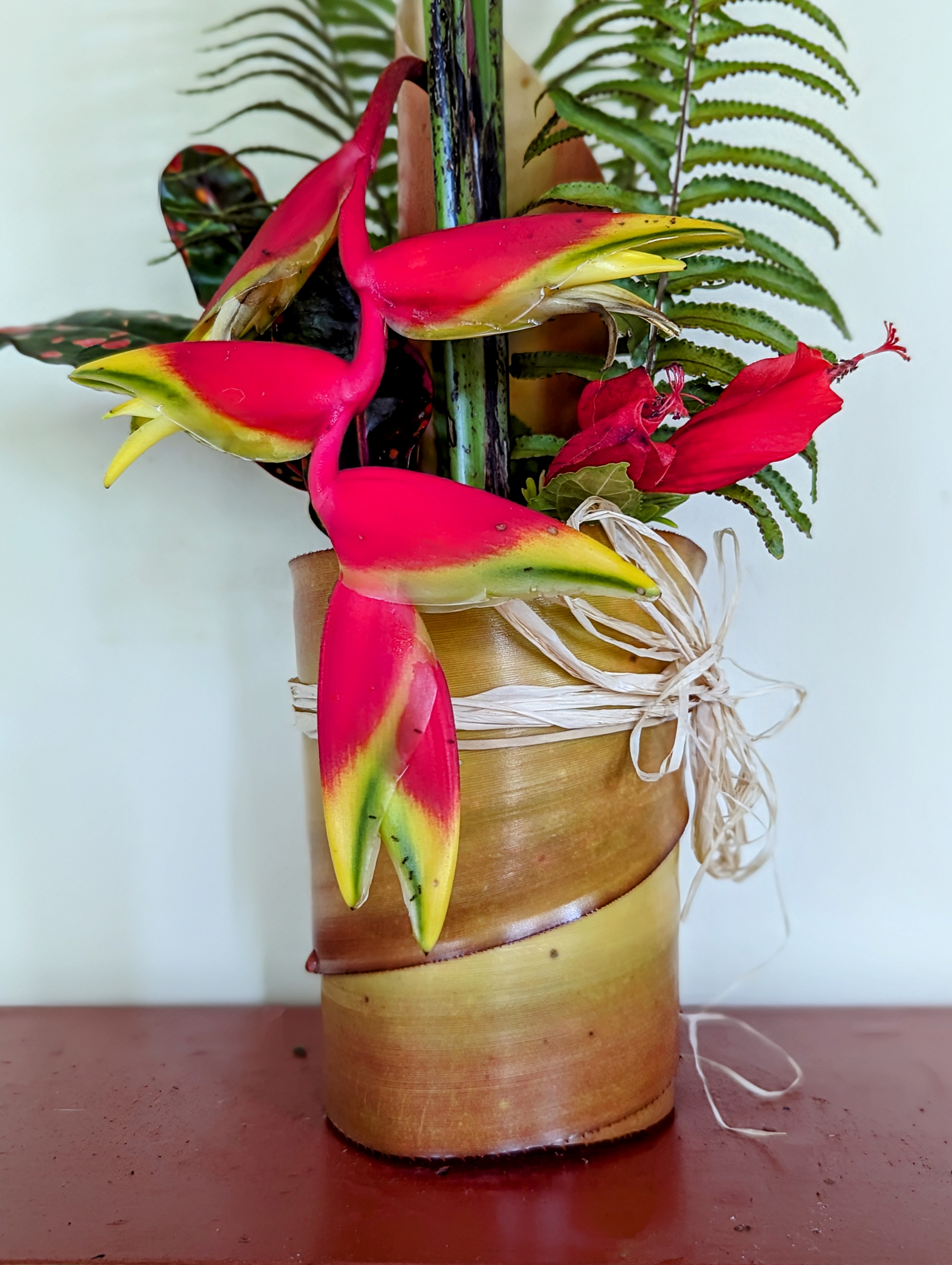
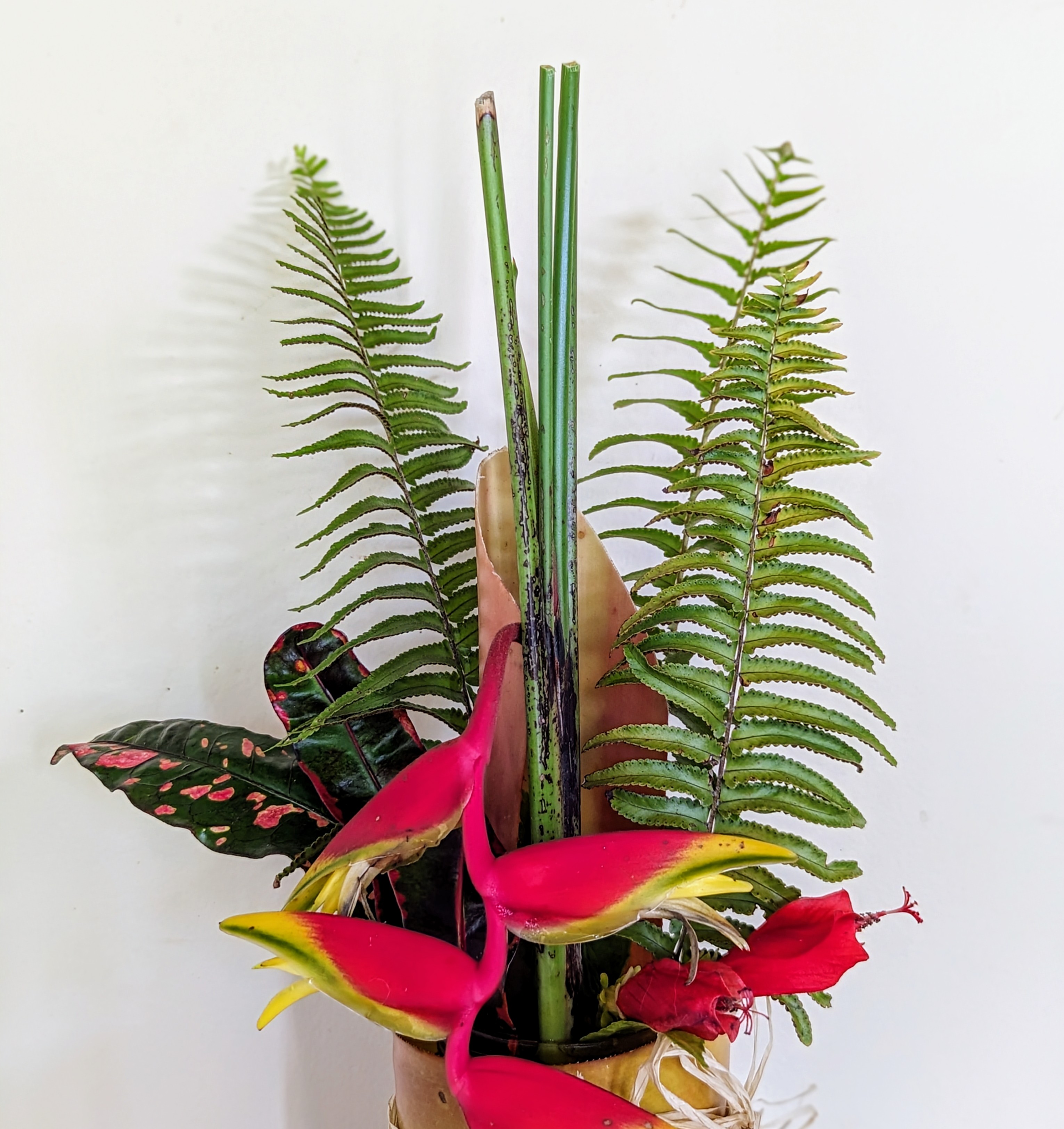
I had my heart set on a linear arrangement to display my first Lobsterclaw Heliconia of the season. The problem – my linear vase broke in the dishwasher. I was in a Pickle, until my dilemma was solved by, of all things, a Pickle jar. My husband is a compulsive jar saver so the perfect vase was soon in hand and fortunately covered in label glue. This made it very easy to roll a bromeliad leaf around it and tie it up with raffia.

The Lobsterclaw Heliconia is definitely a harbinger of summer. We have had some very hot alternating with very pleasant days and no rain. I finished mulching the gardens this morning as it seemed like possibly the last cool morning for a while. My cool and everyone else’s are probably entirely different things!

The Lobsterclaw Heliconia (Heliconia rostrata) is hanging around with two red Nodding Hibiscus (Malvaviscus arboreus) and a few leaves from Mammey Croton (Codieum varigatum)

The linear aspect of this arrangement is enhanced with foliage from Blanchetiana Bromeliad (Aechmea blanchetiana) – this is wrapped around the pickle jar and leaf leftovers I decided to pop in to hold the Heliconia upright. The ferns are Boston Fern (Nephrolepis exaltata)

Hoping for rain in my garden this week! To see more vases, visit Cathy at ramblinginthegarden.

Happy Gardening!!

Heliconias for South Florida

Looking to add some tropical vibe to your garden? Look no further than one of my favorite tropical plants, Heliconias. Heliconias come in many different varieties, two of the most common and easiest types to grow in South Florida’s Zone 10 are Parrot flowers and Lobster claw Heliconias.

Meet the Lobster claw Heliconia (Heliconia rostrata). Featuring large, shiny banana-like foliage and thick stems that support large hanging bracts of red and yellow flowers it is difficult to picture a more tropical plant. They originated in rainforests of South and Central America as understory plants. It is written that the flowers evolved to this shape to attract tropical hummingbirds to pollinate them. In my garden, the hummingbirds aren’t around at the same time as the flowers, so I am guessing this is a phenomena that happens much further south.

While some Lobster claw Heliconia can grow to 15 feet tall, these are usually more tropical types in an actual rainforest. The plants grown in Zone 10 are usually smaller and can be damaged with an extraordinarily cold snap.

Lobsterclaw Heliconia are easily grown in a partial shade setting with ample moisture. They like rich, well drained soil and benefit from compost in the planting hole and mulch. I grow them in my garden on the north side of the house under the edge of the roof. They are very happy and provide cut flowers in the summer.

This is a smaller Lobsterclaw Heliconia in my garden. I enjoy cutting these for smaller vases.

Here is a parrot for the garden. Heliconia psittacorum AKA the Parrot flower. I would characterize this as a tropical flowering perennial. They are leafy, grow about two feet tall, enjoy a moist, part shade environment and can spread like mad if happy. I have had these produce flowers almost every month of the year. I believe they slow down with extremes in weather (drought, heat, cold). Below is the “Lady Di” Parrot flower.

This is another long lasting cut flower. I have a few in a vase by my front door.

In a Vase on Monday – Sculptural Elements

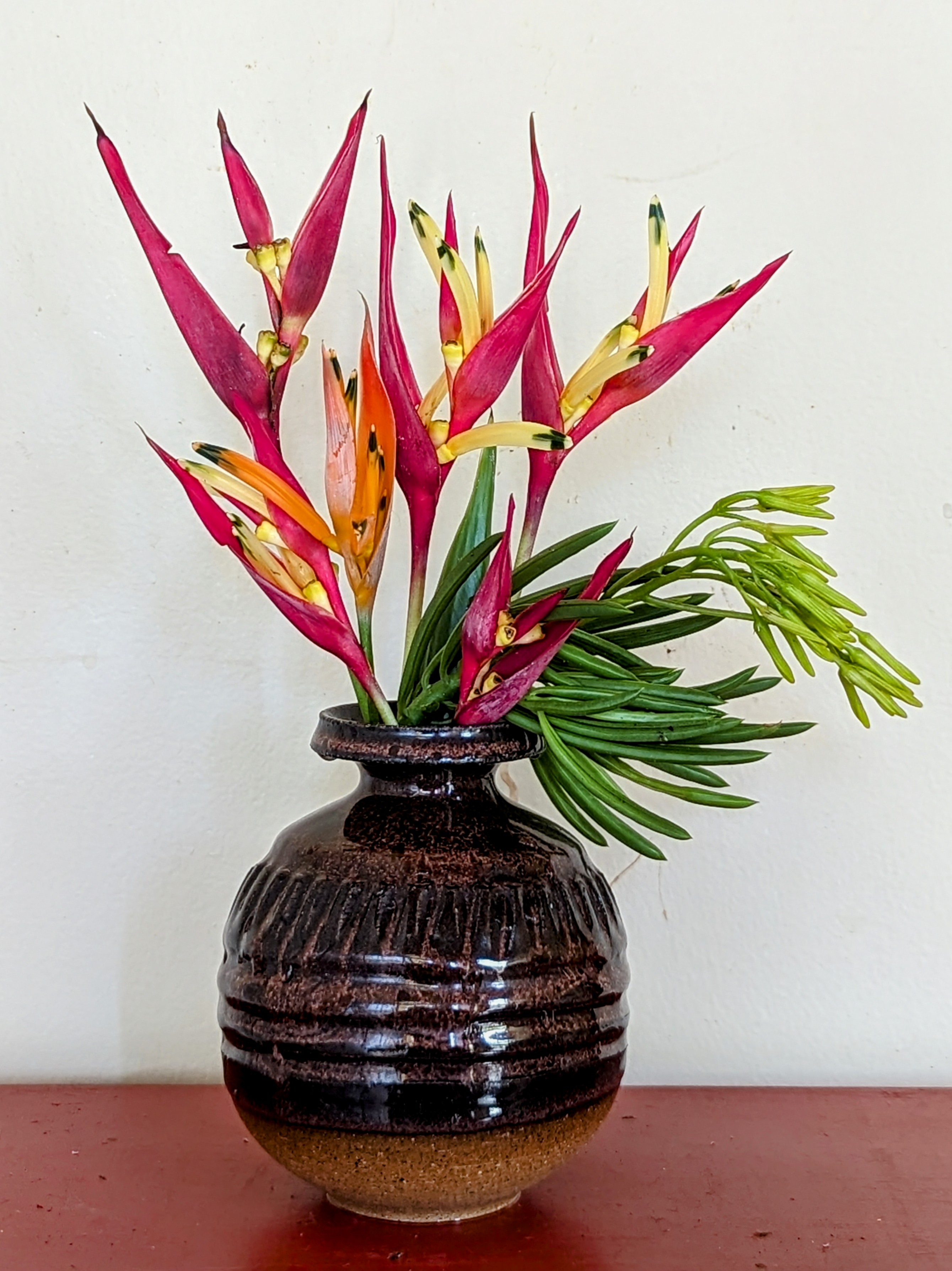
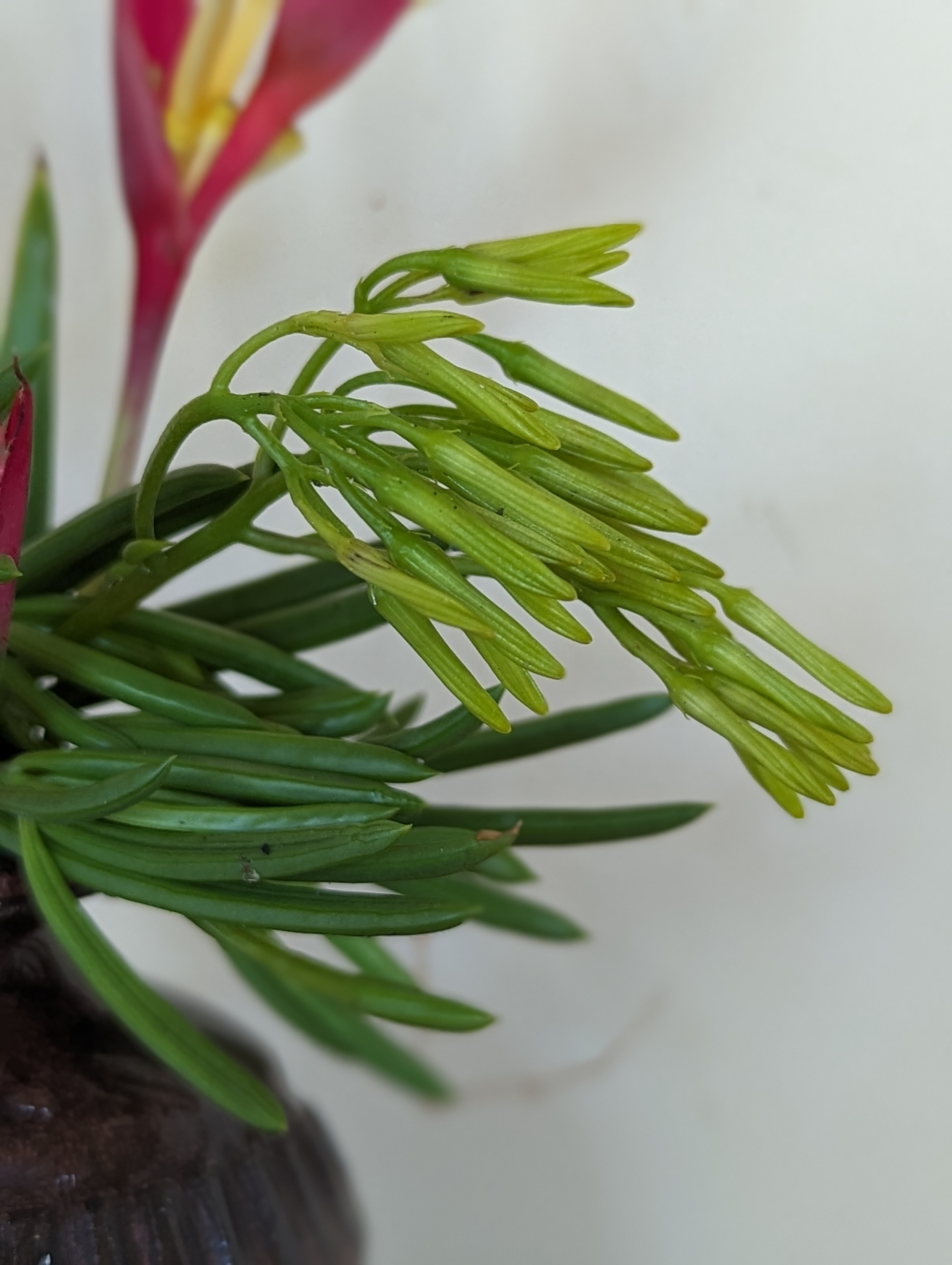
This week my garden is sporting many different types of flowers, from classic cottage style to over the top tropical weirdness. I decided to simplify and cut a few Heliconias accented with the buds of a succulent. It is a bit calm in the face of the exuberance of spring.

March is proving to be its usual windy, showery self, so a quick garden tour and a few snips was a good thing this Sunday morning. I used one of my mother’s heirloom vases to set off the simple flower selection.

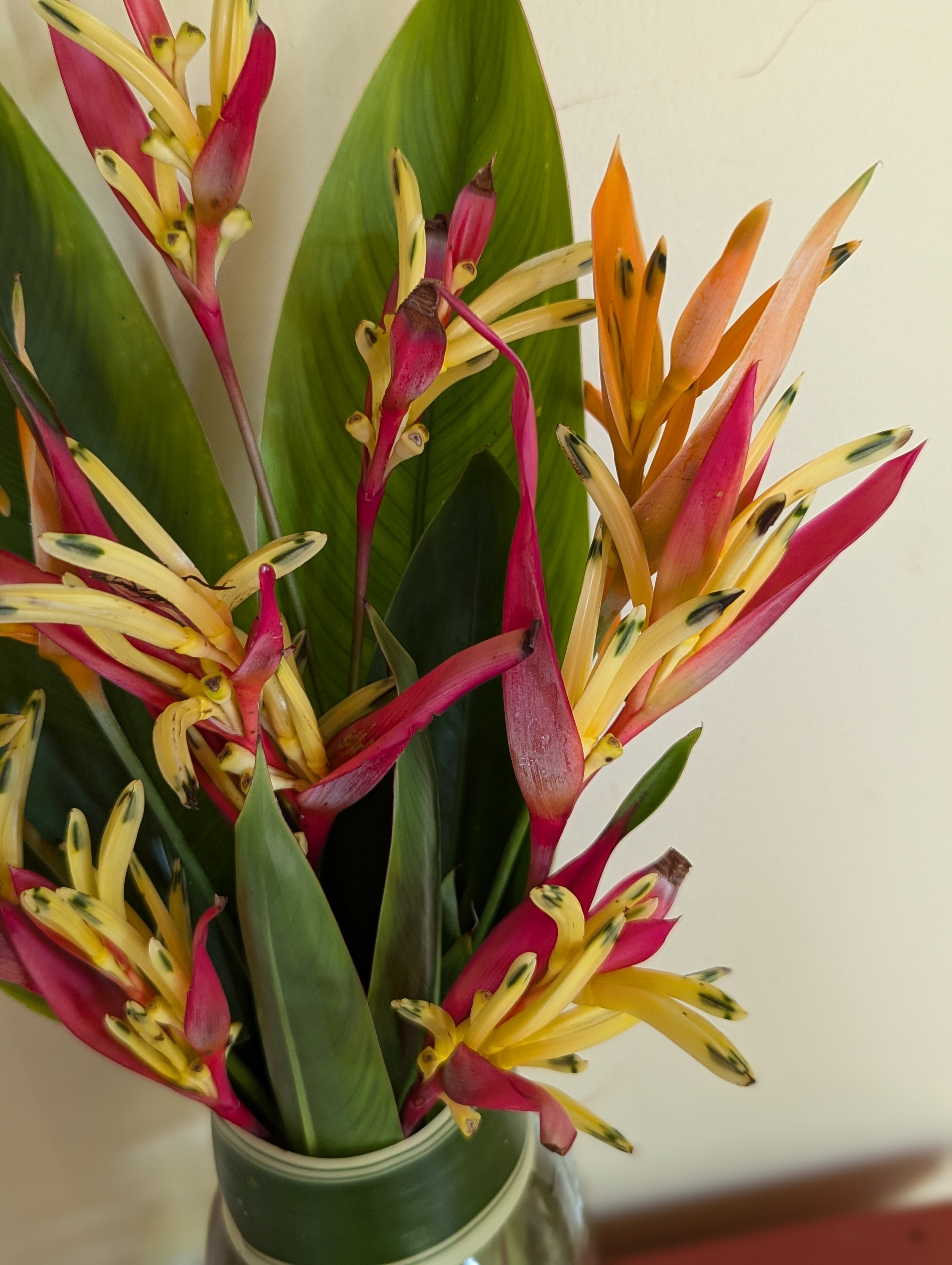
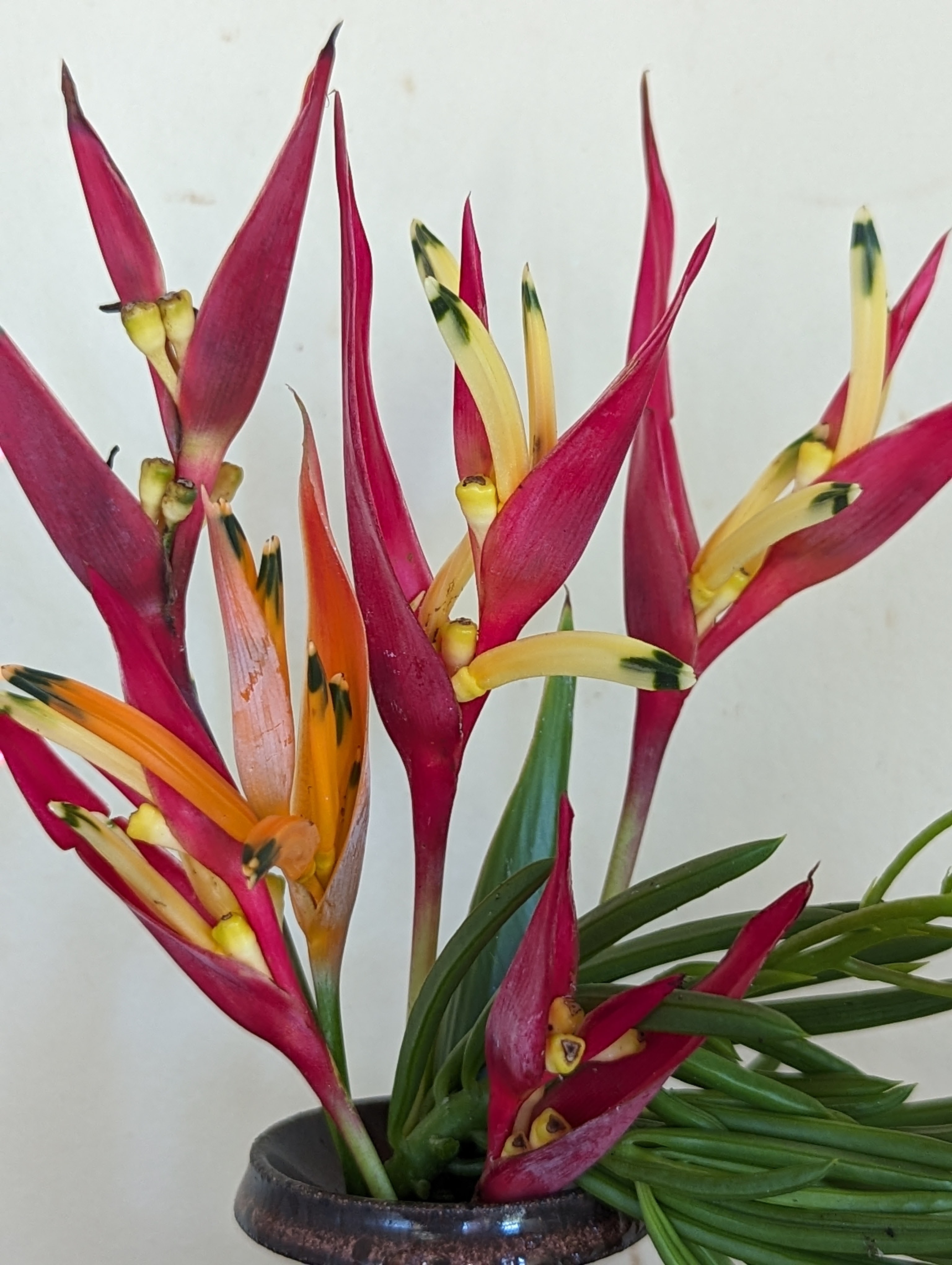
Heliconias are one of my favorite tropical flowers, last a week in a vase and are very easy to grow. These are Heliconia psittacorum “Lady Di” in red, and “Choconiana” in orange. They have a mind of their own and tend to grow and flower under shrubs, which is annoying if you want to see them or cut them.

This is a bit of Senecio barbertonicus, in bud. The flowers look like the promise of an aster that never quite makes it into a yellow daisy, followed by a pseudo dandelion. Pretty weird, but I do love the foliage and the fact these can be left laying around the garden for weeks and are unfazed as long as they are replanted.

That’s all from my garden this Monday, to see more vases visit Cathy’s blog and follow the links in the comments.

Happy Gardening!!

Six on Saturday – Sun!

It’s a great Saturday morning in South Florida. The drearies have been conquered for the moment and the sun is shining. The flowers perked up and I am finding new blooms in the garden to share this Saturday. Visit Jim’s blog to join Six on Saturday tours of gardens around the world.

Here’s a mad flower from Bromeliadland. This is a Quesnelia testudo. I am not sure of the common name. These do well in my garden and are reliable winter color.

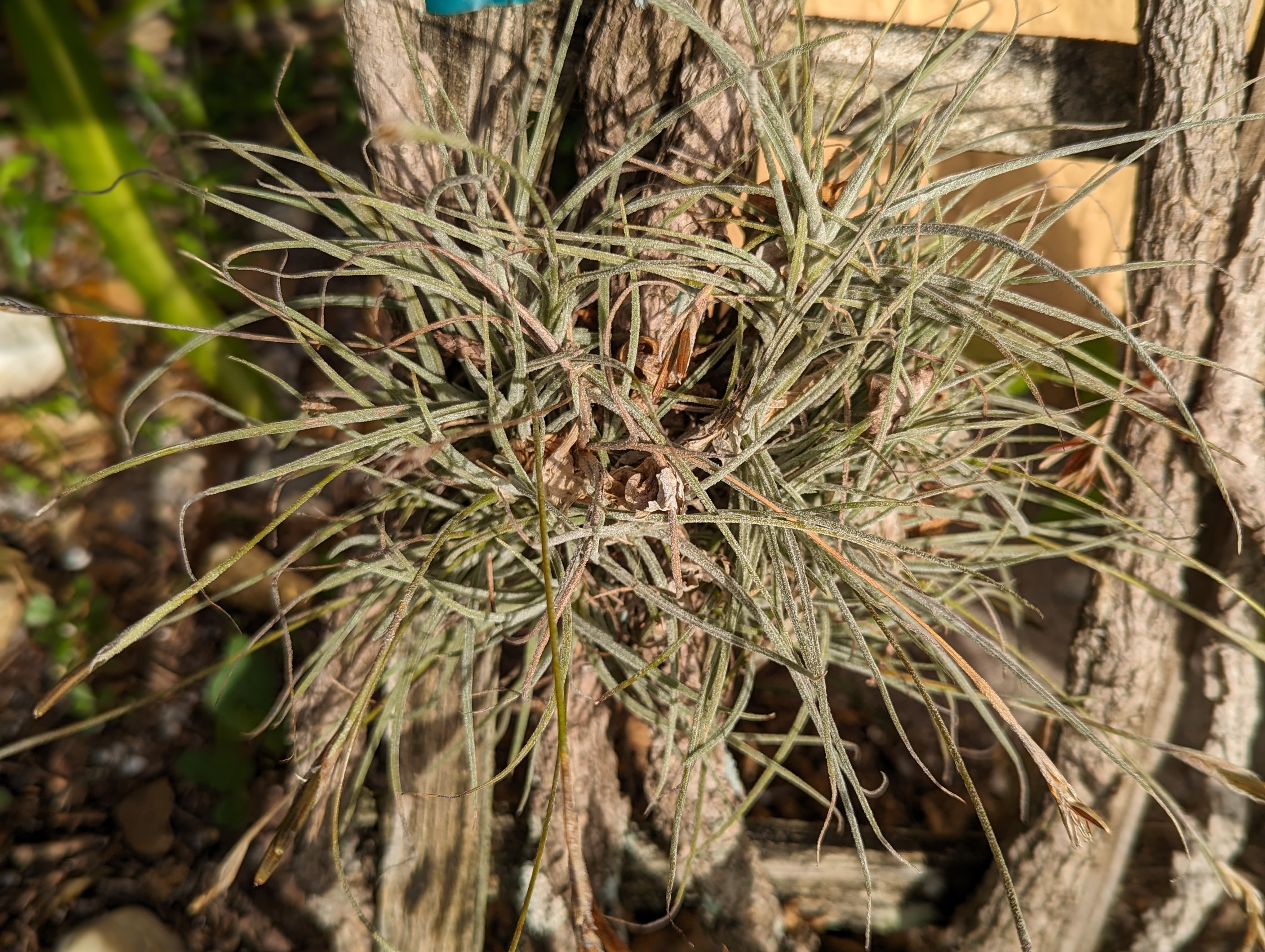
Another mad bromeliad in flower. This is a native Tillandsia, a relative of Spanish Moss, the flowers are brown. This is called Ball Moss (Tillandsia recurvata). It is growing on the trunk of a Bougainvillea.

I finally snagged a Rangpur lime before the vampire rats sucked the juice out. I need a few more for pie.

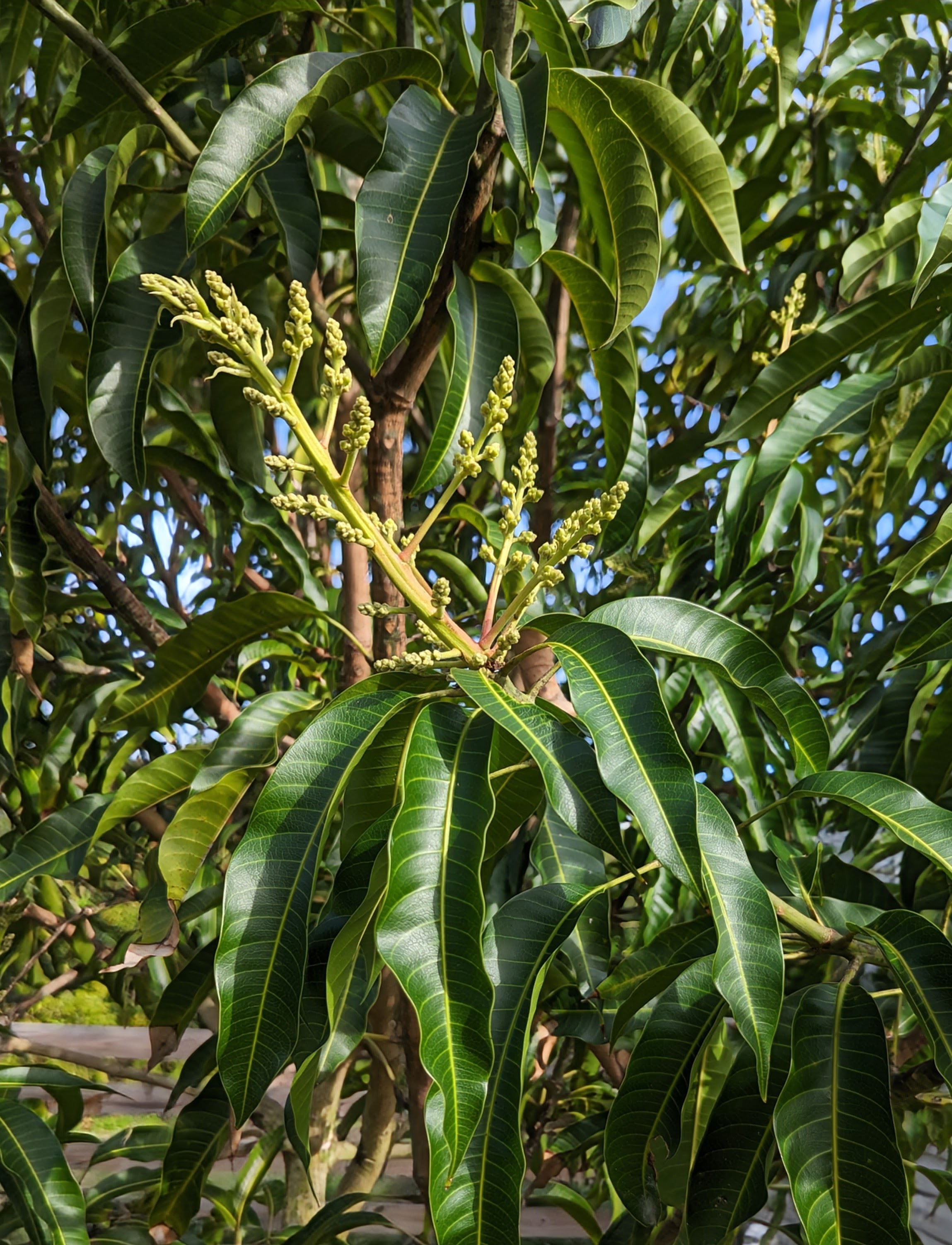
The mango trees are setting buds. This does not bode well, I think. They usually flower in March and we get fruit in June.

Heliconia psittacorum “Lady Di” expressed her appreciation for all the rain.

Google identified this as Golden Stonecrop (Sedum adolphi Firestorm). This has been in a pot for a few years and has not flowered before.

A question ?? Does anyone know if this is a Dahlia? I planted some tubers of a Dwarf Dahlia in October in this spot and this is coming up. I have found that Dahlias have a mind of their own when deciding to grow.

Thanks for the input and thanks to Jim for hosting.

That’s all from my garden this Saturday. Happy Gardening!!

In a Vase on Monday – Chasing Christmas

Suddenly it is about two weeks until Christmas. How did that happen? Cards have not been sent and I probably have missed the opportunity to buy a live Christmas tree. Sigh. Well, I will check and see if I can get a crunchy, nearly free tree this week. I am still indulging my distaste for fake plants, Christmas trees included. Tree lots are set up in baking South Florida parking lots in December that are not conducive to live plants of any kind. I am seriously considering making a bromeliad cutting Christmas tree.

I have managed to unearth a bit of holiday cheer in the form of a Christmas gift I received long ago from my mother. The holiday chocolate pot. She gave me this the year my husband and I moved to the suburbs of Atlanta. Seemingly (from her perspective) I was going to morph into a 1950s housewife and invite the neighbor ladies in for holiday hot chocolate and cookies (there are matching mugs). This is the first time the chocolate pot has ever been used. I think my mother would have approved its use as a vase.

The plant palette:

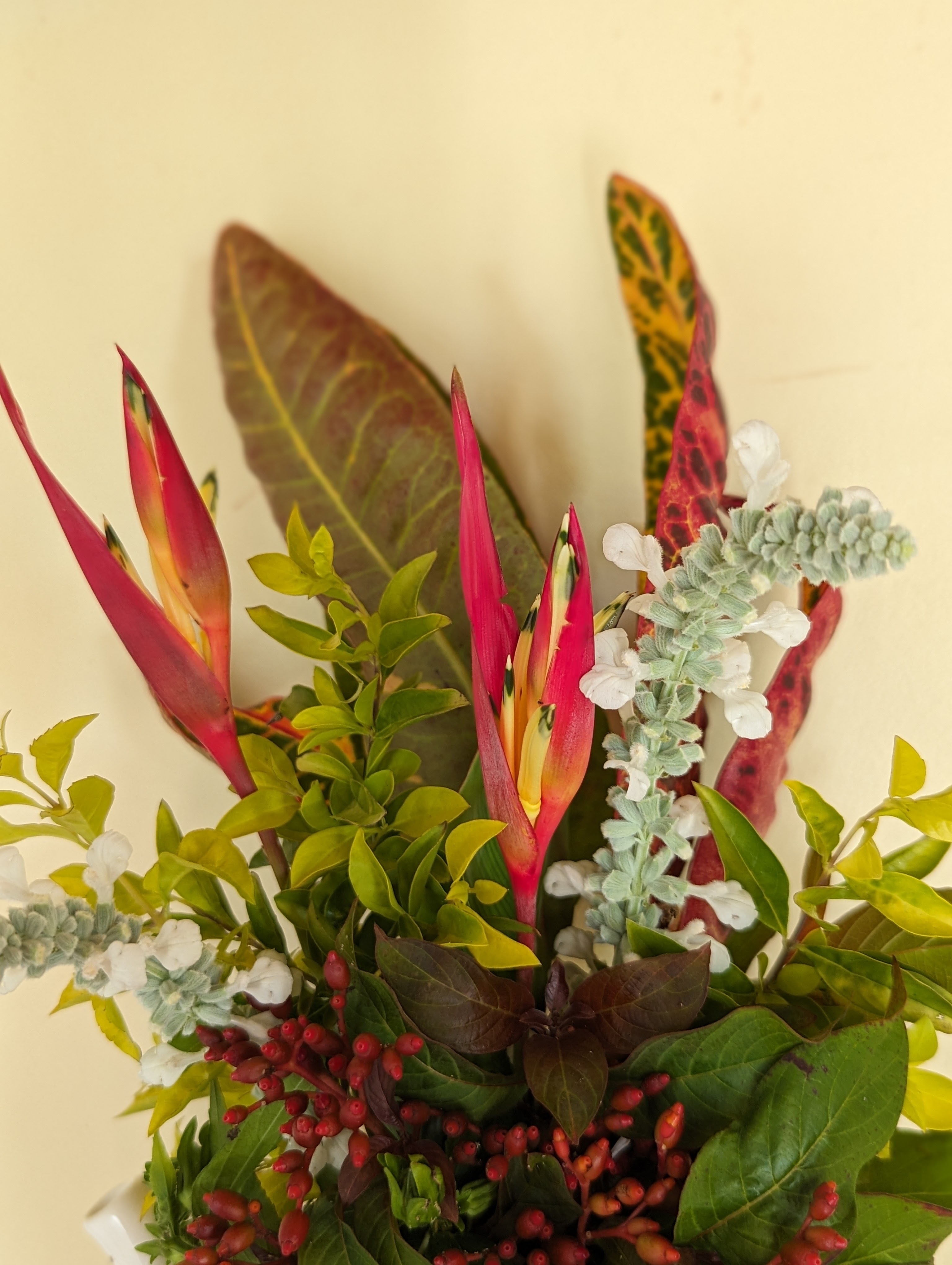
Red flowers draping over the side are Nodding Hibiscus (Malvaviscus arboreus); berries are from the native Firebush (Igiveupon properbotanicalname) – these are beginning stage berries, they eventually form juicy black fruit the birds love.

Chartreuse foliage is from Golden Dewdrop (Duranta repens); white spikes are ‘White Flame’ Salvia; red and yellow flowers are ‘Lady Di’ Heliconias (Heliconia psittacorum); foliage is from ‘Mammey’ Croton (Codieum varigatum).

Thanks to Cathy at http://ramblinginthegarden.wordpress.com for hosting this weekly garden meme. Follow the link to see more vases.

Happy Holidays from South Florida.

In a Vase on Monday – Pineapple Perspective

After collecting flowers for my vase, I looked at what I had gathered and thought, “What a nice fall vase”.

Then, it dawned on me that fifteen years ago I would have thought no such thing. Moving to a frost free area changes your perspective on what a fall flower is – and then pineapples easily grow outside here. I have developed a pineapple perspective on gardening.

The flowers in the vase bloom prolifically in the fall and late summer to early fall is the prime pineapple season here. The town I live in, Jensen Beach, was at one time the pineapple capital of the world. Rarely, I run across a wild pineapple plant on the barrier island near my house. These are very sharp, the foliage covered in spines and have small pink pineapples.

The flowers:

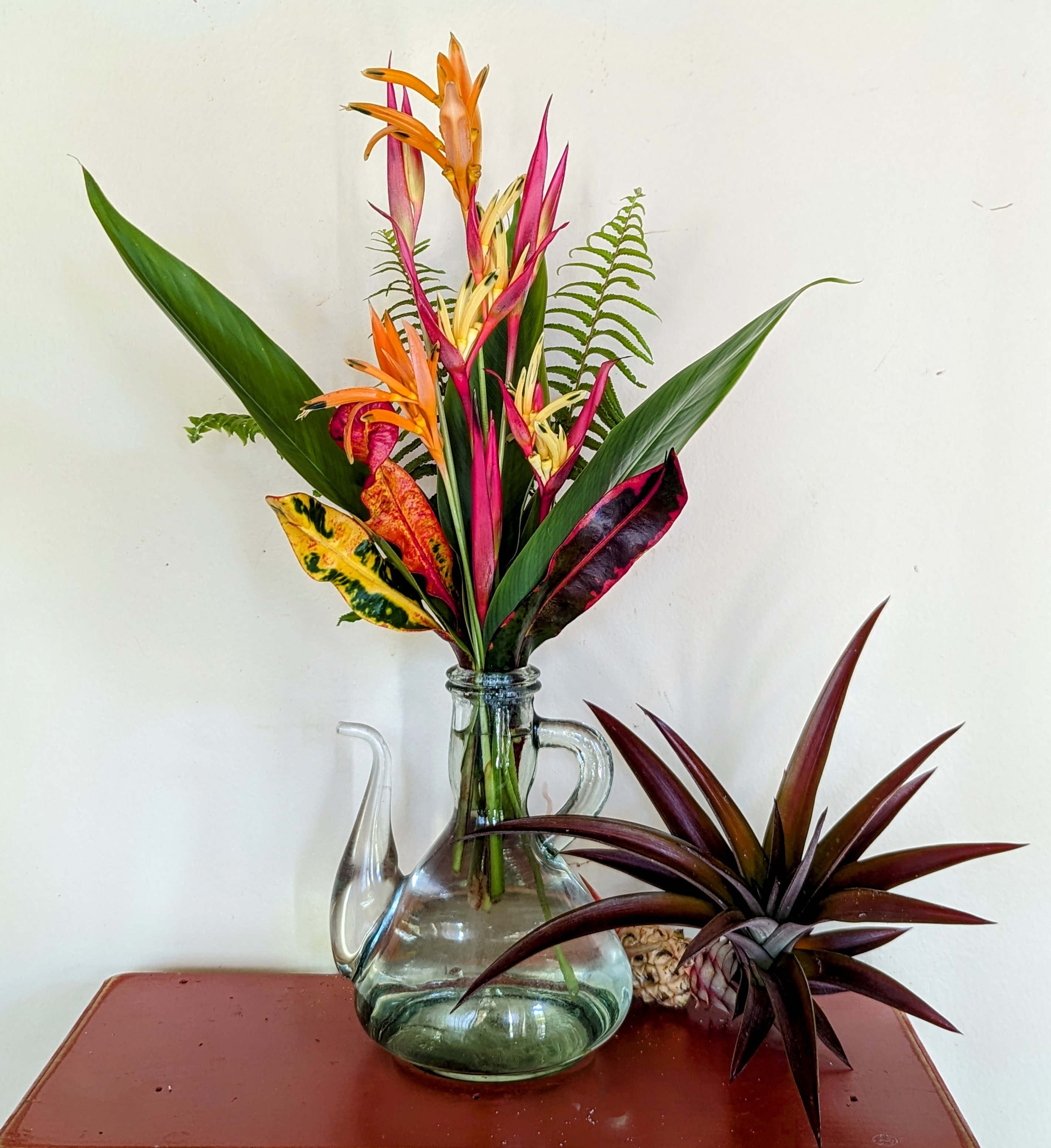
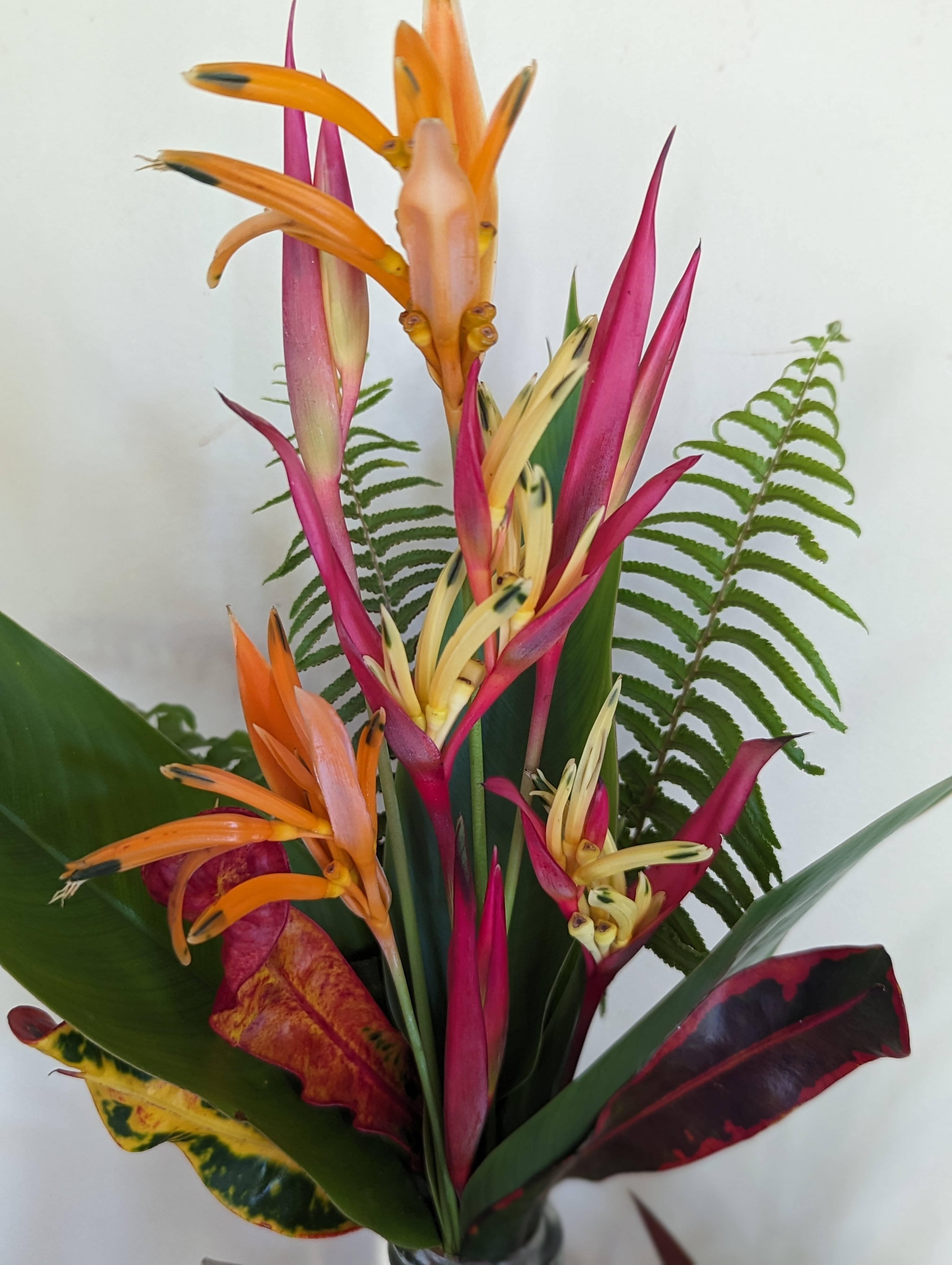
The flowers are Parrotflowers (Heliconia psittacorum) “Lady Di” in red, and “Choconiana” in orange. These are hard to beat for a touch of tropical in the garden. The colored foliage is “Mammey” Croton (Codiaeum variegatum “Mammey”), a dwarf Croton that works great if a low shrub is needed. Boston Fern (Nephrolepsis exaltata) provides some green texture. The vase in an olive oil cruet that belonged to my mother.

The pineapple:

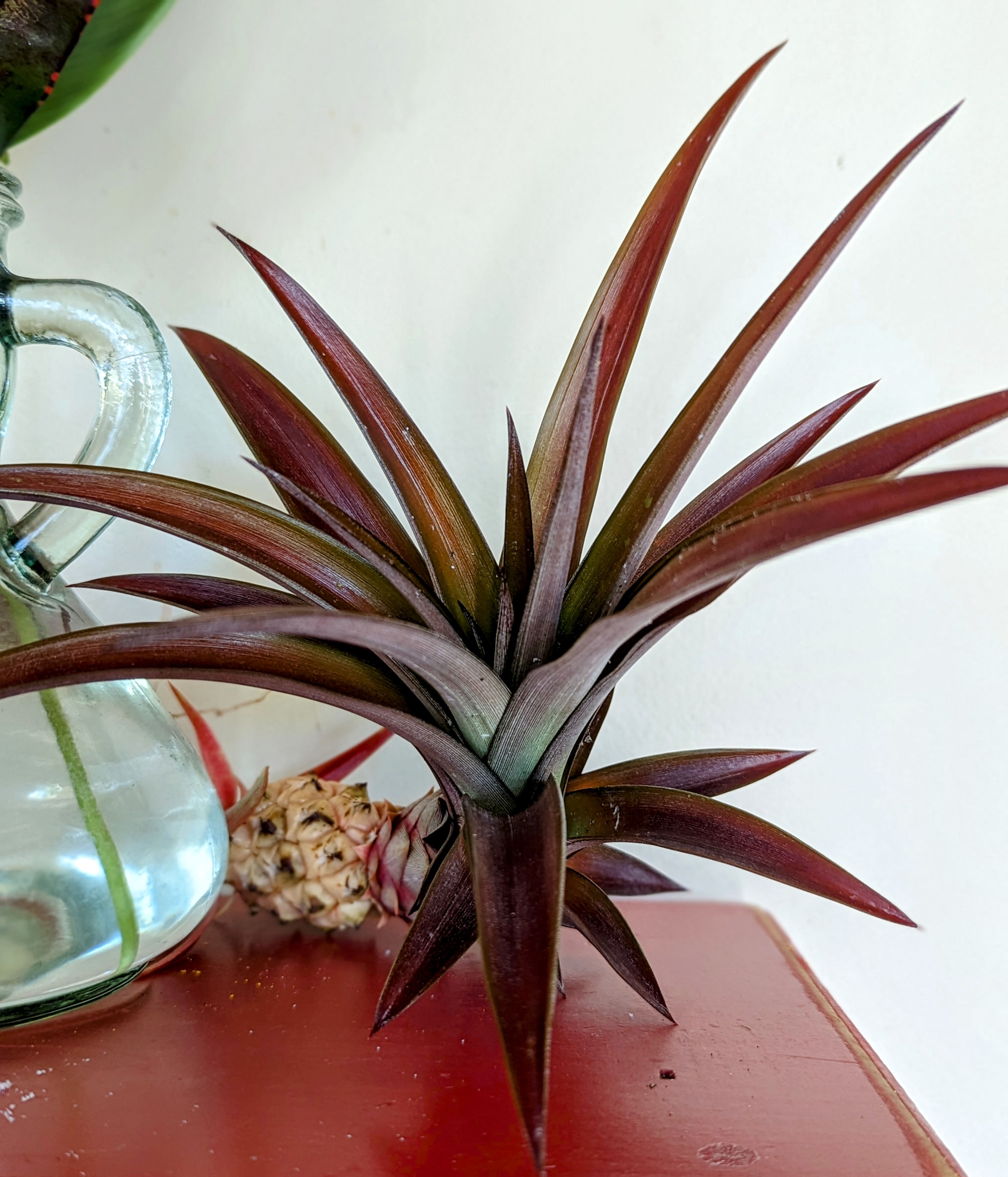
This is an overripe miniature pineapple with a twisting top. It is probably really seedy, these can be juiced or used for decoration. Either is a dicey situation as the whole thing is very sharp. That’s why it got left on the plant so long. I did not want to handle it.

That is all this Monday from the land of pineapples. Thanks to Cathy at http://ramblinginthegarden.wordpress.com for hosting. Follow the link to see more vases.

Happy Gardening!!