Mom Nature Lights My Fire

This plant appeared in my garden a couple of years ago. I thought it was some sort of Amaranthus blown in from across the Atlantic Ocean and decided to leave it to see what happened. Amaranthus can have some interesting flowers (Love Lies Bleeding, etc.) The foliage started getting red around the edges, confirming my thoughts, then the stems started getting woody. Maybe it wasn’t Amaranthus at all.

Then it flowered.

20160503_182813

Definitely not an Amaranth. Not a clue what it was. So, I took this to the Native Plant Society meeting and they said Firebush. Hamelia patens var patens? I said no, it couldn’t be, this is my Firebush, Hamelia patens. Orange flowers and the leaves are half as big.

20150625_081158

Firebush and Friend

Then it dawned on me, there is a great deal of arguing about the true native Firebush. I  usually ignore this kind of argument being more designer than botanist, but think I am agreeing with the Hamelia patens var patens crowd. The orange flowering one is supposed to be from the Caribbean somewhere instead of Florida. Given the seemingly magical appearance of the patens var patens in my garden, I think that the red one is the native.

Mother Nature really is a good designer, she placed the Native Red Firebush in a bed of red and yellow Heliconias behind some yellow Beach Sunflowers and across from some red Bromeliads. Perfect.

20160504_131122-1

Now if everything would just grow together. And be happy.


Gardening in the Rain

20160415_163135-1

One day this week I was waiting for the rain to start so I could go work in the garden. I stopped to think – this seems really stupid, do other gardeners do this? And then went out into a gentle rain to move some Beach Sunflower around. It has been so dry lately the sandy soil has tightened its grip on roots to the point it is difficult to pry things out of the ground. Soil is an overstatement in my garden – I should face the facts, it is Sugar Sand, white, infertile and oddly capable of growing many things. I pried some intractable Johnsonsgrass out (and threw it away) then went looking for more beautiful things.

Here is what I found:

20160415_104634

This is a Bromeliad, Billbergia pyramidalis, I think, bought as a cutting in February. I was told it would grow up the trunk of a tree. As a planted it, I was scoffing. Well, whoever told me that was absolutely correct – it is growing up the tree and much to my surprise, flowering at the same time.

This made my time in the rain worthwhile and hopefully the skies will open again soon.


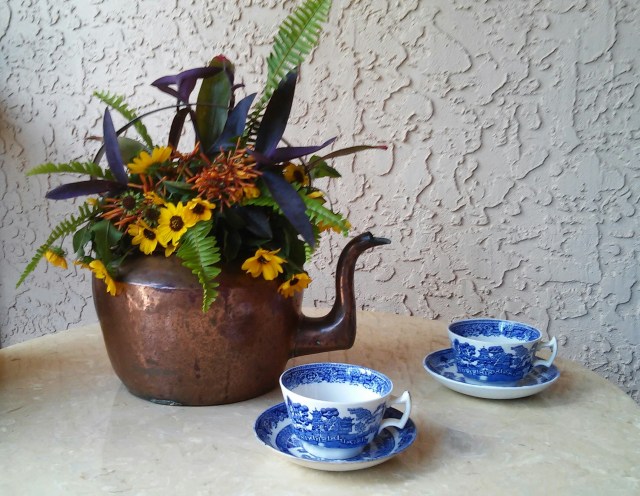
In a Vase on Monday -Natives Tea Party

20160410_160949-1.jpg


The copper tea kettle is one of my favorite things. I bought at a flea market on a weekend trip to the Appalachian Mountains many years ago. I am relatively certain it won’t hold water as it was repaired on the bottom and you can see through the repair. What is lovely about this kettle is the patina of many years of use with dents and hand crafted solder joints adding to its beauty. I can only speculate how many souls have been warmed by the contents of this vessel. The Blue Willow teacups are English and belonged to my grandmother, the saucers are too cracked to use and are kept for their patina as well.

As neither the cups or the kettle can be used for tea, this is a party for the natives. The native flowers in the kettle, of course. The arrangement is primarily native plants of South Florida, the yellow flowers are Beach Sunflower (Helianthus debilis), the orange tubular flowers are Firebush (Hamelia patens), Boston Fern, the purple foliage is Purple Hearts (Setcresea pallida), native to North America says the Florida plant database, and joining the party some Painted Fingernail Bromeliad foliage with the cerise tips, from somewhere south of the border.

As I was arranging the flowers in a pickle jar to place inside the kettle, it occurred to me I should go antiquing to see if I could find some copper friends to join the kettle.

In A Vase on Monday – Spring Renovations


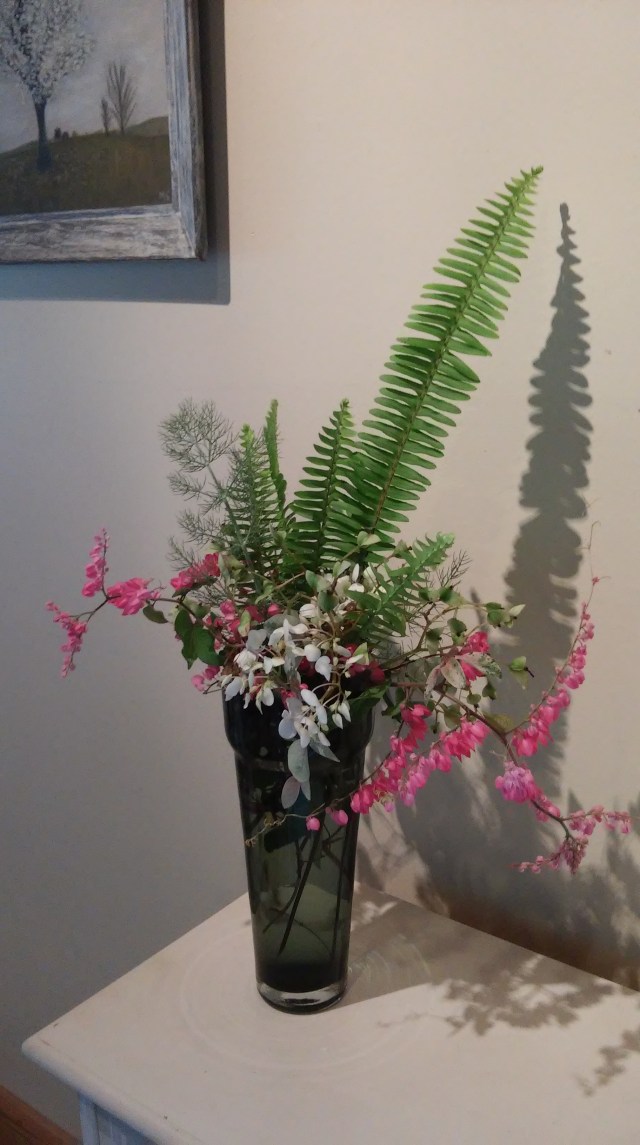
20160403_135338

Here is the Spring part. I put this vase together and thought ‘wow, that really looks like a fresh spring arrangement’. The bright pink flowers with baby Boston fern fronds and some bits of cream Begonias and foliage spoke to me of new beginnings in the garden.

The pink flowers are a new beginning. They are from a Coral Vine (Antigon leptopus) on a nearby fence. This vine is native to Mexico and considered invasive in South Florida, the owners of the fence are snowbirds, winter visitors from the frozen north, and come to Florida for the winter. This vine is unapologetically immolated annually and I have never seen another one around. To the owner’s delight, I cut it back for the flowers. It started to flower just about the time the owners went back north, to my delight.

The rest of the arrangement is comprised of – in white and chartreuse, the flowers and seeds of the Sweet Begonia (Begonia odorata ‘Alba’). The foliage is my ever present Boston Fern, the new spring growth, some culinary Fennel and the variegated is from Hawaiian Snow Bush (Breynia nivosa)

20160403_135346

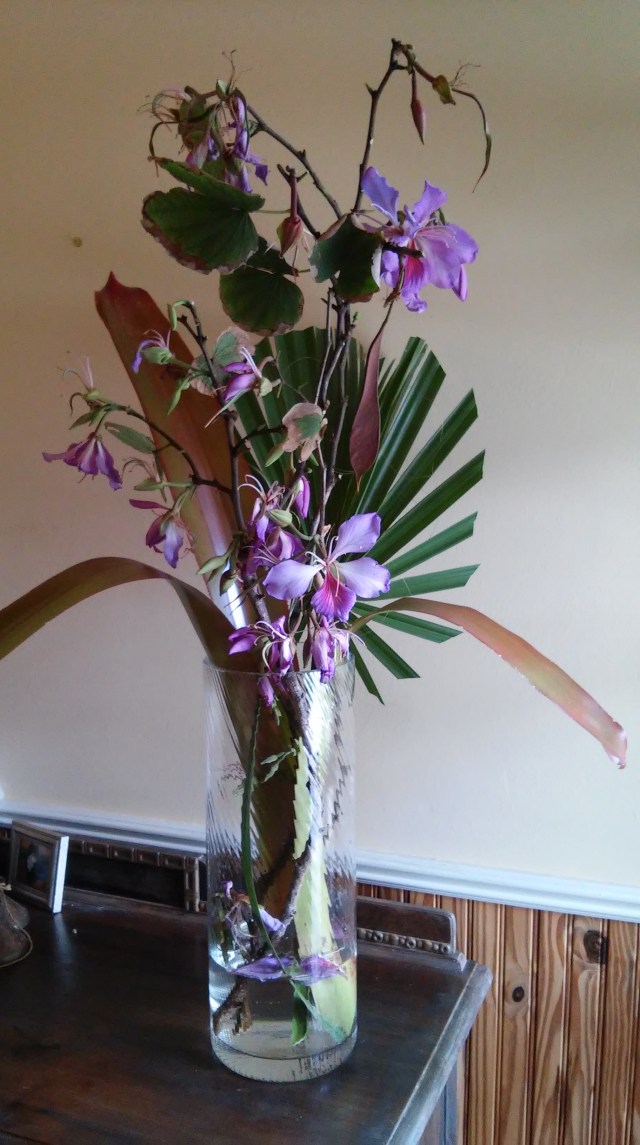
And now the renovations part. Last week I had Orchid Tree branches in this vase and they lasted precisely 50 hours. The flowers wilted despite my best efforts. The buds looked promising so I plucked the offending flowers and left the budded branches to hopefully reflower. After a couple of days I figured out this was not happening. The foliage was in such good shape I cut some Heliconias with long stems and added them to the vase, here is the result.

20160403_134911

I like this arrangement as well, it seems like the tropical version. Below is last week’s arrangement. Hopefully this one lasts longer.

20160327_142327

Springtime in Tropic Florida

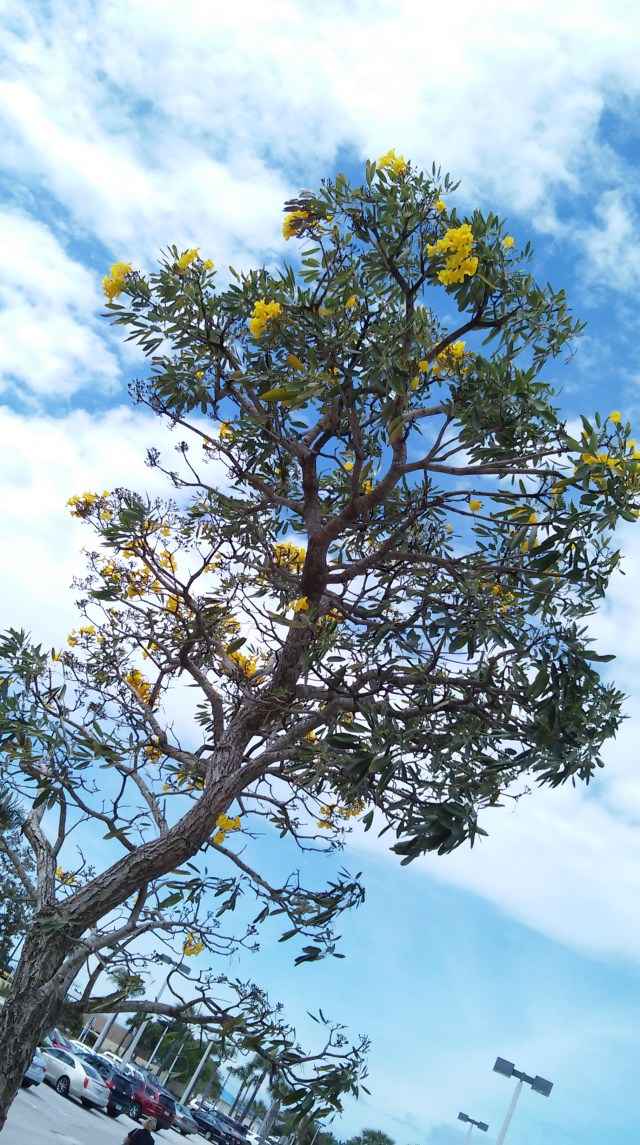
20160330_143413

This is a Tabebuia in the parking lot of my grocery store. To me, Tabebuias are the Forsythias of spring in South Florida. Bright, cheerful yellow flowers on a semi gnarly trunked tree with corky bark. This tree will soon be covered in yellow trumpets.

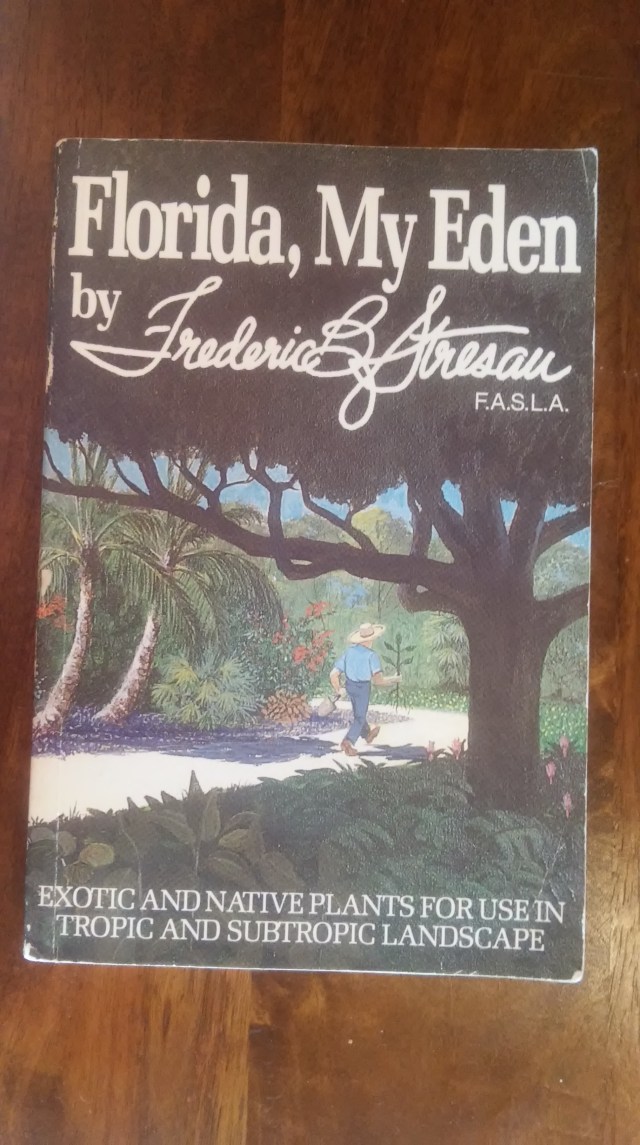
Tropic Florida, to the best of my knowledge is a term coined by Frederic Stresau to describe South Florida, he is a fellow Landscape Architect who wrote the book on Florida. The book is unfortunately titled Florida, My Eden, making it sound more like romance than shrubbery. Mr. Stresau has been gone for many years and I think his book could use a little updating and really a new title.

20160331_091303

Onward, I do like the sound of Tropic Florida vs. South Florida. Whereas it never gets really cold here winter has its cold fronts and they are finally passing into warmer cold fronts. It is late March and here are the actual signs of spring from the garden:

The fruit trees are blooming and the bees are out in full force:

On the left, we have a Rose Apple, Syzgium jambos, a rather weird fruit common in the Caribbean, it has a rose scent with a slightly sweet taste and the texture of a water chestnut. We keep meaning to make a pie from the fruit.

On the right is a Mango in bloom, I think this is a Haden Mango, nice fruit for eating or baking a Mango Rum Cake. I have had fruit from this particular tree and it is highly recommended.

Other harbingers of Spring from Tropic Florida


On the left, Shell Ginger, Alpinia zerumbet, a true sign of Spring peeking out from its foliage and to the right flowers from the Hong Kong Orchid tree. I have cut these for flower arrangements these past couple of weeks.

I am trying to get everything in place for the hot summer weather and feel time slipping away for working outside. My tomatoes have set fruit and I think the Armadillos ate it! Tomato season really ends about Memorial Day here, although it can be pushed to July 4th. I have seen people use umbrellas over tomato plants to extend the season.

Time for me to get back to the garden.

In A Vase on Monday – Bourbon and Branch for Easter

20160327_141901 (2)

I was born and raised in Atlanta, Georgia; the Deep South. Celebrating Easter has some traditions. There is usually an arrangement of flowers centered around Spring featuring pastel colors and bulbs, maybe some forced branches from Cherry trees if Easter is early.

The traditional Easter fare is a ham criss crossed with a knife, canned pineapple rings centered in the squares, cloves inserted (and sometimes a maraschino cherry) the entire ham is then doused in brown sugar and baked. The women are madly working in the kitchen while the men are outside having a Bourbon and Branch.

Bourbon and Branch is a cocktail, branch is water from the pure running creek in the backyard.

I have eschewed the ham tradition and the bourbon tradition. This leaves me looking for some other kind of branches as the creeks I would drink water from are few and far between. What is currently blooming in my garden is mostly orange, not what I had in mind for an Easter arrangement.

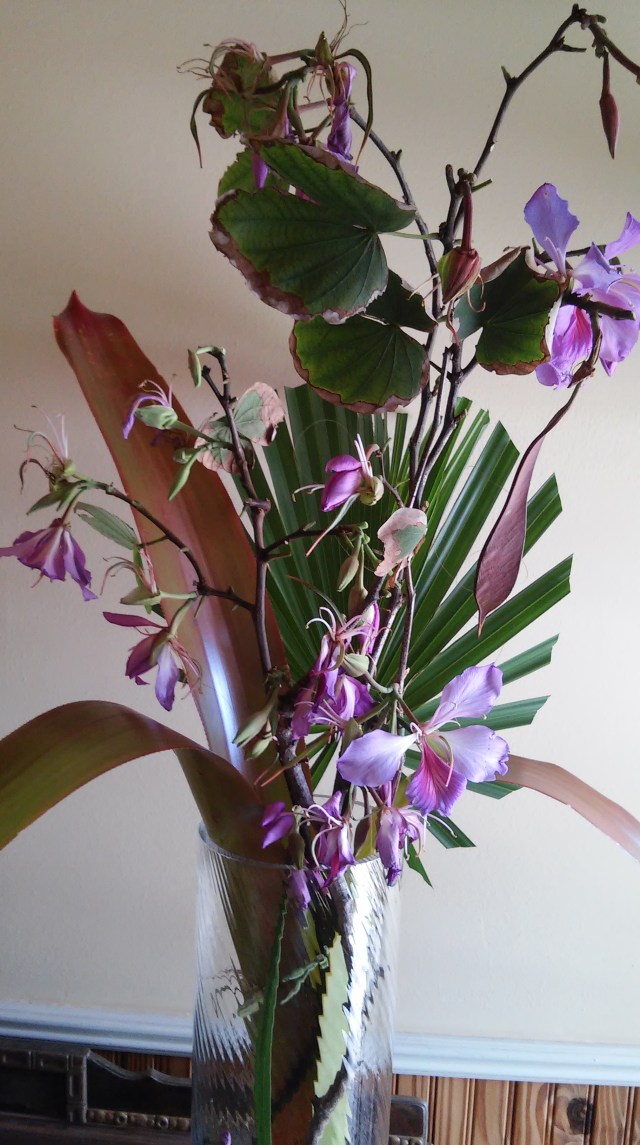
The Hong Kong Orchid tree has been flowering for a couple of weeks, a nice lavendar color and has a gnarled branch look about it. I decided to try one of those large branch arrangements that appear effortless. Ha, the branches are twisty and uncooperative and have to be pruned into submission. Then I decided to add a Palm frond, it is Easter, just a bit late for the palm part. The frond overwhelms everything so I cut it down to a smaller size and add some russet Bromeliad foliage to pick up the darker color in the Orchid flowers.

Here is the result, I thought this was a bit weird, but I like it. I left the pods and some browning foliage on Orchid tree branches and crushed the ends a bit to see if they would last longer that way. A semi traditional Easter arrangement, as I have the branch part covered, maybe I should try to find the bourbon.

20160327_142327

In A Vase on Monday – Alpinia Joy

20160318_144417

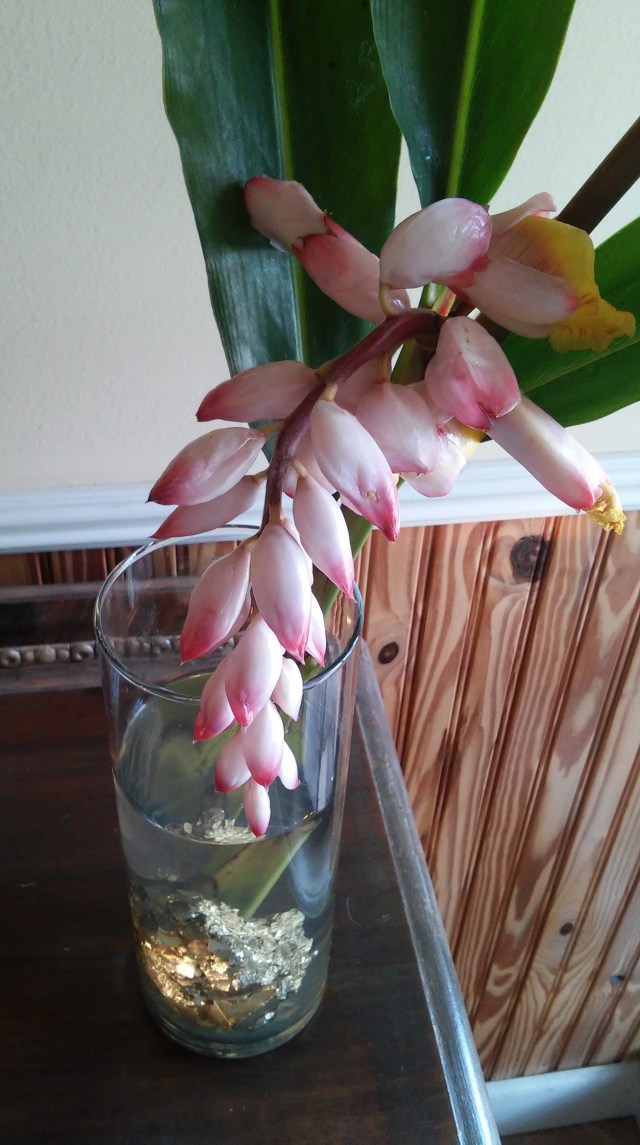
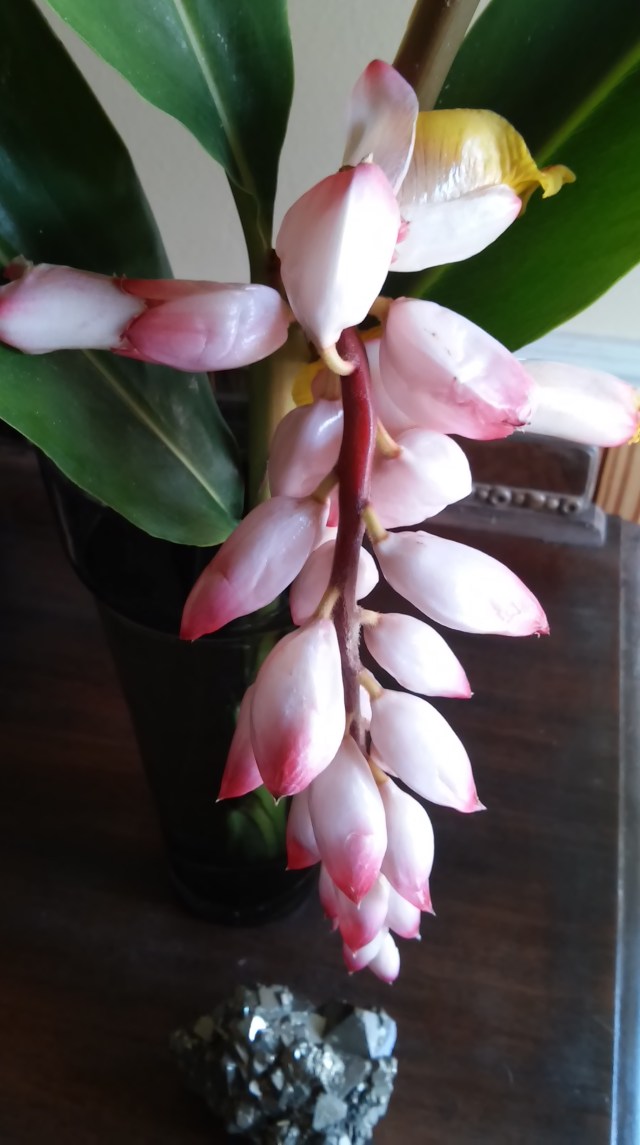
No, that is not Almond Joy or Alpine Joy, it is Alpinia Joy. Alpinia zerumbet to be exact. The Shell Ginger. One of my garage sale finds from a few years ago; the plant is well known for taking two years to flower and this one was true to form. I have been waiting and finally got a flower.

20160318_164710

It takes about a week to fully bloom and bit by bit peeks out from under the foliage. There is a lovely ginger scent when the plant is cut, although a member of the Ginger family it is not a culinary ginger.

The rock that keeps appearing is a hunk of Fool’s Gold from my father’s (the geologist) collection of obscure mineral crystals. I was looking for some marbles to use in the vase to hold the stem, I have some lavendar ones somewhere. I knew where they were before we moved – so inspiration struck and I thought to use the Fool’s Gold vaguely remembering something bad happens to it in water. It is a Pyrite, iron sulfide, I think, and what happens is instantaneous rust when it gets wet. I suspect it would have killed the flower if I had left it in the water. I was also left with the dilemma of how to get the sharp bits that fell off  out of the stainless steel sink without scratching the sink. After everything was rinsed and clean, it dawned on me,  I really didn’t have an arrangement at all.

Back to the garden, fortunately spring brings some interesting flowers into bloom.

20160320_143316

Contents of this vase are:

Soap Aloe flowers (Aloe saponaria), in the foreground; Parrots Flower (Heliconia psittacorum) and foliage; the orange foliage is from Blanchetiana Bromeliad (an Aechmea type)

The vases are both from a simple design phase I went through in the 80s. Less is more or less is a bore depending on how you look at it. The flowers are the focus if these vases are used.

Here are both vases and the Fool’s Gold:

20160320_143814

Moral of this story, no iron minerals in your vases. Fool’s Gold is named for a good reason.

Rock on.

In A Vase on Monday – Refugees from the Potting Bench

20160313_103341-1

I have had a trying dental week, culminating in a root canal followed by pain medication. Never having experienced a root canal, I had not realized the need for pain medication. Vicodin and I usually do not get along, but the drug came highly recommended by the doctor and his staff, so I relented and took some. My problem with these sorts of medications is – if 3 steps are needed to complete a task, only 2 are retained by my mind. Example, to set the timer on the stove it has to be turned on, time set, then started. The loss of any step results in no time. Then you are left wondering if the pasta is done and when you started it. On the other hand, the teeth feel really fine. I have, wisely, stayed away from my car.

I awoke this morning feeling much better, put some cat food in my cereal bowl, got a fork to eat it, then realized it was time for more coffee and a walk around the garden.

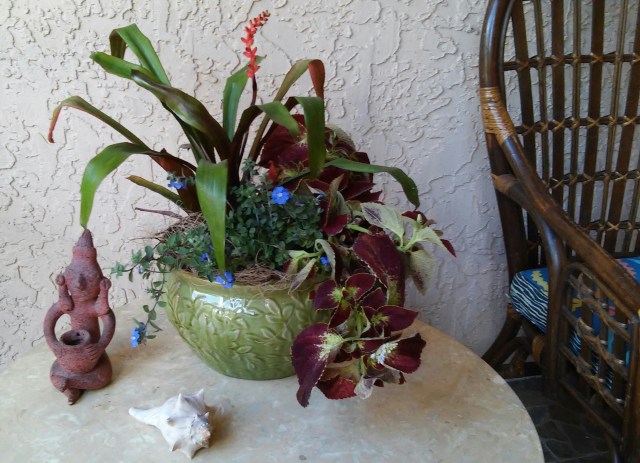
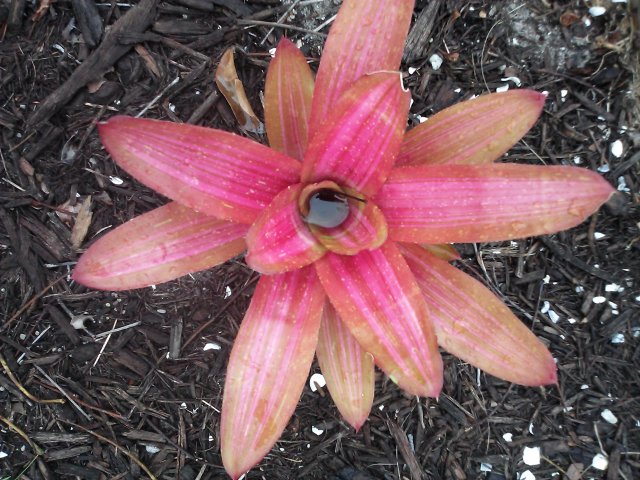
The search for vase materials was on and I stopped at my potting bench where all my plant refugees looking for a home live until they are planted. Sometimes it takes years to find a home as I tend to buy plants without considering where they should go. This Bromeliad had bravely put up a flower after languishing on the bench for quite some time. The fluorescent salmon color is quite lovely. Here is the unnamed Bromeliad, I think it is an Aechmea, burgundy and olive green foliage accent the salmon flower:

20160311_090319 (1)

20160313_102733-1

At the same time I have been rooting some cuttings from an overgrown Solar Sunrise Coleus and thought they looked nice together in this big olive green container I bought at GoodWill (charity shop). The Blue Daze Evolvulous was  left over from a new bed that I am working on in the garden.

I like the combination and have added some other refugees for company. The shell is from the ocean, of course, and the pseudo Mayan sculpture is an incense burner from my brother, circa 1975 and Pier One. I keep this around for sentimental reasons, and it looks great with the Salmon Bromeliad.

In case of culinary concerns, I gave the cat the cat food and she was quite happy, had another cup of coffee and no more Vicodin. Now all I need is a filling to seal the root canal. Joy and Bliss later this week.


Bromeliads for the Treasure Coast- Divide and Conquer

I have learned a great deal about Bromeliads since starting my garden four years ago. Prior to moving to Florida, I only knew a few varieties of Bromeliads and this was from designing shopping mall interiors in the eighties. Guzmanias were (and still are) a great plant for interiorscape. Oddly enough, while they will grow here, I have no Guzmanias. I think they are kind of boring. I like the kind of indestructible, passalong, highly reproductive Bromeliads. The kinds you don’t see in shopping malls. The more unusual the Bromeliad, the better. This could prove to be a bad idea in the long run. I could grow really old here and end up with Martian Planet landscape.

Bromeliads above are: the flower of a Painted Fingernail Aechmea, a common passalong in South Florida, the spotted one is a common Neoregelia (from a garage sale) of some sort, the burgundy one is Burgundy Aechmea. The below Bromeliad is a ‘Blanchetiana’, another Aechmea passed along to me from a neighbor. All thrive here with little care.

My latest venture in the garden has been to add swirling patterns of shells and rocks weaving through the garden. First, I like shells and rocks and second, I detest mulch, not for looks, but for me having to schlep bags of bark through the yard – usually when the weather is tropical steaming. I really just won’t do it and go back inside and plot some other indoor task. The result of this is weedy unkempt beds. So the strands of rocks and shells are being woven through the garden and ribbons of groundcover and tightly planted perennials are going to be installed to hopefully cut down on the maintenance (weeding) and the mulching. I have placed cardboard boxes under all of it to hopefully break the weed cycle.

The correct time of year to divide Bromeliads is the beginning of the growing season, which in South Florida is Fall/ Winter. I have been working on doing this and have divided several and (here’s a surprise) bought some pups last week at the botanical garden. Neoregelia Martin and the popular Blanchtiana Aechmeas have been divided and installed in their shell garden. Both these Bromeliads flourish in full sun, the Blanchetianas are available in Orange, Lemon and Raspberry. I have an Orange and Lemon, I am not quite sure about the Raspberry. The divided Bromeliads are in the left picture; here is a close up of Martin, who is a Neoregelia – doesn’t flower, but the foliage and sun tolerance make Martin worthwhile to have in the garden.

CAM00253

I am trudging onward in dividing, but have yet to conquer.

In A Vase on Monday -Caribbean Delight

20160214_144402-1

This is a Caribbean Delight as the centerpiece of the arrangement is a Dwarf Jamaican Heliconia (Heliconia stricta) – I believe. The lady I bought this from didn’t seem entirely sure of the ID and I have never seen one before. I am, however, a sucker for a well priced Heliconia and hopefully the garden will not overrun with Dwarf Jamaicans. Heliconias can be pretty creepy.

20160214_144036

The dark foliage is from Piecrust Croton (Codiaeum variegatum  ‘Piecrust’) and I love the contrast. The fine textured foliage is  Asparagus Fern (Asparagus aethiopicus). The Croton I planted, the Asparagus Fern just appeared in the back garden one day. I cut some every now and again and that seems to keep it in bounds. Asparagus Fern is rumored to be invasive, I think the spot it popped up in is not its happy place.
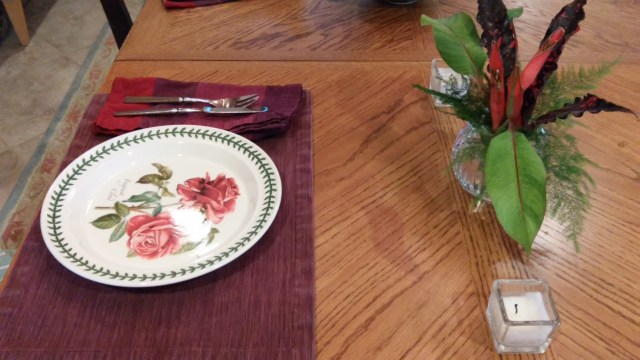
The crystal Rose Bowl belonged to my mother, I think I bought it for her – but that memory just won’t quite gel. It is a nice crystal Rose Bowl. I have Rose issues so it is unlikely to ever see any Roses. I am quite happy about the Heliconias – at least they are red!

It is Valentine’s Day as I write this. This vase is going to be our centerpiece for dinner.

20160214_153442

Here’s the table setting Portmerion Rose China and here is dinner:

CAM00152

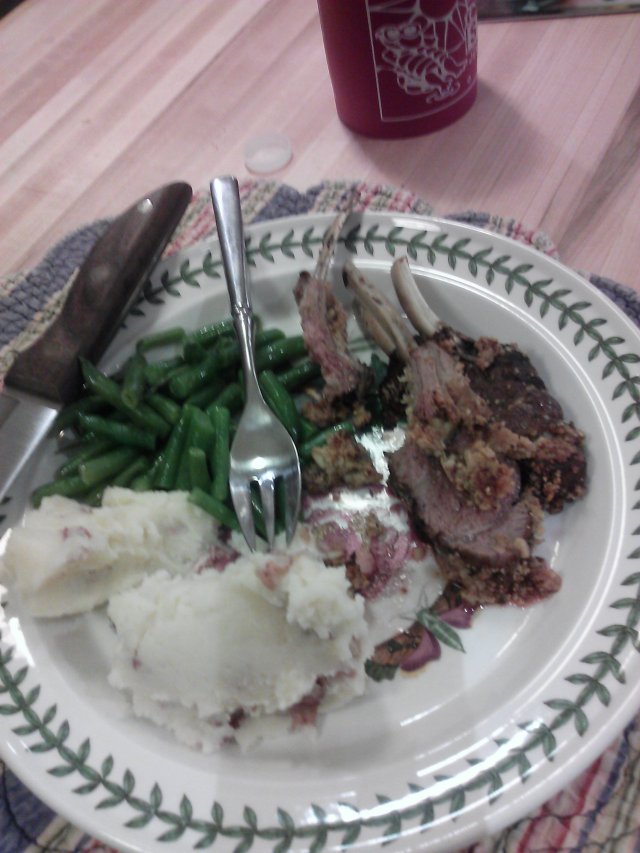
Mustard crusted Rack of Lamb, Mashed Potatoes and Steamed Green Beans. Not particularly Caribbean, but oh so good. Followed by Chocolate Brownies with Vanilla Ice Cream. Hope everyone had a great Valentine’s Day.