The title sounds like a Monty Python skit! It’s not. I walked into the garden this morning and realized I had become accustomed to the wild, colorful shrubs common in South Florida. I decided to share a few. To see more SOS garden posts follow this link to Jim’s blog.
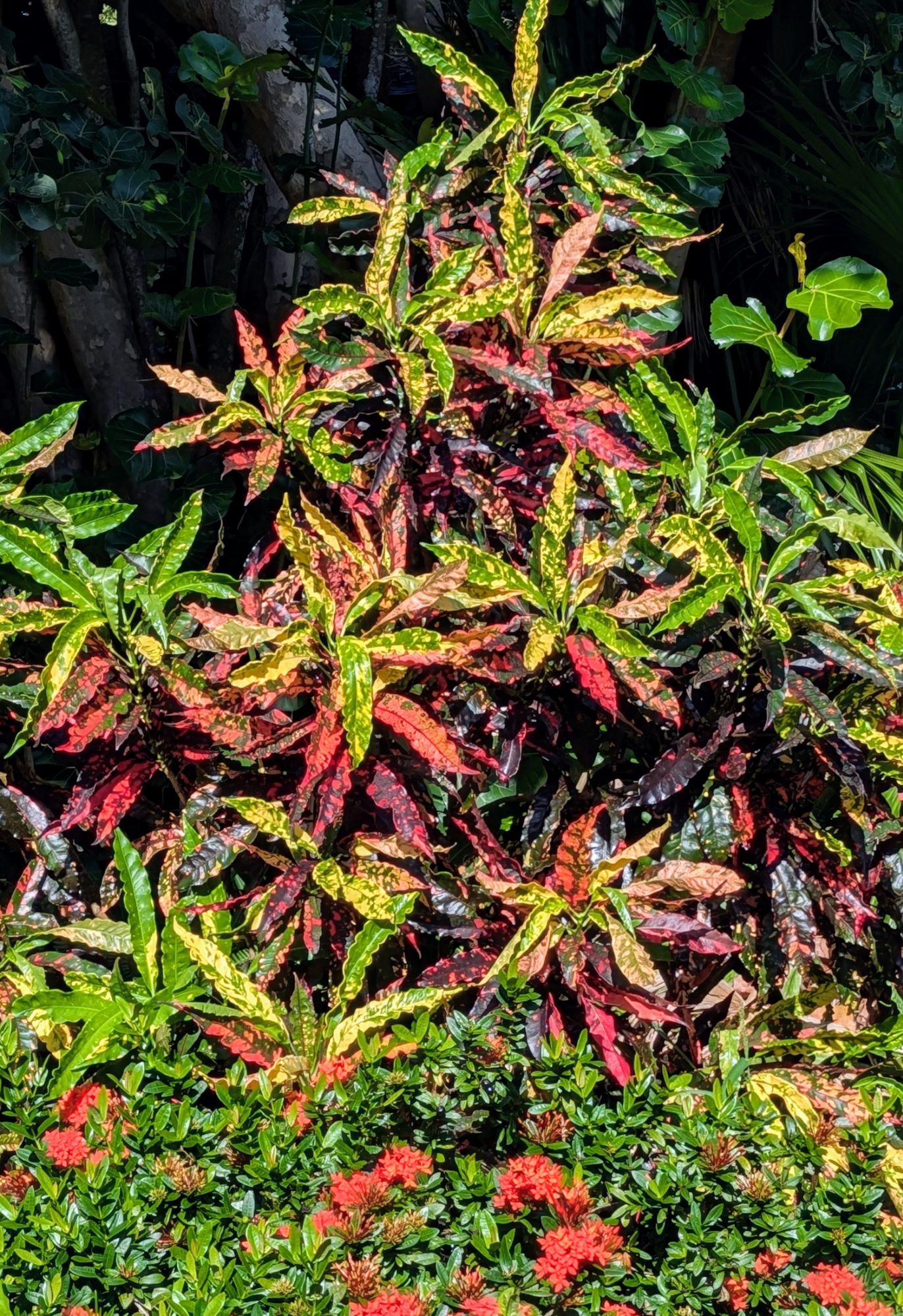
The larger, very colorful shrub is ‘Piecrust’ Croton (Codiaeum variegatum). The edges of the leaves look like a crimped pie crust. The flowering shrub in the foreground is Dwarf Red Ixora, butterflies love this plant and it blooms frequently to the point I almost get tired of it. Almost.
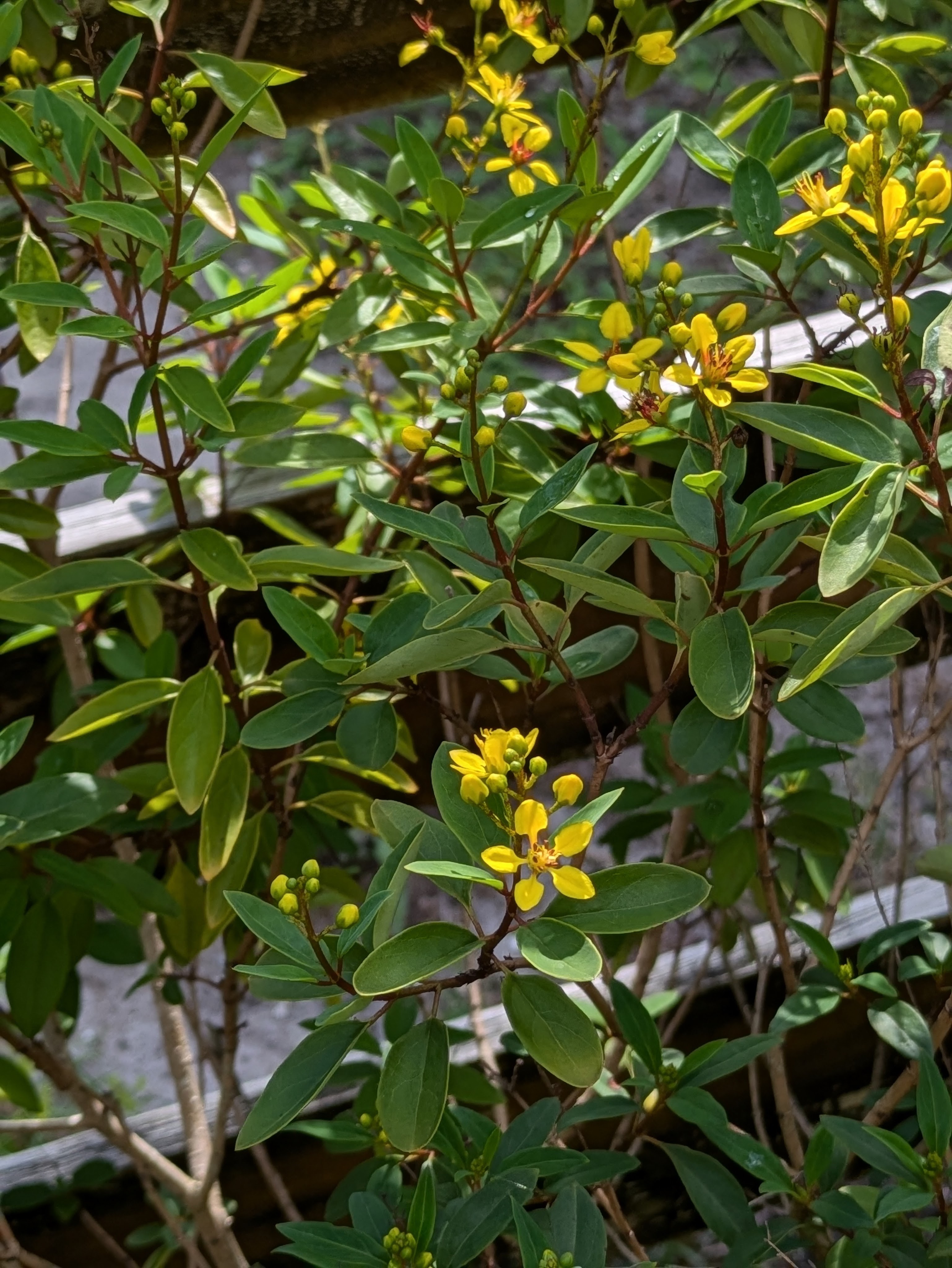
A stalwart shrub in the garden, Thyrallis (Galphimia glauca). I have wondered what Thyrallis means, it seems such a strange thing to call a plant. The only reference I could find said it is Greek for wick. Further confusing me. It is a bulletproof shrub in my garden, living in an unirrigated area and living off of mostly rainwater. It blooms late summer to fall.
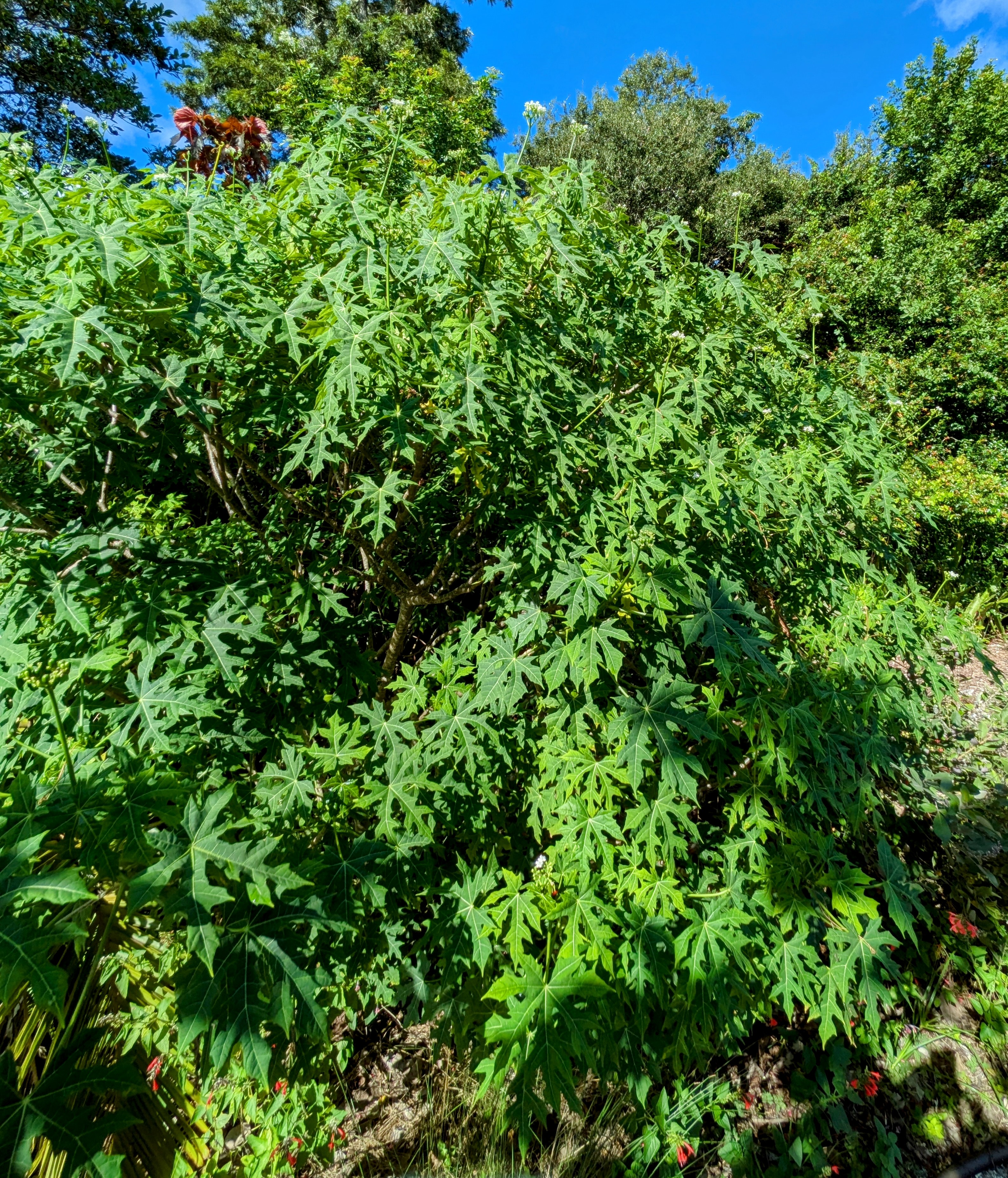
This is a Spinach Tree, also called Chaya (Cnidoscolus aconitifolius) A tree full of spinach! Only in South Florida. Actually, it is from Mexico and a tropical vegetable. It is poisonous unless you know how to cook it. I am told it tastes like spinach and reacts badly (toxic badly) with copper bottomed pans (like I use) so I have never tried it. I planted it for butterflies and they love the flowers.
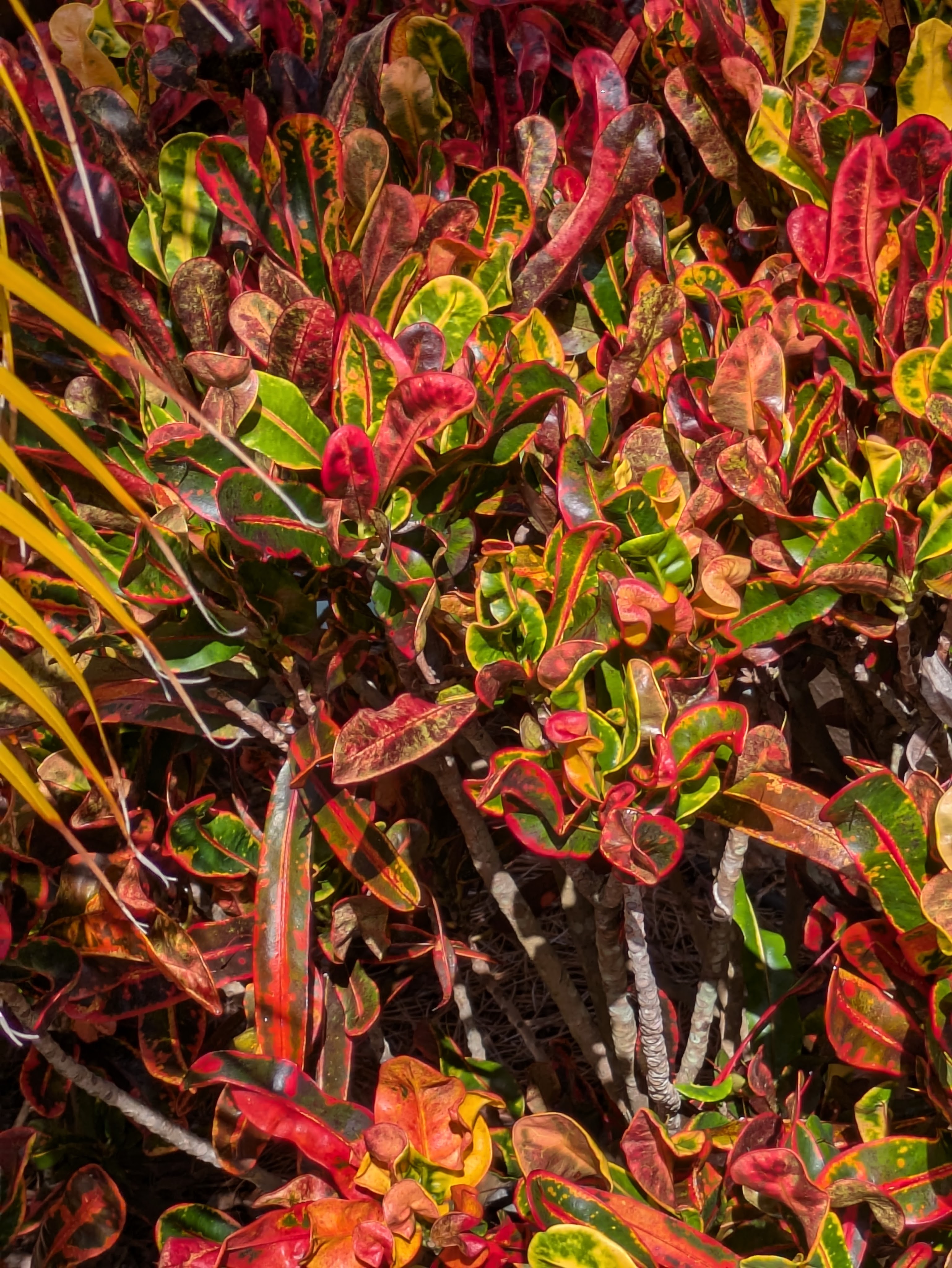
Another Croton. This one is called ‘Mammey’ and is reliably dwarf at about three feet. Making it great for foundation planting. I have seen this planted in front of a house painted orange. It was a bit much.
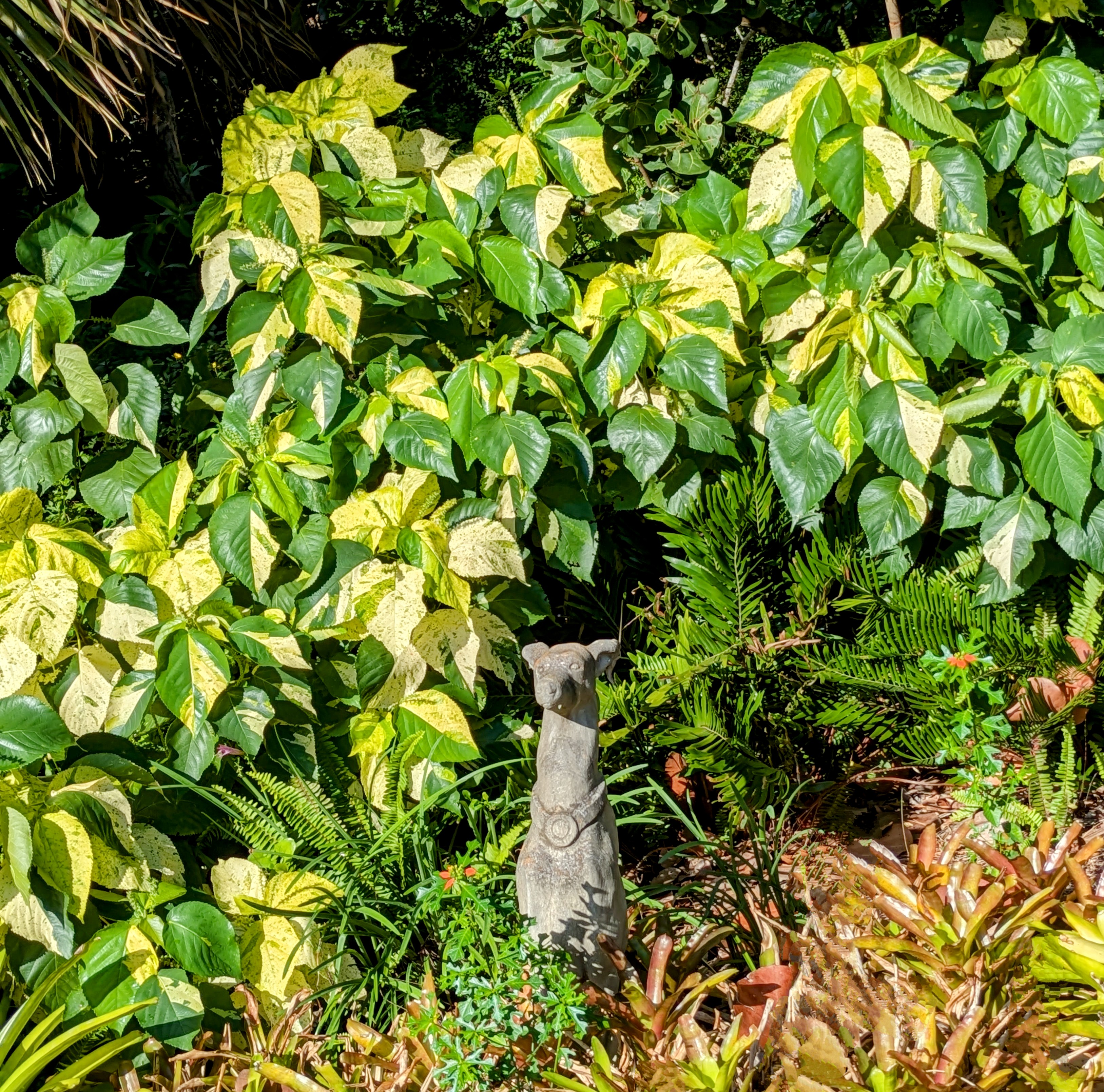
The very tasteful ‘Java White’ Copperleaf (Acalphya wilkesiana) backdrop for my concrete greyhound. This shrub grows like mad. I would estimate I cut about eight feet a year off. How tall it would get without pruning is anyone’s guess.
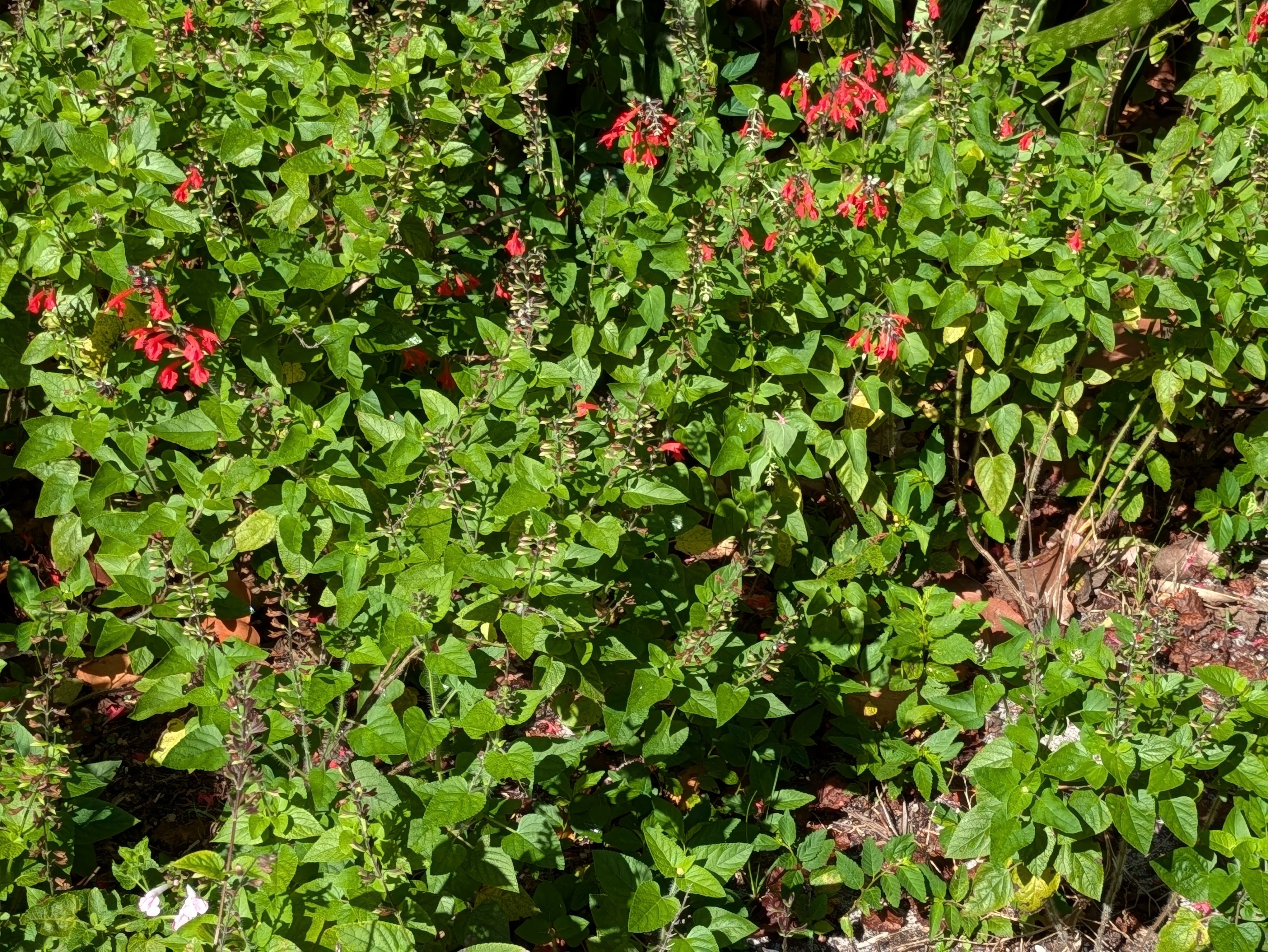
Last, but not least, the ‘no gardening’ zone next to my compost heap. Ironically, probably the prettiest grouping of reseeded Tropical Red Salvia (Salvia coccinea) in the garden.
That’s all from my garden this Saturday. Happy Gardening !!!

 The Shrub Queen
I really like your Thyrallis, I haven’t heard of it before. I’d be afraid to try the spinach tree, it’s pretty enough without being edible. Now I’m craving some pie crust with cinnamon & sugar on top!
LikeLike
Very pretty, I think I tried that red salvia, or one similar.
LikeLike
Your crotons are so big. It is a plant we usually buy in the fall and keep it in the pot.
LikeLike
The Croton’s are amazing! I love the colours.
LikeLiked by 1 person
Thanks they are a tropical festival.
LikeLiked by 1 person
I remember many years ago reading an article about a woman who gardened in SFL, and she said she gardened with a machete. Sounds like the tool for you!
LikeLiked by 1 person
Lol I am too clumsy for a machete I would probably lose a foot 🦶
LikeLiked by 1 person
I loved the visual… imagining having a garden that would grow so exuberantly to need taming with a machete!
LikeLike
Yes, we see Crotons in grocery store floral sections, or in florists’, in pots, to be used as indoor plants…interesting to see how big thy get in a more natural habitat!
LikeLike
Hey, my Six are ‘Madness’! I suppose that I should have been more creative with more selection than just two types of annuals. Are castor bean popular there, and if so, do they really repel dipteran insects? How big does the spinach tree get?
LikeLiked by 1 person
Oh my, it can get twenty feet tall!
LikeLiked by 1 person
yes, that was a surprise.
LikeLiked by 1 person
I see castor beans but wouldn’t say they are popular. Some seeds got loose by the river and there are some huge plants growing alongside huge colocasias. And lots of bugs.
LikeLiked by 1 person
So, no one bothered to inform the insects to avoid them. I almost grew them years ago, and might eventually grow some, but their allure is fading.
LikeLiked by 1 person
I think insect repelling plants are a bit of a hoax. I have used beautyberry foliage for deterring mosquitoes.
LikeLiked by 1 person
I got the only six beautyberry that I know of, and only because someone sent them to me from Virginia. Mosquitoes are not much of a problem, at least for me, though. Because of the aridity, other flying insects are more of an annoyance than a real problem, so repelling them is probably not much of a priority. I just dislike window screens.
LikeLiked by 1 person
I didn’t know the Thyrallis which has a pretty shape. The leaves and flowers are very pretty. As for the spinach tree it is close to the manihot grahamii that I showed you yesterday. Same family of euphorbiaceae, same cut leaves and same toxicity. Avoid testing it on the plate imo !
LikeLiked by 1 person
Yes, not eating Euphorbias!
LikeLiked by 1 person
The salvia looks lovely in a big group like that. 😃 Thyrallis is also really pretty. I noticed how shiny the foliage on all your plants is. And noticed that beautiful blue sky too!
LikeLiked by 1 person
Thanks, Cathy. I am enjoying going to the compost to see the salvia.
LikeLiked by 1 person
I’m always fascinated by words, so I looked up Thyrallis too. Seems it’s actually Thryallis, which doesn’t make anything any easier except that there is a village in South Yorkshire called Thrybergh. That means “three hills”, it lying between three hills. Historically it has been spelt starting “Tri” which is familiar as meaning three, but I suppose “thrice” comes from the same root. “allis” is usually a suffix that creates an adjective from a noun, as in “vit-alis” where “vita” means life and “vitalis” means full of life or pertaining to life. It doesn’t really work for “thry” though; who needs an adjective meaning “pertaining to three”.
You can waste a colossal amount of time (and put off any number of things you’re not keen on doing) by looking things up on the internet.
LikeLiked by 1 person
The vitality of three hills in Greek? LOL
LikeLike