Bridal Bouquet Plumeria – Plumeria pudica


Bridal Bouquet ready for a lei

Bridal Bouquet ready for a lei

A near requirement for living in South Florida, especially as a year round resident, is a Plumeria or a Frangipani in the yard. This is not a good ‘Snowbird’ plant as most Plumeria is naked in the winter and reasonably unattractive.  Summer is a different story, the Plumeria have just burst forth with flowers here on the Treasure Coast and the fragrance and color make it worth having a deciduous tree in the garden.

This is the tree that provides flowers for leis in Hawaii. I was always under the impression the Plumerias were native to the South Pacific. Research tells me the variety Plumeria alba, which is the more common, fragrant, and deciduous Plumeria come from Central and South America.  Sources seem to agree that Plumeria pudica is from Central America. To add to the confusion there is a type of Plumeria called ‘Singapore’ that is native to Columbia. I will leave it to someone else to explain the Hawaiian lei concept.

Enter the Bridal Bouquet Plumeria, I discovered this plant in Stuart, Florida never having seen one before and was told it was evergreen. This particular variety of Plumeria has a columnar habit and I was looking for a plant to place between two windows in an unirrigated planter in front of my house. It is a perfect selection thus far it is about six feet tall and maybe 2 feet wide. There is some disagreement amongst the experts as to the evergreeness of this plant; apparently if it gets cold enough it will drop its foliage.  I can believe it even if Wikipedia doesn’t.

So far the Bridal Bouquet has performed admirably remaining evergreen and blooming profusely. The extension service states it blooms six months out of the year, mine is not quite there. The only complaint I have is the plant is a bit crunchy and high winds tend to blow parts off. It must be noted that the trade off for evergreen foliage is no fragrance. My husband is not a plant guy and he was in the front planter sniffing the plant to no avail. I decided the solution to the crunchies is to root the bits and plant them in front of my neighbors ugly decaying wood fence. Perfect recycle.

There are many, many varieties of Plumeria, and even a society devoted to the plant, inauspiciously called the PSA. I am hopeful this acronym was coined prior to the medical test.

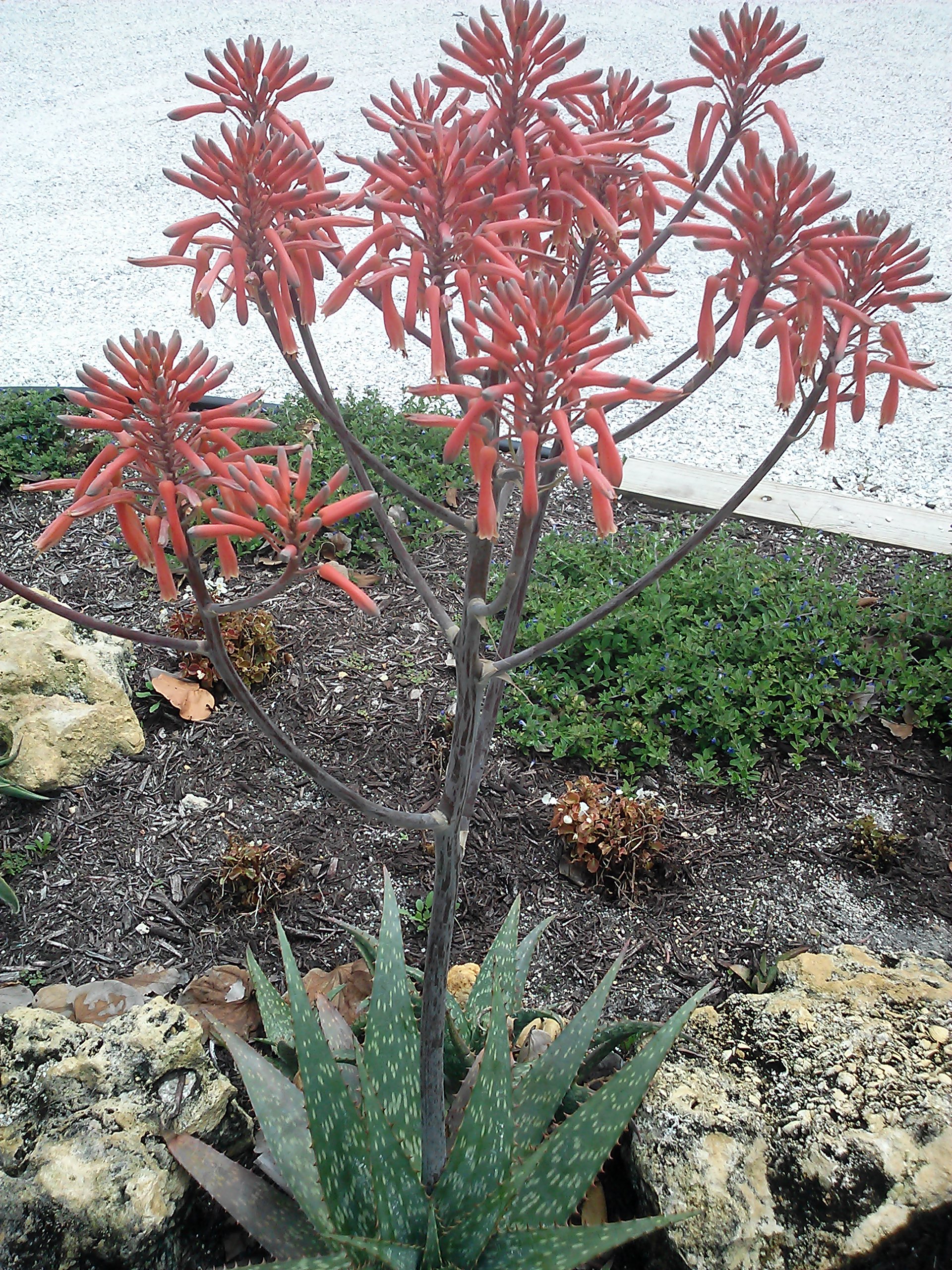
Allo Aloes – Aloe saponaria

Our Soapy Friend

Our Soapy Friend

This is an Aloe an old friend of mine grew and gave me. It is a Soap Aloe, botanically identified as Aloe saponaria by the The University of Florida. Other sources call it Aloe maculatasaponaria makes more sense to me. Saponia being the usual latin word associated with soapy plants. This particular plant is nearly 2 and a half feet wide and the bloom stalk is 4 feet tall. Pretty interesting.

A fine drought tolerant succulent its original home was South Africa. It is adapting nicely to South Florida. I find that mine blooms quarterly just like paying estimated taxes. It somehow knows it is April 15th and someone at the IRS is feeling happy because of its orange flowers.

I have noticed it has a bubbly juice when trimming off the old leaves. Theoretically, this can be used as a soap substitute. However, upon doing a bit of research I found that the soapy substance also causes contact dermatitis in some people. For the time being I am going to stay with the store bought soap.

In my searching I also found that this can be used as a groundcover; I will have to say this stretches my concept of groundcover. It is spreading in my Rock Garden and I have seen quite a few large clumps of its relative Candelabra Aloe  (Aloe arborescens) in my neighborhood. The Candelabra is similar but only has one spike for a flower as opposed to more of a chandelier effect from the Soap Aloe. The Candelabras foliage is narrower as well. It should be noted that these Aloes are all decorated with sharp spines, so don’t plant them near a walkway or under the swing set. Unless you want to keep people away.

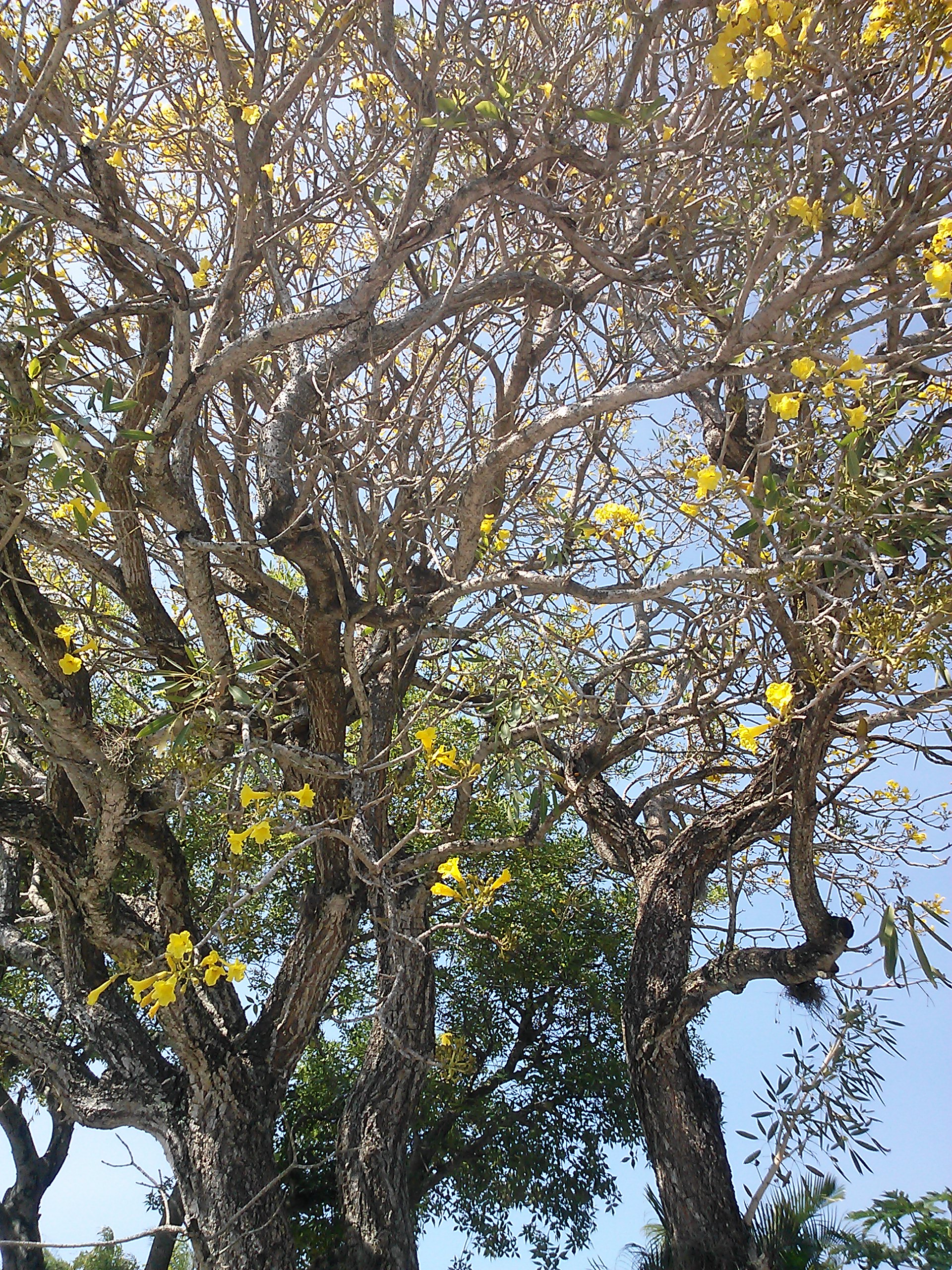
Golden Trumpet Tree – Handroanthus chrysotrichus

Image

The harbinger of spring in South Florida is, in my opinion, the Golden Trumpet tree. Many people call this Tabebuia, formerly its botanical name. The powers that be in botany decided to rename them Handroanthus chrysotrichus, the new name sounding much like a dinosaur.

While there are several types of Trumpet trees, this is the one most associated with spring. It is reminiscent of Forsythia shrubs up north, which also blooms with a burst of yellow flowers in late March. Prior to blooming, the tree drops most of its foliage and then produces buds, letting you know the show is about to begin and will last about a month.  Bright yellow tubular flowers unfurl on gnarly, corky branches when contrasted with the cerulean blue sky overhead it is an exhilarating sight. Ah, spring.

Golden Trumpet trees reach 25 -30 feet height and width and are a good small ornamental tree for homeowners. They are sometimes available in multi trunks, which is my favorite form. Drought tolerant once established and mostly evergreen this is a great addition to your sunny landscape. Their only drawback is they are not particularly wind resistant and produce fairly big pods as fruit.

Handroanthus have an interesting family history. The yellow version popular in South Florida is native to South America where it lives in the rainforest. A near relative, the Ipe or Brazilian Walnut (Handroanthus impetiginosa) is the source of Ipe lumber and the national tree of Paraguay. The lumber is a tropical hardwood that is extremely resistant to the elements and lasts a long, long time outside. The weather resistance of this wood has made it very popular and its harvest is one of the elements causing deforestation in the Amazon. The Ipe is also the source of Pau D’Arco, an herbal medicine used for many ailments by rainforest indigenous people and was once researched as a possible cure for cancer. The Ipe has pink flowers similar to the yellow version that will also grow in South Florida, but is somewhat less cold hardy and taller than the Golden Trumpet.

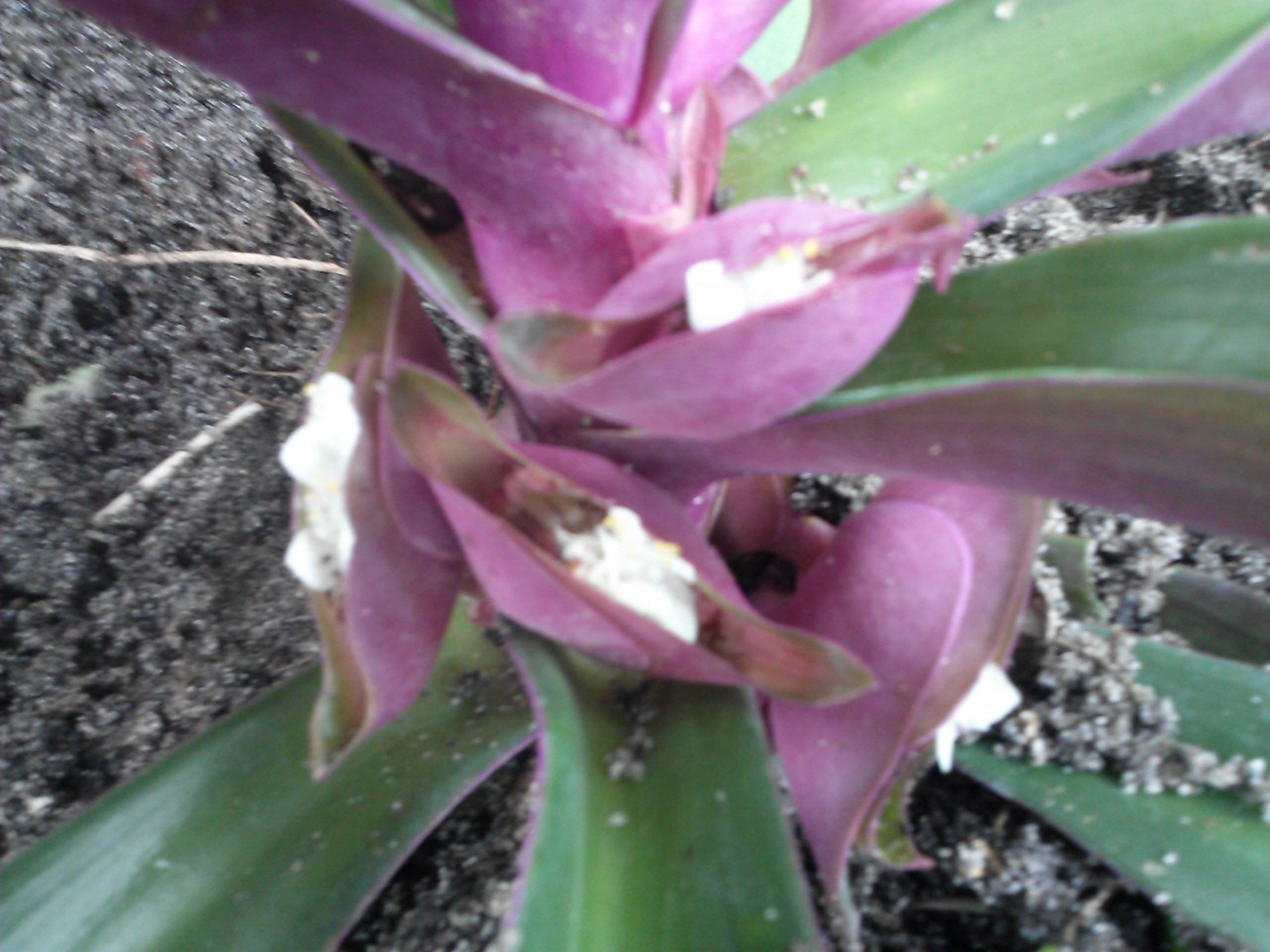
Moses in A Cradle

Flowers of Oyster Plant

Flowers of Oyster Plant

I have always wondered why this plant was called Moses in A Cradle until I found this growing in the roots of my Banyan Tree this morning. The flowers do look like a cradle, I am not so sure about Moses or why he is involved. This is also called Boat Lily, which makes a bit more sense.  Yet another common name is Oyster Plant, Hmmm, maybe it looks like a purple oyster? Then there is the botanical name dilemma, I learned this as Rhoeo, now they seem to have decided it is a Transcandentia. Whatever. Plant taxonomy is not my forte.

The state of Florida lists this as a Category II Invasive. Which sounds scary, but if you do some research it seems this plant has the potential to do damage in certain environments but it hasn’t quite done it yet. The environment this flourishes in is a Tropical Hammock. I live on top of a gigantic Sand Dune, so I think I am safe from the Oyster Plant. As I am somewhat overrun with some invasive plants (the evil Brazilian Pepper and Mother in Law’s Tongues) I am leery of this one, but I think I will just keep an eye on it.

The Garden Club of Stuart Tour

Last Saturday as I was riding in the car with my husband, I noticed a sign for A Garden Tour. This peaked my interest. So I went home to see what it was all about. After a few moments on the computer I found that The Garden Club of Stuart holds a biannual event that includes touring 7 Private Gardens in Stuart and Palm City. The Gardens are open over the weekend and you tour at your leisure.

As I have been around here a while I am not sure how I have missed this event; but I will likely do it again and the next time visit all the gardens. I made it to a little more than half, but they were quite enjoyable. I toured three estates on the St. Lucie River and a Tropical Bromeliad Garden in Palm City.

My favorite was the Tropical Bromeliad Garden, an amazing array of bromeliads and tropical plants arranged in sinuous beds set into lawn. Most were labeled which made it more enjoyable for me as I am turning into a bromeliad collector. Snapshots follow:ImageImage

There were probably 100 different varieties in this garden. Beautifully maintained by the homeowner, who must spend hours out in the garden clipping off excess foliage and mulching.

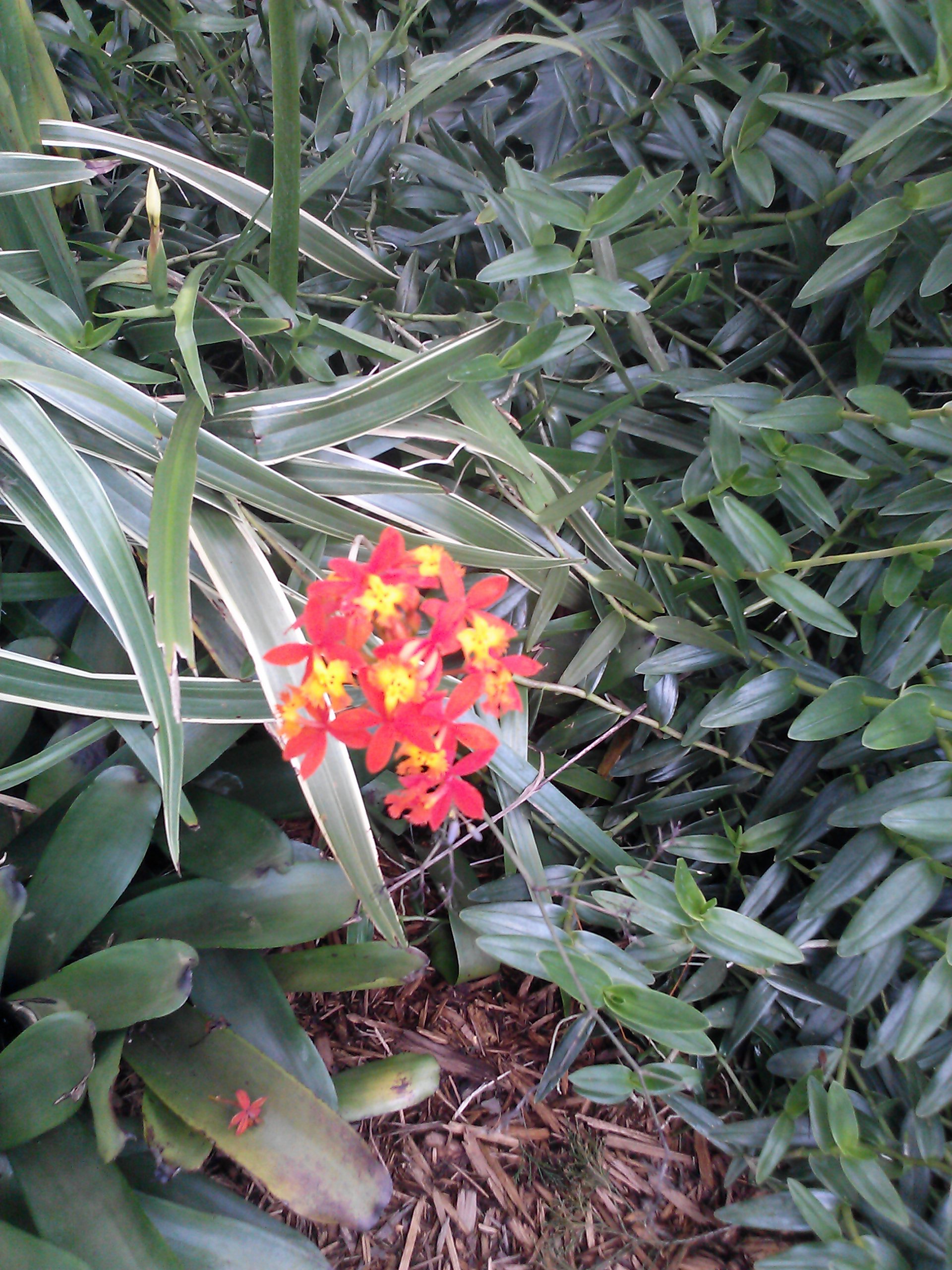
I also found a new plant I must have; a Fire Orchid..

Image

I definitely need to find out more about these. They were beautiful.

The Garden Club has something called the Ramble at the beginning or the end of the tour. At the Ramble they had Bar B Que and a plant and gardening accessories sale. Guess what I bought..some Bromeliads.

Rose Apple – Syzygium jambos

Rose Apple Flowers

Rose Apple Flowers

This is a picture of my neighbors Rose Apple tree in bloom. The tree is about 25 by 25 feet and to the best of my knowledge was planted in the 1960 or 70’s. It has beautiful evergreen foliage reminiscent of Ficus Alii, long thin leaves. The flowers are followed by golf ball sized fruit that no one is very excited about eating. My husband is a famous pie baker and there are some recipes around so maybe we will try a pie later this year. Apparently there is a great deal of differentiation in the quality of fruit from seeds of these trees, meaning some fruit is better than another.

Native to the West Indies, I see these here and there in South Florida, but they are more common in South America and naturalized in parts of India. It is a common dooryard fruit in parts of Peru.

Beautiful when swaying in the wind; in my opinion, this tree could be planted for aesthetic value alone.

Update: We ate some fruit, I can only say it must be an acquired taste or something you have to grow up eating. Kind of perfumy tasting, the fruit is a fibrous shell around a pit. Larry refused to bake a pie after tasting the fruit.

Wild Poinsettias- Euphorbia cyathophora

The Mystery Weed

The Mystery Weed

I was working in my front yard last week and came upon this little plant with bright red flowers. Knowing I had not planted it and it sprang up unbidden from the depths of the sugar sand, I thought it might be a good thing. This plant resembles Snow on the Mountain and looks like a Euphorbia. (Poinsettias are Euphorbias)

My neighbor happened by and I asked her about it. She identified it as a Wild Poinsettia.

The research began, first I found out it is a Wild Poinsettia, sometimes called Fire on the Mountain versus Snow on the Mountain. And a relative of both Snow on the Mountain and Christmas Poinsettias. The next thing that came up was, Invasive! and it had been featured as weed of the month for the state of Florida.

Another foreign invader in our midst. It was too good to be true.

The Plan

The Plan for Driveway and Landscape

The Plan for Driveway and Landscape

At last, the plan has been nailed down and the contractor hired. Soon we will see a passable driveway. As in a surface dedicated to the movement and parking of motor vehicles. Life is good.

I am very happy with the contractor we finally hired. I actually went through 7 interviews/pricing exercises. It got pretty boring and repetitive. No, no, no and more no. I shouldn’t be surprised at what I found in the way of contractors but I am. A good one is a rare find. It is a difficult call for me if I am really picky and uncooperative or if other people are just clueless. Probably a little of both. A great deal of stuff these guys were asking me to tolerate I just wouldn’t. People are too nice sometimes.

So, here is the Final Plan. The area of stepping stones ended up so big I used half seashell stones and half salt finish plain stones. The reality is that is how many we had on hand and I think I will like it. The idea behind this area is that we have a place to park all the trash cans and recycling bins and the mailbox will be moved over to the edge of the stones for a path to the mail as well.

Please comment on the design before it is too late!!

Terse Food

CAM00152 

Above is my idea of a great, terse dinner. Mustard Crusted Rack of Lamb with Mashed Potatoes and lightly steamed, buttered Green Beans.

Here on the Treasure Coast I have not found much in the way of terse food. However, there is a lot of coconut fried seafood. Which, really, is the anti-terse. Terse food is fresh, well, but lightly seasoned and usually not fried. I make an exception for potatoes. Otherwise fried food is verboten.

An old friend of mine, an English professor, used terse to describe his writing style. No excessive adjectives, adverbs or fluff. Say what you mean. Or, write what you mean. He later became famous for writing the biography the movie Becoming Jane was based on. That was the genesis of my terse food concept.  For example, Grilled Mahi in a pineapple glaze, great, add coconut and fry – not so great. I am suspicious that Grilled Pineapple Glazed Mahi coated in Coconut and fried is on a menu somewhere around here.

Back to Coconut fried seafood. Why even eat seafood if you are going to do that to it? Maybe it makes disgusting old frozen shrimp palatable? My husband and I dined at a local restaurant well known for its scallops, which I was bound and determined to try. So I did.. after I scraped the coconut off the scallops were pretty good. My husband had butterfat infused tomato based pasta that was almost good, but just too much..butterfat..and we like some butterfatmore anti terse. Perhaps I should mention the last time my cholesterol was taken it was 135.

I am a design person, have been for years. I am not sure what happened, but I ended up in the running to be a restaurant reviewer for our local newspaper. It is a blessing I did not get that gig. The job went to a retired school administrator of some sort who is always right about the restaurants and rarely makes an ugly comment. For you uninitiated non-Southerners, ugly is comparable to surly. I am sure would find myself unable to be so nice.