In A Vase on Monday – Butterscotch Pudding beats the Rose Bowl

20160521_135255-1

20160521_175109

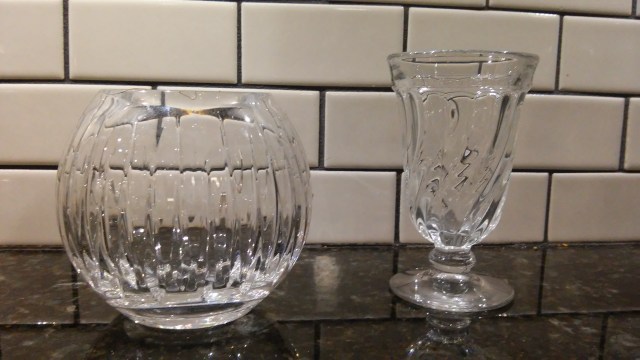
I started to use a Rose Bowl for this arrangement, but the bowl must have sensed my true feelings about Roses (too much trouble and ugly shrubs when not flowering) the flowers were just not sitting right so I had to go to a more straight sided container. See picture above, Rose bowl on the left and Fostoria on the right. The picture is to clarify which Rose Bowl  I was writing about, my husband asked if I was blogging about football this week. The other Rose Bowl is a college football game.

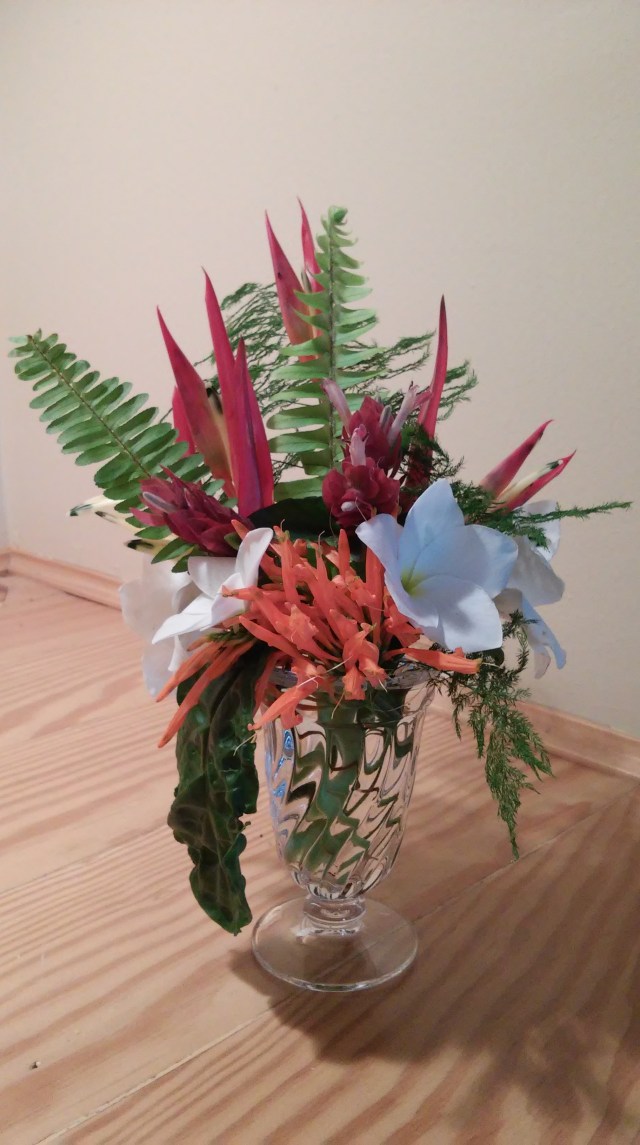
I have a set of these Fostoria glasses, inherited from my mother in law. My husband refers to these as the Butterscotch pudding bowls because that is what she served in them. I really don’t know what they are, it is an oddly sized container for food or drink but works well as a vase. Here is a better picture of the Fostoria.
20160521_135457

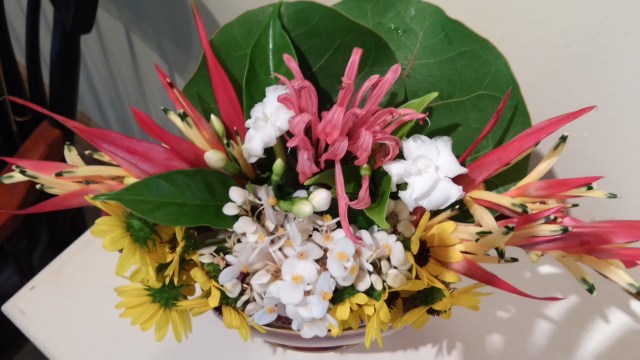
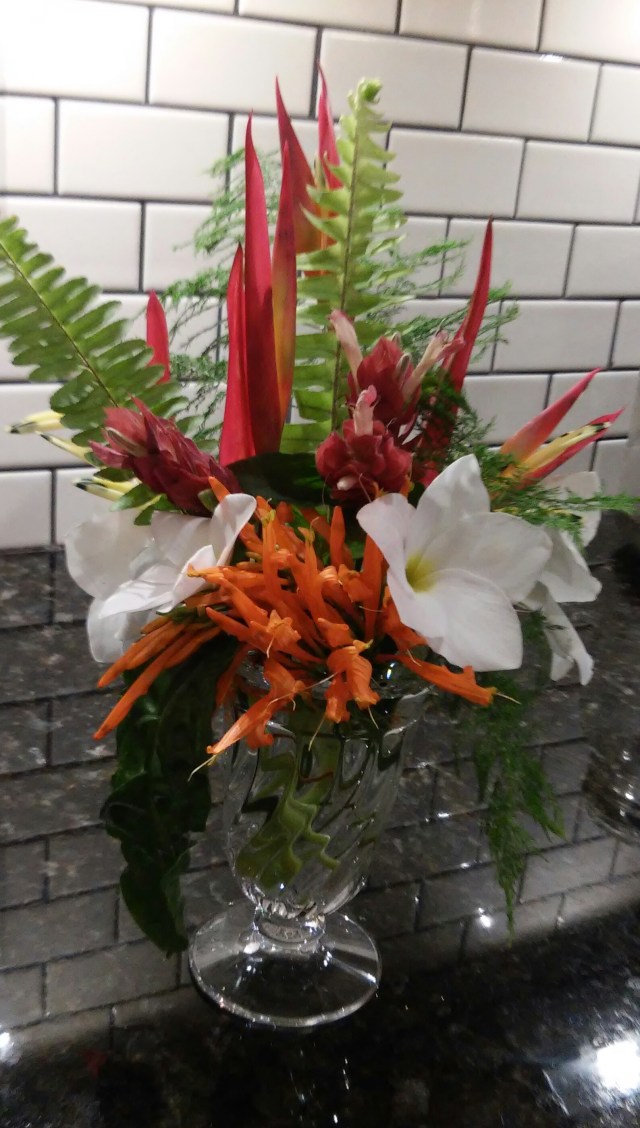
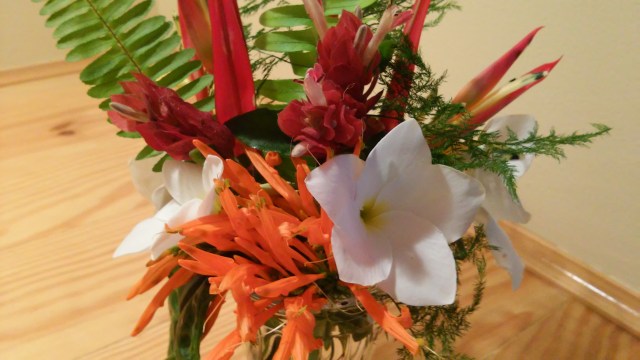
To me the star of the arrangement is a new arrival in my garden, the orange Mexican Honeysuckle (Justicia spicigera), research tells me this plant blooms nearly year round and is a desert tropical that likes regular water. I wonder what these people are smoking who come up with these descriptions sometimes, no doubt something horticultural. Regular water on your desert tropical. Apparently it comes from a weird desert.

The balance of the arrangement contains more Justicia – J. brandegeana, the Red Shrimp Plant in darker red. The lighter red is buds of the Heliconia psittacorum, the white flowers are Bridal Bouquet Plumeria (P. pudica). Greenery is Asparagus and Boston Ferns.
20160521_135509

All this talk about Butterscotch Pudding has inspired me to make some. I think from scratch……Just have to find a recipe with actual Scotch as an ingredient.


In A Vase on Monday – Frangipani and Fennel Failure


20160515_113820-1

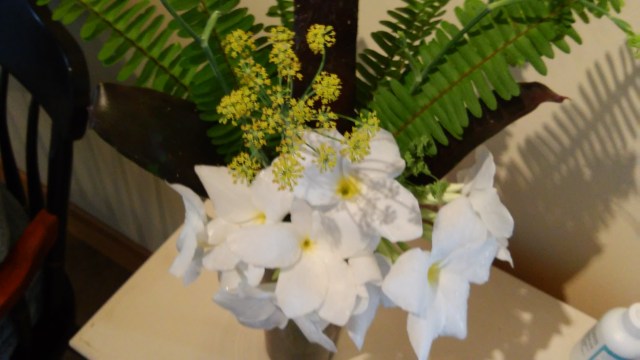
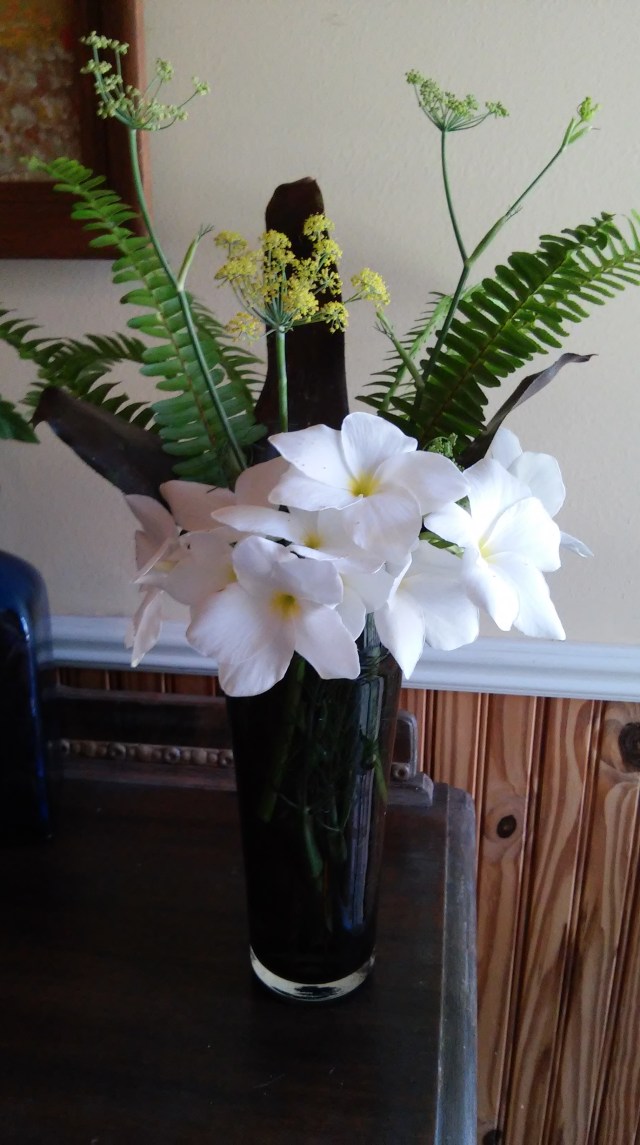
The promise of the eventuality of summer is evidenced by the Frangipani starting to flower in South Florida. The Frangipani in this vase is Bridal Bouquet, a columnar, semi evergreen variety I have come to love in my garden. It is not as fragrant as other Frangipani but the evergreen foliage and form of the plant make up for any shortcomings in fragrance. I have been waiting to see what color the larger Frangipani in my garden are and blast it they are white as well. So, I am in the market for some more colorful friends for the white flowers.

20160515_113615

The failure in this vase is the Fennel, the chartreuse starbursts looking like Dill or Queen Annes Lace. I have been trying to grow culinary Fennel for years from seed. It gets about half the size of a grocery store Fennel and then bolts. I think the climate here is just wrong for Fennel, but have enjoyed eating the foliage and using it in flower arrangements.20160515_135536

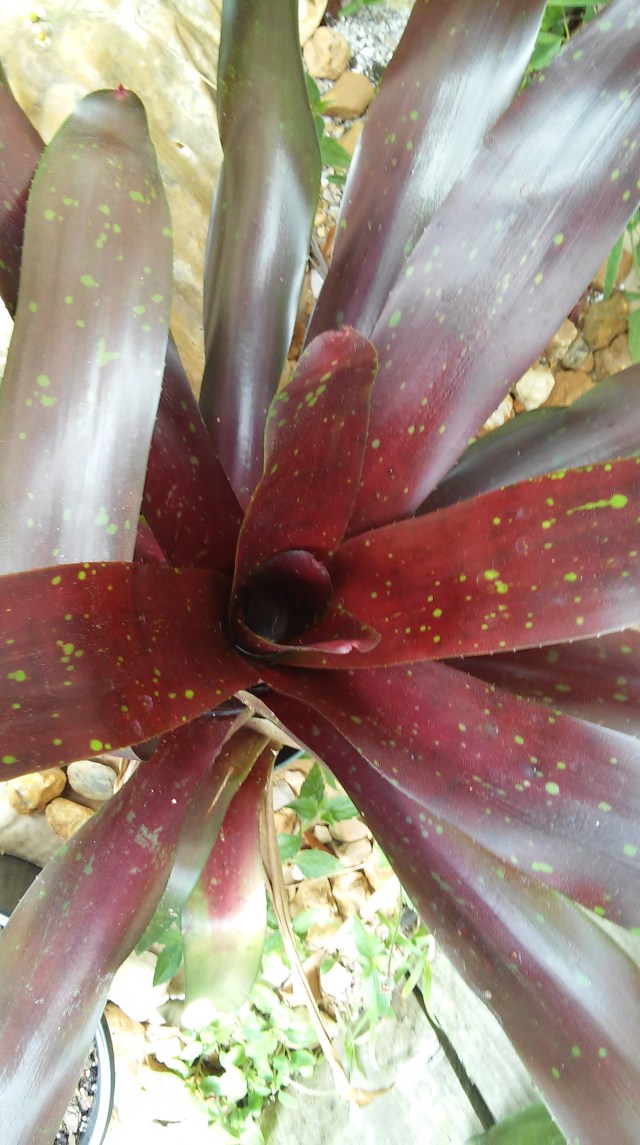
The Burgundy foliage is from my latest Bromeliad bargain. Not a clue what it is. Bargain Bromeliad $5, named specimen, $40. I can live without knowing the name and to me, part of the fun of gardening is seeing what happens next. The other foliage is my everpresent Boston Fern or more likely its evil lookalike tuberous Asian Ferns.

Here is the Bromeliad, burgundy with chartreuse spots, a perfect foil for the yellow green Fennel flowers. If anybody knows its name, please let me know.

20160420_111958

The smoke grey glass vase was from a bargain store near my house bought years ago when I was overrun by a beautiful but much too enthusiastic Red Alstroemeria. The red and gold flecked flowers looked wonderful in the vase, I had a smoke grey glass vase full of Alstroemeria all summer for years.

In A Vase on Monday – Tea Stained Melange

20160508_113259

It was Mother’s Day as I was plotting my Monday vase, so naturally I thought of what my mother might like in a vase. My mother (passed nearly seven years ago) was not nearly as snooty as I am about her flowers and enjoyed just about anything she could grow successfully. I am hard pressed to think of something she really didn’t like. Growing up we always had a seemingly magical forest of Cosmos and Scarlet Runner beans to play in. Many of the plants grown in the garden would end up in a vase on Monday! She would definitely get a kick out of all my wacky tropicals and the vases every Monday.

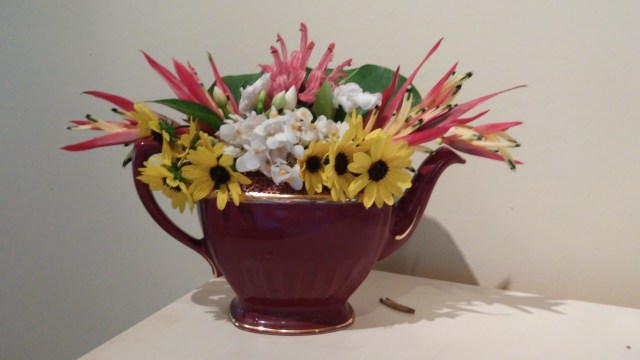
I ended up with her favorite teapot. I am fairly certain it was a wedding gift, the rim and base stained russet from untold thousands of pots of tea, many shared with me. I walked through my garden and cut everything that was in bloom and arranged it all in the teapot.

20160508_113008

The big leaves in the back are Sea Grape (Coccoloba uvifera), the pink flower in the middle is a Brazilian Plume (Justicia carnea), Florida Gardenias (Tabernaemontana divaricata) on each side in white, Sweet Begonias (Begonia odorata ‘alba’) the smaller white flowers, Beach Sunflower (Helianthus debilis) are the yellow and Parrot Flower (Heliconia psittacorum) the red and yellow on the sides. The teapot is marked Hall, made in the USA.

My husband wandered through as I was assembling the vase and asked me, aghast, ‘Is that your Monday vase?’

20160508_140846

This is a side shoot from Sweet 100 tomatoes I hope to root to extend my tomato season.

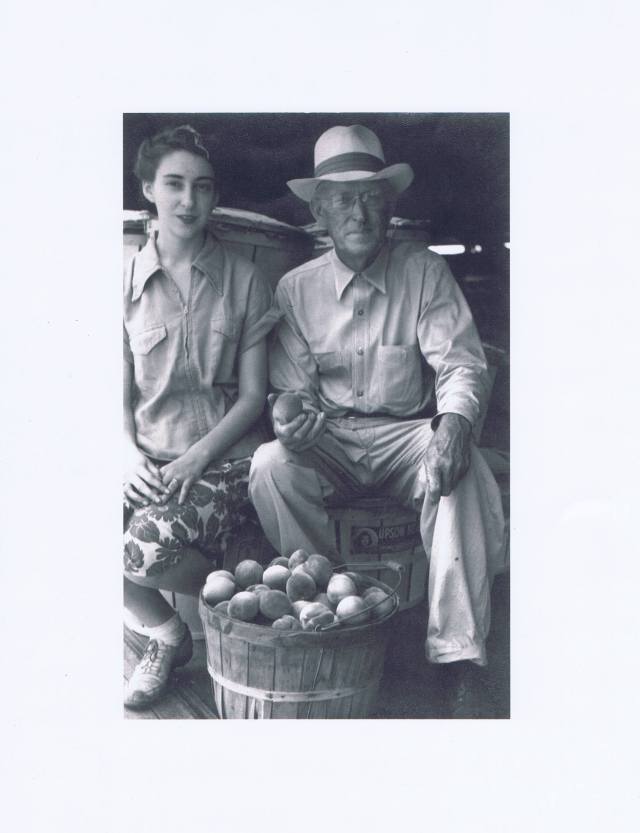
Here is my mother, ever the Southern Belle, at the peach packing house with her grandfather in the late 1940s.

CCE05082014_00000

Miss Betty and Mr. Tommy

Gardening in the Rain

20160415_163135-1

One day this week I was waiting for the rain to start so I could go work in the garden. I stopped to think – this seems really stupid, do other gardeners do this? And then went out into a gentle rain to move some Beach Sunflower around. It has been so dry lately the sandy soil has tightened its grip on roots to the point it is difficult to pry things out of the ground. Soil is an overstatement in my garden – I should face the facts, it is Sugar Sand, white, infertile and oddly capable of growing many things. I pried some intractable Johnsonsgrass out (and threw it away) then went looking for more beautiful things.

Here is what I found:

20160415_104634

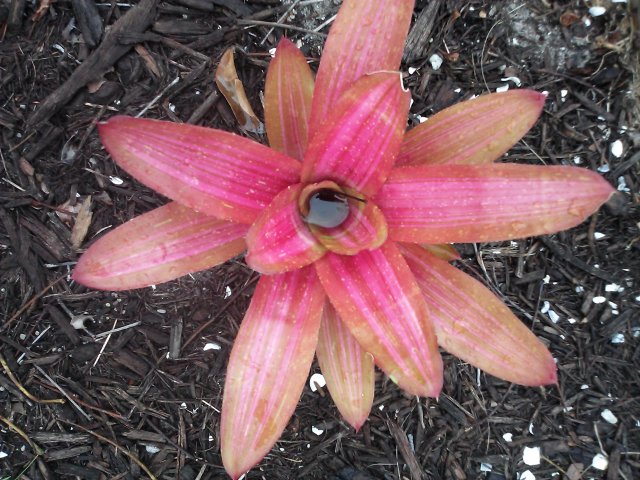
This is a Bromeliad, Billbergia pyramidalis, I think, bought as a cutting in February. I was told it would grow up the trunk of a tree. As a planted it, I was scoffing. Well, whoever told me that was absolutely correct – it is growing up the tree and much to my surprise, flowering at the same time.

This made my time in the rain worthwhile and hopefully the skies will open again soon.


In a Vase on Monday -Natives Tea Party

20160410_160949-1.jpg


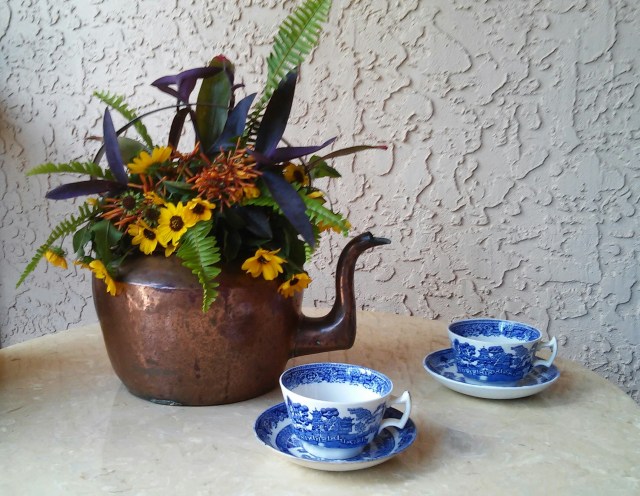
The copper tea kettle is one of my favorite things. I bought at a flea market on a weekend trip to the Appalachian Mountains many years ago. I am relatively certain it won’t hold water as it was repaired on the bottom and you can see through the repair. What is lovely about this kettle is the patina of many years of use with dents and hand crafted solder joints adding to its beauty. I can only speculate how many souls have been warmed by the contents of this vessel. The Blue Willow teacups are English and belonged to my grandmother, the saucers are too cracked to use and are kept for their patina as well.

As neither the cups or the kettle can be used for tea, this is a party for the natives. The native flowers in the kettle, of course. The arrangement is primarily native plants of South Florida, the yellow flowers are Beach Sunflower (Helianthus debilis), the orange tubular flowers are Firebush (Hamelia patens), Boston Fern, the purple foliage is Purple Hearts (Setcresea pallida), native to North America says the Florida plant database, and joining the party some Painted Fingernail Bromeliad foliage with the cerise tips, from somewhere south of the border.

As I was arranging the flowers in a pickle jar to place inside the kettle, it occurred to me I should go antiquing to see if I could find some copper friends to join the kettle.

Bromeliads for the Treasure Coast- Divide and Conquer

I have learned a great deal about Bromeliads since starting my garden four years ago. Prior to moving to Florida, I only knew a few varieties of Bromeliads and this was from designing shopping mall interiors in the eighties. Guzmanias were (and still are) a great plant for interiorscape. Oddly enough, while they will grow here, I have no Guzmanias. I think they are kind of boring. I like the kind of indestructible, passalong, highly reproductive Bromeliads. The kinds you don’t see in shopping malls. The more unusual the Bromeliad, the better. This could prove to be a bad idea in the long run. I could grow really old here and end up with Martian Planet landscape.

Bromeliads above are: the flower of a Painted Fingernail Aechmea, a common passalong in South Florida, the spotted one is a common Neoregelia (from a garage sale) of some sort, the burgundy one is Burgundy Aechmea. The below Bromeliad is a ‘Blanchetiana’, another Aechmea passed along to me from a neighbor. All thrive here with little care.

My latest venture in the garden has been to add swirling patterns of shells and rocks weaving through the garden. First, I like shells and rocks and second, I detest mulch, not for looks, but for me having to schlep bags of bark through the yard – usually when the weather is tropical steaming. I really just won’t do it and go back inside and plot some other indoor task. The result of this is weedy unkempt beds. So the strands of rocks and shells are being woven through the garden and ribbons of groundcover and tightly planted perennials are going to be installed to hopefully cut down on the maintenance (weeding) and the mulching. I have placed cardboard boxes under all of it to hopefully break the weed cycle.

The correct time of year to divide Bromeliads is the beginning of the growing season, which in South Florida is Fall/ Winter. I have been working on doing this and have divided several and (here’s a surprise) bought some pups last week at the botanical garden. Neoregelia Martin and the popular Blanchtiana Aechmeas have been divided and installed in their shell garden. Both these Bromeliads flourish in full sun, the Blanchetianas are available in Orange, Lemon and Raspberry. I have an Orange and Lemon, I am not quite sure about the Raspberry. The divided Bromeliads are in the left picture; here is a close up of Martin, who is a Neoregelia – doesn’t flower, but the foliage and sun tolerance make Martin worthwhile to have in the garden.

CAM00253

I am trudging onward in dividing, but have yet to conquer.

In A Vase on Monday – Surinam Shrimp

20160131_145844-1

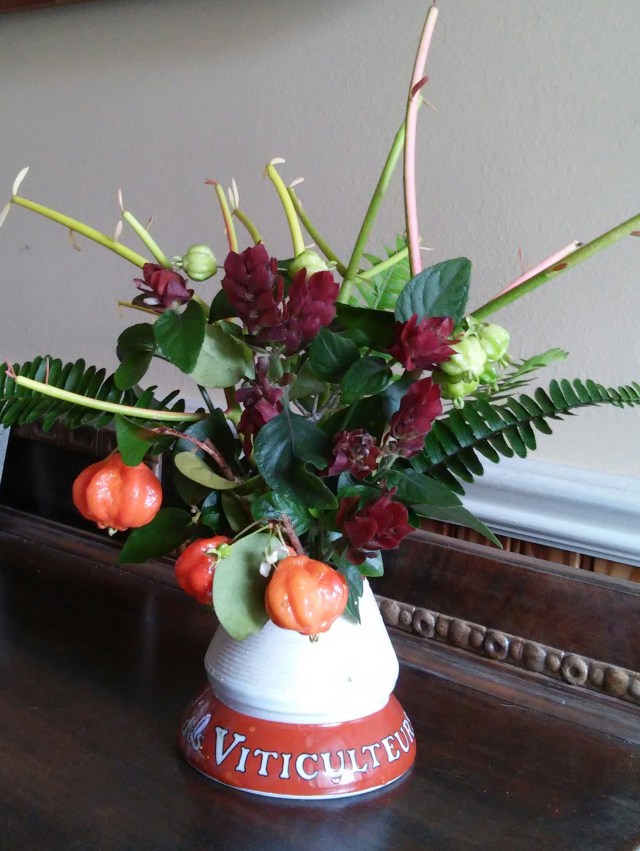
I am aware ‘Surinam Shrimp’ sounds like a dish at a Vietnamese restaurant, however the two main components of this vase are Surinam Cherries and Shrimp Plants. The Surinam Cherries are the fruit in the lower part of the arrangement.
I have a large hedge of these shrubs and was pleased to have a fruit producing hedge, thinking (silly me) the fruit could be eaten. I kept thinking the fruit wasn’t ripe or something as it tasted so bad. Finally my neighbor, a Florida veteran, picked one for me – properly ripe. Still tasted bad. I have seen the taste described as resinously bitter, and the description fits the fruit. Given the taste of the fruit and the colors in various stages of ripeness an arrangement seemed like a better use of the fruit. The rest will be left for our wildlife friends.

20160131_145457-1

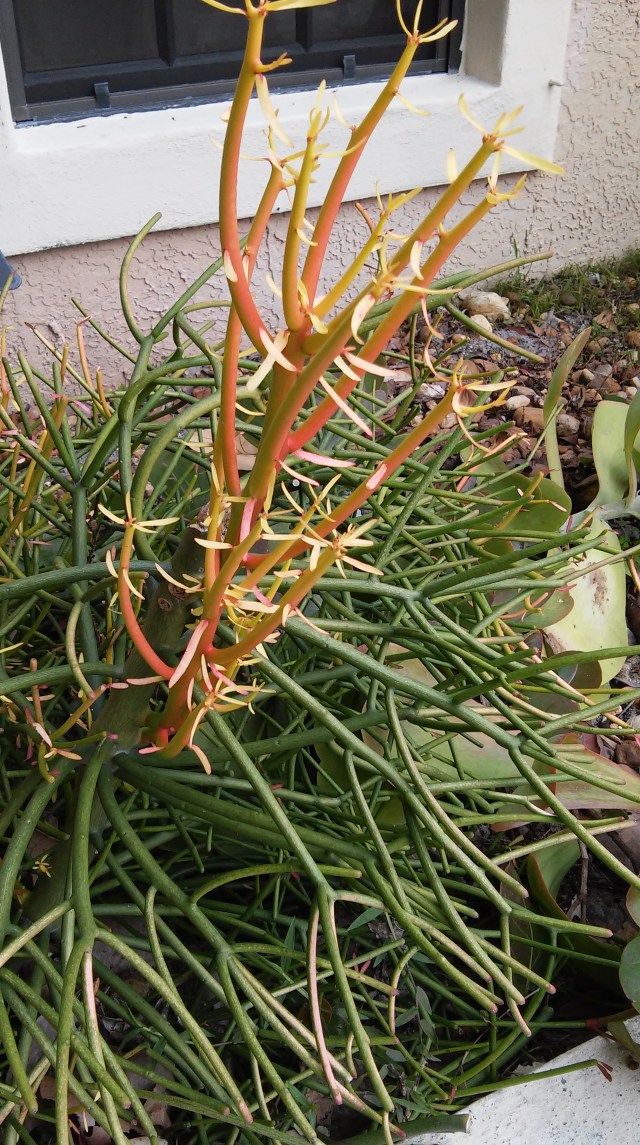
Here is another view with the nearly ripe Surinam Cherry beside the vase. As for the other members of the plant crew, we have: in dark red, flowers of the Red Shrimp Plant (Justicia brandegeana); the foliage of Boston Fern and the upright sticks are from a ‘Firesticks’ Pencil Cactus (Euphorbia tirucalli ‘Firesticks’); in orange and chartreuse, the fruits of the Surinam Cherry (Eugenia uniflora).

The vase was a long ago Christmas gift to my husband from his ex-wife’s cousin! We have absolutely no idea what it is, so if anyone has a clue please send a comment. We have been wondering for years what this is. The top of the vase is much thinner than the base and has a hole in it. It reads “Gd Cafe des Viticulteurs”

As for the ‘Firesticks’ Pencil Cactus’ here is a picture of the plant. Euphorbias still blow my mind, hello, Poinsettias? so weird- I have a few of these around the garden as they easily root from cuttings:

20160131_152001

Now I am craving some Shrimp Pasta for dinner. Without the Euphorbias, of course.

In a Vase on Monday – The Wildflower Blues


20160117_154405-1

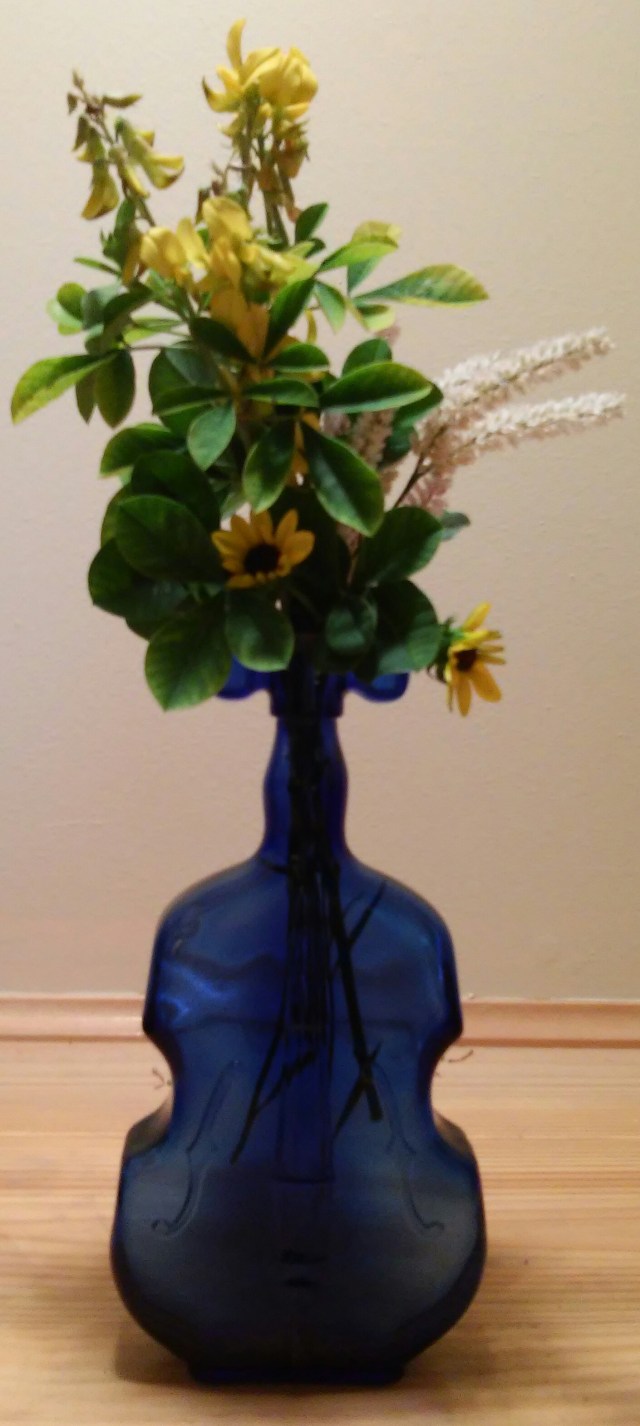
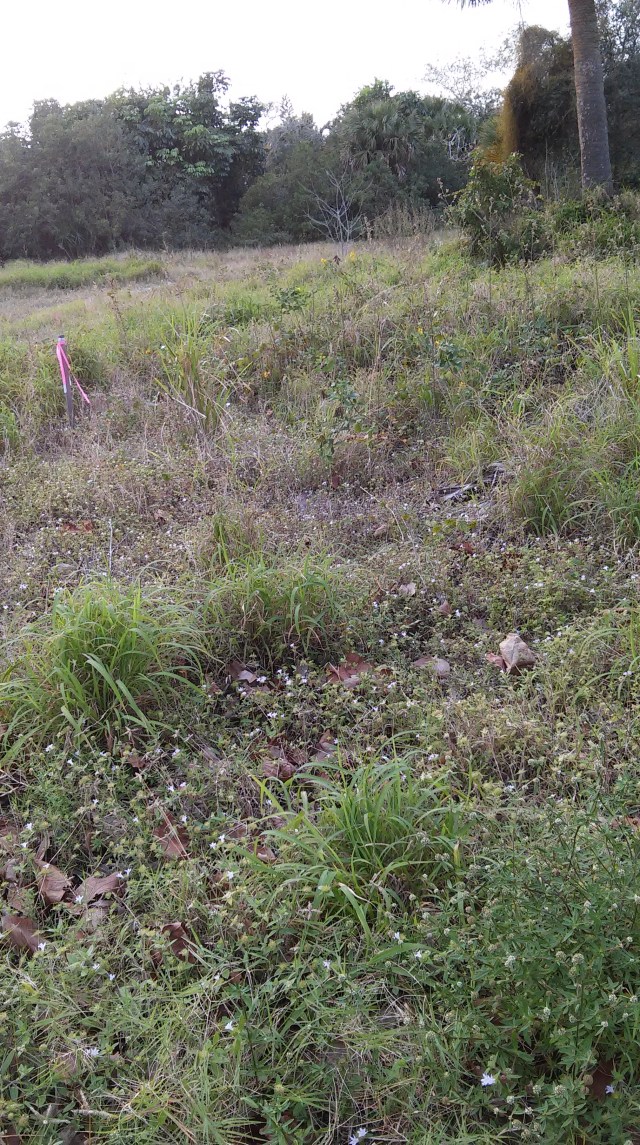
I have been watching a group of Yellow Lupines on the edges of a vacant lot nearby – thinking I could collect some seed and grow Lupines in my back garden. What I did not realize is when the seed pods are ready they explode and hurl seed far and wide. The pods exploded in my car and didn’t seem to think there was enough dirt to grow in the carpets, though there probably is as I haul dogs and plants around with equal enthusiasm. I am not sure if these plants are native to the area, but I am aware of other native Lupines in Florida; it seems peculiar as I associate these plants with Alpine meadows, the Rocky Mountains and cold, arid places. Here is another view of my three blue vases filled with native and/or wildflowers from the vacant lot.

20160117_113625

20160117_111900-1

My blue vases represent three generations of women in my family, the violin belonged to my grandmother and has Yellow Lupines, the white spikes are Jointweed, the yellow daisy shaped flower is a Beach Sunflower.

20160117_114007

The tall bottle belonged to my mother and has Beach Sunflower, Yellow Lupines and seeds, background plants are Shrubby Buttonweed and Muhly Grass.

The corked bottle in the background belongs to me and holds the dried petals of all the roses my husband sent me during our courtship. The bells belonged to my other grandmother and are one of those touchstones that have been around the house as long as I can remember; my father brought them home from World War II.

As I was writing this post, it occurred to me how much more interesting and attractive these flowers appear in their Monday vase. So, I wandered over to the vacant lot and took a before picture:

20160117_163141


All the components of the vase are in the foreground. I think I like the flowers in their blue bottles better. This leads me to ponder if more people saw native plants in a vase instead of a vacant lot – native plants might be more popular.

If you would like to see vases from the world over, stop by the comments section of  https://ramblinginthegarden.wordpress.com where Cathy hosts In A Vase on Monday – every Monday!


Installing Orchids in the Strangler Fig

This is a story I started last year, when I was gifted some Orchids.

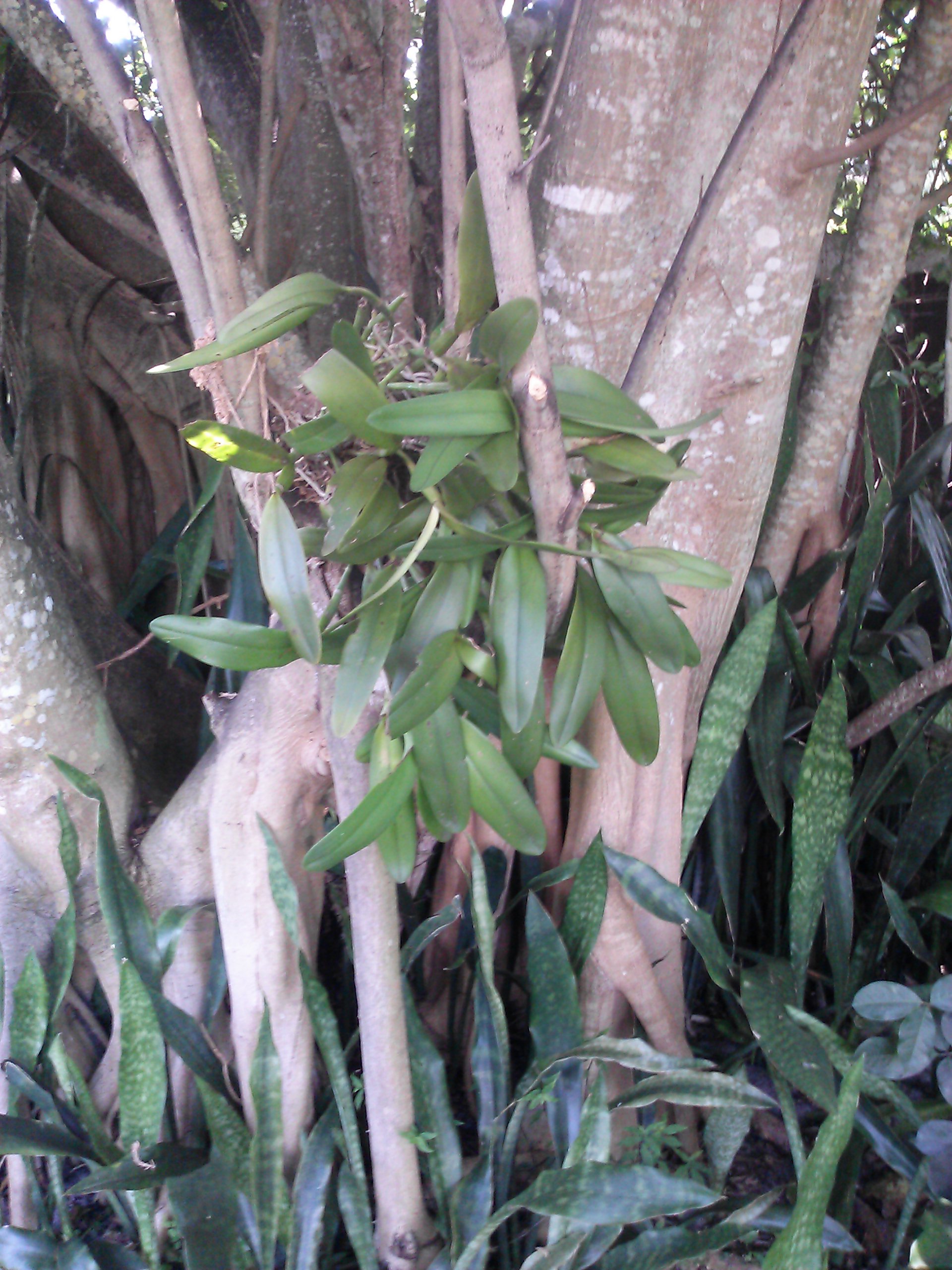
One of the joys of living in South Florida is growing things outside that are houseplants almost anywhere else in North America. My neighbor showed up with a box of Cattleya Orchids yesterday. She grows these in her trees mounted on the branches; it is a beautiful sight when the clouds of purple orchids are blooming in the summer. Some are fragrant and cast sweet scents through the garden.

Orchids Ready for Banyan Tree

Orchids Ready for  Tree

These Orchids were declared unkillable. If this is true these will be the first Orchids I have ever not killed. I think of Orchids more as a floral arrangement; not something that actually is perennialSo, I followed directions:

Cleared a slightly sunny spot in the base of a big Strangler Fig tree in my side yard. There are unfortunately some very poorly trained arborists (?!) around here who left this bad pruning job on my tree. A few orchids will spice things up here and cover the bald spot..

Banyan Tree Trunk

Fig Tree Trunk

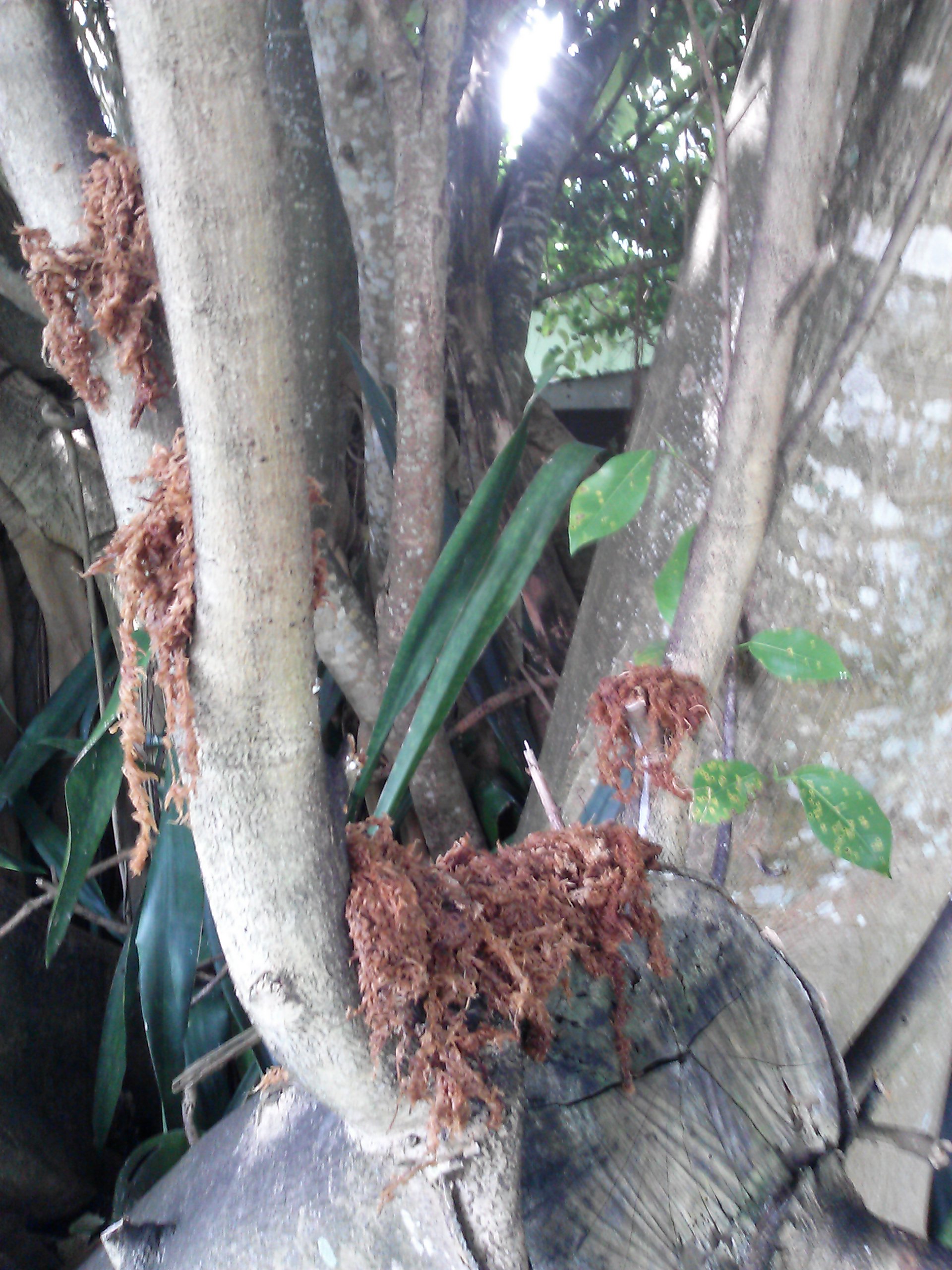
I added some dampened Sphagnum Moss; trying to place the moss so it would drain and not cause any rot on the bark of the tree.

Spaghnum Moss

Spaghnum Moss

Then I hoisted the Orchids into the trunk and tied them to the tree with sisal twine. This takes a bit of jiggling and looping to make things secure, but I think they will stay in place.

The Finished Product

The Finished Product

Here are the Orchids in place. The idea is you water them (not too much) until establishment in the tree. Then maybe water every week during the dry season. Voila! Hopefully, I will get some of these next year; if these are truly unkillable!

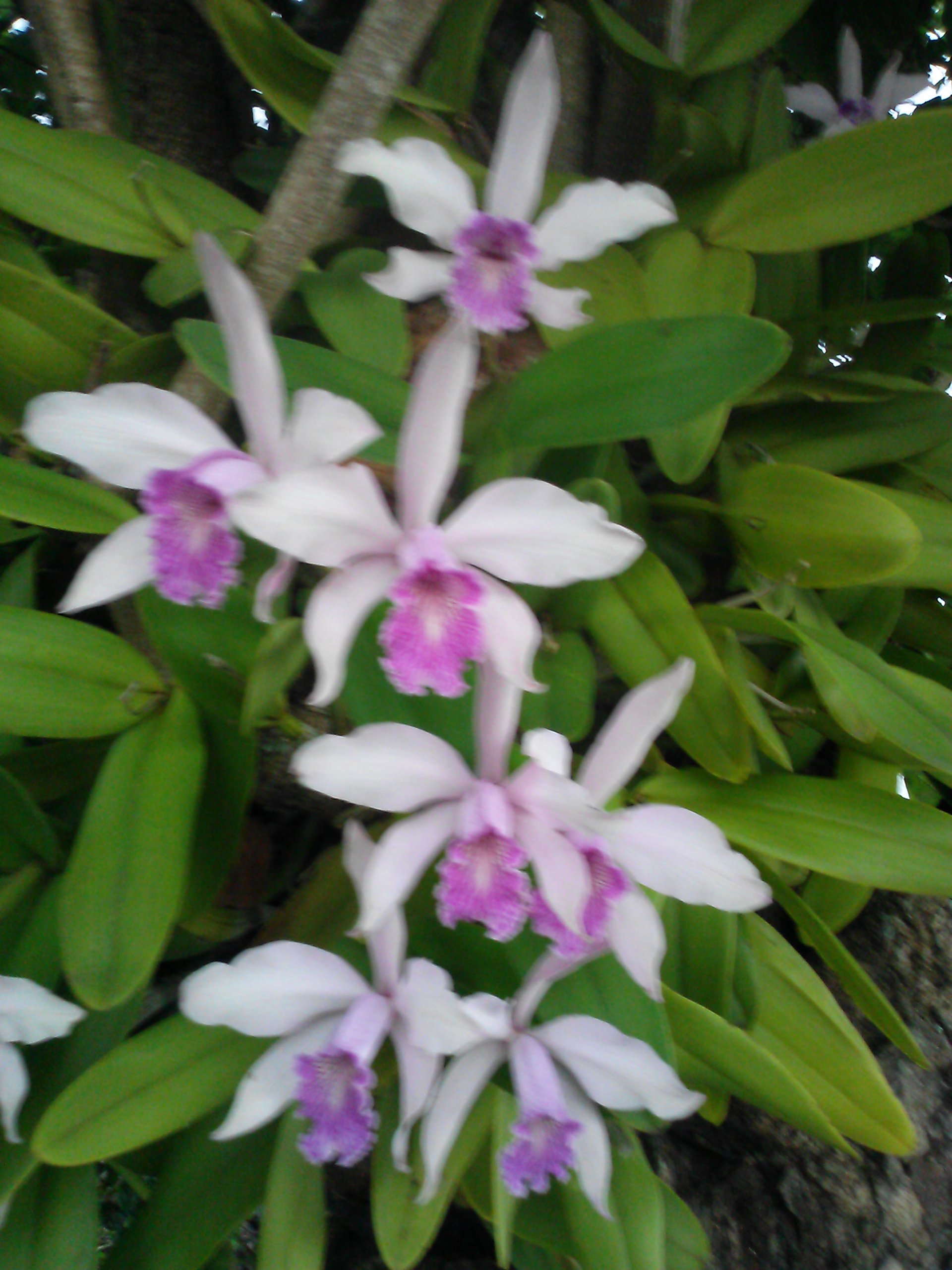
The update here is the Orchids are alive and well and are teasing me with new shoots – hopefully I get some flowers like the ones below. The good news is they do appear to be unkillable!

Cattleyas

Cattleyas

Royal Ponciana – Delonix regia

The Flamboyant Tree

The Flamboyant Tree

If Tabebuia is the harbinger of spring in South Florida, then The Royal Ponciana (or Flamboyant Tree) is the harbinger of summer and the rainy season. I prefer not to use the H word in regards to seasons.

I have heard people refer to these trees as Flamboyants, and I always have to stop and think about what that is for a minute. They are pretty flamboyant. I think the trees look as if they are covered in sprays of red orchids. Ponciana starts blooming in May and then continue  into Summer the leaves seem to follow the flowers and are ferny, deep green and eventually cover the tree with a fine textured foliage providing shade for the sun weary Floridian. The floral display is followed by large pods like beans (this is a member of the bean family) In some Caribbean countries, Poncianas are called “Woman’s Tongue” because the pods rattle in the wind.

A native of Madagascar and India these trees are planted the world  over in the tropics for their fine floral display. Named for  M. DePoinci, a governor of the French West Indies in the 1700’s, the Ponciana is celebrated with a Fiesta and a Festival in Miami around the first week of June.

These trees lend a tropical flair to any landscape and eventually take on an umbrella form reminiscent of trees in the African savanna. There are numerous Poncianas in my area. Of course, most of the horticultural literature I have seen says they shouldn’t grow here. Generally, I see 10B as the hardiness zone limit, I am pretty sure this is 10A – the coastal area of Martin County. Gardening friends in Vero Beach report Ponciana do not do as well there and I have heard that Ft. Pierce is their northern limit.  The lady down the street who is a great gardener advised throwing all the books away and just giving things a try. A reasonable suggestion.

These trees should be placed in the sun and are not for the faint of heart. Fast growing and with the potential of attaining a size of 40 by 40 feet, they need some room to spread and also produce a deep shade that it is difficult to grow anything under. They are semi-deciduous; so if you are a Snowbird tired of raking leaves this tree is not for you. The pods also are pretty messy. I got in touch with my inner Southern Belle at Christmas by spray painting some Ponciana pods silver and using them as a front door decoration along with preserved Cabbage Palm fronds..