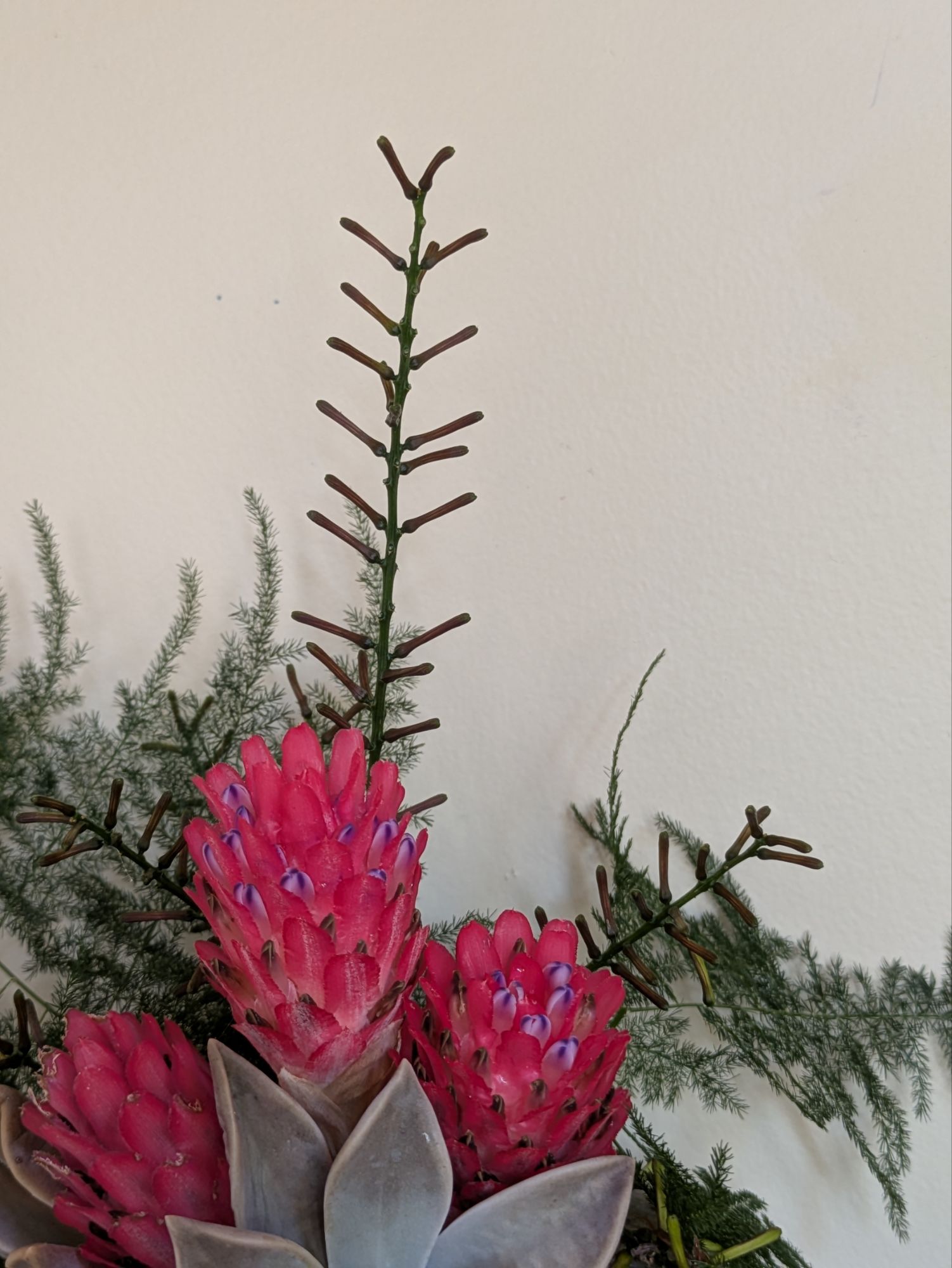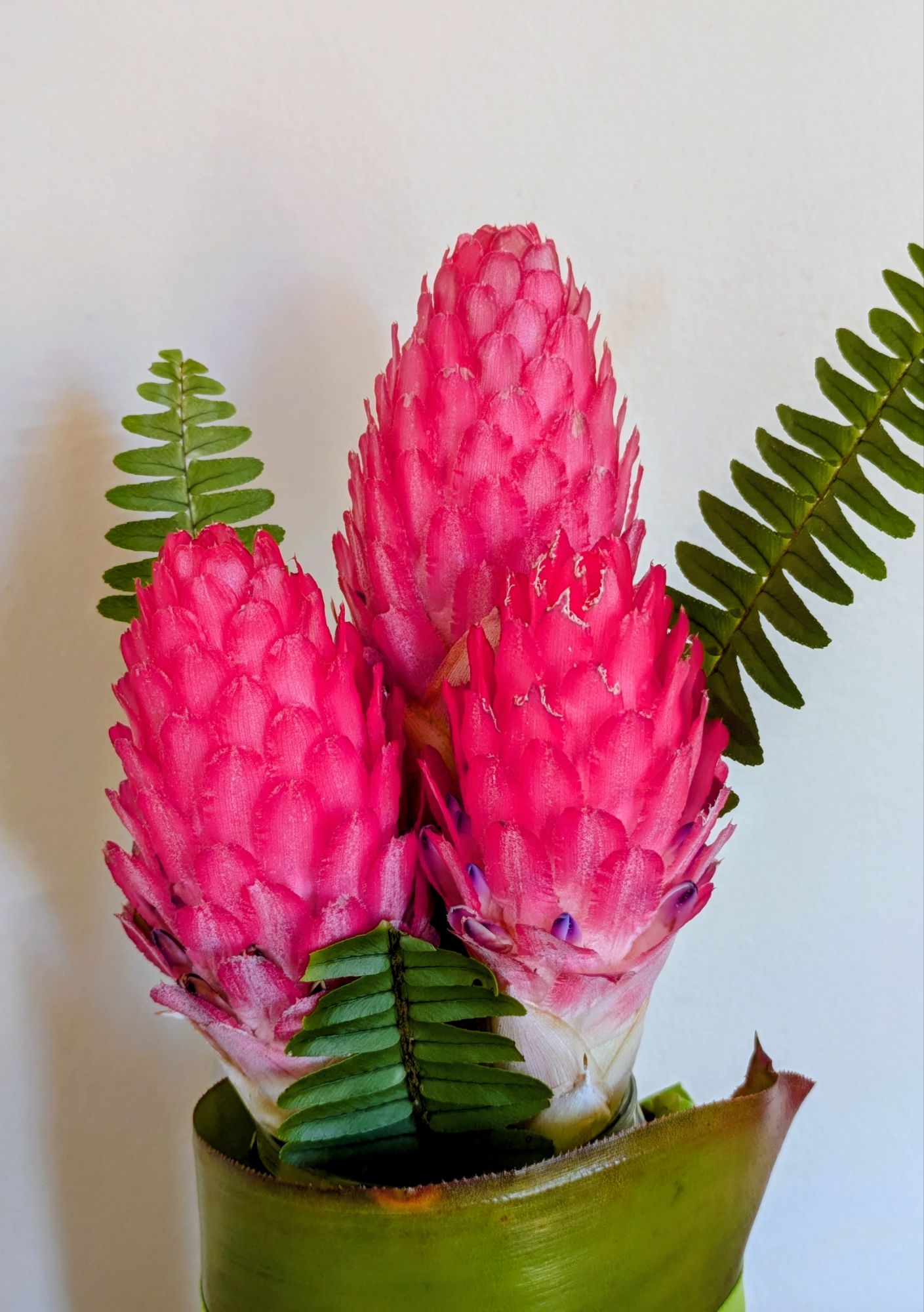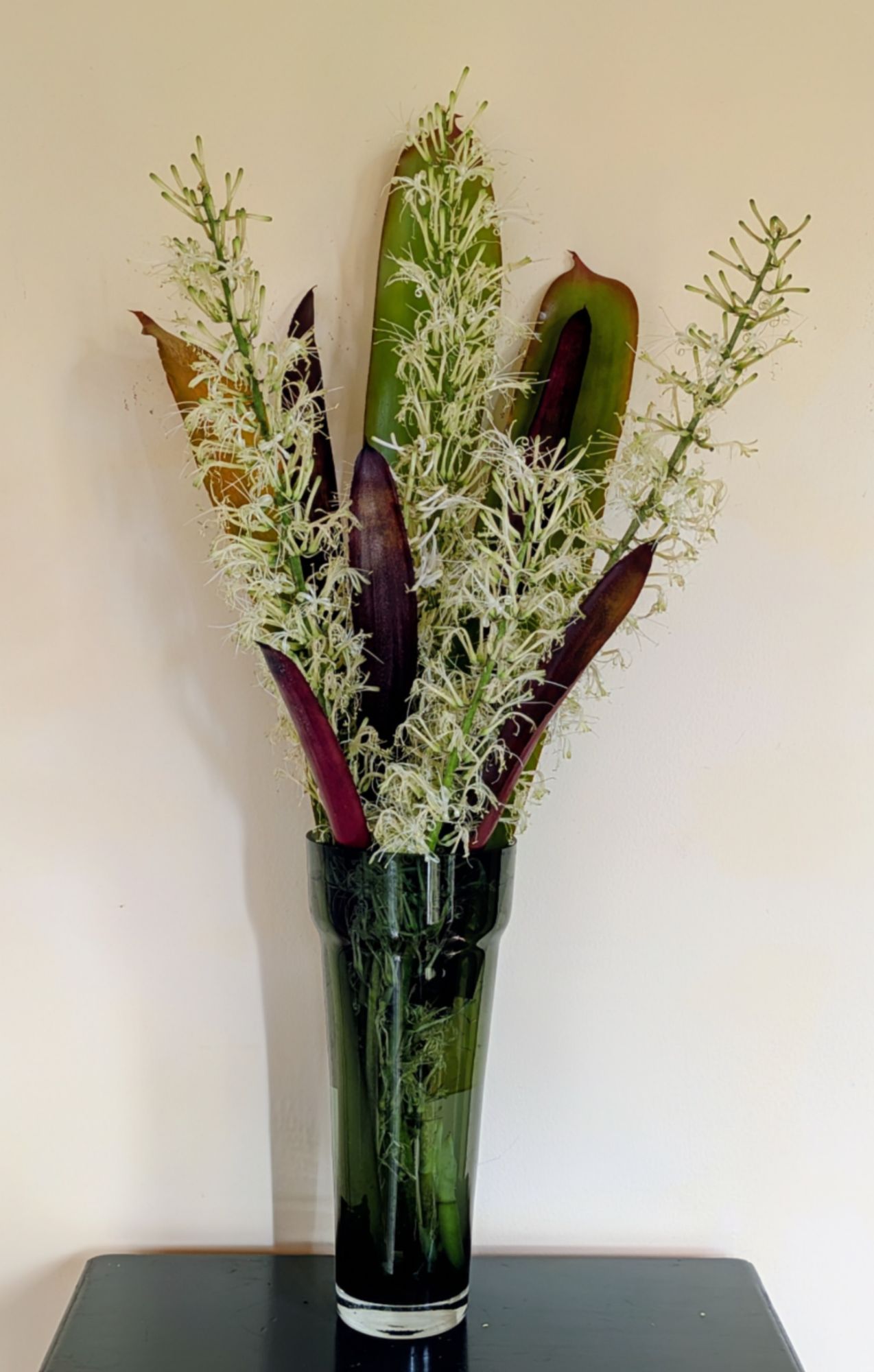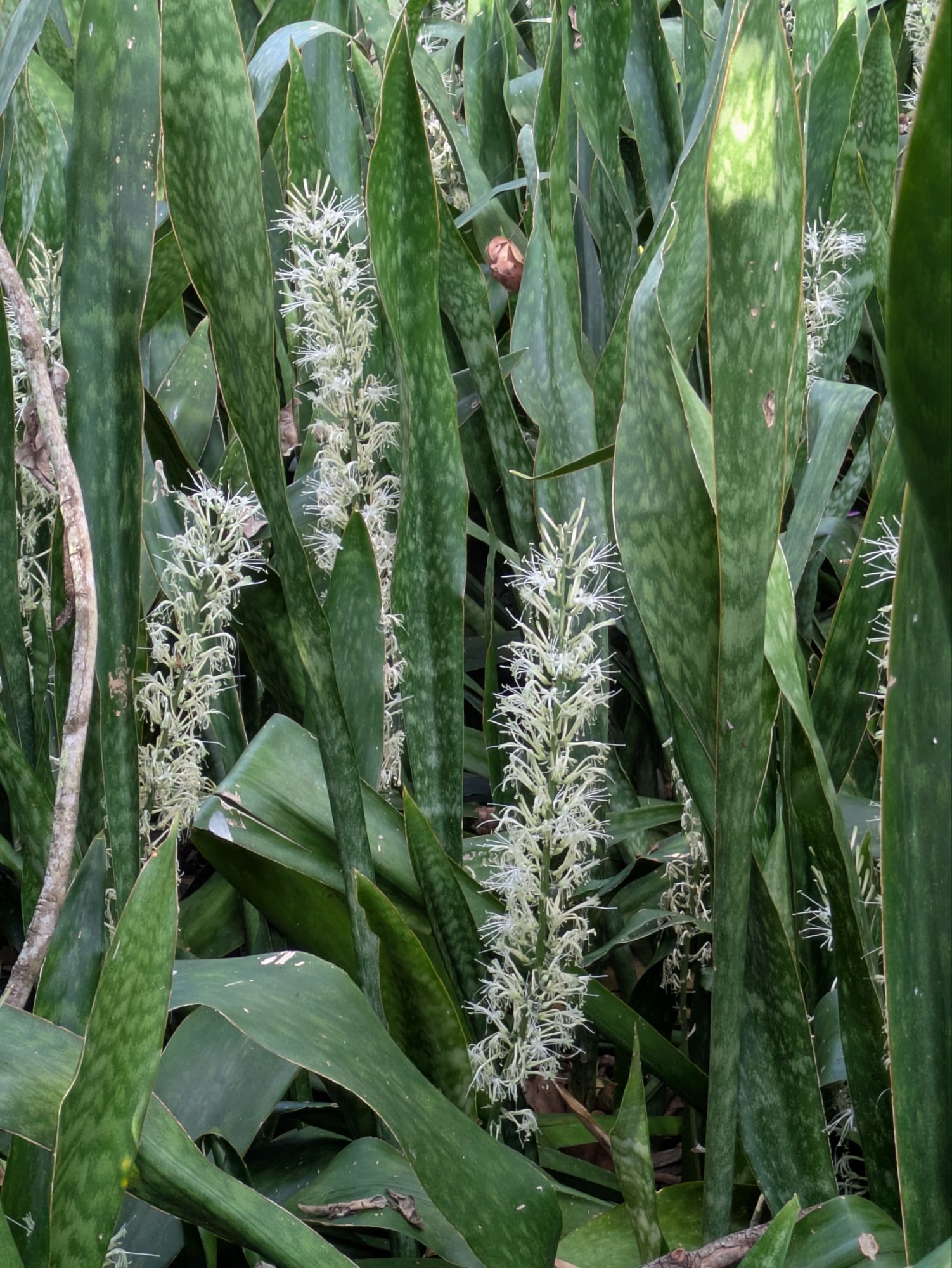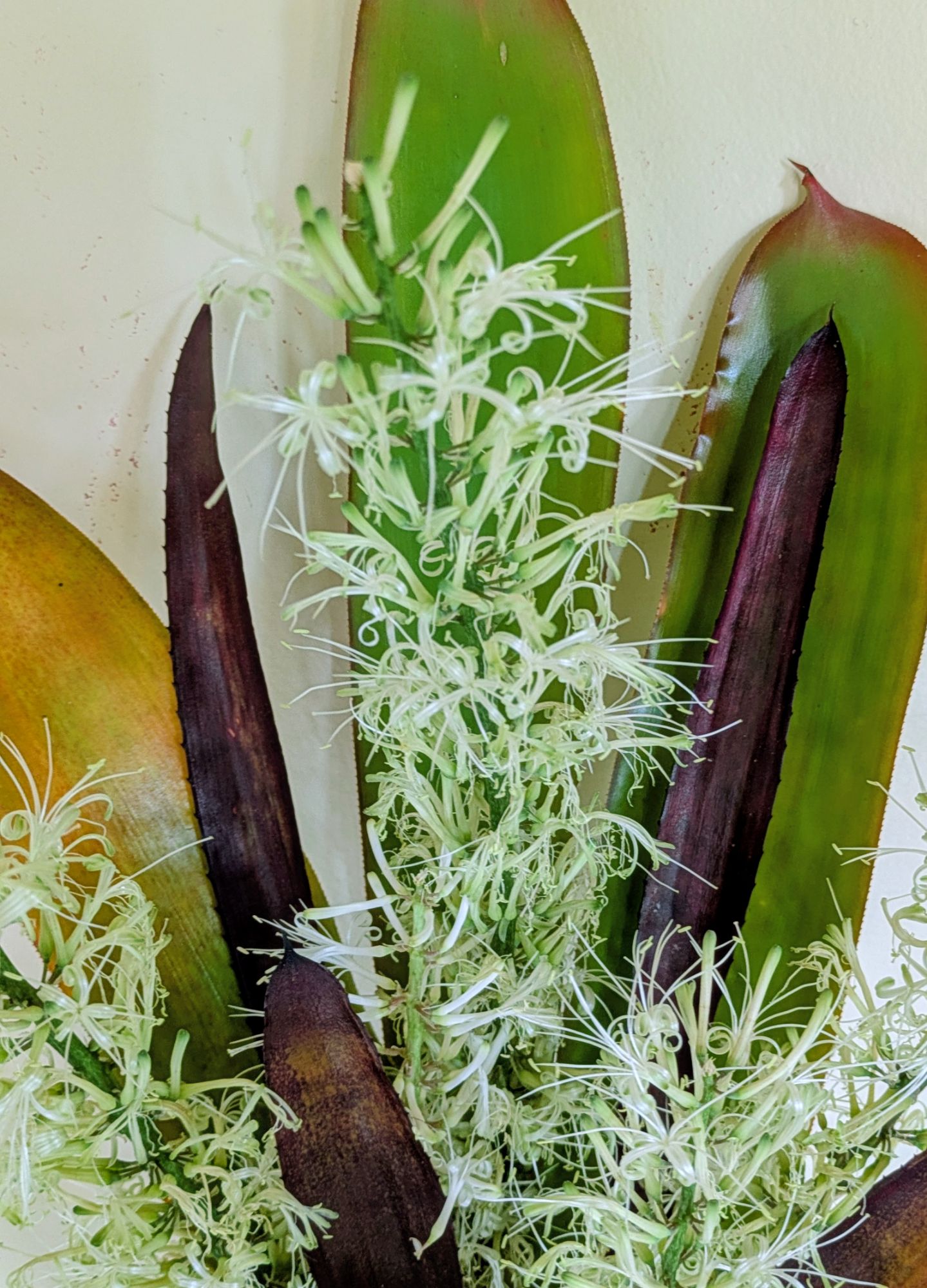
I often tell people I live in the sticks. Coming from a city of five million, that is what it seems like to me. I like sticks of all types – where I live and in vases for texture. We have had another dry spell that has slowed down the flowers (leaving some looking like sticks!) Oddly, the varmints ate all my zinnia and Rudbeckia seedlings (no sticks left) and eschewed the parsley – literally. I am not sure if the varmints are gourmets or anti-snobs as they turned up their noses at my fancy favorite parsley. Varmints are tiresome.
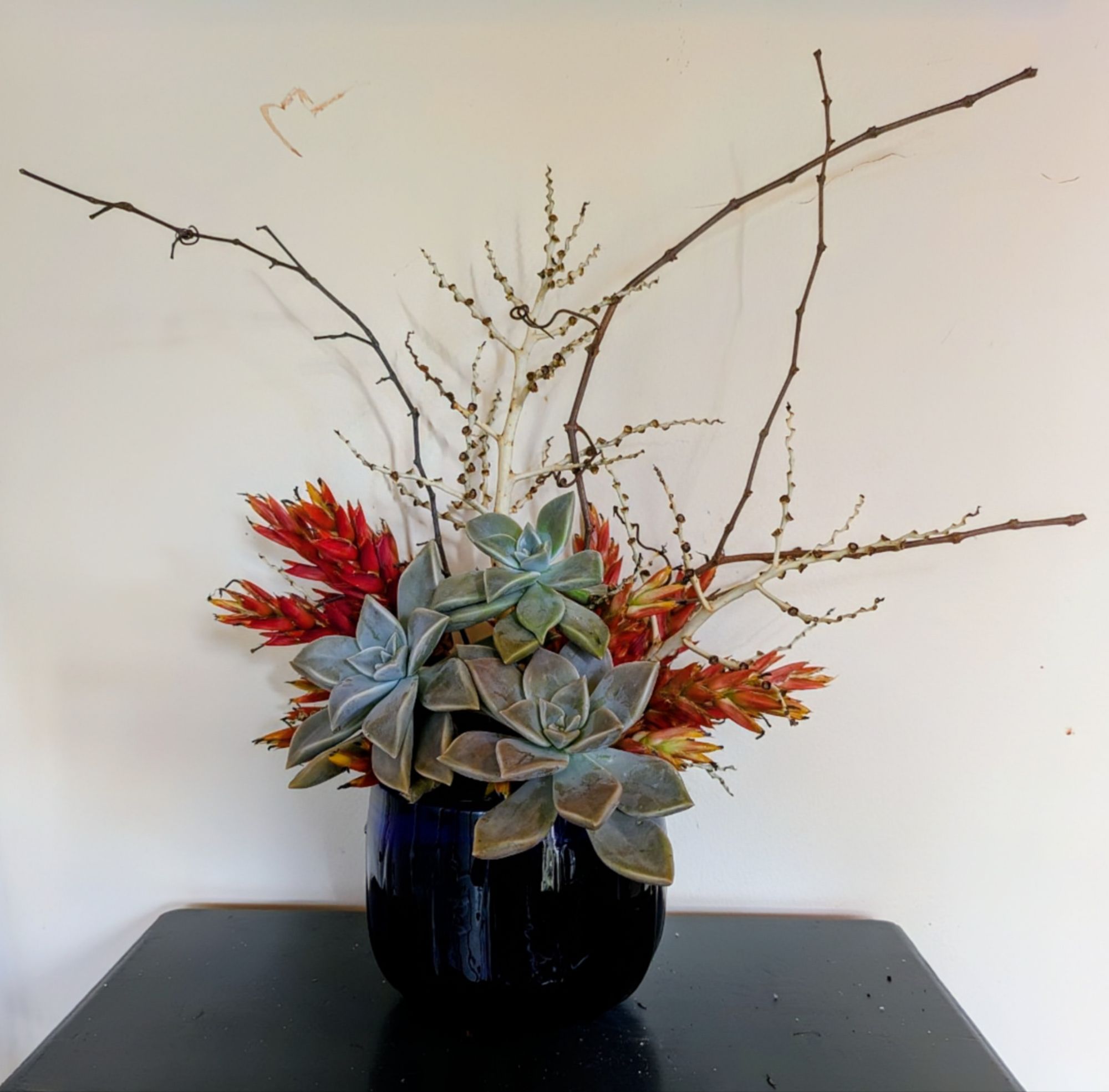
This vase, unlike the garden, requires no water. It did require a bit of a balancing act. The cuttings are balanced along the edge of the vase, I took the pictures quickly.
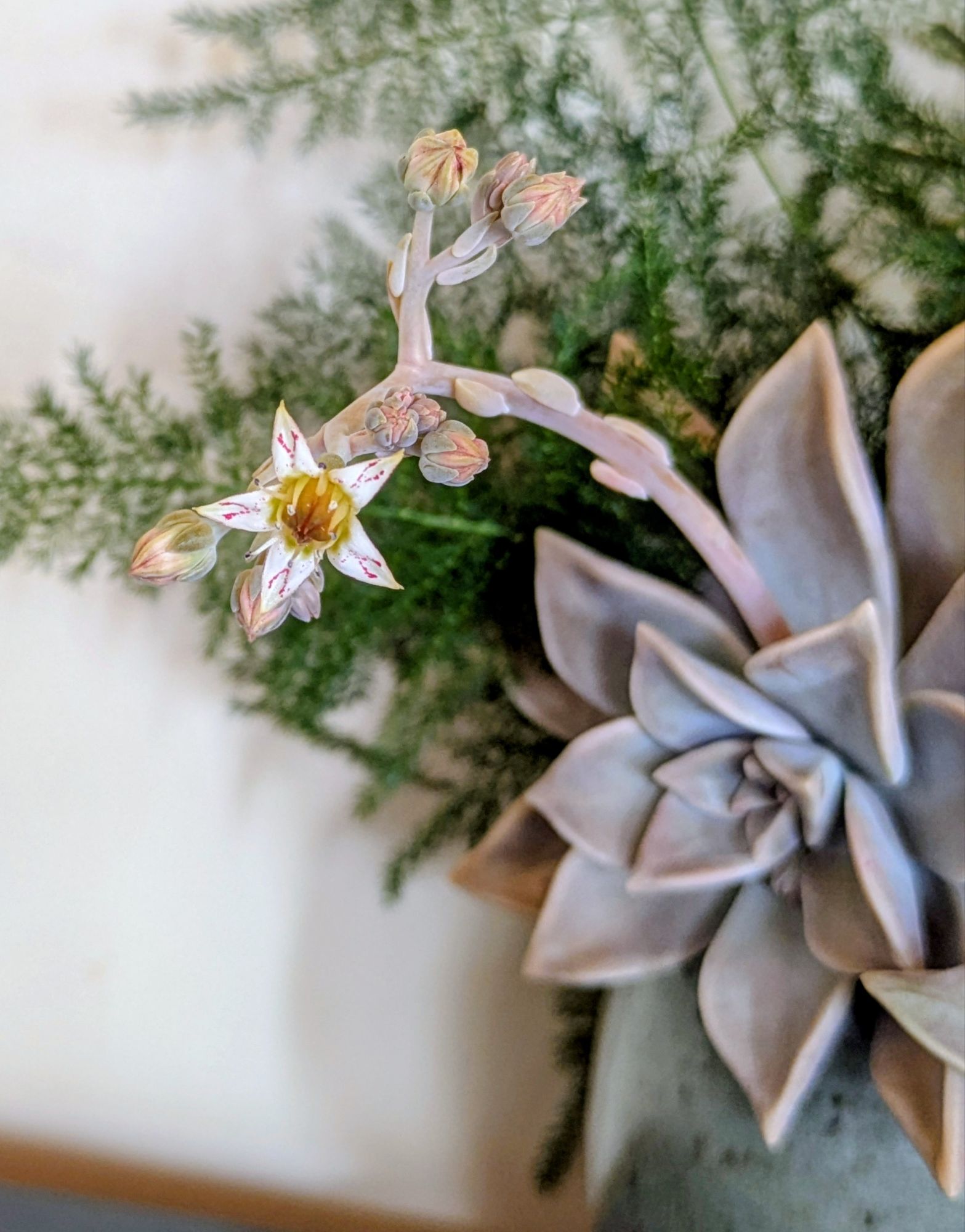
A closer view.
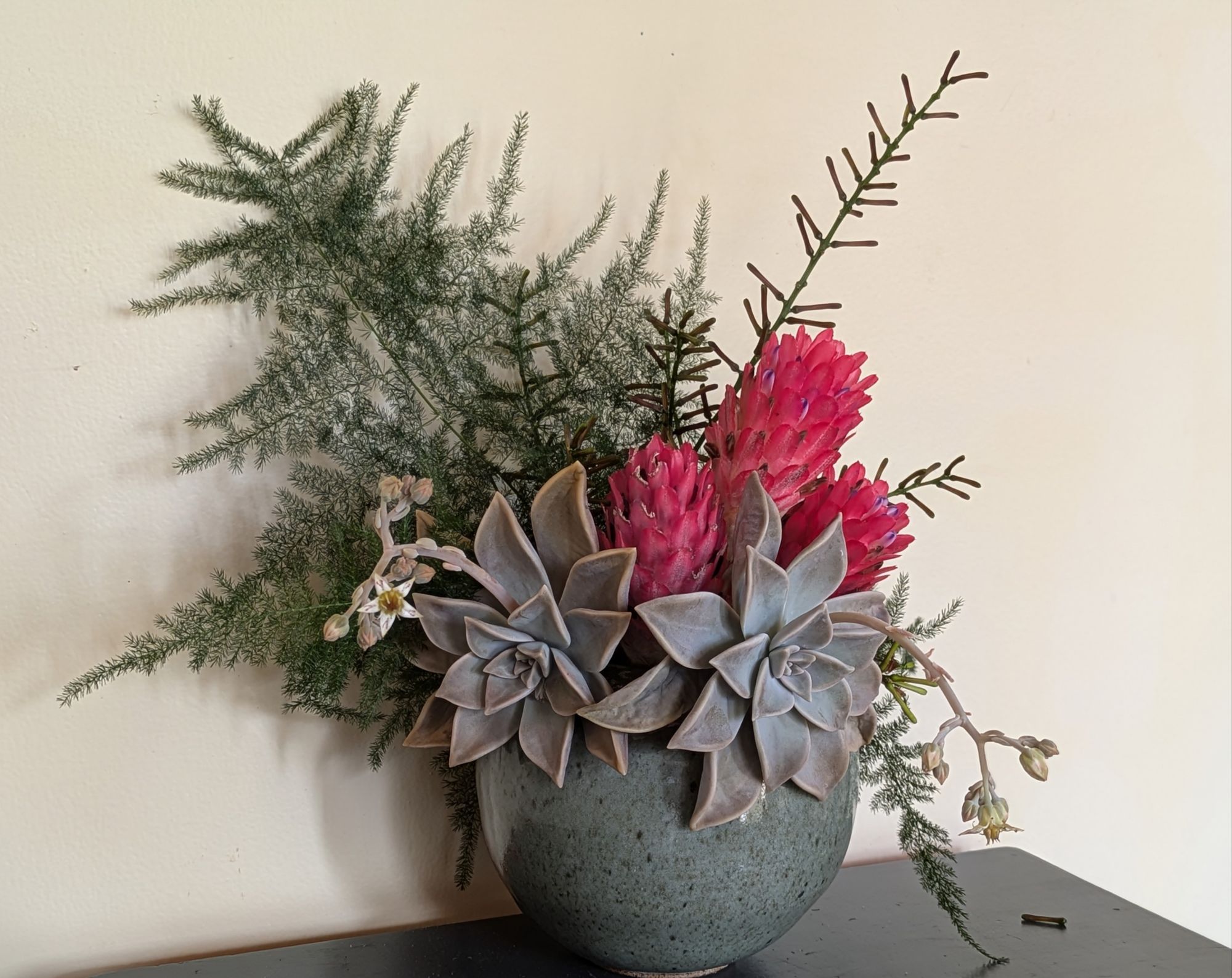
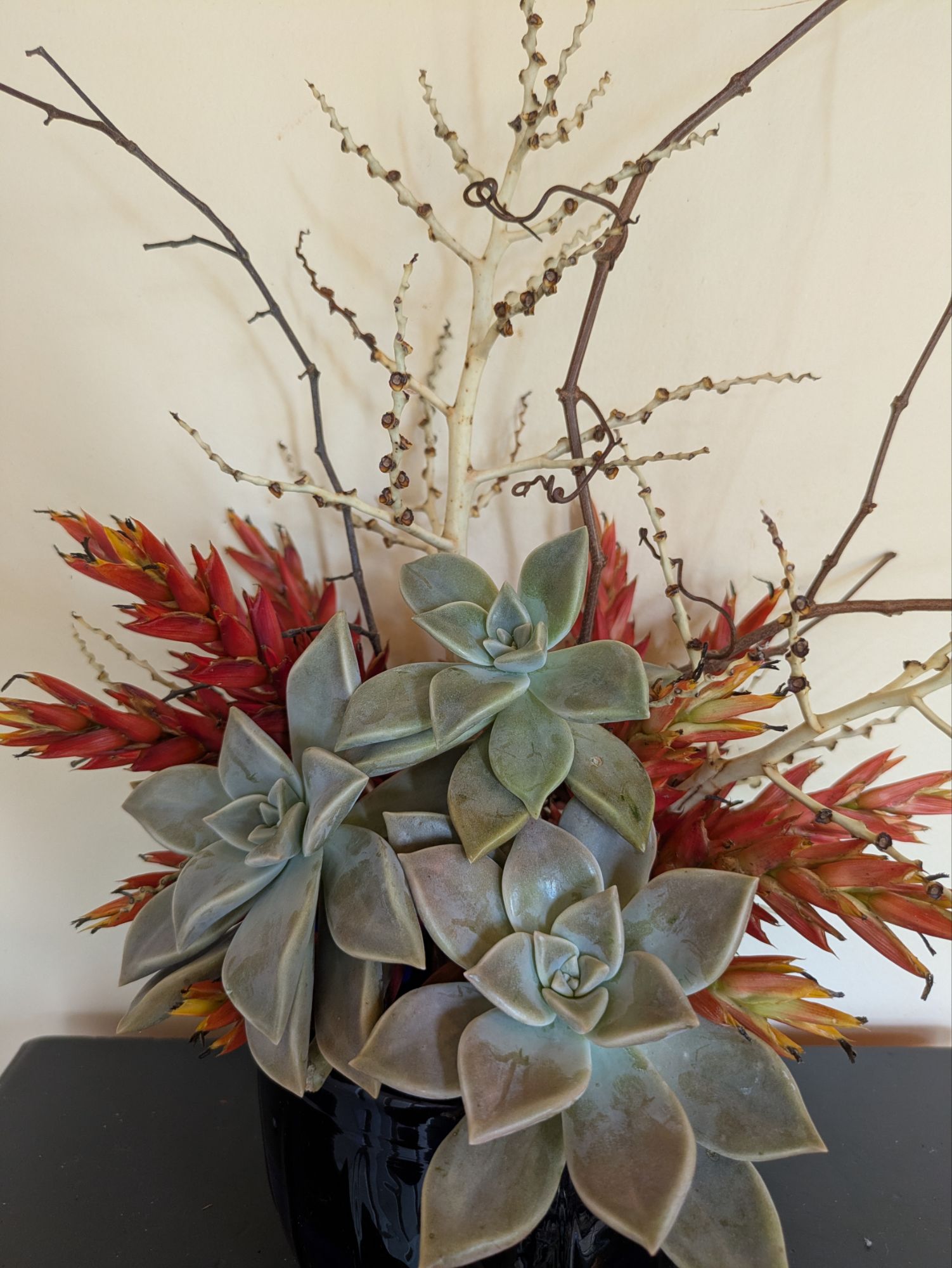
The grey “flowers” are Graptosedum. These are absurdly easy to grow here. I have pots of them and they drop leaves that grow under the pots. Orange flowers are dried Aechmea rubens bromeliad flowers. White sticks are stems from the flowers of the Adonidia Palm (Veitchii merrilli). Brown sticks are native grapes – Muscadines (Vitis rotundifolia)
Thanks to Cathy for hosting. To view more vases follow the link RamblingintheGarden
There are still some unresolved seasonal dilemmas I have to cope with living in South Florida. It’s Thanksgiving in the US this week and I need a harvest themed arrangement with berries and fall color. No funky tropicals, just some fall color. The hunt was on!
After rooting around in the garden I realized a little compromise was required. Fall color is not found in deciduous trees here, but other plants – and berries we have. The basket was located and snipping began.
A closer view:
The fall color compromise is displayed in its full glory. The rusty red Aechmea rubens flower. Yellow flowers are Beach Sunflowers (Helianthus debilis). Purple berries are from the Beautyberry (Calliocarpa americana).
Another view:
Berries are from the Gumbo Limbo (Bursea simaruba) you can’t get much more tropical than that. The (I use the term loosely) fall leaves are from a Raggedy Ann Copperleaf (Acalphya wilkesiana)
White filler flowers are Juba Bush (Iresine diffusa) my fall favorite.
I think my Thanksgiving arrangement has been cobbled together without tropical vibes. I can go forth and thaw my turkey and make cranberry relish in peace now. Happy Thanksgiving to my American counterparts.
In the United States, Thanksgiving is about expressing gratitude and thanking those who have helped us. Some of you know I have been arguing with Inflammatory Breast Cancer for the past four years and it is truly difficult for me to express my gratitude for having my blog community as an escape from the grind of the process. I detest the warrior/battle ethos. And pink for the most part.
Here is a link for more info. There are groups in the UK, Canada and Australia https://theibcnetwork.org/
So, Thank You.
And thanks to Cathy for hosting this sanity saving meme! (my sanity) Follow the link to her blog to see other vases. RamblingintheGarden
This vase is a reflection of the changing seasons in the garden. It features some of my favorite flowers. It’s surprising how long some of them hang around the garden.
The lower part of the arrangement displays bromeliad flowers that dried on the plant. The blooms started in July. I like the muted colors of the dried Broms. I cut some when they were fresh this summer and am still enjoying the flowers months later. They were originally bright reds and oranges. Here are the red flowers from a July IAVOM post.
These bright red flowers (Aechmea miniata) fade to the rusty apricot above. The rusty feathered flowers (Aechmea Rubens) deepen in color through the summer.
Some closer views:
The brown flower with rounded elements is from Aechmea miniata Bromeliad. The orange flower is Chocochiana Heliconia (Heliconia psittacorum). Feathered flowers are from Aechmea Rubens.
The rest of the arrangement is “Lady Di” Heliconia (Heliconia psittacorum) in red and yellow. The ferns are my favorite invasive fern, the Asian Sword. The vase came with a flower arrangement that was not from my garden.
It’s Monday again.I’m joining Cathy and the intrepid producers of floral artistry with a mad concoction from my South Florida garden. Happy Monday!
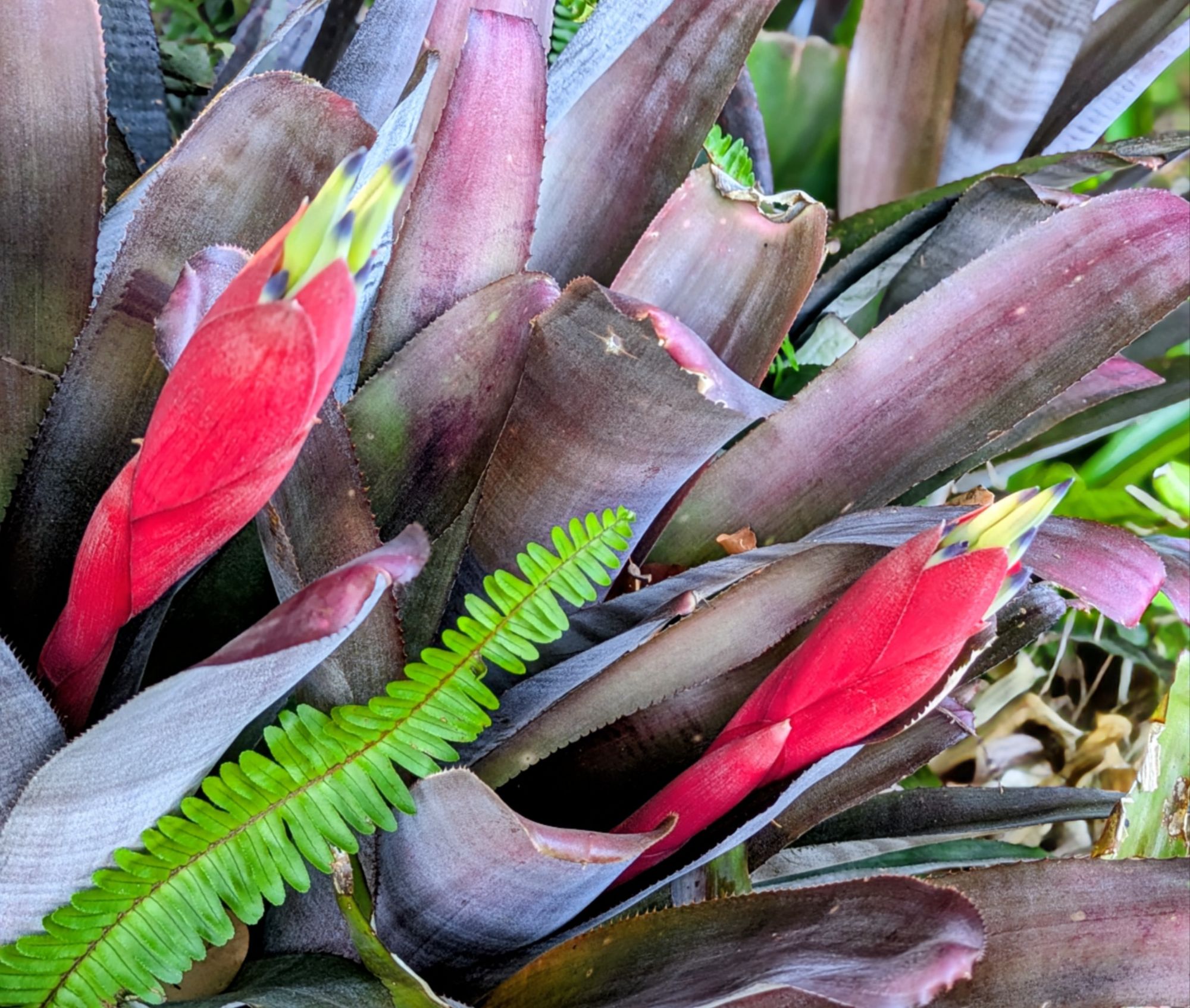
The Bromeliads in my garden are welcoming their season to shine. It’s possible to have Bromeliad flowers year round, but the winter months are when they are happiest. November through March is the time to move the plants around, cut and propagate pups, and cut flowers if you are lucky.
This is no surprise to me as I doubt I encountered a Bromeliad growing up in the Deep South – most people gawk when seeing flowers like these and say “What in the world is that?” I found these plants so intriguing (and bulletproof to boot) I have them everywhere.
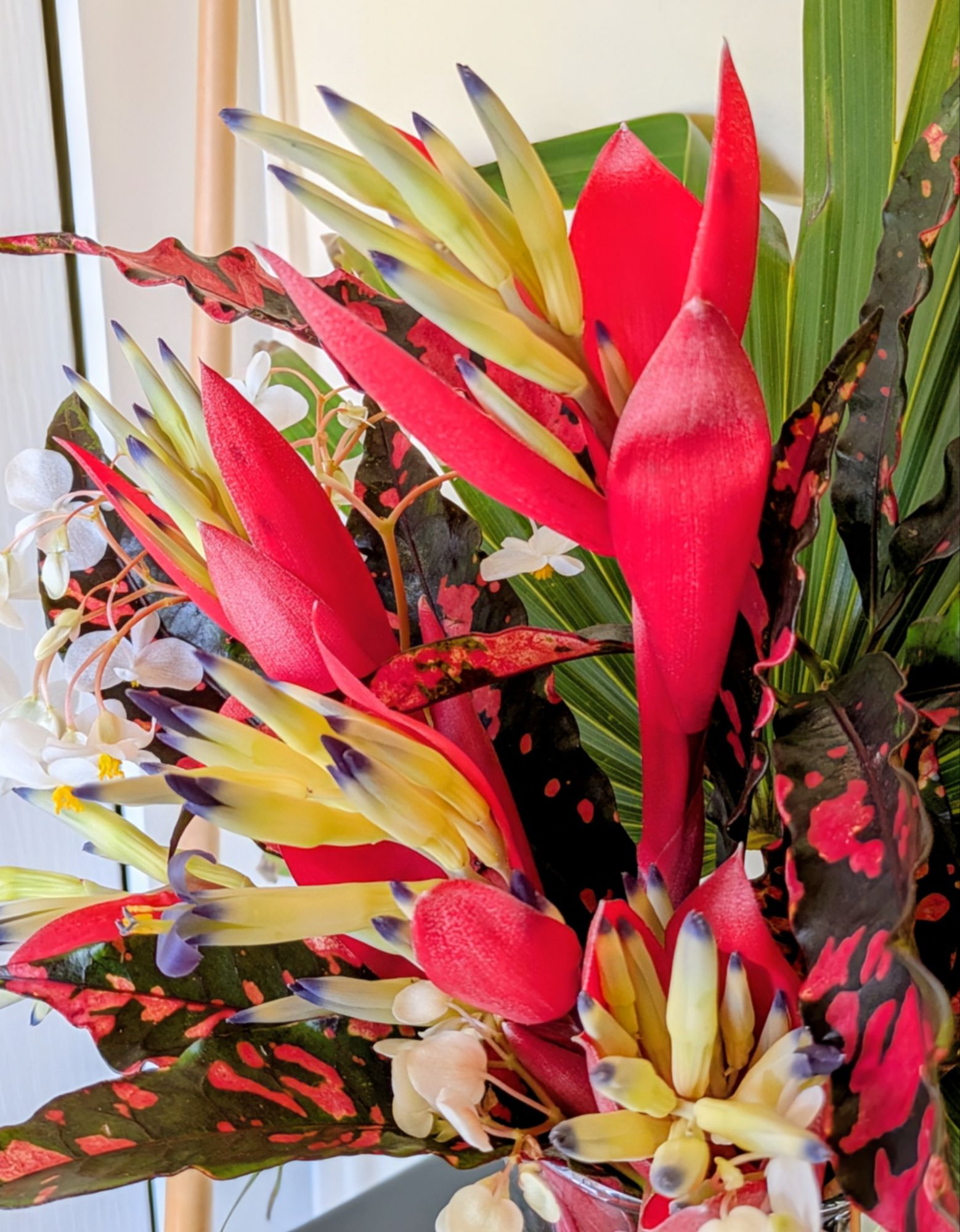
Some closer views. I am wondering if anyone else uses a Pixel phone? The latest upgrade has been giving me fits.
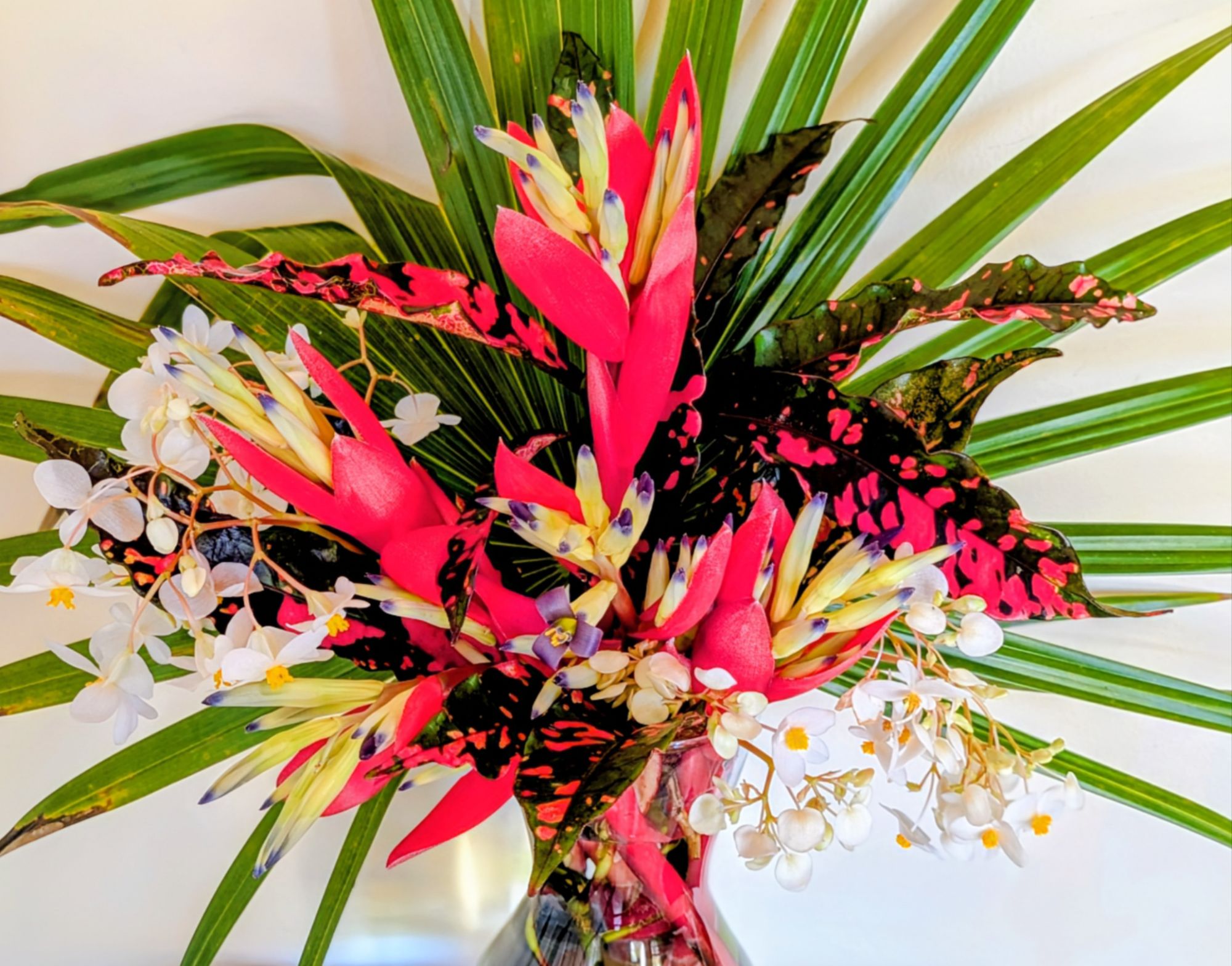
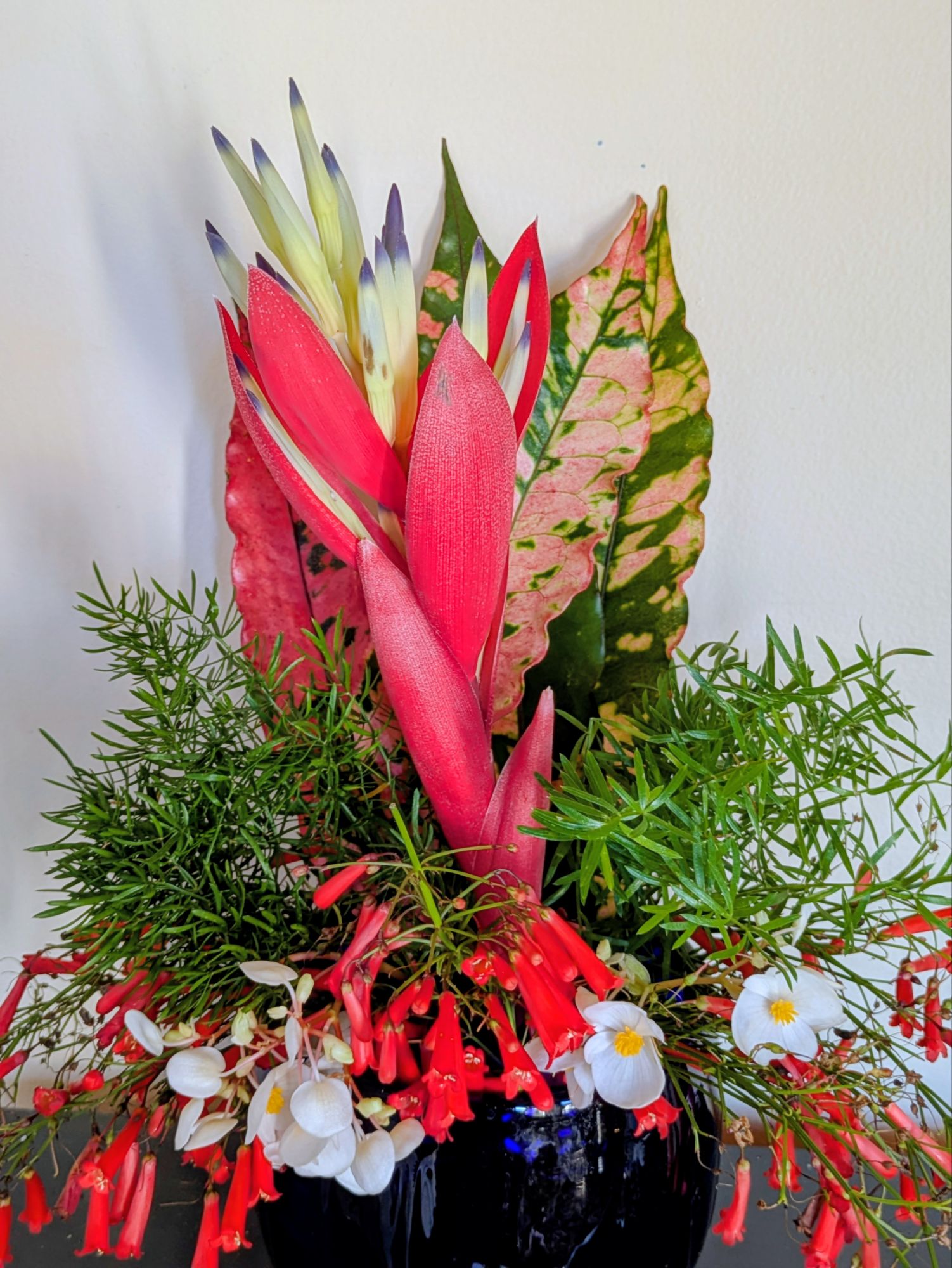
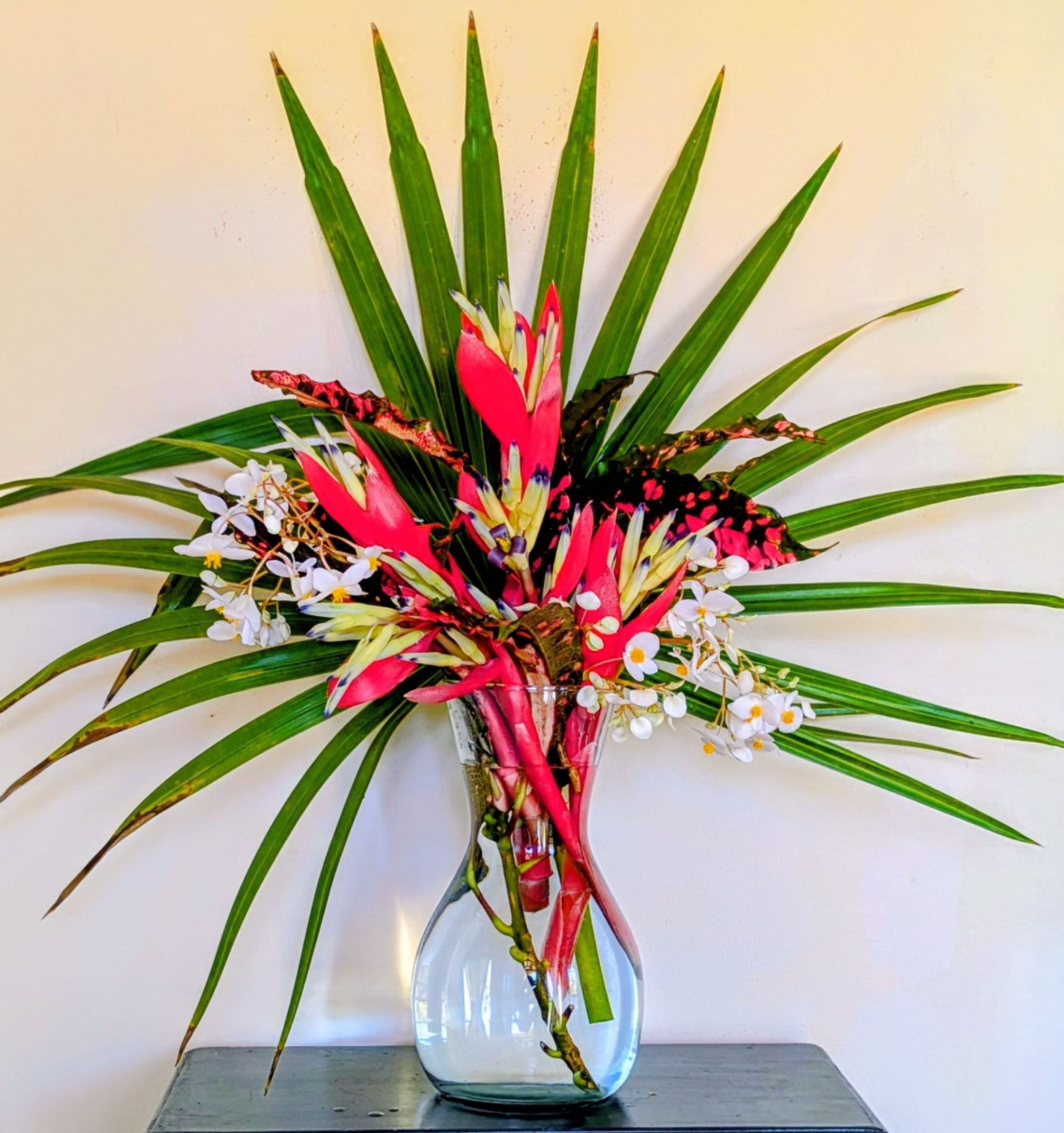
The pale yellow flowers are “Little Harv” Aechmea Bromeliad.
Blue and pink flowers are “Candy” Portea Bromeliads. White flowers are Dragonwing Begonias.
Foliage is from pineapple plants and a White Bird of Paradise.
Thank you to Cathy for hosting. Follow the link to RamblingintheGarden to see more vases.
It’s no secret I love Salvia. I was delighted to see a bevy of blossoms after a few intense rain showers last week. I cut a large handful of mostly red, with a little off red and white. The Tropical Red Salvia (Salvia coccinea) is not really true to seed and color ranges from neon orange to coral, pink and pure red. This off red is a new color, surprising me by flourishing in nearly full shade.
I think I created a Freudian flower arrangement. Does it look like it is shooting a peace sign or is it just me? I fear for my country and am hoping for peace.
A close up of the Tropical Red Salvia (Salva coccinea). The background plants are Lemon Blanchetiana Bromeliad foliage and Asian Sword Ferns. A sprig of Bridal Bouquet Frangipani (Plumeria pudica) was added for fragrance.
A twining stem of Coral Vine graces the edge of the vase. This vine (Antigonon leptopus) refuses to grow on the fence it was planted beside and prefers to climb the very thorny lime tree. I pick a piece out now and then and usually manage to get stabbed.
Peace be with you all.
Visit Cathy’s blog RamblingintheGarden and follow the links to see more vases.
September is finally here. It rained, the weather cooled (ever so slightly) and the flowers opened their buds and cheered. I collected a few of the celebrants, then added some fruits and foliage and am now enjoying the fall colors.
While many lament the end of summer, we celebrate in South Florida. Cooler weather is on the way!
I have had zinnias through the summer. Interestingly, they produced half sized flowers through the August heat. I have a big container still going and hope the flowers get bigger with fall’s arrival. The white daisies are Bidens alba, an indestructible native wildflower. The burgundy foliage is from Aechmea ‘Burgundy’ Bromeliads.
The purple beautyberries (Calliocarpa americana) have been spectacular this year. Even my husband noticed, which is a bit shocking. I collected another cup of berries to freeze and bake treats later. Red flowers are Tropical Red Salvia (Salvia coccinea). Green foliage is Asian Sword Ferns (Nephrolepis brownii) and Macwilliamsii Neoregelia Bromeliad.
I am looking forward to spending more time outside. We are working on a new seating area in my front garden for butterfly reconnaissance. Plotting plantings! Bought chairs and flamingo fabric for pillows. My husband wants to build a platform deck. Autumn Cheers!
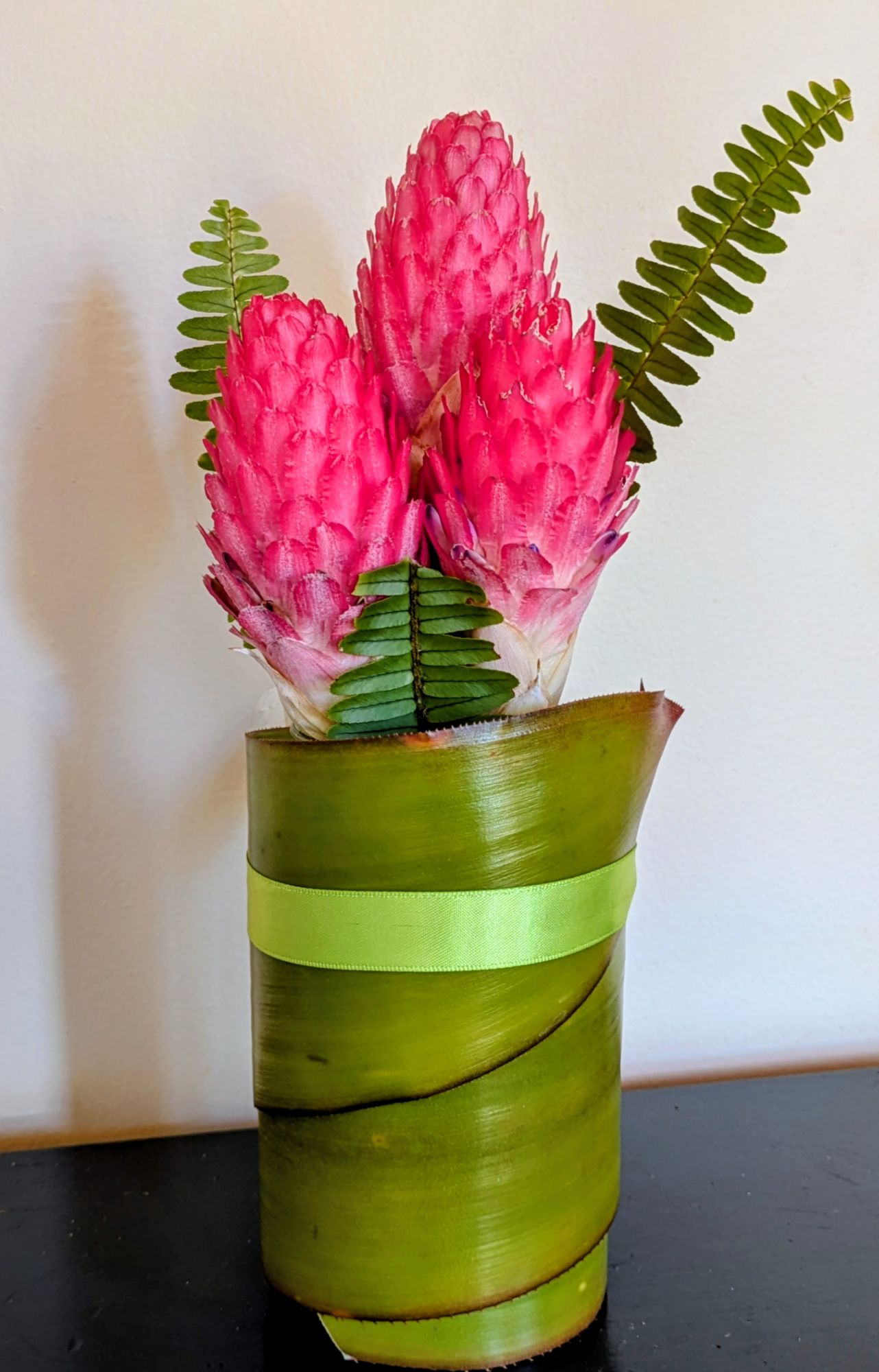
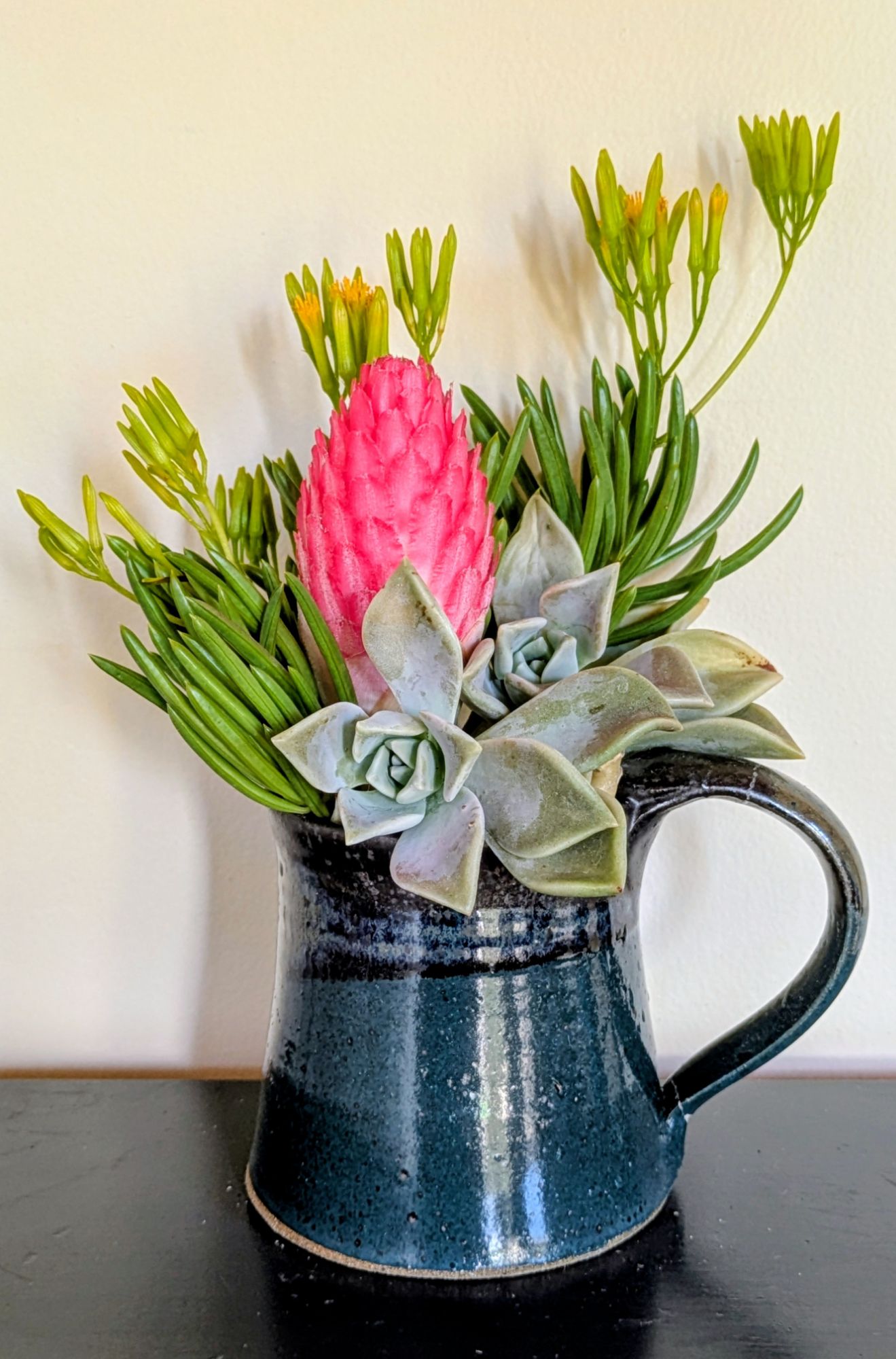
I recently acquired some fabric called Tropical Fantasy. It features animals lurking in palm trees and giant teapots. I believe this vase fits quite well into that theme. Many bromeliad flowers are the embodiment of a tropical fantasy. I get a head shaking moment every now and then in the garden and ask myself “is that a flower or what?”
Our rainy season is taking a long holiday from precipitation. Scorched is the new normal as temperatures have been over 90 (32C) for the past few weeks. The good news is the humidity dropped. The bad news is this is making the orchids very unhappy. I can’t get enough water on them and have had to pull some up to get them out of the sun. I can’t recall ever having crispy brown orchids.
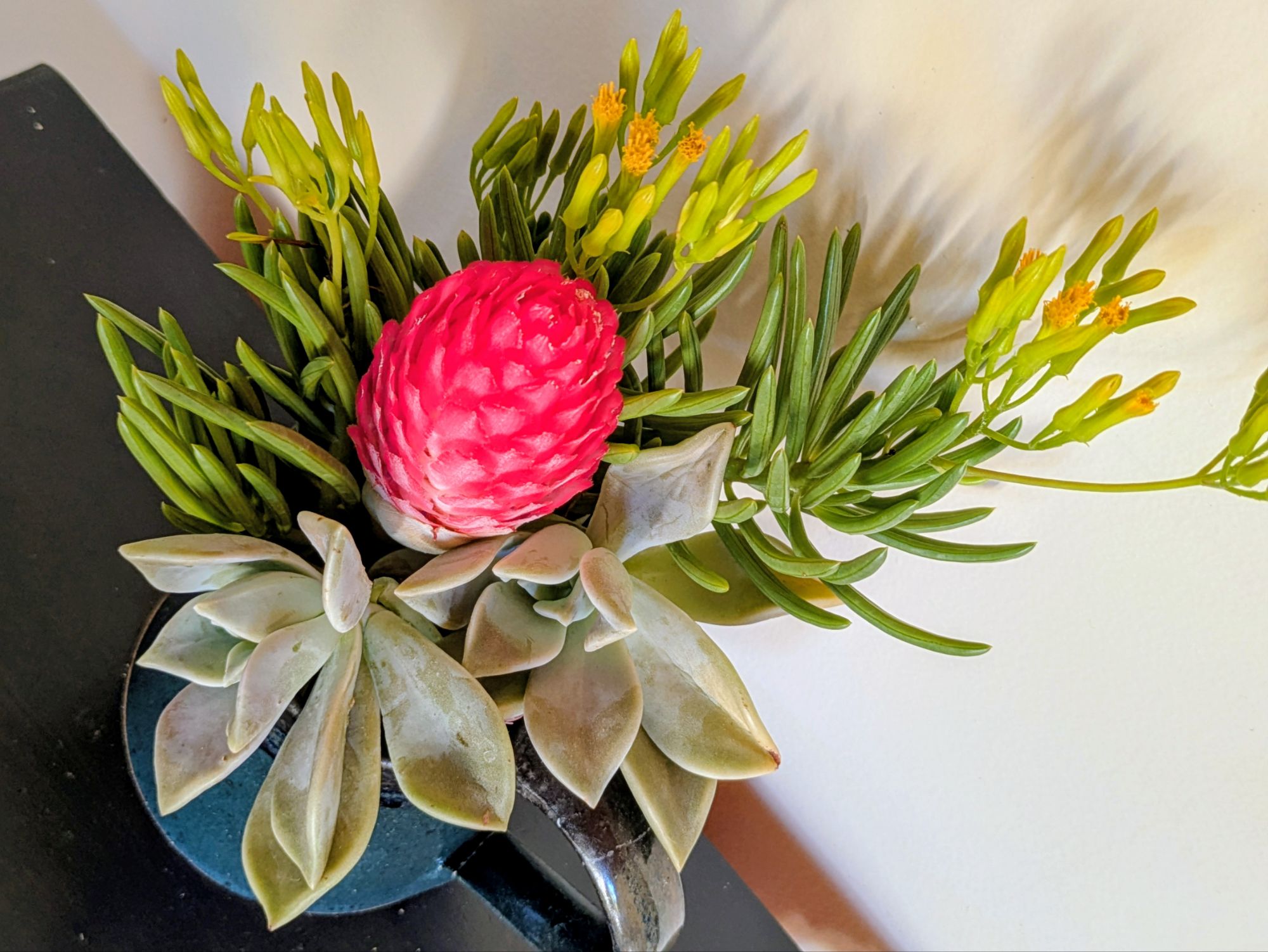
The components:
This is the appropriately named “Fantasia” Aechmea Bromeliad. The foliage is a sawtooth edged silvery grey with pink undertones, pretty fantastic.
These flowers are from two different Aechmea blanchetiana bromeliads. Red stemmed flowers are from the raspberry cultivar and the yellow one is from lemon. The foliage is red or yellow tinged in these two varieties. The Blanchetiana comes in a number of colors, one called iced tea due to the foliage color. These are stunning in the sun. Foliage in the vase is prunings from Dracaena reflexa. These used to be called Pleomele, I think. The one in my garden is (or was!) about 15 feet tall. It was growing over the bottom of the roof so I trimmed it back.
That’s all from the slow simmer setting in South Florida. Thanks to Cathy for hosting our weekly vase adventure into other gardens and climates. To see more vases follow this link RamblingintheGarden.
Saturday morning found me taking pictures in the garden yet again. I am joining in the SOS crowd flocking to Jim’s blog to share six items of interest from their gardens. Today I am featuring summer flowering bromeliads from my tropical oasis in South Florida.
This is a Aechmea Rubens flower with a White Peacock butterfly sipping the nectar. It has been a good year for this butterfly. I have swarms of White Peacocks for some reason. I want to share what I just read on Google. Groups of butterflies can be called swarms, kaleidoscopes, or rabbles.
Buds on a Aechmea ‘Little Harv’ bromeliad.
Another view of ‘Little Harv’. These get much taller and open, the stem is hot pink.
This is Aechmea bracteata in full bloom. These last a long time and eventually dry to a straw color.
Aechmea blanchetiana ‘Lemon’ shooting up flower spikes. These are three or four feet tall and will open up a bit. They remind me of crustaceans.
Aechmea miniata bromeliad flowers. These are my favorites. Easy to grow and nice, low foliage that is not sharp.
That’s all from sweltering South Florida. We are just out of the heat dome in the Eastern US thankfully. It is much warmer further north.
It seems I always find a few things I want to add to the garden – in July. Not a great time for shipping plants to South Florida. I managed to control myself (a little) and bought a few new plants shipped from nearby. July can be a good time to plant things due to copious rainfall.
My garden tour this morning revealed a few other new things in the garden – one has already been eaten! Please join other SOS bloggers and their six items of interest at Jim’s Blog (Garden Ruminations) for more summer fun.
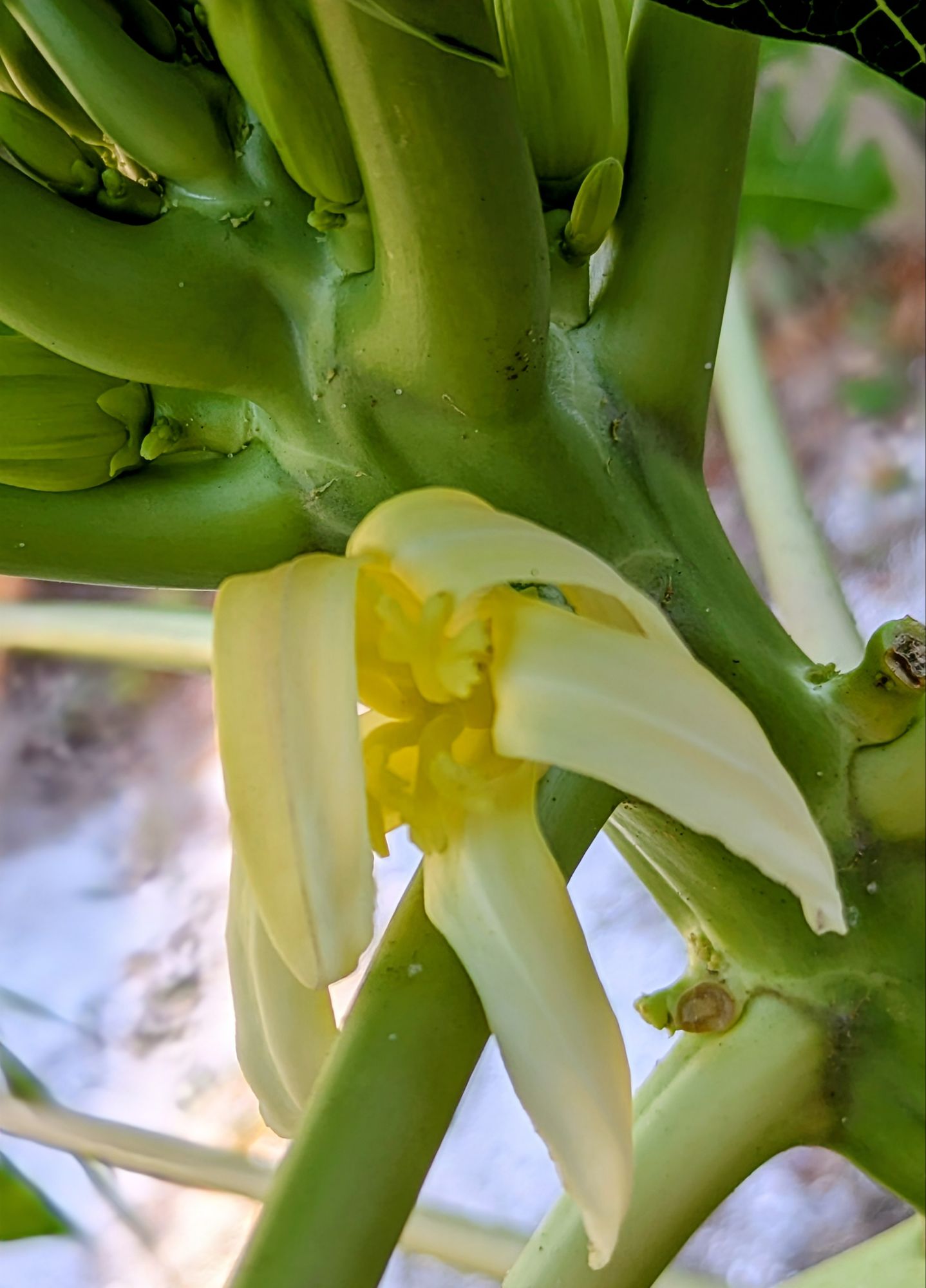
The Yellow Dragonfruit is once again teasing me with a flower. These are pollinated by night flying bats and moths. At this point I am not sure I have any of those in the garden. Usually I get some flowers for a short (hours long) period and they fall off. I thought I would try the paint brush around the inside of the flower and then looked inside.
The flower was loaded with insects doing more than I could ever hope for with a paintbrush. I’ll know in a week or so if there will be fruit.
The homegrown pineapple (on the left) was harvested and devoured. These pineapples are usually much smaller than the grocery store varieties (on the right) I am not sure why because they are grown from the tops of grocery store pineapples? The fruit is sweeter and juicier than pineapples from the store. Delicious.
These are new to the garden. I bought the cuttings of Reed Orchid (Epiprenum radicans). These can be grown in the ground here and are used as a groundcover. This one has orange flowers that look like dendrobium clusters, but they come in many colors. I put it in a terracotta pot to keep the rabbits away. It should take and creep over the sides of the pot and fill in the bed.
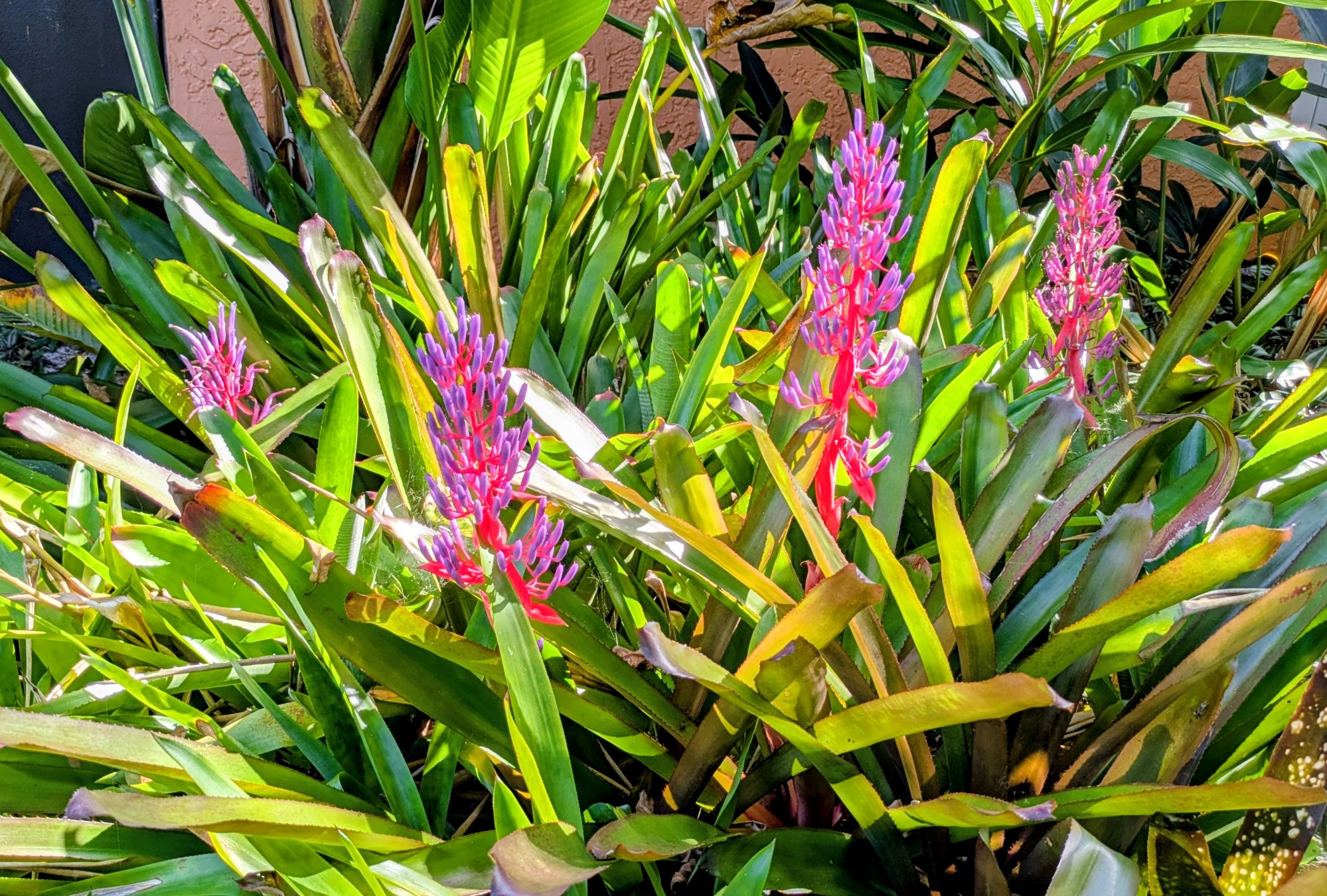
Meet ‘Absolute Zero’ Crypanthus bromeliad. These are shade lovers and should have pink flowers. The common name is Earth Star. I intend to put these in the ground near the Epiprenums. After receiving the plant I realized the sun needs to go down in the sky a bit before I plant them. A little too much afternoon sun currently.
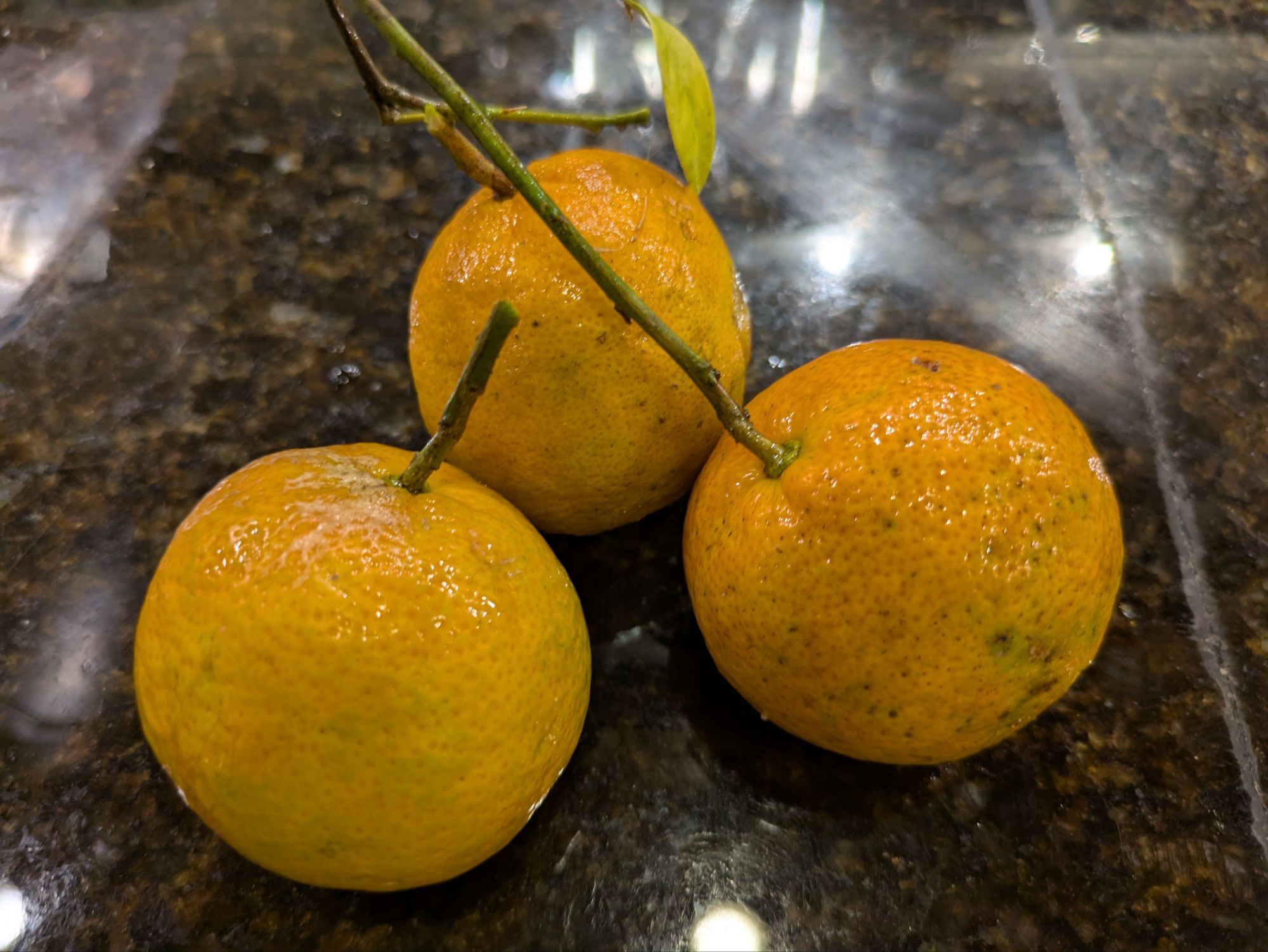
A locally grown coconut. I bought this to bake a pie, without thinking through the fact that power tools are probably needed to open it and it is the wrong kind for baking coconut. Green coconuts have coconut water and jelly. Brown coconuts have the grateable meat for pies. Sigh. Both involve screwdrivers and hammer prior to use. They can be sprouted and planted in the garden – but I am not sure which kind.
That’s all from South Florida. There is a heat advisory in effect for the next couple of days so all gardening has to be done before 9 am. I am done!
It’s high Summer, damp and humid, the tropical flowers are basking in the moisture producing bountiful flowers. For some reason a lot of these flowers are red. My theory is they are red to attract hummingbirds, seemingly a major pollinator in tropical rainforests where a lot of these plants are from. I could be wrong. I was quite surprised this morning by an aggressive Gulf Fritillary butterfly trying to get a taste of my herbal scalp conditioner!
I decided to use a primary colors theme as opposed to a patriotic one. I am finding myself embarrassed and unsupportive of what is going on in my country right now. White flowers were purposely left out. All of the plants are from elsewhere.
Red spikes are Aechmea miniata, from Brazil, surrounded by Blue Plumbago (Plumbago auriculata) from South Africa.
“Lady Di’ Heliconia (Heliconia psittacorum) flowers and foliage are in the background with a few spears of Miniature – “Lava” I think, Pineapple. Heliconias are from Central and South America. Pineapples hail from Brazil and Paraguay. The area I live in used to be home to huge pineapple plantations. I rarely run across pineapples in their natural state – extremely sharp foliage, probably four feet tall and mad colored, tiny fruit.
I think I have digressed enough! Follow this link RamblingintheGarden to visit Cathy’s blog and see what other gardeners have in their vases this Monday.