Tread Softly – or else


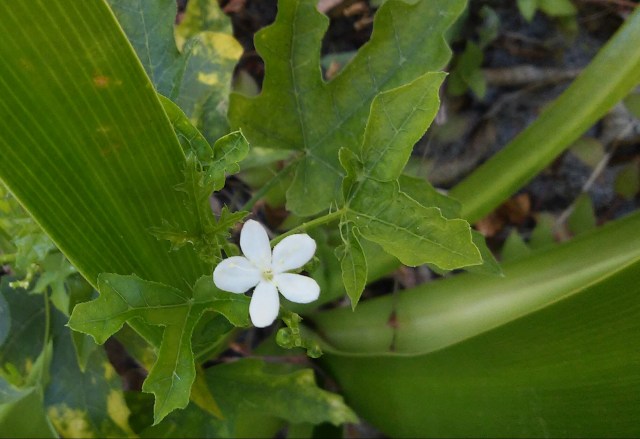
20160601_095230-1.jpg

I found out, per usual, the hard way, about another plant I am allergic to. The Stinging Nettle of South Florida, a devilish little plant with a big punch. Here it is – looking so innocent with its cute little white flower; masking the stinging nettles running up and down the stem. Just waiting for the nonchalant passerby. The straplike foliage in the picture is from a native Hymenocallis. I will have to untangle these later.

The Stinging Nettles here are commonly referred to as Tread Softly (Cnidoscolus stimulosus, if latin makes you feel happy). I hadn’t realized how many were in the so called lawn in the back until it got a little too long and they were slapping me around the ankle with their little nettles. I finally ran over one that was tall enough to see and stop just in time for it to wrap around my ankle. Here is the result:

20160601_185241

I went to rinse it off. That didn’t help. I got the duct tape to pull out the stingers, that did help. Then couldn’t remember if this is a baking soda paste cure or a vinegar cure. Looked that up on the internet after finding my reading glasses. Aha, it is baking soda paste and it did help. The picture is actually from several days later.

Moral of the story: take heart in the common name and Tread Softly.

google-site-verification: google5698a0c2451d4c56.html

In A Vase on Monday-Memorial Day Fireworks


20160529_144300

Today is Memorial Day in the United States. The first holiday weekend that kicks off the summer season and honors those who serve and served our country.

Fireworks are a relatively common occurrence on holiday weekends during the summer; the Fourth of July being the primary holiday associated with fireworks. One can generally find some fireworks on Memorial Day and Labor Day weekends as well. My gardens have been providing some fireworks of a different sort as the heat of summer starts ramping up.

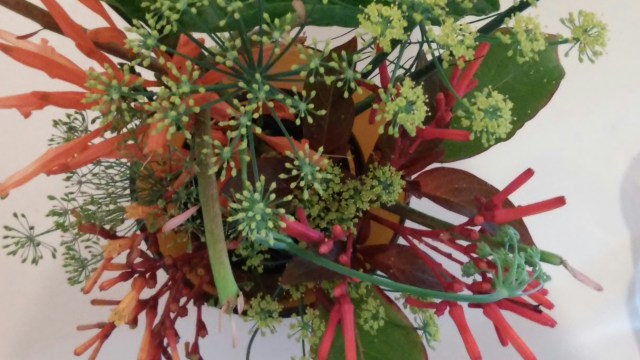
In keeping with my fireworks theme, I began looking around my garden. I have several Firebush, some volunteers and some I paid for. The Firebush flowers look like firecrackers and further searching located some seed heads of culinary Fennel and Dill, the umbels exploding with seed really look like fireworks to me. Here is the Firebush, the native one. I have learned it is called Hamelia patens var patens as plain H. patens is different. Sometimes I think botanists really need to get over it and just call it something else. Of course, I was not consulted on this matter.

20160503_182813

Here is an overhead view, I have to say I like this as it really looks like fireworks:

20160529_143901-1

Included in the vase are the two types of Firebush, the red on the right Hamelia patens var patens, the middle orange one is H. patens and on the left side is Mexican Honeysuckle, the Justicia from last week. The fennel and dill seed heads are in yellow green.

The vase is not a vase at all. It is one half of a set of Dansk candlesticks my husband has carried around since the seventies. Looks pretty good holding all that firepower. It has never held a candle during my tenure, but I may use it as a vase again.

Mom Nature Lights My Fire

This plant appeared in my garden a couple of years ago. I thought it was some sort of Amaranthus blown in from across the Atlantic Ocean and decided to leave it to see what happened. Amaranthus can have some interesting flowers (Love Lies Bleeding, etc.) The foliage started getting red around the edges, confirming my thoughts, then the stems started getting woody. Maybe it wasn’t Amaranthus at all.

Then it flowered.

20160503_182813

Definitely not an Amaranth. Not a clue what it was. So, I took this to the Native Plant Society meeting and they said Firebush. Hamelia patens var patens? I said no, it couldn’t be, this is my Firebush, Hamelia patens. Orange flowers and the leaves are half as big.

20150625_081158

Firebush and Friend

Then it dawned on me, there is a great deal of arguing about the true native Firebush. I  usually ignore this kind of argument being more designer than botanist, but think I am agreeing with the Hamelia patens var patens crowd. The orange flowering one is supposed to be from the Caribbean somewhere instead of Florida. Given the seemingly magical appearance of the patens var patens in my garden, I think that the red one is the native.

Mother Nature really is a good designer, she placed the Native Red Firebush in a bed of red and yellow Heliconias behind some yellow Beach Sunflowers and across from some red Bromeliads. Perfect.

20160504_131122-1

Now if everything would just grow together. And be happy.


In a Vase on Monday -Natives Tea Party

20160410_160949-1.jpg


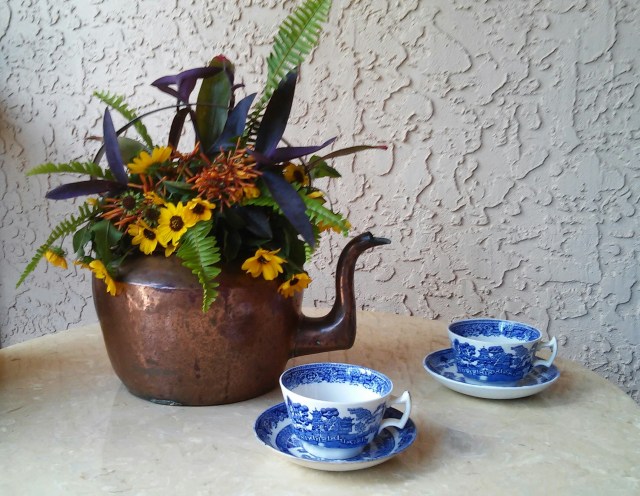
The copper tea kettle is one of my favorite things. I bought at a flea market on a weekend trip to the Appalachian Mountains many years ago. I am relatively certain it won’t hold water as it was repaired on the bottom and you can see through the repair. What is lovely about this kettle is the patina of many years of use with dents and hand crafted solder joints adding to its beauty. I can only speculate how many souls have been warmed by the contents of this vessel. The Blue Willow teacups are English and belonged to my grandmother, the saucers are too cracked to use and are kept for their patina as well.

As neither the cups or the kettle can be used for tea, this is a party for the natives. The native flowers in the kettle, of course. The arrangement is primarily native plants of South Florida, the yellow flowers are Beach Sunflower (Helianthus debilis), the orange tubular flowers are Firebush (Hamelia patens), Boston Fern, the purple foliage is Purple Hearts (Setcresea pallida), native to North America says the Florida plant database, and joining the party some Painted Fingernail Bromeliad foliage with the cerise tips, from somewhere south of the border.

As I was arranging the flowers in a pickle jar to place inside the kettle, it occurred to me I should go antiquing to see if I could find some copper friends to join the kettle.

In A Vase on Monday -The Bovine Micro Meadow

20160306_160023

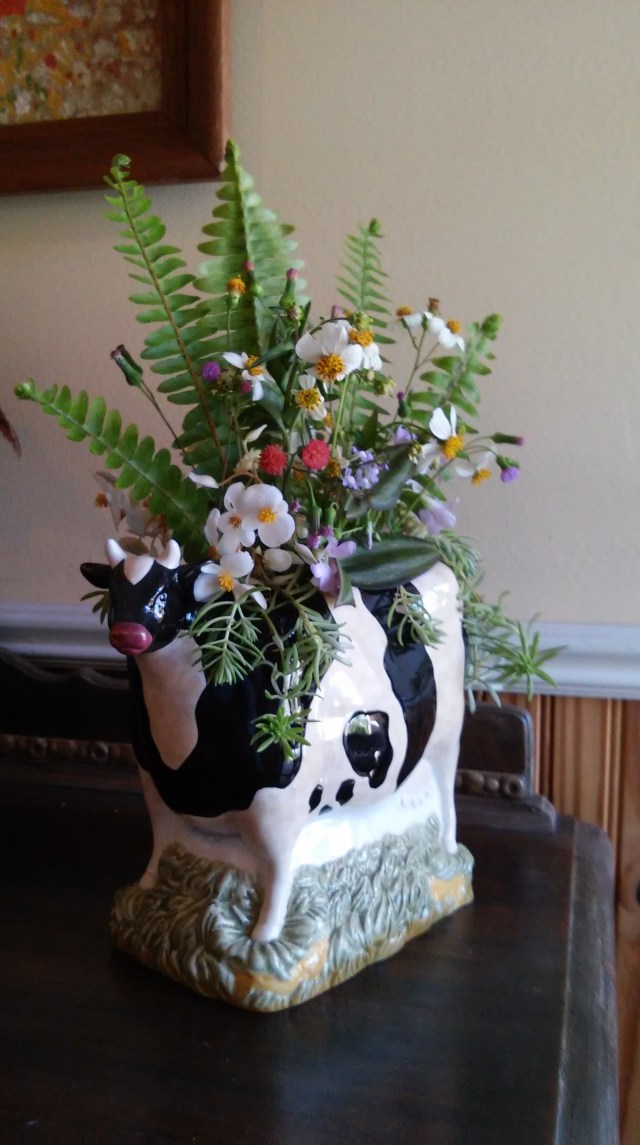
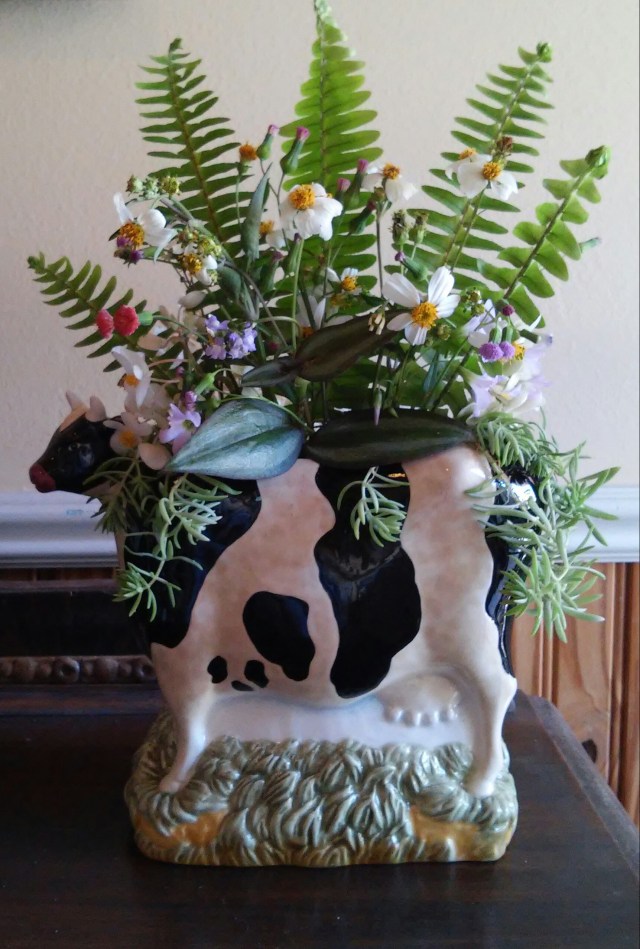
Here is another member of my cow family. A real cow vase. I have a matching hand soap dispenser. I bought the set in a store that sells samples. My suspicion is the vendor figured the market for a matching set of cow vase and soap dispenser was limited and stopped with the samples. I have enjoyed these, although the vase is oddly constructed and difficult to arrange flowers in – mostly it sits on the shelf and exudes bovine loveliness.

20160306_155833-1

The idea for this was based on cows grazing in a meadow. The micro meadow is a tiny representation of what grows in my meadow. The “lawn” in my back yard is truly appalling, so I have many meadow plants. I am not terribly bothered by this as lawn beauty in South Florida is difficult to attain without loads of water and chemicals. Meadow it is. Mown intractable weeds could be another term used to describe the “lawn” My younger greyhound has beaten a perfect racing track into part of it. Flowering meadow plants and sand are for the greyhounds, my gardens are kept away from thundering paws.

20160306_155933

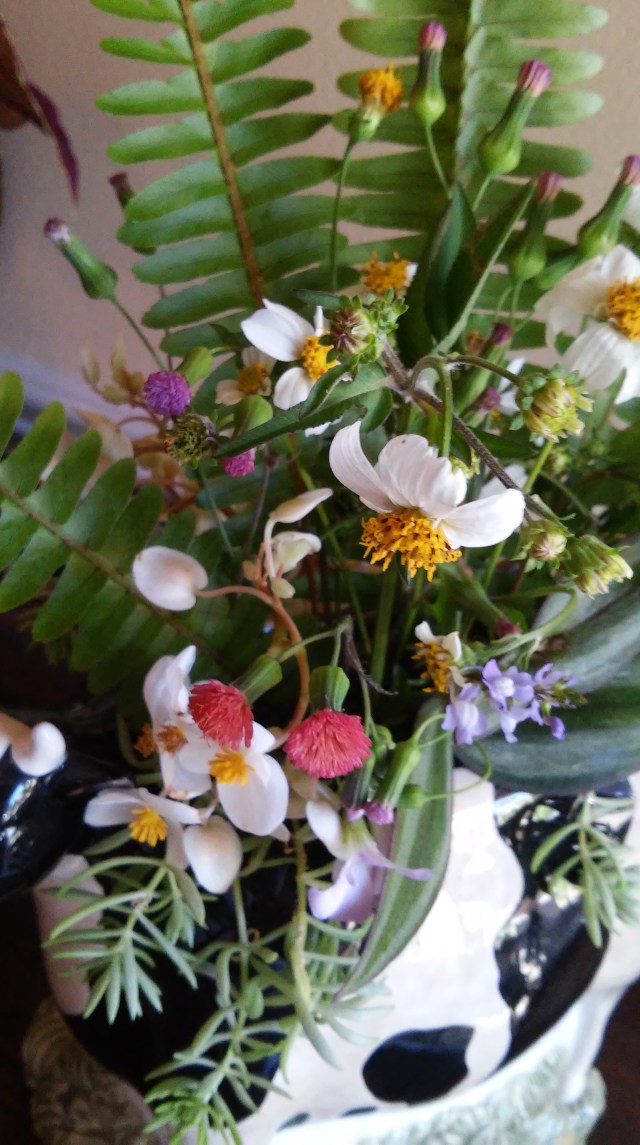
Here is a close up of the plants. There is some Florida friendly Chartruese Sedum at each end (friendly is propaganda from our Extension Service – the plant grows great in a pot with potting soil, if put in the garden a very different story), Sweet Begonia and Spanish Needles in white, the purple and red plants are pretty ( a weed I am not sure I want to identify) but I have been trying to eradicate them and they are frighteningly prolific. Boston Fern and the Wandering Jew (Transcandentia zebrina) just pop up in the meadow. Strange but true.

And my favorite cow family member:


My cow dog, Charles the Greyhound, racing name GLO Cornjacker, a dear friend and companion for the past six years; he retired from racing in 2010 and is nearly ten years old.

He hangs out in the meadow frequently and sometimes snacks on it.


In A Vase on Monday -Going Native

20160207_130423-1

One of the results of moving to Florida from a colder climate – sooner or later you go native. Winter Coats, who needs ’em? The coats are the first thing to go followed by socks, then shoes (sandals are an exception) and most long pants. One year my husband felt compelled to wear long pants twice. It was 50 degrees.

Plants for the garden are no exception. The first thing I had to quit desiring was Japanese Maples, followed by Yoshino Cherries. I got over Azaleas and Roses prior to moving south. Now and again I will suffer perennial envy, then again we have a plethora of great plants here in Florida – many are new to me.

I have always been a fan of native plants and decided to learn more about them by taking an online course about native plants on the Treasure Coast of Florida, taught by the guys behind the WordPress blog, Treasure Coast Natives. This one is for you, George.

20160207_130315-1

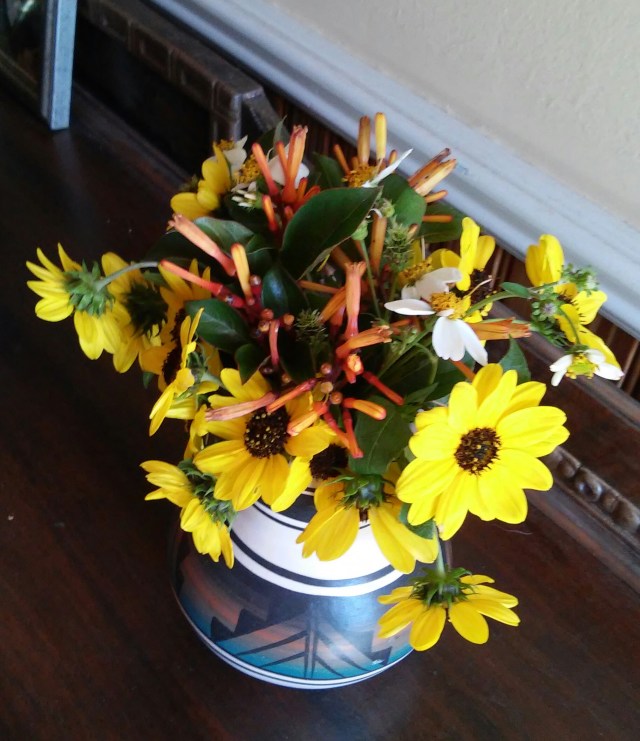
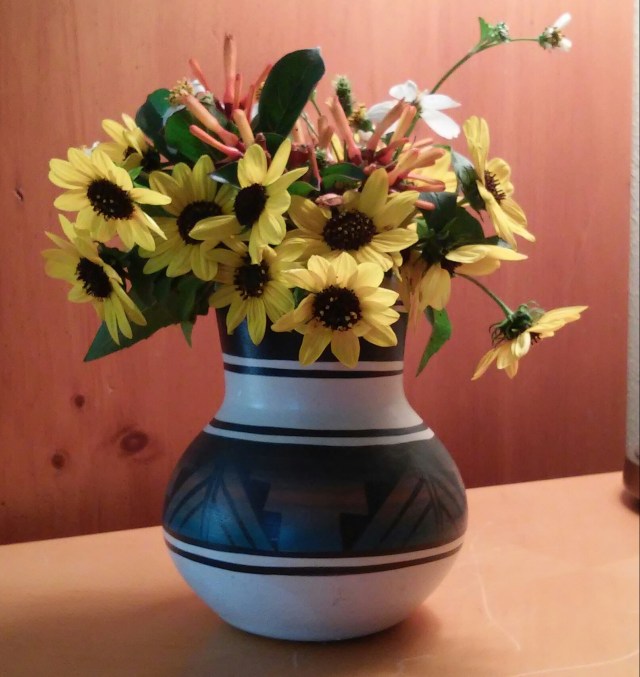
The flowers in this vase are all native and from plants included in the online course. The yellow flowers are Beach Sunflowers (Helianthus debilis), the white flowers are Spanish Needles (Bidens alba), the orange tubular flowers are Firebush, actually Dwarf Firebush (Hamelia patens) I planted the Beach Sunflowers and Firebush but the Spanish Needles appeared on their own and seed freely everywhere cursing me forever.

The vase is also a sort of native. A gift from my mother bought on one of her trips to the Southwestern United States, the vase was made by Native Americans of the Ute tribe and marked as such. One of my favorite things from my mother.

One of the benefits of native plants in the garden is the local butterflies love them. Here is a Zebra Longwing Butterfly on the Firebush:

20150625_081158

Firebush and Friend


In a Vase on Monday – The Wildflower Blues


20160117_154405-1

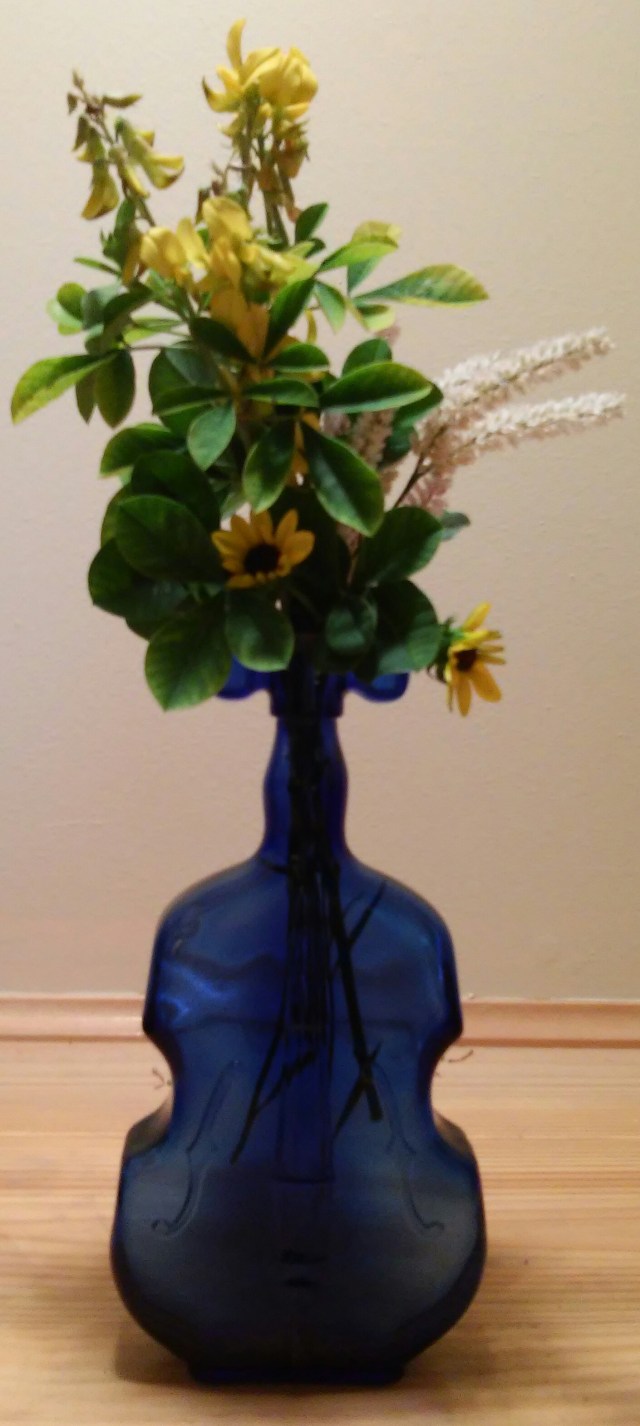
I have been watching a group of Yellow Lupines on the edges of a vacant lot nearby – thinking I could collect some seed and grow Lupines in my back garden. What I did not realize is when the seed pods are ready they explode and hurl seed far and wide. The pods exploded in my car and didn’t seem to think there was enough dirt to grow in the carpets, though there probably is as I haul dogs and plants around with equal enthusiasm. I am not sure if these plants are native to the area, but I am aware of other native Lupines in Florida; it seems peculiar as I associate these plants with Alpine meadows, the Rocky Mountains and cold, arid places. Here is another view of my three blue vases filled with native and/or wildflowers from the vacant lot.

20160117_113625

20160117_111900-1

My blue vases represent three generations of women in my family, the violin belonged to my grandmother and has Yellow Lupines, the white spikes are Jointweed, the yellow daisy shaped flower is a Beach Sunflower.

20160117_114007

The tall bottle belonged to my mother and has Beach Sunflower, Yellow Lupines and seeds, background plants are Shrubby Buttonweed and Muhly Grass.

The corked bottle in the background belongs to me and holds the dried petals of all the roses my husband sent me during our courtship. The bells belonged to my other grandmother and are one of those touchstones that have been around the house as long as I can remember; my father brought them home from World War II.

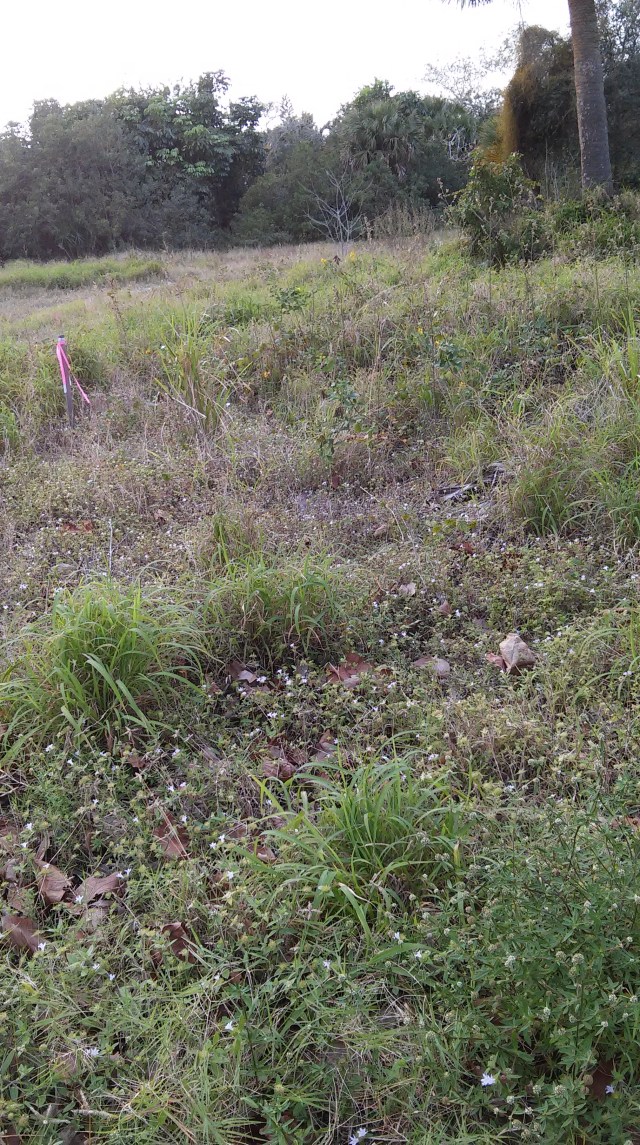
As I was writing this post, it occurred to me how much more interesting and attractive these flowers appear in their Monday vase. So, I wandered over to the vacant lot and took a before picture:

20160117_163141


All the components of the vase are in the foreground. I think I like the flowers in their blue bottles better. This leads me to ponder if more people saw native plants in a vase instead of a vacant lot – native plants might be more popular.

If you would like to see vases from the world over, stop by the comments section of  https://ramblinginthegarden.wordpress.com where Cathy hosts In A Vase on Monday – every Monday!


In A Vase on Monday – New Years with the Natives

20151228_101640

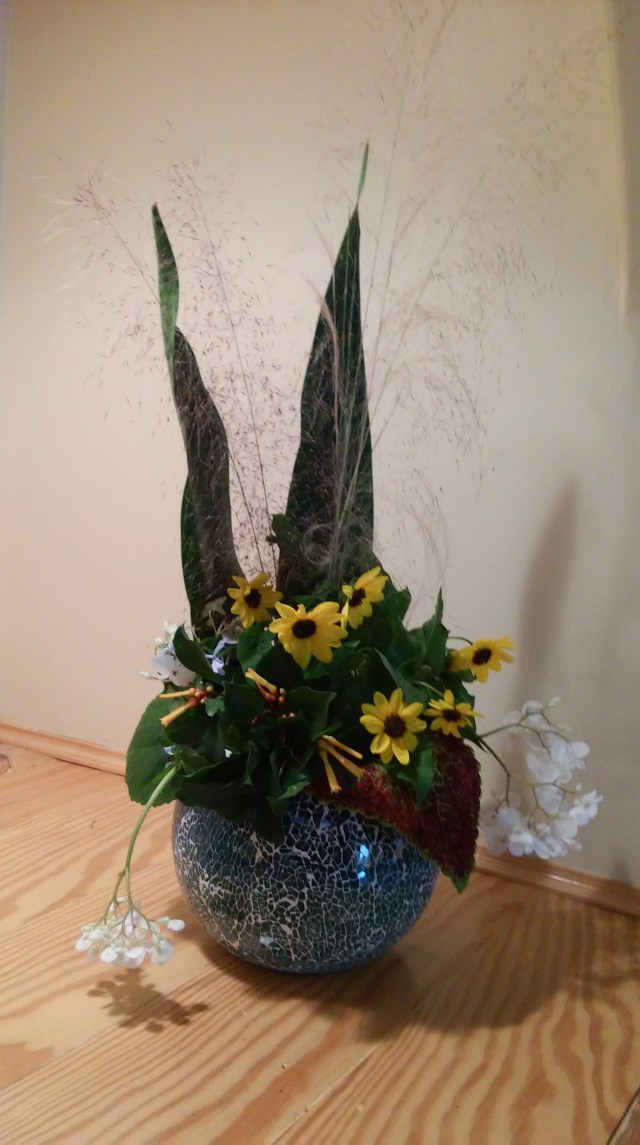
The last vase of the year! My ode to Florida natives with friends from other places. The vase is a Christmas gift from an old friend, my college roommate and is sparkly blue mosaic. Neither of us are Florida natives.

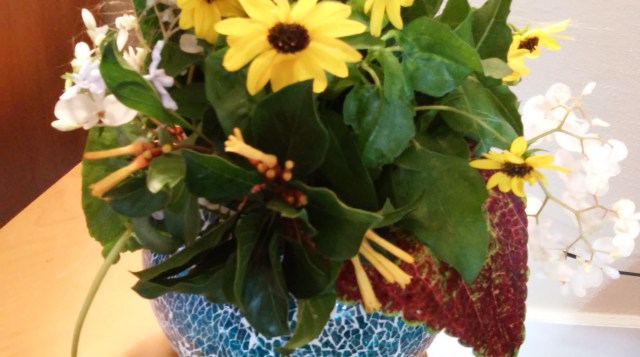
The Florida natives in the vase are: Beach Sunflower (Helianthus debilis) the yellow daisy; Firebush (Hamelia patens) the tubular orange flower; Muhly Grass (Muhlenbergia capillaris) the pink feathery grass in the back. The non native friends are Solar Sunrise Coleus, chartreuse and burgundy leaf; Sweet Begonia (Begonia odorata ‘Alba’), the white flowers and a few pieces of Mother In Laws Tongues in the back of the arrangement (Sansiveria).

Here is a close up:

20151228_100355

I wish everyone a safe and Happy New Year! I have enjoyed comparing vases this year and look forward to next years bounty.

Ahh October

While it seems winter is bearing down on the Northern Hemisphere, things are looking up here in South Florida. The oppressive heat is abating and I have been madly renovating my screen porch furniture in preparation for our gardening season. All new cushion covers and some new (to me) vintage Rattan furniture for lounging. Temperatures are hovering in the 80’s (Fahrenheit, Centigrade confounds me) so it is becoming very pleasant.

I am always looking for signs of Fall here and the pickings aren’t as slim as I once thought. It is your perception that must change. I associate the Royal Ponciana tree with the beginning of Summer.  Their cousin of a different genus, Dwarf or Cuban Ponciana start blooming in earnest in October. The harbinger of Fall:

Dwarf Ponciana Caesalpinia pulcherrima

Dwarf Ponciana
Caesalpinia pulcherrima

These trees are smaller than but similar to the Royal Poinciana, and varieties are available with yellow and coral flowers as well as the red mixed which is most commonly seen. Other things I am now considering fall color are certain Bromeliad flowers (Aechmea blanchetiana) and Bird of Paradise. The tropical Golden Rain Tree (Koelrueteria bipinnatus) is just starting to flower here. In December the pods on the Raintree give us a little more Autumnal feeling.

Blanchetiana Bromeliad

Blanchetiana Bromeliad

Tropic Florida does have some more typical fall fruiting plants. The Beautyberry, Callicarpa americana, native to a large part of the Eastern United States is common here as well. The red berries are from our native shrub, Wild Coffee, Psychotria nervosa. I have seen Beautyberry Jelly but never consumed any and supposedly the Wild Coffee has psychedelic effects so coffee brewed with something other than the Wild Coffee berries is a better idea. Blueberry Scones and Starbucks coffee are more in my line of thinking for breakfast fare.

Beautyberry

Beautyberry

Wild Coffee

Wild Coffee

I know that if I wait long enough, I will spy a Red Maple with some dull purple Fall color, usually in December and in a swamp somewhere. But with all these other Fall beauties I am not missing the Maples – Much.

Hurricanes and Tequila

It just dawned on me that Hurricanes are a cocktail, but they don’t contain Tequila. The Hurricane cocktail contains enough rum that if you drink one you won’t care about the Hurricane and the next morning you will feel like you were hit by one.

The first Atlantic Hurricane of the season may or may not be forming in the Tropical Atlantic. There must be a special language school for the weather forecasters that work on these storms. It’s making statements without really stating any facts. Danny is the name of the storm brewing – he has already been designated a Tropical Storm and might possibly turn into a Hurricane. However, the key however is there is a lot of dry Saharan sand and air floating around out there and we are in an El Nino weather pattern. I could ask my Greyhounds for their storm predictions, but they are clearly too busy. So, we wait. To spare myself drama, I only read the Weather Underground.

Canines occupied

Canines occupied, they’ve put their car magazines on the Ottoman so they can nap
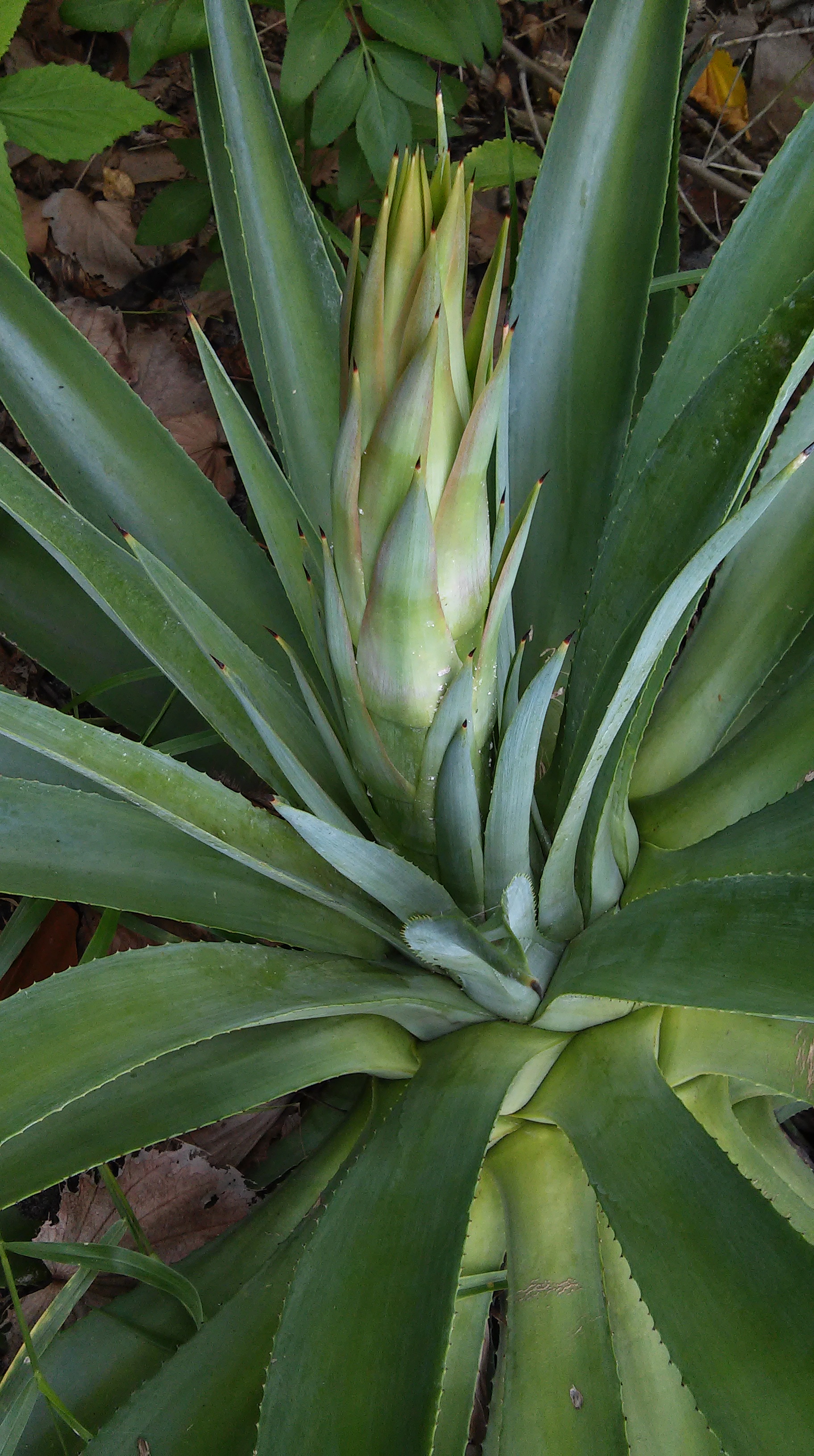
Agave americana

Agave americana

On to the tequila, I have discovered I have an Agave americana shooting up a bloom spike. I thought this was interesting as some of these are called Century Plants because they bloom every hundred years and this one has been around my garden for three years or so. Research has informed me that the bloom spike could be 15 feet tall (!) and indeed tequila is made from this plant. I love the color and texture of the Agave, a glaucous blue green with chocolate brown spines. A friend of mine grew this Agave and gave it to me with a warning ‘some people are allergic to the spines so be sure and cut them off the tips of the leaves’. Well, I decided to move the thing having put it in the wrong place and thought I had cut off all the spines. Later I found myself in the doctor’s office drawing a picture of the plant for her (she couldn’t figure out what could cause such a horrible bruise and reaction) and getting a prescription for Steroids. Yes, I am one of the allergic.

Given my lack of fondness for steroids and the fact that after the Agave americana flowers it dies – I believe it will be asked to leave the garden and I will replace it with a similar sized Bromeliad or Crinum or something lacking chocolate brown spines.

Interesting native plants currently doing their thing in my garden:
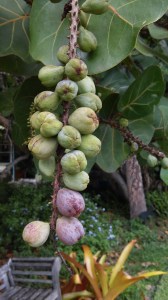
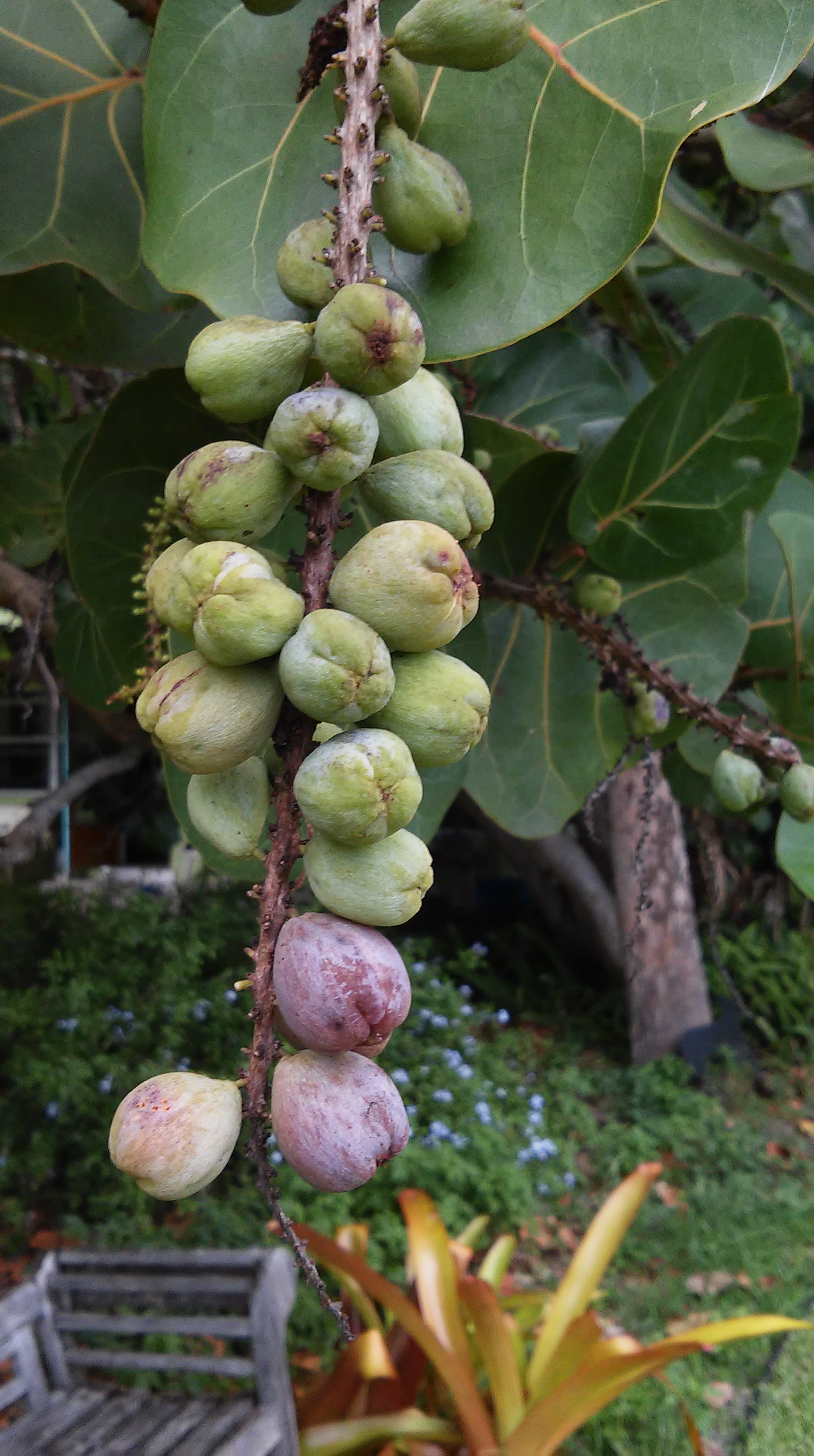
Sea Grapes - Coccoloba uvifera

Sea Grapes – Coccoloba uvifera

These are Sea Grapes, native to the beach and a bit beyond. The natives like to eat them, the bottom two are nearly ripe but, I haven’t really developed a taste for them and the seed is big. Mine go to the raccoons and birds.
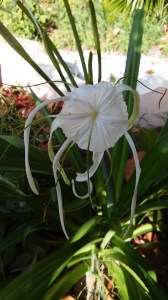
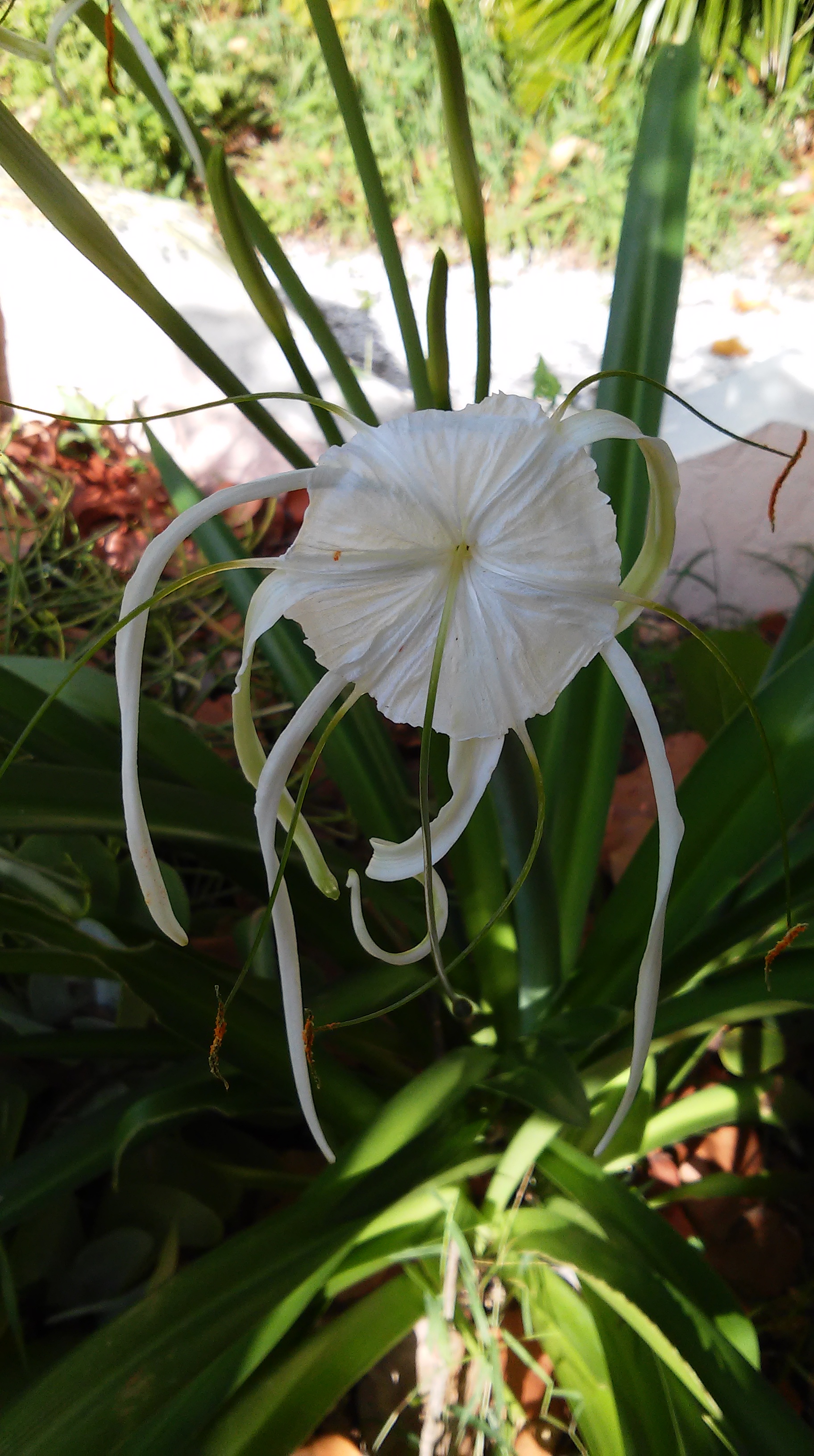
Hymenocallis latifolia

Hymenocallis latifolia

Natives of Florida call these Spider Lilies, I have seen other Hymenocallis called Peruvian Daffodils, clearly I am not in Peru. This is another Florida beachside native- these are easy to grow, but difficult to photograph. The anthers are very like Oriental Lilies, but hard to see. White flowers bloom in clusters, timing is staggered. These are interesting flowers and nearly indestructible.

My plan is to relax with the Greyhounds and await storm news, not eat any Sea Grapes or get stabbed by an Agave. A glass of Chardonnay, no Hurricanes or Tequila in my future, hopefully.